

Transplantation of human cord blood mononuclear cells and umbilical cord-derived mesenchymal stem cells in autism
Open accessThe DOI matches its Crossref record; 52 of the 53 references it cites were found in a registry or an index.
Abstract
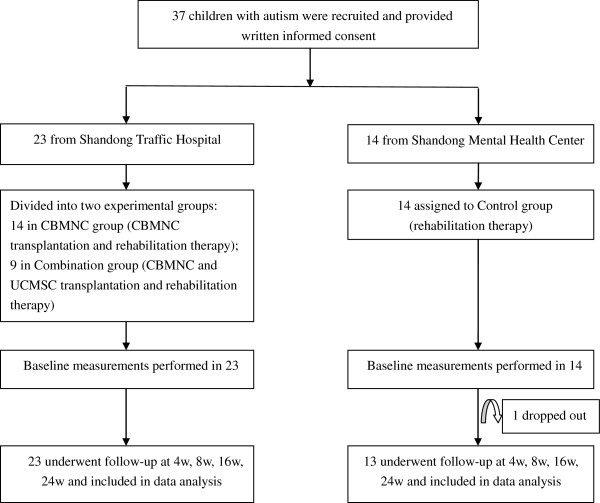
Background: Autism is a pervasive neurodevelopmental disorder. At present there are no defined mechanisms of pathogenesis and therapy is mostly limited to behavioral interventions. Stem cell transplantation may offer a unique treatment strategy for autism due to immune and neural dysregulation observed in this disease. This non-randomized, open-label, single center phase I/II trial investigated the safety and efficacy of combined transplantation of human cord blood mononuclear cells (CBMNCs) and umbilical cord-derived mesenchymal stem cells (UCMSCs) in treating children with autism. Methods: 37 subjects diagnosed with autism were enrolled into this study and divided into three groups: CBMNC group (14 subjects, received CBMNC transplantation and rehabilitation therapy), Combination group (9 subjects, received both CBMNC and UCMSC transplantation and rehabilitation therapy), and Control group (14 subjects, received only rehabilitation therapy). Transplantations included four stem cell infusions through intravenous and intrathecal injections once a week. Treatment safety was evaluated with laboratory examinations and clinical assessment of adverse effects. The Childhood Autism Rating Scale (CARS), Clinical Global Impression (CGI) scale and Aberrant Behavior Checklist (ABC) were adopted to assess the therapeutic efficacy at baseline (pre-treatment) and following treatment. Results: There were no significant safety issues related to the treatment and no observed severe adverse effects. Statistically significant differences were shown on CARS, ABC scores and CGI evaluation in the two treatment groups compared to the control at 24 weeks post-treatment (p < 0.05). Conclusions: Transplantation of CBMNCs demonstrated efficacy compared to the control group; however, the combination of CBMNCs and UCMSCs showed larger therapeutic effects than the CBMNC transplantation alone. There were no safety issues noted during infusion and the whole monitoring period. Trial registration: ClinicalTrials.gov: NCT01343511, Title “Safety and Efficacy of Stem Cell Therapy in Patients with Autism”.
Overview
The claims and statistics of this paper haven’t been checked yet.
Free: it reads the open-access text and checks the first 5 claims that cite a source we can check. Create a free account to check every claim.
Integrity signals
Registry
Cites
Statistics
Figures
Verification
Claims the paper makes
The claims and statistics of this paper haven’t been checked yet.
Free: it reads the open-access text and checks the first 5 claims that cite a source we can check. Create a free account to check every claim.
Claims other papers make about this one
Each is checked against this paper’s own text: does it say what the citing paper says it does?
In the citing paper
“a recent study failed to find any benefit of wild-type microglia in three rodent models of Rett syndrome including the model used in the original study235.”
From Immune mediators in the brain and peripheral tissues in autism spectrum disorder (2015) · cites this paper as [235]
Self-check
Percentages, sums and reported differences re-computed from the paper’s own numbers.
The self-check needs the paper’s full text.
Citations
Cites
Diagnostic and Statistical Manual of Mental Disorders
American Psychiatric Association (2013) · doi:10.1176/appi.books.9780890425596 · Cited by 116,369
Diagnostic and Statistical Manual of Mental Disorders
Williams, J. B. W., & First, M. (2013) · Encyclopedia of Social Work · doi:10.1093/acrefore/9780199975839.013.104 · Cited by 109,519
(1976) · Medical Entomology and Zoology · Cited by 8,899
Isolation of Putative Progenitor Endothelial Cells for Angiogenesis
Asahara, T., Murohara, T., Sullivan, A., Silver, M., van der Zee, R., Li, T., Witzenbichler, B., Schatteman, G., & Isner, J. M. (1997) · Science · doi:10.1126/science.275.5302.964 · Cited by 8,725 · cited 1×
“It has been proved that the endothelial progenitor cell, contained in a CD34 cell population enriched in CBMNCs, has the capacity to trigger angiogenesis in the ischemic tissues [42].”
BackgroundDiagnostic and Statistical Manual of Mental Disorders, 5th Edition
(2013) · American Psychiatric Association Publishing eBooks · doi:10.1176/appi.books.9780890425596.893619 · Cited by 4,383
Neuroglial activation and neuroinflammation in the brain of patients with autism
Vargas, D. L., Nascimbene, C., Krishnan, C., Zimmerman, A. W., & Pardo, C. A. (2005) · Annals of Neurology · doi:10.1002/ana.20315 · Cited by 2,149 · cited 2×
“Studies demonstrated an ongoing neuroinflammatory process with marked activation of microglia and astroglia in the cerebral cortex, white matter and cerebellum of individuals with autism [22].”
BackgroundRisperidone in Children with Autism and Serious Behavioral Problems
McCracken, J. T., McGough, J., Shah, B., Cronin, P., Hong, D., Aman, M. G., Arnold, L. E., Lindsay, R., Nash, P., Hollway, J., et al. (2002) · New England Journal of Medicine · doi:10.1056/nejmoa013171 · Cited by 1,574
(1985) · PubMed · Cited by 1,427
Ashwood, P., Krakowiak, P., Hertz-Picciotto, I., Hansen, R., Pessah, I., & Van de Water, J. (2011) · Brain, Behavior, and Immunity · doi:10.1016/j.bbi.2010.08.003 · Cited by 940 · cited 1×
“A unique proinflammatory cytokine profile in autistic patients has been documented in the cerebrospinal fluid, including a marked increase in macrophage chemoattractant protein-1 [22], and in the peripheral plasma, such as significantly elevated levels of interleukin (IL)-1β, IL-8 and IL-12p40 [23].”
BackgroundSelf-citationLu, L., Liu, Y.-J., Yang, S.-G., Zhao, Q., Wang, X., Gong, W., Han, Z., Xu, Z., Lu, Y., Liu, D., et al. (2006) · PubMed · Cited by 852
The functional neuroanatomy of social behaviour
Critchley, H. D., Daly, E. M., Bullmore, E. T., Williams, S. C. R., Van Amelsvoort, T., Robertson, D. M., Rowe, A., Phillips, M., McAlonan, G., Howlin, P., et al. (2000) · Brain · doi:10.1093/brain/123.11.2203 · Cited by 816 · cited 3×
“Inadequate perfusion resulting in brain tissue hypoxia not only caused neuronal apoptosis and necrosis, but also led to abnormal brain tissue metabolism and accumulation of pathological levels of neurotransmitter [40].”
BackgroundAdministration of CD34+ cells after stroke enhances neurogenesis via angiogenesisin a mouse model
Taguchi, A., Soma, T., Tanaka, H., Kanda, T., Nishimura, H., Yoshikawa, H., Tsukamoto, Y., Iso, H., Fujimori, Y., Stern, D. M., et al. (2004) · Journal of Clinical Investigation · doi:10.1172/jci200420622 · Cited by 784 · cited 1×
“These promising results with CBMNC therapies have been successfully translated into the pre-clinical application for functional recovery in various ischemic animal models through the enhancement of angiogenesis around the site of degeneration [9,45].”
BackgroundImmunomodulation by mesenchymal stem cells and clinical experience
Le Blanc, K., & Ringdén, O. (2007) · Journal of Internal Medicine · doi:10.1111/j.1365-2796.2007.01844.x · Cited by 720 · cited 1×
“It has been shown that MSCs can reduce the proliferative capacity of T cells, B cells, NK cells, DC and neutrophils, and modulate a variety of immune cell functions: cytokine secretion and cytotoxicity of T cells and NK cells, B cell maturation and antibody secretion, DC maturation and activation, as well as antigen p…”
BackgroundImmunosuppressive properties of mesenchymal stem cells: advances and applications
P. De Miguel, M., Fuentes-Julian, S., Blazquez-Martinez, A., Y. Pascual, C., A. Aller, M., Arias, J., & Arnalich-Montiel, F. (2012) · Current Molecular Medicine · doi:10.2174/156652412800619950 · Cited by 660 · cited 3×
“It has been shown that MSCs can reduce the proliferative capacity of T cells, B cells, NK cells, DC and neutrophils, and modulate a variety of immune cell functions: cytokine secretion and cytotoxicity of T cells and NK cells, B cell maturation and antibody secretion, DC maturation and activation, as well as antigen p…”
BackgroundThe role of immune dysfunction in the pathophysiology of autism
Onore, C., Careaga, M., & Ashwood, P. (2012) · Brain, Behavior, and Immunity · doi:10.1016/j.bbi.2011.08.007 · Cited by 635 · cited 2×
“2012) [21].”
BackgroundSelf-citationSearching for ways out of the autism maze: genetic, epigenetic and environmental clues
Persico, A. M., & Bourgeron, T. (2006) · Trends in Neurosciences · doi:10.1016/j.tins.2006.05.010 · Cited by 575 · cited 1×
“Research data have revealed that autism may result from a complex combination of genetic and environmental factors [2,4] and is associated with several biochemical events, including ongoing cerebral hypoperfusion; immune dysregulation and activation of neuroglial cells; decreased methylation capacity; limited producti…”
BackgroundThe immune response in autism: a new frontier for autism research
Ashwood, P., Wills, S., & Van de Water, J. (2006) · Journal of Leukocyte Biology · doi:10.1189/jlb.1205707 · Cited by 528 · cited 1×
“Various autoantibodies responding to the proteins in central nervous system have been detected in the children with autism, which might link autism with an autoimmune process rather than an externally triggered immune reaction [27-29].”
BackgroundSelf-citationMajka, M., Janowska-Wieczorek, A., Ratajczak, J., Ehrenman, K., Pietrzkowski, Z., Kowalska, M. A., Gewirtz, A. M., Emerson, S. G., & Ratajczak, M. Z. (2001) · Blood · doi:10.1182/blood.v97.10.3075 · Cited by 508
Sun, L., Wang, D., Liang, J., Zhang, H., Feng, X., Wang, H., Hua, B., Liu, B., Ye, S., Hu, X., et al. (2010) · Arthritis & Rheumatism · doi:10.1002/art.27548 · Cited by 475 · cited 2×
“The administration of UCMSCs to treat systemic lupus erythematosus has provided additional evidence for their immunoregulatory role [16,36], supporting their use in controlling both autoimmunity and triggered inflammation.”
BackgroundMethodSelf-citationOspina, M. B., Krebs Seida, J., Clark, B., Karkhaneh, M., Hartling, L., Tjosvold, L., Vandermeer, B., & Smith, V. (2008) · PLoS ONE · doi:10.1371/journal.pone.0003755 · Cited by 366 · cited 1×
“However, there is no defined standard treatment intervention for children with autism [7,8].”
BackgroundA Systematic Review of Medical Treatments for Children With Autism Spectrum Disorders
McPheeters, M. L., Warren, Z., Sathe, N., Bruzek, J. L., Krishnaswami, S., Jerome, R. N., & Veenstra-VanderWeele, J. (2011) · Pediatrics · doi:10.1542/peds.2011-0427 · Cited by 356 · cited 1×
“However, there is no defined standard treatment intervention for children with autism [7,8].”
BackgroundKey role for gene dosage and synaptic homeostasis in autism spectrum disorders
Toro, R., Konyukh, M., Delorme, R., Leblond, C., Chaste, P., Fauchereau, F., Coleman, M., Leboyer, M., Gillberg, C., & Bourgeron, T. (2010) · Trends in Genetics · doi:10.1016/j.tig.2010.05.007 · Cited by 331 · cited 2×
“Autism is the most prevalent ASD, characterized by dysfunctions in reciprocal social interaction and communication, as well as presence of repetitive and stereotypical behaviors [2].”
BackgroundRellini, E., Tortolani, D., Trillo, S., Carbone, S., & Montecchi, F. (2004) · Journal of Autism and Developmental Disorders · doi:10.1007/s10803-004-5290-2 · Cited by 292 · cited 1×
“CARS assesses behavior in 14 domains that are generally affected in autism, plus one general category for impressions of features of autism, with the aim to identify children with autism from other developmental disorders [17].”
BackgroundAltered T cell responses in children with autism
Ashwood, P., Krakowiak, P., Hertz-Picciotto, I., Hansen, R., Pessah, I. N., & Van de Water, J. (2011) · Brain, Behavior, and Immunity · doi:10.1016/j.bbi.2010.09.002 · Cited by 281 · cited 1×
“Additional studies found altered function in immune cell subsets [24-26], leading to an inappropriate or ineffective immune response to pathogen challenge in autism.”
BackgroundSelf-citationImmunomodulatory properties and therapeutic application of mesenchymal stem cells
Shi, M., Liu, Z.-W., & Wang, F.-S. (2011) · Clinical and Experimental Immunology · doi:10.1111/j.1365-2249.2011.04327.x · Cited by 281 · cited 3×
“In addition, MSCs can secrete a plethora of growth factors, anti-inflammatory cytokines and immunomodulatory mediators, such as indoleamine 2,3-dioxygenase, prostaglandin E2 (PGE2), nitric oxide, histocompatibility leucocyte antigen-G, transforming growth factor-β, interferon-γ, hepatocyte growth factor (HGF), IL-6, I…”
BackgroundEnstrom, A. M., Lit, L., Onore, C. E., Gregg, J. P., Hansen, R. L., Pessah, I. N., Hertz-Picciotto, I., Van de Water, J. A., Sharp, F. R., & Ashwood, P. (2009) · Brain, Behavior, and Immunity · doi:10.1016/j.bbi.2008.08.001 · Cited by 257 · cited 1×
“Additional studies found altered function in immune cell subsets [24-26], leading to an inappropriate or ineffective immune response to pathogen challenge in autism.”
BackgroundSelf-citationImmunomodulatory Properties of Mesenchymal Stem Cells: Cytokines and Factors
Soleymaninejadian, E., Pramanik, K., & Samadian, E. (2012) · American Journal of Reproductive Immunology · doi:10.1111/j.1600-0897.2011.01069.x · Cited by 239 · cited 1×
“histocompatibility leucocyte antigen-G, transforming growth factor-β, interferon-γ, hepatocyte growth factor (HGF), IL-6, IL-10 and heme oxygenase-1 [14,32].”
BackgroundChen, K., Wang, D., Du, W. T., Han, Z.-B., Ren, H., Chi, Y., Yang, S. G., Zhu, D., Bayard, F., & Han, Z. C. (2010) · Clinical Immunology · doi:10.1016/j.clim.2010.01.015 · Cited by 201
Cutler, A. J., Limbani, V., Girdlestone, J., & Navarrete, C. V. (2010) · The Journal of Immunology · doi:10.4049/jimmunol.1002239 · Cited by 170 · cited 1×
“Recently, the mechanisms and molecules involved in the immunoregulatory effect of UCMSCs have been broadly revealed: suppressing the proliferation of B cells by modifying the phosphorylation pattern of Akt and p38 pathways [33]; mediating suppressive effects on T cell proliferation through monocytes as an essential in…”
BackgroundIn Search of Cellular Immunophenotypes in the Blood of Children with Autism
Ashwood, P., Corbett, B. A., Kantor, A., Schulman, H., Van de Water, J., & Amaral, D. G. (2011) · PLoS ONE · doi:10.1371/journal.pone.0019299 · Cited by 140 · cited 1×
“Additional studies found altered function in immune cell subsets [24-26], leading to an inappropriate or ineffective immune response to pathogen challenge in autism.”
BackgroundSelf-citationAntibrain antibodies in children with autism and their unaffected siblings
Singer, H. S., Morris, C. M., Williams, P. N., Yoon, D. Y., Hong, J. J., & Zimmerman, A. W. (2006) · Journal of Neuroimmunology · doi:10.1016/j.jneuroim.2006.05.025 · Cited by 132 · cited 1×
“Various autoantibodies responding to the proteins in central nervous system have been detected in the children with autism, which might link autism with an autoimmune process rather than an externally triggered immune reaction [27-29].”
BackgroundImmune Response to Dietary Proteins, Gliadin and Cerebellar Peptides in Children with Autism
Vojdani, A., O'Bryan, T., Green, J. A., McCandless, J., Woeller, K. N., Vojdani, E., Nourian, A. A., & Cooper, E. L. (2004) · Nutritional Neuroscience · doi:10.1080/10284150400004155 · Cited by 124 · cited 1×
“Various autoantibodies responding to the proteins in central nervous system have been detected in the children with autism, which might link autism with an autoimmune process rather than an externally triggered immune reaction [27-29].”
BackgroundThe role of angiopoietins in the development of endothelial cells from cord blood CD34+ progenitors
Hildbrand, P., Cirulli, V., Prinsen, R. C., Smith, K. A., Torbett, B. E., Salomon, D. R., & Crisá, L. (2004) · Blood · doi:10.1182/blood-2003-12-4219 · Cited by 115 · cited 1×
“The circulating CD34 progenitors in CBMNCs with the potential for endothelial development were recruited to the injury sites and developed into new endothelial cells to either repair the injured endothelial wall or sprout new vascular structure [43].”
BackgroundZiprasidone in Adolescents with Autism: An Open-Label Pilot Study
Malone, R. P., Delaney, M. A., Hyman, S. B., & Cater, J. R. (2007) · Journal of Child and Adolescent Psychopharmacology · doi:10.1089/cap.2006.0126 · Cited by 104 · cited 1×
“Five subscales are designed in ABC to measure symptoms in children with autism, including “Irritability”, “Lethargy/Social Withdrawal”, “Stereotypic Behavior”, “Hyperactivity” and “Inappropriate Speech” and consisting of 58 items, each rated on a 4-point scale [19,20].”
Human Umbilical Cord Blood Cell Grafts for Brain Ischemia
Park, D., Borlongan, C. V., Willing, A. E., Eve, D. J., Cruz, L. E. G., Sanberg, C. D., Chung, Y.-G., & Sanberg, P. R. (2009) · Cell Transplantation · doi:10.3727/096368909x471279 · Cited by 101 · cited 1×
“Pre-clinical studies reported that human cord blood mononuclear cell (CBMNC) transplantation in animal models of brain ischemia could promote functional recovery by improving local blood perfusion to damaged areas through angiogenesis [9,10].”
BackgroundUmbilical cord mesenchymal stem cells suppress B-cell proliferation and differentiation
Che, N., Li, X., Zhou, S., Liu, R., Shi, D., Lu, L., & Sun, L. (2012) · Cellular Immunology · doi:10.1016/j.cellimm.2012.02.004 · Cited by 97 · cited 1×
“Recently, the mechanisms and molecules involved in the immunoregulatory effect of UCMSCs have been broadly revealed: suppressing the proliferation of B cells by modifying the phosphorylation pattern of Akt and p38 pathways [33]; mediating suppressive effects on T cell proliferation through monocytes as an essential in…”
BackgroundMesenchymal stem cell transplantation for diffuse alveolar hemorrhage in SLE
Liang, J., Gu, F., Wang, H., Hua, B., Hou, Y., Shi, S., Lu, L., & Sun, L. (2010) · Nature Reviews Rheumatology · doi:10.1038/nrrheum.2010.80 · Cited by 88 · cited 1×
“The administration of UCMSCs to treat systemic lupus erythematosus has provided additional evidence for their immunoregulatory role [16,36], supporting their use in controlling both autoimmunity and triggered inflammation.”
BackgroundImmunomodulatory Activity of Mesenchymal Stem Cells
M. Kaplan, J., E. Youd, M., & A. Lodie, T. (2011) · Current Stem Cell Research & Therapy · doi:10.2174/157488811797904353 · Cited by 84 · cited 1×
“MSCs have profound immunoregulatory properties and are currently being investigated as a novel cellular immunomodulatory and anti-inflammatory agent in numerous clinical trials [30].”
BackgroundBradstreet, J. J., Smith, S. A., Baral, M., & Rossignol, D. A. (2010) · PubMed · Cited by 81
Autism: an emerging ‘neuroimmune disorder’ in search of therapy
Theoharides, T. C., Kempuraj, D., & Redwood, L. (2009) · Expert Opinion on Pharmacotherapy · doi:10.1517/14656560903107789 · Cited by 79 · cited 1×
“Introduction Autism spectrum disorders (ASD) are heterogeneous neurodevelopmental disorders [1].”
BackgroundIchim, T. E., Solano, F., Glenn, E., Morales, F., Smith, L., Zabrecky, G. P., & Riordan, N. H. (2007) · Journal of Translational Medicine · doi:10.1186/1479-5876-5-30 · Cited by 75
Yang, W., Zhang, Y., Wu, F., Min, W., Minev, B., Zhang, M., Luo, X.-L., Ramos, F., Ichim, T. E., Riordan, N. H., et al. (2010) · Journal of Translational Medicine · doi:10.1186/1479-5876-8-75 · Cited by 75 · cited 2×
“In addition, the CBMNC was safely transplanted for clinical applications in non-hematopoietic degenerative conditions in the absence of immune suppression [11,12].”
MethodSelf-citationRisperidone in Children with Autism and Serious Behavioral Problems
Munarriz, R. M., Bennett, L., & Goldstein, I. (2002) · New England Journal of Medicine · doi:10.1056/nejm200212053472316 · Cited by 75
Autism Spectrum Disorders: Is Mesenchymal Stem Cell Personalized Therapy the Future?
Siniscalco, D., Sapone, A., Cirillo, A., Giordano, C., Maione, S., & Antonucci, N. (2012) · BioMed Research International · doi:10.1155/2012/480289 · Cited by 69 · cited 1×
“Transplanted MSCs might integrate into the altered brain and restore damaged functions, promote synaptic plasticity and functional recovery, and rescue cerebellar Purkinjie cells in autistic subjects [47].”
Brain Perfusion in Autism Varies with Age
WILCOX, J. A., Tsuang, M. T., Ledger, E. M., Algeo, J., & Schnurr, T. (2002) · Neuropsychobiology · doi:10.1159/000063570 · Cited by 66 · cited 2×
“Given the potency of cord blood CD34 cells to promote angiogenesis in ischemic areas, the CBMNC may be useful for the improvement of the cerebral hypoperfusion and hypoxia that has been suggested to occur in the brains of individuals with autism [37-41].”
BackgroundPeterson, D. A. (2004) · Journal of Clinical Investigation · doi:10.1172/jci22540 · Cited by 57 · cited 2×
“These promising results with CBMNC therapies have been successfully translated into the pre-clinical application for functional recovery in various ischemic animal models through the enhancement of angiogenesis around the site of degeneration [9,45].”
BackgroundTherapies for children with autism spectrum disorders.
Fogleman, C. D. (2012) · PubMed · Cited by 48
Regional cerebral blood flow in childhood autism: a SPET study with SPM evaluation
Burroni, L., Orsi, A., Monti, L., Hayek, Y., Rocchi, R., & Vattimo, A. G. (2008) · Nuclear Medicine Communications · doi:10.1097/mnm.0b013e3282f1bb8e · Cited by 44 · cited 3×
“Given the potency of cord blood CD34 cells to promote angiogenesis in ischemic areas, the CBMNC may be useful for the improvement of the cerebral hypoperfusion and hypoxia that has been suggested to occur in the brains of individuals with autism [37-41].”
BackgroundSk, G., & Ratnam, B. V. (2009) · PubMed · Cited by 44
Yang, W., Zhang, Y., Wu, F., Zhang, M., Cho, S. C., Li, C., Li, S.-H., Shu, G.-J., Sheng, Y.-X., Zhao, N., et al. (2011) · Journal of Translational Medicine · doi:10.1186/1479-5876-9-65 · Cited by 30 · cited 2×
“In addition, the CBMNC was safely transplanted for clinical applications in non-hematopoietic degenerative conditions in the absence of immune suppression [11,12].”
MethodSelf-citationRising Autism Rates Still Pose a Mystery
Mitka, M. (2010) · JAMA · doi:10.1001/jama.2010.113 · Cited by 16 · cited 1×
“Recent reports have highlighted the dramatic rise in the number of children affected with autism (57% growth compared with 2002) with current prevalence rate in the USA approaching 1% [3].”
BackgroundMa, J. (2011) · Zhongguo xinli weisheng zazhi · Cited by 7
Cited by
Immune mediators in the brain and peripheral tissues in autism spectrum disorder
Estes, M. L., & McAllister, A. K. (2015) · Nature Reviews Neuroscience · doi:10.1038/nrn3978 · Cited by 514
Immune Dysfunction and Autoimmunity as Pathological Mechanisms in Autism Spectrum Disorders
Hughes, H. K., Mills Ko, E., Rose, D., & Ashwood, P. (2018) · Frontiers in Cellular Neuroscience · doi:10.3389/fncel.2018.00405 · Cited by 245
Self-citationConcise Review: Wharton's Jelly: The Rich, but Enigmatic, Source of Mesenchymal Stromal Cells
Davies, J. E., Walker, J. T., & Keating, A. (2017) · Stem Cells Translational Medicine · doi:10.1002/sctm.16-0492 · Cited by 215
Fibroblasts and mesenchymal stem cells: Two sides of the same coin?
Soundararajan, M., & Kannan, S. (2018) · Journal of Cellular Physiology · doi:10.1002/jcp.26860 · Cited by 190
“, 2005), and psychiatric disorders, such as autism (Bradstreet et al., 2014; Dawson et al., 2017; Lv et al., 2013).”
BackgroundUmbilical cord mesenchymal stromal cell transplantations: A systemic analysis of clinical trials
Can, A., Çelikkan, F. T., & Çınar, Ö. (2017) · Cytotherapy · doi:10.1016/j.jcyt.2017.08.004 · Cited by 145
“[30] transplanted 1 × 10(6)/kg UC-MSCs together with 2 × 10(6)/kg cord blood (CB) MNCs, and 2 × 10(6)/kg of CB-MNCs to patients with autism (n = 14 and n = 9, respectively) via IV and intrathecal routes.”
Method
Metadata
- Authors
- Lv, Y.-T., Zhang, Y., Liu, M., Qiuwaxi, J.-N.-T., Ashwood, P., Cho, S. C., Huan, Y., Ge, R.-C., Chen, X.-W., Wang, Z.-J., Kim, B.-J., & Hu, X.
- Affiliations
- Beike Biotechnology (China) (CN)
- Shandong Jiaotong Hospital (CN)
- University of California, Davis (US)
- Korea University (KR)
- Corresponding author
- Hu, Xiang
- Venue
- Journal of Translational Medicine
- Published
- 2013-08-27
- Volume
- 11
- Issue
- 1
- Pages
- 196-196
- ISSN
- 1479-5876 (ISSN-L)
- PMC
- PMC3765833
- OpenAlex
- W2149113453
- Cited by
- 174
- References
- 53
- Citations by year
- 2026: 6 · 2025: 11 · 2024: 14 · 2023: 13 · 2022: 14 · 2021: 16 · 2020: 23 · 2019: 13 · 2018: 11 · 2017: 13 · 2016: 13 · 2015: 15 · 2014: 12
- FWCI
- 7.31
- Type
- journal article
- Language
- en
- Open access
- gold
- doi.org
- Licence
- cc-by
- Locations
- Journal of Translational Medicine (publishedVersion, cc-by)
- Europe PMC (PubMed Central) (publishedVersion, cc-by)
- PubMed Central (publishedVersion, cc-by)
- PubMed (publishedVersion)
- eScholarship (California Digital Library) (submittedVersion)
- Topics
- Life Sciences › Neuroscience › Cognitive Neuroscience › Autism Spectrum Disorder Research
- Life Sciences › Biochemistry, Genetics and Molecular Biology › Cell Biology › Mesenchymal stem cell research
- Life Sciences › Biochemistry, Genetics and Molecular Biology › Genetics › Genetics and Neurodevelopmental Disorders
- Keywords
- autism spectrum disorder, stem cell transplantation, cord blood mononuclear cells, human umbilical cord mesenchymal stem cells, intrathecal administration, treatment safety, treatment efficacy, children, rehabilitation therapy, aberrant behavior, neurodevelopmental disorders
- MeSH terms
- Autistic Disorder, Child, Child, Preschool, Female, Humans, Leukocytes, Mononuclear, Male, Umbilical Cord, Treatment Outcome, Cord Blood Stem Cell Transplantation, Mesenchymal Stem Cell Transplantation
About these checks
Registry, retraction, Cites and statistics results are computed, not judged, with one exception: a printed reference that no index lists is read once by a model before it counts as a citation error. Claims are extracted by a model and kept only when their quote appears verbatim in the text; each cited source is then checked, with a model’s help, for whether it says what the claim relies on. Those verdicts can be wrong — read the claim’s quote and the cited source before relying on one.
Statistics and arithmetic are recomputed, not judged.
Confidence bands are shown only for fields calibrated on our annotated test set. None is calibrated yet, so no band is shown.
What counts as a claim ›How we measure confidence ›How we check this ›
Are you an author, or do you see a problem with this page? Request a review
Data sources
Bibliographic data: Semantic Scholar, OpenAlex, Crossref.
Contains information from the Semantic Scholar Academic Graph Datasets, made available under the ODC Attribution License (ODC-BY 1.0).
Semantic Scholar’s data is described in: Kinney, R., et al. (2023). The Semantic Scholar Open Data Platform. arXiv:2301.10140.
