

Transplantation of human cord blood mononuclear cells and umbilical cord-derived mesenchymal stem cells in autism
Open accessThe DOI matches its Crossref record; 52 of the 53 references it cites were found in a registry or an index.
Abstract
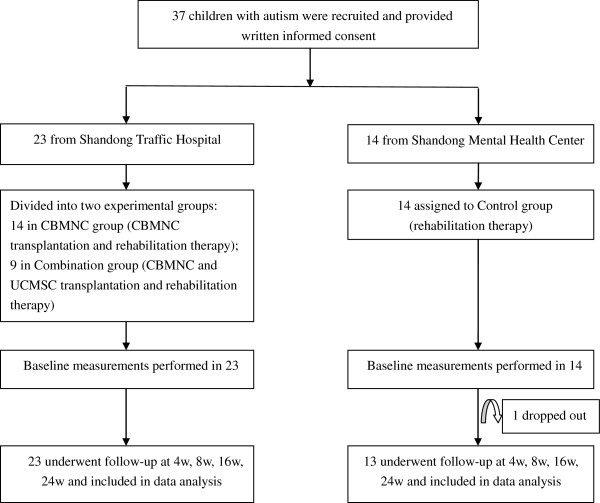
Background: Autism is a pervasive neurodevelopmental disorder. At present there are no defined mechanisms of pathogenesis and therapy is mostly limited to behavioral interventions. Stem cell transplantation may offer a unique treatment strategy for autism due to immune and neural dysregulation observed in this disease. This non-randomized, open-label, single center phase I/II trial investigated the safety and efficacy of combined transplantation of human cord blood mononuclear cells (CBMNCs) and umbilical cord-derived mesenchymal stem cells (UCMSCs) in treating children with autism. Methods: 37 subjects diagnosed with autism were enrolled into this study and divided into three groups: CBMNC group (14 subjects, received CBMNC transplantation and rehabilitation therapy), Combination group (9 subjects, received both CBMNC and UCMSC transplantation and rehabilitation therapy), and Control group (14 subjects, received only rehabilitation therapy). Transplantations included four stem cell infusions through intravenous and intrathecal injections once a week. Treatment safety was evaluated with laboratory examinations and clinical assessment of adverse effects. The Childhood Autism Rating Scale (CARS), Clinical Global Impression (CGI) scale and Aberrant Behavior Checklist (ABC) were adopted to assess the therapeutic efficacy at baseline (pre-treatment) and following treatment. Results: There were no significant safety issues related to the treatment and no observed severe adverse effects. Statistically significant differences were shown on CARS, ABC scores and CGI evaluation in the two treatment groups compared to the control at 24 weeks post-treatment (p < 0.05). Conclusions: Transplantation of CBMNCs demonstrated efficacy compared to the control group; however, the combination of CBMNCs and UCMSCs showed larger therapeutic effects than the CBMNC transplantation alone. There were no safety issues noted during infusion and the whole monitoring period. Trial registration: ClinicalTrials.gov: NCT01343511, Title “Safety and Efficacy of Stem Cell Therapy in Patients with Autism”.
Overview
The claims and statistics of this paper haven’t been checked yet.
Free: it reads the open-access text and checks the first 5 claims that cite a source we can check. Create a free account to check every claim.
Integrity signals
Registry
Cites
Statistics
Figures
Verification
Claims the paper makes
The claims and statistics of this paper haven’t been checked yet.
Free: it reads the open-access text and checks the first 5 claims that cite a source we can check. Create a free account to check every claim.
Claims other papers make about this one
Each is checked against this paper’s own text: does it say what the citing paper says it does?
In the citing paper
“a recent study failed to find any benefit of wild-type microglia in three rodent models of Rett syndrome including the model used in the original study235.”
From Immune mediators in the brain and peripheral tissues in autism spectrum disorder (2015) · cites this paper as [235]
Self-check
Percentages, sums and reported differences re-computed from the paper’s own numbers.
The self-check needs the paper’s full text.
Citations
Cites
Diagnostic and Statistical Manual of Mental Disorders
American Psychiatric Association (2013) · doi:10.1176/appi.books.9780890425596 · Cited by 116,369
Diagnostic and Statistical Manual of Mental Disorders
Williams, J. B. W., & First, M. (2013) · Encyclopedia of Social Work · doi:10.1093/acrefore/9780199975839.013.104 · Cited by 109,519
(1976) · Medical Entomology and Zoology · Cited by 8,899
Isolation of Putative Progenitor Endothelial Cells for Angiogenesis
Asahara, T., Murohara, T., Sullivan, A., Silver, M., van der Zee, R., Li, T., Witzenbichler, B., Schatteman, G., & Isner, J. M. (1997) · Science · doi:10.1126/science.275.5302.964 · Cited by 8,725 · cited 1×
“It has been proved that the endothelial progenitor cell, contained in a CD34 cell population enriched in CBMNCs, has the capacity to trigger angiogenesis in the ischemic tissues [42].”
BackgroundDiagnostic and Statistical Manual of Mental Disorders, 5th Edition
(2013) · American Psychiatric Association Publishing eBooks · doi:10.1176/appi.books.9780890425596.893619 · Cited by 4,383
Neuroglial activation and neuroinflammation in the brain of patients with autism
Vargas, D. L., Nascimbene, C., Krishnan, C., Zimmerman, A. W., & Pardo, C. A. (2005) · Annals of Neurology · doi:10.1002/ana.20315 · Cited by 2,149 · cited 2×
“Studies demonstrated an ongoing neuroinflammatory process with marked activation of microglia and astroglia in the cerebral cortex, white matter and cerebellum of individuals with autism [22].”
BackgroundRisperidone in Children with Autism and Serious Behavioral Problems
McCracken, J. T., McGough, J., Shah, B., Cronin, P., Hong, D., Aman, M. G., Arnold, L. E., Lindsay, R., Nash, P., Hollway, J., et al. (2002) · New England Journal of Medicine · doi:10.1056/nejmoa013171 · Cited by 1,574
(1985) · PubMed · Cited by 1,427
Ashwood, P., Krakowiak, P., Hertz-Picciotto, I., Hansen, R., Pessah, I., & Van de Water, J. (2011) · Brain, Behavior, and Immunity · doi:10.1016/j.bbi.2010.08.003 · Cited by 940 · cited 1×
“A unique proinflammatory cytokine profile in autistic patients has been documented in the cerebrospinal fluid, including a marked increase in macrophage chemoattractant protein-1 [22], and in the peripheral plasma, such as significantly elevated levels of interleukin (IL)-1β, IL-8 and IL-12p40 [23].”
BackgroundSelf-citationLu, L., Liu, Y.-J., Yang, S.-G., Zhao, Q., Wang, X., Gong, W., Han, Z., Xu, Z., Lu, Y., Liu, D., et al. (2006) · PubMed · Cited by 852
Cited by
Items 101–174 of 174
Wong, C. M., Tan, C. S., Riard, N., Yeleswarapu, S. P., Daniel, L. M., Prasath, A., Tan, A. M., Tan, T. C., Sultana, R., & Lam, J. C. M. (2024) · Autism Research · doi:10.1002/aur.3187 · Cited by 6
“This study commenced in December 2019 when the earlier publications on UCB infusion indicated some possible potential for treatment benefit (Chez et al., 2018; Dawson et al., 2017; Lv et al., 2013) and before the DBRCT was published.”
Chernykh, E. R., Shevela, Е. Y., & Ostanin, A. A. (2017) · Medical Immunology (Russia) · doi:10.15789/1563-0625-2017-1-7-18 · Cited by 6
Stem Cell Therapy in Pediatric Neurological Disabilities
Sharma, A., Sane, H. M., Gokulchandran, N., Badhe, P. B., Kulkarni, P., Pai, S., Varghese, R., & Paranjape, A. (2017) · InTech eBooks · doi:10.5772/67656 · Cited by 6
“[59] Human cord blood mononuclear cells (CBMNCs) and umbilical cord–derived mesenchymal stem cells (UCMSCs) Intravenous and intrathecal 37 18 Yes”
BackgroundCell therapies for autism spectrum disorder: a systematic review of clinical applications
Akat, A., & Karaöz, E. (2023) · Middle East Current Psychiatry · doi:10.1186/s43045-023-00363-9 · Cited by 8
“However, Lv et al. [51] found significant improvement with MSC/CB-TNC combination applications via intravenous and intrathecal administrations, suggesting that TNCs enriched with MSCs may be the most effective cellular therapy for ASD patients.”
BackgroundResultInfluentialKabataş, S., Çivelek, E., Savrunlu, E. C., Karaaslan, U., Yıldız, Ö., & Karaöz, E. (2024) · World Journal of Methodology · doi:10.5662/wjm.v15.i1.95857 · Cited by 7
Lee, Y. (2014) · Korean Journal of Pediatrics · doi:10.3345/kjp.2014.57.3.110 · Cited by 5
Martinez, L. V., MartÍnez-Garza, L. E., Rodriguez-Sanchez, I. P., Álvarez‐Villalobos, N. A., Guzmán-Gallardo, F., Pope-Salazar, S., Salinas-Silva, C., Cepeda-Cepeda, M. G., Garza‐Bedolla, A., Domínguez‐Varela, I. A., et al. (2022) · PubMed Central · Cited by 7
Narzisi, A., Halladay, A. K., Masi, G., Novarino, G., & Lord, C. (2023) · Frontiers in Psychiatry · doi:10.3389/fpsyt.2023.1287879 · Cited by 8
Liêm, N. T., Nguyen, P. M., Nguyen, H.-P., Bui, H. T., Dao, L. T. M., Pham, M. V., Hoang, C. K., Nguyen, P. T., Nguyễn, T. T. P., Nguyen, A. T. P., et al. (2025) · Stem Cell Research & Therapy · doi:10.1186/s13287-025-04404-4 · Cited by 9
“%) of whom were excluded, either because they did not meet the inclusion criteria [30] or declined to participate [3].”
Cytokine Dynamics in Autism: Analysis of BMAC Therapy Outcomes
Maric, D. M., Vojvodić, D., Maric, D. L., Velikic, G. S., Radomir, M., Sokolovac, I., Štefik, D., Ivkovic, N., Šušnjević, S., Puletić, M., et al. (2023) · International Journal of Molecular Sciences · doi:10.3390/ijms242015080 · Cited by 7
Bui, H. T. P., Do, D. H., Ly, H. T. T., Tran, K. T., Le, H. T. T., Nguyen, K. T., Pham, L. T. D., Le, H. D., Le, V. S., Mukhopadhyay, A., et al. (2024) · PLoS ONE · doi:10.1371/journal.pone.0290936 · Cited by 4
Smirnov, V. N., Neznanov, N. G., Morozova, Y. V., Makarov, I. V., Emelina, D. A., Gasanov, R. F., & Bazanovich, S. A. (2021) · S S Korsakov Journal of Neurology and Psychiatry · doi:10.17116/jnevro202112111231 · Cited by 4
Fong, C., Biswas, A., Stünkel, W., Chong, Y. S., & Bongso, A. (2016) · Journal of Cellular Biochemistry · doi:10.1002/jcb.25733 · Cited by 4
“The engraftment ability with positive functional outcome of hWJSCs has been demonstrated in human xenograft animal models [Fan et al., 2011] and in human clinical trials [Shi et al., 2012; Lv et al., 2013; Wu et al., 2013a].”
BackgroundMesenchymal Stem/Stromal Cells From Neonatal Tissues
Can, A., & Yığman, Z. (2016) · Elsevier eBooks · doi:10.1016/b978-0-12-803102-5.00003-3 · Cited by 5
Liêm, N. T., Nguyen, H.-P., & Hoang, D. M. (2020) · The Journal of Pediatrics · doi:10.1016/j.jpeds.2020.11.063 · Cited by 4
Stem cell therapy for the treatment of psychiatric disorders: a real hope for the next decades
Villanueva, R. (2025) · Frontiers in Psychiatry · doi:10.3389/fpsyt.2024.1492415 · Cited by 7
Neuropsychiatric Disorder Tackled by Innovative Cell Therapy-A Case Report in Autism
Sharma, A. K., Kulkarni, P., Sane, H. M., & Badhe, P. B. (2014) · Cited by 3
The Use of Umbilical Cord Blood Nucleated Cells in the Treatment of Regressive Autism: A Case Report
Morozova, Y. V., Smirnov, V. N., Makarov, I. V., & Emelina, D. A. (2023) · Consortium Psychiatricum · doi:10.17816/cp9300 · Cited by 3
“Using nucleated CBCs in patients with autism is of even greater interest [17–19].”
BackgroundA snapshot on introspection of autism spectrum disorder
Kale, G., Addepalli, V., & Joshi, S. (2024) · Molecular Biology Reports · doi:10.1007/s11033-024-09514-5 · Cited by 3
“[83].”
Stancioiu, F., Dumitrescu, R. M., Bogdan, R. D., & Ivanescu, B. (2025) · World Journal of Clinical Pediatrics · doi:10.5409/wjcp.v14.i1.96643 · Cited by 3
Karaöz, E., & Aydemir, Ç. İ. (2016) · Stem cell biology and regenerative medicine · doi:10.1007/978-3-319-46410-7_3 · Cited by 4
Frändberg, S., Asp, J., Waldner, B., Holgersson, J., & Palmqvist, L. (2018) · Stem Cell Research · doi:10.1016/j.scr.2018.03.008 · Cited by 3
Safety in mesenchymal stem cell transplantation
Robert, M. (2014) · Biomedical Research and Therapy · doi:10.7603/s40730-014-0004-7 · Cited by 5
“, 2013), autism (Lv et al., 2013), Crohn’s disease (Forbes et al.”
BackgroundLi, Q., Chen, C.-F., Wang, D., Lü, Y.-T., Huan, Y., Fang, S.-X., Han, Y., Ge, R.-C., & Chen, X.-W. (2016) · Genetics and Molecular Research · doi:10.4238/gmr.15027526 · Cited by 6
“, 2008) Transplantation of umbilical cord blood mononuclear cells (CBMNCs) and umbilical cord-derived mesenchymal stem cells (UCMSCs) showed therapeutic efficacy in patients with autism based on the index of Childhood Autism Rating Scale (CARS), Clinical Global Impression (CGI) scale, and Aberrant Behavior Checklist (…”
MethodSelf-citationRetractedUmbilical Cord Blood and Cord Tissue Bank as a Source for Allogeneic Use
Nagamura‐Inoue, T., & Nagamura, F. (2021) · IntechOpen eBooks · doi:10.5772/intechopen.91649 · Cited by 3
Narzisi, A. (2022) · Brain Sciences · doi:10.3390/brainsci12080992 · Cited by 3
Hierarchical therapeutic potential in the mesenchymal stem cell landscape
Pearl, J. R., Marleau, A. M., Pacheco, D. O., Mahant, V., Mizer, J. C., Juárez, P., Asadi, A., Marincola, F. M., Guerena, D., & Clay, E. (2025) · Journal of Translational Medicine · doi:10.1186/s12967-025-07391-5 · Cited by 4
Therapeutic potential of stem cells in pediatric neurology: Insights from clinical trials
Najm, D. B., & Alame, S. (2025) · Neuroprotection/Neuroprotection (Chichester, England. Print) · doi:10.1002/nep3.70022 · Cited by 2
“[ 32 ] A bb r e v i a t i on s : AS D , au t i s m s pe c t r u m d i s o r de r ; B M ‐”
Rose, D. R., Moreno, R. J., Osman, H., Rowland, M. E., Silverman, J., Ciernia, A., & Ashwood, P. (2026) · Journal of Neuroinflammation · doi:10.1186/s12974-026-03739-w · Cited by 2
“In ASD, umbilical cord blood transfer that may alter immune cell phenotypes has also been shown to improve some behaviors [33–35].”
Self-citationXu, M., Zhang, X., Liu, Y., Yang, Y., Zhou, Z., Ma, J., & Shen, S. (2026) · Journal of Translational Medicine · doi:10.1186/s12967-026-08030-3 · Cited by 3
“The MSCs utilized in most trials are cord blood mononuclear cells (CB-MNCs) and umbilical cord tissue-MSCs (UC-MSCs) [159, 160].”
The Immunoemotional Regulatory System
Saghazadeh, A., & Rezaei, N. (2019) · Springer eBooks · doi:10.1007/978-3-030-10620-1_11 · Cited by 2
Stem Cells: Umbilical Cord/Wharton’s Jelly Derived
Walker, J. T., Keating, A., & Davies, J. E. (2019) · Springer eBooks · doi:10.1007/978-3-319-37076-7_10-1 · Cited by 2
Emerging Uses of Cord Blood in Regenerative Medicine—Neurological Applications
Sun, J. M., & Kurtzberg, J. (2014) · Elsevier eBooks · doi:10.1016/b978-0-12-407785-0.00013-x · Cited by 3
The enigma of neuroinflammation
Tandon, P. (2017) · Neurology India · doi:10.4103/neuroindia.ni_517_17 · Cited by 2
Future perspectives on cell therapy for autism spectrum disorder
Nabetani, M., & Mukai, T. (2021) · Biocell · doi:10.32604/biocell.2022.018218 · Cited by 3
“Recently, MSCs for individuals with ASD had favorable outcomes (Lv et al., 2013; Riordan et al., 2019; Sun et al., 2020) (Table 1).”
BackgroundShamim, S., Khan, N., Greene, D. L., Habiba, U. E., & Umer, A. (2023) · Regenerative Medicine · doi:10.2217/rme-2022-0176 · Cited by 2
Umbilical cord blood stem cells and their clinical usage
Sır, G. (2016) · Istanbul Bilim University Florence Nightingale Transplantation Journal · doi:10.5606/fng.transplantasyon.2016.010 · Cited by 2
Sharma, A. K., Gokulchandran, N., Sane, H. M., Kulkarni, P., Kannan, K., Shaikh, Z., Biju, H., Paranjape, A., D'sa, M., & Badhe, P. B. (2023) · Preprints.org · doi:10.20944/preprints202307.1498.v1 · Cited by 2
Application of mesenchymal stem cells in paediatrics
Wawryk‐Gawda, E., & Wójcik, B. (2017) · Current Issues in Pharmacy and Medical Sciences · doi:10.1515/cipms-2017-0022 · Cited by 1
“In children with autism, several authors observed a partial improvement after transplantation of mononuclear cells derived from their umbilical cord blood, together with the mesenchymal stem cells obtained from the Wharton’s jelly [31].”
BackgroundAghoghovwia, B. E., Okpe, O., McIntyre, E., Taniyohwo, E. M., & Ratnayake, J. T. (2021) · Current Stem Cell Reports · doi:10.1007/s40778-021-00189-3 · Cited by 2
Borre, E. D., Myers, E. R., Lopez, M. H., Kurtzberg, J., Shaz, B. H., Troy, J. D., & Sanders, G. D. (2023) · PLoS ONE · doi:10.1371/journal.pone.0282906 · Cited by 3
“In the base-case analysis, we assumed a one-time infusion, however, given the potential need for up to three subsequent infusions we varied the cost of CB from $8,000–45,000 [6, 26].”
Therapeutic Application of Perinatal Mesenchymal Stem Cells in Nervous System Diseases
Liao, W. (2019) · Springer eBooks · doi:10.1007/978-981-13-2703-2_6 · Cited by 1
Could stem cells have a role in treating mental illnesses?
Arbuck, D. M. (2021) · Current Psychiatry · doi:10.12788/cp.0192 · Cited by 1
Rethinking on ethics and regulations in cell therapy as part of neurorestoratology
Alok, S., & Zoubi, Z. M. A. (2016) · Journal of Neurorestoratology · doi:10.2147/jn.s74135 · Cited by 1
Biology of Neuroinflammation: A Common Denominator in Brain Pathologies
Tandon, P. (2016) · Springer eBooks · doi:10.1007/978-981-10-1711-7_1 · Cited by 3
Stem Cells: Umbilical Cord/Wharton’s Jelly Derived
Walker, J. T., Keating, A., & Davies, J. E. (2020) · Springer eBooks · doi:10.1007/978-3-319-08831-0_10 · Cited by 2
Stem Cell Treatment of Autism Spectrum Disorders
Gaston, G., & Gallicchio, V. S. (2022) · Stem Cell & Regenerative Medicine · doi:10.33425/2639-9512.1074 · Cited by 2
“While both groups receiving cell types demonstrated efficacy, the combination of CBMNCs and umbilical cord MSCs was more effective than CBMNCs alone [13].”
The Use of Stem Cell Therapy in the Treatment of Autism Spectrum Disorder
Gallicchio, V. S. (2023) · doi:10.46889/jrmbr.2023.4105 · Cited by 1
Thanh, L. N., Nguyen, H.-P., Ngo, M., Bui, V. A., Dam, P. T. M., Bui, H. T. P., Ngo, D. V., Kiên, T. T., Dang, T. T. T., Duong, B. D., et al. (2021) · Stem Cells Translational Medicine · doi:10.1002/sctm.20-0452
“Reports have also shown this route to be safe, with low incidence of side effects.(23,24) We understand that intravenous stem cell transfusion would be”
BackgroundRegenerative Potential of Cord Blood
Sun, J. M., & Kurtzberg, J. (2014) · Stem cell biology and regenerative medicine · doi:10.1007/978-3-319-06444-4_2 · Cited by 1
Stem Cell Therapy in Pediatric Neurological Disorders
Torabian, F., Nejad, A. A., Rezayat, A. A., Toosi, M. B., Rahimi, H. R., & Nakhaie, A. R. A. (2015) · DOAJ (DOAJ: Directory of Open Access Journals) · Cited by 1
Pham, P. V. (2017) · Stem cells in clinical applications · doi:10.1007/978-3-319-33720-3_7
Perinatal Tissue-Derived Stem Cells: Sources and Applications
Harris, D. T. (2018) · Elsevier eBooks · doi:10.1016/b978-0-12-801238-3.65437-5
Stem Cells: Umbilical Cord/Wharton’s Jelly Derived
Gimble, J. M., Marolt Presen, D., Oreffo, R. O. C., Wolbank, S., Redl, H. R., Walker, J. T., Keating, A., & Davies, J. E. (2020) · Europe PMC (PubMed Central)
Role of Stem Cells in Autistic Spectrum Disorder (ASD); Can it Change the Future?
Awais, R. M., Momin, I., Shazra, K., & Viraj, J. (2020) · International Journal of Science and Research Methodology · doi:10.25166/ijsrm.2020.v16i03.08 · Cited by 1
Koken, G. Y., Öztel, O. N., Demir, C. S., & Karaöz, E. (2020) · International Journal of Scientific and Technological Research · doi:10.7176/jstr/6-12-07
“High expression of HLA-G in WJ-MSCs, makes these cells ideal for third-party/allogeneic applications in neurodegenerative disease in clinical trials [12-14].”
BackgroundSiniscalco, D., & Antonucci, N. (2015) · Springer eBooks · doi:10.1007/978-3-319-16321-5_11
The effect of extracellular matrix on myogenic induction of adipose mesenchymal stem cellsPreprint
Fei, W., Xie, B., Liu, Y., Liu, M., Wang, X., Zhang, Y., Cao, S., Wang, J., Yan, L., & Pei, M. (2020) · doi:10.21203/rs.3.rs-23048/v1
“MSCs are derived from many tissues including bone marrow [16], lung[17], fat[18], liver[19], umbilical cord[20], amniotic uid[21], placenta[22]and umbilical cord blood[23].”
BackgroundSelf-citation10.18081/2333-5106/2022.10/136
(2022) · American Journal of BioMedicine · doi:10.18081/2333-5106/2022.10/136
Barbosa, J. C. C., Quiceno, L. L., Barrios, F. A., Palacio, L. A., Rendon, K., Serrano, C., Trujillo, J., & Halpert-Correa, K. (2023) · SSRN Electronic Journal · doi:10.2139/ssrn.4519557
Anti-Inflammatory Interventions for Autism Spectrum Disorder
Holston, H., Karvat, A., Lallian, S., & Wu, P. (2024) · Berkeley Pharma Tech Journal of Medicine · doi:10.52243/bptjm.v4i1.56 · Cited by 1
Umbilical cord blood stem cells: transplantation prospects in neurological practice
Gazizov, I. M., Izmailov, A., Elagina, E., & Safiullov, Z. Z. (2024) · Neurology Bulletin · doi:10.17816/nb626625
Saisa, D., Pradhani, A., Shen, J. C., Atthariq, M. R., Khodavian, W., & Pawitan, J. A. (2024) · Regenerative Engineering and Translational Medicine · doi:10.1007/s40883-024-00355-z
“Individually, two studies had insignificant outcomes [10, 13], while two others proved to be statistically significant [9, 14].”
InfluentialBone Marrow-Derived Mononuclear Cells and Umbilical Cord Blood-Derived Mononuclear Cells
Nguyen, Q. T., & Forsyth, N. R. (2025) · Springer eBooks · doi:10.1007/978-981-96-1261-1_4
Cell Therapy for Autism Spectrum Disorders
Liem, N. T., & Nguyen, H.-P. (2025) · Springer eBooks · doi:10.1007/978-981-96-1261-1_8
Stem Cell Therapy and Models for Autism Spectrum Disorder: Insights and Research
Liu, Y., Luo, Y., Liu, J., Gong, M., Xia, M., & Fan, X. (2025) · Current Neuropharmacology · doi:10.2174/011570159x368403250618054913
Efficacy of Stem Cell Therapy in Non-Malignant Untreatable Pediatric Diseases: An Update
Sadat‐Ali, M. (2025) · Open Journal of Pediatrics · doi:10.4236/ojped.2025.155071
Kobinia, G. S., Bukaty, A., Holly, E., Kobinia, G., Heuberer, P. R., & Laky, B. (2025) · Frontiers in Medicine · doi:10.3389/fmed.2025.1666486 · Cited by 1
Morozova, Y. V., Skupnevskiy, S. V., Saveljev, R. V., & Ryabov, S. I. (2025) · Russian Cardiology Bulletin · doi:10.17116/cardiobulletin20252004119
Perspectives on the use of stem cells for autism treatment
Solmaz, G. D., & Erbaş, O. (2024) · Demiroglu Science University Florence Nightingale Journal of Medicine · doi:10.5606/fng.btd.2024.163
“[46] In another study using cord tissue-derived MSCs, intravenous administration of 36 million cells over a 9-month period in 20 children resulted in improvements in the Autism Treatment Evaluation Checklist.”
Zhang, Z., Wang, G., Han, F., Zhou, H., Liang, Y., Zhang, L., Pang, P., Cao, X., Hu, P., Yao, X., et al. (2026) · Stem Cell Research & Therapy · doi:10.1186/s13287-026-05091-5
“To date, a total of seven clinical trials have investigated the use of MNCs for treating ASD, including two trials using UCB-MNCs [40, 60] and five using BM-MNCs [39, 41, 57, 58, 61].”
Cho, Y. G., Tay, Z. M. Y., Khoo, N. K. H., Cheong, R. M. Y., Poh, S. L., Wong, J. J., Yaung, K. N., Wasser, M., Albani, S., Lam, J. C. M., et al. (2026) · Frontiers in Immunology · doi:10.3389/fimmu.2026.1738417
Hong, C.-E., & Lyu, S. (2026) · International Journal of Molecular Sciences · doi:10.3390/ijms27198634
Huang, Y., Liu, Y., Liu, Y., Liang, H., Tong, Y., Li, R., Zhang, X., Wang, Y., Deng, Y., Wu, J., et al. (2026) · Science Advances · doi:10.1126/sciadv.adt4995
“On day 21 post–viral injection, all mice were intravenously infused MSCs. Subsequently, behavioral and bio-chemical assessments were conducted on days 3, 7, 14, and 21 post–MSC infusion, including assessment of OT hormone levels, open-field test, EPM test, and three-chamber social interaction test.”
Metadata
- Authors
- Lv, Y.-T., Zhang, Y., Liu, M., Qiuwaxi, J.-N.-T., Ashwood, P., Cho, S. C., Huan, Y., Ge, R.-C., Chen, X.-W., Wang, Z.-J., Kim, B.-J., & Hu, X.
- Affiliations
- Beike Biotechnology (China) (CN)
- Shandong Jiaotong Hospital (CN)
- University of California, Davis (US)
- Korea University (KR)
- Corresponding author
- Hu, Xiang
- Venue
- Journal of Translational Medicine
- Published
- 2013-08-27
- Volume
- 11
- Issue
- 1
- Pages
- 196-196
- ISSN
- 1479-5876 (ISSN-L)
- PMC
- PMC3765833
- OpenAlex
- W2149113453
- Cited by
- 174
- References
- 53
- Citations by year
- 2026: 6 · 2025: 11 · 2024: 14 · 2023: 13 · 2022: 14 · 2021: 16 · 2020: 23 · 2019: 13 · 2018: 11 · 2017: 13 · 2016: 13 · 2015: 15 · 2014: 12
- FWCI
- 7.31
- Type
- journal article
- Language
- en
- Open access
- gold
- doi.org
- Licence
- cc-by
- Locations
- Journal of Translational Medicine (publishedVersion, cc-by)
- Europe PMC (PubMed Central) (publishedVersion, cc-by)
- PubMed Central (publishedVersion, cc-by)
- PubMed (publishedVersion)
- eScholarship (California Digital Library) (submittedVersion)
- Topics
- Life Sciences › Neuroscience › Cognitive Neuroscience › Autism Spectrum Disorder Research
- Life Sciences › Biochemistry, Genetics and Molecular Biology › Cell Biology › Mesenchymal stem cell research
- Life Sciences › Biochemistry, Genetics and Molecular Biology › Genetics › Genetics and Neurodevelopmental Disorders
- Keywords
- autism spectrum disorder, stem cell transplantation, cord blood mononuclear cells, human umbilical cord mesenchymal stem cells, intrathecal administration, treatment safety, treatment efficacy, children, rehabilitation therapy, aberrant behavior, neurodevelopmental disorders
- MeSH terms
- Autistic Disorder, Child, Child, Preschool, Female, Humans, Leukocytes, Mononuclear, Male, Umbilical Cord, Treatment Outcome, Cord Blood Stem Cell Transplantation, Mesenchymal Stem Cell Transplantation
About these checks
Registry, retraction, Cites and statistics results are computed, not judged, with one exception: a printed reference that no index lists is read once by a model before it counts as a citation error. Claims are extracted by a model and kept only when their quote appears verbatim in the text; each cited source is then checked, with a model’s help, for whether it says what the claim relies on. Those verdicts can be wrong — read the claim’s quote and the cited source before relying on one.
Statistics and arithmetic are recomputed, not judged.
Confidence bands are shown only for fields calibrated on our annotated test set. None is calibrated yet, so no band is shown.
What counts as a claim ›How we measure confidence ›How we check this ›
Are you an author, or do you see a problem with this page? Request a review
Data sources
Bibliographic data: Semantic Scholar, OpenAlex, Crossref.
Contains information from the Semantic Scholar Academic Graph Datasets, made available under the ODC Attribution License (ODC-BY 1.0).
Semantic Scholar’s data is described in: Kinney, R., et al. (2023). The Semantic Scholar Open Data Platform. arXiv:2301.10140.
