

The DOI matches its Crossref record; 26 of the 26 references it cites were found in a registry or an index.
The differential diagnosis of children with joint hypermobility: a review of the literature
Open accessAbstract
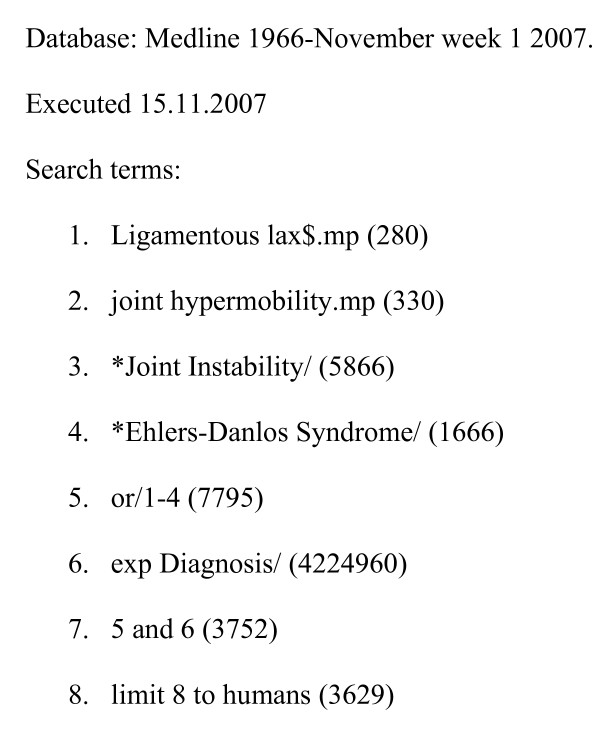
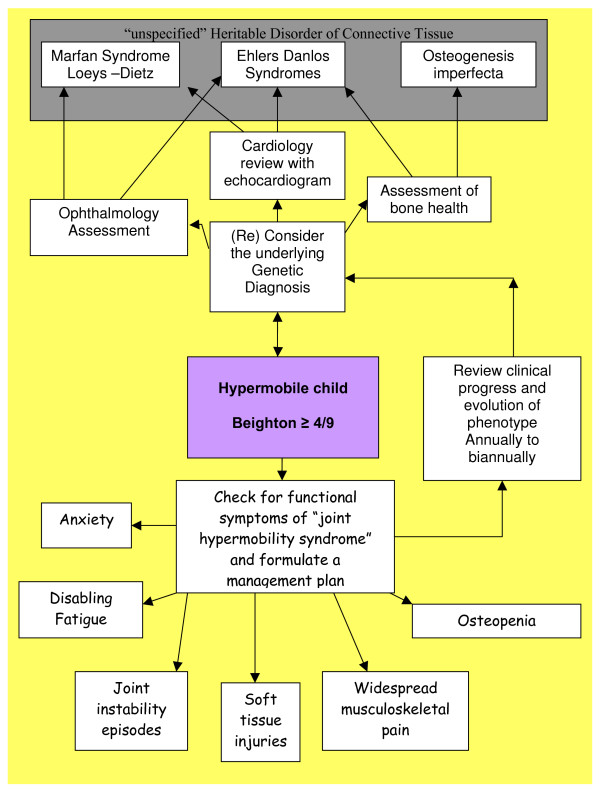
BACKGROUND: In this study we aimed to identify and review publications relating to the diagnosis of joint hypermobility and instability and develop an evidence based approach to the diagnosis of children presenting with joint hypermobility and related symptoms. METHODS: We searched Medline for papers with an emphasis on the diagnosis of joint hypermobility, including Heritable Disorders of Connective Tissue (HDCT). RESULTS: 3330 papers were identified: 1534 pertained to instability of a particular joint; 1666 related to the diagnosis of Ehlers Danlos syndromes and 330 related to joint hypermobility.There are inconsistencies in the literature on joint hypermobility and how it relates to and overlaps with milder forms of HDCT. There is no reliable method of differentiating between Joint Hypermobility Syndrome, familial articular hypermobility and Ehlers-Danlos syndrome (hypermobile type), suggesting these three disorders may be different manifestations of the same spectrum of disorders. We describe our approach to children presenting with joint hypermobility and the published evidence and expert opinion on which this is based. CONCLUSION: There is value in identifying both the underlying genetic cause of joint hypermobility in an individual child and those hypermobile children who have symptoms such as pain and fatigue and might benefit from multidisciplinary rehabilitation management.Every effort should be made to diagnose the underlying disorder responsible for joint hypermobility which may only become apparent over time. We recommend that the term "Joint Hypermobility Syndrome" is used for children with symptomatic joint hypermobility resulting from any underlying HDCT and that these children are best described using both the term Joint Hypermobility Syndrome and their HDCT diagnosis.
Overview
The claims and statistics of this paper haven’t been checked yet.
Run the check — free, no account needed. It reads the open-access text and checks the sources it cites.
Integrity signals
Registry
Cites
Statistics
Figures
Verification
Claims the paper makes
The claims and statistics of this paper haven’t been checked yet.
Run the check — free, no account needed. It reads the open-access text and checks the sources it cites.
Claims other papers make about this one
Each is checked against this paper’s own text: does it say what the citing paper says it does?
The cited source says what the claim attributes to it.
In the citing paper
“Children have high levels of joint hypermobility (herewith hypermobility) [3, 4] making it difficult to distinguish those with a normal physical trait from those with an underlying disorder [5].”
From Pediatric joint hypermobility: a diagnostic framework and narrative review (2023) · cites this paper as [5]
Self-check
Percentages, sums and reported differences re-computed from the paper’s own numbers.
The self-check needs the paper’s full text.
Citations
Cites
Genetic heterogeneity in osteogenesis imperfecta.
Sillence, D. O., Senn, A., & Danks, D. M. (1979) · Journal of Medical Genetics · doi:10.1136/jmg.16.2.101 · Cited by 2,244
Self-citationAneurysm Syndromes Caused by Mutations in the TGF-β Receptor
Loeys, B., Schwarze, U., Holm, T. M., Callewaert, B. L., Thomas, G. H., Pannu, H., Backer, J. F. A. D., Oswald, G. L., Symoens, S., Manouvrier‐Hanu, S., et al. (2006) · New England Journal of Medicine · doi:10.1056/nejmoa055695 · Cited by 1,677
(2000) · PubMed · Cited by 738
Judge, D., & Dietz, H. (2005) · The Lancet · doi:10.1016/s0140-6736(05)67789-6 · Cited by 693
Faivre, L. O., Collod‐Béroud, G., Loeys, B., Child, A. H., Binquet, C., Gautier, É., Callewaert, B. L., Arbustini, E., Mayer, K., Arslan‐Kirchner, M., et al. (2007) · The American Journal of Human Genetics · doi:10.1086/520125 · Cited by 610
Joint hypermobility syndrome in childhood. A not so benign multisystem disorder?
Adib, N., Davies, K., Grahame, R., Woo, P., & Murray, K. J. (2005) · Rheumatology · doi:10.1093/rheumatology/keh557 · Cited by 356
(2007) · PubMed · Cited by 356
Joint hypermobility and genetic collagen disorders: are they related?
Grahame, R. (1999) · Archives of Disease in Childhood · doi:10.1136/adc.80.2.188 · Cited by 344
(2007) · PubMed · Cited by 194
HYPERMOBILITY: PREVALENCE AND FEATURES IN A SWEDISH POPULATION
LARSSON, L.-G., BAUM, J., MUDHOLKAR, G. S., & SRIVASTAVA, D. K. (1993) · Rheumatology · doi:10.1093/rheumatology/32.2.116 · Cited by 143
Cabral, W. A., Makareeva, E., Colige, A., Letocha, A. D., Ty, J. M., Yeowell, H. N., Pals, G., Leikin, S., & Marini, J. C. (2005) · Journal of Biological Chemistry · doi:10.1074/jbc.m414698200 · Cited by 137
Hypermobility and sports injuries in junior netball players
Smith, R. G., Damodaran, A. K., Swaminathan, S., Campbell, R., & Barnsley, L. (2005) · British Journal of Sports Medicine · doi:10.1136/bjsm.2004.015271 · Cited by 127
Hypermobility in two Dutch school poulations
Rikken-Bultman, D. G. A., Wellink, L., & van Dongen, P. W. J. (1997) · European Journal of Obstetrics & Gynecology and Reproductive Biology · doi:10.1016/s0301-2115(97)02745-0 · Cited by 122
Engelbert, R. H. H., Bank, R. A., Sakkers, R. J. B., Helders, P. J. M., Beemer, F. A., & Uiterwaal, C. S. P. M. (2003) · PEDIATRICS · doi:10.1542/peds.111.3.e248 · Cited by 109
Clinical study of hereditary disorders of connective tissues in a Chilean population
Bravo, J. F., & Wolff, C. (2006) · Arthritis & Rheumatism · doi:10.1002/art.21557 · Cited by 108
Stewart, D. R., & Burden, S. B. (2004) · British Journal of Sports Medicine · doi:10.1136/bjsm.2003.004861 · Cited by 97
Prevalence and Features of Joint Hypermobility Among Adolescent Athletes
Decoster, L. C. (1997) · Archives of Pediatrics and Adolescent Medicine · doi:10.1001/archpedi.1997.02170470023005 · Cited by 94
Echocardiographic findings in classical and hypermobile Ehlers–Danlos syndromes
McDonnell, N. B., Gorman, B. L., Mandel, K. W., Schurman, S. H., Assanah‐Carroll, A., Mayer, S. A., Najjar, S. S., & Francomano, C. A. (2006) · American Journal of Medical Genetics Part A · doi:10.1002/ajmg.a.31035 · Cited by 92
Dolan, A. L., Hart, D., Doyle, D., Grahame, R., & Spector, T. D. (2003) · PubMed · Cited by 91
Ho, N. C., Tran, J. R., & Bektas, A. (2005) · The Lancet · doi:10.1016/s0140-6736(05)66995-4 · Cited by 90
Hypermobility syndrome increases the risk for low bone mass
Gülbahar, S., Şahin, E., Baydar, M., Bircan, Ç., Kızıl, R., Manisalı, M., Akalın, E., & Peker, Ö. (2005) · Clinical Rheumatology · doi:10.1007/s10067-005-0103-3 · Cited by 67
Zweers, M. C., Kucharekova, M., & Schalkwijk, J. (2005) · Annals of the Rheumatic Diseases · doi:10.1136/ard.2004.026559 · Cited by 58
Articular hypermobility in school children in Sao Paulo, Brazil.
Forleo, L. H. A., Hilário, M. O. E., Peixoto, A. L., Naspitz, C. K., & Goldenberg, J. (1993) · PubMed · Cited by 42
Nijs, J., Essche, E. V., Munck, M. D., & Dequeker, J. (2000) · Calcified Tissue International · doi:10.1007/s00223001093 · Cited by 30
Age Changes in Five Parameters of Metacarpal Growth
Spencer, R. P., Sagel, S. S., & Garn, S. M. (1968) · Investigative Radiology · doi:10.1097/00004424-196801000-00005 · Cited by 21
Ehlers-Danlos syndromes: Revised nosology, Villefranche, 1997
Beighton, P., Paepe, A. D., Steinmann, B., Tsipouras, P., & Wenstrup, R. J. (1998) · American Journal of Medical Genetics · doi:10.1002/(sici)1096-8628(19980428)77:1
Research works printed but not linked: 1
- Munns C, Sillence D: Disorders Predisposing to Bone Fragility and Decreased Bone Density. Emery and Rimoun's Principles and Practice of Medical Genetics. Edited by: Rimoin DL, Connor J, Pyeritz RE, Korf B. 2007, Philadelphia: Churchill Livingston Elselvier, 3671-3691. 5
Cited by
Sorted by citations
Tinkle, B., Castori, M., Berglund, B., Cohen, H., Grahame, R., Kazkaz, H., & Levy, H. (2017) · American Journal of Medical Genetics Part C: Seminars in Medical Genetics · doi:10.1002/ajmg.c.31538 · Cited by 499
Beighton Score: A Valid Measure for Generalized Hypermobility in Children
Smits-Engelsman, B., Klerks, M., & Kirby, A. (2011) · The Journal of Pediatrics · doi:10.1016/j.jpeds.2010.07.021 · Cited by 389
Tinkle, B. T., Bird, H. A., Grahame, R., Lavallee, M., Levy, H. P., & Sillence, D. (2009) · American Journal of Medical Genetics Part A · doi:10.1002/ajmg.a.33070 · Cited by 290
Self-citationHypermobility and the hypermobility syndrome
Simmonds, J. V., & Keer, R. J. (2007) · Manual Therapy · doi:10.1016/j.math.2007.05.001 · Cited by 265
Macrophage Activation Syndrome
Ravelli, A., Davì, S., Minoia, F., Martini, A., & Cron, R. Q. (2015) · Hematology/Oncology Clinics of North America · doi:10.1016/j.hoc.2015.06.010 · Cited by 211
Metadata
- Authors
- Tofts, L. J., Elliott, E. J., Munns, C., Pacey, V., & Sillence, D. O.
- Affiliations
- Children's Hospital at Westmead (AU)
- The University of Sydney (AU)
- Corresponding author
- Tofts, Louise J
- Venue
- Pediatric Rheumatology
- Published
- 2009-01-05
- Volume
- 7
- Issue
- 1
- Pages
- 1-1
- ISSN
- 1546-0096 (ISSN-L)
- PMC
- PMC2628911
- OpenAlex
- W2102415974
- Cited by
- 109
- References
- 26
- Citations by year
- 2026: 2 · 2025: 4 · 2024: 11 · 2023: 6 · 2022: 7 · 2021: 5 · 2020: 5 · 2019: 13 · 2018: 4 · 2017: 6 · 2016: 5 · 2015: 10 · 2014: 6 · 2013: 4 · 2012: 6
- FWCI
- 3.90
- Type
- journal article
- Language
- en
- Open access
- gold
- doi.org
- Licence
- Locations
- Pediatric Rheumatology (publishedVersion, cc-by)
- PubMed Central (publishedVersion, cc-by)
- PubMed (publishedVersion)
- DOAJ (DOAJ: Directory of Open Access Journals) (submittedVersion)
- Funders
- Medical Research Council
- National Health and Medical Research Council (457084)
- Topics
- Life Sciences › Biochemistry, Genetics and Molecular Biology › Genetics › Connective tissue disorders research
- Health Sciences › Dentistry › Periodontics › Oral and gingival health research
- Life Sciences › Biochemistry, Genetics and Molecular Biology › Genetics › Dermatological and Skeletal Disorders
- Keywords
- joint hypermobility, hereditary connective tissue disorders, joint instability, differential diagnosis, children, diagnostic criteria, multidisciplinary rehabilitation
About these checks
Registry, retraction, Cites and statistics results are computed, not judged, with one exception: a printed reference that no index lists is read once by a model before it counts as a citation error. Claims are extracted by a model and kept only when their quote appears verbatim in the text; each cited source is then checked, with a model’s help, for whether it says what the claim relies on. Those verdicts can be wrong — read the claim’s quote and the cited source before relying on one.
Statistics and arithmetic are recomputed, not judged.
Confidence bands are shown only for fields calibrated on our annotated test set. None is calibrated yet, so no band is shown.
What counts as a claim ›How we measure confidence ›How we check this ›
Are you an author, or do you see a problem with this page? Request a review
