

Creatine monohydrate supplementation on lower-limb muscle power in Brazilian elite soccer players
Open accessThe DOI matches its Crossref record; 39 of the 39 references it cites were found in a registry or an index.
Abstract
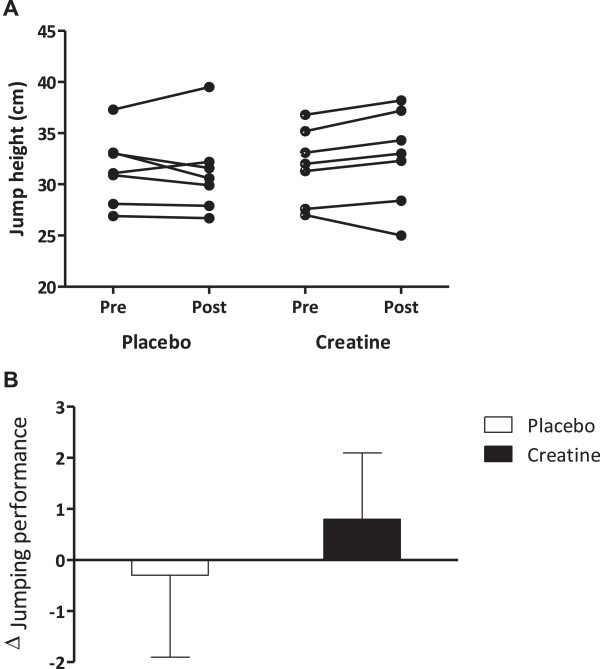
BACKGROUND: Studies involving chronic creatine supplementation in elite soccer players are scarce. Therefore, the aim of this study was to examine the effects of creatine monohydrate supplementation on lower-limb muscle power in Brazilian elite soccer players (n = 14 males) during pre-season training. FINDINGS: This was a randomized, double-blind, placebo-controlled parallel-group study. Brazilian professional elite soccer players participated in this study. During the pre-season (7 weeks), all the subjects underwent a standardized physical and specific soccer training. Prior to and after either creatine monohydrate or placebo supplementation, the lower-limb muscle power was measured by countermovement jump performance. The Jumping performance was compared between groups at baseline (p = 0.99). After the intervention, jumping performance was lower in the placebo group (percent change = - 0.7%; ES = - 0.3) than in the creatine group (percent change = + 2.4%; ES = + 0.1), but it did not reach statistical significance (p = 0.23 for time x group interaction). Fisher's exact test revealed that the proportion of subjects that experienced a reduction in jumping performance was significantly greater in the placebo group than in the creatine group (5 and 1, respectively; p = 0.05) after the training. The magnitude-based inferences demonstrated that placebo resulted in a possible negative effect (50%) in jumping performance, whereas creatine supplementation led to a very likely trivial effect (96%) in jumping performance in the creatine group. CONCLUSIONS: Creatine monohydrate supplementation prevented the decrement in lower-limb muscle power in elite soccer players during a pre-season progressive training.
Overview
The claims and statistics of this paper haven’t been checked yet.
Free: it reads the open-access text and checks the first 5 claims that cite a source we can check. Create a free account to check every claim.
Integrity signals
Registry
Cites
Statistics
Figures
Verification
Claims the paper makes
The claims and statistics of this paper haven’t been checked yet.
Free: it reads the open-access text and checks the first 5 claims that cite a source we can check. Create a free account to check every claim.
Claims other papers make about this one
Each is checked against this paper’s own text: does it say what the citing paper says it does?
The source backs part of the claim, not all of it — or backs it for a different population, condition or comparison.
In the citing paper
“The remaining study, Claudino et al. [42] failed to report any improvements in lower body power production after 14 male adolescent soccer athletes completed a one-week loading and a six-week maintenance dose phase.”
From Creatine Supplementation in Children and Adolescents (2021) · cites this paper as [42]
Experimental — accuracy not yet measuredThe source backs part of the claim, not all of it — or backs it for a different population, condition or comparison.
In the citing paper
“synthesized from the amino acids arginine, glycine, and methionine and stored about 95% in the skeletal muscle and can be found in the free form or linked to a phosphate molecule (phosphocreatine) [7]”
From Dietary and Ergogenic Supplementation to Improve Elite Soccer Players’ Performance (2021) · cites this paper as [7]
Experimental — accuracy not yet measuredIn the citing paper
“Almost all interventions showed performance improvements such as sprint ability, muscular strength, power output, sport-specific skills, and repeated high-intensity efforts, with no reported side effects [46,47,48,49,50,51,52].”
From Use of Nutritional Strategies, Bioactive Compounds, and Dietary Supplements in Young Athletes: From Evidence to Potential Risks—A Narrative Review (2025) · cites this paper as [47]
In the citing paper
“Studies in young athletes (ages 14.3–20), quantitatively very limited compared to the number of interventions conducted in adults, primarily examined swimmers and soccer players, with no adverse effects observed [46,47,48,49,50,51,52,86].”
From Use of Nutritional Strategies, Bioactive Compounds, and Dietary Supplements in Young Athletes: From Evidence to Potential Risks—A Narrative Review (2025) · cites this paper as [47]
Self-check
Percentages, sums and reported differences re-computed from the paper’s own numbers.
The self-check needs the paper’s full text.
Citations
Cites
American College of Sports Medicine position stand
Otis, C. L. (1997) · Medical Entomology and Zoology · Cited by 4,407
Progression Models in Resistance Training for Healthy Adults
(2009) · Medicine & Science in Sports & Exercise · doi:10.1249/mss.0b013e3181915670 · Cited by 4,332
Progression Models in Resistance Training for Healthy Adults
(2002) · Medicine and Science in Sports and Exercise · doi:10.1097/00005768-200202000-00027 · Cited by 2,979
Creatine and Creatinine Metabolism
Wyss, M., & Kaddurah-Daouk, R. (2000) · Physiological Reviews · doi:10.1152/physrev.2000.80.3.1107 · Cited by 2,950 · cited 1×
“Additionally, it may function as an ATP “shuttle”, transferring mitochondrial ATP to the cytosol [1].”
BackgroundMaking Meaningful Inferences About Magnitudes
Batterham, A. M., & Hopkins, W. G. (2006) · International Journal of Sports Physiology and Performance · doi:10.1123/ijspp.1.1.50 · Cited by 2,183 · cited 1×
“Qualitative descriptors were assigned to the quantitative percentile scores as follows: 25-75% possible; 75-95% likely; 95-99% very likely; >99% almost certain [34,35].”
MethodUse of RPE-Based Training Load in Soccer
IMPELLIZZERI, F. M., RAMPININI, E., COUTTS, A. J., SASSI, A., & MARCORA, S. M. (2004) · Medicine & Science in Sports & Exercise · doi:10.1249/01.mss.0000128199.23901.2f · Cited by 1,179 · cited 1×
“; duration, in minutes, of the training session) [18].”
BackgroundDoes plyometric training improve vertical jump height? A meta-analytical review
Markovic, G. (2007) · British Journal of Sports Medicine · doi:10.1136/bjsm.2007.035113 · Cited by 553 · cited 1×
“, horizontal, vertical, and depth jumping) during resistance training sessions, as this type of training can positively affect lower-limb power [16].”
BackgroundHopkins, W. G. (2007) · Cited by 497
Effect of creatine supplementation on body composition and performance: a meta-analysis
Branch, J. D. (2003) · International Journal of Sport Nutrition and Exercise Metabolism · doi:10.1123/ijsnem.13.2.198 · Cited by 309 · cited 1×
“Previous reports support the use of jumping to measure the effects of creatine on lower limb performance [10,23-25].”
ResultBALSOM, P. D., SÖDERLUND, K., SJÖDIN, B., & EKBLOM, B. (1995) · Acta Physiologica Scandinavica · doi:10.1111/j.1748-1716.1995.tb09914.x · Cited by 292 · cited 3×
“The main mechanism underlying the beneficial effects of creatine shown in the current study could be a putative increase in the muscle phosphorylcreatine concentration, which could remain elevated during multiple exercise bouts, possibly offsetting the normal decrease in force production that occurs over the course of…”
BackgroundCreatine supplementation and dynamic high-intensity intermittent exercise
Balsom, P. D., Ekblom, B., Söerlund, K., Sjödln, B., & Hultman, E. (1993) · Scandinavian Journal of Medicine & Science in Sports · doi:10.1111/j.1600-0838.1993.tb00378.x · Cited by 282
Creatine supplementation and sprint performance in soccer players
MUJIKA, I., PADILLA, S., IBA??EZ, J., IZQUIERDO, M., & GOROSTIAGA, E. (2000) · Medicine & Science in Sports & Exercise · doi:10.1097/00005768-200002000-00039 · Cited by 168 · cited 1×
“supplementation improved repeated sprint performance and jumping ability after an intermittent exercise test in highly trained soccer players [11].”
BackgroundEffects of creatine supplementation on muscle power, endurance, and sprint performance
IZQUIERDO, M., IBA??EZ, J., GONZ??LEZ-BADILLO, J. J., & GOROSTIAGA, E. M. (2002) · Medicine and Science in Sports and Exercise · doi:10.1097/00005768-200202000-00023 · Cited by 159 · cited 2×
“The main mechanism underlying the beneficial effects of creatine shown in the current study could be a putative increase in the muscle phosphorylcreatine concentration, which could remain elevated during multiple exercise bouts, possibly offsetting the normal decrease in force production that occurs over the course of…”
BackgroundResultQuantification of the typical weekly in-season training load in elite junior soccer players
Wrigley, R., Drust, B., Stratton, G., Scott, M., & Gregson, W. (2012) · Journal of Sports Sciences · doi:10.1080/02640414.2012.709265 · Cited by 152 · cited 3×
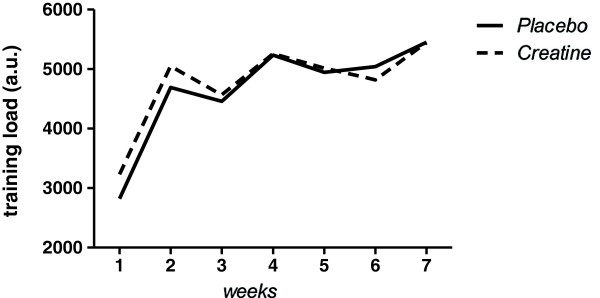
“Total training load, hereafter called training load, was measured as the summation (in arbitrary units) of the specific training loads and the resistance training loads per week according to previously described criteria [19].”
MethodInfluentialChanges in perceived stress and recovery in overreached young elite soccer players
Brink, M. S., Visscher, C., Coutts, A. J., & Lemmink, K. A. P. M. (2012) · Scandinavian Journal of Medicine & Science in Sports · doi:10.1111/j.1600-0838.2010.01237.x · Cited by 136
The use of medication and nutritional supplements during FIFA World Cups 2002 and 2006
Tscholl, P., Junge, A., & Dvorak, J. (2008) · British Journal of Sports Medicine · doi:10.1136/bjsm.2007.045187 · Cited by 133
A New Approach to Monitoring Resistance Training
McGuigan, M. R., & Foster, C. (2004) · Strength and conditioning journal · doi:10.1519/00126548-200412000-00008 · Cited by 133
Validity of Two Methods for Estimation of Vertical Jump Height
Dias, J. A., Pupo, J. D., Reis, D. C., Borges, L., Santos, S. G., Moro, A. R., & Borges, N. G. (2011) · Journal of Strength and Conditioning Research · doi:10.1519/jsc.0b013e3181e73f6e · Cited by 125 · cited 1×
“CMJ performance assessment protocol consisted of 8 jumps with 60-second intervals between each attempt [20,21].”
MethodCox, G., Mujika, I., Tumilty, D., & Burke, L. (2002) · International Journal of Sport Nutrition and Exercise Metabolism · doi:10.1123/ijsnem.12.1.33 · Cited by 110 · cited 1×
“Furthermore, beneficial effects of 6 days of creatine supplementation were observed on repeated sprint and agility tasks in elite female soccer players [12].”
BackgroundVolek, J. S., Ratamess, N. A., Rubin, M. R., G�mez, A. L., French, D. N., McGuigan, M. M., Scheett, T. P., Sharman, M. J., H�kkinen, K., & Kraemer, W. J. (2004) · European Journal of Applied Physiology · doi:10.1007/s00421-003-1031-z · Cited by 107 · cited 2×
“The main mechanism underlying the beneficial effects of creatine shown in the current study could be a putative increase in the muscle phosphorylcreatine concentration, which could remain elevated during multiple exercise bouts, possibly offsetting the normal decrease in force production that occurs over the course of…”
BackgroundResultCreatine in Type 2 Diabetes: A Randomized, Double-Blind, Placebo-Controlled Trial
GUALANO, B., DE SALLES PAINNELI, V., ROSCHEL, H., ARTIOLI, G. G., NEVES, M., DE SÁ PINTO, A. L., DA SILVA, M. E. R., CUNHA, M. R., OTADUY, M. C. G., DA COSTA LEITE, C., et al. (2011) · Medicine & Science in Sports & Exercise · doi:10.1249/mss.0b013e3181fcee7d · Cited by 99 · cited 1×
“The compliance to creatine supplementation was monitored weekly by personal communication, as previously done in our studies in which creatine supplementation was shown to be capable of increasing muscle phosphorylcreatine content [26-28].”
MethodSelf-citationDietary supplements for football
Hespel, P., Maughan, R. J., & Greenhaff, P. L. (2006) · Journal of Sports Sciences · doi:10.1080/02640410500482974 · Cited by 93 · cited 1×
“Possibly, an even higher incidence of creatine users would be found if the survey were extended to the whole season, as this supplement has also been thought to improve the training ability in soccer [36].”
BackgroundInfluence of Training Background on Jumping Height
Ugrinowitsch, C., Tricoli, V., Rodacki, A. L. F., Batista, M. A. B., & Ricard, M. D. (2007) · The Journal of Strength and Conditioning Research · doi:10.1519/r-20162.1 · Cited by 92 · cited 1×
“Subjects were instructed to maintain their hands on their chest and freely determine the amplitude of the countermovement in order to avoid changes in jumping coordination [22].”
MethodAntonio, J., & Ciccone, V. (2013) · Journal of the International Society of Sports Nutrition · doi:10.1186/1550-2783-10-36 · Cited by 83 · cited 1×
“In addition, jumping performance data were analyzed using a contemporary magnitudebased inferences approach [29] in order to detect small effects of practical importance in an applied setting, a technique which is becoming increasingly common in an exercise performance research [30-33].”
MethodCreatine supplementation in fibromyalgia: A randomized, double-blind, placebo-controlled trial
Alves, C. R. R., Santiago, B. M., Lima, F. R., Otaduy, M. C. G., Calich, A. L., Tritto, A. C. C., de Sá Pinto, A. L., Roschel, H., Leite, C. C., Benatti, F. B., et al. (2013) · Arthritis Care & Research · doi:10.1002/acr.22020 · Cited by 73 · cited 1×
“The compliance to creatine supplementation was monitored weekly by personal communication, as previously done in our studies in which creatine supplementation was shown to be capable of increasing muscle phosphorylcreatine content [26-28].”
MethodSelf-citationCreatine supplementation in young soccer players
Ostojic, S. M. (2004) · International Journal of Sport Nutrition and Exercise Metabolism · doi:10.1123/ijsnem.14.1.95 · Cited by 72 · cited 2×
“Creatine supplementation for 7 days improved performance in a soccer-specific battery of tests, including a dribble test, a sprint-power test, an endurance test, and a vertical jump test [10].”
ResultPre Vertical Jump Performance to Regulate the Training Volume
Claudino, J. G., Mezêncio, B., Soncin, R., Ferreira, J. C., Couto, B. P., & Szmuchrowski, L. A. (2011) · International Journal of Sports Medicine · doi:10.1055/s-0031-1286293 · Cited by 71
Self-citationFavero, S. M. D., Roschel, H., Artioli, G. G., Ugrinowitsch, C., Tricoli, V., Costa, A. D. S., Barroso, R., Negrelli, A. L., Otaduy, M. C. G., Leite, C. D. C., et al. (2011) · Amino Acids · doi:10.1007/s00726-011-0972-5 · Cited by 66 · cited 1×
“The compliance to creatine supplementation was monitored weekly by personal communication, as previously done in our studies in which creatine supplementation was shown to be capable of increasing muscle phosphorylcreatine content [26-28].”
MethodSelf-citationEffect of carbohydrate mouth rinsing on multiple sprint performance
Dorling, J. L., & Earnest, C. P. (2013) · Journal of the International Society of Sports Nutrition · doi:10.1186/1550-2783-10-41 · Cited by 63 · cited 1×
“In addition, jumping performance data were analyzed using a contemporary magnitudebased inferences approach [29] in order to detect small effects of practical importance in an applied setting, a technique which is becoming increasingly common in an exercise performance research [30-33].”
MethodLARSON-MEYER, D. E., HUNTER, G. R., TROWBRIDGE, C. A., TURK, J. C., ERNEST, J. M., TORMAN, S. L., & HARBIN, P. A. (2000) · Journal of Strength and Conditioning Research · doi:10.1519/00124278-200011000-00011 · Cited by 61
Lee, C.-L., Lin, J., & Cheng, C. (2011) · European Journal of Applied Physiology · doi:10.1007/s00421-010-1792-0 · Cited by 55 · cited 2×
“Increased levels of creatine/phosphorylcreatine via creatine supplementation have been consistently shown to increase performance in high-intensity intermittent exercise [2-6].”
BackgroundChilibeck, P. D., Magnus, C., & Anderson, M. (2007) · Applied Physiology, Nutrition, and Metabolism · doi:10.1139/h07-072 · Cited by 50 · cited 1×
“has been largely used by athletes engaged in multiplesprint events, such as soccer [7] and other team sports [8].”
BackgroundHoffman, J. R., Stout, J. R., Williams, D. R., Wells, A. J., Fragala, M. S., Mangine, G. T., Gonzalez, A. M., Emerson, N. S., McCormack, W. P., Scanlon, T. C., et al. (2012) · Journal of the International Society of Sports Nutrition · doi:10.1186/1550-2783-9-47 · Cited by 43 · cited 1×
“In addition, jumping performance data were analyzed using a contemporary magnitudebased inferences approach [29] in order to detect small effects of practical importance in an applied setting, a technique which is becoming increasingly common in an exercise performance research [30-33].”
MethodBarber, J. J., McDermott, A. Y., McGaughey, K. J., Olmstead, J. D., & Hagobian, T. A. (2013) · Journal of Strength and Conditioning Research · doi:10.1519/jsc.0b013e318252f6b7 · Cited by 40 · cited 2×
“Increased levels of creatine/phosphorylcreatine via creatine supplementation have been consistently shown to increase performance in high-intensity intermittent exercise [2-6].”
BackgroundEffect of Creatine Supplementation Jumping Performance in Elite Volleyball Players
Lamontagne-Lacasse, M., Nadon, R., & Goulet, E. D. B. (2011) · International Journal of Sports Physiology and Performance · doi:10.1123/ijspp.6.4.525 · Cited by 34
Effect of Sodium Bicarbonate Supplementation on 2000-m Rowing Performance
Hobson, R. M., Harris, R. C., Martin, D., Smith, P., Macklin, B., Elliott-Sale, K. J., & Sale, C. (2014) · International Journal of Sports Physiology and Performance · doi:10.1123/ijspp.2013-0086 · Cited by 33 · cited 1×
“In addition, jumping performance data were analyzed using a contemporary magnitudebased inferences approach [29] in order to detect small effects of practical importance in an applied setting, a technique which is becoming increasingly common in an exercise performance research [30-33].”
MethodCreatine supplementation spares muscle glycogen during high intensity intermittent exercise in rats
Roschel, H., Gualano, B., Marquezi, M., Costa, A., & Lancha, A. H. (2010) · Journal of the International Society of Sports Nutrition · doi:10.1186/1550-2783-7-6 · Cited by 30 · cited 2×
“Increased levels of creatine/phosphorylcreatine via creatine supplementation have been consistently shown to increase performance in high-intensity intermittent exercise [2-6].”
BackgroundSelf-citationCreatine Monohydrate Use Among Elite Australian Power Lifters
Stanton, R., & Abt, G. (2000) · The Journal of Strength and Conditioning Research · Cited by 15
Sarcopenia and Exercise: Mechanisms, Interactions, and Application of Research Findings
Willardson, J. M. (2004) · Strength and conditioning journal · Cited by 9
Research works printed but not linked: 2
- Reilly T Training specificity for soccer Int J Appl Sports Sci 2005 17 17 25
- Hopkins WG Probabilities of clinical or practical significance Sportscience 2002 6 sportsci.org/jour/0201/wghprob.htm
Cited by
ISSN exercise & sports nutrition review update: research & recommendations
Kerksick, C. M., Wilborn, C. D., Roberts, M. D., Smith-Ryan, A., Kleiner, S. M., Jäger, R., Collins, R., Cooke, M., Davis, J. N., Galvan, E., et al. (2018) · Journal of the International Society of Sports Nutrition · doi:10.1186/s12970-018-0242-y · Cited by 945
Kreider, R. B., Kalman, D. S., Antonio, J., Ziegenfuss, T. N., Wildman, R., Collins, R., Candow, D. G., Kleiner, S. M., Almada, A. L., & Lopez, H. L. (2017) · Journal of the International Society of Sports Nutrition · doi:10.1186/s12970-017-0173-z · Cited by 1,057
The countermovement jump to monitor neuromuscular status: A meta-analysis
Claudino, J. G., Cronin, J., Mezêncio, B., McMaster, D. T., McGuigan, M., Tricoli, V., Amadio, A. C., & Serrão, J. C. (2017) · Journal of Science and Medicine in Sport · doi:10.1016/j.jsams.2016.08.011 · Cited by 649
Self-citationCreatine in health and disease
Kreider, R. B., & Stout, J. R. (2021) · Nutrients · doi:10.3390/nu13020447 · Cited by 227
“The improvement in performance has generally been 10–20% on various high-intensity exercise tasks [97] that include lifetime fitness activities like fitness/weight training [77,84,91,98–108], golf [109], volleyball [110], soccer [82,111,112], softball [113], ice hockey [114], running [115–119], and swimming [73,74,120…”
BackgroundPerformance-Enhancing Substances in Sports: A Review of the Literature
Momaya, A. M., Fawal, M., & Estes, R. (2015) · Sports Medicine · doi:10.1007/s40279-015-0308-9 · Cited by 174
“[44] examined chronic (7 weeks) creatine supplementation in elite soccer players.”
Background
Metadata
- Authors
- Claudino, J. G., Mezêncio, B., Amaral, S., Zanetti, V., Benatti, F., Roschel, H., Gualano, B., Amadio, A. C., & Serrão, J. C.
- Affiliations
- Universidade de São Paulo (BR)
- Department of Health and PerformanceRed Bull Brazil Football João Lúcio do Prado street, Km 10 13240-000 Jarinu SP Brazil
- School of Physical Education and Sport - Laboratory of BiomechanicsUniversity of Sao Paulo Av Mello de Moraes, 65 05508-030 Sao Paulo SP Brazil
- ORCID
- Venue
- Journal of the International Society of Sports Nutrition
- Publisher
- Informa UK Limited
- Published
- 2014-08-15
- Volume
- 11
- Issue
- 1
- Pages
- 32-32
- ISSN
- 1550-2783 (ISSN-L)
- PMC
- PMC4077550
- OpenAlex
- W2121466793
- Cited by
- 78
- References
- 37
- Citations by year
- 2026: 6 · 2025: 6 · 2024: 6 · 2023: 8 · 2022: 8 · 2021: 6 · 2020: 7 · 2019: 3 · 2018: 7 · 2017: 6 · 2016: 7 · 2015: 8
- FWCI
- 3.49
- Type
- journal article
- Language
- en
- Open access
- gold
- doi.org
- Licence
- Locations
- Journal of the International Society of Sports Nutrition (publishedVersion, cc-by)
- PubMed Central (publishedVersion, cc-by)
- PubMed (publishedVersion)
- Portuguese National Funding Agency for Science, Research and Technology (RCAAP Project by FCT) (publishedVersion)
- Funders
- Coordenação de Aperfeiçoamento de Pessoal de Nível Superior
- Conselho Nacional de Desenvolvimento Científico e Tecnológico
- Topics
- Health Sciences › Nursing › Nutrition and Dietetics › Muscle metabolism and nutrition
- Health Sciences › Medicine › Orthopedics and Sports Medicine › Sports Performance and Training
- Health Sciences › Medicine › Physiology (medical) › Biochemical effects in animals
- Keywords
- creatine monohydrate supplementation, lower limb muscle power, elite soccer players, countermovement jump, pre-season training, progressive training, placebo effect, magnitude-based inference
About these checks
Registry, retraction, Cites and statistics results are computed, not judged, with one exception: a printed reference that no index lists is read once by a model before it counts as a citation error. Claims are extracted by a model and kept only when their quote appears verbatim in the text; each cited source is then checked, with a model’s help, for whether it says what the claim relies on. Those verdicts can be wrong — read the claim’s quote and the cited source before relying on one.
Statistics and arithmetic are recomputed, not judged.
Confidence bands are shown only for fields calibrated on our annotated test set. None is calibrated yet, so no band is shown.
What counts as a claim ›How we measure confidence ›How we check this ›
Are you an author, or do you see a problem with this page? Request a review
Data sources
Bibliographic data: Semantic Scholar, OpenAlex, Crossref.
Contains information from the Semantic Scholar Academic Graph Datasets, made available under the ODC Attribution License (ODC-BY 1.0).
Semantic Scholar’s data is described in: Kinney, R., et al. (2023). The Semantic Scholar Open Data Platform. arXiv:2301.10140.
