

The age-gender-status profile of high performing athletes in the UK taking nutritional supplements: Lessons for the future
Open accessThe DOI matches its Crossref record; 20 of the 20 references it cites were found in a registry or an index.
Abstract
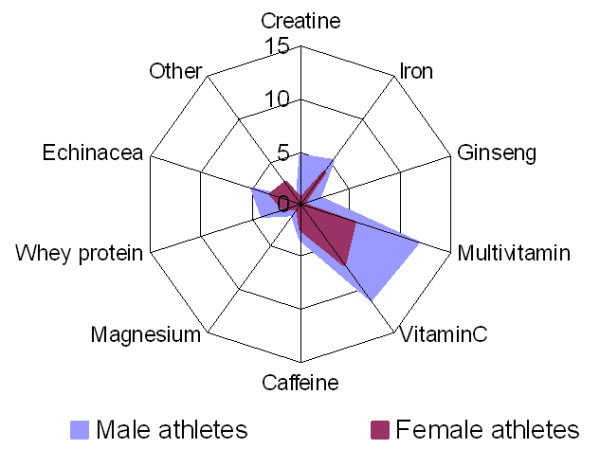
BACKGROUND: Owing to the mechanics of anti-doping regulation via the World Anti-Doping Agency's Prohibited List, nutritional supplement use received little attention in comparison to the prevalence of doping. The aims of this study were to investigate supplement use, identify groups of athletes with high levels of supplement use and the prevalence of concomitant use of supplements. METHODS: Survey data from 847 high-performing athletes in the UK were analysed using descriptive statistics. The survey, conducted by UK Sport, consisted of questions regarding knowledge of the prohibited substances, testing procedure, nutritional supplement use and perceptions of the doping problem. The proportion of supplement users and the relative use of each supplement were compared by age, gender and professional status. RESULTS: Among 874 high-performing athletes in the UK sample, 58.8% of them reported the use of at least one nutritional supplement. Among supplement users, 82.6% used more than one and 11.5% reported use of more than five nutritional supplements. Of the 9 supplements listed, multivitamins (72.6%) and vitamin C (70.7%) were used most, followed by creatine (36.1%), whey protein (31.7%), echinacea (30.9%), iron (29.9%) and caffeine (23.7%). Less than 11% reported the use of magnesium or ginseng. Creatine use was typically associated with males regardless of status and across all ages, whereas iron was characteristically used by females. A 'typical' supplement user is male, between 24 and 29 years of age, involved in professional sport and using a combination of supplements. Male professional players between age 30 and 34 years, and female non-professional athletes between 24 and 29 years of age also represented a considerable proportion of supplement users. Athletes older than 40 years of age were practically non-users. Concomitant use of supplements is characteristic of male users more than females. CONCLUSION: As supplement use has been previously shown to increase the probability of prohibited substance use, groups exhibiting high use of nutritional supplements should be monitored. Future research should incorporate a wide range of supplements and enquire about the daily amount ingested. In addition to tutoring, preventive measures should incorporate offering acceptable and healthy alternatives for assisted performance enhancement.
Overview
The claims and statistics of this paper haven’t been checked yet.
Free: it reads the open-access text and checks the first 5 claims that cite a source we can check. Create a free account to check every claim.
Integrity signals
Registry
Cites
Statistics
Figures
Verification
Claims the paper makes
The claims and statistics of this paper haven’t been checked yet.
Free: it reads the open-access text and checks the first 5 claims that cite a source we can check. Create a free account to check every claim.
Claims other papers make about this one
Each is checked against this paper’s own text: does it say what the citing paper says it does?
The cited source doesn’t support the claim as written.
In the citing paper
“Similarly, in 2008 Petroczi and Naughton [27] surveyed a cohort of 403 elite athletes from the United Kingdom and reported 28% of athletes self-reported creatine use.”
From Creatine Supplementation in Children and Adolescents (2021) · cites this paper as [27]
Checked by a reasoning model — may be wrong.
Experimental — accuracy not yet measuredThe source backs part of the claim, not all of it — or backs it for a different population, condition or comparison.
In the citing paper
“While creatine appears to be a popular dietary supplement of choice among elite adolescent athletes, creatine is still less frequently used when compared to other dietary supplement categories such as multivitamins, protein powders, and energy products, in which usage rates of these product categories can range anywhere from 60–80% among adolescent athletes [26,27,28,29,30,31,32].”
From Creatine Supplementation in Children and Adolescents (2021) · cites this paper as [27]
Experimental — accuracy not yet measuredThe source backs part of the claim, not all of it — or backs it for a different population, condition or comparison.
In the citing paper
“Regardless, there does still appear to be variability in prevalence rates, which is likely attributable to differences in gender, sport-type and associated body composition or training-related goals (70, 75, 76, 82, 83).”
From Safety of Creatine Supplementation in Active Adolescents and Youth: A Brief Review (2018) · cites this paper as [75]
Experimental — accuracy not yet measured
Self-check
Percentages, sums and reported differences re-computed from the paper’s own numbers.
The self-check needs the paper’s full text.
Citations
Cites
Food, nutrition, physical activity, and the prevention of cancer: a global perspective
(2008) · Choice Reviews Online · doi:10.5860/choice.45-5024 · Cited by 5,350
Bjelakovic, G., Nikolova, D., Gluud, L. L., Simonetti, R. G., & Gluud, C. (2007) · JAMA · doi:10.1001/jama.297.8.842 · Cited by 2,275
Lazcano-Ponce, E. C. (2009) · Salud Pública de México · Cited by 1,669
Parkinson’s disease risks associated with dietary iron, manganese, and other nutrient intakes
Powers, K. M., Smith-Weller, T., Franklin, G. M., Longstreth, W. T., Swanson, P. D., & Checkoway, H. (2003) · Neurology · doi:10.1212/01.wnl.0000068021.13945.7f · Cited by 268
Contamination of dietary supplements and positive drug tests in sport
Maughan, R. (2005) · Journal of Sports Sciences · doi:10.1080/02640410400023258 · Cited by 237
Goldberg, L., MacKinnon, D. P., Elliot, D. L., Moe, E. L., Clarke, G., & Cheong, J. (2000) · Archives of Pediatrics & Adolescent Medicine · doi:10.1001/archpedi.154.4.332 · Cited by 223
Medication Use in Athletes Selected for Doping Control at the Sydney Olympics (2000)
Corrigan, B., & Kazlauskas, R. (2003) · Clinical Journal of Sport Medicine · doi:10.1097/00042752-200301000-00007 · Cited by 172
Block, G., Jensen, C. D., Norkus, E. P., Dalvi, T. B., Wong, L. G., McManus, J. F., & Hudes, M. L. (2007) · Nutrition Journal · doi:10.1186/1475-2891-6-30 · Cited by 170
Nutritional supplements as a source for positive doping cases?
Kamber, M., Baume, N., Saugy, M., & Rivier, L. (2001) · International Journal of Sport Nutrition and Exercise Metabolism · doi:10.1123/ijsnem.11.2.258 · Cited by 105
Supplement use and nutritional habits in Norwegian elite athletes
Ronsen, O., Sundgot‐Borgen, J., & Maehlum, S. (1999) · Scandinavian Journal of Medicine & Science in Sports · doi:10.1111/j.1600-0838.1999.tb00203.x · Cited by 97
Research works printed but not linked: 3
- Brissonneau C Deviant Careers: The case of cycling WADA International Conference "Ethics and Social Science Research in Anti-Doping" Larnaca, Cyprus 2006 April 13–14
- UK Parliament, The House of Commons, Science and Technology Committee Human enhancement technologies in sport. HC 67 2007 London: The Stationary Office Limited
- Petróczi A Aidman E Psychological drivers in doping: a developmental vulnerability model 5th Play the Game Conference Reykjavik, Iceland 2007 October 28 – November 2
Cited by
Prevalence of dietary supplement use by athletes: Systematic review and meta-analysis
Knapik, J. J., Steelman, R. A., Hoedebecke, S. S., Austin, K. G., Farina, E. K., & Lieberman, H. R. (2016) · Sports Medicine · doi:10.1007/s40279-015-0387-7 · Cited by 452
Athletes and Supplements: Prevalence and Perspectives
Garthe, I., & Maughan, R. J. (2018) · International Journal of Sport Nutrition and Exercise Metabolism · doi:10.1123/ijsnem.2017-0429 · Cited by 383
Dietary Supplement Use among Elite Young German Athletes
Braun, H., Koehler, K., Geyer, H., Kleinert, J., Mester, J., & Schänzer, W. (2009) · International Journal of Sport Nutrition and Exercise Metabolism · doi:10.1123/ijsnem.19.1.97 · Cited by 235
Pasiakos, S. M., McLellan, T. M., & Lieberman, H. R. (2015) · Sports Medicine · doi:10.1007/s40279-014-0242-2 · Cited by 202
Pasiakos, S. M., Lieberman, H. R., & McLellan, T. M. (2014) · Sports Medicine · doi:10.1007/s40279-013-0137-7 · Cited by 178
Mission impossible? Regulatory and enforcement issues to ensure safety of dietary supplements
Petróczi, A., Taylor, G., & Naughton, D. P. (2010) · Food and Chemical Toxicology · doi:10.1016/j.fct.2010.11.014 · Cited by 195
Self-citationDietary Supplementation Practices in Canadian High-Performance Athletes
Lun, V., Erdman, K. A., Fung, T. S., & Reimer, R. A. (2012) · International Journal of Sport Nutrition and Exercise Metabolism · doi:10.1123/ijsnem.22.1.31 · Cited by 115
Nutritional supplement use by elite young UK athletes: fallacies of advice regarding efficacy
Petróczi, A., Naughton, D. P., Pearce, G., Bailey, R., Bloodworth, A., & McNamee, M. (2008) · Journal of the International Society of Sports Nutrition · doi:10.1186/1550-2783-5-22 · Cited by 81
Self-citationJodra, P., Lago-Rodríguez, Á., Sánchez-Oliver, A. J., López‐Samanes, Á., Pérez‐López, A., Veiga-Herreros, P., Juan, A. F. S., & Domínguez, R. (2020) · Journal of the International Society of Sports Nutrition · doi:10.1186/s12970-019-0332-5 · Cited by 87
Dietary supplements and medications in elite sport—polypharmacy or real need?
Suzic Lazic, J., Dikic, N., Radivojevic, N., Mazic, S., Radovanovic, D., Mitrovic, N., Lazic, M., Zivanic, S., & Suzic, S. (2011) · Scandinavian Journal of Medicine & Science in Sports · doi:10.1111/j.1600-0838.2009.01026.x · Cited by 43
Gender Differences in Prevalence and Patterns of Dietary Supplement Use in Elite Athletes
Aguilar-Navarro, M., Baltazar-Martins, G., Brito de Souza, D., Muñoz-Guerra, J., del Mar Plata, M., & Del Coso, J. (2021) · Research Quarterly for Exercise and Sport · doi:10.1080/02701367.2020.1764469 · Cited by 61
Jagim, A. R., Harty, P. S., Erickson, J. L., Tinsley, G. M., Garner, D., & Galpin, A. J. (2023) · Frontiers in Sports and Active Living · doi:10.3389/fspor.2023.1239121 · Cited by 73
Heikkinen, A., Alaranta, A., Helenius, I., & Vasankari, T. (2011) · Journal of the International Society of Sports Nutrition · doi:10.1186/1550-2783-8-1 · Cited by 64
McLellan, T. M., Pasiakos, S. M., & Lieberman, H. R. (2014) · Sports Medicine · doi:10.1007/s40279-013-0133-y · Cited by 62
Bahrke, M. S., Morgan, W. P., & Stegner, A. (2009) · International Journal of Sport Nutrition and Exercise Metabolism · doi:10.1123/ijsnem.19.3.298 · Cited by 61
Creatine Supplementation in Children and Adolescents
Jagim, A. R., & Kerksick, C. M. (2021) · Nutrients · doi:10.3390/nu13020664 · Cited by 61
“Similarly, in 2008 Petroczi and Naughton [29] surveyed a cohort of 403 elite athletes from the United Kingdom and reported 28% of athletes self-reported creatine use.”
BackgroundInfluentialUse of Sports Supplements in Competitive Handball Players: Sex and Competitive Level Differences
Muñoz, A., López-Samanes, Á., Domínguez, R., Moreno-Pérez, V., Jesús Sánchez-Oliver, A., & Del Coso, J. (2020) · Nutrients · doi:10.3390/nu12113357 · Cited by 48
A Survey on Dietary Supplement Consumption in Amateur and Professional Rugby Players
Sánchez-Oliver, A. J., Domínguez, R., López-Tapia, P., Tobal, F. M., Jodra, P., Montoya, J. J., Guerra-Hernández, E. J., & Ramos-Álvarez, J. J. (2020) · Foods · doi:10.3390/foods10010007 · Cited by 52
Gwacham, N., & Wagner, D. R. (2012) · International Journal of Sport Nutrition and Exercise Metabolism · doi:10.1123/ijsnem.22.2.109 · Cited by 54
Kondrič, M., Sekulić, D., Petróczi, A., Ostojić, L., Rođek, J., & Ostojić, Z. (2011) · Substance Abuse Treatment Prevention and Policy · doi:10.1186/1747-597x-6-27 · Cited by 60
Dietary supplementation and doping-related factors in high-level sailing
Rodek, J., Sekulic, D., & Kondric, M. (2012) · Journal of the International Society of Sports Nutrition · doi:10.1186/1550-2783-9-51 · Cited by 36
Sport nutrition and doping in tennis: an analysis of athletes' attitudes and knowledge.
Kondrič, M., Sekulić, D., Uljević, O., Gabrilo, G., & Žvan, M. (2013) · Europe PMC (PubMed Central) · Cited by 62
Whitehouse, G., & Lawlis, T. (2017) · Nutrition & Dietetics · doi:10.1111/1747-0080.12367 · Cited by 43
Analysis of Sports Supplements Consumption in Young Spanish Elite Dinghy Sailors
Caraballo, I., Domínguez, R., Guerra-Hernandez, E. J., & Sánchez-Oliver, A. J. (2020) · Nutrients · doi:10.3390/nu12040993 · Cited by 39
Protein-Based Supplementation to Enhance Recovery in Team Sports: What is the Evidence?
Poulios, A., Georgakouli, K., Draganidis, D., Deli, C. K., Tsimeas, P. D., Chatzinikolaou, A., Παπανικολάου, Κ., Batrakoulis, A., Mohr, M., Jamurtas, A. Z., et al. (2019) · University of Southern Denmark Research Portal (University of Southern Denmark) · Cited by 56
Safety of Creatine Supplementation in Active Adolescents and Youth: A Brief Review
Jagim, A. R., Stecker, R. A., Harty, P. S., Erickson, J. L., & Kerksick, C. M. (2018) · Frontiers in Nutrition · doi:10.3389/fnut.2018.00115 · Cited by 35
Ordóñez, F. M., Domínguez, R., López‐Samanes, Á., Sánchez-Gómez, Á., Jiménez, P. J., & Sánchez-Oliver, A. J. (2021) · BMC Sports Science Medicine and Rehabilitation · doi:10.1186/s13102-021-00278-0 · Cited by 37
Potentially fatal new trend in performance enhancement: a cautionary note on nitrite
Petróczi, A., & Naughton, D. P. (2010) · Journal of the International Society of Sports Nutrition · doi:10.1186/1550-2783-7-25 · Cited by 37
Self-citationPetróczi, A., Mazanov, J., & Naughton, D. P. (2011) · Substance Abuse Treatment Prevention and Policy · doi:10.1186/1747-597x-6-10 · Cited by 39
Self-citationSports Doping in the Adolescent: The Faustian Conundrum of Hors De Combat
Greydanus, D. E., & Patel, D. R. (2010) · Pediatric Clinics of North America · doi:10.1016/j.pcl.2010.02.008 · Cited by 32
Understanding the Paths to Appearance- and Performance-Enhancing Drug Use in Bodybuilding
Coquet, R., Roussel, P., & Ohl, F. (2018) · Frontiers in Psychology · doi:10.3389/fpsyg.2018.01431 · Cited by 33
Substance Use and Misuse Among Slovenian Table Tennis Players
Kondrič, M., Sekulić, D., & Furjan-Mandić, G. (2010) · Substance Use & Misuse · doi:10.3109/10826080903452553 · Cited by 35
The efficacy of protein supplementation during recovery from muscle-damaging concurrent exercise
Eddens, L., Browne, S., Stevenson, E., Sanderson, B., van Someren, K. A., & Howatson, G. (2017) · Applied Physiology, Nutrition, and Metabolism · doi:10.1139/apnm-2016-0626 · Cited by 31
Use of nutritional supplements and ergogenic aids in professional tennis players
Fonseca, J. F. O. (2017) · Nutrición Hospitalaria · doi:10.20960/nh.1404 · Cited by 31
Herbal supplements and athlete immune function--what's proven, disproven, and unproven?
Senchina, D. S., Shah, N. B., Doty, D. M., Sanderson, C. R., & Hallam, J. E. (2009) · PubMed · Cited by 37
Folkerts, D., Loh, R., Petróczi, A., & Brueckner, S. (2021) · Psychology of sport and exercise · doi:10.1016/j.psychsport.2021.101999 · Cited by 29
Barrack, M. T., Sassone, J., Dizon, F., Wu, A. C., DeLuca, S., Ackerman, K. E., & Tenforde, A. S. (2021) · Journal of the Academy of Nutrition and Dietetics · doi:10.1016/j.jand.2021.07.013 · Cited by 25
RetractedDietary Supplementation of High-Performance Korean and Japanese Judoists
Kim, J., Lee, N., Lee, J.-W., Jung, S.-S., Kang, S.-K., & Yoon, J. (2013) · International Journal of Sport Nutrition and Exercise Metabolism · doi:10.1123/ijsnem.23.2.119 · Cited by 28
Impact of multidisciplinary research on advancing anti-doping efforts
Petróczi, A., & Naughton, D. P. (2011) · International Journal of Sport Policy and Politics · doi:10.1080/19406940.2011.577083 · Cited by 26
Self-citationCristina-Souza, G., Santos-Mariano, A. C., Lima-Silva, A. E., Costa, P. L., Domingos, P. R., Silva, S. F., Abreu, W. C., De-Oliveira, F. R., & Osiecki, R. (2020) · The Journal of Strength and Conditioning Research · doi:10.1519/jsc.0000000000003555 · Cited by 25
Rabassa-Blanco, J., & Linares, I. P. (2017) · Revista Española de Nutrición Humana y Dietética · doi:10.14306/renhyd.21.1.220 · Cited by 34
Female Endurance Runners Have a Healthier Diet than Males—Results from the NURMI Study (Step 2)
Motevalli, M. S., Wagner, K., Leitzmann, C., Tanous, D., Wirnitzer, G., Knechtle, B., & Wirnitzer, K. (2022) · Nutrients · doi:10.3390/nu14132590 · Cited by 19
Senchina, D. S., Hallam, J. E., Dias, A. S., & Perera, M. A. (2009) · Blood Cells Molecules and Diseases · doi:10.1016/j.bcmd.2009.08.003 · Cited by 18
The Physiological Effects of Creatine Supplementation on Hydration: A Review
Sobolewski, E. J., Thompson, B. J., Smith, A. E., & Ryan, E. D. (2011) · American Journal of Lifestyle Medicine · doi:10.1177/1559827611406071 · Cited by 16
Silk peptide treatment can improve the exercise performance of mice
Kim, J., Hwang, H., Park, J.-H., Yun, H.-Y., Suh, H., & Lim, K. (2014) · Journal of the International Society of Sports Nutrition · doi:10.1186/1550-2783-11-35 · Cited by 16
Wirnitzer, K., Motevalli, M. S., Tanous, D., Gregori, M., Wirnitzer, G., Leitzmann, C., Hill, L., Rosemann, T. J., & Beat, K. (2021) · Journal of the International Society of Sports Nutrition · doi:10.1186/s12970-021-00460-2 · Cited by 18
Avaliação do hábito alimentar de praticantes de atividade física matinal
BRASIL, T., PINTO, J., Cocate, P. G., CHÁCARA, R., & Marins, J. C. B. (2009) · Fitness & Performance Journal · doi:10.3900/fpj.8.3.153.e · Cited by 20
Sports supplements use in mountain runners: differences by sex and competitive level
Sanz, J. M. M., Jiménez-Alfageme, R., Domínguez, R., Sánchez-Oliver, A. J., López, I. S., & Gil‐Izquierdo, Á. (2022) · Nutrición Hospitalaria · doi:10.20960/nh.04098 · Cited by 17
Prevalence of nutritional supplements in gyms
Malik, A., & Malik, S. (2010) · British Journal of Sports Medicine · doi:10.1136/bjsm.2010.078725.147 · Cited by 12
Dietary Intake of Vegan and Non-Vegan Endurance Runners—Results from the NURMI Study (Step 2)
Wirnitzer, K., Wagner, K., Motevalli, M. S., Tanous, D., Wirnitzer, G., Leitzmann, C., Rosemann, T. J., & Knechtle, B. (2022) · Nutrients · doi:10.3390/nu14153151 · Cited by 11
Level of knowledge and habits of hydration of mountain bike athletes
Cruz, M. A. E., Cabral, C. A. C., & Marins, J. C. B. (2009) · Fitness & Performance Journal · doi:10.3900/fpj.8.2.79.e · Cited by 20
Science Mapping for Nutrition Education in Sports Recovery Research: A Bibliometric Analysis
Bahri, S., Adnyana, I. K., Hasan, M. F., Ray, H. R. D., & Paramitha, S. T. (2022) · International Journal of Education in Mathematics Science and Technology · doi:10.46328/ijemst.2620 · Cited by 12
Supplements and Ergogenic Aids
Braun, H., Currell, K., & Stear, S. J. (2011) · Wiley eBooks · doi:10.1002/9781444344905.ch9 · Cited by 13
Use of Drugs to Change Appearance in Girls and Female Adolescents
O’Dea, J., & Cinelli, R. L. (2016) · Palgrave Macmillan UK eBooks · doi:10.1057/978-1-137-53535-1_4 · Cited by 13
Protein Supplementation for Military Personnel: A Review of the Mechanisms and Performance Outcomes
McLellan, T. M. (2013) · Journal of Nutrition · doi:10.3945/jn.113.176313 · Cited by 12
Assessing the need to use sport supplements: The mediating role of sports supplement beliefs
Murofushi, Y., Kawata, Y., Nakamura, M., Yamaguchi, S., Sunamoto, S., Fukamachi, H., Aono, H., Kamihigashi, E., Takazawa, Y., Naıto, H., et al. (2023) · Performance Enhancement & Health · doi:10.1016/j.peh.2023.100269 · Cited by 9
Hernández‐García, D., Granado‐Serrano, A. B., Martin‐Garí, M., Ensenyat, A., Naudí, A., & Serrano, J. C. E. (2024) · Biomolecules · doi:10.3390/biom14050533 · Cited by 10
Tanous, D., Wagner, K., Leitzmann, C., Motevalli, M. S., Wirnitzer, G., Rosemann, T. J., Knechtle, B., & Wirnitzer, K. (2022) · Nutrients · doi:10.3390/nu14183698 · Cited by 9
Pilegaard, K., Uldall, A. S. M., & Ravn‐Haren, G. (2022) · Foods · doi:10.3390/foods11244003 · Cited by 9
Sports Supplement Consumption in 316 Federated Female Road Cyclists
García-Durán, J., González-Jurado, J. A., & Sánchez-Oliver, A. J. (2024) · Nutrients · doi:10.3390/nu16152563 · Cited by 7
Kratzenstein (2016) · doi:10.5960/dzsm.2015.203 · Cited by 5
Ma, M., Yan, G., & Huang, G. (2026) · Frontiers in Nutrition · doi:10.3389/fnut.2026.1784740 · Cited by 3
The estimation of mineral contents in oriental supplements consumed by elite athletes
Jung, H., Lee, N., & Kim, J. (2013) · Physical Activity and Nutrition · doi:10.5717/jenb.2013.17.4.161 · Cited by 3
Łagowska, K., & Jeszka, J. (2011) · Medicina Sportiva · doi:10.2478/v10036-011-0009-x · Cited by 3
Consumers and Health Claims of Nutraceuticals
Sharma, S., Saini, A., Singh, G., Giri, S. K., & Bhardwaj, A. (2025) · Wiley eBooks · doi:10.1002/9781119776550.ch8 · Cited by 1
Buying Motives for Anabolic Supplements – An Analysis among German Recreational Athletes
Eberhard, D., & Altobelli, C. F. (2014) · International journal of human movement and sports sciences · doi:10.13189/saj.2014.020501 · Cited by 1
Consumo de suplementos alimentares por praticantes de exercícios físicos
Santos, G. D. O., de Paula, L. F., de Paula, A. F., & da Silva, S. L. (2021) · Research Society and Development · doi:10.33448/rsd-v10i9.18261 · Cited by 3
Untested Supplement Use Among Athletes: An Overlooked Phenomenon?
Negri, A., Townshend, H. D., & Corazza, O. (2021) · Springer eBooks · doi:10.1007/978-3-030-79293-0_3 · Cited by 1
Uso de suplementos nutricionais por atletas das selecções nacionais masculinas portuguesas
Fernandes, M. J. (2009) · Portuguese National Funding Agency for Science, Research and Technology (RCAAP Project by FCT) · doi:10.34626/exsa-b565 · Cited by 7
Cazal, M. D. M., Alfenas, R. C. G., Pelúzio, M. D. C. G., Peluzio, G., Nakajima, V. M., Volpe, S. L., Roberto, P., Amorim, P. R. D. S., & Marins, J. C. B. (2013) · Archivos de medicina del deporte: revista de la Federación Española de Medicina del Deporte y de la Confederación Iberoamericana de Medicina del Deporte
The use of dietary supplements and medication among Finnish elite athletes
Aavikko, A. (2012) · UTUPub (University of Turku) · Cited by 2
Sports Supplements and Risk: Perceptions of Young Male Supplement Users
Bowman, C. (2011) · The Atrium (University of Guelph)
(UK), H. D. M. (. R. D. (. (2012) · Wiley eBooks · doi:10.1002/9781118702697.refs
Nkabini, S. M., Nkabini-Anderson, L., & Zuma, F. (2025) · medRxiv · doi:10.1101/2025.09.16.25335902
Should young people take creatine?
Hough, P. (2025) · The Conversation · doi:10.64628/ab.v5cw6qanu
The use of creatine in adolescents
van Staden, C., & Milne, M. (2026) · SA pharmaceutical journal. · doi:10.36303/sapj.4549
Sarıyer, E. T., Akyüz, E. Y., & Yeşildağ, Ş. (2026) · Journal of Human Nutrition and Dietetics · doi:10.1111/jhn.70352
Metadata
- Authors
- Petroczi, A., & Naughton, D. P.
- Affiliations
- School of Life Sciences, Faculty of Science, Kingston upon ThamesKingston University Surrey KT1 2EE UK
- Venue
- Journal of the International Society of Sports Nutrition
- Publisher
- Informa UK Limited
- Published
- 2008-01-03
- Volume
- 5
- Issue
- 1
- Pages
- 2-2
- ISSN
- 1550-2783 (ISSN-L)
- PMC
- PMC2263015
- OpenAlex
- W2054555098
- Cited by
- 78
- References
- 19
- Citations by year
- 2026: 3 · 2025: 4 · 2024: 2 · 2023: 2 · 2022: 6 · 2021: 7 · 2020: 5 · 2019: 1 · 2018: 3 · 2017: 4 · 2016: 3 · 2015: 1 · 2014: 4 · 2013: 6 · 2012: 5
- FWCI
- 25.46
- Type
- journal article
- Language
- en
- Open access
- gold
- doi.org
- Licence
- Locations
- Journal of the International Society of Sports Nutrition (publishedVersion, cc-by)
- PubMed Central (publishedVersion, cc-by)
- PubMed (publishedVersion)
- Research Repository (Kingston University London) (acceptedVersion)
- DOAJ (DOAJ: Directory of Open Access Journals) (submittedVersion, cc-by-sa)
- Topics
- Social Sciences › Sociology and Political Science › Doping in Sports
- Health Sciences › Medicine › Public Health, Environmental and Occupational Health › Nutrition and Health Studies
- Life Sciences › Agricultural and Biological Sciences › Animal Science and Zoology › Pharmacological Effects and Assays
- Keywords
- anti-doping, prohibited substances, creatine, multivitamins, iron supplementation, age and gender differences, professional vs amateur athletes, doping risk, performance improvement
About these checks
Registry, retraction, Cites and statistics results are computed, not judged, with one exception: a printed reference that no index lists is read once by a model before it counts as a citation error. Claims are extracted by a model and kept only when their quote appears verbatim in the text; each cited source is then checked, with a model’s help, for whether it says what the claim relies on. Those verdicts can be wrong — read the claim’s quote and the cited source before relying on one.
Statistics and arithmetic are recomputed, not judged.
Confidence bands are shown only for fields calibrated on our annotated test set. None is calibrated yet, so no band is shown.
What counts as a claim ›How we measure confidence ›How we check this ›
Are you an author, or do you see a problem with this page? Request a review
Data sources
Bibliographic data: Semantic Scholar, OpenAlex, Crossref.
Contains information from the Semantic Scholar Academic Graph Datasets, made available under the ODC Attribution License (ODC-BY 1.0).
Semantic Scholar’s data is described in: Kinney, R., et al. (2023). The Semantic Scholar Open Data Platform. arXiv:2301.10140.
