

The DOI matches its Crossref record; 17 of the 17 references it cites were found in a registry or an index.
The influence of a CYP1A2 polymorphism on the ergogenic effects of caffeine
Open accessAbstract
BACKGROUND: Although caffeine supplementation improves performance, the ergogenic effect is variable. The cause(s) of this variability are unknown. A (C/A) single nucleotide polymorphism at intron 1 of the cytochrome P450 (CYP1A2) gene influences caffeine metabolism and clinical outcomes from caffeine ingestion. The purpose of this study was to determine if this polymorphism influences the ergogenic effect of caffeine supplementation. METHODS: Thirty-five trained male cyclists (age = 25.0 ± 7.3 yrs, height = 178.2 ± 8.8 cm, weight = 74.3 ± 8.8 kg, VO2max = 59.35 ± 9.72 ml·kg-1·min-1) participated in two computer-simulated 40-kilometer time trials on a cycle ergometer. Each test was performed one hour following ingestion of 6 mg·kg-1 of anhydrous caffeine or a placebo administered in double-blind fashion. DNA was obtained from whole blood samples and genotyped using restriction fragment length polymorphism-polymerase chain reaction. Participants were classified as AA homozygotes (N = 16) or C allele carriers (N = 19). The effects of treatment (caffeine, placebo) and the treatment × genotype interaction were assessed using Repeated Measures Analysis of Variance. RESULTS: Caffeine supplementation reduced 40 kilometer time by a greater (p < 0.05) magnitude in AA homozygotes (4.9%; caffeine = 72.4 ± 4.2 min, placebo = 76.1 ± 5.8 min) as compared to C allele carriers (1.8%; caffeine = 70.9 ± 4.3 min, placebo = 72.2 ± 4.2 min). CONCLUSIONS: Results suggest that individuals homozygous for the A allele of this polymorphism may have a larger ergogenic effect following caffeine ingestion.
Overview
The claims and statistics of this paper haven’t been checked yet.
Run the check — free, no account needed. It reads the open-access text and checks the sources it cites.
Integrity signals
Registry
Cites
Statistics
Figures
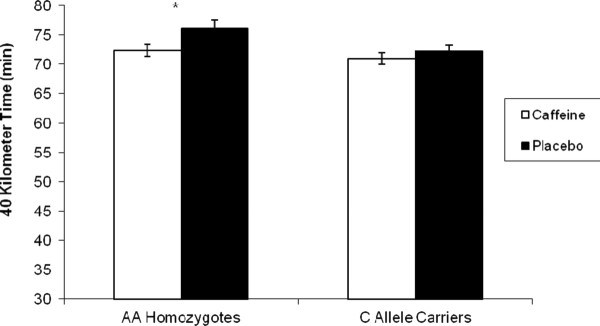
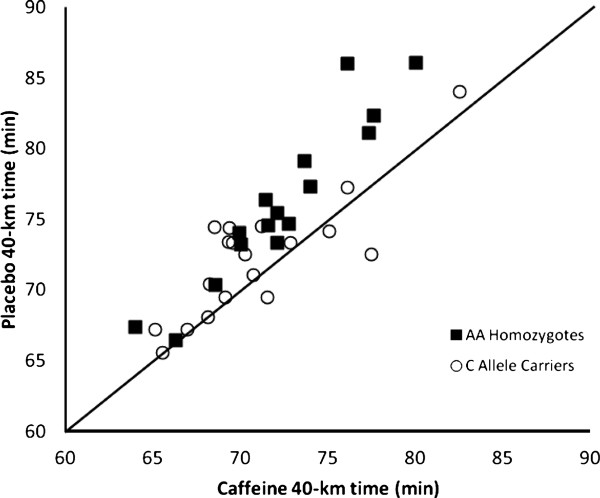
Verification
Claims the paper makes
The claims and statistics of this paper haven’t been checked yet.
Run the check — free, no account needed. It reads the open-access text and checks the sources it cites.
Claims other papers make about this one
Each is checked against this paper’s own text: does it say what the citing paper says it does?
In the citing paper
“Furthermore, evolving confirmation of genetic and other sources of individual variability in caffeine metabolism provides support for the well-known observations that some athletes are lowresponders [123] to caffeine or suffer side effects.”
From New strategies in sport nutrition to increase exercise performance (2016) · cites this paper as [123]
In the citing paper
“Caffeine is widely consumed as part of a normal diet, and there is clear evidence-for-efficacy regarding its ergogenic properties in a variety of sports [150–152], although the extent of the ergogenic effect is largely dependent on inter-individual genetic variance [153].”
From International Society of Sports Nutrition Position Stand: nutritional considerations for single-stage ultra-marathon training and racing (2019) · cites this paper as [153]
Self-check
Percentages, sums and reported differences re-computed from the paper’s own numbers.
The self-check needs the paper’s full text.
Citations
Cites
Sachse, C., Brockmöller, J., Bauer, S., & Roots, I. (1999) · British Journal of Clinical Pharmacology · doi:10.1046/j.1365-2125.1999.00898.x · Cited by 751
Coffee, CYP1A2 genotype, and risk of myocardial infarction
Cornelis, M. C., El-Sohemy, A., Kabagambe, E. K., & Campos, H. (2006) · JAMA · doi:10.1001/jama.295.10.1135 · Cited by 490 · cited 4×
“This polymorphism has clinical importance, as caffeine increases risk for cardiovascular disease in individuals who possess the C variant, but not in individuals homozygous for the A variant [11,12], presumably due to a slower caffeine clearance in the former group.”
BackgroundResultInfluentialDaly, J. W., Butts-Lamb, P., & Padgett, W. L. (1983) · Cellular and Molecular Neurobiology · doi:10.1007/bf00734999 · Cited by 443
Effect of different protocols of caffeine intake on metabolism and endurance performance
Cox, G. R., Desbrow, B., Montgomery, P. G., Anderson, M. E., Bruce, C. R., Macrides, T. A., Martin, D. T., Moquin, A., Roberts, A., Hawley, J. A., et al. (2002) · Journal of Applied Physiology · doi:10.1152/japplphysiol.00249.2002 · Cited by 309
Benefits of Caffeine Ingestion on Sprint Performance in Trained and Untrained Swimmers
Collomp, K., Ahmaidi, S., Chatard, J. C., Audran, M., & Pr�faut, C. (1992) · European Journal of Applied Physiology and Occupational Physiology · doi:10.1007/bf00636227 · Cited by 207
Effect of caffeine and ephedrine ingestion on anaerobic exercise performance
Bell, D. G., Jacobs, I. A., & ELLERINGTON, K. (2001) · Medicine & Science in Sports & Exercise · doi:10.1097/00005768-200108000-00024 · Cited by 186
Grosso, L. M., & Bracken, M. B. (2005) · Annals of Epidemiology · doi:10.1016/j.annepidem.2004.12.011 · Cited by 170
Meyers, B. M., & CAFARELLI, E. (2005) · Journal of Applied Physiology · doi:10.1152/japplphysiol.00937.2004 · Cited by 95
The Effects of Caffeine on the Maximal Accumulated Oxygen Deficit and Short-Term Running Performance
Doherty, M. (1998) · International Journal of Sport Nutrition · doi:10.1123/ijsn.8.2.95 · Cited by 92
Genetic polymorphism of CYP1A2 increases the risk of myocardial infarction
Cornelis, M. C., El‐Sohemy, A., & Campos, H. (2004) · Journal of Medical Genetics · doi:10.1136/jmg.2004.022012 · Cited by 84
Research works printed but not linked: 1
- Hallstrom H, 2010, NutrMetab, 7, 12
Cited by
Sorted by citations
International Society of Sports Nutrition Position Stand: Caffeine and Exercise Performance
Guest, N. S., VanDusseldorp, T. A., Nelson, M. T., Grgic, J., Schoenfeld, B. J., Jenkins, N. D. M., Arent, S. M., Antonio, J., Stout, J. R., Trexler, E. T., et al. (2021) · Journal of the International Society of Sports Nutrition · doi:10.1186/s12970-020-00383-4 · Cited by 665
Southward, K., Rutherfurd-Markwick, K. J., & Ali, A. (2018) · Sports Medicine · doi:10.1007/s40279-018-0939-8 · Cited by 254
Caffeine, CYP1A2 Genotype, and Endurance Performance in Athletes
GUEST, N., COREY, P., VESCOVI, J., & EL-SOHEMY, A. (2018) · Medicine & Science in Sports & Exercise · doi:10.1249/mss.0000000000001596 · Cited by 231
New strategies in sport nutrition to increase exercise performance
Close, G. L., Hamilton, D. L., Philp, A., Burke, L. M., & Morton, J. P. (2016) · Free Radical Biology and Medicine · doi:10.1016/j.freeradbiomed.2016.01.016 · Cited by 221
Cytochrome P450: Polymorphisms and Roles in Cancer, Diabetes and Atherosclerosis
Elfaki, I., Mir, R., Almutairi, F. M., & Abuduhier, F. M. (2018) · Europe PMC (PubMed Central) · doi:10.22034/apjcp.2018.19.8.2057 · Cited by 218
Metadata
- Authors
- Womack, C. J., Saunders, M. J., Bechtel, M. K., Bolton, D. J., Martin, M., Luden, N. D., Dunham, W., & Hancock, M.
- Affiliations
- James Madison University (US)
- Corresponding author
- Womack, Christopher J
- ORCID
- Luden, Nicholas D
- Venue
- Journal of the International Society of Sports Nutrition
- Publisher
- Informa UK Limited
- Published
- 2012-02-06
- Volume
- 9
- Issue
- 1
- Pages
- 7-7
- ISSN
- 1550-2783 (ISSN-L)
- PMC
- PMC3334681
- OpenAlex
- W2130611622
- Cited by
- 178
- References
- 17
- Citations by year
- 2026: 7 · 2025: 15 · 2024: 23 · 2023: 12 · 2022: 12 · 2021: 13 · 2020: 16 · 2019: 14 · 2018: 22 · 2017: 10 · 2016: 10 · 2015: 10 · 2014: 5 · 2013: 5 · 2012: 2
- FWCI
- 5.18
- Type
- journal article
- Language
- en
- Update notices
- correction (2022-04-01)
- Open access
- gold
- doi.org
- Licence
- Locations
- Journal of the International Society of Sports Nutrition (publishedVersion, cc-by)
- Europe PMC (PubMed Central) (publishedVersion, cc-by)
- PubMed Central (publishedVersion, cc-by)
- PubMed (publishedVersion)
- DOAJ (DOAJ: Directory of Open Access Journals) (submittedVersion, cc-by-sa)
- Funders
- James Madison University
- University of Toronto
- Topics
- Health Sciences › Medicine › Pharmacology (medical) › Coffee research and impacts
- Life Sciences › Biochemistry, Genetics and Molecular Biology › Genetics › Genetics and Physical Performance
- Life Sciences › Pharmacology, Toxicology and Pharmaceutics › Pharmacology › Pharmacogenetics and Drug Metabolism
- Keywords
- caffeine, CYP1A2, single nucleotide polymorphisms, caffeine metabolism, ergogenic aids, genetic variation, time trial performance, cyclists, genotype × treatment interaction, caffeine supplementation
About these checks
Registry, retraction, Cites and statistics results are computed, not judged, with one exception: a printed reference that no index lists is read once by a model before it counts as a citation error. Claims are extracted by a model and kept only when their quote appears verbatim in the text; each cited source is then checked, with a model’s help, for whether it says what the claim relies on. Those verdicts can be wrong — read the claim’s quote and the cited source before relying on one.
Statistics and arithmetic are recomputed, not judged.
Confidence bands are shown only for fields calibrated on our annotated test set. None is calibrated yet, so no band is shown.
What counts as a claim ›How we measure confidence ›How we check this ›
Are you an author, or do you see a problem with this page? Request a review
