

The DOI matches its Crossref record; 75 of the 76 references it cites were found in a registry or an index, and 1 are not checked yet.
Proteomic analysis of human vitreous humor
Open accessAbstract
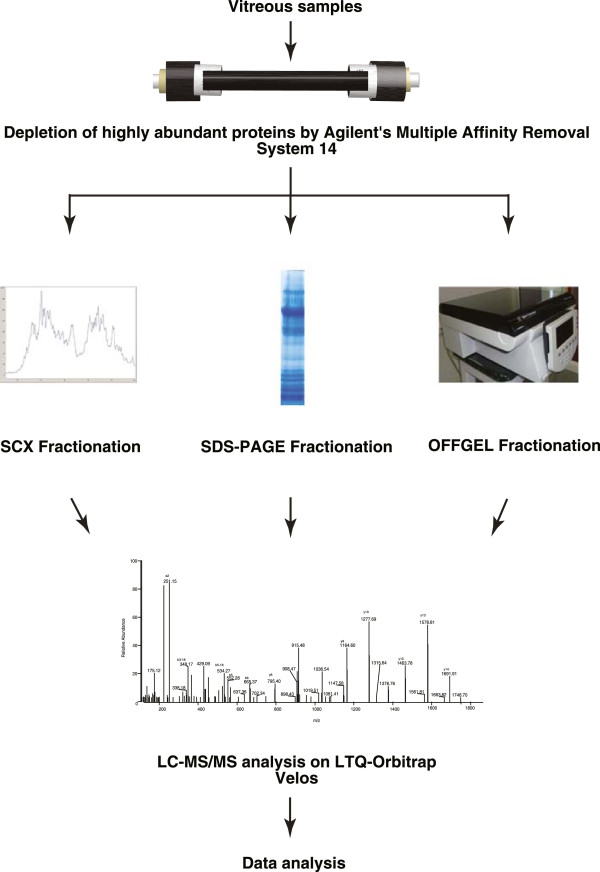
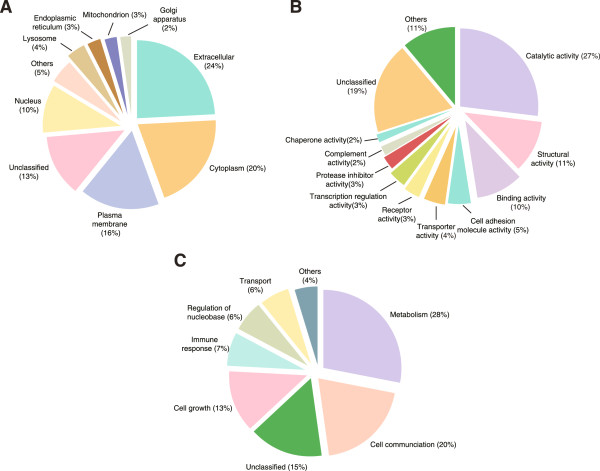
BACKGROUND: The vitreous humor is a transparent, gelatinous mass whose main constituent is water. It plays an important role in providing metabolic nutrient requirements of the lens, coordinating eye growth and providing support to the retina. It is in close proximity to the retina and reflects many of the changes occurring in this tissue. The biochemical changes occurring in the vitreous could provide a better understanding about the pathophysiological processes that occur in vitreoretinopathy. In this study, we investigated the proteome of normal human vitreous humor using high resolution Fourier transform mass spectrometry. RESULTS: The vitreous humor was subjected to multiple fractionation techniques followed by LC-MS/MS analysis. We identified 1,205 proteins, 682 of which have not been described previously in the vitreous humor. Most proteins were localized to the extracellular space (24%), cytoplasm (20%) or plasma membrane (14%). Classification based on molecular function showed that 27% had catalytic activity, 10% structural activity, 10% binding activity, 4% cell and 4% transporter activity. Categorization for biological processes showed 28% participate in metabolism, 20% in cell communication and 13% in cell growth. The data have been deposited to the ProteomeXchange with identifier PXD000957. CONCLUSION: This large catalog of vitreous proteins should facilitate biomedical research into pathological conditions of the eye including diabetic retinopathy, retinal detachment and cataract.
Overview
The claims and statistics of this paper haven’t been checked yet.
Run the check — free, no account needed. It reads the open-access text and checks the sources it cites.
Integrity signals
Registry
Cites
Statistics
Figures
Verification
Claims the paper makes
The claims and statistics of this paper haven’t been checked yet.
Run the check — free, no account needed. It reads the open-access text and checks the sources it cites.
Claims other papers make about this one
Each is checked against this paper’s own text: does it say what the citing paper says it does?
In the citing paper
“proteomic studies of the eye reveal that ocular tissues, including the retina, shed intracellular proteins into adjacent intraocular fluid compartments (e.g., the vitreous fluid; Fig. 1a)20,26–28.”
From Investigation of Cas9 Antibodies in the Human Eye (2022) · cites this paper as [28]
In the citing paper
“This tissue makes up 80% of the human eye by volume and sequesters both intracellular and extracellular proteins shed from the retina and adjacent tissues20,26–28.”
From Investigation of Cas9 Antibodies in the Human Eye (2022) · cites this paper as [28]
In the citing paper
“This tissue makes up 80% of the human eye by volume and sequesters both intracellular and extracellular proteins shed from the retina and adjacent tissues20,26–28.”
From Investigation of Cas9 Antibodies in the Human Eye (2022) · cites this paper as [28]
Self-check
Percentages, sums and reported differences re-computed from the paper’s own numbers.
The self-check needs the paper’s full text.
Citations
Cites
1 retracted
Konson, A., Pradeep, S., D’Acunto, C. W., & Seger, R. (2010) · Journal of Biological Chemistry · doi:10.1074/jbc.m110.151548 · Cited by 35
RetractedMechanisms of TGF-β Signaling from Cell Membrane to the Nucleus
Shi, Y., & Massagué, J. (2003) · Cell · doi:10.1016/s0092-8674(03)00432-x · Cited by 5,860
Rappsilber, J., Mann, M., & Ishihama, Y. (2007) · Nature Protocols · doi:10.1038/nprot.2007.261 · Cited by 4,641
Complement factor H polymorphism in age-related macular degeneration
Klein, R. J., Zeiss, C., Chew, E. Y., Tsai, J.-Y., Sackler, R. S., Haynes, C., Henning, A. K., SanGiovanni, J. P., Mane, S. M., Mayne, S. T., et al. (2005) · Science · doi:10.1126/science.1109557 · Cited by 4,492
Human Protein Reference Database--2009 update
Prasad, T. S. K., Goel, R., Kandasamy, K., Keerthikumar, S., Kumar, S., Mathivanan, S., Telikicherla, D., Raju, R., Shafreen, R. B., Venugopal, A., et al. (2008) · Nucleic Acids Research · doi:10.1093/nar/gkn892 · Cited by 3,252
Self-citationProteomeXchange provides globally coordinated proteomics data submission and dissemination
Vizcaíno, J. A., Deutsch, E. W., Wang, R., Csordás, A., Reisinger, F., Ríos, D., Dianes, J. A., Sun, Z., Farrah, T., Bandeira, N., et al. (2014) · Nature Biotechnology · doi:10.1038/nbt.2839 · Cited by 2,735
Human protein reference database--2006 update
Mishra, G. (2005) · Nucleic Acids Research · doi:10.1093/nar/gkj141 · Cited by 601
The human complement factor H: functional roles, genetic variations and disease associations
de Córdoba, S. R., Esparza-Gordillo, J., GOICOECHEADEJORGE, E., López‐Trascasa, M., & Sánchez‐Corral, P. (2004) · Molecular Immunology · doi:10.1016/j.molimm.2004.02.005 · Cited by 574
Insulin-like growth factor binding proteins and their role in controlling IGF actions
Clemmons, D. R. (1997) · Cytokine & Growth Factor Reviews · doi:10.1016/s1359-6101(96)00053-6 · Cited by 509
Role of insulin-like growth factor binding proteins in controlling IGF actions
Clemmons, D. R. (1998) · Molecular and Cellular Endocrinology · doi:10.1016/s0303-7207(98)00024-0 · Cited by 396
Cited by
Sorted by citations
Items 101–145 of 145
Oculomics and AI: The eye as a biomarker for health span
Wong, J. L. Y., Cheng, H., Peh, W. J., Ho, D., Wong, T. Y., Hui, C. Y. Y., Ting, D. S. J., Bee, Y. M., Goh, S., Apte, R. S., et al. (2026) · Asia-Pacific Journal of Ophthalmology · doi:10.1016/j.apjo.2026.100282 · Cited by 4
Human exposure to micro- and nanoplastics: routes, accumulation, and health implications
Oh, M. Y., Song, G. B., Kim, B., Hong, J., Ju, M., & Hong, S. (2026) · Molecular & Cellular Toxicology · doi:10.1007/s13273-026-00610-0 · Cited by 4
Thermal Effects on Fluid Mixing in the Eye
Huang, J., & Gharib, M. (2020) · Annals of Biomedical Engineering · doi:10.1007/s10439-020-02534-9 · Cited by 4
Human Optic Nerve: An Enhanced Proteomic Expression Profile
Karthikkeyan, G., Subbannayya, Y., Najar, M. A., Mohanty, V., Pinto, S. M., Arunachalam, C., Prasad, T. S. K., & Murthy, K. R. (2018) · OMICS A Journal of Integrative Biology · doi:10.1089/omi.2018.0130 · Cited by 4
Self-citationIntrinsic disorder in the human vitreous proteome
Antonietti, M., Gonzalez, D. J. T., Djulbegovic, M. B., Gameiro, G. R., Uversky, V. N., Sridhar, J. S., & Karp, C. L. (2024) · International Journal of Biological Macromolecules · doi:10.1016/j.ijbiomac.2024.131274 · Cited by 4
Targeted IgMs agonize ocular targets with extended vitreal exposure
Chen, Y., Paluch, M. T., Zorn, J. A., Rajan, S., Leonard, B. C., Estevez, A., Brady, J. R., Chiu, H. H., Phung, W., Famili, A., et al. (2020) · mAbs · doi:10.1080/19420862.2020.1818436 · Cited by 4
Application of nanotechnology in ophthalmology: Where are we?
Garzón, M. G., Martínez‐Ceballos, M. A., Gómez-López, A., & Rojas‐Villarraga, A. (2022) · Characterization and Application of Nanomaterials · doi:10.24294/can.v5i1.1681 · Cited by 4
Vitreous Fibrillar Structure and Interfibrillar Composition in Adult Mice
Jaramillo, P., Pampalona, J., Carretero, A., José‐Cunilleras, E. L. V., Ramos, D., & Ruberte, J. (2025) · Investigative Ophthalmology & Visual Science · doi:10.1167/iovs.66.3.60 · Cited by 3
Ruttenberg, S. M., Rowe, J., & Abdolvahabi, A. (2025) · Journal of Proteome Research · doi:10.1021/acs.jproteome.5c00208 · Cited by 3
Oguchi, Y., Sekiryu, T., Omori, T., Kato, Y., Ogasawara, M., Sugano, Y., Itagaki, K., Ojima, A., Machida, T., & Sekine, H. (2020) · Experimental Eye Research · doi:10.1016/j.exer.2020.108025 · Cited by 3
Vitreous proteomics in rhegmatogenous retinal detachment and proliferative vitreoretinopathy
Havlík, J., Lada, M., Tesař, J., Krátký, V., & Šín, M. (2025) · Biomedical Papers · doi:10.5507/bp.2025.015 · Cited by 2
Proteomic biomarkers in vitreoretinal disease
de Carvalho, J. R. L., Park, K. S., Saraiva, F. P., Tsang, S. H., Mahajan, V. B., & Cabral, T. (2019) · Elsevier eBooks · doi:10.1016/b978-0-12-819178-1.00023-x · Cited by 2
Role of Albumin and Alpha-Fetoprotein in Prenatal Ontogenesis of the Human Eye
Panova, I. G., & Tatikolov, A. S. (2023) · Biology Bulletin · doi:10.1134/s1062359022700133 · Cited by 2
Cutting-Edge Developments in utilizing Lipid Nano-carrier for Enhanced Drug Delivery
Chauhan, S. B., Singh, A., & Singh, I. (2024) · International Journal of Pharmaceutical Sciences and Nanotechnology · doi:10.37285/ijpsn.2024.17.5.8 · Cited by 2
Wójtowicz, A., Mitura, A., Wietecha‐Posłuszny, R., Kurczab, R., & Zawadzki, M. (2021) · Monatshefte für Chemie - Chemical Monthly · doi:10.1007/s00706-021-02786-8 · Cited by 2
Pharmacologic Vitreolysis in Vascular Diseases of the Retina
Soliman, M. K., Agarwal, A. K., Sarwar, S., Hanout, M., Sadiq, M. A., Diana, V., & Nguyen, Q. D. (2016) · Ophthalmic surgery, lasers & imaging retina · doi:10.3928/23258160-20151214-09 · Cited by 2
The development and clinical applications of proteomics: an Indian perspective
Taunk, K., Kalita, B., Kale, V., Chanukuppa, V., Naiya, T., Zingde, S. M., & Rapole, S. (2020) · Expert Review of Proteomics · doi:10.1080/14789450.2020.1787157 · Cited by 2
Improved protocol for histological and histopathological preparation of large eyes
Zhang, M., Silva, R. L. E., Zhou, L., Hackett, S. F., Campochiaro, P. A., & Shen, J. (2024) · Microscopy Research and Technique · doi:10.1002/jemt.24698 · Cited by 1
Veith, M., Reháčková, M., Rajs, P., Motlík, J., Kamenická, B., & Klusoň, P. (2026) · ACS Omega · doi:10.1021/acsomega.6c02409 · Cited by 1
The genetic basis of the formation, structure, and functions of the vitreous body
Mglinets, V. A. (2016) · Biology Bulletin Reviews · doi:10.1134/s2079086416060049 · Cited by 1
Retinal Pigment Epithelium in Proliferative Disorders
Dik, W. A., Bastiaans, J., & van Meurs, J. C. (2020) · Springer eBooks · doi:10.1007/978-3-030-28384-1_8 · Cited by 1
Hydrostatic Pressure Gradients and a New Membrane-glymphatic Theory of Primary Glaucoma
Beisekeeva, J., Kulumbetova, J., Beisekeev, S., & Кочергин, С. А. (2022) · International Journal of Ophthalmology & Visual Science · doi:10.11648/j.ijovs.20220701.13 · Cited by 1
Ocular Physiology and Vision in the Equine Neonate
Hamor, R. E., & Whitley, D. (2024) · Wiley eBooks · doi:10.1002/9781119617228.ch52 · Cited by 1
Analyse des xénobiotiques dans l’humeur vitrée en toxicologie médicolégale : revue de la littérature
Bévalot, F., Cartiser, N., Bottinelli, C., Guitton, J., & Fanton, L. (2016) · La Revue de Médecine Légale · doi:10.1016/j.medleg.2016.08.001
Goto, A. Y. (2017) · Digital Library of Theses and Dissertations (Universidade de São Paulo) · doi:10.11606/d.47.2017.tde-22022017-115235
Aplicaciones de la nanotecnología en el campo de la oftalmología: ¿dónde estamos?
Garzón, M. G., Martínez‐Ceballos, M. A., Gómez-López, A., & Rojas‐Villarraga, A. (2020) · Revista Mexicana de Oftalmología · doi:10.24875/rmo.m20000125
Evaluation of age-related changes in the vitreous using magnetic resonance imaging
Kuzan, B. N., Kuzan, T. Y., & Buğdaycı, O. (2022) · The European Research Journal · doi:10.18621/eurj.1134577
Ørskov, M. (2022) · VBN Forskningsportal (Aalborg Universitet) · doi:10.54337/aau520800556
Retinales Pigmentepithel bei proliferativen Erkrankungen
Dik, W. A., Bastiaans, J., & van Meurs, J. C. (2024) · Springer eBooks · doi:10.1007/978-3-031-35055-9_8
Angiogenic Properties of Vitreous
Micera, A., Balzamino, B. O., Cosimi, P., & Cacciamani, A. (2024) · Elsevier eBooks · doi:10.1016/b978-0-443-13820-1.00040-2
Role of Albumin and Alpha-Fetoprotein in Prenatal Ontogenesis of the Human Eye
Panova, I. G., & Tatikolov, A. S. (2023) · Известия Российской академии наук Серия биологическая · doi:10.31857/s1026347022700093
Sharma, S., Hameed, S. S., Vishwakarma, S., Chhablani, J. K., Tyagi, M., Narayanan, R., Pappuru, R. R., Swarup, G., Chakrabharti, S., & Kaur, I. (2024) · bioRxiv (Cold Spring Harbor Laboratory) · doi:10.1101/2024.07.08.601678
Age-Related Diffusion Changes in The Corpus Vitreum And Aqueous Humor of The Ocular Bulb
Güney, B., Sarı, F. B., & Doğan, E. (2024) · Muğla Sıtkı Koçman Üniversitesi Tıp Dergisi · doi:10.47572/muskutd.1482491
Cheung, J. K.-W., Li, K. K., Zhou, L., To, C. H., & Lam, T. C. (2024) · International Journal of Molecular Sciences · doi:10.3390/ijms251910644
Potential of Extracellular Vesicles as Therapeutics in Retinal Diseases
Bosch, S., Lajunen, T., Merivaara, A., Rilla, K. J., & Urtti, A. (2024) · Biology of extracellular matrix · doi:10.1007/978-3-031-68811-9_8
Insight into vitreous biomechanics and clinical implications: A systematic reviewPreprint
Ong, L. F., Suresh, T., Son, E., Schwartz, D., & Brodie, F. L. (2025) · medRxiv · doi:10.1101/2025.09.17.25335952
Borucińska, U., Pietruszewska, H., Sędziak, O., Kruszewska, N., Skrzynecka, S., & Perski, K. (2025) · Archiv Euromedica · doi:10.35630/2025/15/iss.6.616
Anatomical and topographic features and structural characteristics of the vitreous body
Киселева, Т. Н., Eliseeva, E. K., & Batalova, A. L. (2026) · Russian Ophthalmological Journal · doi:10.21516/2072-0076-2025-18-4-178-184
TMT-based quantitative proteomic analysis of vitreous humor in proliferative diabetic retinopathy
Xiong, X., Zhou, Q., Cao, Y., Tang, M., Xie, L., & Lv, H. (2026) · BMC Ophthalmology · doi:10.1186/s12886-026-04847-0
Single molecule protein detection for proteomic profiling
Leclerc, S. (2018) · theses.fr (ABES) · doi:10.70675/62e90461zb705z42e1z8661z3db23d7ca70d
Index matching for quantitative measurements in an in vitro vitreous eye model
O'Gara, S., Koochesfahani, M., & Gharib, M. (2026) · Experiments in Fluids · doi:10.1007/s00348-026-04211-4
Metadata
- Authors
- Murthy, K. R., Goel, R., Subbannayya, Y., Jacob, H. K., Murthy, P. R., Manda, S. S., Patil, A. H., Sharma, R., Sahasrabuddhe, N. A., Parashar, A., Nair, B. G., Krishna, V., Prasad, T. K., Gowda, H., & Pandey, A.
- Affiliations
- Institute of Bioinformatics (IN)
- Kuvempu University (IN)
- Pondicherry University (IN)
- National Institute of Mental Health and Neurosciences (IN)
- Armed Forces Medical College (IN)
- Amrita Vishwa Vidyapeetham (IN)
- Johns Hopkins University (US)
- Corresponding author
- Murthy, Krishna R
- ORCID
- Venue
- Clinical Proteomics
- Published
- 2014-07-14
- Volume
- 11
- Issue
- 1
- Pages
- 29-29
- ISSN
- 1542-6416 (ISSN-L)
- 1559-0275
- PMC
- PMC4106660
- OpenAlex
- W2164518567
- Cited by
- 145
- References
- 76
- Citations by year
- 2026: 6 · 2025: 10 · 2024: 14 · 2023: 12 · 2022: 9 · 2021: 10 · 2020: 21 · 2019: 8 · 2018: 18 · 2017: 15 · 2016: 14 · 2015: 6 · 2014: 2
- FWCI
- 5.29
- Type
- journal article
- Language
- en
- Open access
- gold
- doi.org
- Licence
- cc-by
- Locations
- Clinical Proteomics (publishedVersion, cc-by)
- PubMed Central (publishedVersion, cc-by)
- PubMed (publishedVersion)
- Funders
- Wellcome Trust
- Department of Biotechnology, Ministry of Science and Technology, India
- University Grants Commission
- The Wellcome Trust DBT India Alliance
- Topics
- Physical Sciences › Chemistry › Spectroscopy › Advanced Proteomics Techniques and Applications
- Health Sciences › Medicine › Ophthalmology › Retinal Diseases and Treatments
- Physical Sciences › Chemistry › Spectroscopy › Mass Spectrometry Techniques and Applications
- Keywords
- vitreous humor, vitreous proteome, vitreoretinopathy, vitreous proteins, extracellular proteins, protein function classification, diabetic retinopathy, retinal detachment, cataract
About these checks
Registry, retraction, Cites and statistics results are computed, not judged, with one exception: a printed reference that no index lists is read once by a model before it counts as a citation error. Claims are extracted by a model and kept only when their quote appears verbatim in the text; each cited source is then checked, with a model’s help, for whether it says what the claim relies on. Those verdicts can be wrong — read the claim’s quote and the cited source before relying on one.
Statistics and arithmetic are recomputed, not judged.
Confidence bands are shown only for fields calibrated on our annotated test set. None is calibrated yet, so no band is shown.
What counts as a claim ›How we measure confidence ›How we check this ›
Are you an author, or do you see a problem with this page? Request a review
