

The DOI matches its Crossref record; 55 of the 56 references it cites were found in a registry or an index.
Modulation of extracellular matrix genes reflects the magnitude of physiological adaptation to aerobic exercise training in humans
Open accessAbstract
Background: Regular exercise reduces cardiovascular and metabolic disease partly through improved aerobic fitness. The determinants of exercise-induced gains in aerobic fitness in humans are not known. We have demonstrated that over 500 genes are activated in response to endurance-exercise training, including modulation of muscle extracellular matrix (ECM) genes. Real-time quantitative PCR, which is essential for the characterization of lower abundance genes, was used to examine 15 ECM genes potentially relevant for endurance-exercise adaptation. Twenty-four sedentary male subjects undertook six weeks of high-intensity aerobic cycle training with muscle biopsies being obtained both before and 24 h after training. Subjects were ranked based on improvement in aerobic fitness, and two cohorts were formed (n = 8 per group): the high-responder group (HRG; peak rate of oxygen consumption increased by +0.71 ± 0.1 L min -1 ; p < 0.0001) while the low-responder group (LRG; peak rate of oxygen consumption did not change, +0.17 ± 0.1 L min -1 , ns). ECM genes profiled included the angiopoietin 1 and related genes ( angiopoietin 2 , tyrosine kinase with immunoglobulin-like and EGF-like domains 1 (TIE1) and 2 ( TIE2 ), vascular endothelial growth factor ( VEGF ) and related receptors ( VEGF receptor 1, VEGF receptor 2 and neuropilin-1 ), thrombospondin-4 , α2-macroglobulin and transforming growth factor β2 . Results: neuropilin-1 (800%; p < 0.001) and VEGF receptor 2 (300%; p < 0.01) transcript abundance increased only in the HRG, whereas levels of VEGF receptor 1 mRNA actually declined in the LRG (p < 0.05). TIE1 and TIE2 mRNA levels were unaltered in the LRG, whereas transcription levels of both genes were increased by 2.5-fold in the HRG (p < 0.01). Levels of thrombospondin-4 (900%; p < 0.001) and α2-macroglobulin (300%, p < 0.05) mRNA increased substantially in the HRG. In contrast, the amount of transforming growth factor β2 transcript increased only in the HRG (330%; p < 0.01), whereas it remained unchanged in the LRG (-80%). Conclusion: We demonstrate for the first time that aerobic training activates angiopoietin 1 and TIE2 genes in human muscle, but only when aerobic capacity adapts to exercise-training. The fourfold-greater increase in aerobic fitness and markedly differing gene expression profile in the HRG indicates that these ECM genes may be critical for physiological adaptation to exercise in humans. In addition, we show that, without careful demonstration of physiological adaptation, conclusions derived from gene expression profiling of human skeletal muscle following exercise may be of limited value. We propose that future studies should (a) investigate the mechanisms that underlie the apparent link between physiological adaptation and gene expression and (b) use the genes profiled in this paper as candidates for population genetic studies.
Overview
The claims and statistics of this paper haven’t been checked yet.
Run the check — free, no account needed. It reads the open-access text and checks the sources it cites.
Integrity signals
Registry
Cites
Statistics
Figures
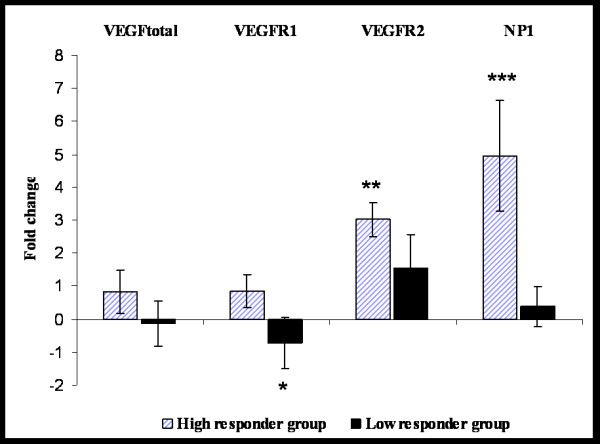
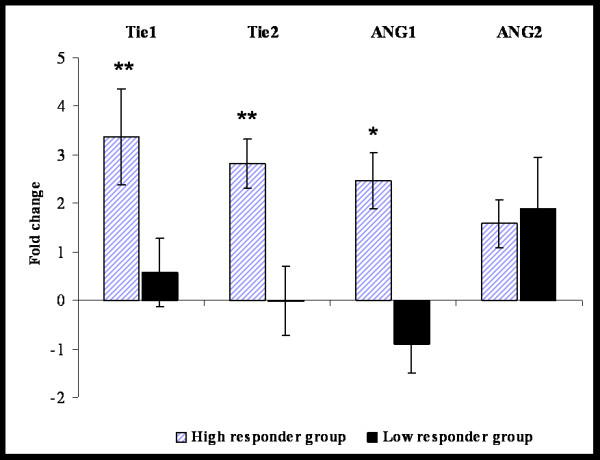
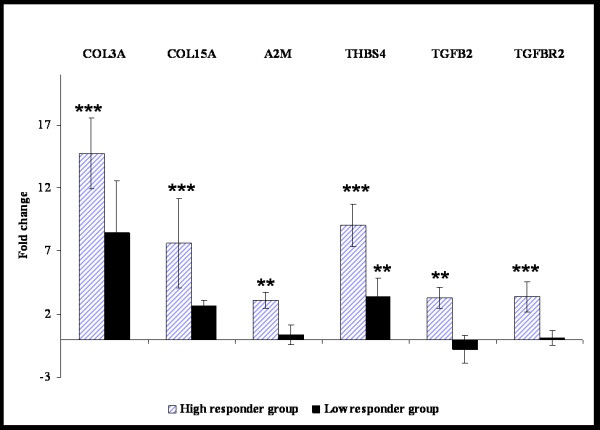
Verification
Claims the paper makes
The claims and statistics of this paper haven’t been checked yet.
Run the check — free, no account needed. It reads the open-access text and checks the sources it cites.
Claims other papers make about this one
Each is checked against this paper’s own text: does it say what the citing paper says it does?
The source backs part of the claim, not all of it — or backs it for a different population, condition or comparison.
In the citing paper
“The characterisation of individual responses is not a new phenomenon, but the results of studies of individuals undertaking resistance and endurance training in isolation suggest that 'low responders' to each exercise stimulus may be as high as 25% (Timmons et al., 2005;Phillips et al., 2013;Gurd et al., 2016).”
From Concurrent exercise training: do opposites distract? (2017) · cites this paper as Timmons et al., 2005
Experimental — accuracy not yet measured
Self-check
Percentages, sums and reported differences re-computed from the paper’s own numbers.
The self-check needs the paper’s full text.
Citations
Cites
Angiopoietin-2, a Natural Antagonist for Tie2 That Disrupts in vivo Angiogenesis
Maisonpierre, P. C., Suri, C., Jones, P. F., Bartunkova, S., Wiegand, S. J., Radziejewski, C., Compton, D., McClain, J., Aldrich, T. H., Papadopoulos, N., et al. (1997) · Science · doi:10.1126/science.277.5322.55 · Cited by 3,570
Vessel Cooption, Regression, and Growth in Tumors Mediated by Angiopoietins and VEGF
Holash, J. A., Maisonpierre, P. C., Compton, D. L., Boland, P., Alexander, C., Zagzag, D., Yancopoulos, G. D., & Wiegand, S. J. (1999) · Science · doi:10.1126/science.284.5422.1994 · Cited by 2,222
Regulation of Mammalian O 2 Homeostasis by Hypoxia-Inducible Factor 1
Semenza, G. L. (1999) · Annual Review of Cell and Developmental Biology · doi:10.1146/annurev.cellbio.15.1.551 · Cited by 1,914 · cited 1×
“VEGFR1) typically reflects the posttranslational stabilization of HIF1α protein [38], and consistent with this dogma, HIF mRNA was not significantly upregulated.”
Signal Transduction by Vascular Endothelial Growth Factor ReceptorsPreprint
Koch, S., Tugues, S., Li, X., Gualandi, L., & Claesson, L. (2011) · Cold Spring Harbor Perspectives in Medicine · doi:10.1042/bj20110301 · Cited by 1,710
The Effects of Climate Change on Cardiac Health
De Blois, J., Kjellstrom, T., Agewall, S., Ezekowitz, J. A., Armstrong, P. W., & Atar, D. (2015) · Cardiology · doi:10.1159/000398787 · Cited by 1,697
Effects of the amount and intensity of exercise on plasma lipoproteins
Kraus, W. E., Houmard, J. A., Duscha, B. D., Knetzger, K. J., Wharton, M. B., McCartney, J. S., Bales, C. W., Henes, S., Samsa, G. P., Otvos, J. D., et al. (2002) · New England Journal of Medicine · doi:10.1056/nejmoa020194 · Cited by 1,554
Winer, J., Jung, C. K. S., Shackel, I., & Williams, P. M. (1999) · Analytical Biochemistry · doi:10.1006/abio.1999.4085 · Cited by 1,393
Walking Compared with Vigorous Exercise for the Prevention of Cardiovascular Events in Women
Manson, J. E., Greenland, P., LaCroix, A. Z., Stefanick, M. L., Mouton, C. P., Oberman, A., Perri, M. G., Sheps, D. S., Pettinger, M. B., & Siscovick, D. S. (2002) · New England Journal of Medicine · doi:10.1056/nejmoa021067 · Cited by 1,349
Tanaka, M., Yamamoto, Y., Misawa, E., Nabeshima, K., Saito, M., Yamauchi, K., Abe, F., & Furukawa, F. (2016) · Skin Pharmacology and Physiology · doi:10.1159/000454718 · Cited by 1,092
Individual differences in response to regular physical activity
BOUCHARD, C., & RANKINEN, T. (2001) · Medicine and Science in Sports and Exercise · doi:10.1097/00005768-200106001-00013 · Cited by 939
Cited by
Sorted by citations
Timmons, J. A., Wennmalm, K., Larsson, O., Walden, T. B., Lassmann, T., Petrovic, N., Hamilton, D. L., Gimeno, R. E., Wahlestedt, C., Baar, K., et al. (2007) · Proceedings of the National Academy of Sciences · doi:10.1073/pnas.0610615104 · Cited by 732
Self-citationBurgomaster, K. A., Heigenhauser, G. J. F., & Gibala, M. J. (2006) · Journal of Applied Physiology · doi:10.1152/japplphysiol.01220.2005 · Cited by 432
Davidsen, P. K., Gallagher, I. J., Hartman, J. W., Tarnopolsky, M. A., Dela, F., Helge, J. W., Timmons, J. A., & Phillips, S. M. (2011) · Journal of Applied Physiology · doi:10.1152/japplphysiol.00901.2010 · Cited by 385
Self-citationRees, T., Hardy, L., Güllich, A., Abernethy, B., Côté, J., Woodman, T., Montgomery, H., Laing, S. J., & Warr, C. (2016) · Sports Medicine · doi:10.1007/s40279-016-0476-2 · Cited by 384
Concurrent exercise training: do opposites distract?
Coffey, V. G., & Hawley, J. A. (2017) · The Journal of Physiology · doi:10.1113/jp272270 · Cited by 351
Metadata
- Authors
- Timmons, J. A., Jansson, E., Fischer, H., Gustafsson, T., Greenhaff, P. L., Ridden, J., Rachman, J., & Sundberg, C. J.
- Affiliations
- Karolinska Institutet (SE)
- University of Nottingham (GB)
- AstraZeneca (United Kingdom) (GB)
- Corresponding author
- Timmons, James A
- Venue
- BMC Biology
- Published
- 2005-09-02
- Volume
- 3
- Issue
- 1
- Pages
- 19-19
- ISSN
- 1741-7007 (ISSN-L)
- PMC
- PMC1224855
- OpenAlex
- W1527271891
- Cited by
- 135
- References
- 55
- Citations by year
- 2026: 3 · 2025: 1 · 2024: 4 · 2023: 5 · 2022: 6 · 2021: 6 · 2020: 5 · 2019: 6 · 2018: 9 · 2017: 3 · 2016: 9 · 2015: 5 · 2014: 8 · 2013: 10 · 2012: 7
- FWCI
- 17.01
- Type
- journal article
- Language
- en
- Open access
- gold
- doi.org
- Licence
- cc-by
- Locations
- BMC Biology (publishedVersion, cc-by)
- Europe PMC (PubMed Central) (publishedVersion)
- PubMed Central (publishedVersion)
- PubMed (publishedVersion)
- DOAJ (DOAJ: Directory of Open Access Journals) (submittedVersion)
- Funders
- Medical Research Council
- Topics
- Health Sciences › Medicine › Physiology (medical) › Cardiovascular and exercise physiology
- Life Sciences › Biochemistry, Genetics and Molecular Biology › Genetics › Genetics and Physical Performance
- Health Sciences › Medicine › Physiology (medical) › Exercise and Physiological Responses
- Keywords
- aerobic exercise training, endurance training, exercise-induced gene expression, extracellular matrix genes, cardiorespiratory fitness, high responders, low responders, VEGF receptor 2, neuropilin-1, Tie1, Tie2, angiopoietin-1, angiopoietin-2, thrombospondin-4, alpha2-macroglobulin, transforming growth factor-beta2
- MeSH terms
- Acclimatization, Aerobiosis, Extracellular Matrix, Gene Expression Regulation, Humans, Oxygen Consumption, Physical Fitness, Exercise, Extracellular Matrix Proteins, Gene Expression Profiling, Receptors, Vascular Endothelial Growth Factor, Vascular Endothelial Growth Factor A
About these checks
Registry, retraction, Cites and statistics results are computed, not judged, with one exception: a printed reference that no index lists is read once by a model before it counts as a citation error. Claims are extracted by a model and kept only when their quote appears verbatim in the text; each cited source is then checked, with a model’s help, for whether it says what the claim relies on. Those verdicts can be wrong — read the claim’s quote and the cited source before relying on one.
Statistics and arithmetic are recomputed, not judged.
Confidence bands are shown only for fields calibrated on our annotated test set. None is calibrated yet, so no band is shown.
What counts as a claim ›How we measure confidence ›How we check this ›
Are you an author, or do you see a problem with this page? Request a review
