

The DOI matches its Crossref record; 114 of the 117 references it cites were found in a registry or an index.
Strong mitochondrial DNA support for a Cretaceous origin of modern avian lineages
Open accessAbstract
BACKGROUND: Determining an absolute timescale for avian evolutionary history has proven contentious. The two sources of information available, paleontological data and inference from extant molecular genetic sequences (colloquially, 'rocks' and 'clocks'), have appeared irreconcilable; the fossil record supports a Cenozoic origin for most modern lineages, whereas molecular genetic estimates suggest that these same lineages originated deep within the Cretaceous and survived the K-Pg (Cretaceous-Paleogene; formerly Cretaceous-Tertiary or K-T) mass-extinction event. These two sources of data therefore appear to support fundamentally different models of avian evolution. The paradox has been speculated to reflect deficiencies in the fossil record, unrecognized biases in the treatment of genetic data or both. Here we attempt to explore uncertainty and limit bias entering into molecular divergence time estimates through: (i) improved taxon (n = 135) and character (n = 4594 bp mtDNA) sampling; (ii) inclusion of multiple cladistically tested internal fossil calibration points (n = 18); (iii) correction for lineage-specific rate heterogeneity using a variety of methods (n = 5); (iv) accommodation of uncertainty in tree topology; and (v) testing for possible effects of episodic evolution. RESULTS: The various 'relaxed clock' methods all indicate that the major (basal) lineages of modern birds originated deep within the Cretaceous, although temporal intraordinal diversification patterns differ across methods. We find that topological uncertainty had a systematic but minor influence on date estimates for the origins of major clades, and Bayesian analyses assuming fixed topologies deliver similar results to analyses with unconstrained topologies. We also find that, contrary to expectation, rates of substitution are not autocorrelated across the tree in an ancestor-descendent fashion. Finally, we find no signature of episodic molecular evolution related to either speciation events or the K-Pg boundary that could systematically mislead inferences from genetic data. CONCLUSION: The 'rock-clock' gap has been interpreted by some to be a result of the vagaries of molecular genetic divergence time estimates. However, despite measures to explore different forms of uncertainty in several key parameters, we fail to reconcile molecular genetic divergence time estimates with dates taken from the fossil record; instead, we find strong support for an ancient origin of modern bird lineages, with many extant orders and families arising in the mid-Cretaceous, consistent with previous molecular estimates. Although there is ample room for improvement on both sides of the 'rock-clock' divide (e.g. accounting for 'ghost' lineages in the fossil record and developing more realistic models of rate evolution for molecular genetic sequences), the consistent and conspicuous disagreement between these two sources of data more likely reflects a genuine difference between estimated ages of (i) stem-group origins and (ii) crown-group morphological diversifications, respectively. Further progress on this problem will benefit from greater communication between paleontologists and molecular phylogeneticists in accounting for error in avian lineage age estimates.
Overview
The claims and statistics of this paper haven’t been checked yet.
Run the check — free, no account needed. It reads the open-access text and checks the sources it cites.
Integrity signals
Registry
Cites
Statistics
Figures
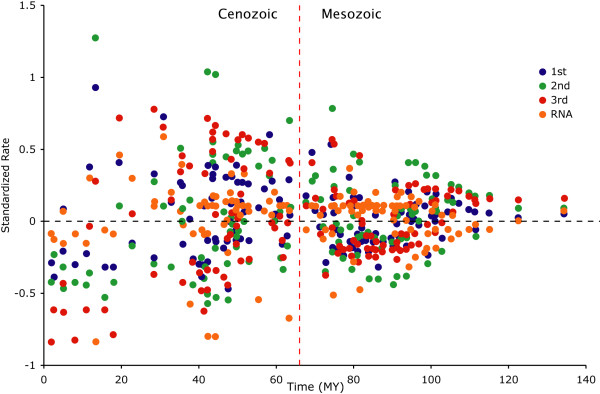
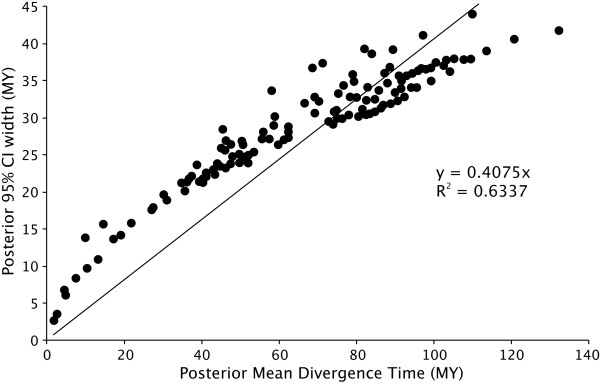
Verification
Claims the paper makes
The claims and statistics of this paper haven’t been checked yet.
Run the check — free, no account needed. It reads the open-access text and checks the sources it cites.
Claims other papers make about this one
Each is checked against this paper’s own text: does it say what the citing paper says it does?
The cited source says what the claim attributes to it.
In the citing paper
“Although WAIR has been recorded in the Tinamou and some neognaths, the origin of crown Aves (Neornithes) is estimated at approximately 86.5 MYA, using fossils [106], and 130 MYA, using molecular dating [107].”
From Assessing Arboreal Adaptations of Bird Antecedents: Testing the Ecological Setting of the Origin of the Avian Flight Stroke (2011) · cites this paper as [107]
Self-check
Percentages, sums and reported differences re-computed from the paper’s own numbers.
The self-check needs the paper’s full text.
Citations
Cites
PHYLIP-Phylogeny inference package (Version 3.2)
Felsenstein, J. (1989) · Cladistics · Cited by 17,682
BEAST: Bayesian evolutionary analysis by sampling trees
Drummond, A. J., & Rambaut, A. (2007) · BMC Evolutionary Biology · doi:10.1186/1471-2148-7-214 · Cited by 13,104
Relaxed Phylogenetics and Dating with Confidence
Drummond, A. J., Ho, S. Y. W., Phillips, M. J., & Rambaut, A. (2006) · PLoS Biology · doi:10.1371/journal.pbio.0040088 · Cited by 6,463 · cited 6×
“Newly developed methods exist where probability distributions can be applied to calibrated nodes in a Bayesian framework [47,84,85].”
InfluentialPAML: a program package for phylogenetic analysis by maximum likelihood
Yang, Z. (1997) · Computer applications in the biosciences · doi:10.1093/bioinformatics/13.5.555 · Cited by 5,377
Punctuated equilibria: an alternative to phyletic gradualism
Eldredge, N., Gould, S. J., & Schöpf, T. J. M. (1972) · Cited by 3,257
PHYLIP ( PHYLogeny Inference Package)
Cummings, M. P. (2004) · Dictionary of Bioinformatics and Computational Biology · doi:10.1002/9780471650126.dob0534.pub2 · Cited by 3,127
Handbook of the Birds of the World
del Hoyo, J., Elliott, A., Vicens, J. S. I., & Christie, D. G. S. (2010) · Medical Entomology and Zoology · Cited by 2,893
Cellular Scaling Rules for the Brains of Marsupials: Not as “Primitive” as Expected
Santos, S. E. D., Porfírio, J., Cunha, F., Manger, P. R., Tavares, W. C., Pessôa, L. M., Raghanti, M. A., Sherwood, C. C., & Herculano‐Houzel, S. (2017) · Brain Behavior and Evolution · doi:10.1159/000452856 · Cited by 2,652
Phylogeny and Classification of the Birds
Sibley, C. G., & Ahlquist, J. E. (1991) · Yale University Press eBooks · doi:10.2307/j.ctt1xp3v3r · Cited by 2,312
The delayed rise of present-day mammals
Bininda-Emonds, O. R. P., Cardillo, M., Jones, K. E., MacPhee, R. D. E., Beck, R. M. D., Grenyer, R., Price, S. A., Vos, R. A., Gittleman, J. L., & Purvis, A. (2007) · Nature · doi:10.1038/nature05634 · Cited by 2,082
Research works printed but not linked: 4
- Easteal S: Molecular evidence for the early divergence of placental mammals. BioEssays. 1999, 21: 1052-1058. 10.1002/(SICI)1521-1878(199912)22:1<1052::AID-BIES9>3.0.CO;2-6. · DOI
- Swofford DL: PAUP*. Phylogenetic Analysis Using Parsimony (*and Other Methods) 4 (beta 10). 2003, Sunderland, MA: Sinauer Associates
- Britton T, Anderson CL, Jaquet D, Lundqvist S, Bremer K: PATHd8 – a new method for estimating divergence times in large phylogenetic trees without a molecular clock. 2006, [ http://www.math.su.se/PATHd8 ]
- Cutler DJ: Dating5. 2000
Cited by
Sorted by citations
Items 101–200 of 239
Jiang, F., Miao, Y., Liang, W., Ye, H., Liu, H., & Liu, B. (2009) · Molecular Biology Reports · doi:10.1007/s11033-009-9868-9 · Cited by 42
Phylogenetic position and delimitation of the moss family Plagiotheciaceae in the order Hypnales
Huttunen, S., Ignatov, M. S., Quandt, D., & Hedenäs, L. (2013) · Botanical Journal of the Linnean Society · doi:10.1111/j.1095-8339.2012.01322.x · Cited by 41
Old but Not (So) Degenerated—Slow Evolution of Largely Homomorphic Sex Chromosomes in Ratites
Yazdi, H. P., & Ellegren, H. (2014) · Molecular Biology and Evolution · doi:10.1093/molbev/msu101 · Cited by 41
Extant-only comparative methods fail to recover the disparity preserved in the bird fossil record
Mitchell, J. S. (2015) · Evolution · doi:10.1111/evo.12738 · Cited by 40
Phylogenetic definitions for 25 higher-level clade names of birds
Sangster, G., Braun, E. L., Johansson, U. S., Kimball, R. T., Mayr, G., & Suh, A. (2022) · Avian Research · doi:10.1016/j.avrs.2022.100027 · Cited by 37
Davies, T. W., Bell, M. A., Goswami, A., & Halliday, T. J. D. (2017) · Paleobiology · doi:10.1017/pab.2017.20 · Cited by 37
Comment on “Whole-genome analyses resolve early branches in the tree of life of modern birds”
Mitchell, K. J., Cooper, A., & Phillips, M. J. (2015) · Science · doi:10.1126/science.aab1062 · Cited by 38
Ornelas, J. F., González, C., Monteros, A. E. D. L., Rodríguez‐Gómez, F., & García-Feria, L. M. (2013) · Journal of Biogeography · doi:10.1111/jbi.12184 · Cited by 37
The development of scientific consensus: Analyzing conflict and concordance among avian phylogenies
Brown, J. W., Wang, N., & Smith, S. A. (2017) · Molecular Phylogenetics and Evolution · doi:10.1016/j.ympev.2017.08.002 · Cited by 35
Self-citationBarata, M., Carranza, S., & Harris, D. J. (2012) · BMC Evolutionary Biology · doi:10.1186/1471-2148-12-167 · Cited by 36
Brassey, C., Kitchener, A. C., Withers, P. J., Manning, P. L., & Sellers, W. I. (2013) · The Anatomical Record · doi:10.1002/ar.22658 · Cited by 35
Feduccia, A. (2014) · Cretaceous Research · doi:10.1016/j.cretres.2014.03.009 · Cited by 36
One Tree to Link Them All: A Phylogenetic Dataset for the European Tetrapoda
Roquet, C., Lavergne, S., & Thuiller, W. (2014) · PLoS Currents · doi:10.1371/currents.tol.5102670fff8aa5c918e78f5592790e48 · Cited by 33
Evidence for a recent origin of penguins
Subramanian, S., Beans-Picón, G., Swaminathan, S. K., Millar, C. D., & Lambert, D. M. (2013) · Biology Letters · doi:10.1098/rsbl.2013.0748 · Cited by 33
Histories of molecules: Reconciling the past
O’Malley, M. A. (2015) · Studies in History and Philosophy of Science Part A · doi:10.1016/j.shpsa.2015.09.002 · Cited by 34
Nagy, J., & Tökölyi, J. (2014) · Ornis Hungarica · doi:10.2478/orhu-2014-0008 · Cited by 34
Flying rocks and flying clocks: disparity in fossil and molecular dates for birds
Ksepka, D. T., Ware, J. L., & Lamm, K. S. (2014) · Proceedings of the Royal Society B Biological Sciences · doi:10.1098/rspb.2014.0677 · Cited by 32
Butler, I. A., Siletti, K., Oxley, P. R., & Kronauer, D. J. C. (2014) · PLoS ONE · doi:10.1371/journal.pone.0107334 · Cited by 32
Recent progress in paleontological methods for dating the Tree of Life
Laurin, M. (2012) · Frontiers in Genetics · doi:10.3389/fgene.2012.00130 · Cited by 32
PHYLOGENY AND FORELIMB DISPARITY IN WATERBIRDS
Wang, X., & Clarke, J. A. (2014) · Evolution · doi:10.1111/evo.12486 · Cited by 32
Analysis of the Immunoglobulin Light Chain Genes in Zebra Finch: Evolutionary Implications
Das, S., Mohamedy, U., Hirano, M., Nei, M., & Nikolaidis, N. (2009) · Molecular Biology and Evolution · doi:10.1093/molbev/msp212 · Cited by 31
Zajonc, D. M., Striegl, H., Dascher, C. C., & Wilson, I. A. (2008) · Proceedings of the National Academy of Sciences · doi:10.1073/pnas.0809814105 · Cited by 31
Köhler, A., Pirk, C. W. W., & Nicolson, S. W. (2012) · Journal of Insect Physiology · doi:10.1016/j.jinsphys.2012.04.007 · Cited by 30
Gibb, G. C., & Penny, D. (2010) · Molecular Phylogenetics and Evolution · doi:10.1016/j.ympev.2010.04.016 · Cited by 30
Mayr, G. (2013) · Comptes Rendus Palevol · doi:10.1016/j.crpv.2013.07.005 · Cited by 29
Ballare, E. F., & Ware, J. L. (2011) · International Journal of Odonatology · doi:10.1080/13887890.2011.579538 · Cited by 29
Ober, K. A., & Heider, T. N. (2010) · BMC Evolutionary Biology · doi:10.1186/1471-2148-10-262 · Cited by 29
Viseshakul, N., CHAROENNITIKUL, W., Kitamura, S., Kemp, A. C., Thong-Aree, S., SURAPUNPITAK, Y., Poonswad, P., & Ponglikitmongkol, M. (2011) · Journal of Evolutionary Biology · doi:10.1111/j.1420-9101.2011.02285.x · Cited by 28
Worthy, T. H. (2011) · Zoological Journal of the Linnean Society · doi:10.1111/j.1096-3642.2011.00693.x · Cited by 28
Field, D. J., Berv, J. S., Hsiang, A. Y., Lanfear, R., Landis, M. J., & Dornburg, A. (2019) · doi:10.7287/peerj.preprints.27521v1 · Cited by 29
Taphonomy and abundance of birds from the Lower Eocene Fur Formation of Denmark
Dyke, G. J., & Lindow, B. E. K. (2009) · Geological Journal · doi:10.1002/gj.1150 · Cited by 27
Schweizer, M., Güntert, M., D, O. S. C., Leuenberger, C., & Hertwig, S. T. (2014) · Ecology and Evolution · doi:10.1002/ece3.1131 · Cited by 27
Complex Evolution of Bile Salts in Birds
Hagey, L. R., Vidal, N., Hofmann, A. F., & Krasowski, M. D. (2010) · The Auk · doi:10.1525/auk.2010.09155 · Cited by 27
Phylogenetic Position of Avian Nocturnal and Diurnal Raptors
Mahmood, M. T., McLenachan, P. A., Gibb, G. C., & Penny, D. (2014) · Genome Biology and Evolution · doi:10.1093/gbe/evu016 · Cited by 28
Evolving Perceptions on the Antiquity of the Modern Avian Tree
Brown, J. W., & van Tuinen, M. (2011) · Wiley eBooks · doi:10.1002/9781119990475.ch12 · Cited by 27
Self-citationChristidis, L., Rheindt, F. E., Iliff, M. J., Lepage, D., Rasmussen, P. C., Donald, P., Alström, P., Areta, J. I., Brammer, F., Chesser, T., et al. (2026) · AviList · doi:10.2173/avilist.v2025b · Cited by 27
Genome and life-history evolution link bird diversification to the end-Cretaceous mass extinction
Berv, J. S., Singhal, S., Field, D. J., Walker‐Hale, N., McHugh, S. W., Shipley, J. R., Miller, E. T., Kimball, R. T., Braun, E. L., Dornburg, A., et al. (2024) · Science Advances · doi:10.1126/sciadv.adp0114 · Cited by 31
Badyaev, A. V., Morrison, E. S., Belloni, V., & Sanderson, M. J. (2015) · Biology Direct · doi:10.1186/s13062-015-0073-6 · Cited by 25
Ksepka, D. T., & Boyd, C. (2012) · Paleobiology · doi:10.1666/10059.1 · Cited by 24
Mayr, G., Goedert, J. L., & Vogel, O. (2015) · Journal of Vertebrate Paleontology · doi:10.1080/02724634.2014.943764 · Cited by 24
Phylogenetically vetted and stratigraphically constrained fossil calibrations within Aves
Ksepka, D. T., & Clarke, J. A. (2015) · Palaeontologia Electronica · doi:10.26879/373 · Cited by 25
Cloning, expression and functional analysis of PKR from grass carp (Ctenopharyngodon idellus)
Hu, Y., Li, W., Li, D., Liu, Y., Fan, L., Rao, Z., Lin, G., & Hu, C. (2013) · Fish & Shellfish Immunology · doi:10.1016/j.fsi.2013.09.024 · Cited by 23
Winterton, S. L., & Ware, J. L. (2015) · Systematic Entomology · doi:10.1111/syen.12117 · Cited by 23
Global Rate Variation in Bony Vertebrates
Takezaki, N. (2018) · Genome Biology and Evolution · doi:10.1093/gbe/evy125 · Cited by 21
Kan, X., Li, X., Lei, Z.-P., Chen, L., Gao, H., Yang, Z., Yang, J., Guo, Z., Yu, L., Zhang, L., et al. (2010) · AFRICAN JOURNAL OF BIOTECHNOLOGY · doi:10.5897/ajb2010.000-3145 · Cited by 23
Sigurðsson, S., & Cracraft, J. L. (2014) · Zoological Journal of the Linnean Society · doi:10.1111/zoj.12109 · Cited by 21
Forearm Posture and Mobility in Quadrupedal Dinosaurs
VanBuren, C. S., & Bonnan, M. F. (2013) · PLoS ONE · doi:10.1371/journal.pone.0074842 · Cited by 21
Mitchell, J. S. (2015) · Paleobiology · doi:10.1017/pab.2014.23 · Cited by 21
The timing of diversification within the most divergent parrot clade
Rheindt, F. E., Christidis, L., Kuhn, S., de Kloet, S., Norman, J. A., & Fidler, A. E. (2013) · Journal of Avian Biology · doi:10.1111/j.1600-048x.2013.00200.x · Cited by 22
Foth, C. (2011) · Journal of Morphology · doi:10.1002/jmor.10916 · Cited by 20
Corfield, J. R., Kolominsky, J., Marin, G. J., Craciun, I., Mulvany-Robbins, B. E., Iwaniuk, A. N., & WYLIE, D. R. W. (2015) · Brain Behavior and Evolution · doi:10.1159/000380810 · Cited by 20
Dávalos, L. M., & Porzecanski, A. L. (2009) · Molecular Phylogenetics and Evolution · doi:10.1016/j.ympev.2009.06.003 · Cited by 20
Mitochondrial rate variation among lineages of passerine birds
Nguyen, J. M. T., & Ho, S. Y. W. (2016) · Journal of Avian Biology · doi:10.1111/jav.00928 · Cited by 18
Blokland, J. C., Reid, C. M., Worthy, T. H., Tennyson, A. J. D., Clarke, J. A., & Scofield, R. P. (2019) · Palaeontologia Electronica · doi:10.26879/1009 · Cited by 20
Faunes, M., Fernández, S. R. M., Gutiérrez‐Ibáñez, C., Iwaniuk, A. N., WYLIE, D. R. W., Mpodozis, J., Karten, H. J., & Marin, G. J. (2012) · The Journal of Comparative Neurology · doi:10.1002/cne.23253 · Cited by 20
Prum, R. O. (2008) · Science · doi:10.1126/science.1168808 · Cited by 19
Deep-Time Demographic Inference Suggests Ecological Release as Driver of Neoavian Adaptive Radiation
Houde, P., Braun, E. L., & Zhou, L. H. (2020) · Diversity · doi:10.3390/d12040164 · Cited by 20
Brocklehurst, N., & Field, D. J. (2024) · Proceedings of the Royal Society B Biological Sciences · doi:10.1098/rspb.2023.2618 · Cited by 18
Díaz‐Martínez, I., Suárez-Hernando, O., Martínez‐García, B., Hernández, J. M., Fernández, S. G., Pérez‐Lorente, F., & Murelaga, X. (2015) · Palaios · doi:10.2110/palo.2014.078 · Cited by 19
Ksepka, D. T., Balanoff, A. M., Bell, M. A., & Houseman, M. (2013) · Palaeontology · doi:10.1111/pala.12040 · Cited by 18
Shape from shading in starlings (Sturnus vulgaris).
Qadri, M. A. J., Romero, L. M., & Cook, R. G. (2014) · Journal of comparative psychology · doi:10.1037/a0036848 · Cited by 18
Ramírez, J. L., Miyaki, C. Y., & Lama, S. N. D. (2013) · Genetics and Molecular Research · doi:10.4238/2013.july.30.11 · Cited by 18
The Origin of Birds: Current Consensus, Controversy, and the Occurrence of Feathers
Rauhut, O. W. M., & Foth, C. (2020) · Fascinating life sciences · doi:10.1007/978-3-030-27223-4_3 · Cited by 17
Dabert, J., Mironov, S. V., & Dabert, M. (2021) · Zoological Journal of the Linnean Society · doi:10.1093/zoolinnean/zlab057 · Cited by 18
Krabichler, Q., Vega‐Zuniga, T., Morales, C., Luksch, H., & Marin, G. J. (2014) · The Journal of Comparative Neurology · doi:10.1002/cne.23676 · Cited by 16
Njabo, K. Y., & Sorenson, M. D. (2009) · Ostrich · doi:10.2989/ostrich.2009.80.1.1.759 · Cited by 16
Self-citationZhang, Q., Hill, G. E., Edwards, S. V., & Backström, N. (2014) · BMC Genomics · doi:10.1186/1471-2164-15-305 · Cited by 16
Balakrishnan, C. N., Chapus, C., Brewer, M. S., & Clayton, D. F. (2013) · Open Biology · doi:10.1098/rsob.130063 · Cited by 16
Tsai, H. P., Middleton, K. M., Hutchinson, J. R., & Holliday, C. M. (2020) · Evolution · doi:10.1111/evo.14017 · Cited by 17
The Analysis of Visual Cognition in Birds: Implications for Evolution, Mechanism, and Representation
Cook, R. G., Qadri, M. A. J., & Keller, A. M. (2015) · The Psychology of learning and motivation/The psychology of learning and motivation · doi:10.1016/bs.plm.2015.03.002 · Cited by 12
Smith, N. D., Grande, L., & Clarke, J. A. (2013) · Journal of Vertebrate Paleontology · doi:10.1080/02724634.2012.722898 · Cited by 15
Arias, D., Peñaloza‐Ramírez, J. M., Dorado, Ó., Cuevas‐Reyes, P., Leyva, E., Albarrán-Lara, A. L., & Rangel-Altamirano, G. (2010) · Genetic Resources and Crop Evolution · doi:10.1007/s10722-010-9569-1 · Cited by 14
The Molecular Clock as a Tool for Understanding Host-Parasite Evolution
Warnock, R. C. M., & Engelstädter, J. (2021) · Topics in geobiology · doi:10.1007/978-3-030-52233-9_13 · Cited by 13
Follin, E., Karlsson, M. E., Lundegaard, C., Nielsen, M., Wallin, S., Paulsson, K. M., & Westerdahl, H. (2013) · Immunogenetics · doi:10.1007/s00251-012-0676-3 · Cited by 13
Tertiary fossil waterfowl (Aves: anseriformes) of Australia and New Zealand.
Worthy, T. H. (2008) · Adelaide Research & Scholarship (AR&S) (University of Adelaide) · Cited by 14
Drivers of avian genomic change revealed by evolutionary rate decomposition
Duchêne, D. A., Chowdhury, A.-A., Yang, J., Iglesias‐Carrasco, M., Stiller, J., Feng, S., Bhatt, S., Gilbert, M. T. P., Zhang, G., Tobias, J. A., et al. (2025) · Nature · doi:10.1038/s41586-025-08777-7 · Cited by 14
Taxonomic recommendations for Western Palearctic birds: ninth report
Sangster, G., Collinson, J. M., Crochet, P., Knox, A. G., Parkin, D. T., & Votier, S. C. (2013) · Ibis · doi:10.1111/ibi.12091 · Cited by 13
Next generation sequencing and analysis of a conserved transcriptome of New Zealand's kiwi
Subramanian, S., Huynen, L., Millar, C. D., & Lambert, D. M. (2010) · BMC Evolutionary Biology · doi:10.1186/1471-2148-10-387 · Cited by 13
Kong, L., Lovell, P. V., Heger, A., Mello, C. V., & Ponting, C. P. (2010) · Molecular Biology and Evolution · doi:10.1093/molbev/msq080 · Cited by 13
Battistuzzi, F. U., Filipski, A. J., & Kumar, S. (2011) · Wiley eBooks · doi:10.1002/9780470015902.a0001803.pub2 · Cited by 12
Thomas, G. H. (2015) · Nature · doi:10.1038/nature15638 · Cited by 12
Turkey Vulture (Cathartes aura)
Kirk, D. A., Mossman, M. J., Bildstein, K. L., Naveda‐Rodríguez, A., & Mallon, J. M. (2024) · Cornell Lab of Ornithology eBooks · doi:10.2173/bow.turvul.02 · Cited by 12
Koparde, P., Mehta, P., Reddy, S., Ramakrishnan, U., Mukherjee, S., & Robin, V. V. (2018) · PLoS ONE · doi:10.1371/journal.pone.0192359 · Cited by 11
Quintero‐Galvis, J. F., Paleo‐López, R., Solano‐Iguaran, J. J., Poupin, M. J., Ledger, T., Gaitán‐Espitía, J. D., Antoł, A., Travisano, M., & Nespolo, R. F. (2018) · Ecology and Evolution · doi:10.1002/ece3.3979 · Cited by 8
The perception of Glass patterns by starlings (Sturnus vulgaris)
Qadri, M. A. J., & Cook, R. G. (2014) · Psychonomic Bulletin & Review · doi:10.3758/s13423-014-0709-z · Cited by 11
Skoracki, M., Unsoeld, M., Marciniak, N., & Sikora, B. (2016) · Journal of Medical Entomology · doi:10.1093/jme/tjw065 · Cited by 11
Huang, Z., Tu, F., & Ke, D. (2016) · Pakistan Journal of Zoology · doi:10.17582/journal.pjz/2017.49.1.79.84 · Cited by 11
Islam, F. B., Uno, Y., Nunome, M., Nishimura, O., Tarui, H., Agata, K., & Matsuda, Y. (2013) · The Journal of Poultry Science · doi:10.2141/jpsa.0130090 · Cited by 12
Andonov, A. P., Coulthart, M. B., Pérez‐Losada, M., Crandall, K. A., Posada, D., Padmore, R., Giulivi, A., Oger, J. J.-F., Peters, A. A., & Dekaban, G. A. (2012) · Infection Genetics and Evolution · doi:10.1016/j.meegid.2012.07.015 · Cited by 10
Immunoglobulin Genes in Tetrapods
Sun, Y., & Zhao, Y. (2014) · Apple Academic Press eBooks · doi:10.1201/b16844-3 · Cited by 9
Avian Diversity and Distributions and Their Evolution Through Space and Time
Schweizer, M., & Liu, Y. (2018) · Fascinating life sciences · doi:10.1007/978-3-319-91689-7_8 · Cited by 10
Cibois, A., Dekker, R. W. R. J., Pasquet, É., & Thibault, J. (2012) · Ibis · doi:10.1111/j.1474-919x.2012.01260.x · Cited by 9
McInerney, P., Blokland, J. C., & Worthy, T. H. (2024) · Historical Biology · doi:10.1080/08912963.2024.2308212 · Cited by 8
Population Genomics Advances and Opportunities in Conservation of Kiwi (Apteryx spp.)
Ramstad, K. M., & Dunning, L. T. (2020) · Population genomics · doi:10.1007/13836_2019_71 · Cited by 9
Skoracki, M., Fajfer, M., Hromada, M., Hušek, J., & Sikora, B. (2023) · Animals · doi:10.3390/ani13172728 · Cited by 8
Three IgH isotypes, IgM, IgA and IgY are expressed in Gentoo penguin and zebra finch
Han, B., Li, Y., Han, H., Zhao, Y., Pan, Q., & Ren, L. (2017) · PLoS ONE · doi:10.1371/journal.pone.0173334 · Cited by 9
SOUZA, G. A. D., BULAK, B. A., Soares, M. B., Sayão, J. M., Weinschütz, L. C., Batezelli, A., & Kellner, A. W. A. (2023) · Anais da Academia Brasileira de Ciências · doi:10.1590/0001-3765202320230802 · Cited by 8
Mayr, G. (2015) · Palaeobiodiversity and Palaeoenvironments · doi:10.1007/s12549-015-0200-5 · Cited by 8
Reconstructing evolutionary timescales using phylogenomicsPreprint
Tong, K., Lo, N. C., & Ho, S. Y. W. (2016) · doi:10.7287/peerj.preprints.2403v1 · Cited by 8
The Paleogene Birds of South America
Tambussi, C. P., & Degrange, F. J. (2012) · SpringerBriefs in earth system sciences · doi:10.1007/978-94-007-5467-6_5 · Cited by 8
Metadata
- Authors
- Brown, J. W., Rest, J. S., García-Moreno, J., Sorenson, M. D., & Mindell, D. P.
- Affiliations
- University of Michigan (US)
- University of Chicago (US)
- Boston University (US)
- Corresponding author
- Brown, Joseph W
- Venue
- BMC Biology
- Published
- 2008-01-28
- Volume
- 6
- Issue
- 1
- Pages
- 6-6
- ISSN
- 1741-7007 (ISSN-L)
- PMC
- PMC2267772
- OpenAlex
- W2099180789
- Cited by
- 236
- References
- 117
- Citations by year
- 2026: 1 · 2025: 4 · 2024: 7 · 2023: 2 · 2022: 4 · 2021: 5 · 2020: 5 · 2019: 5 · 2018: 7 · 2017: 5 · 2016: 15 · 2015: 31 · 2014: 29 · 2013: 24 · 2012: 20
- FWCI
- 18.01
- Type
- journal article
- Language
- en
- Open access
- gold
- doi.org
- Licence
- Locations
- BMC Biology (publishedVersion, cc-by)
- Europe PMC (PubMed Central) (publishedVersion, cc-by)
- PubMed Central (publishedVersion, cc-by)
- PubMed (publishedVersion)
- Deep Blue (University of Michigan) (submittedVersion)
- DOAJ (DOAJ: Directory of Open Access Journals) (submittedVersion, cc-by-sa)
- OpenBU (Boston University) (submittedVersion, cc-by)
- Topics
- Physical Sciences › Earth and Planetary Sciences › Paleontology › Evolution and Paleontology Studies
- Physical Sciences › Earth and Planetary Sciences › Paleontology › Paleontology and Evolutionary Biology
- Life Sciences › Agricultural and Biological Sciences › Ecology, Evolution, Behavior and Systematics › Plant Diversity and Evolution
- Keywords
- avian evolution, mitochondrial DNA, K-Pg mass extinction, fossil calibration, relaxed molecular clock, topological uncertainty, avian phylogeny, Cenozoic diversification, fossil record bias
- MeSH terms
- Animals, Bayes Theorem, Birds, DNA, Mitochondrial, Fossils, Phylogeny, Genetic Variation, Evolution, Molecular, Genetic Speciation
About these checks
Registry, retraction, Cites and statistics results are computed, not judged, with one exception: a printed reference that no index lists is read once by a model before it counts as a citation error. Claims are extracted by a model and kept only when their quote appears verbatim in the text; each cited source is then checked, with a model’s help, for whether it says what the claim relies on. Those verdicts can be wrong — read the claim’s quote and the cited source before relying on one.
Statistics and arithmetic are recomputed, not judged.
Confidence bands are shown only for fields calibrated on our annotated test set. None is calibrated yet, so no band is shown.
What counts as a claim ›How we measure confidence ›How we check this ›
Are you an author, or do you see a problem with this page? Request a review
