

The DOI matches its Crossref record; 1 of the 1 references it cites were found in a registry or an index.
Evidence that a West-East admixed population lived in the Tarim Basin as early as the early Bronze Age
Abstract
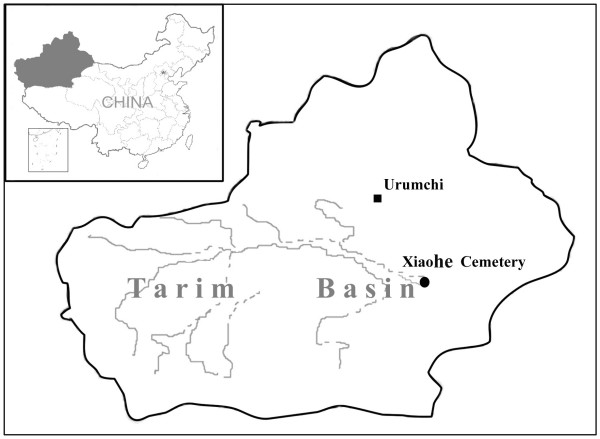
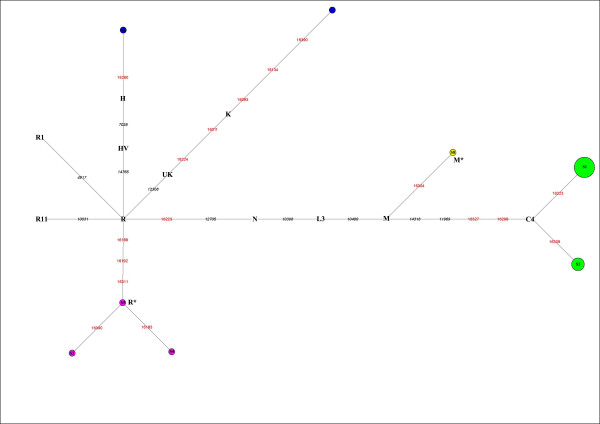
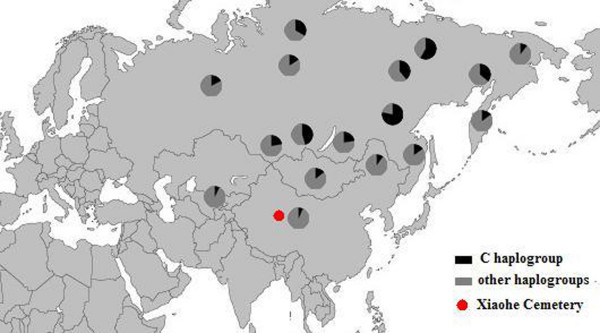
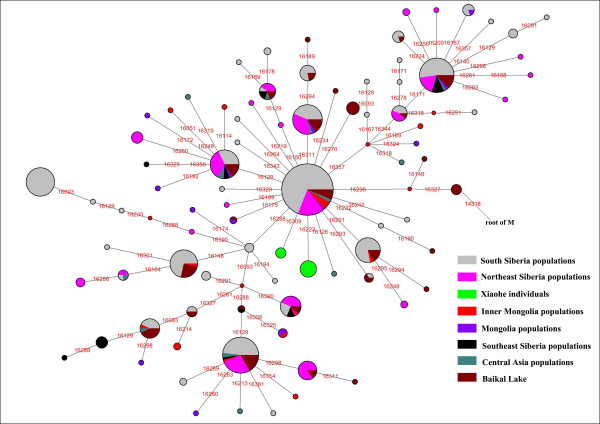
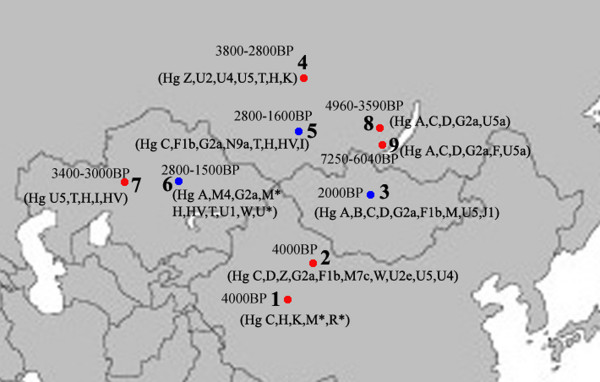
Background: The Tarim Basin, located on the ancient Silk Road, played a very important role in the history of human migration and cultural communications between the West and the East. However, both the exact period at which the relevant events occurred and the origins of the people in the area remain very obscure. In this paper, we present data from the analyses of both Y chromosomal and mitochondrial DNA (mtDNA) derived from human remains excavated from the Xiaohe cemetery, the oldest archeological site with human remains discovered in the Tarim Basin thus far. Results: Mitochondrial DNA analysis showed that the Xiaohe people carried both the East Eurasian haplogroup (C) and the West Eurasian haplogroups (H and K), whereas Y chromosomal DNA analysis revealed only the West Eurasian haplogroup R1a1a in the male individuals. Conclusion: Our results demonstrated that the Xiaohe people were an admixture from populations originating from both the West and the East, implying that the Tarim Basin had been occupied by an admixed population since the early Bronze Age. To our knowledge, this is the earliest genetic evidence of an admixed population settled in the Tarim Basin.
Overview
The claims and statistics of this paper haven’t been checked yet.
Run the check — free, no account needed. It reads the open-access text and checks the sources it cites.
Integrity signals
Registry
Cites
Statistics
Figures
Verification
Claims the paper makes
The claims and statistics of this paper haven’t been checked yet.
Run the check — free, no account needed. It reads the open-access text and checks the sources it cites.
Claims other papers make about this one
Each is checked against this paper’s own text: does it say what the citing paper says it does?
In the citing paper
“Other ancient specimens from the Tarim Basin where Wusun lived also belonged to the haplogroup R1a1 [18].”
From The medieval Mongolian roots of Y-chromosomal lineages from South Kazakhstan (2020) · cites this paper as [18]
Self-check
Percentages, sums and reported differences re-computed from the paper’s own numbers.
The self-check needs the paper’s full text.
Citations
Cites
Updated comprehensive phylogenetic tree of global human mitochondrial DNA variation
van Oven, M., & Kayser, M. (2009) · Human Mutation · doi:10.1002/humu.20921 · Cited by 1,810
Research works printed but not linked: 45
- Mair VH: Prehistoric Caucasoid corpses of the Tarim Basin. J Indo Eur Stud. 1995, 23: 281-307.
- Hemphill BE, Mallory JP: Horse-mounted invaders from the Russo-Kazakh steppe or agricultural colonists from western Central Asia? A craniometric investigation of the Bronze Age settlement of Xinjiang. Am J Phys Anthropol. 2004, 124: 199-222. 10.1002/ajpa.10354. · DOI
- Mair VH: The rediscovery and complete excavation of Ördek's Necropolis. Jf Indo-European Stud. 2006, 34 (3-4): 273-318.
- Cooper A, Poinar HN: Ancient DNA: do it right or not at all. Science. 2000, 289: 1139-10.1126/science.289.5482.1139b. · DOI
- Haak W, Forster P, Bramanti B, Matsumura S, Brandt G, Tänzer M, Villems R, Renfrew C, Gronenborn D, Alt KW, Burger J: Ancient DNA from the first European farmers in 7500-Year-Old Neolithic Sites. Science. 2005, 310: 1016-1018. · DOI
- Pääbo S, Poinar H, Serre D, Jaenicke-Despres V, Hebler J, Rohland N, Kuch M, Krause J, Vigilant L, Hofreiter M: Genetic analyses from ancient DNA. Annu Rev Genet. 2004, 38: 645-679. 10.1146/annurev.genet.37.110801.143214. · DOI · Paper page
- Willerslev E, Cooper A: Ancient DNA. Proc R Soc B. 2005, 272: 3-16. 10.1098/rspb.2004.2813. · DOI · Paper page
- Sampietro ML, Gilbert MT, Lao O, Caramelli D, Lari M, Bertranpetit J, Lalueza-Fox C: Tracking down human contamination in ancient human teeth. Mol Biol Evol. 2006, 23: 1801-1807. 10.1093/molbev/msl047. · DOI
- Xie CZ, Li CX, Cui YQ, Zhang QC, Fu YQ, Zhu H, Zhou H: Evidence of ancient DNA reveals the first European lineage in Iron Age central China. Proc Biol Sci. 2007, 274: 1597-1602. 10.1098/rspb.2007.0219. · DOI
- Yang DY, Eng B, Waye JS, Dudar JC, Saunders SR: Improved DNA extraction from ancient bones using silica-based spin columns. Am J Phys Anthropol. 1998, 105: 539-543. 10.1002/(SICI)1096-8644(199804)105:4<539::AID-AJPA10>3.0.CO;2-1. · DOI
- Shinoda K, Adachi N, Guillen S, Shimada I: Mitochondrial DNA analysis of ancient Peruvian highlanders. Am J Phys Anthropol. 2006, 131 (1): 98-107. 10.1002/ajpa.20408. · DOI
- Malyarchuk B, Grzybowski T, Derenko M, Perkova M, Vanecek T, Lazur J, Gomolcak P, Tsybovsky I: Mitochondrial DNA phylogeny in Eastern and Western Slavs. Mol Biol Evol. 2008, 25 (8): 1651-1658. 10.1093/molbev/msn114. · DOI
- Underhill PA, Myres NM, Rootsi S, Metspalu M, Zhivotovsky LA, King RJ, Lin AA, Chow CE, Semino O, Battaglia V, Kutuev I, Järve M, Chaubey G, Ayub Q, Mohyuddin A, Mehdi SQ, Sengupta S, Rogaev EI, Khusnutdinova EK, Pshenichnov A, Balanovsky O, Balanovska E, Jeran N, Augustin DH, Baldovic M, Herrera RJ, Thangaraj K, Singh V, Singh L, Majumder P, Rudan P, Primorac D, Villems R, Kivisild T: Separating the post-Glacial coancestry of European and Asian Y chromosomes within haplogroup R1a. Eur J Hum Genet. 2009, doi:10.1038.
- Karafet TM, Mendez FL, Meilerman MB, Underhill PA, Zegura SL, Hammer MF: New binary polymorphisms reshape and increase resolution of the human Y-chromosomal haplogroup tree. Genome Res. 2008, 18 (5): 830-838. 10.1101/gr.7172008. · DOI · Paper page
- Macaulay V, Richards M, Hickey E, Vega E, Cruciani F, Guida V, Scozzari R, Bonné-Tamir B, Sykes B, Torroni A: The emerging tree of West Eurasian mtDNAs: a synthesis of control-region sequences and RFLPs. Am J Hum Genet. 1999, 64: 232-249. 10.1086/302204. · DOI · Paper page
- Kivisild T, Tolk HV, Parik J, Wang Y, Papiha SS, Bandelt HJ, Villems R: The emerging limbs and twigs of the East Asian mtDNA tree. Mol Biol Evol. 2002, 19: 1737-1751. · DOI · Paper page
- Torroni A, Schurr TG, Cabell MF, Brown MD, Neel JV, Larsen M, Smith DG, Vullo CM, Wallace DC: Asian affinities and continental radiation of the four founding Native American mtDNAs. Am J Hum Genet. 1993, 53: 563-590.
- Comas D, Calafell F, Mateu E, Pérez-Lezaun A, Bosch E, Martínez-Arias R, Clarimon J, Facchini F, Fiori G, Luiselli D, Pettener D, Bertranpetit J: Trading genes along the Silk Road: mitochondrial DNA sequences and the origin of Central Asian populations. Am J Hum Genet. 1998, 63: 1824-1838. 10.1086/302133. · DOI · Paper page
- Torroni A, Richards M, Macaulay V, Forster P, Villems R, Norby S, Savontaus ML, Huoponen K, Scozzari R, Bandelt HJ: MtDNA haplogroups and frequency patterns in Europe. Am J Hum Genet. 2000, 66: 1173-1177. 10.1086/302789. · DOI
- Kivisild T, Bamshad MJ, Kaldma K, Metspalu M, Metspalu E, Reidla M, Laos S, Parik J, Watkins WS, Dixon ME, Papiha SS, Mastana SS, Mir MR, Ferak V, Villems R: Deep common ancestry of Indian and western-Eurasian mitochondrial DNA lineages. Curr Biol. 1999, 9: 1331-1334. 10.1016/S0960-9822(00)80057-3. · DOI
- Comas D, Plaza S, Wells RS, Yuldusheva N, Lao O, Calafell F, Bertranpetit J: Admixture, migrations, and dispersals in Central Asia: evidence from maternal DNA lineages. Eur J Hum Genet. 2004, 12 (6): 495-504. · DOI · Paper page
- Koryakova LN, Epimakhov AV: The Urals and Western Siberia in the Bronze and Iron Ages. 2007, Cambridge: Cambridge University Press · DOI
- Balanovsky O, Rootsi S, Pshenichnov A, Kivisild T, Churnosov M, Evseeva I, Pocheshkhova E, Boldyreva M, Yankovsky N, Balanovska E, Villems R: Two Sources of the Russian Patrilineal Heritage in Their Eurasian Context. Am J Hum Genet. 2008, 82 (1): 236-250. 10.1016/j.ajhg.2007.09.019. · DOI
- Sharma S, Rai E, Sharma P, Jena M, Singh S, Darvishi K, Bhat AK, Bhanwer AJ, Tiwari PK, Bamezai RN: The Indian origin of paternal haplogroup R1a1(*) substantiates the autochthonous origin of Brahmins and the caste system. J Hum Genet. 2009, 54 (1): 47-55. 10.1038/jhg.2008.2. · DOI
- Torroni A, Sukernik RI, Schurr TG, Starikorskaya YB, Cabell MF, Crawford MH, Comuzzie AG, Wallace DC: mtDNA variation of aboriginal Siberians reveals distinct genetic affinities with Native Americans. Am J Hum Genet. 1993, 53: 591-608.
- Starikovskaya EB, Sukernik RI, Derbeneva OA, Volodko NV, Ruiz-Pesini E, Torroni A, Brown MD, Lott MT, Hosseini SH, Huoponen K, Wallace DC: Mitochondrial DNA diversity in indigenous populations of the southern extent of Siberia, and the origins of Native American haplogroups. Ann Hum Genet. 2005, 69: 67-89. 10.1046/j.1529-8817.2003.00127.x. · DOI
- Kolman CJ, Sambuughin N, Bermingham E: Mitochondrial DNA analysis of Mongolian populations and implications for the origin of New World founders. Genetics. 1996, 142 (4): 1321-1334. · DOI
- Kong Q-P, Yao Y-G, Liu M, Shen S-P, Chen C, Zhu C-L, Palanichamy MG, Zhang Y-P: Mitochondrial DNA sequence polymorphisms of five ethnic populations from northern China. Hum Genet. 2003, 113: 391-405. 10.1007/s00439-003-1004-7. · DOI
- Gao SZ, Yang YD, Xu Y, Zhang QC, Zhu H, Zhou H: Tracing the genetic history of the Chinese people: Mitochondrial DNA analysis of a neolithic population from the Lajia site. Am J Phys Anthropol. 2007, 133: 1128-1136. 10.1002/ajpa.20623. · DOI
- Ricaut FX, Fedoseeva A, Keyser-Tracqui C, Crubézy E, Ludes B: Ancient DNA analysis of human neolithic remains found in northeastern Siberia. Am J Phys Anthropol. 2005, 126: 458-462. 10.1002/ajpa.20257. · DOI
- Schurr TG: Molecular genetic diversity of Siberian populations: Implications for ancient DNA studies of archeological populations from the Cis-Baikal region. Prehistoric Foragers of the Cis-Baikal, Siberia: Proceedings from the First Conference of the Baikal Archaeology Project. Edited by: McKenzie H, Weber A. 2003, Canadian Circumpolar Institute: Edmonton, 153-186.
- Achilli A, Rengo C, Magri C, Battaglia V, Olivieri A, Scozzari R, Cruciani F, Zeviani M, Briem E, Carelli V, Moral P, Dugoujon JM, Roostalu U, Loogväli EL, Kivisild T, Bandelt HJ, Richards M, Villems R, Santachiara-Benerecetti AS, Semino O, Torroni A: The molecular dissection of mtDNA haplogroup H confirms that the Franco-Cantabrian glacial refuge was a major source for the European gene pool. Am J Hum Genet. 2004, 75 (5): 910-918. 10.1086/425590. · DOI
- Simoni L, Calafell F, Pettener D, Bertranpetit J, Barbujani G: Geographic patterns of mtDNA diversity in Europe. Am J Hum Genet. 2000, 66: 262-278. 10.1086/302706. · DOI
- Richards M, Macaulay V, Hickey E, Vega E, Sykes B, Guida V, Rengo C, Sellitto D, Cruciani F, Kivisild T, Villems R, Thomas M, Rychkov S, Rychkov O, Rychkov Y, Gölge M, Dimitrov D, Hill E, Bradley D, Romano V, Calì F, Vona G, Demaine A, Papiha S, Triantaphyllidis C, Stefanescu G, Hatina J, Belledi M, Di Rienzo A, Novelletto A, Oppenheim A, Nørby S, Al-Zaheri N, Santachiara-Benerecetti S, Scozari R, Torroni A, Bandelt HJ: Tracing European founder lineages in the Near Eastern mtDNA pool. Am J Hum Genet. 2000, 67 (5): 1251-1276. · DOI
- Picornell A, Giménez P, Castro JA, Ramon MM: Mitochondrial DNA sequence variation in Jewish populations. Int J Legal Med. 2006, 120 (5): 271-281. 10.1007/s00414-006-0083-0. · DOI
- Behar DM, Metspalu E, Kivisild T, Achilli A, Hadid Y, Tzur S, Pereira L, Amorim A, Quintana-Murci L, Majamaa K, Herrnstadt C, Howell N, Balanovsky O, Kutuev I, Pshenichnov A, Gurwitz D, Bonne-Tamir B, Torroni A, Villems R, Skorecki K: The matrilineal ancestry of Ashkenazi Jewry: portrait of a recent founder event. Am J Hum Genet. 2006, 78 (3): 487-497. 10.1086/500307. · DOI
- Keyser C, Bouakaze C, Crubézy E, Nikolaev VG, Montagnon D, Reis T, Ludes B: Ancient DNA provides new insights into the history of south Siberian Kurgan people. Hum Genet. 2009, 126 (3): 395-410. 10.1007/s00439-009-0683-0. · DOI · Paper page
- Semino O, Passarino G, Oefner PJ, Lin AA, Arbuzova S, Beckman LE, De Benedictis G, Francalacci P, Kouvatsi A, Limborska S, Marcikiae M, Mika A, Mika B, Primorac D, Santachiara-Benerecetti AS, Cavalli-Sforza LL, Underhill PA: The genetic legacy of Paleolithic Homo sapiens sapiens in extant Europeans: a Y chromosome perspective. Science. 2000, 290: 1155-1159. 10.1126/science.290.5494.1155. · DOI
- Yao YG, Kong QP, Wang CY, Zhu CL, Zhang YP: Different matrilineal contributions to genetic structure of ethnic groups in the silk road region in China. Mol Biol Evol. 2004, 21 (12): 2265-2280. 10.1093/molbev/msh238. · DOI
- Lalueza-Fox C, Sampietro ML, Gilbert MT, Castri L, Facchini F, Pettener D, Bertranpetit J: Unravelling migrations in the steppe: mitochondrial DNA sequences from ancient Central Asians. Proc Biol Sci. 2004, 271: 941-947. 10.1098/rspb.2004.2698. · DOI
- Mair VH: Genes, geography, and glottochronology: the Tarim Basin during late prehistory and history. The Journal of Indo-European Studies Monograph Series. No. 50. 2005, Washington DC: Institute for the Study of Man, 1-47.
- Francalacci P: DNA analysis of ancient desiccated corpses from Xinjiang. J Indo Eur Stud. 1995, 23: 385-398.
- Francalacci P: DNA analysis on ancient desiccated corpses from Xinjiang (China): further results. The Bronze Age and Early Iron Age Peoples of Eastern Central Asia. Edited by: Mair VH. 1998, Washington, DC: Institute for the Study of Man, 537-547.
- Mooder KP, Schurr TG, Bamforth FJ, Bazaliiski VI, Savel'ev NA: Population affinities of neolithic Siberians: a snapshot from prehistoric Lake Baikal. Am J Phys Anthropol. 2006, 129: 349-361. 10.1002/ajpa.20247. · DOI
- Keyser-Tracqui C, Crubézy E, Ludes B: Nuclear and mitochondrial DNA analysis of a 2,000-year-old necropolis in the Egyin Gol Valley of Mongolia. Am J Hum Genet. 2003, 73 (2): 247-260. 10.1086/377005. · DOI · Paper page
Cited by
The medieval Mongolian roots of Y-chromosomal lineages from South Kazakhstan
Zhabagin, M., Sabitov, Z., Tarlykov, P., Tazhigulova, I., Junissova, Z., Yerezhepov, D., Akilzhanov, R., Zholdybayeva, E., Wei, L.-H., Akilzhanova, A., et al. (2020) · BMC Genetics · doi:10.1186/s12863-020-00897-5 · Cited by 21
The Search for the First Americans: Science, Power, and Politics
Davis, R. (2021) · doi:10.38118/9780806175935 · Cited by 1
Metadata
- Authors
- Li, C., Li, H., Cui, Y., Xie, C., Cai, D., Li, W., Mair, V. H., Xu, Z., Zhang, Q., Abuduresule, I., Jin, L., Zhu, H., & Zhou, H.
- Venue
- BMC Biology
- Published
- 2010-02-17
- Volume
- 8
- Issue
- 1
- ISSN
- 1741-7007
- PMC
- PMC2838831
- Cited by
- 91
- References
- 1
- Language
- en
About these checks
Registry, retraction, Cites and statistics results are computed, not judged, with one exception: a printed reference that no index lists is read once by a model before it counts as a citation error. Claims are extracted by a model and kept only when their quote appears verbatim in the text; each cited source is then checked, with a model’s help, for whether it says what the claim relies on. Those verdicts can be wrong — read the claim’s quote and the cited source before relying on one.
Statistics and arithmetic are recomputed, not judged.
Confidence bands are shown only for fields calibrated on our annotated test set. None is calibrated yet, so no band is shown.
What counts as a claim ›How we measure confidence ›How we check this ›
Are you an author, or do you see a problem with this page? Request a review
