

Multimorbidity in bipolar disorder and undertreatment of cardiovascular disease: a cross sectional study
Open accessThe DOI matches its Crossref record; 42 of the 43 references it cites were found in a registry or an index, and 1 are not checked yet.
Abstract
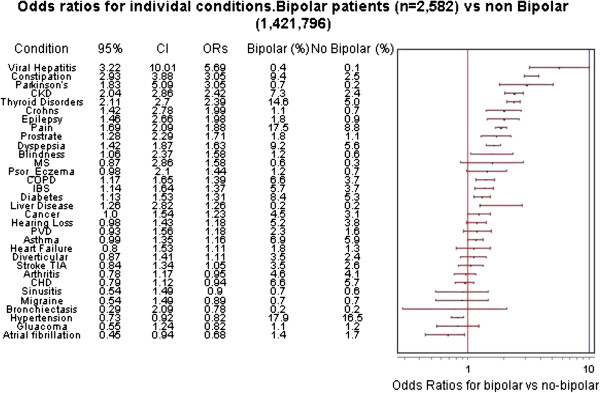
BACKGROUND: Individuals with serious mental disorders experience poor physical health, especially increased rates of cardiometabolic morbidity and premature morbidity. Recent evidence suggests that individuals with schizophrenia have numerous comorbid physical conditions that may be under-recorded and undertreated, but to date very few studies have explored this issue for bipolar disorder. METHODS: We conducted a cross-sectional analysis of a dataset of 1,751,841 registered patients within 314 primary care practices in Scotland, UK. Bipolar disorder was identified using Read Codes recorded within electronic medical records. Data on 32 common chronic physical conditions were also assessed. Potential prescribing inequalities were evaluated by analysing prescribing data for coronary heart disease (CHD) and hypertension. RESULTS: Compared to controls, individuals with bipolar disorder were significantly less likely to have no recorded physical conditions (OR 0.59, 95% CI 0.54 to 0.63) and significantly more likely to have one physical condition (OR 1.27, 95% CI 1.16 to 1.39), two physical conditions (OR 1.45, 95% CI 1.30 to 1.62) and three or more physical conditions (OR 1.44, 95% CI 1.30 to 1.64). People with bipolar disorder also had higher rates of thyroid disorders, chronic kidney disease, chronic pain, chronic obstructive airways disease and diabetes but, surprisingly, lower recorded rates of hypertension and atrial fibrillation. People with bipolar disorder and comorbid CHD or hypertension were significantly more likely to be prescribed no antihypertensive or cholesterol-lowering medications compared to controls, and bipolar individuals with CHD or hypertension were significantly less likely to be on two or more antihypertensive agents. CONCLUSIONS: Individuals with bipolar disorder are similar to individuals with schizophrenia in having a wide range of comorbid and multiple physical health conditions. They are also less likely than controls to have a primary-care record of cardiovascular conditions such as hypertension and atrial fibrillation. Those with a recorded diagnosis of CHD or hypertension were less likely to be treated with cardiovascular medications and were treated less intensively. This study highlights the high physical healthcare needs of people with bipolar disorder, and provides evidence for a systematic under-recognition and undertreatment of cardiovascular disease in this group.
Overview
The claims and statistics of this paper haven’t been checked yet.
Free: it reads the open-access text and checks the first 5 claims that cite a source we can check. Create a free account to check every claim.
Integrity signals
Registry
Cites
Statistics
Figures
Verification
Claims the paper makes
The claims and statistics of this paper haven’t been checked yet.
Free: it reads the open-access text and checks the first 5 claims that cite a source we can check. Create a free account to check every claim.
Claims other papers make about this one
Each is checked against this paper’s own text: does it say what the citing paper says it does?
The source backs part of the claim, not all of it — or backs it for a different population, condition or comparison.
In the citing paper
“In a large UK cross‐sectional analysis of electronic data sets involving 1.7 million patients in primary care, those diagnosed with BD, when compared with healthy controls, had lower rates of diagnoses (odds ratio [OR] 0.59, 95% confidence interval [CI] 0.54‐0.63) and treatment of medical conditions, despite higher rates of one (OR 1.2, 95% CI 1.16‐1.39) or multiple illnesses (OR 1.44, 95% CI 1.3‐”
From Canadian Network for Mood and Anxiety Treatments ( CANMAT ) and International Society for Bipolar Disorders ( ISBD ) 2018 guidelines for the management of patients with bipolar disorder (2018) · cites this paper as [769]
Experimental — accuracy not yet measuredThe cited source says what the claim attributes to it.
In the citing paper
“While there is consistent evidence showing the high prevalence of comorbid medical conditions in BD768, 769, 770, 771, 772, 773, 774 and the negative impact these diagnoses have on longevity,775, 776 these conditions frequently go undiagnosed or undertreated.”
Self-check
Percentages, sums and reported differences re-computed from the paper’s own numbers.
The self-check needs the paper’s full text.
Citations
Cites
Barnett, K., Mercer, S. W., Norbury, M., Watt, G., Wyke, S., & Guthrie, B. (2012) · The Lancet · doi:10.1016/s0140-6736(12)60240-2 · Cited by 6,972 · cited 1×
“A more detailed explanation of how these conditions were selected and defined is available elsewhere [18].”
BackgroundSelf-citationDE HERT, M., CORRELL, C. U., BOBES, J., CETKOVICH‐BAKMAS, M., COHEN, D., ASAI, I., DETRAUX, J., GAUTAM, S., MÖLLER, H., NDETEI, D. M., et al. (2011) · World Psychiatry · doi:10.1002/j.2051-5545.2011.tb00014.x · Cited by 2,488 · cited 1×
“It is well documented that physical and mental health problems interact to cause prolonged hospitalisation, treatment failure, poor quality of life and premature mortality [25,37,38].”
Background(2006) · Europe PMC (PubMed Central) · Cited by 1,299
Deprivation and Health in Scotland
Tunstall-Pedoe, H. (1993) · Postgraduate Medical Journal · doi:10.1136/pgmj.69.814.665-a · Cited by 1,167
Excess Mortality in Bipolar and Unipolar Disorder in Sweden
Ösby, U., Brandt, L., Correia, N., Ekbom, A., & Sparén, P. (2001) · Archives of General Psychiatry · doi:10.1001/archpsyc.58.9.844 · Cited by 1,120 · cited 2×
“However, it is not possible to fully explore the relationship between treatment and outcome in crosssectional data, particularly given the substantial premature cardiovascular mortality in bipolar disorder [1,12], consistent with people who were undertreated and with poor intermediate outcome control not surviving to…”
BackgroundResultMortality of patients with mood disorders: follow-up over 34–38 years
Angst, F., Stassen, H. H., Clayton, P. J., & Angst, J. (2002) · Journal of Affective Disorders · doi:10.1016/s0165-0327(01)00377-9 · Cited by 881 · cited 1×
“Although suicide is a major cause of premature mortality in bipolar disorder, with a lifetime risk of around 8% [10], most of the excess mortality associated with bipolar disorder and similar serious major mental disorders is due to an increased prevalence of cardiovascular, metabolic and endocrine conditions and risk…”
BackgroundDE HERT, M., COHEN, D., BOBES, J., CETKOVICH‐BAKMAS, M., LEUCHT, S., NDETEI, D. M., NEWCOMER, J. W., UWAKWE, R., ASAI, I., MÖLLER, H., et al. (2011) · World Psychiatry · doi:10.1002/j.2051-5545.2011.tb00036.x · Cited by 870 · cited 2×
“It is well documented that physical and mental health problems interact to cause prolonged hospitalisation, treatment failure, poor quality of life and premature mortality [25,37,38].”
BackgroundComorbidities and mortality in persons with schizophrenia: a Swedish national cohort study
Crump, C., Winkleby, M. A., Sundquist, K., & Sundquist, J. (2013) · American Journal of Psychiatry · doi:10.1176/appi.ajp.2012.12050599 · Cited by 619 · cited 2×
“However, rates of recording of cardiovascular disease and cancer were only slightly increased in people with schizophrenia, even though these individuals had more healthcare system contacts, suggesting that cardiovascular disease and cancer are significantly underdiagnosed and/or under-recorded in this population [24].”
BackgroundDeprivation and health in Scotland
Watt, G. (1992) · Social Science & Medicine · doi:10.1016/0277-9536(92)90326-l · Cited by 473
Morbidity and Rate of Undiagnosed Physical Illnesses in a Psychiatric Clinic Population
Koranyi, E. K. (1979) · Archives of General Psychiatry · doi:10.1001/archpsyc.1979.01780040056006 · Cited by 407
Cited by
Items 101–138 of 138
Stapp, E. K., Cui, L., Guo, W., Paksarian, D., & Merikangas, K. R. (2022) · Journal of Psychosomatic Research · doi:10.1016/j.jpsychores.2022.110927 · Cited by 7
Lasebikan, V. O., & Azegbeobor, J. (2016) · Community Mental Health Journal · doi:10.1007/s10597-016-0063-x · Cited by 7
Sułkowski, L., Matyja, A., & Matyja, M. (2025) · Medicina · doi:10.3390/medicina61071295 · Cited by 6
“This may be due to cumulative exposure to uremic toxins, hemodynamic instability during dialysis sessions, and age-related neurodegenerative processes [11–14].”
Mental health and kidney disease
Chilcot, J., Cogley, C., Carswell, C., Hudson, J. L., Greenwood, S. A., Sharma, S., Bramham, K., Lunn, A. J., & Farrington, K. (2026) · Nature Reviews Nephrology · doi:10.1038/s41581-026-01055-3 · Cited by 6
Philipsen, L., Würtz, N., Polcwiartek, C., Kragholm, K. H., Torp-Pedersen, C. T., Nielsen, R. E., Jensen, S. E., & Attar, R. (2022) · Nordic Journal of Psychiatry · doi:10.1080/08039488.2022.2102208 · Cited by 3
Kaya, T., & Demir, N. (2024) · ALPHA PSYCHIATRY · doi:10.5152/alphapsychiatry.2024.231363 · Cited by 5
Gatta, E., Maltese, V., Dondi, F., Bellini, P., Ugoccioni, M., Silvestrini, I., Ceraso, A., Vita, A., Rotondi, M., Bertagna, F., et al. (2025) · Frontiers in Endocrinology · doi:10.3389/fendo.2025.1580854 · Cited by 3
Hoeft, T. J., Hall, J. D., Solberg, L. I., Takamine, L. H., Danna, M. N., Fortney, J. C., Shushan, S., & Cohen, D. J. (2022) · Psychiatric Services · doi:10.1176/appi.ps.202100595 · Cited by 5
Bipolar Disorder and Physical Activity
Vancampfort, D., & Goldstein, B. I. (2018) · Elsevier eBooks · doi:10.1016/b978-0-12-812605-9.00003-4 · Cited by 9
Major psychiatric disorders and the aetiology and progression of coronary heart disease
Jackson, A. C., Barton, D. A., & Murphy, B. M. (2018) · British Journal of Cardiac Nursing · doi:10.12968/bjca.2018.13.9.446 · Cited by 3
Hsu, H.-E., Chen, P., Chang, H., Pan, C., Su, S., Tsai, S., Chen, C.-C., & Kuo, C. (2022) · Australian & New Zealand Journal of Psychiatry · doi:10.1177/00048674221100153 · Cited by 5
“Inconsistent results have been reported regarding the likelihood of having hypertension in patients with bipolar disorder compared with the general population (Chien et al., 2013; Smith et al., 2013).”
ResultChan, J. K. N., Fang, C. Z., Lo, H. K. Y., Wong, C. S. M., Yung, N. C. L., & Chang, W. C. (2024) · European Neuropsychopharmacology · doi:10.1016/j.euroneuro.2024.03.014 · Cited by 2
Cogley, C., Smith-Jones, M., Ralston, E., Bramham, J., Chilcot, J., D’Alton, P., Carswell, C., Lam, C. C. S. F., Ratnam, A., Al-Agil, M., et al. (2024) · Journal of Nephrology · doi:10.1007/s40620-024-02103-6 · Cited by 2
Physical Health of People with Mental Illness
Holt, R. I. G., Shiers, D., & Peveler, R. (2018) · Cambridge University Press eBooks · doi:10.1017/9781911623038.021 · Cited by 2
Vettini, A., Brennan, G., Mercer, S. W., & Jackson, C. (2024) · BJGP Open · doi:10.3399/bjgpo.2023.0176 · Cited by 2
“12,13 The Lancet Psychiatry Commission blueprint for protecting physical health in patients with mental illness highlights the role of continuing care and improved use of medical investigations and treatments, including cardioprotective medications, in reducing physical disease burden in this group.”
Self-citationPHYSICAL HEALTH CHECKS IN SERIOUS MENTAL ILLNESS: A PROGRAMME OF RESEARCH IN SECONDARY CARE
White, J. (2015) · UEA Digital Repository (University of East Anglia) · Cited by 3
Godemann, F., Wiegand, H. F., Wolff‐Menzler, C., Nitschke, R., Häfner, S., Pogarell, O. M., Falkai, P., Löhr, M. J., & Seemüller, F. (2014) · Nervenheilkunde · doi:10.1055/s-0038-1627757 · Cited by 1
“Reaktionen auf schwere Belastungs- und Anpassungsstörungen zeigen in anderen Studien mit etwa 16% aller bipolaren Patienten fast doppelt so hohe Prävalenzraten wie in der Allgemeinbevölkerung (24).”
BackgroundInfluentialCarswell, C., Nisbet, R., Khan, J., Patel, Z., Husain, A., Bramham, K., Chilcot, J., Jacobs, R., Osborn, D., & Siddiqi, N. (2026) · The British Journal of Psychiatry · doi:10.1192/bjp.2026.10659 · Cited by 1
Tian, X., Ding, Z., Zhao, J., Gu, T., Liu, X., Chen, K., Lip, G. Y. H., & Liu, T. (2026) · Heart Rhythm · doi:10.1016/j.hrthm.2026.07.041 · Cited by 1
Recognising Bipolar Disorders in Primary Care.
Dietch, D. (2015) · PubMed · Cited by 4
Cardiovascular diseases in Patients with Bipolar disease: Pragmatic Management.
Jesus, C., Jesus, I., & Agius, M. A. (2016) · PubMed · Cited by 1
Allocation aux adultes handicapés : pathologies et recours aux soins des bénéficiaires en 2017
Verboux, D., Thomas, M., Colinot, N., Espagnacq, M., Pichetti, S., Chevalier, S., Landais, C., Fouard, A., Gastaldi‐Ménager, C., & Rachas, A. (2022) · Santé Publique · doi:10.3917/spub.223.0345 · Cited by 1
Zhao, H. Q., Zhou, M., Jiang, J. Q., Luo, Z. Q., & Wang, Y. H. (2024) · Frontiers in Neurology · doi:10.3389/fneur.2024.1393022 · Cited by 1
“Moreover, Bipolar Disorder is also associated with a higher comorbidity rate (8), including cardiovascular diseases (9), endocrine disorders (10), and metabolic syndrome (11).”
BackgroundShonibare, D. O. (2018) · TSpace (University of Toronto) · Cited by 1
Depression-Avoidance Defences in Bipolar-Euthymia
Granger, S. (2015) · Victoria University Research Repository (Victoria University)
Biological and Clinical Correlates of Vascular Risk in Adolescent Bipolar Disorder
Hatch, J. K. (2016) · TSpace (University of Toronto)
Pješčić, K. D., Gutovic, J., Tesic, J., Djukić, A., Grbić, I., & Cvetković, J. (2016) · Praxis medica · doi:10.5937/pramed1602083d
“Patients with bipolar disorders and who already are diagnosed with CVC (hypertension and ischemic heart disease) receive poorer treatment compared to the general public [10].”
BackgroundInvestigating susceptibility to bipolar disorder, migraine and epilepsy
Knott, S. (2016) · ORCA Online Research @Cardiff (Cardiff University)
PO-472 Chemotherapy resistance-associated epithelial to endothelial transition in gastric cancer
Peri, S., Biagioni, A., Cianchi, F., Skalamera, I., Foppa, C., Schiavone, N., Papucci, L., & Magnelli, L. (2018) · ESMO Open · doi:10.1136/esmoopen-2018-eacr25.492
Ahearn, E. P., Chen, P., & Sajatovic, M. (2020) · Elsevier eBooks · doi:10.1016/b978-0-12-819182-8.00031-4 · Cited by 3
de Paiva, L. L. L., Teixeira, L. M., & Figueira, O. A. (2022) · Brazilian Journal of Health Review · doi:10.34119/bjhrv5n6-226
Epidemiology of Mental Health Conditions in Older Adult Women
Webb, F. J., Swagger, P., & Webster-Bass, S. (2024) · Springer eBooks · doi:10.1007/978-3-031-58293-6_4 · Cited by 1
Recognizing Symptom Evolution in Bipolar Disorder in Aging Individuals
Harmancı, P. (2025) · IntechOpen eBooks · doi:10.5772/intechopen.1008298 · Cited by 1
Mutz, J., Choudhury, U., Zhao, J., & Dregan, A. (2022) · Figshare · doi:10.6084/m9.figshare.20727578
Piché, F., Morell, R., Ward, P., Rosenbaum, S., & Romain, A. J. (2026) · Applied Physiology, Nutrition, and Metabolism · doi:10.1139/apnm-2025-0176
Eltorki, Y. H., Abdallah, O., Alkudsi, Z., Elamin, W., Gharaibeh, A. M., Mustafa, M., Shameh, N. A., Riaz, S., Mahran, I., Al‐Khuzaei, N., et al. (2026) · Risk Management and Healthcare Policy · doi:10.2147/rmhp.s578820
Peters, S. J., Schlomann, L., Jänner, M., Medenbach, J., Zielasek, J., Groß, S., & Gouzoulis‐Mayfrank, E. (2026) · International Journal of Cardiology Cardiovascular Risk and Prevention · doi:10.1016/j.ijcrp.2026.200690
“A cross-sectional study from Scotland, UK showed that people with bipolar disorder and comorbid coronary heart disease or hypertension were less likely to receive anti-hypertensive or cholesterol-lowering medication [22].”
Metadata
- Authors
- Smith, D. J., Martin, D., McLean, G., Langan, J., Guthrie, B., & Mercer, S. W.
- Affiliations
- Gartnavel General Hospital (GB)
- University of Glasgow (GB)
- University of Dundee (GB)
- Venue
- BMC Medicine
- Published
- 2013-12
- Volume
- 11
- Issue
- 1
- Pages
- 263-263
- ISSN
- 1741-7015 (ISSN-L)
- PMC
- PMC3880052
- OpenAlex
- W2088438351
- Cited by
- 138
- References
- 42
- Citations by year
- 2026: 6 · 2025: 3 · 2024: 11 · 2023: 9 · 2022: 22 · 2021: 6 · 2020: 12 · 2019: 5 · 2018: 13 · 2017: 10 · 2016: 22 · 2015: 11 · 2014: 8
- FWCI
- 9.68
- Type
- journal article
- Language
- en
- Open access
- gold
- doi.org
- Licence
- Locations
- BMC Medicine (publishedVersion, cc-by)
- Europe PMC (PubMed Central) (publishedVersion, cc-by)
- PubMed Central (publishedVersion, cc-by)
- PubMed (publishedVersion)
- ENLIGHTEN (Jurnal Bimbingan dan Konseling Islam) (acceptedVersion)
- Discovery Research Portal (University of Dundee) (submittedVersion)
- Edinburgh Research Explorer (University of Edinburgh) (submittedVersion, cc-by)
- Funders
- Scottish Government
- University of Glasgow
- University of Aberdeen
- Chief Scientist Office, Scottish Government Health and Social Care Directorate
- Topics
- Health Sciences › Medicine › Psychiatry and Mental health › Bipolar Disorder and Treatment
- Health Sciences › Medicine › Epidemiology › Chronic Disease Management Strategies
- Health Sciences › Medicine › Psychiatry and Mental health › Schizophrenia research and treatment
- Keywords
- bipolar disorder, multimorbidity, cardiovascular disease, undertreatment, coronary artery disease, hypertension, antihypertensive drugs, cholesterol-lowering drugs, atrial fibrillation, thyroid dysfunction, chronic kidney disease, chronic pain, chronic obstructive pulmonary disease, diabetes mellitus, somatic comorbidity, primary care, electronic health records
- MeSH terms
- Adolescent, Adult, Aged, Aged, 80 and over, Bipolar Disorder, Cardiovascular Diseases, Cross-Sectional Studies, Female, Humans, Male, Middle Aged, Scotland, Comorbidity, Young Adult
About these checks
Registry, retraction, Cites and statistics results are computed, not judged, with one exception: a printed reference that no index lists is read once by a model before it counts as a citation error. Claims are extracted by a model and kept only when their quote appears verbatim in the text; each cited source is then checked, with a model’s help, for whether it says what the claim relies on. Those verdicts can be wrong — read the claim’s quote and the cited source before relying on one.
Statistics and arithmetic are recomputed, not judged.
Confidence bands are shown only for fields calibrated on our annotated test set. None is calibrated yet, so no band is shown.
What counts as a claim ›How we measure confidence ›How we check this ›
Are you an author, or do you see a problem with this page? Request a review
Data sources
Bibliographic data: Semantic Scholar, OpenAlex, Crossref.
Contains information from the Semantic Scholar Academic Graph Datasets, made available under the ODC Attribution License (ODC-BY 1.0).
Semantic Scholar’s data is described in: Kinney, R., et al. (2023). The Semantic Scholar Open Data Platform. arXiv:2301.10140.
