

Multimorbidity in bipolar disorder and undertreatment of cardiovascular disease: a cross sectional study
Open accessThe DOI matches its Crossref record; 42 of the 43 references it cites were found in a registry or an index, and 1 are not checked yet.
Abstract
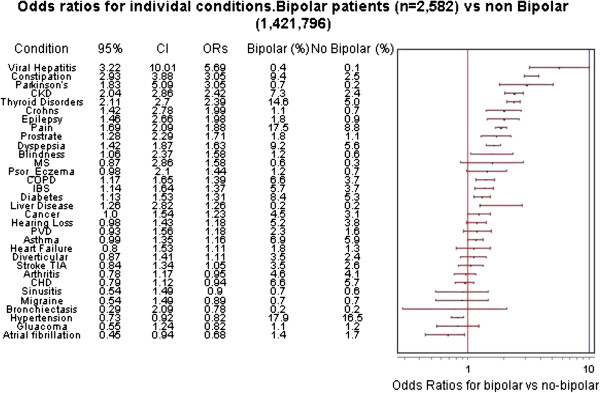
BACKGROUND: Individuals with serious mental disorders experience poor physical health, especially increased rates of cardiometabolic morbidity and premature morbidity. Recent evidence suggests that individuals with schizophrenia have numerous comorbid physical conditions that may be under-recorded and undertreated, but to date very few studies have explored this issue for bipolar disorder. METHODS: We conducted a cross-sectional analysis of a dataset of 1,751,841 registered patients within 314 primary care practices in Scotland, UK. Bipolar disorder was identified using Read Codes recorded within electronic medical records. Data on 32 common chronic physical conditions were also assessed. Potential prescribing inequalities were evaluated by analysing prescribing data for coronary heart disease (CHD) and hypertension. RESULTS: Compared to controls, individuals with bipolar disorder were significantly less likely to have no recorded physical conditions (OR 0.59, 95% CI 0.54 to 0.63) and significantly more likely to have one physical condition (OR 1.27, 95% CI 1.16 to 1.39), two physical conditions (OR 1.45, 95% CI 1.30 to 1.62) and three or more physical conditions (OR 1.44, 95% CI 1.30 to 1.64). People with bipolar disorder also had higher rates of thyroid disorders, chronic kidney disease, chronic pain, chronic obstructive airways disease and diabetes but, surprisingly, lower recorded rates of hypertension and atrial fibrillation. People with bipolar disorder and comorbid CHD or hypertension were significantly more likely to be prescribed no antihypertensive or cholesterol-lowering medications compared to controls, and bipolar individuals with CHD or hypertension were significantly less likely to be on two or more antihypertensive agents. CONCLUSIONS: Individuals with bipolar disorder are similar to individuals with schizophrenia in having a wide range of comorbid and multiple physical health conditions. They are also less likely than controls to have a primary-care record of cardiovascular conditions such as hypertension and atrial fibrillation. Those with a recorded diagnosis of CHD or hypertension were less likely to be treated with cardiovascular medications and were treated less intensively. This study highlights the high physical healthcare needs of people with bipolar disorder, and provides evidence for a systematic under-recognition and undertreatment of cardiovascular disease in this group.
Overview
The claims and statistics of this paper haven’t been checked yet.
Free: it reads the open-access text and checks the first 5 claims that cite a source we can check. Create a free account to check every claim.
Integrity signals
Registry
Cites
Statistics
Figures
Verification
Claims the paper makes
The claims and statistics of this paper haven’t been checked yet.
Free: it reads the open-access text and checks the first 5 claims that cite a source we can check. Create a free account to check every claim.
Claims other papers make about this one
Each is checked against this paper’s own text: does it say what the citing paper says it does?
The source backs part of the claim, not all of it — or backs it for a different population, condition or comparison.
In the citing paper
“In a large UK cross‐sectional analysis of electronic data sets involving 1.7 million patients in primary care, those diagnosed with BD, when compared with healthy controls, had lower rates of diagnoses (odds ratio [OR] 0.59, 95% confidence interval [CI] 0.54‐0.63) and treatment of medical conditions, despite higher rates of one (OR 1.2, 95% CI 1.16‐1.39) or multiple illnesses (OR 1.44, 95% CI 1.3‐”
From Canadian Network for Mood and Anxiety Treatments ( CANMAT ) and International Society for Bipolar Disorders ( ISBD ) 2018 guidelines for the management of patients with bipolar disorder (2018) · cites this paper as [769]
Experimental — accuracy not yet measuredThe cited source says what the claim attributes to it.
In the citing paper
“While there is consistent evidence showing the high prevalence of comorbid medical conditions in BD768, 769, 770, 771, 772, 773, 774 and the negative impact these diagnoses have on longevity,775, 776 these conditions frequently go undiagnosed or undertreated.”
Self-check
Percentages, sums and reported differences re-computed from the paper’s own numbers.
The self-check needs the paper’s full text.
Citations
Cites
Barnett, K., Mercer, S. W., Norbury, M., Watt, G., Wyke, S., & Guthrie, B. (2012) · The Lancet · doi:10.1016/s0140-6736(12)60240-2 · Cited by 6,972 · cited 1×
“A more detailed explanation of how these conditions were selected and defined is available elsewhere [18].”
BackgroundSelf-citationDE HERT, M., CORRELL, C. U., BOBES, J., CETKOVICH‐BAKMAS, M., COHEN, D., ASAI, I., DETRAUX, J., GAUTAM, S., MÖLLER, H., NDETEI, D. M., et al. (2011) · World Psychiatry · doi:10.1002/j.2051-5545.2011.tb00014.x · Cited by 2,488 · cited 1×
“It is well documented that physical and mental health problems interact to cause prolonged hospitalisation, treatment failure, poor quality of life and premature mortality [25,37,38].”
Background(2006) · Europe PMC (PubMed Central) · Cited by 1,299
Deprivation and Health in Scotland
Tunstall-Pedoe, H. (1993) · Postgraduate Medical Journal · doi:10.1136/pgmj.69.814.665-a · Cited by 1,167
Excess Mortality in Bipolar and Unipolar Disorder in Sweden
Ösby, U., Brandt, L., Correia, N., Ekbom, A., & Sparén, P. (2001) · Archives of General Psychiatry · doi:10.1001/archpsyc.58.9.844 · Cited by 1,120 · cited 2×
“However, it is not possible to fully explore the relationship between treatment and outcome in crosssectional data, particularly given the substantial premature cardiovascular mortality in bipolar disorder [1,12], consistent with people who were undertreated and with poor intermediate outcome control not surviving to…”
BackgroundResultMortality of patients with mood disorders: follow-up over 34–38 years
Angst, F., Stassen, H. H., Clayton, P. J., & Angst, J. (2002) · Journal of Affective Disorders · doi:10.1016/s0165-0327(01)00377-9 · Cited by 881 · cited 1×
“Although suicide is a major cause of premature mortality in bipolar disorder, with a lifetime risk of around 8% [10], most of the excess mortality associated with bipolar disorder and similar serious major mental disorders is due to an increased prevalence of cardiovascular, metabolic and endocrine conditions and risk…”
BackgroundDE HERT, M., COHEN, D., BOBES, J., CETKOVICH‐BAKMAS, M., LEUCHT, S., NDETEI, D. M., NEWCOMER, J. W., UWAKWE, R., ASAI, I., MÖLLER, H., et al. (2011) · World Psychiatry · doi:10.1002/j.2051-5545.2011.tb00036.x · Cited by 870 · cited 2×
“It is well documented that physical and mental health problems interact to cause prolonged hospitalisation, treatment failure, poor quality of life and premature mortality [25,37,38].”
BackgroundComorbidities and mortality in persons with schizophrenia: a Swedish national cohort study
Crump, C., Winkleby, M. A., Sundquist, K., & Sundquist, J. (2013) · American Journal of Psychiatry · doi:10.1176/appi.ajp.2012.12050599 · Cited by 619 · cited 2×
“However, rates of recording of cardiovascular disease and cancer were only slightly increased in people with schizophrenia, even though these individuals had more healthcare system contacts, suggesting that cardiovascular disease and cancer are significantly underdiagnosed and/or under-recorded in this population [24].”
BackgroundDeprivation and health in Scotland
Watt, G. (1992) · Social Science & Medicine · doi:10.1016/0277-9536(92)90326-l · Cited by 473
Morbidity and Rate of Undiagnosed Physical Illnesses in a Psychiatric Clinic Population
Koranyi, E. K. (1979) · Archives of General Psychiatry · doi:10.1001/archpsyc.1979.01780040056006 · Cited by 407
Cited by
Yatham, L. N., Kennedy, S. H., Parikh, S. V., Schaffer, A., Bond, D. J., Frey, B. N., Sharma, V., Goldstein, B. I., Rej, S., Beaulieu, S., et al. (2018) · Bipolar Disorders · doi:10.1111/bdi.12609 · Cited by 1,852
Correll, C. U., Solmi, M., Veronese, N., Bortolato, B., Rosson, S., Santonastaso, P., Thapa‐Chhetri, N., Fornaro, M., Gallicchio, D., Collantoni, E., et al. (2017) · World Psychiatry · doi:10.1002/wps.20420 · Cited by 1,729
Cooper, S.-A., McLean, G., Guthrie, B., McConnachie, A., Mercer, S., Sullivan, F., & Morrison, J. (2015) · BMC Family Practice · doi:10.1186/s12875-015-0329-3 · Cited by 443
Self-citationCardiovascular disease in patients with severe mental illness
Nielsen, R. E., Banner, J., & Jensen, S. E. (2021) · Nature Reviews Cardiology · doi:10.1038/s41569-020-00463-7 · Cited by 389
Clague, F., Mercer, S. W., McLean, G., Reynish, E., & Guthrie, B. (2016) · Age and Ageing · doi:10.1093/ageing/afw176 · Cited by 195
Self-citationStubbs, B., Vancampfort, D., Veronese, N., Solmi, M., Gaughran, F., Manu, P., Rosenbaum, S., De Hert, M., & Fornaro, M. (2016) · Journal of Affective Disorders · doi:10.1016/j.jad.2016.02.060 · Cited by 192
“…major depressive disorder (MDD), bipolar disorder (BD) and schizophrenia spectrum disorders) have significantly poorer physical health than the general population and are at increased risk of comorbidities (Smith, Langan, McLean, Guthrie, & Mercer, 2013a; Smith et al., 2013b; Stubbs et al., 2014).”
BackgroundKatikireddi, S. V., Skivington, K., Leyland, A. H., Hunt, K., & Mercer, S. W. (2017) · BMC Medicine · doi:10.1186/s12916-017-0913-6 · Cited by 171
“Furthermore, there is a need for further research to distinguish the relative importance of mental and physical health conditions [31] as well as investigate combinations of specific health conditions in greater detail [32, 33].”
BackgroundSelf-citationComorbid medical illness in bipolar disorder
Forty, L., Ulanova, A., Jones, L., Jones, I., Gordon-Smith, K., Fraser, C., Farmer, A., McGuffin, P., Lewis, C. M., Hosang, G. M., et al. (2014) · British Journal of Psychiatry · doi:10.1192/bjp.bp.114.152249 · Cited by 166
Kessing, L. V., Gerds, T. A., Feldt-Rasmussen, B., Andersen, P. K., & Licht, R. W. (2015) · JAMA Psychiatry · doi:10.1001/jamapsychiatry.2015.1834 · Cited by 156
Chan, J. K. N., Tong, C. C. H. Y., Wong, C. S. M., Chen, E. Y. H., & Chang, W. C. (2022) · The British Journal of Psychiatry · doi:10.1192/bjp.2022.19 · Cited by 177
The prevalence of pain in bipolar disorder: a systematic review and large-scale meta-analysis
Stubbs, B., Eggermont, L., Mitchell, A. J., De Hert, M., Correll, C. U., Soundy, A., Rosenbaum, S., & Vancampfort, D. (2015) · Acta Psychiatrica Scandinavica · doi:10.1111/acps.12325 · Cited by 129
“All of the studies adopted a cross-sectional measurement of pain, and seven of these (n with BD = 138 285) (8, 33, 38, 41, 44, 49, 52) had a control group without a mental Table 1.”
BackgroundResultMcLean, G., Hindle, J. V., Guthrie, B., & Mercer, S. W. (2017) · BMC Neurology · doi:10.1186/s12883-017-0904-4 · Cited by 135
Self-citationBoal, A. H., Smith, D. J., McCallum, L., Muir, S., Touyz, R. M., Dominiczak, A. F., & Padmanabhan, S. (2016) · Hypertension · doi:10.1161/hypertensionaha.116.08188 · Cited by 125
Hanlon, P., Hannigan, L. J., Rodriguez-Perez, J., Fischbacher, C., Welton, N. J., Dias, S., Mair, F. S., Guthrie, B., Wild, S. H., & McAllister, D. (2019) · BMC Medicine · doi:10.1186/s12916-019-1427-1 · Cited by 121
Self-citationHalstead, S., Cao, C., Mohr, G. H., Ebdrup, B. H., Pillinger, T., McCutcheon, R. A., Firth, J., Siskind, D. J., & Warren, N. (2024) · The Lancet Psychiatry · doi:10.1016/s2215-0366(24)00091-9 · Cited by 118
Pizzol, D., Trott, M., Butler, L. T., Barnett, Y., Ford, T. J., Neufeld, S., Ragnhildstveit, A., Parris, C. N., Underwood, B. R., Sánchez, G. F. L., et al. (2023) · BMJ Mental Health · doi:10.1136/bmjment-2023-300870 · Cited by 135
Mutz, J., Choudhury, U., Zhao, J., & Dregan, A. (2022) · BMC Medicine · doi:10.1186/s12916-022-02474-2 · Cited by 100
“Individuals with psychosis were excluded from all cases and individuals with bipolar disorder were excluded from anxiety disorder cases due to their increased risk of physical multimorbidity [24, 25].”
BackgroundBrämberg, E. B., Torgerson, J., Kjellström, A. N., Welin, P., & Rusner, M. (2018) · BMC Family Practice · doi:10.1186/s12875-017-0687-0 · Cited by 132
Risk of Developing Parkinson Disease in Bipolar Disorder: A Systematic Review and Meta-analysis
Faustino, P., Duarte, G. S., Chendo, I., Caldas, A. C., Reimão, S., Fernandes, R. M., Vale, J., Tinazzi, M., Bhatia, K. P., & Ferreira, J. J. (2019) · JAMA Neurology · doi:10.1001/jamaneurol.2019.3446 · Cited by 94
“Forty et al,14 2014 Cross-sectional United Kingdom 1720 Patients with BD and 1340 controls (70% female); median age in BD group, 47 y General population Medical records using DSM-IV and ICD-10; median (IQR) age, 20 (7-55) y Self-reported diagnosis of PD; NR Lifetime rate of self-reported PD, 0.”
MethodCorrell, C. U., Ng-Mak, D. S., Stafkey-Mailey, D., Farrelly, E., Rajagopalan, K., & Loebel, A. (2017) · Annals of General Psychiatry · doi:10.1186/s12991-017-0133-7 · Cited by 79
Telomere length and bipolar disorder
Powell, T. R., Dima, D., Frangou, S., & Breen, G. (2018) · Neuropsychopharmacology · doi:10.1038/npp.2017.125 · Cited by 78
“…as hypertension, elevated lipids, poor glycemic control, and diabetes type 2 are more prevalent in patients with BD compared with the general population (Beyer et al , 2005; Czepielewski et al , 2013; Fiedorowicz et al , 2010; Forty et al , 2014; McIntyre et al , 2006, 2010; Smith et al , 2013).”
Medical Comorbidities in Bipolar Disorder
Sinha, A., Shariq, A., Said, K., Sharma, A., Newport, D. J., & Salloum, I. M. (2018) · Current Psychiatry Reports · doi:10.1007/s11920-018-0897-8 · Cited by 76
Sandström, Y. K., Ljunggren, G., Wändell, P. E., Wahlström, L., & Carlsson, A. C. (2016) · Journal of Hypertension · doi:10.1097/hjh.0000000000000824 · Cited by 88
“Less is known about the association between bipolar disorder and hypertension, where an American study reported a high association [27], and a British study showed no such association [28], although the latter showed that cardiovascular disease in general was undertreated and underrecognized among patients with bipola…”
BackgroundResultLaunders, N., Hayes, J., Price, G., & Osborn, D. (2022) · PLoS Medicine · doi:10.1371/journal.pmed.1003976 · Cited by 84
Bobo, W. V., Yawn, B. P., Sauver, J. L. S., Grossardt, B. R., Boyd, C. M., & Rocca, W. A. (2016) · The Journals of Gerontology Series A · doi:10.1093/gerona/glw032 · Cited by 84
Charles, E. F., Lambert, C. G., & Kerner, B. (2016) · International Journal of Bipolar Disorders · doi:10.1186/s40345-016-0054-4 · Cited by 70
“Since symptoms of these somatic disorders overlap with those of BD, they could challenge the diagnostic process and delay treatment (Sajatovic and Chen 2011; Smith et al. 2013; Maina et al. 2013).”
BackgroundChan, J. K. N., Wong, C. S. M., Yung, N. C. L., Chen, E. Y. H., & Chang, W. C. (2021) · Epidemiology and Psychiatric Sciences · doi:10.1017/s2045796021000305 · Cited by 69
“, 2020) and under-prescription of cardioprotective medications (Smith et al., 2013; Laursen et al., 2014).”
BackgroundImpact of socioeconomic deprivation on rate and cause of death in severe mental illness
Martin, J. L., McLean, G., Park, J. B., Martin, D. J., Connolly, M., Mercer, S. W., & Smıth, D. J. (2014) · BMC Psychiatry · doi:10.1186/s12888-014-0261-4 · Cited by 64
Self-citationMassironi, S., Pigoni, A., Vegni, E. A. M., Keefer, L., Dubinsky, M. C., Brambilla, P., Delvecchio, G., & Danese, S. (2024) · Inflammatory Bowel Diseases · doi:10.1093/ibd/izae206 · Cited by 62
Stanton, R., Happell, B., & Reaburn, P. R. J. (2015) · International Journal of Mental Health Nursing · doi:10.1111/inm.12125 · Cited by 70
Simpson, R. J., McLean, G., Guthrie, B., Mair, F., & Mercer, S. W. (2014) · BMC Neurology · doi:10.1186/1471-2377-14-128 · Cited by 54
“[37], who analysed the same dataset and discovered surprisingly low levels of recorded cardiovascular disease amongst patients with Schizophrenia.”
BackgroundSelf-citationPrevalences of autoimmune diseases in schizophrenia, bipolar I and II disorder, and controls
Cremaschi, L., Kardell, M., Johansson, V., Isgren, A., Sellgren, C. M., Altamura, A. C., Hultman, C. M., & Landén, M. (2017) · Psychiatry Research · doi:10.1016/j.psychres.2017.09.071 · Cited by 58
“These results concur with previous studies (Bai et al., 2013; DE Hert et al., 2009; Forty et al., 2014; Smith et al., 2013; Stubbs et al., 2015), and the most likely explanation is metabolic effects of antipsychotic drug treatment.”
ResultWoodhead, C., Ashworth, M. J., Broadbent, M. T. M., Callard, F. J., Hotopf, M. H., Schofield, P., Soncul, M., Stewart, R. J., & Henderson, M. J. (2016) · British Journal of General Practice · doi:10.3399/bjgp16x685189 · Cited by 62
Monteith, S., Glenn, T., Geddes, J., Whybrow, P. C., & Bauer, M. (2016) · International Journal of Bipolar Disorders · doi:10.1186/s40345-016-0051-7 · Cited by 50
Acute general hospital admissions in people with serious mental illness
Jayatilleke, N., Hayes, R. D., Chang, C., & Stewart, R. J. (2018) · Psychological Medicine · doi:10.1017/s0033291718000284 · Cited by 55
Factors associated with co-occurring medical conditions among adults with serious mental disorders
Razzano, L. A., Cook, J. Α., Yost, C., Jonikas, J. A., Swarbrick, M. A., Carter, T. M., & Santos, A. B. (2014) · Schizophrenia Research · doi:10.1016/j.schres.2014.11.021 · Cited by 56
“…have found low rates of diabetes care among those with severe mental disorders (Kreyenbuhl et al., 2006), under-treatment of arthritis among individuals with psychosis (Redelmeier et al., 1998), and under-treatment of cardio-vascular disease among people with bipolar disorder (Smith et al., 2013).”
BackgroundSevere mental illness and chronic kidney disease: a cross-sectional study in the United Kingdom
Iwagami, M., Mansfield, K. E., Hayes, J., Walters, K. R., Osborn, D., Smeeth, L. L., Nitsch, D., & Tomlinson, L. A. (2018) · Clinical Epidemiology · doi:10.2147/clep.s154841 · Cited by 64
“bipolar disorder had a higher prevalence of CKD than people without the condition.(18) Several studies have focused on the prevalence or incidence of CKD in patients using lithium.”
Cogley, C., Bramham, J., Bramham, K., Smith, A., Holian, J., O’Riordan, A., Teh, J. W., Conlon, P. J., Hale, S. M., & D’Alton, P. (2023) · Nephrology Dialysis Transplantation · doi:10.1093/ndt/gfad021 · Cited by 55
“Furthermore, people with schizophrenia and bipolar disorder have higher rates of CKD [12, 13] due to risk factors such as the use of lithium treatment and higher rates of cardiovascular disease [14].”
BackgroundChronic kidney disease and severe mental illness: a scoping review
Carswell, C., Cogley, C., Bramham, K., Chilcot, J., Noble, H. R., & Siddiqi, N. (2023) · Journal of Nephrology · doi:10.1007/s40620-023-01599-8 · Cited by 60
Ribe, A. R., Vestergaard, M., Katon, W. J., Charles, M., Benros, M. E., Vanderlip, E. R., Nordentoft, M., & Laursen, T. M. (2015) · American Journal of Psychiatry · doi:10.1176/appi.ajp.2015.14091100 · Cited by 47
“However, substance abuse and comorbid physical diseases may be underdiagnosed among persons with severe mental illness (23, 24), which could lead to an underestimation of the excess mortality accounted for by these intermediate variables.”
BackgroundComorbidity of depression and anxiety disorders in patients with hypertension
Graham, N., & Smıth, D. J. (2016) · Journal of Hypertension · doi:10.1097/hjh.0000000000000850 · Cited by 47
“However, one possible explanation is that this vulnerable group of patients (in contrast to patients with MDD and anxiety disorders) are less likely to have cardiometabolic parameters such as blood pressure measured, recorded, and treated within both primary and secondary care settings [16,17].”
BackgroundThe prevalence of depressive symptoms among older patients with hypertension in rural China
Xue, J., Chen, S., Bogner, H. R., Tang, W., Li, L., & Conwell, Y. (2016) · International Journal of Geriatric Psychiatry · doi:10.1002/gps.4628 · Cited by 45
“…especially depression, has a negative long-term impact on health outcomes for older adults with hypertension (HTN) (Adamenko, 1967; Musselman et al., 1998; Sandstrom et al., 2016; Smith et al., 2013), to date, few studies have explored the relationship between depression and HTN in rural China.”
BackgroundClinical features, comorbidity, and cognitive impairment in elderly bipolar patients
Rise, I. V., Haro, J. M., & Gjervan, B. (2016) · Neuropsychiatric Disease and Treatment · doi:10.2147/ndt.s100843 · Cited by 49
“44) physical conditions compared to age-matched controls.(15) The same study also reported”
InfluentialComorbidity and polypharmacy in chronic heart failure: a large cross-sectional study in primary care
Barón‐Franco, B., McLean, G., Mair, F. S., Roger, V. L., Guthrie, B., & Mercer, S. W. (2017) · British Journal of General Practice · doi:10.3399/bjgp17x690533 · Cited by 40
Self-citationMental health multimorbidity and poor quality of life in patients with schizophrenia
Bhalla, I. P., Stefanovics, E. A., & Rosenheck, R. A. (2018) · Schizophrenia Research · doi:10.1016/j.schres.2018.04.035 · Cited by 44
Nikolova, V. L., Pelton, L., Moulton, C. D., Zorzato, D., Cleare, A. J., Young, A. H., & Stone, J. M. (2022) · Psychosomatic Medicine · doi:10.1097/psy.0000000000001046 · Cited by 40
“(7) Primary care medical records, Scotland, UK Bipolar disorder Bipolar: 2582 Controls: 1,421,796 51.”
BackgroundInfluentialMcLean, G., & Mercer, S. W. (2017) · Journal of Comorbidity · doi:10.15256/joc.2017.7.114 · Cited by 39
Self-citationKavalidou, K., Smıth, D. J., Der, G., & O’Connor, R. C. (2019) · BMC Psychiatry · doi:10.1186/s12888-019-2032-8 · Cited by 41
Fibromyalgia and Bipolar Disorder: Emerging Epidemiological Associations and Shared Pathophysiology
Bortolato, B., Berk, M., Maes, M. H. J., McIntyre, R. S., & Carvalho, A. F. (2016) · Current Molecular Medicine · doi:10.2174/1566524016666160126144027 · Cited by 39
Fjukstad, K. K., Engum, A., Lydersen, S., Dieset, I., Steen, N. E., Andreassen, O. A., & Spigset, O. (2016) · Journal of Clinical Psychopharmacology · doi:10.1097/jcp.0000000000000582 · Cited by 38
Stubbs, B., Perera, G., Koyanagi, A., Veronese, N., Vancampfort, D., Firth, J., Sheehan, K. J., Binder, M. D., Stewart, R. J., & Mueller, C. (2020) · Journal of the American Medical Directors Association · doi:10.1016/j.jamda.2020.03.005 · Cited by 39
Informe mundial sobre la salud mental: Transformar la salud mental para todos
de la Salud, O. P. (2023) · Pan American Health Organization eBooks · doi:10.37774/9789275327715 · Cited by 104
Ribe, A. R., Laurberg, T., Laursen, T. M., Charles, M., Vedsted, P., & Vestergaard, M. (2016) · PLoS ONE · doi:10.1371/journal.pone.0158013 · Cited by 37
“Mounting evidence suggests that comorbid physical conditions are generally under-diagnosed [5, 6, 7, 8] and under-treated [7, 9] in persons with SMI.”
BackgroundNew drug candidates for bipolar disorder—A nation‐wide population‐based study
Kessing, L. V., Rytgaard, H. C. W., Gerds, T. A., Berk, M., Ekstrøm, C. T., & Andersen, P. K. (2019) · Bipolar Disorders · doi:10.1111/bdi.12772 · Cited by 33
Heiberg, I. H., Nesvåg, R., Balteskard, L., Bramness, J. G., Hultman, C. M., Næss, Ø., Reichborn‐Kjennerud, T., Ystrøm, E., Jacobsen, B. K., & Høye, A. (2020) · Acta Psychiatrica Scandinavica · doi:10.1111/acps.13157 · Cited by 32
Mutz, J., & Lewis, C. M. (2022) · Biological Psychiatry Global Open Science · doi:10.1016/j.bpsgos.2022.08.008 · Cited by 32
“Individuals with psychosis were excluded from all groups, and individuals with bipolar disorder were excluded from the anxiety disorder group due to their increased risk of physical multimorbidity (27,28).”
BackgroundButterly, E. W., Hanlon, P., Shah, A. S. V., Hannigan, L. J., McIntosh, E., Lewsey, J., Wild, S. H., Guthrie, B., Mair, F. S., Kent, D. M., et al. (2023) · PLoS Medicine · doi:10.1371/journal.pmed.1004154 · Cited by 46
“Multimorbidity, where individuals have 2 or more health conditions, is common and important as it is strongly associated with higher mortality and hospitalisation rates [4,5], and treatments that have been shown in clinical trials to improve quality of life are prescribed to people with multimorbidity less frequently…”
BackgroundSelf-citationThe onset and accumulation of physical multimorbidity in severe and common mental disorders
Filipčić, I. Š., Bajić, Ž., & Filipčić, I. (2020) · Current Opinion in Psychiatry · doi:10.1097/yco.0000000000000635 · Cited by 35
Turner, R. M., de Koning, E. M., Fontana, V., Thompson, A. H., & Pirmohamed, M. (2020) · BMC Medicine · doi:10.1186/s12916-020-01827-z · Cited by 33
“We found multimorbidity post-NSTE-ACS to be associated with increased drug use, yet a lower likelihood of being prescribed secondary prevention medications, in keeping with other studies [43, 44].”
ResultVancampfort, D., Wyckaert, S., Sienaert, P. A., Binder, M. D., Stubbs, B., Buys, R., Schueremans, A., & Probst, M. (2015) · Psychiatry Research · doi:10.1016/j.psychres.2015.07.040 · Cited by 29
“Relative to the extensive literature now available on many aspects of CVD in bipolar disorder (Swartz and Fagiolini, 2012; Smith et al., 2013; Vancampfort et al., 2013a), there is limited evidence available concerning the influence of increased medical co-morbidities on the functional limitations in daily living in pa…”
BackgroundBendayan, R., Kraljević, Ž., Shaari, S., Das‐Munshi, J., Leipold, L., Chaturvedi, J., Mirza, L., Aldelemi, S., Searle, T., Chance, N., et al. (2022) · BMJ Open · doi:10.1136/bmjopen-2021-054414 · Cited by 33
“Although our results are not directly comparable with previous studies, they are in line with findings in previous research in ageing 62 or some specific SMI populations.”
ResultBroder, M. S., Greene, M., Chang, E. Y., Hartry, A., Touya, M., Munday, J., & Yan, T. (2018) · Clinical Therapeutics · doi:10.1016/j.clinthera.2018.08.004 · Cited by 26
Happell, B., Wilson, K., Platania‐Phung, C., & Stanton, R. (2016) · Journal of Clinical Nursing · doi:10.1111/jocn.13505 · Cited by 26
Anxiety disorders and age-related changes in physiology
Mutz, J., Hoppen, T. H., Fabbri, C., & Lewis, C. M. (2022) · The British Journal of Psychiatry · doi:10.1192/bjp.2021.189 · Cited by 28
A Possible Antidepressive Effect of Dietary Interventions: Emergent Findings and Research Challenges
Ceolin, G., Breda, V., Koning, E., Chinna‐Meyyappan, A., Gomes, F. A., Moreira, J. D., Gerchman, F., & Brietzke, E. M. (2022) · Current Treatment Options in Psychiatry · doi:10.1007/s40501-022-00259-1 · Cited by 23
Mind-Body Connection: Cardiovascular Sequelae of Psychiatric Illness
Minhas, S., Patel, J., Malik, M. I., Hana, D., Hassan, F., & Khouzam, R. N. (2021) · Current Problems in Cardiology · doi:10.1016/j.cpcardiol.2021.100959 · Cited by 21
Mirza, L., Das‐Munshi, J., Chaturvedi, J., Wu, H., Kraljević, Ž., Searle, T., Shaari, S., Mascio, A., Skiada, N., Roberts, A., et al. (2021) · European Psychiatry · doi:10.1192/j.eurpsy.2021.2255 · Cited by 21
“Individuals diagnosed with SMI, which includes schizophrenia-spectrum (SSD) and bipolar disorders (BD), have also been reported to have a greater risk of comorbid physical health conditions than individuals without SMI [7,8].”
BackgroundDrug–drug interactions involving antipsychotics and antihypertensives
Buzea, A., Dima, L., Correll, C. U., & Manu, P. (2022) · Expert Opinion on Drug Metabolism & Toxicology · doi:10.1080/17425255.2022.2086121 · Cited by 20
“Patients with bipolar disorder and hypertension or coronary heart disease were less likely to receive antihypertensive drugs than the general population [15,16].”
BackgroundPhysical health indicators in major mental illness: analysis of QOF data across UK general practice
Martin, J. L., Lowrie, R., McConnachie, A., McLean, G., Mair, F. S., Mercer, S. W., & Smıth, D. J. (2014) · British Journal of General Practice · doi:10.3399/bjgp14x681829 · Cited by 20
Self-citationCardiometabolic and endocrine comorbidities in women with bipolar disorder: A systematic review
Pahwa, M., Küçüker, M. U., Ho, A. M., Puspitasari, A. J., Moore, K. M., Betcher, H. K., Frye, M. A., Singh, B., Özerdem, A., & Veldić, M. (2022) · Journal of Affective Disorders · doi:10.1016/j.jad.2022.12.023 · Cited by 18
How to early recognize mood disorders in primary care: A nationwide, population-based, cohort study
Castellini, G., Pecchioli, S., Cricelli, I., Mazzoleni, F., Cricelli, C. A., Ricca, V., Hudziak, J. J., Brignoli, O., & Lapi, F. (2016) · European Psychiatry · doi:10.1016/j.eurpsy.2016.04.003 · Cited by 14
“Finally, we were unable to include the socio-economic status, which has been reported as an important factor associated with mood disorders [38,39].”
BackgroundMood disorders, childhood maltreatment, and medical morbidity in US adults: An observational study
Stapp, E. K., Williams, S. C., Kalb, L. G., Holingue, C., Eck, K. V., Ballard, E. D., Merikangas, K. R., & Gallo, J. J. (2020) · Journal of Psychosomatic Research · doi:10.1016/j.jpsychores.2020.110207 · Cited by 15
Sun, L., Moltke, L. L. V., & Yeo, K. R. (2020) · Clinical Pharmacokinetics · doi:10.1007/s40262-020-00969-w · Cited by 14
Managing Multimorbidity: How Can the Patient Experience be Improved?
Hasardzhiev, S., Mendão, L., Nolte, W., Aben, B., & Kadenbach, K. (2016) · Journal of Comorbidity · doi:10.15256/joc.2016.6.75 · Cited by 15
Threapleton, C. J., Kimpton, J. E., Carey, I. M., DeWilde, S., Cook, D. G., Harris, T. J., & Baker, E. H. (2020) · British Journal of Clinical Pharmacology · doi:10.1111/bcp.14243 · Cited by 18
“Furthermore, such patients are less likely to be prescribed prophylactic medicines [8], for example, to reduce cardiovascular risk [12,13] and the efficacy of therapy is more likely to be reduced by drugdrug interactions [14-16].”
BackgroundThe somatic care situation of people with mental illness
Haussleiter, I. S., Emons, B., Hoffmann, K., & Juckel, G. (2020) · Health Science Reports · doi:10.1002/hsr2.226 · Cited by 24
“Although annual screenings for cardiovascular and metabolic disorders could be cost effective, people with mental illness are also less likely than people without mental illness to have a primary care record of cardiovascular conditions.(13,14) It seems that the somatic well-being of people with mental illness has bee…”
BackgroundAssociation between history of psychosis and cardiovascular disease in bipolar disorder
Prieto, M. L., McElroy, S. L., Hayes, S. N., Sutor, B., Kung, S., Bobo, W. V., Fuentes, M. E., Barboza, A. B. C., Crow, S. J., Ösby, U., et al. (2015) · Bipolar Disorders · doi:10.1111/bdi.12302 · Cited by 18
“While cross-sectional studies have reported an increased risk of CVD in patients with bipolar disorder (9, 22–26), other similar studies have reported no association (27).”
ResultWiuff, A. C., Rohde, C., Jensen, B. D., Nierenberg, A. A., Østergaard, S. D., & Köhler‐Forsberg, O. (2023) · Bipolar Disorders · doi:10.1111/bdi.13356 · Cited by 20
Baptista, T., Sandia, I., Fernández, É., Balzán, L., Connell, L., Uzcátegui, E., Serrano, A., Pabon, A., Angeles, F., Araque, Y., et al. (2015) · Brazilian Journal of Psychiatry · doi:10.1590/1516-4446-2014-1425 · Cited by 14
Happell, B., Stanton, R., & Scott, D. S. (2014) · Journal of Comorbidity · doi:10.15256/joc.2014.4.36 · Cited by 11
de Filippis, R., Aloi, M., Bruni, A., Gaetano, R., Segura‐Garcìa, C., & Fazio, P. D. (2018) · Journal of Affective Disorders · doi:10.1016/j.jad.2018.03.010 · Cited by 13
Wang, Z., Wang, X., Zhao, X., Hu, Z., Sun, D., Wu, D., & Xing, Y. (2022) · Frontiers in Genetics · doi:10.3389/fgene.2022.970933 · Cited by 10
“5 million people in the UK, people with BD were nearly twice as likely to develop IBD as those without a BD diagnosis (Smith et al. 2013).”
BackgroundNHS Health Checks for people with mental ill-health 2013–2017: an observational study
Garriga, C., Robson, J. P., Coupland, C. A. C., & Hippisley‐Cox, J. (2020) · Epidemiology and Psychiatric Sciences · doi:10.1017/s2045796020001006 · Cited by 11
Cárdenas‐Robledo, S., Otero‐Romero, S., Passarell‐Bacardit, M. A., Carbonell‐Mirabent, P., Sastre‐Garriga, J., Montalbán, X., & Tintoré, M. (2021) · European Journal of Neurology · doi:10.1111/ene.15030 · Cited by 11
“This association is highly relevant, because of the impact that the coexistence of both diseases has on quality of life [51,52], and the challenges that bipolar disorder poses for the treatment of chronic conditions [53,54].”
Cogley, C., Carswell, C., Bramham, J., Bramham, K., Smith, A., Holian, J., Conlon, P. J., & D’Alton, P. (2023) · Frontiers in Public Health · doi:10.3389/fpubh.2023.1225102 · Cited by 11
Alwar, A., & Addis, G. (2021) · Journal of Renal Care · doi:10.1111/jorc.12401 · Cited by 19
Respiratory disease in people with bipolar disorder: a systematic review and meta-analysis
Laguna-Muñoz, D., Jiménez-Peinado, A., Jaén‐Moreno, M. J., Camacho-Rodríguez, C., del Pozo, G. I., Vieta, E., Caballero‐Villarraso, J., Khan, M. I., Rico‐Villademoros, F., & Sarramea, F. (2024) · Molecular Psychiatry · doi:10.1038/s41380-024-02793-1 · Cited by 13
“There were suf fi cient data to meta-analyze four conditions (asthma – seven studies [20, 22 – 25, 28, 30]), COPD — thirteen studies [20, 22, 23, 25, 28, 30, 32 – 39], pneumonia — two studies [23, 28] and lung cancer — two studies [25, 28].”
Poo, S. X. W., & Agius, M. A. (2015) · PubMed · Cited by 8
Mannapperuma, U., Galappatthy, P., Jayakody, R. L., Mendis, J., de Silva, V. A., & Hanwella, R. (2019) · BMC Psychiatry · doi:10.1186/s12888-019-2183-7 · Cited by 8
Hannigan, L. J., Phillippo, D. M., Hanlon, P., Moss, L., Butterly, E. W., Hawkins, N., Dias, S., Welton, N. J., & McAllister, D. A. (2021) · Medical Decision Making · doi:10.1177/0272989x211029556 · Cited by 7
Is SARS-CoV-2 a Risk Factor of Bipolar Disorder?—A Narrative Review
Lorkiewicz, P., & Waszkiewicz, N. (2022) · Journal of Clinical Medicine · doi:10.3390/jcm11206060 · Cited by 9
“Additionally, the risk of death due to other diseases, such as cardiovascular, metabolic or respiratory diseases, is greater in patients with BD than in the general population [15].”
BackgroundAhearn, E. P., Szymanski, B. R., Chen, P., Sajatovic, M., Katz, I. R., & McCarthy, J. F. (2020) · Psychiatric Services · doi:10.1176/appi.ps.201900325 · Cited by 8
Ellins, E. A., Harris, D. E., Lacey, A., Akbari, A., Torabi, F., Smith, D. A., Jenkins, G. H., Obaid, D. R., Chase, A. J., John, A. M., et al. (2022) · PLoS ONE · doi:10.1371/journal.pone.0264529 · Cited by 8
“Our findings of less testing and achievement of targets in those checked, is consistent with findings in patients with severe mental illness, who are less likely to receive annual CV screening, have delayed identification and treatment of risk factors, which when treated, are treated less intensively [4, 5, 18].”
BackgroundResultSelf-citationFarran, D., Feely, O., Ashworth, M. J., & Gaughran, F. (2022) · Journal of Psychiatric Research · doi:10.1016/j.jpsychires.2022.11.002 · Cited by 8
Lithium + Colchicine: A Potential Strategy to Reduce Pro-inflammatory Effects of Lithium Treatment
Mooney, J. J., & Brady, R. O. (2017) · Journal of Clinical Psychopharmacology · doi:10.1097/jcp.0000000000000830 · Cited by 8
“" Such observations have additional significance, because going forward, bipolar patients are often undertreated and less likely to be monitored for coexisting medical disorders.(8,18) Chung et al(19) found that there was a greater risk for bipolar patients (n = 24,262) to develop gout than a comparison group (n = 121…”
BackgroundBrouwer, J., Wardenaar, K. J., Liemburg, E. J., Doornbos, B., Mulder, H., & Cath, D. C. (2024) · Journal of Affective Disorders · doi:10.1016/j.jad.2024.03.042 · Cited by 6
Hannigan, L. J., Phillippo, D., Hanlon, P., Moss, L., Butterly, E. W., Hawkins, N., Dias, S., Welton, N. J., & McAllister, D. (2022) · White Rose Research Online (University of Leeds, The University of Sheffield, University of York) · Cited by 6
Chin, K., Ghosh, S. K., Subramaniam, H., & Beishon, L. (2023) · Frontiers in Psychiatry · doi:10.3389/fpsyt.2023.1110361 · Cited by 8
“A large meta-analysis of observational studies found higher rates of all CVD sub-types amongst those with SMI, but contemporary data in the UK is lacking (12), the last studies being conducted over a decade ago (13, 14).”
BackgroundWang, B.-R., Wang, J., Tian, T., Zhang, S., Zhao, Y.-Q., Meng, S., Wu, Z.-Y., Huang, F., Zeng, J., & Ni, J. (2023) · Journal of Affective Disorders · doi:10.1016/j.jad.2023.12.042 · Cited by 7
Multiple morbidities are associated with serious infections in patients with rheumatoid arthritis
Kimbrough, B. A., Crowson, C. S., Lennon, R. J., Davis, J. M., Strangfeld, A., & Myasoedova, E. (2024) · Seminars in Arthritis and Rheumatism · doi:10.1016/j.semarthrit.2024.152386 · Cited by 8
Metadata
- Authors
- Smith, D. J., Martin, D., McLean, G., Langan, J., Guthrie, B., & Mercer, S. W.
- Affiliations
- Gartnavel General Hospital (GB)
- University of Glasgow (GB)
- University of Dundee (GB)
- Venue
- BMC Medicine
- Published
- 2013-12
- Volume
- 11
- Issue
- 1
- Pages
- 263-263
- ISSN
- 1741-7015 (ISSN-L)
- PMC
- PMC3880052
- OpenAlex
- W2088438351
- Cited by
- 138
- References
- 42
- Citations by year
- 2026: 6 · 2025: 3 · 2024: 11 · 2023: 9 · 2022: 22 · 2021: 6 · 2020: 12 · 2019: 5 · 2018: 13 · 2017: 10 · 2016: 22 · 2015: 11 · 2014: 8
- FWCI
- 9.68
- Type
- journal article
- Language
- en
- Open access
- gold
- doi.org
- Licence
- Locations
- BMC Medicine (publishedVersion, cc-by)
- Europe PMC (PubMed Central) (publishedVersion, cc-by)
- PubMed Central (publishedVersion, cc-by)
- PubMed (publishedVersion)
- ENLIGHTEN (Jurnal Bimbingan dan Konseling Islam) (acceptedVersion)
- Discovery Research Portal (University of Dundee) (submittedVersion)
- Edinburgh Research Explorer (University of Edinburgh) (submittedVersion, cc-by)
- Funders
- Scottish Government
- University of Glasgow
- University of Aberdeen
- Chief Scientist Office, Scottish Government Health and Social Care Directorate
- Topics
- Health Sciences › Medicine › Psychiatry and Mental health › Bipolar Disorder and Treatment
- Health Sciences › Medicine › Epidemiology › Chronic Disease Management Strategies
- Health Sciences › Medicine › Psychiatry and Mental health › Schizophrenia research and treatment
- Keywords
- bipolar disorder, multimorbidity, cardiovascular disease, undertreatment, coronary artery disease, hypertension, antihypertensive drugs, cholesterol-lowering drugs, atrial fibrillation, thyroid dysfunction, chronic kidney disease, chronic pain, chronic obstructive pulmonary disease, diabetes mellitus, somatic comorbidity, primary care, electronic health records
- MeSH terms
- Adolescent, Adult, Aged, Aged, 80 and over, Bipolar Disorder, Cardiovascular Diseases, Cross-Sectional Studies, Female, Humans, Male, Middle Aged, Scotland, Comorbidity, Young Adult
About these checks
Registry, retraction, Cites and statistics results are computed, not judged, with one exception: a printed reference that no index lists is read once by a model before it counts as a citation error. Claims are extracted by a model and kept only when their quote appears verbatim in the text; each cited source is then checked, with a model’s help, for whether it says what the claim relies on. Those verdicts can be wrong — read the claim’s quote and the cited source before relying on one.
Statistics and arithmetic are recomputed, not judged.
Confidence bands are shown only for fields calibrated on our annotated test set. None is calibrated yet, so no band is shown.
What counts as a claim ›How we measure confidence ›How we check this ›
Are you an author, or do you see a problem with this page? Request a review
Data sources
Bibliographic data: Semantic Scholar, OpenAlex, Crossref.
Contains information from the Semantic Scholar Academic Graph Datasets, made available under the ODC Attribution License (ODC-BY 1.0).
Semantic Scholar’s data is described in: Kinney, R., et al. (2023). The Semantic Scholar Open Data Platform. arXiv:2301.10140.
