

Multimorbidity in bipolar disorder and undertreatment of cardiovascular disease: a cross sectional study
Open accessThe DOI matches its Crossref record; 42 of the 43 references it cites were found in a registry or an index, and 1 are not checked yet.
Abstract
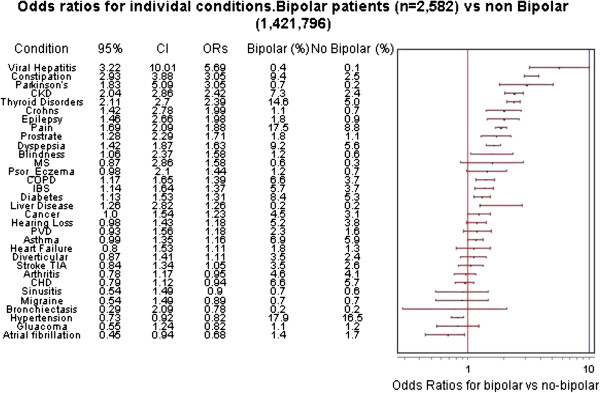
BACKGROUND: Individuals with serious mental disorders experience poor physical health, especially increased rates of cardiometabolic morbidity and premature morbidity. Recent evidence suggests that individuals with schizophrenia have numerous comorbid physical conditions that may be under-recorded and undertreated, but to date very few studies have explored this issue for bipolar disorder. METHODS: We conducted a cross-sectional analysis of a dataset of 1,751,841 registered patients within 314 primary care practices in Scotland, UK. Bipolar disorder was identified using Read Codes recorded within electronic medical records. Data on 32 common chronic physical conditions were also assessed. Potential prescribing inequalities were evaluated by analysing prescribing data for coronary heart disease (CHD) and hypertension. RESULTS: Compared to controls, individuals with bipolar disorder were significantly less likely to have no recorded physical conditions (OR 0.59, 95% CI 0.54 to 0.63) and significantly more likely to have one physical condition (OR 1.27, 95% CI 1.16 to 1.39), two physical conditions (OR 1.45, 95% CI 1.30 to 1.62) and three or more physical conditions (OR 1.44, 95% CI 1.30 to 1.64). People with bipolar disorder also had higher rates of thyroid disorders, chronic kidney disease, chronic pain, chronic obstructive airways disease and diabetes but, surprisingly, lower recorded rates of hypertension and atrial fibrillation. People with bipolar disorder and comorbid CHD or hypertension were significantly more likely to be prescribed no antihypertensive or cholesterol-lowering medications compared to controls, and bipolar individuals with CHD or hypertension were significantly less likely to be on two or more antihypertensive agents. CONCLUSIONS: Individuals with bipolar disorder are similar to individuals with schizophrenia in having a wide range of comorbid and multiple physical health conditions. They are also less likely than controls to have a primary-care record of cardiovascular conditions such as hypertension and atrial fibrillation. Those with a recorded diagnosis of CHD or hypertension were less likely to be treated with cardiovascular medications and were treated less intensively. This study highlights the high physical healthcare needs of people with bipolar disorder, and provides evidence for a systematic under-recognition and undertreatment of cardiovascular disease in this group.
Overview
The claims and statistics of this paper haven’t been checked yet.
Free: it reads the open-access text and checks the first 5 claims that cite a source we can check. Create a free account to check every claim.
Integrity signals
Registry
Cites
Statistics
Figures
Verification
Claims the paper makes
The claims and statistics of this paper haven’t been checked yet.
Free: it reads the open-access text and checks the first 5 claims that cite a source we can check. Create a free account to check every claim.
Claims other papers make about this one
Each is checked against this paper’s own text: does it say what the citing paper says it does?
The source backs part of the claim, not all of it — or backs it for a different population, condition or comparison.
In the citing paper
“In a large UK cross‐sectional analysis of electronic data sets involving 1.7 million patients in primary care, those diagnosed with BD, when compared with healthy controls, had lower rates of diagnoses (odds ratio [OR] 0.59, 95% confidence interval [CI] 0.54‐0.63) and treatment of medical conditions, despite higher rates of one (OR 1.2, 95% CI 1.16‐1.39) or multiple illnesses (OR 1.44, 95% CI 1.3‐”
From Canadian Network for Mood and Anxiety Treatments ( CANMAT ) and International Society for Bipolar Disorders ( ISBD ) 2018 guidelines for the management of patients with bipolar disorder (2018) · cites this paper as [769]
Experimental — accuracy not yet measuredThe cited source says what the claim attributes to it.
In the citing paper
“While there is consistent evidence showing the high prevalence of comorbid medical conditions in BD768, 769, 770, 771, 772, 773, 774 and the negative impact these diagnoses have on longevity,775, 776 these conditions frequently go undiagnosed or undertreated.”
Self-check
Percentages, sums and reported differences re-computed from the paper’s own numbers.
The self-check needs the paper’s full text.
Citations
Cites
Barnett, K., Mercer, S. W., Norbury, M., Watt, G., Wyke, S., & Guthrie, B. (2012) · The Lancet · doi:10.1016/s0140-6736(12)60240-2 · Cited by 6,972 · cited 1×
“A more detailed explanation of how these conditions were selected and defined is available elsewhere [18].”
BackgroundSelf-citationDE HERT, M., CORRELL, C. U., BOBES, J., CETKOVICH‐BAKMAS, M., COHEN, D., ASAI, I., DETRAUX, J., GAUTAM, S., MÖLLER, H., NDETEI, D. M., et al. (2011) · World Psychiatry · doi:10.1002/j.2051-5545.2011.tb00014.x · Cited by 2,488 · cited 1×
“It is well documented that physical and mental health problems interact to cause prolonged hospitalisation, treatment failure, poor quality of life and premature mortality [25,37,38].”
Background(2006) · Europe PMC (PubMed Central) · Cited by 1,299
Deprivation and Health in Scotland
Tunstall-Pedoe, H. (1993) · Postgraduate Medical Journal · doi:10.1136/pgmj.69.814.665-a · Cited by 1,167
Excess Mortality in Bipolar and Unipolar Disorder in Sweden
Ösby, U., Brandt, L., Correia, N., Ekbom, A., & Sparén, P. (2001) · Archives of General Psychiatry · doi:10.1001/archpsyc.58.9.844 · Cited by 1,120 · cited 2×
“However, it is not possible to fully explore the relationship between treatment and outcome in crosssectional data, particularly given the substantial premature cardiovascular mortality in bipolar disorder [1,12], consistent with people who were undertreated and with poor intermediate outcome control not surviving to…”
BackgroundResultMortality of patients with mood disorders: follow-up over 34–38 years
Angst, F., Stassen, H. H., Clayton, P. J., & Angst, J. (2002) · Journal of Affective Disorders · doi:10.1016/s0165-0327(01)00377-9 · Cited by 881 · cited 1×
“Although suicide is a major cause of premature mortality in bipolar disorder, with a lifetime risk of around 8% [10], most of the excess mortality associated with bipolar disorder and similar serious major mental disorders is due to an increased prevalence of cardiovascular, metabolic and endocrine conditions and risk…”
BackgroundDE HERT, M., COHEN, D., BOBES, J., CETKOVICH‐BAKMAS, M., LEUCHT, S., NDETEI, D. M., NEWCOMER, J. W., UWAKWE, R., ASAI, I., MÖLLER, H., et al. (2011) · World Psychiatry · doi:10.1002/j.2051-5545.2011.tb00036.x · Cited by 870 · cited 2×
“It is well documented that physical and mental health problems interact to cause prolonged hospitalisation, treatment failure, poor quality of life and premature mortality [25,37,38].”
BackgroundComorbidities and mortality in persons with schizophrenia: a Swedish national cohort study
Crump, C., Winkleby, M. A., Sundquist, K., & Sundquist, J. (2013) · American Journal of Psychiatry · doi:10.1176/appi.ajp.2012.12050599 · Cited by 619 · cited 2×
“However, rates of recording of cardiovascular disease and cancer were only slightly increased in people with schizophrenia, even though these individuals had more healthcare system contacts, suggesting that cardiovascular disease and cancer are significantly underdiagnosed and/or under-recorded in this population [24].”
BackgroundDeprivation and health in Scotland
Watt, G. (1992) · Social Science & Medicine · doi:10.1016/0277-9536(92)90326-l · Cited by 473
Morbidity and Rate of Undiagnosed Physical Illnesses in a Psychiatric Clinic Population
Koranyi, E. K. (1979) · Archives of General Psychiatry · doi:10.1001/archpsyc.1979.01780040056006 · Cited by 407
Mortality and medical comorbidity among psychiatric patients: a review
(1996) · Psychiatric Services · doi:10.1176/ps.47.12.1356 · Cited by 393 · cited 1×
“Mental health professionals may fail to appropriately diagnose physical health problems in their patients [28,29], they may carry out incomplete physical examinations [30] and a proportion may not feel confident with prescribing physical health (non-psychotropic) medications [16].”
Background(2012) · Cited by 389
Risk for Bipolar Illness in Patients Initially Hospitalized for Unipolar Depression
Goldberg, J. F., Harrow, M., & Whiteside, J. E. (2001) · American Journal of Psychiatry · doi:10.1176/appi.ajp.158.8.1265 · Cited by 319 · cited 1×
“There are also reports that indicate that severe or psychotic depression may be an early manifestation of bipolar disorder [36].”
BackgroundLaursen, T. M., Munk-Olsen, T., Agerbo, E., Gasse, C., & Mortensen, P. B. (2009) · Archives of General Psychiatry · doi:10.1001/archgenpsychiatry.2009.61 · Cited by 271 · cited 3×
“The fundamental question that our study raises is whether this equal access translates into equal treatment and care for those with bipolar disorder [17].”
BackgroundSmith, D. J., Langan, J., McLean, G., Guthrie, B., & Mercer, S. W. (2013) · BMJ Open · doi:10.1136/bmjopen-2013-002808 · Cited by 249
Self-citationMedical Evaluation of Psychiatric Patients: I. Results in a State Mental Health System
Koran, L. M. (1989) · Archives of General Psychiatry · doi:10.1001/archpsyc.1989.01810080063007 · Cited by 249 · cited 1×
“Mental health professionals may fail to appropriately diagnose physical health problems in their patients [28,29], they may carry out incomplete physical examinations [30] and a proportion may not feel confident with prescribing physical health (non-psychotropic) medications [16].”
BackgroundLaursen, T. M., Munk-Olsen, T., & Gasse, C. (2011) · PLoS ONE · doi:10.1371/journal.pone.0024597 · Cited by 234 · cited 3×
“However, it is not possible to fully explore the relationship between treatment and outcome in crosssectional data, particularly given the substantial premature cardiovascular mortality in bipolar disorder [1,12], consistent with people who were undertreated and with poor intermediate outcome control not surviving to…”
BackgroundResultThe Validity of Major Depression With Psychotic Features Based on a Community Study
Johnson, J. (1991) · Archives of General Psychiatry · doi:10.1001/archpsyc.1991.01810360039006 · Cited by 232 · cited 1×
“The prevalence of severe/ psychotic depression in the general population is considerably lower than that of bipolar disorder and psychotic features are present in only a minority of cases of major depressive disorder [35].”
BackgroundTsuang, M. T. (1980) · Archives of General Psychiatry · doi:10.1001/archpsyc.1980.01780220017001 · Cited by 197 · cited 1×
“Background Individuals with bipolar disorder have a standardised mortality rate (SMR) up to twice that of the general population [1-9].”
BackgroundTHE COURSE OF MANIC‐DEPRESSIVE PSYCHOSIS A follow up investigation of 215 patients
Bratfosand, O., & Haug, J. O. (1968) · Acta Psychiatrica Scandinavica · doi:10.1111/j.1600-0447.1968.tb07637.x · Cited by 178 · cited 1×
“Background Individuals with bipolar disorder have a standardised mortality rate (SMR) up to twice that of the general population [1-9].”
BackgroundThe Effect of Comorbid Substance Use Disorders on the Course of Bipolar Disorder: A Review
Tohen, M., Greenfield, S. F., Weiss, R. D., Zarate, C. A., & Vagge, L. M. (1998) · Harvard Review of Psychiatry · doi:10.3109/10673229809000321 · Cited by 163 · cited 1×
“There are high rates of drug abuse in bipolar disorder [20] and within Scotland there is a national programme of testing for blood borne viruses in those diagnosed with drug dependence.”
BackgroundMortality in affective disorder
Sharma, R., & Markar, H. R. (1994) · Journal of Affective Disorders · doi:10.1016/0165-0327(94)90112-0 · Cited by 158 · cited 1×
“Background Individuals with bipolar disorder have a standardised mortality rate (SMR) up to twice that of the general population [1-9].”
BackgroundTobacco Use Before, At, and After First-Episode Psychosis: A Systematic Meta-Analysis
Myles, N., Newall, H. D., Curtis, J., Nielssen, O., Shiers, D., & Large, M. (2012) · The Journal of Clinical Psychiatry · doi:10.4088/jcp.11r07222 · Cited by 158 · cited 1×
“Approximately 45% of individuals with bipolar disorder are known to smoke, compared with the population average of 20% [13].”
BackgroundSecond-generation antipsychotics and constipation: A review of the literature
Hert, M. D., Hudyana, H., Dockx, L., Bernagie, C., Sweers, K., Tack, J., Leucht, S., & Peuskens, J. (2011) · European Psychiatry · doi:10.1016/j.eurpsy.2010.03.003 · Cited by 147 · cited 1×
“Furthermore, constipation is an under-recognised side effect of antipsychotic medication that can significantly impact on quality of life, experienced by 20% to 30% of all patients prescribed such drugs [23].”
BackgroundFerrari, A. J., Baxter, A. J., & Whiteford, H. (2010) · Journal of Affective Disorders · doi:10.1016/j.jad.2010.11.007 · Cited by 143 · cited 1×
“2% is lower than might be expected, with most estimates of the prevalence of bipolar disorder being around 1% [34].”
BackgroundMitchell, A. J., Lord, O., & Malone, D. (2012) · British Journal of Psychiatry · doi:10.1192/bjp.bp.111.094532 · Cited by 136 · cited 6×
“These findings might be unexpected given existing knowledge on physical comorbidity in bipolar disorder [11,12,15,16], but, as noted above, recent reports have highlighted that physical comorbidity in major mental illness is often underdiagnosed and undertreated [15-17,24].”
BackgroundInfluentialHøyer, E. H., Mortensen, P. B., & Olesen, A. V. (2000) · British Journal of Psychiatry · doi:10.1192/bjp.176.1.76 · Cited by 129
Prevalence of irritable bowel syndrome in Korea: Population‐based survey using the Rome II criteria
Han, S. H., Lee, O. Y., Bae, S. C., Lee, S. H., Chang, Y. K., Yang, S. Y., Yoon, B. C., Choi, H. S., Hahm, J. S., Lee, M. H., et al. (2006) · Journal of Gastroenterology and Hepatology · doi:10.1111/j.1440-1746.2006.04269.x · Cited by 129 · cited 1×
“Although there is no clear mechanism for increased rates of constipation within bipolar disorder, psychological symptoms including those experienced as part of significant mood disorder are related to symptoms of irritable bowel syndrome including constipation [21,22].”
BackgroundExcess mortality of bipolar and unipolar manic-depressive patients
Weeke, A., & Væth, M. (1986) · Journal of Affective Disorders · doi:10.1016/0165-0327(86)90074-1 · Cited by 97 · cited 1×
“Background Individuals with bipolar disorder have a standardised mortality rate (SMR) up to twice that of the general population [1-9].”
BackgroundFive-year mortality in lithium-treated manic-depressive patients
Vestergaard, P., & Aagaard, J. (1991) · Journal of Affective Disorders · doi:10.1016/0165-0327(91)90016-l · Cited by 94 · cited 1×
“Background Individuals with bipolar disorder have a standardised mortality rate (SMR) up to twice that of the general population [1-9].”
BackgroundArseni, C., & Simionescu, M. D. (1959) · Acta Psychiatrica Scandinavica · doi:10.1111/j.1600-0447.1959.tb07559.x · Cited by 91
Bai, Y., Su, T., Chen, M., Chen, T., & Chang, W.-H. (2013) · Journal of Affective Disorders · doi:10.1016/j.jad.2013.02.019 · Cited by 86 · cited 1×
“It is also estimated that approximately 10% of people prescribed long-term antipsychotic medications will develop type II diabetes (at least twice the rate in the general population), and that 15% will develop hyperlipidaemia [14].”
BackgroundMultimorbidity and mental health: can psychiatry rise to the challenge?
Langan, J., Mercer, S. W., & Smith, D. J. (2013) · British Journal of Psychiatry · doi:10.1192/bjp.bp.112.123943 · Cited by 67 · cited 1×
“It is well documented that physical and mental health problems interact to cause prolonged hospitalisation, treatment failure, poor quality of life and premature mortality [25,37,38].”
BackgroundSelf-citationA follow-up of 270 patients with acute affective psychoses.
Astrup, C., Fossum, A., & Holmboe, R. (1959) · PubMed · Cited by 64
Manic-depressive illness. A clinical, social and genetic study.
Petterson, U. (1977) · PubMed · Cited by 50
Cardiovascular drugs and the risk of suicide: a nested case-control study
Callréus, T., Andersen, U. A., Hallas, J., & Andersen, M. T. (2007) · European Journal of Clinical Pharmacology · doi:10.1007/s00228-007-0293-5 · Cited by 45 · cited 1×
“about suicide risk, as some cardiovascular medications, such as beta blockers, may be dangerous in overdose [16,33].”
BackgroundWeinryb, R. M., Österberg, E., Blomquist, L., Hultcrantz, R., Krakau, I., & Åsberg, M. (2003) · Scandinavian Journal of Gastroenterology · doi:10.1080/00365520310002166 · Cited by 44 · cited 1×
“Although there is no clear mechanism for increased rates of constipation within bipolar disorder, psychological symptoms including those experienced as part of significant mood disorder are related to symptoms of irritable bowel syndrome including constipation [21,22].”
BackgroundVariables associated with general practitioners taking on serious mental disorder patients
Fleury, M., Bamvita, J., & Tremblay, J. (2009) · BMC Family Practice · doi:10.1186/1471-2296-10-41 · Cited by 38 · cited 1×
“General practitioners who do not feel confident in managing complex and severe mental illness may be less likely to follow-up patients with major mental illness and comorbid physical health problems [31].”
BackgroundTHE EFFECTS OF ATARAXIC DRUGS ON SCHIZOPHRENIC SUBGROUPS RELATED TO EXPERIMENTAL FINDINGS
Astrup, C. (1959) · Acta Psychiatrica Scandinavica · doi:10.1111/j.1600-0447.1959.tb07826.x · Cited by 28
Mackell, J. A., Harrison, D. J., & McDonnell, D. D. (2005) · Mental Health Services Research · doi:10.1007/s11020-005-7454-x · Cited by 24 · cited 1×
“People with bipolar disorder may also be prone to less regular attendance at clinics because of depressive and manic or hypomanic episodes [27].”
BackgroundMedication management of depression
Kurdyak, P. A., & Gnam, W. (2004) · Journal of Psychosomatic Research · doi:10.1016/j.jpsychores.2004.04.367 · Cited by 23 · cited 1×
“There are, however, conflicting reports within the literature that suggest that a higher frequency of healthcare visits in the context of mental illness may result in increases in guideline-recommended care for comorbid physical conditions [32].”
ResultHolt, R. I. G. (2012) · The South African journal of diabetes & vascular disease · Cited by 14
HYPNOTIC INDUCTION BY MEANS OF FOLDING HANDS
Wagner, F. F. (1951) · Acta Psychiatrica Scandinavica · doi:10.1111/j.1600-0447.1951.tb04634.x · Cited by 1
Cited by
Yatham, L. N., Kennedy, S. H., Parikh, S. V., Schaffer, A., Bond, D. J., Frey, B. N., Sharma, V., Goldstein, B. I., Rej, S., Beaulieu, S., et al. (2018) · Bipolar Disorders · doi:10.1111/bdi.12609 · Cited by 1,852
Correll, C. U., Solmi, M., Veronese, N., Bortolato, B., Rosson, S., Santonastaso, P., Thapa‐Chhetri, N., Fornaro, M., Gallicchio, D., Collantoni, E., et al. (2017) · World Psychiatry · doi:10.1002/wps.20420 · Cited by 1,729
Cooper, S.-A., McLean, G., Guthrie, B., McConnachie, A., Mercer, S., Sullivan, F., & Morrison, J. (2015) · BMC Family Practice · doi:10.1186/s12875-015-0329-3 · Cited by 443
Self-citationCardiovascular disease in patients with severe mental illness
Nielsen, R. E., Banner, J., & Jensen, S. E. (2021) · Nature Reviews Cardiology · doi:10.1038/s41569-020-00463-7 · Cited by 389
Clague, F., Mercer, S. W., McLean, G., Reynish, E., & Guthrie, B. (2016) · Age and Ageing · doi:10.1093/ageing/afw176 · Cited by 195
Self-citation
Metadata
- Authors
- Smith, D. J., Martin, D., McLean, G., Langan, J., Guthrie, B., & Mercer, S. W.
- Affiliations
- Gartnavel General Hospital (GB)
- University of Glasgow (GB)
- University of Dundee (GB)
- Venue
- BMC Medicine
- Published
- 2013-12
- Volume
- 11
- Issue
- 1
- Pages
- 263-263
- ISSN
- 1741-7015 (ISSN-L)
- PMC
- PMC3880052
- OpenAlex
- W2088438351
- Cited by
- 138
- References
- 42
- Citations by year
- 2026: 6 · 2025: 3 · 2024: 11 · 2023: 9 · 2022: 22 · 2021: 6 · 2020: 12 · 2019: 5 · 2018: 13 · 2017: 10 · 2016: 22 · 2015: 11 · 2014: 8
- FWCI
- 9.68
- Type
- journal article
- Language
- en
- Open access
- gold
- doi.org
- Licence
- Locations
- BMC Medicine (publishedVersion, cc-by)
- Europe PMC (PubMed Central) (publishedVersion, cc-by)
- PubMed Central (publishedVersion, cc-by)
- PubMed (publishedVersion)
- ENLIGHTEN (Jurnal Bimbingan dan Konseling Islam) (acceptedVersion)
- Discovery Research Portal (University of Dundee) (submittedVersion)
- Edinburgh Research Explorer (University of Edinburgh) (submittedVersion, cc-by)
- Funders
- Scottish Government
- University of Glasgow
- University of Aberdeen
- Chief Scientist Office, Scottish Government Health and Social Care Directorate
- Topics
- Health Sciences › Medicine › Psychiatry and Mental health › Bipolar Disorder and Treatment
- Health Sciences › Medicine › Epidemiology › Chronic Disease Management Strategies
- Health Sciences › Medicine › Psychiatry and Mental health › Schizophrenia research and treatment
- Keywords
- bipolar disorder, multimorbidity, cardiovascular disease, undertreatment, coronary artery disease, hypertension, antihypertensive drugs, cholesterol-lowering drugs, atrial fibrillation, thyroid dysfunction, chronic kidney disease, chronic pain, chronic obstructive pulmonary disease, diabetes mellitus, somatic comorbidity, primary care, electronic health records
- MeSH terms
- Adolescent, Adult, Aged, Aged, 80 and over, Bipolar Disorder, Cardiovascular Diseases, Cross-Sectional Studies, Female, Humans, Male, Middle Aged, Scotland, Comorbidity, Young Adult
About these checks
Registry, retraction, Cites and statistics results are computed, not judged, with one exception: a printed reference that no index lists is read once by a model before it counts as a citation error. Claims are extracted by a model and kept only when their quote appears verbatim in the text; each cited source is then checked, with a model’s help, for whether it says what the claim relies on. Those verdicts can be wrong — read the claim’s quote and the cited source before relying on one.
Statistics and arithmetic are recomputed, not judged.
Confidence bands are shown only for fields calibrated on our annotated test set. None is calibrated yet, so no band is shown.
What counts as a claim ›How we measure confidence ›How we check this ›
Are you an author, or do you see a problem with this page? Request a review
Data sources
Bibliographic data: Semantic Scholar, OpenAlex, Crossref.
Contains information from the Semantic Scholar Academic Graph Datasets, made available under the ODC Attribution License (ODC-BY 1.0).
Semantic Scholar’s data is described in: Kinney, R., et al. (2023). The Semantic Scholar Open Data Platform. arXiv:2301.10140.
