

High-end normal adrenocorticotropic hormone and cortisol levels are associated with specific cardiovascular risk factors in pediatric obesity: a cross-sectional study
Open accessThe DOI matches its Crossref record; 43 of the 43 references it cites were found in a registry or an index.
Abstract
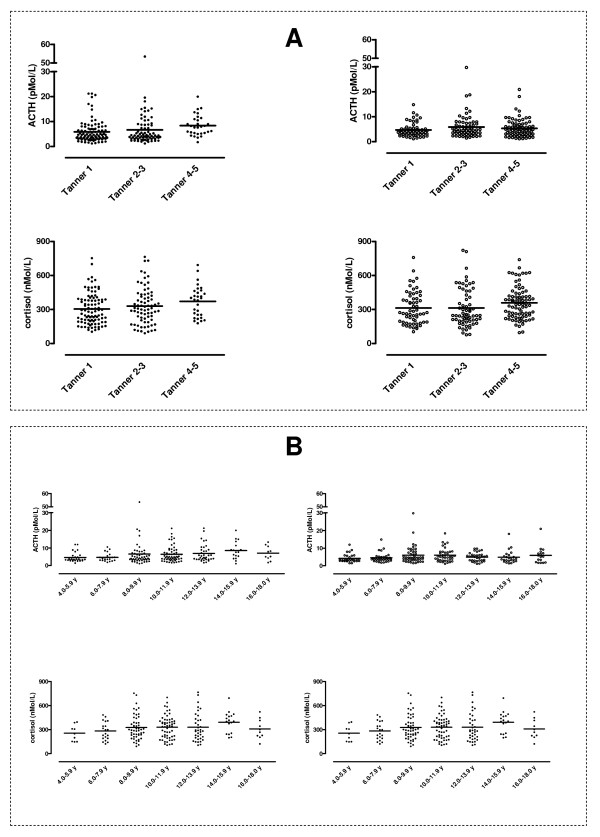
BACKGROUND: The hypothalamic-pituitary-adrenal (HPA) axis, and in particular cortisol, has been reported to be involved in obesity-associated metabolic disturbances in adults and in selected populations of adolescents. The aim of this study was to investigate the association between morning adrenocorticotropic hormone (ACTH) and cortisol levels and cardiovascular risk factors in overweight or obese Caucasian children and adolescents. METHODS: This cross-sectional study of 450 obese children and adolescents (aged 4 to 18 years) was performed in a tertiary referral center. ACTH, cortisol, cardiovascular risk factors (fasting and post-challenge glucose, high-density lipoprotein (HDL)-cholesterol, low-density lipoprotein (LDL)-cholesterol, triglycerides, and hypertension) and insulin resistance were evaluated. All analyses were corrected for confounding factors (sex, age, puberty, body mass index), and odds ratios were determined. RESULTS: ACTH and cortisol levels were positively associated with systolic and diastolic blood pressure, triglycerides, fasting glucose and insulin resistance. Cortisol, but not ACTH, was also positively associated with LDL-cholesterol. When adjusted for confounding factors, an association between ACTH and 2 h post-oral glucose tolerance test glucose was revealed. After stratification according to cardiovascular risk factors and adjustment for possible confounding factors, ACTH levels were significantly higher in subjects with triglycerides ≥90th percentile (P <0.02) and impaired fasting glucose or glucose tolerance (P <0.001). Higher cortisol levels were found in subjects with blood pressure ≥95th percentile and LDL-cholesterol ≥90th percentile. Overall, the highest tertiles of ACTH (>5.92 pmol/l) and cortisol (>383.5 nmol/l) although within the normal range were associated with increases in cardiovascular risk factors in this population. CONCLUSIONS: In obese children and adolescents, high morning ACTH and cortisol levels are associated with cardiovascular risk factors. High ACTH levels are associated with high triglyceride levels and hyperglycemia, while high cortisol is associated with hypertension and high LDL-cholesterol. These specific relationships suggest complex mechanisms through which the HPA axis may contribute to metabolic impairments in obesity, and merit further investigations.
Overview
The claims and statistics of this paper haven’t been checked yet.
Free: it reads the open-access text and checks the first 5 claims that cite a source we can check. Create a free account to check every claim.
Integrity signals
Registry
Cites
Statistics
Figures
Verification
Claims the paper makes
The claims and statistics of this paper haven’t been checked yet.
Free: it reads the open-access text and checks the first 5 claims that cite a source we can check. Create a free account to check every claim.
Claims other papers make about this one
Each is checked against this paper’s own text: does it say what the citing paper says it does?
The cited source doesn’t support the claim as written.
In the citing paper
“Serum cortisol is associated with greater insulin resistance and worsening of insulin resistance in healthy adolescents and those at risk for Type 2 diabetes, even after accounting for body fat (Adam et al., 2010; Huybrechts et al., 2014; Prodam et al., 2013).”
From Relationship of Mindfulness to Distress and Cortisol Response in Adolescent Girls At-Risk for Type 2 Diabetes. (2018) · cites this paper as Prodam et al., 2013
Checked by a reasoning model — may be wrong.
Experimental — accuracy not yet measured
Self-check
Percentages, sums and reported differences re-computed from the paper’s own numbers.
The self-check needs the paper’s full text.
Citations
Cites
National High Blood Pressure Education Program Working Group on High Blood Pressure in Children and Adolescents (2004) · PEDIATRICS · doi:10.1542/peds.114.2.s2.555 · Cited by 6,938
Obesity and the Metabolic Syndrome in Children and Adolescents
Weiss, R., Dziura, J., Burgert, T. S., Tamborlane, W. V., Taksali, S. E., Yeckel, C. W., Allen, K., Lopes, M., Savoye, M., Morrison, J., et al. (2004) · New England Journal of Medicine · doi:10.1056/nejmoa031049 · Cited by 3,459
The diagnosis of Cushing's syndrome: an Endocrine Society Clinical Practice Guideline.
Nieman, L. K., Biller, B. M. K., Findling, J. W., Newell-Price, J., Savage, M. O., Stewart, P. M., & Montori, V. M. (2008) · The Journal of Clinical Endocrinology & Metabolism · doi:10.1210/jc.2008-0125 · Cited by 2,718 · cited 2×
“Nieman LK, Biller BM, Findling JW, Newell-Price J, Savage MO, Stewart PM, Montori VM: The diagnosis of Cushing’s syndrome: an Endocrine Society Clinical Practice Guideline.”
MethodPrevalence of obesity in the United States, 2009-2010.
Ogden, C. L., Carroll, M. D., Kit, B. K., & Flegal, K. M. (2012) · PubMed · Cited by 2,467
Cook, S., Weitzman, M., Auinger, P., Nguyen, M., & Dietz, W. H. (2003) · Archives of Pediatrics & Adolescent Medicine · doi:10.1001/archpedi.157.8.821 · Cited by 2,326 · cited 11×
“It is interesting to note that when a cut-off was imposed, cortisol levels were significantly higher only with respect to the 95th percentile of BP, whereas there was no significant association with the 90th percentile, which is suggested as pathological in the MetS definition [18], and is prehypertensive according to…”
BackgroundMethodInfluentialGlobal prevalence and trends of overweight and obesity among preschool children
de Onis, M., Blössner, M., & Borghi, E. (2010) · The American Journal of Clinical Nutrition · doi:10.3945/ajcn.2010.29786 · Cited by 2,182 · cited 1×
“Background The prevalence of obesity in children and adolescents has increased over several decades in many countries [1,2].”
BackgroundLipid screening and cardiovascular health in childhood
Daniels, S. R., Greer, F. R., & and the Committee on Nutrition (2008) · Pediatrics · doi:10.1542/peds.2008-1349 · Cited by 1,178 · cited 1×
“Triglyceride, LDL-cholesterol and HDL-cholesterol cut-off levels for age and sex were those used in the Lipid Research Clinic Pediatric Prevalence Study [22].”
Methodde Ferranti, S. D., Gauvreau, K., Ludwig, D. S., Neufeld, E. J., Newburger, J. W., & Rifai, N. (2004) · Circulation · doi:10.1161/01.cir.0000145117.40114.c7 · Cited by 1,123 · cited 10×
“It is interesting to note that when a cut-off was imposed, cortisol levels were significantly higher only with respect to the 95th percentile of BP, whereas there was no significant association with the 90th percentile, which is suggested as pathological in the MetS definition [18], and is prehypertensive according to…”
MethodInfluentialThe metabolic syndrome in children and adolescents
Zimmet, P., Alberti, G., Kaufman, F., Tajima, N., Silink, M., Arslanian, S., Wong, G., Bennett, P., Shaw, J., & Caprio, S. (2007) · The Lancet · doi:10.1016/s0140-6736(07)60958-1 · Cited by 937
Rosmond, R., Dallman, M. F., & Björntorp, P. (1998) · The Journal of Clinical Endocrinology & Metabolism · doi:10.1210/jcem.83.6.4843 · Cited by 871
Italian cross-sectional growth charts for height, weight and BMI (2 to 20 yr)
Cacciari, E., Milani, S., Balsamo, A., Spada, E., Bona, G., Cavallo, L., Cerutti, F., Gargantini, L., Greggio, N., Tonini, G., et al. (2006) · Journal of Endocrinological Investigation · doi:10.1007/bf03344156 · Cited by 813
Self-citationThe Pathogenetic Role of Cortisol in the Metabolic Syndrome: A Hypothesis
Anagnostis, P., Athyros, V. G., Tziomalos, K., Karagiannis, A., & Mikhailidis, D. P. (2009) · The Journal of Clinical Endocrinology & Metabolism · doi:10.1210/jc.2009-0370 · Cited by 613 · cited 15×
“The association between cortisol and LDL-cholesterol could be a consequence of multifactorial mechanisms, including direct and indirect effects on lipolysis, free fatty acid production and turnover, and very-low-density lipoprotein synthesis and fatty acid accumulation in the liver (for review see [8,37]).”
BackgroundInfluentialRosmond, R. (1998) · Journal of Clinical Endocrinology & Metabolism · doi:10.1210/jc.83.6.1853 · Cited by 590
Glucocorticoids and cardiovascular disease
Walker, B. R. (2007) · European Journal of Endocrinology · doi:10.1530/eje-07-0455 · Cited by 529 · cited 10×
“It is interesting to note that when a cut-off was imposed, cortisol levels were significantly higher only with respect to the 95th percentile of BP, whereas there was no significant association with the 90th percentile, which is suggested as pathological in the MetS definition [18], and is prehypertensive according to…”
BackgroundInfluentialPrevalence and Trends of a Metabolic Syndrome Phenotype Among U.S. Adolescents, 1999–2000
Duncan, G. E., Li, S. M., & Zhou, X.-H. (2004) · Diabetes Care · doi:10.2337/diacare.27.10.2438 · Cited by 500 · cited 1×
“It is well known that Hispanic people have a higher prevalence of type 2 diabetes and cardiovascular diseases [20,23-25], thus such a selected sample of subjects could have quite a different phenotype linked to their genetic susceptibility.”
BackgroundLambillotte, C., Gilon, P., & Henquin, J. C. (1997) · Journal of Clinical Investigation · doi:10.1172/jci119175 · Cited by 419 · cited 1×
“The relationship between glucose and cortisol is in line with glucocorticoid effects on hepatic gluconeogenesis, insulin secretion and resistance [8,39].”
BackgroundMetabolic consequences of stress during childhood and adolescence
Pervanidou, P., & Chrousos, G. P. (2012) · Metabolism · doi:10.1016/j.metabol.2011.10.005 · Cited by 316 · cited 1×
“However, a single morning fasting cortisol measurement has been shown to be associated with chronic stress and metabolic disturbances [40].”
BackgroundThe metabolic syndrome in children and adolescents
Cruz, M. L., & Goran, M. I. (2004) · Current Diabetes Reports · doi:10.1007/s11892-004-0012-x · Cited by 294
Racial/Ethnic Differences in Cortisol Diurnal Rhythms in a Community Sample of Adolescents
DeSantis, A. S., Adam, E. K., Doane, L. D., Mineka, S., Zinbarg, R. E., & Craske, M. G. (2007) · Journal of Adolescent Health · doi:10.1016/j.jadohealth.2007.03.006 · Cited by 240 · cited 1×
“A study in adolescents found racial/ethnic differences in daily cortisol secretion [10], but any studies in children have been limited to select or small populations.”
BackgroundChildhood obesity and cardiovascular disease: links and prevention strategies
Nadeau, K. J., Maahs, D. M., Daniels, S. R., & Eckel, R. H. (2011) · Nature Reviews Cardiology · doi:10.1038/nrcardio.2011.86 · Cited by 199 · cited 1×
“This phenomenon has been accompanied by an increased incidence of type 2 diabetes and metabolic syndrome (MetS), which includes dyslipidemia and hypertension [3].”
BackgroundKnutsson, U., Dahlgren, J., Marcus, C., Rosberg, S., Brönnegård, M., Stierna, P., & Albertsson-Wikland, K. (1997) · The Journal of Clinical Endocrinology & Metabolism · doi:10.1210/jcem.82.2.3769 · Cited by 198
Pathophysiology of Dyslipidemia in Cushing’s Syndrome
Arnaldi, G., Scandali, V. M., Trementino, L., Cardinaletti, M., Appolloni, G., & Boscaro, M. (2010) · Neuroendocrinology · doi:10.1159/000314213 · Cited by 189 · cited 2×
“The association between cortisol and LDL-cholesterol could be a consequence of multifactorial mechanisms, including direct and indirect effects on lipolysis, free fatty acid production and turnover, and very-low-density lipoprotein synthesis and fatty acid accumulation in the liver (for review see [8,37]).”
BackgroundClassification of Body Fatness by Body Mass Index–for-Age Categories Among Children
Freedman, D. S., Wang, J., Thornton, J. C., Mei, Z., Sopher, A. B., Pierson, R. N., Dietz, W. H., & Horlick, M. (2009) · Archives of Pediatrics & Adolescent Medicine · doi:10.1001/archpediatrics.2009.104 · Cited by 165 · cited 1×
“However, BMI is a good surrogate for body fat in obesity in large epidemiological sample sizes [41].”
BackgroundResistance to Glucocorticoid Feedback in Obesity
Jessop, D. S. (2001) · Journal of Clinical Endocrinology & Metabolism · doi:10.1210/jc.86.9.4109 · Cited by 141 · cited 1×
“ACTH can be increased and total circulating cortisol concomitantly reduced [30].”
BackgroundActivity of the hypothalamic–pituitary–adrenal axis in different obesity phenotypes
Pasquali, R., & Vicennati, V. (2000) · International Journal of Obesity · doi:10.1038/sj.ijo.0801277 · Cited by 131
Association between the Metabolic Syndrome and Serum Cortisol in Overweight Latino Youth
Weigensberg, M. J., Toledo-Corral, C. M., & Goran, M. I. (2008) · The Journal of Clinical Endocrinology & Metabolism · doi:10.1210/jc.2007-2309 · Cited by 128 · cited 5×
“The data regarding cortisol are in agreement with the study of Weigensberg and coworkers who demonstrated that cortisol is higher in obese Latino youths with MetS, independent of the degree of obesity and insulin sensitivity [12].”
BackgroundResultInfluentialFernandez-Real, J.-M., Pugeat, M., Grasa, M., Broch, M., Vendrell, J., Brun, J., & Ricart, W. (2002) · The Journal of Clinical Endocrinology & Metabolism · doi:10.1210/jc.2001-011843 · Cited by 114 · cited 1×
“In a large population study, CBG levels were negatively correlated with BMI, BP and insulin resistance, perhaps indicating suppression of CBG synthesis, or a CBG gene polymorphism in obesity [35].”
BackgroundMechanisms of cortisol-induced hypertension in humans
Whitworth, J. A., Brown, M. A., Kelly, J. J. P., & Williamson, P. M. (1995) · Steroids · doi:10.1016/0039-128x(94)00033-9 · Cited by 110
Wudy, S. A., Hartmann, M. F., & Remer, T. (2007) · American Journal of Physiology-Endocrinology and Metabolism · doi:10.1152/ajpendo.00495.2006 · Cited by 101 · cited 1×
“However 24-h excretion of free cortisol and free cortisone in healthy children up to an age of about 14 years is constant after body surface area correction [29,33].”
BackgroundCortisol Is Negatively Associated with Insulin Sensitivity in Overweight Latino Youth
Adam, T. C., Hasson, R. E., Ventura, E. E., Toledo-Corral, C., Le, K.-A., Mahurkar, S., Lane, C. J., Weigensberg, M. J., & Goran, M. I. (2010) · The Journal of Clinical Endocrinology & Metabolism · doi:10.1210/jc.2010-0322 · Cited by 95 · cited 3×
“Many studies evaluating cortisol in pediatric obesity have demonstrated an association between cortisol and insulin resistance, leading to hypothesis that a relationship between cortisol and metabolic disturbances would be mediated by insulin sensitivity [9,11,13].”
BackgroundResultCortisol and Its Relation to Insulin Resistance before and after Weight Loss in Obese Children
Reinehr, T., & Andler, W. (2004) · Hormone Research in Paediatrics · doi:10.1159/000079841 · Cited by 91 · cited 9×
“These findings suggested that, in children, there are similar mechanisms to those reported in adults, and that higher cortisol levels are first a consequence rather than a cause of comorbidities in obesity [9].”
BackgroundResultInfluentialCorticosteroid-binding globulin: The clinical significance of altered levels and heritable mutations
Gagliardi, L., Ho, J. T., & Torpy, D. J. (2010) · Molecular and Cellular Endocrinology · doi:10.1016/j.mce.2009.07.015 · Cited by 88 · cited 2×
“Higher CBG levels reduce the rate of cortisol clearance, and thus reflect cortisol levels in plasma [34].”
BackgroundAdrenocortical activity in healthy children is associated with fat mass
Dimitriou, T., Maser‐Gluth, C., & Remer, T. (2003) · American Journal of Clinical Nutrition · doi:10.1093/ajcn/77.3.731 · Cited by 80 · cited 5×
“However 24-h excretion of free cortisol and free cortisone in healthy children up to an age of about 14 years is constant after body surface area correction [29,33].”
BackgroundResultInfluentialSex-dependent role of glucocorticoids and androgens in the pathophysiology of human obesity
Pasquali, R., Vicennati, V, Gambineri, A., & Pagotto, U. (2008) · International Journal of Obesity · doi:10.1038/ijo.2008.129 · Cited by 74 · cited 1×
“Cortisol has been reported to have a role in obesity, hypertension, and the altered glucose and lipid profile in Cushing’s syndrome, and some studies have suggested that moderately increased morning fasting cortisol may be associated with the presence of cardiovascular risk factors in adults [4-6].”
BackgroundPathophysiology of type 2 diabetes mellitus in youth: the evolving chameleon
Tfayli, H. M., & Arslanian, S. A. (2009) · Arquivos Brasileiros de Endocrinologia & Metabologia · doi:10.1590/s0004-27302009000200008 · Cited by 69 · cited 1×
“It is well known that Hispanic people have a higher prevalence of type 2 diabetes and cardiovascular diseases [20,23-25], thus such a selected sample of subjects could have quite a different phenotype linked to their genetic susceptibility.”
BackgroundIwen, K. A. H., Senyaman, O., Schwartz, A., Drenckhan, M., Meier, B., Hadaschik, D., & Klein, J. (2008) · Journal of Endocrinology · doi:10.1677/joe-07-0299 · Cited by 62 · cited 1×
“It has been shown in vitro that ACTH interacts with adipocytes, promotes insulin resistance and is proinflammatory [14].”
BackgroundWitchel, S. F., & DeFranco, D. B. (2006) · Nature Clinical Practice Endocrinology & Metabolism · doi:10.1038/ncpendmet0323 · Cited by 58
Barat, P., Gayard-Cros, M., Andrew, R., Corcuff, J., Jouret, B., Barthe, N., Perez, P., Germain, C., Tauber, M., Walker, B. R., et al. (2007) · The Journal of Pediatrics · doi:10.1016/j.jpeds.2007.01.029 · Cited by 40 · cited 4×
“Many studies evaluating cortisol in pediatric obesity have demonstrated an association between cortisol and insulin resistance, leading to hypothesis that a relationship between cortisol and metabolic disturbances would be mediated by insulin sensitivity [9,11,13].”
BackgroundResultInfluentialSukhija, R., Kakar, P., Mehta, V., & Mehta, J. L. (2006) · The American Journal of Cardiology · doi:10.1016/j.amjcard.2006.03.028 · Cited by 25 · cited 1×
“Cortisol has been reported to have a role in obesity, hypertension, and the altered glucose and lipid profile in Cushing’s syndrome, and some studies have suggested that moderately increased morning fasting cortisol may be associated with the presence of cardiovascular risk factors in adults [4-6].”
BackgroundReduction of plasma cortisol levels in childhood obesity
Chalew, S. A., Lozano, R. A., Armour, K. M., Zadik, Z., & Kowarski, A. A. (1991) · The Journal of Pediatrics · doi:10.1016/s0022-3476(05)80302-6 · Cited by 24 · cited 1×
“However, also in children reduced cortisol blood levels are not uncommon in case of elevated body fat levels [31,32].”
BackgroundBerg, A., Rafnsson, A. T., Jóhannsson, M., Dallongeville, J., & Árnadóttir, M. (2006) · Metabolism · doi:10.1016/j.metabol.2006.04.001 · Cited by 19 · cited 1×
“Moreover, ACTH has been shown to increase apolipoprotein E levels in humans, a key protein in determining triglyceride metabolism [38].”
BackgroundProdam, F., Trovato, L., Demarchi, I., Busti, A., Petri, A., Moia, S., Walker, G. E., Aimaretti, G., Bona, G., & Bellone, S. (2011) · e-SPEN the European e-Journal of Clinical Nutrition and Metabolism · doi:10.1016/j.eclnm.2011.04.001 · Cited by 13 · cited 1×
“Other assays and formulas are as previously described [17].”
MethodSelf-citationAdaptive and maladaptive cortisol responses to pediatric obesity
Soros, A., Zadik, Z., & Chalew, S. A. (2008) · Medical Hypotheses · doi:10.1016/j.mehy.2008.04.020 · Cited by 9 · cited 2×
“These findings are concordant with the evidence that lower daily cortisol levels and normal CBG concentrations have been shown in childhood obesity as an age-dependent mechanism to prevent type 2 diabetes [32].”
BackgroundResult
Research works printed but not linked: 1
- 42. Pre-publication history The pre-publication history for this paper can be accessed here: http://www.biomedcentral.com/1741-7015/11/44/prepub doi:10.1186/1741-7015-11-44 Cite this article as: Prodam et al.: High-end normal adrenocorticotropic hormone and cortisol levels are associated with specific cardiovascular risk factors in pediatric obesity: a cross-sectional study. BMC Medicine 2013 11:44.
Cited by
Developmental origins of cardiovascular disease: Impact of early life stress in humans and rodents
Murphy, M. O., Cohn, D. M., & Loria, A. S. (2017) · Neuroscience & Biobehavioral Reviews · doi:10.1016/j.neubiorev.2016.07.018 · Cited by 117
“A recent study examining the relationship between the HPA axis and cardiovascular risk factors in obese children revealed a positive association between systolic blood pressure and ACTH and cortisol levels (Prodam et al., 2013) thereby the risk for cardiovascular disease.”
BackgroundEvidence for Stress-like Alterations in the HPA-Axis in Women Taking Oral Contraceptives
Hertel, J., König, J., Homuth, G., der Auwera, S. V., Wittfeld, K., Pietzner, M., Kacprowski, T., Pfeiffer, L., Kretschmer, A., Waldenberger, M., et al. (2017) · Scientific Reports · doi:10.1038/s41598-017-13927-7 · Cited by 106
Pathophysiology of hypertension in obese children: a systematic review
Wirix, A. J. G., Kaspers, P. J., Nauta, J., Chinapaw, M. J. M., & Holthe, J. E. K. (2015) · Obesity Reviews · doi:10.1111/obr.12305 · Cited by 86
“Higher cortisol and ACTH levels, even though both within the normal range, increased the odds of having hypertension, independently of BMI (46).”
BackgroundReinehr, T., Kulle, A., Wolters, B., Knop, C., Lass, N., Welzel, M., & Holterhus, P.-M. (2014) · The Journal of Clinical Endocrinology & Metabolism · doi:10.1210/jc.2013-4398 · Cited by 50
Low-protein diet in puberty impairs testosterone output and energy metabolism in male rats
de Oliveira, J. C., de Moura, E. G., Miranda, R. A., de Moraes, A. M. P., Barella, L. F., da Conceição, E. P. S., Gomes, R. M., Ribeiro, T. A., Malta, A., Martins, I. P., et al. (2018) · Journal of Endocrinology · doi:10.1530/joe-17-0606 · Cited by 46
Metadata
- Authors
- Prodam, F., Ricotti, R., Agarla, V., Parlamento, S., Genoni, G., Balossini, C., Walker, G. E., Aimaretti, G., Bona, G., & Bellone, S.
- Affiliations
- Università degli Studi del Piemonte Orientale “Amedeo Avogadro” (IT)
- Corresponding author
- Prodam, Flavia
- Venue
- BMC Medicine
- Published
- 2013-02-20
- Volume
- 11
- Issue
- 1
- Pages
- 44-44
- ISSN
- 1741-7015 (ISSN-L)
- PMC
- PMC3621818
- OpenAlex
- W1973926831
- Cited by
- 47
- References
- 43
- Citations by year
- 2026: 2 · 2025: 3 · 2024: 2 · 2023: 2 · 2022: 1 · 2021: 3 · 2020: 2 · 2019: 2 · 2018: 4 · 2017: 3 · 2016: 9 · 2015: 9 · 2014: 3 · 2013: 2
- FWCI
- 5.59
- Type
- journal article
- Language
- en
- Open access
- gold
- doi.org
- Licence
- Locations
- BMC Medicine (publishedVersion, cc-by)
- Europe PMC (PubMed Central) (publishedVersion, cc-by)
- PubMed Central (publishedVersion, cc-by)
- PubMed (publishedVersion)
- Funders
- Ministero dell’Istruzione, dell’Università e della Ricerca (20082P8CCE)
- Regione Piemonte
- Ministero dell'Università e della Ricerca
- Topics
- Health Sciences › Medicine › Endocrinology, Diabetes and Metabolism › Adipokines, Inflammation, and Metabolic Diseases
- Health Sciences › Medicine › Endocrinology, Diabetes and Metabolism › Adrenal Hormones and Disorders
- Life Sciences › Neuroscience › Behavioral Neuroscience › Stress Responses and Cortisol
- Keywords
- childhood obesity, ACTH, cortisol, hypothalamic-pituitary-adrenal axis, cardiovascular risk factors, hypertension, insulin resistance, hypertriglyceridemia, impaired fasting glucose, glucose tolerance, LDL cholesterol, hyperglycemia, children and adolescents
- MeSH terms
- Adolescent, Adrenocorticotropic Hormone, Cardiovascular Diseases, Child, Child, Preschool, Cross-Sectional Studies, Female, Humans, Hydrocortisone, Male, Obesity, Risk Factors, Tertiary Care Centers
About these checks
Registry, retraction, Cites and statistics results are computed, not judged, with one exception: a printed reference that no index lists is read once by a model before it counts as a citation error. Claims are extracted by a model and kept only when their quote appears verbatim in the text; each cited source is then checked, with a model’s help, for whether it says what the claim relies on. Those verdicts can be wrong — read the claim’s quote and the cited source before relying on one.
Statistics and arithmetic are recomputed, not judged.
Confidence bands are shown only for fields calibrated on our annotated test set. None is calibrated yet, so no band is shown.
What counts as a claim ›How we measure confidence ›How we check this ›
Are you an author, or do you see a problem with this page? Request a review
Data sources
Bibliographic data: Semantic Scholar, OpenAlex, Crossref.
Contains information from the Semantic Scholar Academic Graph Datasets, made available under the ODC Attribution License (ODC-BY 1.0).
Semantic Scholar’s data is described in: Kinney, R., et al. (2023). The Semantic Scholar Open Data Platform. arXiv:2301.10140.
