

Modeling of the hypothalamic-pituitary-adrenal axis-mediated interaction between the serotonin regulation pathway and the stress response using a Boolean approximation: a novel study of depression
Open accessThe DOI matches its Crossref record; 70 of the 70 references it cites were found in a registry or an index.
Abstract
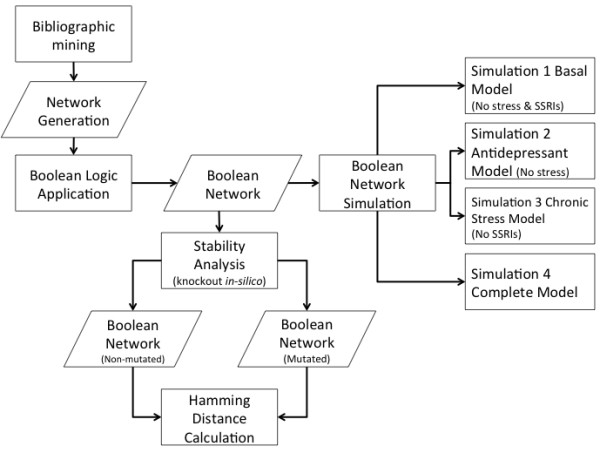
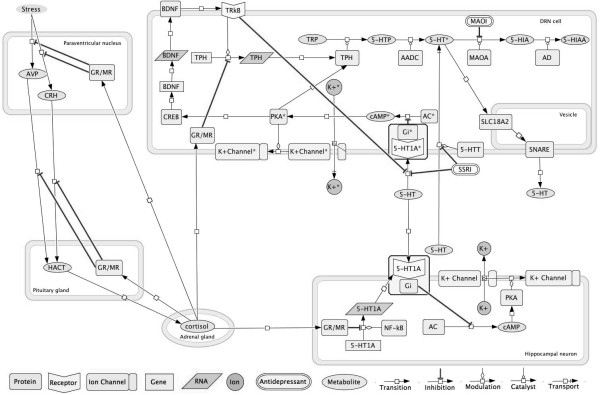
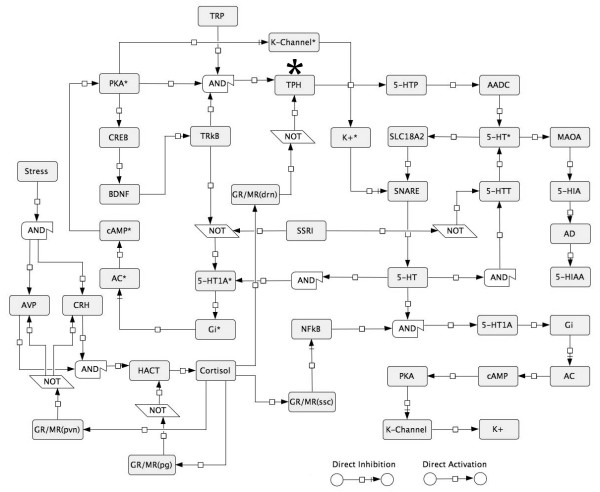
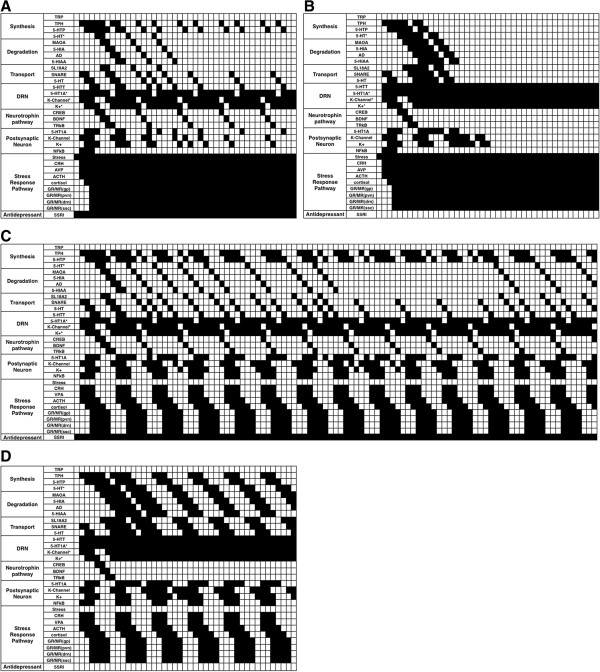
Major depressive disorder (MDD) is a multifactorial disorder known to be influenced by both genetic and environmental factors. MDD presents a heritability of 37%, and a genetic contribution has also been observed in studies of family members of individuals with MDD that imply that the probability of suffering the disorder is approximately three times higher if a first-degree family member is affected. Childhood maltreatment and stressful life events (SLEs) have been established as critical environmental factors that profoundly influence the onset of MDD. The serotonin pathway has been a strong candidate for genetic studies, but it only explains a small proportion of the heritability of the disorder, which implies the involvement of other pathways. The serotonin (5-HT) pathway interacts with the stress response pathway in a manner mediated by the hypothalamic-pituitary-adrenal (HPA) axis. To analyze the interaction between the pathways, we propose the use of a synchronous Boolean network (SBN) approximation. The principal aim of this work was to model the interaction between these pathways, taking into consideration the presence of selective serotonin reuptake inhibitors (SSRIs), in order to observe how the pathways interact and to examine if the system is stable. Additionally, we wanted to study which genes or metabolites have the greatest impact on model stability when knocked out in silico. We observed that the biological model generated predicts steady states (attractors) for each of the different runs performed, thereby proving that the system is stable. These attractors changed in shape, especially when anti-depressive drugs were also included in the simulation. This work also predicted that the genes with the greatest impact on model stability were those involved in the neurotrophin pathway, such as CREB, BDNF (which has been associated with major depressive disorder in a variety of studies) and TRkB, followed by genes and metabolites related to 5-HT synthesis.
Overview
The claims and statistics of this paper haven’t been checked yet.
Free: it reads the open-access text and checks the first 5 claims that cite a source we can check. Create a free account to check every claim.
Integrity signals
Registry
Cites
Statistics
Figures
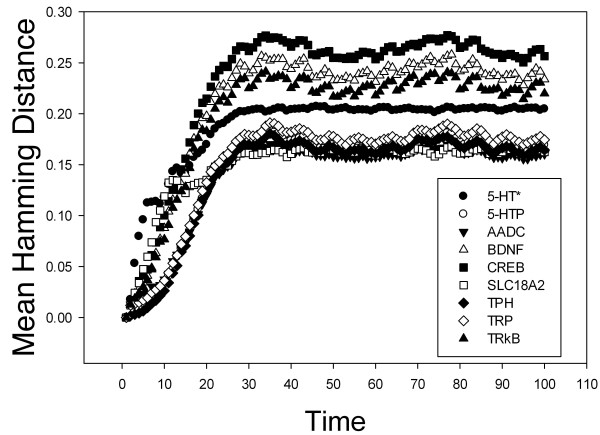
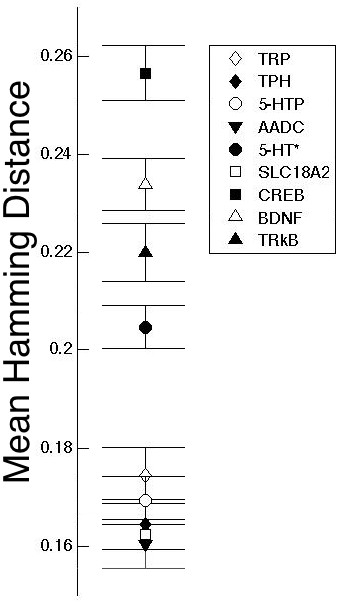
Verification
Claims the paper makes
The claims and statistics of this paper haven’t been checked yet.
Free: it reads the open-access text and checks the first 5 claims that cite a source we can check. Create a free account to check every claim.
Claims other papers make about this one
Each is checked against this paper’s own text: does it say what the citing paper says it does?
The check wasn’t confident either way, so it gives no verdict — never disputed.
In the citing paper
“Trauma, such as violence and abuse, can trigger the autonomic nervous system and the immune system, leading to an inflammatory response to nociceptive stimuli [107].”
From The association between violence against women and chronic pain: a systematic review and meta-analysis (2024) · cites this paper as [107]
Experimental — accuracy not yet measuredIn the citing paper
“Trauma, such as violence and abuse, can cause the same biological reactions to nociceptive stimuli, activating the autonomic nervous system, which triggers the immune system and inflammatory response [41].”
From The Risk Factors of Chronic Pain in Victims of Violence: A Scoping Review (2023) · cites this paper as [41]
Self-check
Percentages, sums and reported differences re-computed from the paper’s own numbers.
The self-check needs the paper’s full text.
Citations
Cites
Kessler, R. C., Berglund, P., Demler, O., Jin, R., Merikangas, K. R., & Walters, E. E. (2005) · Archives of General Psychiatry · doi:10.1001/archpsyc.62.6.593 · Cited by 20,391 · cited 1×
“Approximately 15% of the population is estimated to be affected with this disorder at least once in their lifetime [1-4].”
BackgroundKessler, R. C., Chiu, W. T., Demler, O., & Walters, E. E. (2005) · Archives of General Psychiatry · doi:10.1001/archpsyc.62.6.617 · Cited by 12,052 · cited 1×
“Approximately 15% of the population is estimated to be affected with this disorder at least once in their lifetime [1-4].”
BackgroundMolecular Mechanisms of Depression: Perspectives on New Treatment Strategies
Lang, U. E., & Borgwardt, S. (2013) · Cellular Physiology and Biochemistry · doi:10.1159/000350094 · Cited by 8,475
Influence of life stress on depression: moderation by a polymorphism in the 5-HTT gene
Caspi, A., Sugden, K., Moffitt, T. E., Taylor, A., Craig, I. W., Harrington, H., McClay, J., Mill, J., Martin, J., Braithwaite, A., et al. (2003) · Science · doi:10.1126/science.1083968 · Cited by 8,120 · cited 1×
“In this work, they evaluated the possible association of a genetic variant of the serotonin transporter (5-HTT) with maltreatment [9].”
BackgroundKessler, R. C., Berglund, P., Demler, O., Jin, R., Koretz, D., Merikangas, K. R., Rush, A. J., Walters, E. E., & Wang, P. S. (2003) · JAMA · doi:10.1001/jama.289.23.3095 · Cited by 7,988 · cited 1×
“Approximately 15% of the population is estimated to be affected with this disorder at least once in their lifetime [1-4].”
BackgroundGenetic Epidemiology of Major Depression: Review and Meta-Analysis
Sullivan, P. F., Neale, M. C., & Kendler, K. S. (2000) · American Journal of Psychiatry · doi:10.1176/appi.ajp.157.10.1552 · Cited by 3,431 · cited 1×
“31042) based on data from twin studies, and a genetic contribution has also been observed in family studies of individuals with MDD that imply that the probabili ty of suffering the disorder is approximately three times higher if a first-degree famil y ember is affected [5,6].”
BackgroundA Neurotrophic Model for Stress-Related Mood Disorders
Duman, R. S., & Monteggia, L. M. (2006) · Biological Psychiatry · doi:10.1016/j.biopsych.2006.02.013 · Cited by 3,375 · cited 1×
“On the other hand, both stress and glucocorticoids are known to decrease brain levels of BDNF in rodents and post-mortem human tissue [20].”
BackgroundBelmaker, R. H., & Agam, G. (2008) · New England Journal of Medicine · doi:10.1056/nejmra073096 · Cited by 2,166
The neurobiology of stress and development.
Gunnar, M., & Quevedo, K. (2007) · Annual Review of Psychology · doi:10.1146/annurev.psych.58.110405.085605 · Cited by 2,011 · cited 1×
“Childhood maltreatment and stressful life events (SLEs) have been established as critical environmental factors that profoundly influence the onset of MDD [7,8]; however, the question of why some individuals develop MDD when exposed to stressful events and some do not has been difficult to answer.”
BackgroundDecreased serum brain-derived neurotrophic factor levels in major depressed patients
Karege, F., Perret, G., Bondolfi, G., Schwald, M., Bertschy, G., & Aubry, J.-M. (2002) · Psychiatry Research · doi:10.1016/s0165-1781(02)00005-7 · Cited by 1,232 · cited 1×
“Various authors have reported low BDNF serum concentrations in depressive patients and in association with suicidal behavior [42-44].”
Background
Research works printed but not linked: 2
- Horowitz JL The Bootstrap 2000 In Handbook of Econometrics: Elsevier Science 3159 3238
- Varian H Boostrap Tutorial The Mathematica Journal 2005 9 768 775
Cited by
Sigurdardottir, S. L., & Halldórsdóttir, S. (2021) · International Journal of Environmental Research and Public Health · doi:10.3390/ijerph18041849 · Cited by 91
“Inflammation also increases the risk of cardiovascular disease and type 2 diabetes by affecting the exacerbation of atherosclerosis and the increase in insulin sensitivity [7].”
BackgroundRodrigues, F. T. S., de Souza, M. R. M., Lima, C. N. D. C., da Silva, F. E. R., Costa, D. V. D. S., dos Santos, C. C., Miyajima, F., de Sousa, F. C. F., Vasconcelos, S. M. M., Barichello, T., et al. (2018) · Journal of Psychiatric Research · doi:10.1016/j.jpsychires.2018.10.003 · Cited by 70
Peritore, A. F., Crupi, R., Scuto, M. C., Gugliandolo, E., Siracusa, R., Impellizzeri, D., Cordaro, M., D’Amico, R., Fusco, R., Paola, R. D., et al. (2020) · CNS & Neurological Disorders - Drug Targets · doi:10.2174/1871527319666200107094732 · Cited by 61
Modelling gene-environment interaction in first episodes of psychosis
Bernardo, M., Bioque, M., Cabrera, B., Lobo, A., González-Pinto, A. M., Pina, L., Corripio, I., Sanjuán, J., Mané, A., Castro‐Fornieles, J., et al. (2017) · Schizophrenia Research · doi:10.1016/j.schres.2017.01.058 · Cited by 63
Molecular and genetic basis of depression
ROY, M., Tapadia, M. G., Joshi, S., & Koch, B. (2014) · Journal of Genetics · doi:10.1007/s12041-014-0449-x · Cited by 45
Moreno-Ramos, O. A., Olivares, A. M., Haider, N. B., de Autismo, L. C., & Lattig, M. C. (2015) · PLOS ONE · doi:10.1371/journal.pone.0135927 · Cited by 36
“A previous study of our group reported that genes involved in transcription regulation are essential to serotoninergic pathway stability in depression [65].”
Self-citationBarreto, F. S., Filho, A. J. M. C., Araújo, M. C., de Moraes, M. O., de Moraes, M. E. A., Maes, M. H. J., de Lucena, D. F., & Macêdo, D. S. (2018) · Behavioural Pharmacology · doi:10.1097/fbp.0000000000000384 · Cited by 39
Uvelli, A., Ribaudo, C., Gualtieri, G., Coluccia, A., & Ferretti, F. (2024) · BMC Women's Health · doi:10.1186/s12905-024-03097-w · Cited by 31
“Trauma, such as violence and abuse, can trigger the autonomic nervous system and the immune system, leading to an inflammatory response to nociceptive stimuli [107].”
BackgroundModelling cholesterol effects on the dynamics of the hypothalamic–pituitary–adrenal (HPA) axis
Marković, V. M., Čupić, Ž., Maćešić, S., Stanojević, A., Vukojević, V., & Kolar-Anić, L. (2016) · Mathematical Medicine and Biology · doi:10.1093/imammb/dqu020 · Cited by 31
“…et al., 2011; Marković et al., 2011b; Maćešić et al., 2012; Scheff et al., 2012; Sriram et al., 2012; Postnova et al., 2013; Andersen et al., 2013; Moreno-Ramos et al., 2013; 1 Ultradian rhythms have a period shorter than 24 h, whereas circadian are characterised by periods that are close…”
BackgroundHigh-fidelity discrete modeling of the HPA axis: a study of regulatory plasticity in biology
Sedghamiz, H., Morris, M. C., Craddock, T. J. A., Whitley, D., & Broderick, G. (2018) · BMC Systems Biology · doi:10.1186/s12918-018-0599-1 · Cited by 25
Joshi, A., Wang, D., Watterson, S., McClean, P. L., Behera, C. K., Sharp, T., & Wong‐Lin, K. (2020) · Neuropharmacology · doi:10.1016/j.neuropharm.2020.108118 · Cited by 23
Comorbidity of Novel CRHR2 Gene Variants in Type 2 Diabetes and Depression
Amin, M., Ott, J., Gordon, D., Wu, R., Postolache, T. T., Vergare, M. J., & Gragnoli, C. (2022) · International Journal of Molecular Sciences · doi:10.3390/ijms23179819 · Cited by 18
“These results align with the concept that sequential stressors or chronic stress in the setting of genetic predisposition to HPA-axis hyperactivation may maintain chronic hypercortisolemia and lead primarily to depression [43] via the mediated serotonin down-regulation [44] and secondarily to T2D potentially via the l…”
ResultPoret, A., & Boissel, J. (2014) · Comptes Rendus Biologies · doi:10.1016/j.crvi.2014.10.002 · Cited by 18
Liu, L., Yang, J., Qian, F., & Lu, C. (2017) · Experimental and Therapeutic Medicine · doi:10.3892/etm.2017.4498 · Cited by 16
“Multiple studies have demonstrated that HPA axis imbalance contributes to diseases of the central nervous system (10,11).”
Dynamic transitions in a model of the hypothalamic-pituitary-adrenal axis
Čupić, Ž., Marković, V., Maćešić, S. R., Stanojević, A., Damjanovic, S. S., Vukojević, V. B., & Kolar-Anic, L. Z. (2016) · Chaos An Interdisciplinary Journal of Nonlinear Science · doi:10.1063/1.4944040 · Cited by 14
The Risk Factors of Chronic Pain in Victims of Violence: A Scoping Review
Uvelli, A., Duranti, C., Salvo, G., Coluccia, A., Gualtieri, G., & Ferretti, F. (2023) · Healthcare · doi:10.3390/healthcare11172421 · Cited by 10
Type-D fuzzy CAs for medical and social sciences
Teodorescu, H.-N. (2015) · E-Health and Bioengineering Conference (EHB) · doi:10.1109/ehb.2015.7391560 · Cited by 6
Psychoneuroimmunology of Depression
Yan, Q. (2016) · Springer eBooks · doi:10.1007/978-3-319-45111-4_6 · Cited by 7
A logic-based modeling derived from boolean networks: adding fuzzy logic and edge tuningPreprint
Poret, A., Sousa, C. M., & Boissel, J. (2014) · arXiv (Cornell University) · Cited by 3
Enhancing Boolean networks with continuous logical operators and edge tuningPreprint
Poret, A., Sousa, C. M., & Boissel, J. (2014) · arXiv (Cornell University) · Cited by 2
Bazmara, H., Soltani, M., Raahemifar, K., Sefidgar, M., Bazargan, M., Naeenian, M. M., & Elkamel, A. (2015) · BioMed Research International · doi:10.1155/2015/908757 · Cited by 1
Enhancing Boolean networks with continuous logical operators and edge tuningPreprint
Poret, A., Monteiro, C., & Boissel, J. (2019) · bioRxiv (Cold Spring Harbor Laboratory) · doi:10.1101/584243 · Cited by 1
“However, if tendencies and global properties are the main concern, qualitative modeling is entirely fitting and proved itself through several works [29–54].”
BackgroundCerebral Palsy: Diagnosis, Treatment, and Nursing Approaches in Care
ATAY, M. E., & DEGE, G. (2024) · Bidge Yayınları eBooks · doi:10.70269/10.70269/1898837283
Diyabetin Yönetiminde Navigatör Hemşirenin Rolü
Bağcı, Y. (2024) · Bidge Yayınları eBooks · doi:10.70269/10.70269/8885769222
Basic Approaches to Value and Care in Nursing
Atay, M. E., Uzun, L. N., Bağcı, Y., Dinçer, B., ÖZTÜRK, T., Karasungur, R., DEGE, G., Tok, H. H., Bahçecik, N., & Polat, O. (2024) · Bidge Yayınları eBooks · doi:10.70269/mshn3h28en1z
Monkeypox ın Pregnancy and Nursıng Care
Karasungur, R., & Polat, O. (2024) · Bidge Yayınları eBooks · doi:10.70269/10.70269/2933532176
Hemşirelikte Dönüşümcü Liderlik
BAŞARAN, E. (2024) · Bidge Yayınları eBooks · doi:10.70269/10.70269/7733558728
Yayla, E. M., & Ağaslan, M. (2024) · Bidge Yayınları eBooks · doi:10.70269/10.70269/4781243563
Diyabetli Bireylerde Psikososyal Sorunlar ve Hemşirelik
Bağcı, Y. (2024) · Bidge Yayınları eBooks · doi:10.70269/10.70269/4377179757
Aile Planlamasında Karşılanamayan Gereksinimler: Aile Planlamasındaki Eksiklikler
ÖZTÜRK, T. (2024) · Bidge Yayınları eBooks · doi:10.70269/10.70269/7997695818
Hemşirelik Hizmetlerinde Dönüşümsel Liderliğin Etkili Liderliğe Katkısı
KÖSE, E. (2024) · Bidge Yayınları eBooks · doi:10.70269/10.70269/8595516215
Hemşirelik Uygulamalarında Sanal Gerçeklik
NAL, B., TOPUZ, İ., & Şahin, N. D. (2024) · Bidge Yayınları eBooks · doi:10.70269/10.70269/7338441725
Kadına Yönelik Şiddet ve Ağrı İlişkisi
ÖZTÜRK, T. (2024) · Bidge Yayınları eBooks · doi:10.70269/10.70269/9625311784
Metadata
- Authors
- Moreno-Ramos, O. A., Lattig, M. C., & González Barrios, A. F.
- Affiliations
- Universidad de Los Andes (CO)
- Venue
- Theoretical Biology and Medical Modelling
- Published
- 2013-10-05
- Volume
- 10
- Issue
- 1
- Pages
- 59-59
- ISSN
- 1742-4682 (ISSN-L)
- PMC
- PMC3856587
- OpenAlex
- W2132180972
- Cited by
- 22
- References
- 70
- Citations by year
- 2024: 1 · 2023: 1 · 2022: 1 · 2021: 1 · 2020: 2 · 2019: 1 · 2018: 3 · 2017: 2 · 2016: 2 · 2015: 3 · 2014: 5
- FWCI
- 1.51
- Type
- journal article
- Language
- en
- Open access
- hybrid
- doi.org
- Licence
- cc-by
- Locations
- Theoretical Biology and Medical Modelling (publishedVersion, cc-by)
- Europe PMC (PubMed Central) (publishedVersion, cc-by)
- PubMed Central (publishedVersion, cc-by)
- PubMed (publishedVersion)
- Greater South Information System
- Topics
- Life Sciences › Neuroscience › Behavioral Neuroscience › Stress Responses and Cortisol
- Life Sciences › Biochemistry, Genetics and Molecular Biology › Molecular Biology › Gene Regulatory Network Analysis
- Life Sciences › Neuroscience › Cellular and Molecular Neuroscience › Neurotransmitter Receptor Influence on Behavior
- Keywords
- major depressive disorder, hypothalamic-pituitary-adrenal axis, serotonin pathway, stress response, Boolean networks, model stability, attractors, selective serotonin reuptake inhibitors, child abuse, life events, brain-derived neurotrophic factor, CREB, TrkB
- MeSH terms
- Computer Simulation, Depression, Humans, Hypothalamo-Hypophyseal System, Models, Biological, Molecular Sequence Data, Pituitary-Adrenal System, Serotonin, Stress, Psychological, Signal Transduction, Gene Knockout Techniques
About these checks
Registry, retraction, Cites and statistics results are computed, not judged, with one exception: a printed reference that no index lists is read once by a model before it counts as a citation error. Claims are extracted by a model and kept only when their quote appears verbatim in the text; each cited source is then checked, with a model’s help, for whether it says what the claim relies on. Those verdicts can be wrong — read the claim’s quote and the cited source before relying on one.
Statistics and arithmetic are recomputed, not judged.
Confidence bands are shown only for fields calibrated on our annotated test set. None is calibrated yet, so no band is shown.
What counts as a claim ›How we measure confidence ›How we check this ›
Are you an author, or do you see a problem with this page? Request a review
Data sources
Bibliographic data: Semantic Scholar, OpenAlex, Crossref.
Contains information from the Semantic Scholar Academic Graph Datasets, made available under the ODC Attribution License (ODC-BY 1.0).
Semantic Scholar’s data is described in: Kinney, R., et al. (2023). The Semantic Scholar Open Data Platform. arXiv:2301.10140.
