

Autonomous identification of freezing of gait in Parkinson's disease from lower-body segmental accelerometry
Open accessThe DOI matches its Crossref record; 33 of the 34 references it cites were found in a registry or an index.
Abstract
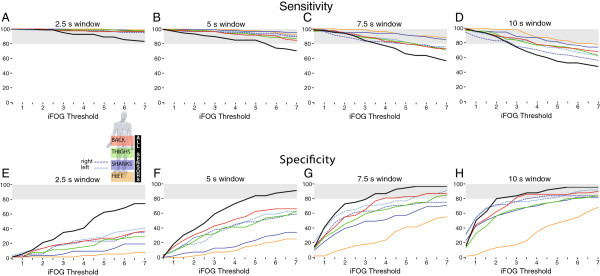
BACKGROUND: We have previously published a technique for objective assessment of freezing of gait (FOG) in Parkinson's disease (PD) from a single shank-mounted accelerometer. Here we extend this approach to evaluate the optimal configuration of sensor placement and signal processing parameters using seven sensors attached to the lumbar back, thighs, shanks and feet. METHODS: Multi-segmental acceleration data was obtained from 25 PD patients performing 134 timed up and go tasks, and clinical assessment of FOG was performed by two experienced raters from video. Four metrics were used to compare objective and clinical measures; the intraclass correlation coefficient (ICC) for number of FOG episodes and the percent time frozen per trial; and the sensitivity and specificity of FOG detection. RESULTS: The seven-sensor configuration was the most robust, scoring highly on all measures of performance (ICC number of FOG 0.75; ICC percent time frozen 0.80; sensitivity 84.3%; specificity 78.4%). A simpler single-shank sensor approach provided similar ICC values and exhibited a high sensitivity to FOG events, but specificity was lower at 66.7%. Recordings from the lumbar sensor offered only moderate agreement with the clinical raters in terms of absolute number and duration of FOG events (likely due to musculoskeletal attenuation of lower-limb 'trembling' during FOG), but demonstrated a high sensitivity (86.2%) and specificity (82.4%) when considered as a binary test for the presence/absence of FOG within a single trial. CONCLUSIONS: The seven-sensor approach was the most accurate method for quantifying FOG, and is best suited to demanding research applications. A single shank sensor provided measures comparable to the seven-sensor approach but is relatively straightforward in execution, facilitating clinical use. A single lumbar sensor may provide a simple means of objective FOG detection given the ubiquitous nature of accelerometers in mobile telephones and other belt-worn devices.
Overview
The claims and statistics of this paper haven’t been checked yet.
Free: it reads the open-access text and checks the first 5 claims that cite a source we can check. Create a free account to check every claim.
Integrity signals
Registry
Cites
Statistics
Figures
Verification
Claims the paper makes
The claims and statistics of this paper haven’t been checked yet.
Free: it reads the open-access text and checks the first 5 claims that cite a source we can check. Create a free account to check every claim.
Claims other papers make about this one
Each is checked against this paper’s own text: does it say what the citing paper says it does?
The cited source doesn’t support the claim as written.
In the citing paper
“Whereas, when using a short window size, it has been reported an important decrease in the sensitivity at short episodes, which are normally the most frequent in patients with FOG [61,68].”
From Deep Learning Approaches for Detecting Freezing of Gait in Parkinson’s Disease Patients through On-Body Acceleration Sensors (2020) · cites this paper as [61]
Checked by a reasoning model — may be wrong.
Experimental — accuracy not yet measured
Self-check
Percentages, sums and reported differences re-computed from the paper’s own numbers.
The self-check needs the paper’s full text.
Citations
Cites
Folstein, M. F., Folstein, S. E., & McHugh, P. R. (1975) · Journal of Psychiatric Research · doi:10.1016/0022-3956(75)90026-6 · Cited by 88,282 · cited 1×
“All patients satisfied UKPDS Brain Bank criteria [27], had a MiniMental State Examination (MMSE) [28] score of ≥ 24 and were deemed unlikely to have dementia or major depression according to DSM-IV criteria by consensus rating of a neurologist (SJGL) and a neuropsychologist (SLN).”
MethodIntraclass correlations: Uses in assessing rater reliability.
Shrout, P. E., & Fleiss, J. L. (1979) · Psychological Bulletin · doi:10.1037/0033-2909.86.2.420 · Cited by 24,532 · cited 1×
“The reliability of the quantification of the number of FOG episodes and percent time frozen was calculated between the clinical observers and the objective accelerometer-derived (iFOG) measures using the ICC [32]; the 134-element arrays for frequency, and relative duration of FOG, obtained from clinical assessment wer…”
MethodParkinsonism: onset, progression, and mortality
Hoehn, M. M., & Yahr, M. D. (1967) · Neurology · doi:10.1212/wnl.17.5.427 · Cited by 12,107
Unified Parkinson's Disease Rating Scale
(2012) · SpringerReference · doi:10.1007/springerreference_184495 · Cited by 3,066
Recent developments in Parkinson's disease
Fahn, S., Elton, R., MARSDEN, C. D., Calne, D. B., & Goldstein, M. (1986) · Raven Press eBooks · Cited by 2,306
JENKINSON, C., FITZPATRICK, R., PETO, V., GREENHALL, R., & HYMAN, N. (1997) · Age and Ageing · doi:10.1093/ageing/26.5.353 · Cited by 1,321 · cited 1×
“3], Parkinson's Disease Questionnaire (PDQ) 39 [30] 67.”
Bloem, B. R., Hausdorff, J. M., Visser, J. E., & Giladi, N. (2004) · Movement Disorders · doi:10.1002/mds.20115 · Cited by 1,297 · cited 4×
“Current treatment options for FOG are largely ineffective [1].”
BackgroundInfluentialStefani, A., Lozano, A. M., Peppe, A., Stanzione, P., Galati, S., Tropepi, D., Pierantozzi, M., Brusa, L., Scarnati, E., & Mazzone, P. (2007) · Brain · doi:10.1093/brain/awl346 · Cited by 807 · cited 1×
“Patients may undergo deep brain stimulation surgery to relieve symptoms of 'off' state FOG, although these surgical interventions are currently viewed as a treatment option only in the latter stages of PD [26].”
BackgroundSchaafsma, J. D., Balash, Y., Gurevich, T., Bartels, A. L., Hausdorff, J. M., & Giladi, N. (2003) · European Journal of Neurology · doi:10.1046/j.1468-1331.2003.00611.x · Cited by 725 · cited 3×
“Increasing levodopa dosage can reduce the frequency of 'off' (unmedicated) state freezing [1,22], likely by increasing the threshold for FOG to occur without altering the underlying pathophysiology [22].”
BackgroundRascol, O., Brooks, D., Melamed, E., Oertel, W., Poewe, W., Stocchi, F., & Tolosa, E. (2005) · The Lancet · doi:10.1016/s0140-6736(05)71083-7 · Cited by 641 · cited 1×
“A Freezing of Gait Questionnaire (FOG-Q) [7] and the new FOG-Q (NFOG-Q) [8] have recently been proposed as more sensitive tools to identify FOG behavior and assess the efficacy of interventions [9].”
Method
Cited by
Items 101–200 of 204
Computer model for leg agility quantification and assessment for Parkinson’s disease patients
Ornelas-Vences, C., Fernández, L. P. S., Sánchez-Pérez, L. A., & Martínez-Hernández, J. M. (2018) · Medical & Biological Engineering & Computing · doi:10.1007/s11517-018-1894-0 · Cited by 21
Smartphone based freezing of gait detection for Parkinsonian patients
Pepa, L., Verdini, F., Capecci, M., & Ceravolo, M. G. (2015) · International Conference on Consumer Electronics · doi:10.1109/icce.2015.7066386 · Cited by 18
“Recently the same group of study [7] used this parameter for FOG detection through an architecture composed of 7 inertial measurement units that transmitted data to a computer.”
BackgroundPardoel, S., Shalin, G., Lemaire, E. D., Kofman, J., & Nantel, J. (2021) · PLoS ONE · doi:10.1371/journal.pone.0258544 · Cited by 18
Smart sensors for the recognition of specific human motion disorders in Parkinson's disease
Lorenzi, P., Rao, R., Romano, G., Kita, A., Serpa, M., Filesi, F., Irrera, F., Bologna, M., Suppa, A., & Berardelli, A. (2015) · International Workshop on Advances in Sensors and Interfaces (IWASI) · doi:10.1109/iwasi.2015.7184973 · Cited by 21
“classes: those that can be used outdoor [19-21] and those that must be used indoor [22-24].”
BackgroundDevelopment of a remote therapeutic monitoring platform: applications for movement disorders
Thankathuraipandian, S., Greenleaf, W., Kyani, A., Tomlinson, T., Balasingh, B., Ross, E., & Pathak, Y. J. (2024) · Scientific Reports · doi:10.1038/s41598-024-80567-z · Cited by 23
Technology for measuring freezing of gait: Current state of the art and recommendations
Mancini, M., McKay, J. L., Cockx, H., D’Cruz, N., Esper, C. D., Filtjens, B., Heimler, B., MacKinnon, C. D., Palmerini, L., Roerdink, M., et al. (2025) · Journal of Parkinson s Disease · doi:10.1177/1877718x241301065 · Cited by 29
Far, M. S., Stolz, M., Fischer, J. M., Eickhoff, S. B., & Dukart, J. (2021) · Frontiers in Public Health · doi:10.3389/fpubh.2021.763621 · Cited by 20
Sigcha, L., Polvorinos-Fernández, C., Costa, N., da Costa, S. P., Arezes, P., Gago, M. F., Lee, C., López, J. M., de Arcas, G., & Pavón, I. (2023) · Frontiers in Neurology · doi:10.3389/fneur.2023.1326640 · Cited by 19
Goubault, É., Nguyen, H., Bogard, S., Blanchet, P. J., Bézard, E., Vincent, C., Langlois, M., & Duval, C. (2018) · Journal of Parkinson s Disease · doi:10.3233/jpd-181312 · Cited by 18
Feature Selection for Machine Learning Based Step Length Estimation Algorithms
Vandermeeren, S., Bruneel, H., & Steendam, H. (2020) · Sensors · doi:10.3390/s20030778 · Cited by 16
“These features are then arranged in a vector xi, with i the step index and i ∈ [1, 837].”
BackgroundMekruksavanich, S., & Jitpattanakul, A. (2021) · International Conference on Open Source Systems and Technologies (ICOSST) · doi:10.1109/icosst53930.2021.9683890 · Cited by 20
Feasibility of Smartphone-Based Gait Assessment for Parkinson’s Disease
Tang, S., Tai, C., Yang, C., & Lin, J. (2020) · Journal of Medical and Biological Engineering · doi:10.1007/s40846-020-00551-6 · Cited by 16
“Human gait is a periodic phenomenon, and the number of steps per unit time is the second harmonic in the walking spectrum [19].”
BackgroundDeciphering the Role of Nanoparticle-based Treatment for Parkinson’s Disease
Moni, M. M. R., Begum, M. M., Uddin, M. S., & Ashraf, G. M. (2021) · Current Drug Metabolism · doi:10.2174/1389200222666210202110129 · Cited by 16
Chen, Z., Li, G., Gao, C., Tan, Y., Liu, J., Zhao, J., Ling, Y., Yu, X., Ren, K., & Chen, S. (2021) · Frontiers in Human Neuroscience · doi:10.3389/fnhum.2021.636414 · Cited by 14
Kin-FOG: Automatic Simulated Freezing of Gait (FOG) Assessment System for Parkinson’s Disease
Soltaninejad, S., Cheng, I., & Basu, A. (2019) · Sensors · doi:10.3390/s19102416 · Cited by 17
“In 2013, Moore et al. [25], proposed assessing different numbers of sensors in different locations for gait analysis with the purpose of FOG detection.”
BackgroundSmart Sensing Systems for the Detection of Human Motion Disorders
Lorenzi, P., Rao, R., Romano, G., Kita, A., Serpa, M., Filesi, F., Parisi, R., Suppa, A., Bologna, M., Berardelli, A., et al. (2015) · Procedia Engineering · doi:10.1016/j.proeng.2015.08.626 · Cited by 15
Diep, C., O’Day, J. J., Kehnemouyi, Y. M., Burnett, G., & Bronte-Stewart, H. M. (2021) · Sensors · doi:10.3390/s21082661 · Cited by 16
“Although our logistic regression models achieved performance results similar to other IMU-based FOG algorithms [8-9, 11-34, 41], the training and testing sets were built using data from one trial of SIP from a small cohort of participants and were further reduced after balancing freeze and non-freeze steps.”
MethodDvorani, A., Waldheim, V., Jochner, M. C. E., Salchow-Hömmen, C., Meyer-Ohle, J., Kühn, A. A., Wenger, N., & Schauer, T. (2021) · Frontiers in Neurology · doi:10.3389/fneur.2021.720516 · Cited by 16
“(21) calculated a parameter called Freezing Index (FI) by dividing the frequency spectrum of the vertical leg acceleration of a shank-worn sensor in a normal locomotor band (0–3Hz) and a freeze band (3–8Hz).”
BackgroundInfluentialSensor technology with gait as a diagnostic tool for assessment of Parkinson’s disease: a survey
Kour, N., Gupta, S., & Arora, S. (2022) · Multimedia Tools and Applications · doi:10.1007/s11042-022-13398-7 · Cited by 20
Chan, H., Chen, R., Kuo, C.-C., Chen, Y., Liaw, J., Liao, G.-S., Lin, W., Chien, S.-H., & Chang, Y. (2024) · Frontiers in Bioengineering and Biotechnology · doi:10.3389/fbioe.2024.1334403 · Cited by 13
Wearable computing of Freezing of Gait in Parkinson's disease: A survey
Sun, M., Watson, A., & Zhou, G. (2020) · Smart Health · doi:10.1016/j.smhl.2020.100143 · Cited by 13
“Motion Sensors Accelerometers [39], [40], [41], [42],[43],[44], [45], [46], [47], [48], [49], [50], [51], [52], [53], [54], [55], [56], [57], [58], [59], [60], [61],[62], [63] Accelerometers + Gyroscopes [64], [65], [66], [67], [68] Accelerometers + Gyroscopes + Magnetometers [69], [57] Accelerometers + Telemeter + Go…”
BackgroundTanahashi, T., Yamamoto, T., Endo, T., Fujimura, H., Yokoe, M., Mochizuki, H., Nomura, T., & Sakoda, S. (2013) · PLoS ONE · doi:10.1371/journal.pone.0084423 · Cited by 13
“Several studies have performed gait analyses in PD patients using accelerometers or gyroscopes recently, because these sensors do not require a special laboratory, do not interfere with locomotion, and enable long-term monitoring [24], [25], [26], [27].”
BackgroundMulti-Level Adversarial Spatio-Temporal Learning for Footstep Pressure Based FoG Detection
Hu, K., Mei, S., Wang, W., Martens, K. A. E., Wang, L., Lewis, S. J. G., Feng, D. D., & Wang, Z. (2023) · IEEE Journal of Biomedical and Health Informatics · doi:10.1109/jbhi.2023.3272902 · Cited by 14
“But optimal configurations are yet to be validated across centres [24] and placing wearable sensors correctly on a patient’s body generally need suitable training and experiences.”
BackgroundSelf-citationTelemonitoring of patients with Parkinson’s disease using inertia sensors
Baumann, L. C., Tengler, M., Piro, L., Blechschmidt-Trapp, R., & Piro, N. E. (2014) · Applied Clinical Informatics · doi:10.4338/aci-2014-04-ra-0046 · Cited by 15
“They often focus on the analysis of single Parkinson specific motor symptoms like tremor [5], gait abnormalities including freeze of gait [6] and lower extremity bradykinesia [7].”
BackgroundPham, T. T. T., Nguyen, D. N., Dutkiewicz, E., McEwan, A. L., & Leong, P. H. W. (2017) · International Conference on Communications · doi:10.1109/icc.2017.7997415 · Cited by 12
“The main points of our system include utilising spectral coherence analysis to define anomaly scores for FoG TABLE III FOG DETECTION PERFORMANCE AGAINST EXISTING METHODS [15] a [17] b [18][19] c d ) ACROSS CONFIGURATIONS e AND DATASETS.”
BackgroundMethodInfluentialAshour, A. S., El-Attar, A., Dey, N., El-Naby, M. M. A., & Elkader, H. A. (2018) · Cairo International Biomedical Engineering Conference · doi:10.1109/cibec.2018.8641809 · Cited by 11
“Furthermore, different patient-independent methods were used for FOG detection [5, 9-12].”
MethodGoubault, É., Nguyen, H., Bogard, S., Blanchet, P. J., Bézard, E., Vincent, C., Sarna, J. R., Monchi, O., & Duval, C. (2019) · Frontiers in Neurology · doi:10.3389/fneur.2019.00256 · Cited by 13
“(56) for at least four of the seven sensors used in this algorithm.”
BackgroundDeep-Learning-Based Emergency Stop Prediction for Robotic Lower-Limb Rehabilitation Training Systems
Cha, B., Lee, K.-H., & Ryu, J. (2021) · IEEE Transactions on Neural Systems and Rehabilitation Engineering · doi:10.1109/tnsre.2021.3087725 · Cited by 10
“markers of the freezing of gate (FOG) [12], including cadence increase, decrease in step length, appearance of new peaks, and”
BackgroundA real-time detection algorithm for freezing of gait in Parkinson's disease
Chang, Y., Ding, J., Hu, H., Yang, W., Lin, K.-H., & Wu, P. (2014) · IEEE International Symposium on Circuits and Systems proceedings · doi:10.1109/iscas.2014.6865384 · Cited by 10
“Table II compares the performance of the proposed method and that of methods in [3-5].”
BackgroundMethodInfluentialTemplate-Matching-Based Detection of Freezing of Gait Using Wearable Sensors
Xu, C., He, J., Zhang, X., Wang, C., & Duan, S. (2018) · Procedia Computer Science · doi:10.1016/j.procs.2018.03.038 · Cited by 10
Tahafchi, P., & Judy, J. W. (2019) · Annual International Conference of the IEEE Engineering in Medicine and Biology Society (EMBC) · doi:10.1109/embc.2019.8856480 · Cited by 12
“They changed the number of sensors to evaluate the results and concluded that using all the 7 sensors will give the strongest result [10].”
BackgroundLin, O., Tian, Y., Hou, Y., Zhu, Y., & Liu, X. (2023) · International IEEE/EMBS Conference on Neural Engineering · doi:10.1109/ner52421.2023.10123828 · Cited by 9
“This cutoff was chosen because FOG events are best predicted by signals originating from the 0-3 Hz ”locomotor” band and the 3-8 Hz ”freeze” band [12].”
MethodDevelopment, Validation, and Limits of Freezing of Gait Detection Using a Single Waist-Worn Device
Chan, L. L. Y., Yang, S., Aswani, M., Kark, L., Henderson, E. J., Lord, S. R., & Brodie, M. A. D. (2024) · IEEE Transactions on Biomedical Engineering · doi:10.1109/tbme.2024.3407059 · Cited by 10
A smartphone based system for freezing of gait monitoring for Parkinson's disease patients
Wang, K., Li, B., Gu, D., Dai, K., & Zhou, L. (2017) · IEEE International Conference on Communication Software and Networks · doi:10.1109/iccsn.2017.8230364 · Cited by 9
“According to the evaluating strategy in [9], we choose percent time frozen per trial as the metric to evaluate the detection performance, which was a more elaborate metric compared to the freezing count.”
BackgroundMethodMethod of gait disorders in Parkinson's disease classification based on machine learning algorithms
Guo, Y., Wu, X. L., Shen, L., Zhang, Z., & Zhang, Y. (2019) · IEEE Joint International Information Technology and Artificial Intelligence Conference (ITAIC) · doi:10.1109/itaic.2019.8785586 · Cited by 9
Pepa, L., Verdini, F., Capecci, M., Ceravolo, M. G., & Leo, T. (2014) · Springer eBooks · doi:10.1007/978-3-319-01119-6_18 · Cited by 7
“Results indicate that the proposed architecture is capable of identifyingFOGepisodes with suitable sensibility and specificity, compared to other studies [2, 15, 17].”
MethodResultAssessment of the e-AR sensor for gait analysis of Parkinson;s Disease patients
Jarchi, D., Peters, A., Lo, B. P. L., Kalliolia, E., Giulio, I. D., Limousin, P. D., Day, B. L., & Yang, G. (2015) · Wearable and Implantable Body Sensor Networks · doi:10.1109/bsn.2015.7299396 · Cited by 8
Hands-Free EEG-Based Control of a Computer Interface Based on Online Detection of Clenching of Jaw
Khoshnam, M., Kuatsjah, E., Zhang, X., & Menon, C. (2017) · Lecture notes in computer science · doi:10.1007/978-3-319-56148-6_44 · Cited by 8
Optimal window lengths, features and subsets thereof for freezing of gait classification
Mikos, V., Heng, C.-H., Tay, A. E., Chia, N. S. Y., Koh, K. M. L., Tan, D. M. L., & Au, W. L. (2017) · International Conference on Intelligent Informatics and Biomedical Sciences (ICIIBMS) · doi:10.1109/iciibms.2017.8279699 · Cited by 10
“5 seconds [17] for the freeze index feature alone.”
BackgroundHerman, T., Dagan, M., Shema-Shiratzky, S., Reches, T., Brozgol, M., Giladi, N., Manor, B. D., & Hausdorff, J. M. (2020) · Journal of Neurology · doi:10.1007/s00415-020-09856-7 · Cited by 10
“Several studies used ‘percent time frozen’ as an outcome measure for change [3, 6, 10, 20] and it was suggested that the percent time frozen had very strong agreement between raters and was found to be a reliable metric of FOG severity [21].”
BackgroundInertial Sensor Based Detection of Freezing of Gait for On-Demand Cueing in Parkinson’s Disease
Dvorani, A., Jochner, M. C. E., Seel, T., Salchow-Hömmen, C., Meyer-Ohle, J., Wiesener, C., Voigt, H., Kühn, A. A., Wenger, N., & Schauer, T. (2020) · IFAC-PapersOnLine · doi:10.1016/j.ifacol.2020.12.400 · Cited by 7
Fronto‐parieto‐subthalamic activity decodes motor status in Parkinson's disease
Zhang, Q., Xie, H., Zhao, B., Yin, Z., Liu, Y., Liu, D., Bai, Y., Zhu, G., Qin, G., Gan, Y., et al. (2023) · CNS Neuroscience & Therapeutics · doi:10.1111/cns.14155 · Cited by 7
Comparative Study of Four Instrumented Mobility Analysis Tests on Neurological Disease Patients
Kuusik, A., Gross‐Paju, K., Maamâgi, H., & Reilent, E. (2014) · Wearable and Implantable Body Sensor Networks · doi:10.1109/bsn.workshops.2014.13 · Cited by 7
“One of the most popular studied tasks is the timed up and go (TUG) test [5,7,10,14].”
BackgroundWang, W.-A., Lin, J., Le, X., Li, Y., Liu, T., Pan, L., Li, M., Yao, D., & Ren, P. (2024) · IEEE Journal of Biomedical and Health Informatics · doi:10.1109/jbhi.2024.3522664 · Cited by 6
“Certain studies have achieved promising outcomes by manually extracting time or frequency domain features from sensor data and employing statistical analyses or machine learning techniques [8], [9], [10], [11], [12], [13].”
Baarbé, J. K., Brown, M. J. N., Saha, U., Tran, S., Weißbach, A., Saravanamuttu, J., Cheyne, D., Hutchison, W. D., & Chen, R. E. (2024) · Neurobiology of Disease · doi:10.1016/j.nbd.2024.106557 · Cited by 5
“Prior studies that aimed to detect FOG in PD patients have focused solely on lower limb shuffling in the 3-8 Hz range and did not consider the LLMB phenotype (Delval et al., 2010; Moore et al., 2013; Morris et al., 2012).”
BackgroundYi, M.-K., & Hwang, S. O. (2025) · Computers in Biology and Medicine · doi:10.1016/j.compbiomed.2025.110138 · Cited by 7
Yogev‐Seligmann, G., Josman, N., Bitterman, N., Rosenblum, S., Naaman, S., & Gilboa, Y. (2023) · BioMedical Engineering OnLine · doi:10.1186/s12938-023-01066-2 · Cited by 10
FPGA-Based Realtime Detection of Freezing of Gait of Parkinson Patients
Langer, P., Esfahani, A. H., Dyka, Z., & Langendörfer, P. (2022) · Lecture notes of the Institute for Computer Sciences, Social Informatics and Telecommunications Engineering · doi:10.1007/978-3-030-95593-9_9 · Cited by 7
Scully, A. E., de Oliveira, B., Hill, K., Tan, D. M. L., Pua, Y., Clark, R. A., & Burton, E. (2022) · Clinical Rehabilitation · doi:10.1177/02692155221121180 · Cited by 7
“Parkinson’s disease is the second most common neurodegenerative condition, affecting over 10 million people worldwide.1 Approximately 50% of people with Parkinson’s experience freezing of gait.2 This increases with advancing disease – over 90% of those in Hoehn and Yahr Stage 4 have been reported to experience freezin…”
MethodInfluentialWalking assessment in the phase space by using ultra-miniaturized Inertial Measurement Units
Sessa, S., Saito, K., Zecca, M., Bartolomeo, L. D., Lin, Z., Cosentino, S., Ishii, H., Ikai, T., & Takanishi, A. (2013) · IEEE International Conference on Mechatronics and Automation (ICMA) · doi:10.1109/icma.2013.6618035 · Cited by 6
O’Day, J. J., Syrkin‐Nikolau, J., Anidi, C. M., Kidziński, Ł., Delp, S. L., & Bronte-Stewart, H. M. (2019) · bioRxiv (Cold Spring Harbor Laboratory) · doi:10.1101/671479 · Cited by 6
Attention-Based Deep Learning Model for Early Detection of Parkinson's Disease
Sadiq, M., Khan, M. T., & Masood, S. (2022) · Computers, materials & continua/Computers, materials & continua (Print) · doi:10.32604/cmc.2022.020531 · Cited by 8
“Relative analysis of various sensor arrangements, parameters used in signal processing and placement of sensors was performed by Moore et al. [43].”
MethodParkinson's Disease Gait Evaluation Leveraging Wearable Insoles and Deep Learning Approach
Channa, A., Popescu, N., & Faisal, M. (2022) · International Conference on Control, Decision and Information Technologies (CoDIT) · doi:10.1109/codit55151.2022.9804064 · Cited by 5
Development of gait assist method for parkinson's disease patients with FOG in walking
Uehara, A., Kawamoto, H., & Sankai, Y. (2016) · Annual Conference of the Society of Instrument and Control Engineers of Japan (SICE) · doi:10.1109/sice.2016.7749257 · Cited by 5
Detecting Freezing of Gait in Parkinson's Disease Patient via Deep Residual Network
Miao, R., Shokur, S., de Lima‐Pardini, A. C., Boari, D., & Bouri, M. (2021) · International Conference on Machine Learning and Applications · doi:10.1109/icmla52953.2021.00056 · Cited by 4
Wearable Wireless Sensors for Rehabilitation
Dorsch, A. K., King, C., & Dobkin, B. H. (2016) · Springer eBooks · doi:10.1007/978-3-319-28603-7_29 · Cited by 4
Li, X., Hou, M., Qu, Y., Huo, Y., Liu, S., Ma, M., & Liang, Z. (2025) · Frontiers in Neuroscience · doi:10.3389/fnins.2025.1560333 · Cited by 4
Ratanasutiranont, C., Srisilpa, K., Termsarasab, P., & Ruthiraphong, P. (2022) · Assistive Technology · doi:10.1080/10400435.2022.2113179 · Cited by 3
Dual-Level Freezing of Gait Recognition Algorithm
Chen, Q., Chen, Z., Zhang, F., Chen, S., Ren, K., & Lu, N. (2025) · IEEE Sensors Journal · doi:10.1109/jsen.2025.3557407 · Cited by 4
Hu, H., Ding, J., Lin, K.-H., & Yang, W. (2014) · IEEE International Conference on Consumer Electronics - Taiwan (ICCE-Taiwan) · doi:10.1109/icce-tw.2014.6904053 · Cited by 3
Step Length Estimation for Freezing of Gait Monitoring in Parkinsonian Patients
Pepa, L., Rossini, M., Spalazzi, L., & Verdini, F. (2016) · Lecture notes in electrical engineering · doi:10.1007/978-3-319-39700-9_25 · Cited by 3
Use of accelerometer for walk-run or shot analysis for sport and rehabilitation purposes
Štork, M., Weissar, P., Kosturik, K., Novak, J., & Zeman, V. (2016) · International Conference on Applied Electronics · doi:10.1109/ae.2016.7577286 · Cited by 3
ParCuR—A Novel AI-Enabled Gait Cueing Wearable for Patients with Parkinson’s Disease
Lopes, T., Carneiro, M. R., Morgadinho, A., Carneiro, D. R., & Tavakoli, M. (2025) · Sensors · doi:10.3390/s25227077 · Cited by 5
“…in the freezing band (3 to 8 Hz) and the power in the locomotion band (0.5 to 3 Hz) [29], and the frequency and magnitude of the two highest amplitude peaks in the frequency domain of the acceleration, corresponding to the stride and stance frequencies (approximately 1 and 2 Hz, respectively) [30].”
InfluentialCordillet, S., Drapier, S., Leh, F., Dumont, A., Bidet, F., Bonan, I., & Jamal, K. (2025) · JMIR Research Protocols · doi:10.2196/58612 · Cited by 4
Pepa, L., Verdini, F., Capecci, M., Maracci, F., Ceravolo, M. G., & Leo, T. (2015) · Biosystems & biorobotics · doi:10.1007/978-3-319-18374-9_6 · Cited by 2
JTrack: A Digital Biomarker Platform for Remote Monitoring in Neurological and Psychiatric DiseasesPreprint
Far, M. S., Stolz, M., Fischer, J. M., Eickhoff, S. B., & Dukart, J. (2021) · arXiv (Cornell University) · doi:10.48550/arxiv.2101.10091 · Cited by 2
Rodríguez-Martín, D. (2014) · UPCommons institutional repository (Universitat Politècnica de Catalunya) · doi:10.5821/dissertation-2117-95295 · Cited by 6
[Pictures of autism in the American cinema].
Matusevich, M., & Matusevich, D. (2005) · PubMed · Cited by 2
Far, M. S., Stolz, M., Fischer, J. M., Eickhoff, S. B., & Dukart, J. (2021) · doi:10.2196/preprints.27476 · Cited by 2
Shallow multi-view network for sensor-based recognition of Parkinson’s freezing of gait
Chen, Q., Zhang, F., Chen, Z., Ren, K., Chen, S., & Zhao, J. (2025) · Biomedical Signal Processing and Control · doi:10.1016/j.bspc.2025.108473 · Cited by 1
Xian, W., Hu, B., Chomiak, T., Su, F., & Pei, Z. (2026) · Journal of Neurology · doi:10.1007/s00415-026-13631-5 · Cited by 1
“In our study, the magnitude of “On-meds” FOG induction appeared substantially higher than that reported in the literature [29, 30].”
Point Anomaly Detection: Application to Freezing of Gait Monitoring
Pham, T. T. T. (2018) · Springer theses · doi:10.1007/978-3-319-98675-3_4 · Cited by 1
Toward a unified gait freeze index: a standardized benchmark for clinical and regulatory evaluations
Schaer, A., Maurenbrecher, H., Mangiante, C., Sobkuliak, R., Müsch, K., Lopez, P., Moraud, E. M., Ergeneman, O., & Chatzipirpiridis, G. (2025) · Frontiers in Neurology · doi:10.3389/fneur.2025.1528963 · Cited by 1
Monitoring Gait System to Patients with Parkinson’s Disease
Inocêncio, A. V. M., Cavalcante, É. L., de Souza, C. C. B., Lucena, R. J. R. S., Freitas, D. R. R., Coriolano, M. D. G. W. D. S., Gondim, I. T. G. D. O., & Rodrigues, M. A. B. (2019) · World Congress on Medical Physics and Biomedical Engineering, September 7 - 12, 2009, Munich, Germany · doi:10.1007/978-981-13-2119-1_45 · Cited by 1
Sigcha, L. (2021) · UPM Digital Archive (Technical University of Madrid) · doi:10.20868/upm.thesis.68904 · Cited by 4
Electrophysiological insights into freezing in Parkinson’s disease
Shine, J. M. (2016) · Clinical Neurophysiology · doi:10.1016/j.clinph.2016.03.020
Self-citationUsing Neural Networks for the Recognition of Specific Motion Symptoms of the Parkinson’s Disease
Lorenzi, P., Rao, R., Romano, G., Kita, A., Serpa, M., Filesi, F., Bologna, M., Suppa, A., Berardelli, A., & Irrera, F. (2016) · Smart innovation, systems and technologies · doi:10.1007/978-3-319-33747-0_12
Filtjens, B., Ginis, P., Nieuwboer, A., Slaets, P., & Vanrumste, B. (2021) · arXiv (Cornell University)
Lab-on-a-chip: wearables as a one stop shop for free-living assessments
Morris, R., & Mancin, M. (2021) · Elsevier eBooks · doi:10.1016/b978-0-12-818914-6.00017-x
Sensor Approach for Brain Pathophysiology of Freezing of Gait in Parkinson's Disease Patients
Marquez, J. S. (2020) · FIU - Digital Commons (Florida International University) · doi:10.25148/etd.fidc009227
Pereira, A. P. S., Silva, M. G. S., Magalhães, F. E. X., da Silva, V. N. C., & Marinho, V. (2021) · Instituto Produzir eBooks · doi:10.4322/978-65-995353-4-5.c39
E-book - Pesquisa e Tecnologia: Protagonismo e Inovações
Santana, G. D. M., da Silva, J. C. P., & Santana, L. D. M. (2021) · Instituto Produzir eBooks · doi:10.4322/978-65-995353-4-5 · Cited by 1
Diagnosis of Neurogenetic Disorders: Contribution of Next Generation Sequencing and Deep Phenotyping
McNeill, A. (2019) · MDPI eBooks · doi:10.3390/books978-3-03921-611-6
Pham, T. T. T. (2018) · Springer theses · doi:10.1007/978-3-319-98675-3_3
Pham, T. T. T. (2018) · Springer theses · doi:10.1007/978-3-319-98675-3_2
Analysis of the Accelerometer Signal for Gait Asymmetry Detection
Pirozhkov, R., Ermakov, A. K., Muzafarov, D. A., & Karachentsev, V. (2022) · Lecture notes in mechanical engineering · doi:10.1007/978-981-19-3788-0_30
Comparison of Different Sensor Locations on Freezing-of-Gait Ratio Results
Neťuková, S., Horáková, L., Růžička, E., Dušek, P., Szabó, Z., & Krupička, R. (2025) · IRBM · doi:10.1016/j.irbm.2025.100881
Freezing of Gait in Parkinson’s Disease: Balance, Gait, and Neurophysiological Aspects
de Oliveira, C. E. N., Cupertino, L., Milanese, V., & Coelho, D. B. (2024) · Springer eBooks · doi:10.1007/978-3-031-74123-4_13
Subtype Classification and Stage Assessment of Parkinson’s Disease Based on Wearable Sensors
Zhang, X., Yang, L., Li, T., Wu, Y., Li, H., Liu, X., Yin, J., Zhang, B., & Liu, T. (2025) · IEEE/ASME International Conference on Advanced Intelligent Mechatronics · doi:10.1109/aim64088.2025.11175762
“This method works particularly well for tremor-dominant patients [27].”
Big Hardware: Sensors and Physiological Data
Bainbridge, W. A. (2025) · Cambridge University Press eBooks · doi:10.1017/9781009343602.010
Cockx, H., Nonnekes, J. H., Bloem, B. R., Wezel, R. J. A. V., Cameron, I. G. M., & Wang, Y. (2023) · Figshare · doi:10.6084/m9.figshare.22715248
Yogev‐Seligmann, G., Josman, N., Bitterman, N., Rosenblum, S., Naaman, S., & Gilboa, Y. (2023) · Figshare · doi:10.6084/m9.figshare.22613978
Yogev‐Seligmann, G., Josman, N., Bitterman, N., Rosenblum, S., Naaman, S., & Gilboa, Y. (2023) · Figshare · doi:10.6084/m9.figshare.22613987
Yogev‐Seligmann, G., Josman, N., Bitterman, N., Rosenblum, S., Naaman, S., & Gilboa, Y. (2023) · Figshare · doi:10.6084/m9.figshare.22613984
Karjagi, S., Kehnemouyi, Y. M., Petrucci, M. N., Parisi, L., Lambert, E. F., Melbourne, J. A., Akella, P., Wilkins, K. B., O’Day, J. J., Dorris, H. J., et al. (2026) · medRxiv · doi:10.64898/2026.02.23.26346487 · Cited by 1
The Problem of Developing Hardware System for Monitoring the Development of Parkinson’s Disease
Prokopchuk, K. D. (2026) · doi:10.1109/elcon-cn69892.2026.11413888
“Key considerations are channel count (from minimal 2-4 channels over motor cortex to full 16-32 channels) and electrode type [12]: • Wet Ag/AgCl Electrodes: Provide optimal, stable skin contact with low impedance but require gel application and cleanup.”
Chen, Y., Huang, T., Lin, Z., & Zhou, Q. (2026) · Frontiers in Neurorobotics · doi:10.3389/fnbot.2026.1766109 · Cited by 1
Detection of Freezing of Gait in Parkinson's disease
Saad, A. (2016) · theses.fr (ABES) · doi:10.70675/0cc32abfz7a8cz4e6bza049zc66c9a9715eb · Cited by 3
Assistive control of motion in sensorimotor impairments based on functional electrical stimulation
Sijobert, B. (2018) · theses.fr (ABES) · doi:10.70675/7f7f5f40z00c1z4e15z95d7z7617d3504921 · Cited by 1
“have proposed a technique to identify FOG episodes [148] based on the frequency properties of leg vertical accelerations recorded via an IMU located on the shank.”
Method
Metadata
- Authors
- Moore, S. T., Yungher, D. A., Morris, T. R., Dilda, V., MacDougall, H. G., Shine, J. M., Naismith, S. L., & Lewis, S. J.
- Affiliations
- Icahn School of Medicine at Mount Sinai (US)
- The University of Sydney (AU)
- Corresponding author
- Moore, Steven T
- Venue
- Journal of NeuroEngineering and Rehabilitation
- Published
- 2013
- Volume
- 10
- Issue
- 1
- Pages
- 19
- ISSN
- 1743-0003 (ISSN-L)
- PMC
- PMC3598888
- OpenAlex
- W2122354382
- Semantic Scholar
- eccc832cda8feeb94c4b07b7cc695b6102153777
- Cited by
- 204
- References
- 34
- Citations by year
- 2026: 8 · 2025: 11 · 2024: 9 · 2023: 18 · 2022: 18 · 2021: 24 · 2020: 17 · 2019: 20 · 2018: 17 · 2017: 15 · 2016: 17 · 2015: 12 · 2014: 12 · 2013: 5
- FWCI
- 39.85
- Type
- journal article
- Language
- en
- Open access
- gold
- doi.org
- Licence
- cc-by
- Locations
- Journal of NeuroEngineering and Rehabilitation (publishedVersion, cc-by)
- Europe PMC (PubMed Central) (publishedVersion, cc-by)
- PubMed Central (publishedVersion, cc-by)
- PubMed (publishedVersion)
- Acquire (CQUniversity) (submittedVersion, cc-by)
- Figshare (submittedVersion, cc-by)
- Funders
- National Aeronautics and Space Administration (NNX09AL14G, NNX12AM25G)
- National Space Biomedical Research Institute (1008117)
- University of Sydney
- Garnett Passe and Rodney Williams Memorial Foundation
- National Health and Medical Research Council (1008117)
- Topics
- Health Sciences › Health Professions › Physical Therapy, Sports Therapy and Rehabilitation › Balance, Gait, and Falls Prevention
- Physical Sciences › Computer Science › Computer Vision and Pattern Recognition › Context-Aware Activity Recognition Systems
- Physical Sciences › Engineering › Biomedical Engineering › Gait Recognition and Analysis
- Keywords
- freezing of gait, Parkinson's disease, accelerometry, sensor placement, Timed Up and Go test, objective gait assessment, wearable sensors
- MeSH terms
- Biomechanical Phenomena, Data Interpretation, Statistical, Electrodes, Female, Foot, Humans, Leg, Locomotion, Lumbosacral Region, Male, Musculoskeletal Physiological Phenomena, Neuropsychological Tests, Parkinson Disease, Psychomotor Performance, Signal Processing, Computer-Assisted, Software, Thigh, Reproducibility of Results, Cohort Studies, Gait Disorders, Neurologic, Lower Extremity
About these checks
Registry, retraction, Cites and statistics results are computed, not judged, with one exception: a printed reference that no index lists is read once by a model before it counts as a citation error. Claims are extracted by a model and kept only when their quote appears verbatim in the text; each cited source is then checked, with a model’s help, for whether it says what the claim relies on. Those verdicts can be wrong — read the claim’s quote and the cited source before relying on one.
Statistics and arithmetic are recomputed, not judged.
Confidence bands are shown only for fields calibrated on our annotated test set. None is calibrated yet, so no band is shown.
What counts as a claim ›How we measure confidence ›How we check this ›
Are you an author, or do you see a problem with this page? Request a review
Data sources
Bibliographic data: Semantic Scholar, OpenAlex, Crossref.
Contains information from the Semantic Scholar Academic Graph Datasets, made available under the ODC Attribution License (ODC-BY 1.0).
Semantic Scholar’s data is described in: Kinney, R., et al. (2023). The Semantic Scholar Open Data Platform. arXiv:2301.10140.
