

Autonomous identification of freezing of gait in Parkinson's disease from lower-body segmental accelerometry
Open accessThe DOI matches its Crossref record; 33 of the 34 references it cites were found in a registry or an index.
Abstract
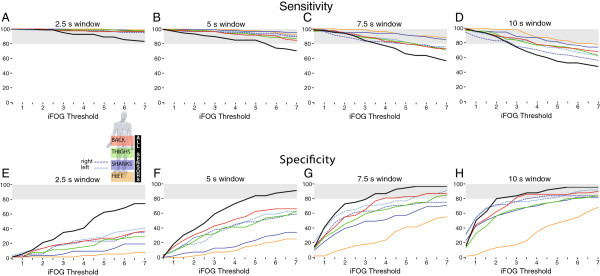
BACKGROUND: We have previously published a technique for objective assessment of freezing of gait (FOG) in Parkinson's disease (PD) from a single shank-mounted accelerometer. Here we extend this approach to evaluate the optimal configuration of sensor placement and signal processing parameters using seven sensors attached to the lumbar back, thighs, shanks and feet. METHODS: Multi-segmental acceleration data was obtained from 25 PD patients performing 134 timed up and go tasks, and clinical assessment of FOG was performed by two experienced raters from video. Four metrics were used to compare objective and clinical measures; the intraclass correlation coefficient (ICC) for number of FOG episodes and the percent time frozen per trial; and the sensitivity and specificity of FOG detection. RESULTS: The seven-sensor configuration was the most robust, scoring highly on all measures of performance (ICC number of FOG 0.75; ICC percent time frozen 0.80; sensitivity 84.3%; specificity 78.4%). A simpler single-shank sensor approach provided similar ICC values and exhibited a high sensitivity to FOG events, but specificity was lower at 66.7%. Recordings from the lumbar sensor offered only moderate agreement with the clinical raters in terms of absolute number and duration of FOG events (likely due to musculoskeletal attenuation of lower-limb 'trembling' during FOG), but demonstrated a high sensitivity (86.2%) and specificity (82.4%) when considered as a binary test for the presence/absence of FOG within a single trial. CONCLUSIONS: The seven-sensor approach was the most accurate method for quantifying FOG, and is best suited to demanding research applications. A single shank sensor provided measures comparable to the seven-sensor approach but is relatively straightforward in execution, facilitating clinical use. A single lumbar sensor may provide a simple means of objective FOG detection given the ubiquitous nature of accelerometers in mobile telephones and other belt-worn devices.
Overview
The claims and statistics of this paper haven’t been checked yet.
Free: it reads the open-access text and checks the first 5 claims that cite a source we can check. Create a free account to check every claim.
Integrity signals
Registry
Cites
Statistics
Figures
Verification
Claims the paper makes
The claims and statistics of this paper haven’t been checked yet.
Free: it reads the open-access text and checks the first 5 claims that cite a source we can check. Create a free account to check every claim.
Claims other papers make about this one
Each is checked against this paper’s own text: does it say what the citing paper says it does?
The cited source doesn’t support the claim as written.
In the citing paper
“Whereas, when using a short window size, it has been reported an important decrease in the sensitivity at short episodes, which are normally the most frequent in patients with FOG [61,68].”
From Deep Learning Approaches for Detecting Freezing of Gait in Parkinson’s Disease Patients through On-Body Acceleration Sensors (2020) · cites this paper as [61]
Checked by a reasoning model — may be wrong.
Experimental — accuracy not yet measured
Self-check
Percentages, sums and reported differences re-computed from the paper’s own numbers.
The self-check needs the paper’s full text.
Citations
Cites
Folstein, M. F., Folstein, S. E., & McHugh, P. R. (1975) · Journal of Psychiatric Research · doi:10.1016/0022-3956(75)90026-6 · Cited by 88,282 · cited 1×
“All patients satisfied UKPDS Brain Bank criteria [27], had a MiniMental State Examination (MMSE) [28] score of ≥ 24 and were deemed unlikely to have dementia or major depression according to DSM-IV criteria by consensus rating of a neurologist (SJGL) and a neuropsychologist (SLN).”
MethodIntraclass correlations: Uses in assessing rater reliability.
Shrout, P. E., & Fleiss, J. L. (1979) · Psychological Bulletin · doi:10.1037/0033-2909.86.2.420 · Cited by 24,532 · cited 1×
“The reliability of the quantification of the number of FOG episodes and percent time frozen was calculated between the clinical observers and the objective accelerometer-derived (iFOG) measures using the ICC [32]; the 134-element arrays for frequency, and relative duration of FOG, obtained from clinical assessment wer…”
MethodParkinsonism: onset, progression, and mortality
Hoehn, M. M., & Yahr, M. D. (1967) · Neurology · doi:10.1212/wnl.17.5.427 · Cited by 12,107
Unified Parkinson's Disease Rating Scale
(2012) · SpringerReference · doi:10.1007/springerreference_184495 · Cited by 3,066
Recent developments in Parkinson's disease
Fahn, S., Elton, R., MARSDEN, C. D., Calne, D. B., & Goldstein, M. (1986) · Raven Press eBooks · Cited by 2,306
JENKINSON, C., FITZPATRICK, R., PETO, V., GREENHALL, R., & HYMAN, N. (1997) · Age and Ageing · doi:10.1093/ageing/26.5.353 · Cited by 1,321 · cited 1×
“3], Parkinson's Disease Questionnaire (PDQ) 39 [30] 67.”
Bloem, B. R., Hausdorff, J. M., Visser, J. E., & Giladi, N. (2004) · Movement Disorders · doi:10.1002/mds.20115 · Cited by 1,297 · cited 4×
“Current treatment options for FOG are largely ineffective [1].”
BackgroundInfluentialStefani, A., Lozano, A. M., Peppe, A., Stanzione, P., Galati, S., Tropepi, D., Pierantozzi, M., Brusa, L., Scarnati, E., & Mazzone, P. (2007) · Brain · doi:10.1093/brain/awl346 · Cited by 807 · cited 1×
“Patients may undergo deep brain stimulation surgery to relieve symptoms of 'off' state FOG, although these surgical interventions are currently viewed as a treatment option only in the latter stages of PD [26].”
BackgroundSchaafsma, J. D., Balash, Y., Gurevich, T., Bartels, A. L., Hausdorff, J. M., & Giladi, N. (2003) · European Journal of Neurology · doi:10.1046/j.1468-1331.2003.00611.x · Cited by 725 · cited 3×
“Increasing levodopa dosage can reduce the frequency of 'off' (unmedicated) state freezing [1,22], likely by increasing the threshold for FOG to occur without altering the underlying pathophysiology [22].”
BackgroundRascol, O., Brooks, D., Melamed, E., Oertel, W., Poewe, W., Stocchi, F., & Tolosa, E. (2005) · The Lancet · doi:10.1016/s0140-6736(05)71083-7 · Cited by 641 · cited 1×
“A Freezing of Gait Questionnaire (FOG-Q) [7] and the new FOG-Q (NFOG-Q) [8] have recently been proposed as more sensitive tools to identify FOG behavior and assess the efficacy of interventions [9].”
Method
Cited by
Technology in Parkinson’s disease: challenges and opportunities
Espay, A. J., Bonato, P., Nahab, F. B., Maetzler, W., Dean, J. M., Klucken, J., Eskofier, B. M., Merola, A., Horak, F., Lang, A. E., et al. (2016) · Movement Disorders · doi:10.1002/mds.26642 · Cited by 654
“The system may detect an increase in cadence with a corresponding decrease in step length or a change in frequency of the lower leg oscillations.(34) The detection of such motor behaviors could trigger a device designed to deliver proprioceptive cues that could lead to a change in postural control and stepping pattern…”
BackgroundFree‐living monitoring of Parkinson's disease: Lessons from the field
Del Din, S., Godfrey, A., Mazzà, C., Lord, S., & Rochester, L. (2016) · Movement Disorders · doi:10.1002/mds.26718 · Cited by 370
“74%) for detection of FOG and moderate agreement with clinical measures.(43,44) These results provide a critical step from which validation can be extended to free living.”
ResultFreezing of gait: a practical approach to management
Nonnekes, J., Snijders, A. H., Nutt, J. G., Deuschl, G., Giladi, N., & Bloem, B. R. (2015) · The Lancet Neurology · doi:10.1016/s1474-4422(15)00041-1 · Cited by 365
Rodríguez-Martín, D., Samà, A., Pérez-López, C., Català, A., Moreno Arostegui, J. M., Cabestany, J., Bayés, À., Alcaine, S., Mestre, B., Prats, A., et al. (2017) · PLOS ONE · doi:10.1371/journal.pone.0171764 · Cited by 237
“In 2008, Moore et al. proposed a methodology for detecting FoG with an accelerometer at the ankle where they described the Freezing Index (FI), which is the quotient of the power spectral density (PSD) from 3 to 8 Hz (Freezing Band, FB) and the PSD from 0.5 to 3 Hz (Walking Band, WB) [21].”
BackgroundMethodInfluentialCamps, J., Samà, A., Martín, M., Rodríguez-Martín, D., Pérez-López, C., Moreno Arostegui, J. M., Cabestany, J., Català, A., Alcaine, S., Mestre, B., et al. (2018) · Knowledge-Based Systems · doi:10.1016/j.knosys.2017.10.017 · Cited by 224
“…the already preprocessed data was windowed using a window size of 2.56 s since sensor measurements employed were acquired at435 50 Hz, according to Moore et al. (2013) [57], window sizes for FOG detection should be at least of 2.5 s to achieve accurate results, and GPUs are more efficient for…”
MethodResultInfluentialWearable-Sensor-Based Detection and Prediction of Freezing of Gait in Parkinson’s Disease: A Review
Pardoel, S., Kofman, J., Nantel, J., & Lemaire, E. D. (2019) · Sensors · doi:10.3390/s19235141 · Cited by 201
“FOG detection methods vary in complexity, with the simplest models directly comparing wearable sensor variables to thresholds [29,41,44,46,53,63,73,123].”
BackgroundMethodInfluentialBuckley, C., Alcock, L., McArdle, R., Rehman, R., Del Din, S., Mazzà, C., Yarnall, A., & Rochester, L. (2019) · Brain Sciences · doi:10.3390/brainsci9020034 · Cited by 197
Silva de Lima, A. L., Evers, L. J. W., Hahn, T., Bataille, L., Hamilton, J. L., Little, M. A., Okuma, Y., Bloem, B. R., & Faber, M. J. (2017) · Journal of Neurology · doi:10.1007/s00415-017-8424-0 · Cited by 191
Measuring freezing of gait during daily-life: an open-source, wearable sensors approach
Mancini, M., Shah, V. V., Stuart, S., Curtze, C., Horak, F. B., Safarpour, D., & Nutt, J. G. (2021) · Journal of NeuroEngineering and Rehabilitation · doi:10.1186/s12984-020-00774-3 · Cited by 182
Clinical and methodological challenges for assessing freezing of gait: Future perspectives
Mancini, M., Bloem, B. R., Horak, F. B., Lewis, S. J. G., Nieuwboer, A., & Nonnekes, J. (2019) · Movement Disorders · doi:10.1002/mds.27709 · Cited by 173
Self-citationThe Next Step: A Common Neural Mechanism for Freezing of Gait
Lewis, S. J. G., & Shine, J. M. (2016) · The Neuroscientist · doi:10.1177/1073858414559101 · Cited by 160
Self-citationThe clinical significance of freezing while turning in Parkinson’s disease
Mancini, M., Smulders, K., Cohen, R. G., Horak, F. B., Giladi, N., & Nutt, J. G. (2017) · Neuroscience · doi:10.1016/j.neuroscience.2016.11.045 · Cited by 144
“…requiring bilateral limb coordination, such as stepping in place (Nantel et al., 2011), walking and turning on the TUG test (Mancini et al., 2012, Moore et al., 2013), and turning in place (Spildooren et al., 2010, Snijders et al., 2012, Zach et al., 2015) are the most reliable methods to elicit…”
MethodSigcha, L., Costa, N., Pavón, I., Costa, S., Arezes, P., López, J. M., & De Arcas, G. (2020) · Sensors · doi:10.3390/s20071895 · Cited by 126
“In this work, a high performance was achieved using a single accelerometer located in the waits, as suggested by Moore [61].”
BackgroundMethodInfluentialShine, J. M., Handojoseno, A. M. A., Nguyen, T. N., Tran, Y., Naismith, S. L., Nguyen, H. T., & Lewis, S. J. G. (2013) · Clinical Neurophysiology · doi:10.1016/j.clinph.2013.09.006 · Cited by 144
Self-citationPalmerini, L., Rocchi, L., Mazilu, S., Gazit, E., Hausdorff, J. M., & Chiari, L. (2017) · Frontiers in Neurology · doi:10.3389/fneur.2017.00394 · Cited by 116
“The most frequent approach for the detection of FOG events is based on the fact that during FOG the acceleration signals recorded by inertial sensors show a pattern of high frequency movements (mostly given by the trembling behavior of the legs) (4, 6–15).”
Peterson, D. S., King, L. A., Cohen, R. G., & Horak, F. B. (2015) · Physical Therapy · doi:10.2522/ptj.20140603 · Cited by 133
Freezing of gait: Promising avenues for future treatment
Gilat, M., de Lima, A. L. S., Bloem, B. R., Shine, J. M., Nonnekes, J. H., & Lewis, S. J. G. (2018) · Parkinsonism & Related Disorders · doi:10.1016/j.parkreldis.2018.03.009 · Cited by 127
Self-citationThe New Freezing of Gait Questionnaire: Unsuitable as an Outcome in Clinical Trials?
Hulzinga, F., Nieuwboer, A., Dijkstra, B. W., Mancini, M., Strouwen, C., Bloem, B. R., & Ginis, P. (2020) · Movement Disorders Clinical Practice · doi:10.1002/mdc3.12893 · Cited by 116
“However, this method is very labor intensive as it should ideally be done by at least 2 independent raters in a standardized manner to allow for comparison between studies.(46,47) Automated video algorithms may enable faster and standardized FOG video annotations.”
MethodShalin, G., Pardoel, S., Lemaire, E. D., Nantel, J., & Kofman, J. (2021) · Journal of NeuroEngineering and Rehabilitation · doi:10.1186/s12984-021-00958-5 · Cited by 126
“Percentage of time frozen FOG detection models have been evaluated using the percentage of time frozen during a walking trial to compare the model classifications to the ground truth labels [46], and to compare labels from different labelers [47].”
MethodChandrabhatla, A. S., Pomeraniec, I. J., & Ksendzovsky, A. (2022) · npj Digital Medicine · doi:10.1038/s41746-022-00568-y · Cited by 123
“Similar fi ndings were reported by Moore et al., who showed that freezing-of-gait (FoG) identi fi cation based on frequency characteristics of lower extremity motion correlated strongly (interclass correlation >0.7) with clinical assessments by specialists 30 .”
BackgroundInfluentialA smartphone-based architecture to detect and quantify freezing of gait in Parkinson’s disease
Capecci, M., Pepa, L., Verdini, F., & Ceravolo, M. G. (2016) · Gait & Posture · doi:10.1016/j.gaitpost.2016.08.018 · Cited by 118
Clinical Assessments in Parkinson's Disease
Bhidayasiri, R., & Martínez‐Martín, P. (2017) · International review of neurobiology · doi:10.1016/bs.irn.2017.01.001 · Cited by 124
Shawen, N., O’Brien, M. K., Venkatesan, S., Lonini, L., Simuni, T., Hamilton, J. L., Ghaffari, R., Rogers, J. A., & Jayaraman, A. (2020) · Journal of NeuroEngineering and Rehabilitation · doi:10.1186/s12984-020-00684-4 · Cited by 116
“strated that relative utility of data is highly dependent on body location and the intended application [22, 34].”
BackgroundChatzaki, C., Skaramagkas, V., Tachos, N. S., Christodoulakis, G., Maniadi, E., Kefalopoulou, Z. M., Fotiadis, D. I., & Tsiknakis, M. (2021) · Sensors · doi:10.3390/s21082821 · Cited by 117
Detection of Freezing of Gait in Parkinson Disease: Preliminary Results
Azevedo Coste, C., Sijobert, B., Pissard-Gibollet, R., Pasquier, M., Espiau, B., & Geny, C. (2014) · Sensors · doi:10.3390/s140406819 · Cited by 100
“The FI method was validated using one to seven accelerometers mounted on patients with satisfactory detection results [19].”
MethodZach, H., Janssen, A. M., Snijders, A. H., Delval, A., Ferraye, M. U., Auff, E., Weerdesteyn, V., Bloem, B. R., & Nonnekes, J. (2015) · Parkinsonism & Related Disorders · doi:10.1016/j.parkreldis.2015.09.051 · Cited by 97
“shank), window-lengths and thresholds [11,12].”
BackgroundMethodResultInfluentialDetection and assessment of Parkinson's disease based on gait analysis: A survey
Guo, Y., Yang, J., Liu, Y., Chen, X., & Yang, G. (2022) · Frontiers in Aging Neuroscience · doi:10.3389/fnagi.2022.916971 · Cited by 128
“In specific, Freeze Index (FI) is one of the most frequently used acceleration-based features for FOG detection (Moore et al., 2013), which is defined as the ratio of power in the freeze (3–8 Hz) and locomotor (0–3 Hz) bands.”
BackgroundRezvanian, S., & Lockhart, T. E. (2016) · Sensors · doi:10.3390/s16040475 · Cited by 89
“during gait initiation and turning or, encountering an obstacle [7].”
BackgroundMethodResultThe Practicalities of Assessing Freezing of Gait
Barthel, C., Mallia, E., Debu, B. H. G., Bloem, B. R., & Ferraye, M. (2016) · Journal of Parkinson s Disease · doi:10.3233/jpd-160927 · Cited by 104
“The sensitivity for an IMU placed at the shank is high though the specificity is rather low [41].”
BackgroundPham, T. T. T., Moore, S. T., Lewis, S. J. G., Nguyen, D. N., Dutkiewicz, E., Fuglevand, A. J., McEwan, A. L., & Leong, P. H. W. (2017) · IEEE Transactions on Biomedical Engineering · doi:10.1109/tbme.2017.2665438 · Cited by 93
“reference [19] examined one case of using seven sensors (single axis each sensor) that was the majority votes of seven outputs, we categorize that into the SCSS group.”
BackgroundMethodInfluentialSelf-citationThe role of frontostriatal impairment in freezing of gait in Parkinson's disease
Shine, J. M., Moustafa, A. A., Matar, E., Frank, M. J., & Lewis, S. J. G. (2013) · Frontiers in Systems Neuroscience · doi:10.3389/fnsys.2013.00061 · Cited by 86
Self-citationAich, S., Pradhan, P. M., Park, J., Sethi, N. K., Vathsa, V. S. S., & Kim, H. (2018) · Sensors · doi:10.3390/s18103287 · Cited by 98
“expensive and can facilitate long-term monitoring outside the clinical environment [26,27].”
BackgroundZhao, Y., Nonnekes, J. H., Storcken, E. J. M., Janssen, S., van Wegen, E. E. H., Bloem, B. R., Dorresteijn, L. D. A., van Vugt, J. P. P., Heida, T., & Wezel, R. J. A. V. (2016) · Journal of Neurology · doi:10.1007/s00415-016-8115-2 · Cited by 92
Long short term memory based patient-dependent model for FOG detection in Parkinson's disease
Ashour, A. S., El-Attar, A., Dey, N., Elkader, H. A., & El-Naby, M. M. A. (2019) · Pattern Recognition Letters · doi:10.1016/j.patrec.2019.11.036 · Cited by 85
Suppa, A., Kita, A., Leodori, G., Zampogna, A., Nicolini, E., Lorenzi, P., Rao, R., & Irrera, F. (2017) · Frontiers in Neurology · doi:10.3389/fneur.2017.00406 · Cited by 110
“In turn, setting fs = 25 Hz does not present any drawbacks in the detection since the characteristic band of FOG in PD lies below 12 Hz (21).”
BackgroundMethodInfluentialDjuric-Jovicic, M. D., Jovičić, N. S., Radovanovic, S. M., Stanković, I., Popović, M. B., & Kostić, V. (2013) · IEEE Transactions on Neural Systems and Rehabilitation Engineering · doi:10.1109/tnsre.2013.2287241 · Cited by 86
“performed with more than 86% sensitivity success and more than 66% specificity success for sensor placed on shank [22].”
BackgroundMethodMazzetta, I., Zampogna, A., Suppa, A., Gumiero, A., Pessione, M., & Irrera, F. (2019) · Sensors · doi:10.3390/s19040948 · Cited by 90
Samà, A., Rodríguez-Martín, D., Pérez-López, C., Català, A., Alcaine, S., Mestre, B., Prats, A., Crespo, M. C., & Bayés, À. (2018) · Pattern Recognition Letters · doi:10.1016/j.patrec.2017.05.009 · Cited by 76
“This position has been chosen, first, because it has been previously used to detect FoG with relative success (Moore et al. 2013), and, second, it also enables the monitoring of other relevant information for PD (such as gait parameters (Sayeed et al. 2015), dyskinesia (Pérez-López, Samà,…”
MethodUnconstrained detection of freezing of Gait in Parkinson's disease patients using smartphone
Kim, H., Lee, H. J., Lee, W., Kwon, S., Kim, S. K., Jeon, H. S., Park, H., Shin, C. W., Yi, W. J., Jeon, B. S., et al. (2015) · 2015 37th Annual International Conference of the IEEE Engineering in Medicine and Biology Society (EMBC) · doi:10.1109/embc.2015.7319209 · Cited by 74
“This may suggest chest as another candidate position for detecting FOG because previous researches usually focused on lower body accelerometer measurement [8], [17].”
Assessing inertial measurement unit locations for freezing of gait detection and patient preference
O’Day, J. J., Lee, M. R., Seagers, K. A., Hoffman, S. L., Jih-Schiff, A., Kidziński, Ł., Delp, S. L., & Bronte-Stewart, H. M. (2022) · Journal of NeuroEngineering and Rehabilitation · doi:10.1186/s12984-022-00992-x · Cited by 88
Naghavi, N., & Wade, E. (2019) · IEEE Transactions on Neural Systems and Rehabilitation Engineering · doi:10.1109/tnsre.2019.2910165 · Cited by 80
“tify FoG episodes [14], [23], [33], [34].”
Cortical phase-amplitude coupling is key to the occurrence and treatment of freezing of gait
Yin, Z., Zhu, G., Liu, Y., Zhao, B., Liu, D., Bai, Y., Zhang, Q., Shi, L., Feng, T., Yang, A., et al. (2022) · Brain · doi:10.1093/brain/awac121 · Cited by 81
“A ‘freezing threshold’ was set to ‘3’.(21) Notably, because FI is a dynamic measurement, we defined that if FI dropped from >3 to a value between 2 and 3 and then rose back”
Antonini, A., Reichmann, H., Gentile, G., Garon, M., Tedesco, C., Frank, A. K., Falkenburger, B. H., Konitsiotis, S., Tsamis, K. I., Rigas, G., et al. (2023) · Frontiers in Neurology · doi:10.3389/fneur.2023.1080752 · Cited by 80
“(58), which is estimated using data from the ankle gyroscope, as well as other features necessary for the discrimination between FoG and other kinds of activity (i.”
MethodSmart Gait-Aid Glasses for Parkinson's Disease Patients
Ahn, D., Chung, H., Lee, H., Kang, K., Ko, P., Kim, N. S., & Park, T. (2017) · IEEE Transactions on Biomedical Engineering · doi:10.1109/tbme.2017.2655344 · Cited by 70
“Based on Moore’s method [8], [29], Jovanov et al.”
BackgroundMethodInfluentialHow to Annotate Freezing of Gait from Video: A Standardized Method Using Open-Source Software
Gilat, M. (2019) · Journal of Parkinson s Disease · doi:10.3233/jpd-191700 · Cited by 65
Reches, T., Dagan, M., Herman, T., Gazit, E., Gouskova, N., Giladi, N., Manor, B. D., & Hausdorff, J. M. (2020) · Sensors · doi:10.3390/s20164474 · Cited by 73
“Analyzing FOG episodes with inertial sensors enables objective measurement of FOG duration, its dynamics, the number of episodes, and the context in which they occurred [8,12,14,15].”
BackgroundLong‐term double‐blinded unilateral pedunculopontine area stimulation in Parkinson's disease
Mestre, T., Sidiropoulos, C., Hamani, C., Poon, Y., Lozano, A. M., Lang, A. E., & Moro, E. (2016) · Movement Disorders · doi:10.1002/mds.26710 · Cited by 63
Rodríguez‐Molinero, A., Pérez‐López, C., Samà, A., de Mingo-Fernández, E., Rodríguez-Martín, D., Hernández‐Vara, J., Bayés, À., Moral, A., Álvarez, R., Pérez-Martínez, D. A., et al. (2018) · JMIR Rehabilitation and Assistive Technologies · doi:10.2196/rehab.8335 · Cited by 71
“Other authors have used inertial sensors to analyze the freezing of gait [10-12], although the accuracy of their detection algorithms was lower, often below 70%.”
BackgroundSmartphone based Fuzzy Logic freezing of gait detection in Parkinson's Disease
Pepa, L., Ciabattoni, L., Verdini, F., Capecci, M., & Ceravolo, M. G. (2014) · IEEE/ASME International Conference on Mechatronic and Embedded Systems and Applications · doi:10.1109/mesa.2014.6935630 · Cited by 62
“A number of studies on wireless body sensor networks have been proposed to monitor FOG and provide a quantitative and objective assessment [13], [14], [15], [16].”
Goyal, J., Khandnor, P., & Aseri, T. C. (2020) · Engineering Applications of Artificial Intelligence · doi:10.1016/j.engappai.2020.103955 · Cited by 71
Mobile Devices For The Real Time Detection Of Specific Human Motion Disorders
Irrera, F., Lorenzi, P., Rao, R., Romano, G., & Kita, A. (2016) · IEEE Sensors Journal · doi:10.1109/jsen.2016.2530944 · Cited by 65
“They can be divided into two classes: those that can be used outdoor [22]–[24] and those that must be used indoor [25]–[27].”
Backgroundde Lima‐Pardini, A. C., Coelho, D. B., Souza, C. P., de Souza, C. O., Ghilardi, M. G. D. S., Garcia, T., Voos, M. C., Milosevic, M., Hamani, C., Teixeira, L. A., et al. (2018) · eLife · doi:10.7554/elife.37727 · Cited by 58
“Values above the clinical threshold of 2 were considerate as FoG events (Moore et al., 2013; Moore et al., 2008).”
BackgroundMethodInfluentialArami, A., Poulakakis-Daktylidis, A., Tai, Y., & Burdet, E. (2019) · IEEE Transactions on Neural Systems and Rehabilitation Engineering · doi:10.1109/tnsre.2019.2933626 · Cited by 60
“This is in agreement with previous findings on FI [30] and can be explained as EFI is explicitly defined on the frequency content of the”
BackgroundResultFreezing of Gait in People with Parkinson’s Disease: Nature, Occurrence, and Risk Factors
Lord, S. R., Bindels, H., Ketheeswaran, M., Brodie, M. A. D., Lawrence, A. D., Close, J., Whone, A. L., Ben‐Shlomo, Y., & Henderson, E. J. (2020) · Journal of Parkinson s Disease · doi:10.3233/jpd-191813 · Cited by 65
Warlop, T., Detrembleur, C., Bollens, B., Stoquart, G. G., Crevecoeur, F., Jeanjean, A. P., & Lejeune, T. M. (2016) · Journal of Rehabilitation Medicine · doi:10.2340/16501977-2158 · Cited by 56
Chen, C.-C., Yeh, C.-H., Chan, H., Chang, Y., Tu, P., Yeh, C., Lu, C., Fischer, P., Tinkhauser, G., Tan, H., et al. (2019) · Neurobiology of Disease · doi:10.1016/j.nbd.2019.104605 · Cited by 54
Sigcha, L., Borzì, L., Pavón, I., Costa, N., da Costa, S. P., Arezes, P., López, J. M., & de Arcas, G. (2022) · Engineering Applications of Artificial Intelligence · doi:10.1016/j.engappai.2022.105482 · Cited by 64
Huang, T., Li, M., & Huang, J. (2023) · Frontiers in Aging Neuroscience · doi:10.3389/fnagi.2023.1119956 · Cited by 58
Home monitoring of motor fluctuations in Parkinson’s disease patients
Borzì, L., Varrecchia, M., Olmo, G., Artusi, C. A., Fabbri, M., Rizzone, M. G., Romagnolo, A., Zibetti, M., & Lopiano, L. (2019) · Journal of Reliable Intelligent Environments · doi:10.1007/s40860-019-00086-x · Cited by 54
Validation of Freezing-of-Gait Monitoring Using Smartphone
Kim, H. B., Lee, H. J., Lee, W. W., Kim, S. K., Jeon, H. S., Park, H. Y., Shin, C., Yi, W. J., Jeon, B., & Park, K. S. (2018) · Telemedicine Journal and e-Health · doi:10.1089/tmj.2017.0215 · Cited by 48
“Previous studies were mainly conducted in two ways: Most of them 8,9,13,14,19 manually designed the fixed-threshold algorithms; the methods detected FOG events, when some of the features exceeded a certain threshold.”
Neural Correlates of Freezing of Gait in Parkinson's Disease: An Electrophysiology Mini-Review
Marquez, J. S., Hasan, S. M. S., Siddiquee, M. R., Luca, C. C., Mishra, V. R., Mari, Z. K., & Bai, O. (2020) · Frontiers in Neurology · doi:10.3389/fneur.2020.571086 · Cited by 57
Wu, P., Cao, B., Liang, Z., & Wu, M. (2023) · Frontiers in Aging Neuroscience · doi:10.3389/fnagi.2023.1191378 · Cited by 43
O’Day, J. J., Syrkin‐Nikolau, J., Anidi, C. M., Kidziński, Ł., Delp, S. L., & Bronte-Stewart, H. M. (2020) · PLoS ONE · doi:10.1371/journal.pone.0231984 · Cited by 48
Predicting Freezing of Gait in Parkinsons Disease Patients Using Machine Learning
Orphanidou, N. K., Hussain, A., Keight, R., Lishoa, P., Hind, J., & Al-Askar, H. (2018) · 2018 IEEE Congress on Evolutionary Computation (CEC) · doi:10.1109/cec.2018.8477909 · Cited by 39
“Threshold based algorithms have previously identified FoG events with high accuracy [18]–[23].”
BackgroundGuo, Y., Huang, D., Zhang, W., Wang, L., Li, Y., Olmo, G., Wang, Q., Meng, F., & Chan, P. (2022) · Computers in Biology and Medicine · doi:10.1016/j.compbiomed.2022.105629 · Cited by 47
IMU based detection of freezing of gait and festination in Parkinson's disease
Sijobert, B., Denys, J., Coste, C. A., & Geny, C. (2014) · 2014 IEEE 19th International Functional Electrical Stimulation Society Annual Conference (IFESS) · doi:10.1109/ifess.2014.7036751 · Cited by 39
Filtjens, B., Ginis, P., Nieuwboer, A., Slaets, P., & Vanrumste, B. (2022) · Journal of NeuroEngineering and Rehabilitation · doi:10.1186/s12984-022-01025-3 · Cited by 52
“The MS-GCN architecture naturally extends to other graph-based input data, such as single- or multi-camera markerless pose estimation [67, 68], and FOG assessment protocols that employ multiple on-body sensors [24, 25].”
BackgroundTherapy-resistant symptoms in Parkinson’s disease
Vorovenci, R. J., Biundo, R., & Antonini, A. (2015) · Journal of Neural Transmission · doi:10.1007/s00702-015-1463-8 · Cited by 46
Motion Sensors to Assess and Monitor Medical and Surgical Management of Parkinson Disease
Lieber, B. A., Taylor, B. E. S., Appelboom, G., McKhann, G. M., & Connolly, E. S. (2015) · World Neurosurgery · doi:10.1016/j.wneu.2015.03.024 · Cited by 42
“In a recent pilot study of 25 patients, a simple, cheap, lightweight sensor, which also contained a gyroscope, was placed on the subjects’ lower leg, and was highly sensitive and 67% specific for detecting FOG events [13,40].”
BackgroundEmerging Promise of Nanoparticle-Based Treatment for Parkinson’s disease
(2020) · Biointerface Research in Applied Chemistry · doi:10.33263/briac106.71357151 · Cited by 36
Khoshnam, M., Häner, D. M. C., Kuatsjah, E., Zhang, X., & Menon, C. (2018) · Frontiers in Neuroscience · doi:10.3389/fnins.2018.00633 · Cited by 45
Short rapid steps to provoke freezing of gait in Parkinson’s disease
Nonnekes, J. H., Janssen, A. M., Mensink, S. H. G., Nijhuis, L. B. O., Bloem, B. R., & Snijders, A. H. (2014) · Journal of Neurology · doi:10.1007/s00415-014-7422-8 · Cited by 40
de Souza, C. R., Miao, R., de Oliveira, J. Á., de Lima‐Pardini, A. C., de Campos, D. D. S. F., Silva‐Batista, C., Teixeira, L. A., Shokur, S., Bouri, M., & Coelho, D. B. (2022) · Frontiers in Neuroscience · doi:10.3389/fnins.2022.832463 · Cited by 48
Reliable and Robust Detection of Freezing of Gait Episodes With Wearable Electronic Devices
Kita, A., Lorenzi, P., Rao, R., & Irrera, F. (2017) · IEEE Sensors Journal · doi:10.1109/jsen.2017.2659780 · Cited by 34
“As an evidence of the current interest in the field, several FoG detection systems have been proposed in literature in the last decade, to be used outdoor [8]–[10] or indoor [11]–[14].”
A fuzzy logic system for the home assessment of freezing of gait in subjects with Parkinsons disease
Pepa, L., Capecci, M., Andrenelli, E., Ciabattoni, L., Spalazzi, L., & Ceravolo, M. G. (2020) · Expert Systems with Applications · doi:10.1016/j.eswa.2020.113197 · Cited by 32
Ashfaque Mostafa, T., Soltaninejad, S., McIsaac, T. L., & Cheng, I. (2021) · Sensors · doi:10.3390/s21196446 · Cited by 32
“Moore et al. [49] then proposed a threshold based method for FOG detection by defining the Freeze Index (FI), which is the ratio between the power of the signal in “freeze” band (3–8 Hz) divided by the power of the signal in the “locomotion” band (0.5–3 Hz).”
BackgroundMethodInfluentialChomiak, T., Xian, W., Pei, Z., & Hu, B. (2019) · Journal of Neural Transmission · doi:10.1007/s00702-019-02020-0 · Cited by 38
Cao, Z., John, A. R., Chen, H., Martens, K. A. E., Georgiades, M., Gilat, M., Nguyen, H. T., Lewis, S. J. G., & Lin, C. (2021) · IEEE Transactions on Neural Systems and Rehabilitation Engineering · doi:10.1109/tnsre.2021.3107106 · Cited by 42
Self-citationFar, M. S., Eickhoff, S. B., Goñi, M., & Dukart, J. (2021) · Journal of Medical Internet Research · doi:10.2196/26608 · Cited by 34
Dual Task Turning in Place: A Reliable, Valid, and Responsive Outcome Measure of Freezing of Gait
D’Cruz, N., Seuthe, J., Somer, C. D., Hulzinga, F., Ginis, P., Schlenstedt, C., & Nieuwboer, A. (2021) · Movement Disorders · doi:10.1002/mds.28887 · Cited by 36
“Another limitation of this work is that we compared our clinical ratings to a summary measure of the FOG ratio rather than segment FOG episodes using automated algorithms.(43) An attempt to segment FOG episodes based on thresholding of the FOG ratio (>2.”
ResultYungher, D. A., Morris, T. R., Dilda, V., Shine, J. M., Naismith, S. L., Lewis, S. J. G., & Moore, S. T. (2014) · Parkinson's Disease · doi:10.1155/2014/606427 · Cited by 28
“Although the pathophysiological basis of FOG is not clear, these results, and those of prior studies [21, 23, 24, 26, 28, 29], suggest that a cardinal clinical feature of freezing is the development of high-frequency oscillations in the lower limbs of central origin.”
BackgroundMethodResultInfluentialSelf-citationDetection and prediction of freezing of gait with wearable sensors in Parkinson’s disease
Zhang, W., Sun, H., Huang, D., Zhang, Z., Li, J., Wu, C., Sun, Y., Gong, M., Wang, Z., Sun, C., et al. (2023) · Neurological Sciences · doi:10.1007/s10072-023-07017-y · Cited by 36
“Force sensitive resistor (FSR) voltages from the soles of feet were used to Compute ICC index to judge the agreements between different raters, [28, 38, 120] calculate Pearson’s correlation coefficient (Pcc) between one normal step and the other steps [44], but the baseline normal gait had to be…”
InfluentialClinical Evaluation in Parkinson’s Disease: Is the Golden Standard Shiny Enough?
Kanellos, F. S., Tsamis, K. I., Rigas, G., Simos, Y. V., Katsenos, A. P., Kartsakalis, G., Fotiadis, D. I., Vezyraki, P., Peschos, D., & Konitsiotis, S. (2023) · Sensors · doi:10.3390/s23083807 · Cited by 31
Bansal, S. K., Basumatary, B., Bansal, R., & Sahani, A. K. (2023) · MethodsX · doi:10.1016/j.mex.2023.102106 · Cited by 31
“In some papers, performance metrics are extracted using Fourier transform [32 , 35 , 41 , 55 , 62] and wavelet transform [37 , 39 , 56 , 58 , 69] to improve classification performance.”
BackgroundMethodObjective measurement versus clinician-based assessment for Parkinson’s disease
Guerra, A., D’Onofrio, V., Ferreri, F., Bologna, M., & Antonini, A. (2023) · Expert Review of Neurotherapeutics · doi:10.1080/14737175.2023.2229954 · Cited by 30
“sensor provided a high sensitivity but low specificity [115].”
BackgroundExplicative human activity recognition using adaptive association rule-based classification
Atzmueller, M., Hayat, N., Trojahn, M., & Kroll, D. (2018) · doi:10.1109/fiot.2018.8325603 · Cited by 31
“This also relates to the medical context, in particular for Parkinson’s disease, e. g., Bachlin et al. [18], Mazilu et al. [19], as well as Moore et al. [20], [21].”
BackgroundHu, H., Chen, J., Huang, H., Zhou, C.-H., Zhang, S., Liu, X., Wang, L., Chen, P., Nie, K., Chen, L., et al. (2019) · Brain Imaging and Behavior · doi:10.1007/s11682-018-0031-x · Cited by 24
Yan, Y., Liu, Y.-S., Li, C., Wang, J., Ma, L., Xiong, J., Zhao, X., & Wang, L. (2022) · IEEE Sensors Journal · doi:10.1109/jsen.2022.3142750 · Cited by 27
Prediction of freezing of gait based on self-supervised pretraining via contrastive learning
Xia, Y., Sun, H. D., Zhang, B., Xu, Y., & Ye, Q. (2023) · Biomedical Signal Processing and Control · doi:10.1016/j.bspc.2023.105765 · Cited by 24
Cupertino, L., dos Reis, T. G., Angeles, E. L., Costa, T. M., Shokur, S., Bouri, M., de Lima‐Pardini, A. C., & Coelho, D. B. (2021) · Gait & Posture · doi:10.1016/j.gaitpost.2021.10.021 · Cited by 20
Cockx, H., Nonnekes, J. H., Bloem, B. R., Wezel, R. J. A. V., Cameron, I. G. M., & Wang, Y. (2023) · Journal of NeuroEngineering and Rehabilitation · doi:10.1186/s12984-023-01175-y · Cited by 31
“We see this approach as a major strength of our study, as previous work usually ignored these types of events, like voluntary stops or normal turns, neglecting the specific investigations for potential false positive events [13, 35]; or only compared the overall FOG severity calculated by the algorithm to the FOG seve…”
MethodTowards an affordable mobile analysis platform for pathological walking assessment
Bonnet, V., Coste, C., Lapierre, L., Cadic, J., Fraisse, P., Zapata, R., Venture, G., & Gény, C. (2015) · Robotics and Autonomous Systems · doi:10.1016/j.robot.2014.12.002 · Cited by 24
Recognition of Freezing of Gait in Parkinson’s Disease Based on Machine Vision
Li, W., Chen, X., Zhang, J., Lu, J., Zhang, C., Bai, H., Liang, J., Wang, J., Du, H., Xue, G., et al. (2022) · Frontiers in Aging Neuroscience · doi:10.3389/fnagi.2022.921081 · Cited by 25
Elbatanouny, H., Kleanthous, N., Dahrouj, H., Alusi, S. H., Almajali, E. R., Mahmoud, S. A., & Hussain, A. J. (2024) · Sensors · doi:10.3390/s24123959 · Cited by 24
“Some, on the other hand, placed more emphasis on specificity and sensitivity [46,110,122], concentrating on the model’s accuracy in identifying positive occurrences (FOG events) or negative instances (non-FOG events).”
BackgroundMancini, M., Curtze, C., Stuart, S., El‐Gohary, M., McNames, J., Nutt, J. G., & Horak, F. B. (2018) · Annual International Conference of the IEEE Engineering in Medicine and Biology Society (EMBC) · doi:10.1109/embc.2018.8512910 · Cited by 22
“5-3Hz) with larger ratios indicating more freezing [25, 26].”
D’Cruz, N., Vervoort, G., Fieuws, S., Moreau, C., Vandenberghe, W., & Nieuwboer, A. (2020) · Journal of Parkinson s Disease · doi:10.3233/jpd-191759 · Cited by 23
“…to extract the amplitude, frequency, freezing index (ratio of power spectral density in the freeze (3–8 Hz) compared to locomotor (0–3 Hz) bands) [38], bilateral coordination (relative phase error – degree of deviation from relative phase difference of 180 ◦ ) [39] and inconsistency of movement…”
Video-Based Detection of Freezing of Gait in Daily Clinical Practice in Patients With Parkinsonism
Kondo, Y., Bando, K., Suzuki, I., Miyazaki, Y., Nishida, D., Hara, T., Kadone, H., & Suzuki, K. (2024) · IEEE Transactions on Neural Systems and Rehabilitation Engineering · doi:10.1109/tnsre.2024.3413055 · Cited by 24
“…such as video-recorded [13], [14], [15], three-dimensional (3D) motion capture systems [16], force plates [17], [18], Inertial Measurement Units (IMU) [19], [20], [21], [22], [23], [24], [25], [26], [27], and electroencephalography caps [28], [29] have been employed to detect FoG episodes [30].”
MethodAbbasi, S., & Rezaee, K. (2024) · Brain and Behavior · doi:10.1002/brb3.70206 · Cited by 24
The Gray Area of Freezing of Gait Annotation: A Guideline and Open‐Source Practical Tool
Cockx, H., Klaver, E., Tjepkema‐Cloostermans, M. C., Wezel, R. J. A. V., & Nonnekes, J. H. (2022) · Movement Disorders Clinical Practice · doi:10.1002/mdc3.13556 · Cited by 19
Detection of Freezing of Gait Using Template-Matching-Based Approaches
Xu, C., He, J., Zhang, X., Wang, C., & Duan, S. (2017) · Journal of Sensors · doi:10.1155/2017/1260734 · Cited by 19
“The research topics about forewarning of FOG based on wearable sensors mainly concentrate on the selection of sensors [5], locations [9], and high effective algorithms [10].”
Background
Metadata
- Authors
- Moore, S. T., Yungher, D. A., Morris, T. R., Dilda, V., MacDougall, H. G., Shine, J. M., Naismith, S. L., & Lewis, S. J.
- Affiliations
- Icahn School of Medicine at Mount Sinai (US)
- The University of Sydney (AU)
- Corresponding author
- Moore, Steven T
- Venue
- Journal of NeuroEngineering and Rehabilitation
- Published
- 2013
- Volume
- 10
- Issue
- 1
- Pages
- 19
- ISSN
- 1743-0003 (ISSN-L)
- PMC
- PMC3598888
- OpenAlex
- W2122354382
- Semantic Scholar
- eccc832cda8feeb94c4b07b7cc695b6102153777
- Cited by
- 204
- References
- 34
- Citations by year
- 2026: 8 · 2025: 11 · 2024: 9 · 2023: 18 · 2022: 18 · 2021: 24 · 2020: 17 · 2019: 20 · 2018: 17 · 2017: 15 · 2016: 17 · 2015: 12 · 2014: 12 · 2013: 5
- FWCI
- 39.85
- Type
- journal article
- Language
- en
- Open access
- gold
- doi.org
- Licence
- cc-by
- Locations
- Journal of NeuroEngineering and Rehabilitation (publishedVersion, cc-by)
- Europe PMC (PubMed Central) (publishedVersion, cc-by)
- PubMed Central (publishedVersion, cc-by)
- PubMed (publishedVersion)
- Acquire (CQUniversity) (submittedVersion, cc-by)
- Figshare (submittedVersion, cc-by)
- Funders
- National Aeronautics and Space Administration (NNX09AL14G, NNX12AM25G)
- National Space Biomedical Research Institute (1008117)
- University of Sydney
- Garnett Passe and Rodney Williams Memorial Foundation
- National Health and Medical Research Council (1008117)
- Topics
- Health Sciences › Health Professions › Physical Therapy, Sports Therapy and Rehabilitation › Balance, Gait, and Falls Prevention
- Physical Sciences › Computer Science › Computer Vision and Pattern Recognition › Context-Aware Activity Recognition Systems
- Physical Sciences › Engineering › Biomedical Engineering › Gait Recognition and Analysis
- Keywords
- freezing of gait, Parkinson's disease, accelerometry, sensor placement, Timed Up and Go test, objective gait assessment, wearable sensors
- MeSH terms
- Biomechanical Phenomena, Data Interpretation, Statistical, Electrodes, Female, Foot, Humans, Leg, Locomotion, Lumbosacral Region, Male, Musculoskeletal Physiological Phenomena, Neuropsychological Tests, Parkinson Disease, Psychomotor Performance, Signal Processing, Computer-Assisted, Software, Thigh, Reproducibility of Results, Cohort Studies, Gait Disorders, Neurologic, Lower Extremity
About these checks
Registry, retraction, Cites and statistics results are computed, not judged, with one exception: a printed reference that no index lists is read once by a model before it counts as a citation error. Claims are extracted by a model and kept only when their quote appears verbatim in the text; each cited source is then checked, with a model’s help, for whether it says what the claim relies on. Those verdicts can be wrong — read the claim’s quote and the cited source before relying on one.
Statistics and arithmetic are recomputed, not judged.
Confidence bands are shown only for fields calibrated on our annotated test set. None is calibrated yet, so no band is shown.
What counts as a claim ›How we measure confidence ›How we check this ›
Are you an author, or do you see a problem with this page? Request a review
Data sources
Bibliographic data: Semantic Scholar, OpenAlex, Crossref.
Contains information from the Semantic Scholar Academic Graph Datasets, made available under the ODC Attribution License (ODC-BY 1.0).
Semantic Scholar’s data is described in: Kinney, R., et al. (2023). The Semantic Scholar Open Data Platform. arXiv:2301.10140.
