

The DOI matches its Crossref record; 55 of the 56 references it cites were found in a registry or an index.
Effect of gait speed on gait rhythmicity in Parkinson's disease: variability of stride time and swing time respond differently
Open accessAbstract
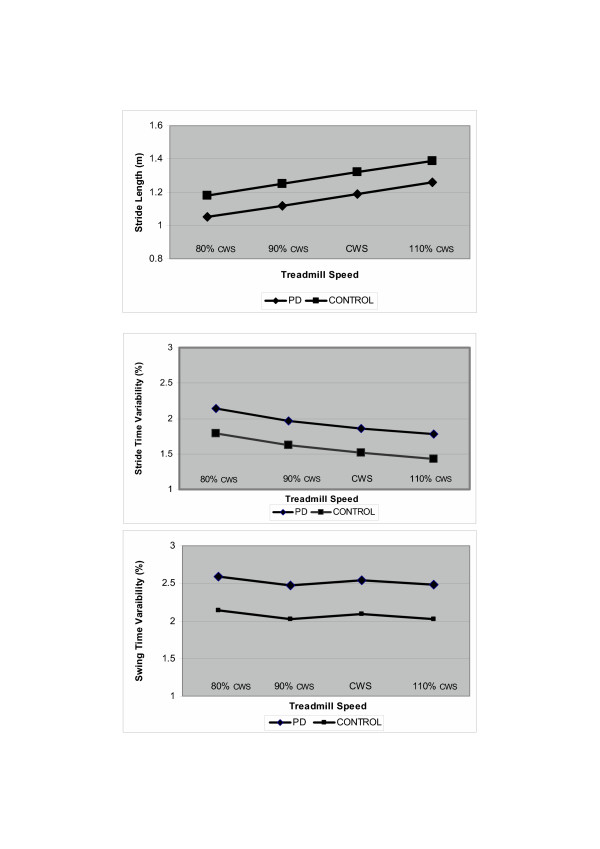
BACKGROUND: The ability to maintain a steady gait rhythm is impaired in patients with Parkinson's disease (PD). This aspect of locomotor dyscontrol, which likely reflects impaired automaticity in PD, can be quantified by measuring the stride-to-stride variability of gait timing. Previous work has shown an increase in both the variability of the stride time and swing time in PD, but the origins of these changes are not fully understood. Patients with PD also generally walk with a reduced gait speed, a potential confounder of the observed changes in variability. The purpose of the present study was to examine the relationship between walking speed and gait variability. METHODS: Stride time variability and swing time variability were measured in 36 patients with PD (Hoehn and Yahr stage 2-2.5) and 30 healthy controls who walked on a treadmill at four different speeds: 1) Comfortable walking speed (CWS), 2) 80% of CWS 3) 90% of CWS, and 4) 110% of CWS. In addition, we studied the effects of walking slowly on level ground, both with and without a walker. RESULTS: Consistent with previous findings, increased variability of stride time and swing time was observed in the patients with PD in CWS, compared to controls. In both groups, there was a small but significant association between treadmill gait speed and stride time variability such that higher speeds were associated with lower (better) values of stride time variability (p = 0.0002). In contrast, swing time variability did not change in response to changes in gait speed. Similar results were observed with walking on level ground. CONCLUSION: The present results demonstrate that swing time variability is independent of gait speed, at least over the range studied, and therefore, that it may be used as a speed-independent marker of rhythmicity and gait steadiness. Since walking speed did not affect stride time variability and swing time variability in the same way, it appears that these two aspects of gait rhythmicity are not entirely controlled by the same mechanisms. The present findings also suggest that the increased gait variability in PD is disease-related, and not simply a consequence of bradykinesia.
Overview
The claims and statistics of this paper haven’t been checked yet.
Run the check — free, no account needed. It reads the open-access text and checks the sources it cites.
Integrity signals
Registry
Cites
Statistics
Figures
Verification
Claims the paper makes
The claims and statistics of this paper haven’t been checked yet.
Run the check — free, no account needed. It reads the open-access text and checks the sources it cites.
Claims other papers make about this one
Each is checked against this paper’s own text: does it say what the citing paper says it does?
In the citing paper
“Gait impairments that involve reductions in speed and step length as well as increased stride length variability are common in PD and impact quality of life 23.”
From Exercise-enhanced neuroplasticity targeting motor and cognitive circuitry in Parkinson's disease (2013) · cites this paper as [23]
Self-check
Percentages, sums and reported differences re-computed from the paper’s own numbers.
The self-check needs the paper’s full text.
Citations
Cites
Folstein, M. F., Folstein, S. E., & McHugh, P. R. (1975) · Journal of Psychiatric Research · doi:10.1016/0022-3956(75)90026-6 · Cited by 88,282
Hirono, N., Mori, E., Ikejiri, Y., Imamura, T., Shimomura, T., Hashimoto, M., Yamashita, H., & Ikeda, M. (1997) · PubMed · Cited by 21,012
Kok, J. S., Berg, I. J., & Scherder, E. J. A. (2013) · Dementia and Geriatric Cognitive Disorders Extra · doi:10.1159/000353441 · Cited by 20,589
Older Adults' Reasons for Using Technology while Aging in Place
Peek, S. T. M., Luijkx, K. G., Rijnaard, M. D., Nieboer, M. E., van der Voort, C. S., Aarts, S., van Hoof, J., Vrijhoef, H. J., & Wouters, E. (2015) · Gerontology · doi:10.1159/000430949 · Cited by 19,852
Sensitivity and False Alarm Rate of a Fall Sensor in Long-Term Fall Detection in the Elderly
Kangas, M., Korpelainen, R., Vikman, I., Nyberg, L., & Jämsä, T. J. (2014) · Gerontology · doi:10.1159/000362720 · Cited by 19,007
Parkinsonism: onset, progression, and mortality
Hoehn, M. M., & Yahr, M. D. (1967) · Neurology · doi:10.1212/wnl.17.5.427 · Cited by 12,107
Overdependence on degraded gist memory in Alzheimer's disease.
Gallo, D. A., Shahid, K. R., Olson, M. A., Solomon, T. M., Schacter, D. L., & Budson, A. E. (2006) · Neuropsychology · doi:10.1037/0894-4105.20.6.625 · Cited by 4,757
Predicting the Probability for Falls in Community-Dwelling Older Adults Using the Timed Up & Go Test
Shumway‐Cook, A., Brauer, S., & Woollacott, M. H. (2000) · Physical Therapy · doi:10.1093/ptj/80.9.896 · Cited by 3,355
Unified Parkinson's Disease Rating Scale
(2012) · Springer eBooks · doi:10.1007/springerreference_184495 · Cited by 3,071
Diagnostic Criteria for Parkinson Disease
Gelb, D. J., Oliver, E., & Gilman, S. (1999) · Archives of Neurology · doi:10.1001/archneur.56.1.33 · Cited by 2,822
Research works printed but not linked: 3
- Baltadjieva R, Giladi N, Balash Y, Herman T, Hausdorff JM: Gait changes in de novo Parkinson's disease patients: A force/rhythm dichotomy. Movement Disorders 2004, 19: S138-S138.
- Lowenthal J, Gruedlinger L, Baltadjieva R, Herman T, Hausdorff JM, Giladi N: Effects of rhythmic auditory stimulation on gait dynamics in Parkinson's disease. Movement Disorders 2004, 19: S139-S139.
- Rochester L, Hetherington V, Jones D, Nieuwboer A, Willems AM, Kwakkel G, Van Wegen G: The effect of rhythmical cues on walking during a simple and dual functional motor task in a complex environment in people with Parkinson's disease. Arch Phys Med Rehabil 2005, in press.
Cited by
Sorted by citations
Hausdorff, J. M. (2007) · Human Movement Science · doi:10.1016/j.humov.2007.05.003 · Cited by 927
Exercise-enhanced neuroplasticity targeting motor and cognitive circuitry in Parkinson's disease
Petzinger, G. M., Fisher, B. E., McEwen, S., Beeler, J. A., Walsh, J. P., & Jakowec, M. W. (2013) · The Lancet Neurology · doi:10.1016/s1474-4422(13)70123-6 · Cited by 798
Dual‐tasking effects on gait variability: The role of aging, falls, and executive function
Springer, S., Giladi, N., Peretz, C., Yogev‐Seligmann, G., Simon, E. S., & Hausdorff, J. M. (2006) · Movement Disorders · doi:10.1002/mds.20848 · Cited by 720
Hausdorff, J. M. (2009) · Chaos An Interdisciplinary Journal of Nonlinear Science · doi:10.1063/1.3147408 · Cited by 633
Rhythmic auditory stimulation modulates gait variability in Parkinson’s disease
Hausdorff, J. M., Lowenthal, J., Herman, T., Gruendlinger, L., Peretz, C., & Giladi, N. (2007) · European Journal of Neuroscience · doi:10.1111/j.1460-9568.2007.05810.x · Cited by 489
Metadata
- Authors
- Frenkel-Toledo, S., Giladi, N., Peretz, C., Herman, T., Gruendlinger, L., & Hausdorff, J. M.
- Affiliations
- Tel Aviv University (IL)
- Tel Aviv Sourasky Medical Center (IL)
- Harvard University (US)
- Corresponding author
- Hausdorff, Jeffrey M
- Venue
- Journal of NeuroEngineering and Rehabilitation
- Published
- 2005-07-31
- Volume
- 2
- Issue
- 1
- Pages
- 23-23
- ISSN
- 1743-0003 (ISSN-L)
- PMC
- PMC1188069
- OpenAlex
- W2095634651
- Cited by
- 285
- References
- 56
- Citations by year
- 2026: 16 · 2025: 20 · 2024: 12 · 2023: 14 · 2022: 16 · 2021: 18 · 2020: 26 · 2019: 24 · 2018: 19 · 2017: 17 · 2016: 18 · 2015: 12 · 2014: 4 · 2013: 8 · 2012: 12
- FWCI
- 22.76
- Type
- journal article
- Language
- en
- Open access
- gold
- doi.org
- Licence
- cc-by
- Locations
- Journal of NeuroEngineering and Rehabilitation (publishedVersion, cc-by)
- Europe PMC (PubMed Central) (publishedVersion, cc-by)
- PubMed Central (publishedVersion, cc-by)
- PubMed (publishedVersion)
- Digital Access to Scholarship at Harvard (DASH) (Harvard University) (submittedVersion, cc-by)
- DOAJ (DOAJ: Directory of Open Access Journals) (submittedVersion, cc-by-sa)
- Funders
- Parkinson's Disease Foundation
- National Institute on Aging
- National Center for Research Resources
- Topics
- Health Sciences › Health Professions › Physical Therapy, Sports Therapy and Rehabilitation › Balance, Gait, and Falls Prevention
- Life Sciences › Neuroscience › Cognitive Neuroscience › Motor Control and Adaptation
- Health Sciences › Medicine › Clinical Neurology › Deep Brain Stimulation and Movement Disorders
- Keywords
- Parkinson's disease, walking speed, stride time variability, gait variability, automaticity, bradykinesia, treadmill walking, walker use
About these checks
Registry, retraction, Cites and statistics results are computed, not judged, with one exception: a printed reference that no index lists is read once by a model before it counts as a citation error. Claims are extracted by a model and kept only when their quote appears verbatim in the text; each cited source is then checked, with a model’s help, for whether it says what the claim relies on. Those verdicts can be wrong — read the claim’s quote and the cited source before relying on one.
Statistics and arithmetic are recomputed, not judged.
Confidence bands are shown only for fields calibrated on our annotated test set. None is calibrated yet, so no band is shown.
What counts as a claim ›How we measure confidence ›How we check this ›
Are you an author, or do you see a problem with this page? Request a review
