

Evidence of connections between cerebrospinal fluid and nasal lymphatic vessels in humans, non-human primates and other mammalian species
Open accessThe DOI matches its Crossref record; 39 of the 39 references it cites were found in a registry or an index.
Abstract
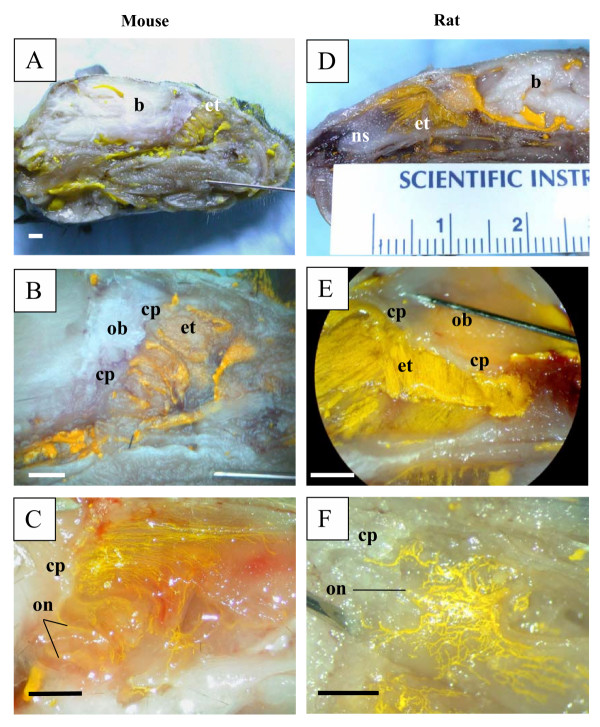
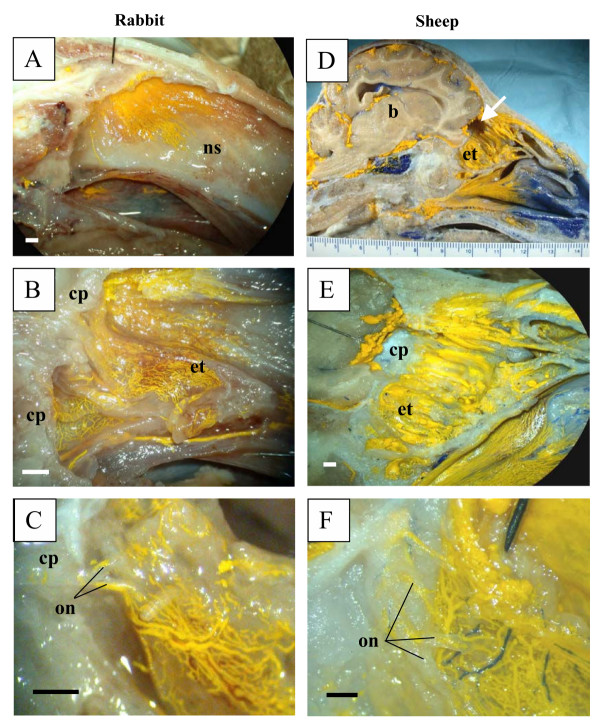
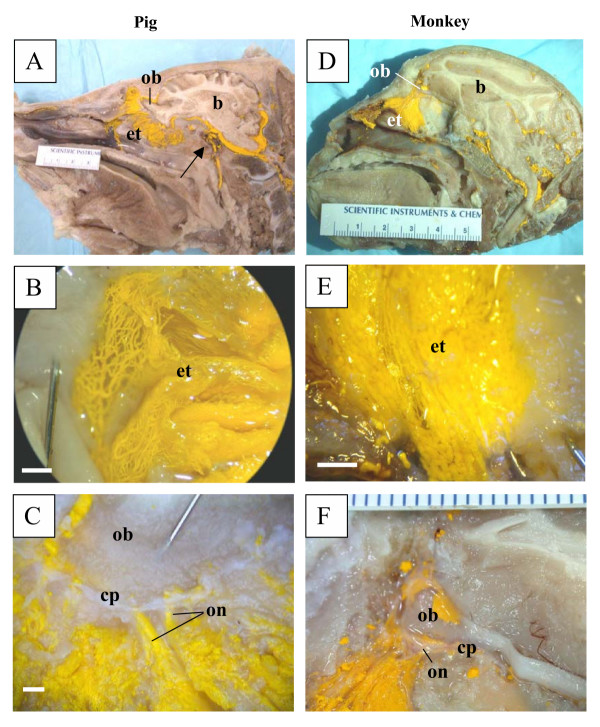
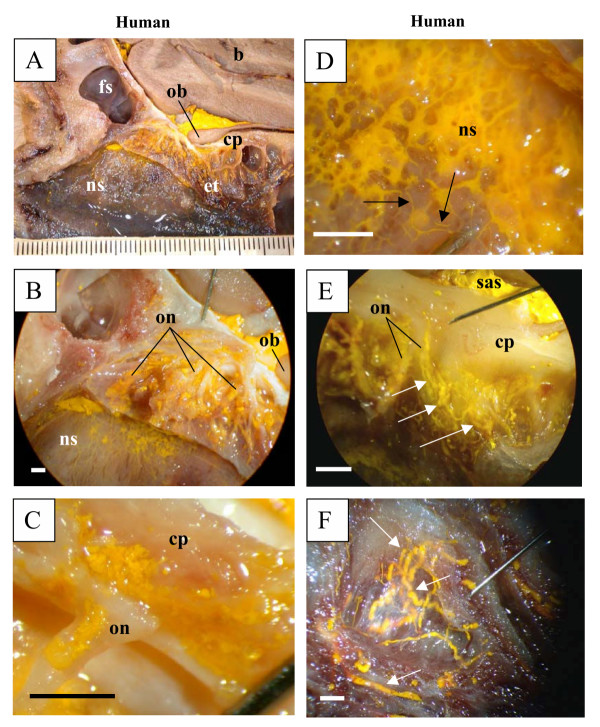
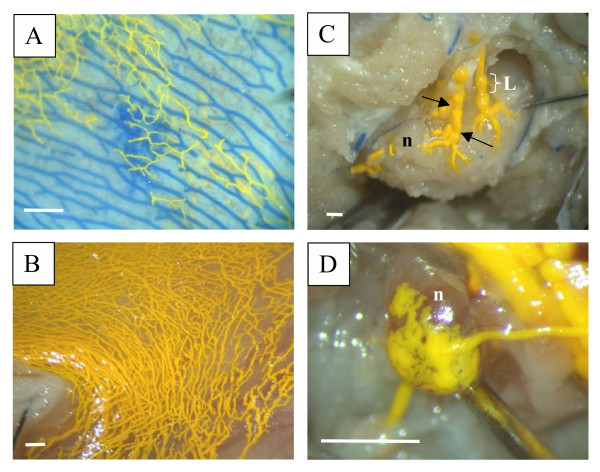
Background: The parenchyma of the brain does not contain lymphatics. Consequently, it has been assumed that arachnoid projections into the cranial venous system are responsible for cerebrospinal fluid (CSF) absorption. However, recent quantitative and qualitative evidence in sheep suggest that nasal lymphatics have the major role in CSF transport. Nonetheless, the applicability of this concept to other species, especially to humans has never been clarified. The purpose of this study was to compare the CSF and nasal lymph associations in human and non-human primates with those observed in other mammalian species. Methods: Studies were performed in sheep, pigs, rabbits, rats, mice, monkeys and humans. Immediately after sacrifice (or up to 7 hours after death in humans), yellow Microfil was injected into the CSF compartment. The heads were cut in a sagittal plane. Results: In the seven species examined, Microfil was observed primarily in the subarachnoid space around the olfactory bulbs and cribriform plate. The contrast agent followed the olfactory nerves and entered extensive lymphatic networks in the submucosa associated with the olfactory and respiratory epithelium. This is the first direct evidence of the association between the CSF and nasal lymph compartments in humans. Conclusions: The fact that the pattern of Microfil distribution was similar in all species tested, suggested that CSF absorption into nasal lymphatics is a characteristic feature of all mammals including humans. It is tempting to speculate that some disorders of the CSF system (hydrocephalus and idiopathic intracranial hypertension for example) may relate either directly or indirectly to a lymphatic CSF absorption deficit.
Overview
The claims and statistics of this paper haven’t been checked yet.
Free: it reads the open-access text and checks the first 5 claims that cite a source we can check. Create a free account to check every claim.
Integrity signals
Registry
Cites
Statistics
Figures
Verification
Claims the paper makes
The claims and statistics of this paper haven’t been checked yet.
Free: it reads the open-access text and checks the first 5 claims that cite a source we can check. Create a free account to check every claim.
Claims other papers make about this one
Each is checked against this paper’s own text: does it say what the citing paper says it does?
In the citing paper
“Human and animal studies demonstrate that CSF absorption occurs through lymphatic pathways, primarily through the cribriform plate and ultimately into the extracranial lymphatics located in the paranasal region (Johnston et al ., 2004).”
From Early brain enlargement and elevated extra-axial fluid in infants who develop autism spectrum disorder (2013) · cites this paper as Johnston et al., 2004
Self-check
Percentages, sums and reported differences re-computed from the paper’s own numbers.
The self-check needs the paper’s full text.
Citations
Cites
Kida, S., Pantazis, A., & Weller, R. O. (1993) · Neuropathology and Applied Neurobiology · doi:10.1111/j.1365-2990.1993.tb00476.x · Cited by 520 · cited 1×
“However, histological and radiological evidence indicate that CSF-lymph connections exist in other species including rats [8,19-24], mice [25], rabbits [26-28], cats [20,29,30], dogs [20,30], guinea pigs [31], and nonhuman primates [30,32].”
BackgroundDrainage of cerebral interstitial fluid into deep cervical lymph of the rabbit
Bradbury, M. W., Cserr, H. F., & Westrop, R. J. (1981) · American Journal of Physiology-Renal Physiology · doi:10.1152/ajprenal.1981.240.4.f329 · Cited by 335 · cited 1×
“However, histological and radiological evidence indicate that CSF-lymph connections exist in other species including rats [8,19-24], mice [25], rabbits [26-28], cats [20,29,30], dogs [20,30], guinea pigs [31], and nonhuman primates [30,32].”
BackgroundWeller, R. O., Kida, S., & Zhang, E. (1992) · Brain Pathology · doi:10.1111/j.1750-3639.1992.tb00704.x · Cited by 283 · cited 2×
“Circumstantial evidence also suggests that similar CSFlymphatic connections exist in humans as well [22,3336].”
BackgroundConn, P. M. (2003) · Humana Press eBooks · doi:10.1385/1592593712 · Cited by 224
Zhang, E. T., Richards, H. K., Kida, S., & Weller, R. O. (1992) · Acta Neuropathologica · doi:10.1007/bf00296784 · Cited by 207 · cited 1×
“However, histological and radiological evidence indicate that CSF-lymph connections exist in other species including rats [8,19-24], mice [25], rabbits [26-28], cats [20,29,30], dogs [20,30], guinea pigs [31], and nonhuman primates [30,32].”
BackgroundA Model of Pulsations in Communicating Hydrocephalus
Egnor, M., Zheng, L., Rosiello, A., Gutman, F., & Davis, R. (2002) · Pediatric Neurosurgery · doi:10.1159/000063533 · Cited by 201 · cited 1×
“However, the quantitative evidence supporting a role for arachnoid projections is very limited and unconvincing [37-39].”
BackgroundPathophysiology of the blood-brain barrier
Johansson, B. B., Owman, C., & Widner, H. (1990) · Elsevier eBooks · Cited by 159
Experimental biology of the lymphatic circulation
Johnston, M. G. (1985) · Elsevier eBooks · Cited by 154
Self-citation永井, 肇., Kamiya, K., & 石井, 昌. (1994) · Springer eBooks · Cited by 152
Lymph and blood supply of the human intervertebral disc: Cadaver study of correlations to discitis
Rudert, M., & Tillmann, B. (1993) · Acta Orthopaedica Scandinavica · doi:10.3109/17453679308994524 · Cited by 149 · cited 1×
“Circumstantial evidence also suggests that similar CSFlymphatic connections exist in humans as well [22, 33- 36 ].”
Background
Research works printed but not linked: 5
- Brinker T, Botel C, Rothkotter HJ, Walter GF, Samii M: The perineural pathway of cerebrospinal fluid absorption into the cervical lymphatic system. Morphological findings in rats, cats, dogs and monkeys. Intracranial pressure IX. Edited by: Nagai H, Kamiya K and Ishii K. 1994, Toyko, Springer, 132-135.
- Brinker T, Botel C, Samii M: A species comparing radiological study on the absorption of cerebrospinal fluid into the cervical lymphatic system. Intracranial pressure IX. Edited by: Nagai H, Kamiya K and Ishii K. 1994, Toyko, Springer, 559-560.
- Arnold W, Ilberg CV: The connections of the cerebrospinal fluid (CSF) with the lymphatic system of the head and neck. Progress in Lymphology IV. Edited by: Mayall RC and Witte MH. 1973, Tucson, AZ, Plenum Press, 57-58.
- Csanda E, Obal F, Obal FJ: Central nervous system and lymphatic system. Lymphangiology. Edited by: Foldi M and Casley-Smith JR. 1983, New York, F.K. Schattauer Verlag, 475-508.
- McComb JG, Hyman S, Weiss MH: Lymphatic drainage of cerebrospinal fluid in the cat. Hydrocephalus. Edited by: Shapiro K, Marmarou A and Portnoy H. 1984, New York, Raven, 83-98.
Cited by
Items 501–580 of 580
Central Nervous System Immune Inflammation
Healy, L. M., Touil, H., Rao, V. T. S., Michell‐Robinson, M. A., Antel, J. P., & Weller, R. O. (2016) · Elsevier eBooks · doi:10.1016/b978-0-12-801914-6.00003-9
Rigamonti, D. (2014) · Cambridge University Press eBooks · doi:10.1017/cbo9781139382816.002
Randakevičienė, G., Gleiznienė, R., Nylander, R., & Laurenčikas, E. (2016) · Medicinos teorija ir praktika · doi:10.15591/mtp.2016.009
Pathophysiology of Idiopathic Intracranial Hypertension
Millichap, J. G. (2012) · Pediatric Neurology Briefs · doi:10.15844/pedneurbriefs-26-5-3
Andersson, N. (2007) · KTH Publication Database DiVA (KTH Royal Institute of Technology)
im Liquor cerebrospinalis für Patienten mit Normaldruckhydrozephalus und Pseudotumor cerebri
Neurologie, A. D. A., & Bähr, M. (2011)
Extracellular Fluid Systems in the Brain and the Pathogenesis of Hydrocephalus
Nagra, G. (2010) · TSpace (University of Toronto) · Cited by 2
Pathophysiologie des Hydrozephalus
Schuhmann, M. U. (2018) · Springer eBooks · doi:10.1007/978-3-662-48700-6_23
Idiopathic intracranial hypertension (idiopathic pseudotumor cerebri)
Grzybowski, D. M., & Lubow, M. (2010) · Elsevier eBooks · doi:10.1016/b978-0-7020-2983-7.00039-5
Masouleh, M. P. (2018) · Nottingham ePrints (University of Nottingham)
Characterising the phenotype and impact of adipose in idiopathic intracranial hypertension
Westgate, C. S. J. (2019) · University of Birmingham Institutional Research Archive (University of Birmingham)
Romero‐Suárez, S. (2019) · edoc Publication server (Humboldt University of Berlin) · doi:10.18452/20355 · Cited by 1
CNS lymphatics in health and disease
Yun, J. W., Alexander, J. S., & Gavins, F. N. E. (2019) · Elsevier eBooks · doi:10.1016/b978-0-12-815645-2.00005-8 · Cited by 1
New insight into the cranial nerve pathology secondary to elevated CSF pressure
Peng, K., & Wang, S. (2020) · Cephalalgia · doi:10.1177/0333102420908869
“One of the possibilities for a rapid restoration of olfactory sensitivity is an altered glymphatic pathway – spontaneous CSF drainage into the perivascular space (4), specifically CSF efflux via the olfactory bulb in IIH (5): Certain IIH patients developed spontaneous CSF rhinorrhea, which possibly in part affects the…”
BackgroundSundholm, A. (2020) · Figshare
Luisetto, M., Akram, M., Ibrahim, G., Nili, A. B., Ahmad, K. F., Rafa, A. Y., & Латышев, О. Ю. (2020) · Insights in Clinical and Cellular Immunology · doi:10.29328/journal.icci.1001014
“Al literature presented is presented in scienti ic biomedical database like PUBMED [1-49] or Other open science journals.”
BackgroundCai, X. (2020) · Digital Repository Service (Northeastern University) · doi:10.17760/d20398331
Hagemann, P., Kia, T., & Caille, P. V. (2013) · Elsevier eBooks · doi:10.1016/b978-3-437-58830-3.00009-x
Immunotherapy for glioblastoma as a means to overcome resistance to standard therapy
Batich, K. A., Sampson, J. H., Khasraw, M., Friedman, H. S., & Ashley, D. M. (2021) · Elsevier eBooks · doi:10.1016/b978-0-12-821567-8.00018-x
Glymphatic Structure and Morphological Features of the Brain
Nur, İ. H., & Pérez, W. (2021) · Journal of Morphological Sciences · doi:10.51929/jms.38.43.2021
“In certain well-evolved creatures, it is assessed that half of CSF is drained towards lymphatics Cserr et al.(1992); however, this rate is still unknown in humans Johnston et al. (2004) Journal of Morphological Sciences Vol. 38/2021249 CSF serves a floatability function for the brain liquid.”
BackgroundLessons learned from a career in neuropathology
Weller, R. O. (2021) · Free Neuropathology · doi:10.17879/freeneuropathology-2021-3634 · Cited by 1
“Such channels were also shown to exist in post mortem humans brains by the injection of Myodil tracer into the CSF 18 and by reconstruction from serial sections of the human cribriform plate and nasal mucosa by Effie Djuanda in her fourth year medical student project 19 .”
Peripheric smell regions in patients with semicircular canal dehiscence: An MRI evaluation
İnal, M., Muluk, N. B., Asal, N., & Çelik, E. N. (2021) · Journal of Clinical Neuroscience · doi:10.1016/j.jocn.2021.10.019
Kaskar, O. G. (2021) · NCSU Libraries Repository (North Carolina State University Libraries) · Cited by 1
Imaging of Glymphatic Flow and Neurodegeneration
Filippi, C. G., & Watts, R. (2021) · Springer eBooks · doi:10.1007/978-3-030-82367-2_71
Fetal and Perinatal Hydrocephalus
Bigio, M. R. D. (2021) · Cambridge University Press eBooks · doi:10.1017/9781316671863.040 · Cited by 1
Benveniste, H., & Nedergaard, M. (2016) · Springer eBooks · doi:10.1007/978-1-4939-3474-4_138 · Cited by 2
Hydrocephalus and Arachnoid Cysts
Drake, J. M., & Abou‐Hamden, A. (2012) · Elsevier eBooks · doi:10.1016/b978-1-4377-0435-8.00027-5
Cerebrospinal fluid physiology
Shapey, J., & Toma, A. K. (2022) · Elsevier eBooks · doi:10.1016/b978-0-12-819509-3.00011-0
Métastases lepto-méningées : place de la thérapie intrathécale
Decq, P., Ortiz-Carle, A., Staquet, H., Faillot, M., Declèves, X., & Goutagny, S. (2022) · Revue des Maladies Respiratoires Actualités · doi:10.1016/s1877-1203(22)00133-1
Potential Targeting Sites to the Brain Through Nasal Passage
Govender, M., Indermun, S., Kumar, P., & Choonara, Y. E. (2023) · Springer eBooks · doi:10.1007/978-3-031-23112-4_6 · Cited by 1
Does Intracranial Pressure Influence the Development of Glaucoma?
Lee, M. S., McCulley, T. J., Lee, A. G., & Stavern, G. P. V. (2023) · Journal of Neuro-Ophthalmology · doi:10.1097/wno.0000000000001857
Neurofiziologija cerebrospinalnog likvora – što znamo nakon 100 godina njegova istraživanja?
Dmitrović, P., Mamić, M., & Pirkić, B. (2023) · Veterinarska stanica · doi:10.46419/vs.55.3.1
МИАЛГИЧЕСКИЙ ЭНЦЕФАЛИТ КАК ОСЛОЖНЕНИЕ НОВОЙ КОРОНОВИРУСНОЙ ИНФЕКЦИИ
Колядова, Н. В., Джалали, А. Д., Шачнев, Е. В., & Семенов, В. А. (2023) · Вектор научной мысли · doi:10.58351/2949-2041.2023.3.3.002
Cerebrospinal Fluid, the Meninges, and the Subarachnoid Space
Yaksh, T. L. (2023) · Springer eBooks · doi:10.1007/978-3-031-39558-1_10
Penco-Campillo, M. (2022) · theses.fr (ABES) · doi:10.70675/56fec474z9b4ez4abczb93dz6d3d651089bc · Cited by 1
Cerebrospinal Fluid Dynamics: Uncovering Alternative Blood Vessel Clearance MechanismsPreprint
Yuan, Q., Satyanarayanan, S. K., Lee, S. M.-Y., Yan, L., Wang, Y., Xian, Y., He, L., Zhou, Y., Wu, W., Song, Y., et al. (2024) · Research Square · doi:10.1101/2024.06.13.598807
Çöllü, İ., & Turamanlar, O. (2024) · Farabi Tıp Dergisi · doi:10.59518/farabimedj.1420088
Role of tanycytes in Tau clearance and their relevance in Alzheimer's disease
Sauvé, F. (2022) · theses.fr (ABES) · doi:10.70675/25300be3z6219z4081z98a4z9dbe9641b2d2
García, M. D. C., Donoso, M. C. B., Fernández, Y. P., Carrazana, E. J., & Rabinowicz, A. L. (2024) · Neurología Argentina · doi:10.1016/j.neuarg.2024.11.003
Chmielecki, J. M., Vemula, A., Schwartz, J. G., Gelfond, J. A. L., & Phillips, W. T. (2025) · Frontiers in Pain Research · doi:10.3389/fpain.2025.1521500
Matsuura, K., Osawa, I., Nagawa, K., Kakemoto, S., Inoue, K., & Kozawa, E. (2025) · Cureus · doi:10.7759/cureus.82153
“Several studies have investigated CSF outflow to the nasal mucosa in human cadavers [14,15] and in vivo in humans [16,17].”
Hydrocephalus, Cysts, and Cystic Malformations
Tully, H. M., & Hauptman, J. S. (2025) · Elsevier eBooks · doi:10.1016/b978-0-443-10944-7.00045-7
Chae, J., Choi, M., Choi, J., & Yoo, S. (2025) · Research Square · doi:10.21203/rs.3.rs-7142040/v1
Wilting, J., & Chao, T. I. (2025) · Springer eBooks · doi:10.1007/978-3-031-77734-9_20
Zawieja, D. C., von der Weid, P., & Gashev, A. A. (1984) · Comprehensive physiology · doi:10.1002/j.2040-4603.1984.tb01014.x
Chua, N. Y. M., Ang, L. F., Loh, B. J. S., & Wang, J. D. J. (2025) · Clinical bioenergetics · doi:10.3390/clinbioenerg1020010
“…Fluid Clearance Mechanisms Anatomical, experimental, and clinical evidence establishes the cribriform-plate– olfactory–lymphatic pathway as a major extracranial cerebrospinal fluid egress route whose dysfunction mechanistically couples CRS to neurodegenerative disease progression [91,92].”
VEGFR-3 and Tie pathways in vascular network formation
Tammela, T. (2008) · Helda - University of Helsinki Institutional Repository
Minta, K., Jeppsson, A., Brinkmalm, G., Portelius, E., Zetterberg, H., Blennow, K., Tullberg, M., & Andréasson, U. (2021) · Figshare · doi:10.6084/m9.figshare.14594250
Jukkola, J., Kaakinen, M., Singh, A., Moradi, S., Ferdinando, H., Myllylä, T., Kiviniemi, V. V., & Eklund, L. (2024) · Figshare · doi:10.6084/m9.figshare.26673456
Bergman, J., Svenningsson, A., Liv, P., Bergenheim, T. A., & Burman, J. (2020) · Figshare · doi:10.6084/m9.figshare.12737199
Jukkola, J., Kaakinen, M., Singh, A., Moradi, S., Ferdinando, H., Myllylä, T., Kiviniemi, V. V., & Eklund, L. (2024) · Figshare · doi:10.6084/m9.figshare.26673450
Jukkola, J., Kaakinen, M., Singh, A., Moradi, S., Ferdinando, H., Myllylä, T., Kiviniemi, V. V., & Eklund, L. (2024) · Figshare · doi:10.6084/m9.figshare.26673462
Jukkola, J., Kaakinen, M., Singh, A., Moradi, S., Ferdinando, H., Myllylä, T., Kiviniemi, V. V., & Eklund, L. (2024) · Figshare · doi:10.6084/m9.figshare.26673459
Immune cell dynamics in irradiated gliomas
Agardy, D. A. (2025) · heiDOK (Heidelberg University) · doi:10.11588/heidok.00035920
Bergman, J., Svenningsson, A., Liv, P., Bergenheim, T. A., & Burman, J. (2020) · Figshare · doi:10.6084/m9.figshare.12737196
Brady, M., Rahman, A., Combs, A., Venkatraman, C., Kasper, R. T., McQuaid, C., Kwok, W.-C. E., Wood, R. W., & Deane, R. (2020) · Figshare · doi:10.6084/m9.figshare.13311007
Jukkola, J., Kaakinen, M., Singh, A., Moradi, S., Ferdinando, H., Myllylä, T., Kiviniemi, V. V., & Eklund, L. (2024) · Figshare · doi:10.6084/m9.figshare.26673453
Vera Quesada, C. L., Rao, S. B., Torp, R., & Eide, P. K. (2023) · Figshare · doi:10.6084/m9.figshare.22617716
Pan, S., Koleske, J. P., Koller, G. M., Halupnik, G. L., Alli, A.-H. O., Koneru, S., DeFreitas, D., Ramagiri, S., & Strahle, J. M. (2024) · Figshare · doi:10.6084/m9.figshare.26665084
Zhang, Z., Tan, Q., Guo, P., Suna, H., Jia, Z., Liu, X., Feng, H., & Chen, Y. (2022) · Figshare · doi:10.6084/m9.figshare.20115322
Gimeno Guillén, C., Ráfales, C. B., & De Torre Martínez, A. (2023) · Zaguan (Universidad de Zaragoza)
Odor identification as a biomarker for progression of pre-symptomatic Alzheimer's disease
Lafaille-Magnan, M.-E. (2018) · eScholarship@McGill (McGill) · doi:10.82308/23276 · Cited by 3
Sergueef, N. (2009) · Elsevier eBooks · doi:10.1016/b978-2-8101-0096-5.00020-1
Mechanisms of Dural Involvement in Cerebral Amyloid Angiopathy
Zedde, M., Piazza, F., & Pascarella, R. (2025) · Cells · doi:10.3390/cells15010026
“…to the deposition of A β associated with CAA [87]. https://doi.org/10.3390/cells15010026 Additionally, tracer studies conducted in both animal models and humans reveal that solutes in the CSF are transported via perineural pathways through the basal cisterns and the cribriform plate [88,89].”
InfluentialFournier, A. P. (2017) · theses.fr (ABES) · doi:10.70675/8fe6570dzf678z416czbfd0zb0bdcf0790e8 · Cited by 1
Étude de la plasticité liquidienne du système cranio-spinal : de la physiologie à la pathologie
Lokossou, A. (2019) · theses.fr (ABES) · doi:10.70675/532b5045z5dd4z4268z9d4bz51e04f957bf7 · Cited by 1
Regenerating smell in neurodegenerative disease –translating theory into therapy
Stadio, A. D., Brenner, M. J., Luca, P. D., D’Ascanio, L., & Patel, Z. M. (2026) · European Archives of Oto-Rhino-Laryngology · doi:10.1007/s00405-026-10279-9
A conceptual model of pseudo–meningeal lumen formation in cerebrospinal fluid–venous fistula
Nakai, E., Fukuda, H., Kawanishi, Y., & Ueba, T. (2026) · Interdisciplinary Neurosurgery · doi:10.1016/j.inat.2026.102279
Targeted Proteomic Profiling of Nasal Fluid from the Brain-Nose InterfacePreprint
Bashiri, M., Babu, M., Weiß, G., Kotschote, S., Metzler, R., Wunderlich, H., Petrera, A., Domenico, E. D., Theis, H., Lehmann, K., et al. (2026) · medRxiv · doi:10.64898/2026.06.16.26355519
Proteomic Profiling of Nasal Fluid from the Brain-Nose Interface using Mass SpectrometryPreprint
Müller, S. A., Feng, X. H., Babu, M., Mertzig, S., Metzler, R., Wunderlich, H., Weiß, G., Bashiri, M., Peters, O., Froelich, L., et al. (2026) · medRxiv · doi:10.64898/2026.07.20.26358433
Phillips, W. T., & Schwartz, J. G. (2026) · Frontiers in Neuroscience · doi:10.3389/fnins.2026.1897376 · Cited by 1
Imaging of intranasal drug delivery to the brain: updated review 2.0
Beaven, H. E., Schinker, M. R., Oo, T. T., Smith, K. R., Alhamami, M., & Veronesi, M. C. (2026) · Drug Delivery and Translational Research · doi:10.1007/s13346-026-02204-8
Mănescu, M. D., Minca, T.-N., Pirici, I., Busuioc, C. J., Mateescu, V. O., & Pirici, D. N. (2026) · Frontiers in Cellular Neuroscience · doi:10.3389/fncel.2026.1903812
“…a “collar” or fuse with the perineural sheath, allowing CSF to enter directly the lymphatic lumen without significant exposure to the interstitial space (Johnston et al., 2004), and (iii) a trans-cribriform lymphatics pathway, with lymphatic vessels that actually cross the cribriform plate…”
Foundations and History of Intrathecal Drug Delivery
Menéndez‐González, M. (2026) · Neuromethods · doi:10.1007/978-1-0716-5241-1_1
Multimodal imaging maps spinal glymphatic transport in health and its disruption after injuryPreprint
Nedergaard, M., Kaur, J., Giannetto, M. J., Wong, D., Kelley, D. H., & Weikop, P. (2026) · Research Square · doi:10.21203/rs.3.rs-11054050/v1
Kim, Y. B., Yun, C.-O., & Yoon, A. R. (2026) · Drug Delivery · doi:10.1080/10717544.2026.2738285
“This creates a weak link between fluidic redistribution and parenchymal access, and the process is vulnerable to redistribution, secondary repartitioning, and diversion towards lymphatic drainage (Johnston et al. 2004; Nagra et al. 2006; Lochhead and Davis 2019; Lochhead et al. 2019; Proulx 2021).”
Glymphatic dysfunction in intracranial hemorrhage and neurodegenerative disease
Gonzalez, M., Kent, B., DeYoung, C. L., Dagra, A., & Lucke-Wold, B. P. (2026) · Academia Biology · doi:10.20935/acadbiol8557
Introduction to Neuroimmunology
Coyle, P. K. (2011) · Humana Press eBooks · doi:10.1007/978-1-60327-860-7_1
Metadata
- Authors
- Johnston, M., Zakharov, A., Papaiconomou, C., Salmasi, G., & Armstrong, D.
- Affiliations
- Sunnybrook Health Science Centre (CA)
- Corresponding author
- Johnston, Miles
- ORCID
- Zakharov, Andrei
- Venue
- Cerebrospinal Fluid Research
- Published
- 2004-12-10
- Volume
- 1
- Issue
- 1
- Pages
- 2-2
- ISSN
- 1743-8454 (ISSN-L)
- PMC
- PMC546409
- OpenAlex
- W2163562064
- Cited by
- 572
- References
- 39
- Citations by year
- 2026: 18 · 2025: 33 · 2024: 34 · 2023: 37 · 2022: 37 · 2021: 46 · 2020: 33 · 2019: 43 · 2018: 40 · 2017: 31 · 2016: 19 · 2015: 23 · 2014: 33 · 2013: 22 · 2012: 19
- FWCI
- 3.92
- Type
- journal article
- Language
- en
- Open access
- gold
- doi.org
- Licence
- cc-by
- creativecommons.org/licenses/by/2.0/ (tdm)
- creativecommons.org/licenses/by/2.0/ (vor)
- Locations
- Cerebrospinal Fluid Research (publishedVersion, cc-by)
- PubMed Central (publishedVersion, cc-by)
- PubMed (publishedVersion)
- TSpace (University of Toronto) (submittedVersion)
- DOAJ (DOAJ: Directory of Open Access Journals) (submittedVersion, cc-by-sa)
- Funders
- University of Toronto
- Canadian Institutes of Health Research
- Topics
- Health Sciences › Medicine › Clinical Neurology › Cerebrospinal fluid and hydrocephalus
- Health Sciences › Medicine › Oncology › Lymphatic System and Diseases
- Health Sciences › Medicine › Surgery › Lymphatic Disorders and Treatments
- Keywords
- cerebrospinal fluid absorption, olfactory bulb, cribriform plate, olfactory nerve, subarachnoid space, non-human primates, hydrocephalus, idiopathic intracranial hypertension
About these checks
Registry, retraction, Cites and statistics results are computed, not judged, with one exception: a printed reference that no index lists is read once by a model before it counts as a citation error. Claims are extracted by a model and kept only when their quote appears verbatim in the text; each cited source is then checked, with a model’s help, for whether it says what the claim relies on. Those verdicts can be wrong — read the claim’s quote and the cited source before relying on one.
Statistics and arithmetic are recomputed, not judged.
Confidence bands are shown only for fields calibrated on our annotated test set. None is calibrated yet, so no band is shown.
What counts as a claim ›How we measure confidence ›How we check this ›
Are you an author, or do you see a problem with this page? Request a review
Data sources
Bibliographic data: Semantic Scholar, OpenAlex, Crossref.
Contains information from the Semantic Scholar Academic Graph Datasets, made available under the ODC Attribution License (ODC-BY 1.0).
Semantic Scholar’s data is described in: Kinney, R., et al. (2023). The Semantic Scholar Open Data Platform. arXiv:2301.10140.
