

Evidence of connections between cerebrospinal fluid and nasal lymphatic vessels in humans, non-human primates and other mammalian species
Open accessThe DOI matches its Crossref record; 39 of the 39 references it cites were found in a registry or an index.
Abstract
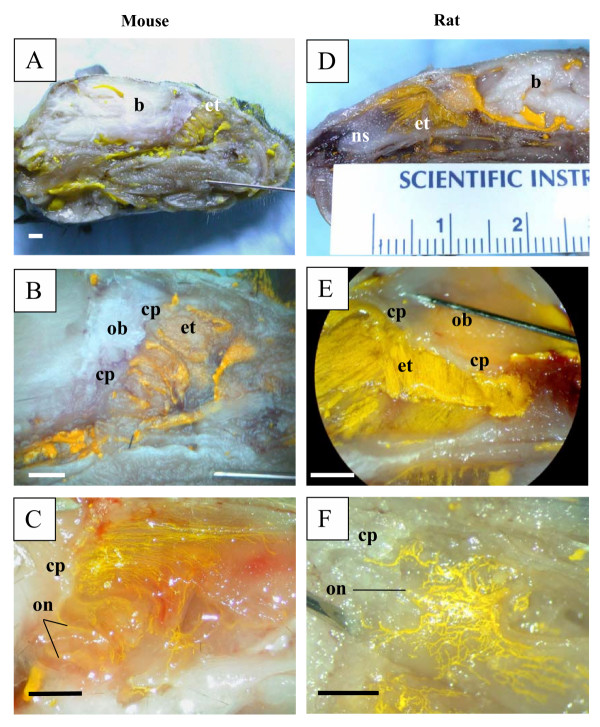
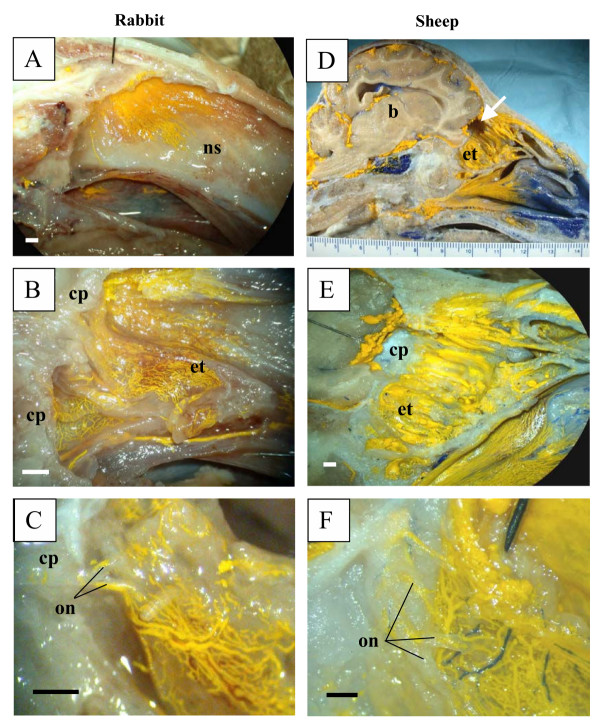
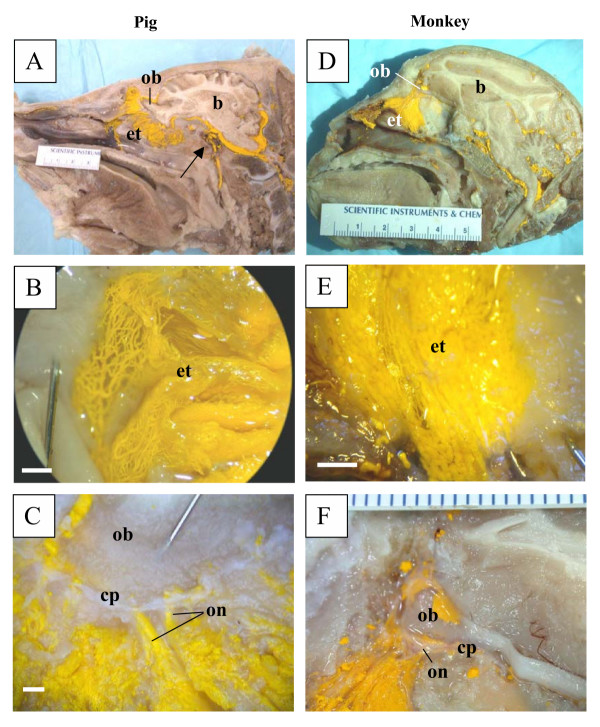
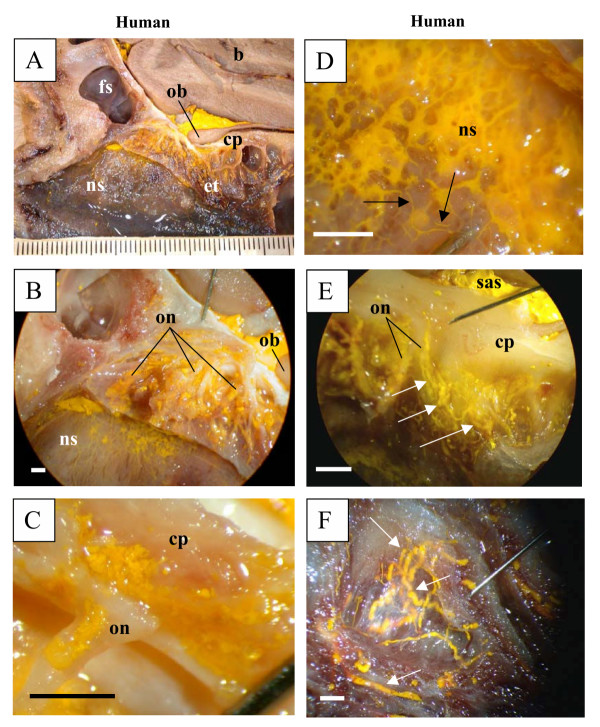
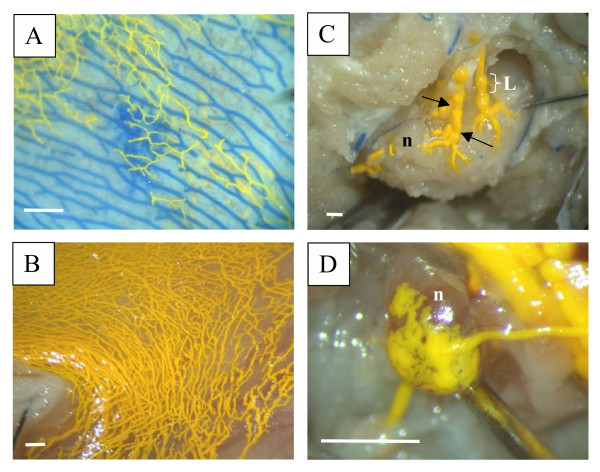
Background: The parenchyma of the brain does not contain lymphatics. Consequently, it has been assumed that arachnoid projections into the cranial venous system are responsible for cerebrospinal fluid (CSF) absorption. However, recent quantitative and qualitative evidence in sheep suggest that nasal lymphatics have the major role in CSF transport. Nonetheless, the applicability of this concept to other species, especially to humans has never been clarified. The purpose of this study was to compare the CSF and nasal lymph associations in human and non-human primates with those observed in other mammalian species. Methods: Studies were performed in sheep, pigs, rabbits, rats, mice, monkeys and humans. Immediately after sacrifice (or up to 7 hours after death in humans), yellow Microfil was injected into the CSF compartment. The heads were cut in a sagittal plane. Results: In the seven species examined, Microfil was observed primarily in the subarachnoid space around the olfactory bulbs and cribriform plate. The contrast agent followed the olfactory nerves and entered extensive lymphatic networks in the submucosa associated with the olfactory and respiratory epithelium. This is the first direct evidence of the association between the CSF and nasal lymph compartments in humans. Conclusions: The fact that the pattern of Microfil distribution was similar in all species tested, suggested that CSF absorption into nasal lymphatics is a characteristic feature of all mammals including humans. It is tempting to speculate that some disorders of the CSF system (hydrocephalus and idiopathic intracranial hypertension for example) may relate either directly or indirectly to a lymphatic CSF absorption deficit.
Overview
The claims and statistics of this paper haven’t been checked yet.
Free: it reads the open-access text and checks the first 5 claims that cite a source we can check. Create a free account to check every claim.
Integrity signals
Registry
Cites
Statistics
Figures
Verification
Claims the paper makes
The claims and statistics of this paper haven’t been checked yet.
Free: it reads the open-access text and checks the first 5 claims that cite a source we can check. Create a free account to check every claim.
Claims other papers make about this one
Each is checked against this paper’s own text: does it say what the citing paper says it does?
In the citing paper
“Human and animal studies demonstrate that CSF absorption occurs through lymphatic pathways, primarily through the cribriform plate and ultimately into the extracranial lymphatics located in the paranasal region (Johnston et al ., 2004).”
From Early brain enlargement and elevated extra-axial fluid in infants who develop autism spectrum disorder (2013) · cites this paper as Johnston et al., 2004
Self-check
Percentages, sums and reported differences re-computed from the paper’s own numbers.
The self-check needs the paper’s full text.
Citations
Cites
Kida, S., Pantazis, A., & Weller, R. O. (1993) · Neuropathology and Applied Neurobiology · doi:10.1111/j.1365-2990.1993.tb00476.x · Cited by 520 · cited 1×
“However, histological and radiological evidence indicate that CSF-lymph connections exist in other species including rats [8,19-24], mice [25], rabbits [26-28], cats [20,29,30], dogs [20,30], guinea pigs [31], and nonhuman primates [30,32].”
BackgroundDrainage of cerebral interstitial fluid into deep cervical lymph of the rabbit
Bradbury, M. W., Cserr, H. F., & Westrop, R. J. (1981) · American Journal of Physiology-Renal Physiology · doi:10.1152/ajprenal.1981.240.4.f329 · Cited by 335 · cited 1×
“However, histological and radiological evidence indicate that CSF-lymph connections exist in other species including rats [8,19-24], mice [25], rabbits [26-28], cats [20,29,30], dogs [20,30], guinea pigs [31], and nonhuman primates [30,32].”
BackgroundWeller, R. O., Kida, S., & Zhang, E. (1992) · Brain Pathology · doi:10.1111/j.1750-3639.1992.tb00704.x · Cited by 283 · cited 2×
“Circumstantial evidence also suggests that similar CSFlymphatic connections exist in humans as well [22,3336].”
BackgroundConn, P. M. (2003) · Humana Press eBooks · doi:10.1385/1592593712 · Cited by 224
Zhang, E. T., Richards, H. K., Kida, S., & Weller, R. O. (1992) · Acta Neuropathologica · doi:10.1007/bf00296784 · Cited by 207 · cited 1×
“However, histological and radiological evidence indicate that CSF-lymph connections exist in other species including rats [8,19-24], mice [25], rabbits [26-28], cats [20,29,30], dogs [20,30], guinea pigs [31], and nonhuman primates [30,32].”
BackgroundA Model of Pulsations in Communicating Hydrocephalus
Egnor, M., Zheng, L., Rosiello, A., Gutman, F., & Davis, R. (2002) · Pediatric Neurosurgery · doi:10.1159/000063533 · Cited by 201 · cited 1×
“However, the quantitative evidence supporting a role for arachnoid projections is very limited and unconvincing [37-39].”
BackgroundPathophysiology of the blood-brain barrier
Johansson, B. B., Owman, C., & Widner, H. (1990) · Elsevier eBooks · Cited by 159
Experimental biology of the lymphatic circulation
Johnston, M. G. (1985) · Elsevier eBooks · Cited by 154
Self-citation永井, 肇., Kamiya, K., & 石井, 昌. (1994) · Springer eBooks · Cited by 152
Lymph and blood supply of the human intervertebral disc: Cadaver study of correlations to discitis
Rudert, M., & Tillmann, B. (1993) · Acta Orthopaedica Scandinavica · doi:10.3109/17453679308994524 · Cited by 149 · cited 1×
“Circumstantial evidence also suggests that similar CSFlymphatic connections exist in humans as well [22, 33- 36 ].”
BackgroundBoulton, M., Flessner, M., Armstrong, D., Mohamed, R., Hay, J., & Johnston, M. (1999) · American Journal of Physiology-Regulatory, Integrative and Comparative Physiology · doi:10.1152/ajpregu.1999.276.3.r818 · Cited by 139 · cited 3×
“olfactory nerve-lymphatic pathway contributes significantly to volumetric CSF absorption [2,3,5-9,11,13-16].”
BackgroundMethodSelf-citationMollanji, R., Bozanovic-Sosic, R., Zakharov, A., Makarian, L., & Johnston, M. G. (2002) · American Journal of Physiology-Regulatory, Integrative and Comparative Physiology · doi:10.1152/ajpregu.00695.2001 · Cited by 134 · cited 2×
“olfactory nerve-lymphatic pathway contributes significantly to volumetric CSF absorption [2,3,5-9,11,13-16].”
BackgroundMethodSelf-citationBoulton, M., Yonung, A., Hay, J., Armstrong, D., Flessner, M., Schwartz, M., & Johnston, M. (1996) · Neuropathology and Applied Neurobiology · doi:10.1111/j.1365-2990.1996.tb01111.x · Cited by 120 · cited 2×
“olfactory nerve-lymphatic pathway contributes significantly to volumetric CSF absorption [2,3,5-9,11,13-16].”
BackgroundMethodSelf-citationDetermination of volumetric cerebrospinal fluid absorption into extracranial lymphatics in sheep
Boulton, M., Flessner, M., Armstrong, D., Hay, J., & Johnston, M. (1998) · American Journal of Physiology-Regulatory, Integrative and Comparative Physiology · doi:10.1152/ajpregu.1998.274.1.r88 · Cited by 118 · cited 2×
“olfactory nerve-lymphatic pathway contributes significantly to volumetric CSF absorption [2,3,5-9,11,13-16].”
BackgroundMethodSelf-citationBoulton, M., Armstrong, D., Flessner, M., Hay, J., Szalai, J. P., & Johnston, M. (1998) · American Journal of Physiology-Regulatory, Integrative and Comparative Physiology · doi:10.1152/ajpregu.1998.275.3.r889 · Cited by 114 · cited 2×
“olfactory nerve-lymphatic pathway contributes significantly to volumetric CSF absorption [2,3,5-9,11,13-16].”
BackgroundMethodSelf-citationZakharov, A., Papaiconomou, C., Djenic, J., Midha, R., & Johnston, M. (2003) · Neuropathology and Applied Neurobiology · doi:10.1046/j.0305-1846.2003.00508.x · Cited by 110 · cited 3×
“We reported previously that Microfil was observed primarily within lymphatic vessels in the sheep with very little evidence of this agent within the interstitium of the submucosa [17,18].”
BackgroundMethodSelf-citationCerebrospinal Fluid Transport: a Lymphatic Perspective
Johnston, M., & Papaiconomou, C. (2002) · Physiology · doi:10.1152/nips.01400.2002 · Cited by 110 · cited 1×
“However, the quantitative evidence supporting a role for arachnoid projections is very limited and unconvincing [37-39].”
BackgroundSelf-citationUltrastructural morphology of the olfactory pathway for cerebrospinal fluid drainage in the rabbit
Erlich, S. S., McComb, J. G., Hyman, S., & Weiss, M. H. (1986) · Journal of Neurosurgery · doi:10.3171/jns.1986.64.3.0466 · Cited by 105 · cited 1×
“However, histological and radiological evidence indicate that CSF-lymph connections exist in other species including rats [8,19-24], mice [25], rabbits [26-28], cats [20,29,30], dogs [20,30], guinea pigs [31], and nonhuman primates [30,32].”
BackgroundSpinal and cranial contributions to total cerebrospinal fluid transport
Bozanovic-Sosic, R., Mollanji, R., & Johnston, M. G. (2001) · American Journal of Physiology-Regulatory, Integrative and Comparative Physiology · doi:10.1152/ajpregu.2001.281.3.r909 · Cited by 103 · cited 1×
“This conclusion is based on experiments that span over 100 years of investigation [reviewed in [4]] with the most extensive analysis of CSF transport having been carried out more recently in sheep [2,3,5-17].”
MethodSelf-citationPapaiconomou, C., Bozanovic-Sosic, R., Zakharov, A., & Johnston, M. (2002) · American Journal of Physiology-Regulatory, Integrative and Comparative Physiology · doi:10.1152/ajpregu.00173.2002 · Cited by 98 · cited 2×
“olfactory nerve-lymphatic pathway contributes significantly to volumetric CSF absorption [2,3,5-9,11,13-16].”
BackgroundMethodSelf-citationDynamic properties of lymphatic pathways for the absorption of cerebrospinal fluid
Brinker, T., Lüdemann, W. O., von Rautenfeld, D. B., & Samii, M. (1997) · Acta Neuropathologica · doi:10.1007/s004010050738 · Cited by 93 · cited 1×
“However, histological and radiological evidence indicate that CSF-lymph connections exist in other species including rats [8,19-24], mice [25], rabbits [26-28], cats [20,29,30], dogs [20,30], guinea pigs [31], and nonhuman primates [30,32].”
BackgroundThe nasal route of cerebrospinal fluid drainage in man. A light–microscope study
Hendèn, P. L., Johansson, B. B., & Nordborg, C. (1994) · Neuropathology and Applied Neurobiology · doi:10.1111/j.1365-2990.1994.tb01008.x · Cited by 90 · cited 1×
“For example, Indian ink administered into the CSF in human autopsy material [35] was observed to fill the perineurial spaces around the olfactory nerve branches and was found in the nasal submucosal tissue.”
BackgroundMollanji, R., Bozanovic-Sosic, R., Silver, I., Li, B., Kim, C., Midha, R., & Johnston, M. (2001) · American Journal of Physiology-Regulatory, Integrative and Comparative Physiology · doi:10.1152/ajpregu.2001.280.5.r1573 · Cited by 89
Self-citationZakharov, A., Papaiconomou, C., Koh, L., Djenic, J., Bozanovic-Sosic, R., & Johnston, M. (2003) · Microvascular Research · doi:10.1016/j.mvr.2003.08.004 · Cited by 88
Self-citationReassessment of the pathways responsible for cerebrospinal fluid absorption in the neonate
Papaiconomou, C., Zakharov, A., Azizi, N., Djenic, J., & Johnston, M. (2004) · Child s Nervous System · doi:10.1007/s00381-003-0840-z · Cited by 83 · cited 5×
“Recent experiments suggest that the movement of CSF directly into the cranial venous system may only occur at high pressures suggesting that the arachnoid projections may have an accessory function rather than representing the primary locations at which CSF is absorbed [2,3].”
BackgroundMethodInfluentialSelf-citationZakharov, A., Papaiconomou, C., & Johnston, M. G. (2004) · Lymphatic Research and Biology · doi:10.1089/1539685042564372 · Cited by 83 · cited 5×
“In a previous report, we infused Microfil into the subarachnoid compartment of sheep and noted that it was carried through the cribriform plate into an extensive network of lymphatic vessels in the nasal submucosa of this species [2,3,17, 18 ].”
BackgroundMethodInfluentialSelf-citationCerebrospinal fluid drainage as influenced by ventricular pressure in the rabbit
McComb, J. G., Davson, H., Hyman, S., & Weiss, M. H. (1982) · Journal of Neurosurgery · doi:10.3171/jns.1982.56.6.0790 · Cited by 79 · cited 1×
“Other groups have failed to observe enrichment of a CSF tracer in the superior sagittal sinus of the rabbit, cat and monkey when the intracranial pressures achieved in the experiments simulated physiological conditions more realistically [32,41,42].”
BackgroundBoulton, M., Flessner, M., Armstrong, D., Hay, J., & Johnston, M. (1997) · American Journal of Physiology-Regulatory, Integrative and Comparative Physiology · doi:10.1152/ajpregu.1997.272.5.r1613 · Cited by 79 · cited 2×
“olfactory nerve-lymphatic pathway contributes significantly to volumetric CSF absorption [2,3,5-9,11,13-16].”
BackgroundMethodSelf-citationSilver, I., Kim, C., Mollanji, R., & Johnston, M. (2002) · Neuropathology and Applied Neurobiology · doi:10.1046/j.1365-2990.2002.00373.x · Cited by 76 · cited 2×
“olfactory nerve-lymphatic pathway contributes significantly to volumetric CSF absorption [2,3,5-9,11,13-16].”
BackgroundMethodSelf-citationPathophysiology of the blood-brain barrier
Selmaj, K. W. (1996) · Springer Seminars in Immunopathology · doi:10.1007/bf00792609 · Cited by 76
Glycolytic flux in permeabilized freshly isolated vascular smooth muscle cells
Hardin, C. D., & Finder, D. R. (1998) · American Journal of Physiology-Cell Physiology · doi:10.1152/ajpcell.1998.274.1.c88 · Cited by 65
Study of cerebrospinal fluid flow dynamics in TGF-β1 induced chronic hydrocephalic mice
Moinuddin, S. M., & Tada, T. (2000) · Neurological Research · doi:10.1080/01616412.2000.11741064 · Cited by 61 · cited 1×
“However, histological and radiological evidence indicate that CSF-lymph connections exist in other species including rats [8,19-24], mice [25], rabbits [26-28], cats [20,29,30], dogs [20,30], guinea pigs [31], and nonhuman primates [30,32].”
BackgroundComparison of cerebrospinal fluid transport in fetal and adult sheep
Mollanji, R., Papaiconomou, C., Boulton, M., Midha, R., & Johnston, M. (2001) · American Journal of Physiology-Regulatory, Integrative and Comparative Physiology · doi:10.1152/ajpregu.2001.281.4.r1215 · Cited by 57 · cited 1×
“This conclusion is based on experiments that span over 100 years of investigation [reviewed in [4]] with the most extensive analysis of CSF transport having been carried out more recently in sheep [2,3,5-17].”
MethodSelf-citationRelationship between intracranial pressure and cervical lymphatic pressure and flow rates in sheep
Silver, I., Li, B., Szalai, J., & Johnston, M. (1999) · American Journal of Physiology-Regulatory, Integrative and Comparative Physiology · doi:10.1152/ajpregu.1999.277.6.r1712 · Cited by 49 · cited 2×
“olfactory nerve-lymphatic pathway contributes significantly to volumetric CSF absorption [2,3,5-9,11,13-16].”
BackgroundMethodSelf-citationMann, J. D., Butler, A. B., Johnson, R. N., & Bass, N. H. (1979) · Journal of neurosurgery · doi:10.3171/jns.1979.50.3.0343 · Cited by 48 · cited 1×
“The most informative technique was to employ the classical approach of Mann to look for enrichment of a radioactive CSF tracer in the superior sagittal sinus compared to a peripheral vein [40].”
MethodThe Drainage of Cerebrospinal Fluid into the Lymphatic System of the Neck in Humans
Caversaecio, M., Peschel, O. K., & Arnold, W. (2010) · ORL · doi:10.1159/000276818 · Cited by 45 · cited 1×
“Circumstantial evidence also suggests that similar CSFlymphatic connections exist in humans as well [22, 33- 36 ].”
BackgroundSome observations on the lymphatics of the nasal mucous membrane in the cat and monkey.
Yoffey, J. M., & Drinker, C. K. (1939) · Europe PMC (PubMed Central) · Cited by 39
Cerebrospinal Fluid Absorption in the Rabbit: Olfactory Pathways
Gomez, D. G., Fenstermacher, J. D., Manzo, R. P., Johnson, D. L., & Pcyits, D. G. (1985) · Acta Oto-Laryngologica · doi:10.3109/00016488509126567 · Cited by 39 · cited 1×
“However, histological and radiological evidence indicate that CSF-lymph connections exist in other species including rats [8,19-24], mice [25], rabbits [26-28], cats [20,29,30], dogs [20,30], guinea pigs [31], and nonhuman primates [30,32].”
BackgroundRelationship between cerebrospinal fluid and extracranial lymph.
Johnston, M. (2000) · PubMed · Cited by 12
Self-citation
Research works printed but not linked: 5
- Brinker T, Botel C, Rothkotter HJ, Walter GF, Samii M: The perineural pathway of cerebrospinal fluid absorption into the cervical lymphatic system. Morphological findings in rats, cats, dogs and monkeys. Intracranial pressure IX. Edited by: Nagai H, Kamiya K and Ishii K. 1994, Toyko, Springer, 132-135.
- Brinker T, Botel C, Samii M: A species comparing radiological study on the absorption of cerebrospinal fluid into the cervical lymphatic system. Intracranial pressure IX. Edited by: Nagai H, Kamiya K and Ishii K. 1994, Toyko, Springer, 559-560.
- Arnold W, Ilberg CV: The connections of the cerebrospinal fluid (CSF) with the lymphatic system of the head and neck. Progress in Lymphology IV. Edited by: Mayall RC and Witte MH. 1973, Tucson, AZ, Plenum Press, 57-58.
- Csanda E, Obal F, Obal FJ: Central nervous system and lymphatic system. Lymphangiology. Edited by: Foldi M and Casley-Smith JR. 1983, New York, F.K. Schattauer Verlag, 475-508.
- McComb JG, Hyman S, Weiss MH: Lymphatic drainage of cerebrospinal fluid in the cat. Hydrocephalus. Edited by: Shapiro K, Marmarou A and Portnoy H. 1984, New York, Raven, 83-98.
Cited by
Iliff, J. J., Wang, M., Liao, Y., Plogg, B. A., Peng, W., Gundersen, G. A., Benveniste, H., Vates, G. E., Deane, R., Goldman, S. A., et al. (2012) · Science Translational Medicine · doi:10.1126/scitranslmed.3003748 · Cited by 5,824
The glymphatic system: a beginner's guide
Jessen, N. A., Munk, A. S. F., Lundgaard, I., & Nedergaard, M. (2015) · Neurochemical Research · doi:10.1007/s11064-015-1581-6 · Cited by 2,075
“interstitial fluid is collected in the perivenous space from where it drains out of the brain toward the cervical lymphatic system [31, 34].”
The glymphatic pathway in neurological disorders.
Rasmussen, M. K., Mestre, H., & Nedergaard, M. (2018) · The Lancet Neurology · doi:10.1016/s1474-4422(18)30318-1 · Cited by 1,560
Lymphangiogenesis: Molecular Mechanisms and Future Promise
Tammela, T., & Alitalo, K. (2010) · Cell · doi:10.1016/j.cell.2010.01.045 · Cited by 1,441
“However, some connections between the cerebrospinal fluid and lymphatic vascular systems exist, and lymphatic vessels are capable of partly compensating for the drainage of intracranial fluid when clearance of the cerebrospinal fluid is compromised (Johnston et al., 2004).”
BackgroundIntranasal delivery to the central nervous system: Mechanisms and experimental considerations
Dhuria, S. V., Hanson, L. R., & Frey, W. H. (2010) · Journal of Pharmaceutical Sciences · doi:10.1002/jps.21924 · Cited by 1,239
Metadata
- Authors
- Johnston, M., Zakharov, A., Papaiconomou, C., Salmasi, G., & Armstrong, D.
- Affiliations
- Sunnybrook Health Science Centre (CA)
- Corresponding author
- Johnston, Miles
- ORCID
- Zakharov, Andrei
- Venue
- Cerebrospinal Fluid Research
- Published
- 2004-12-10
- Volume
- 1
- Issue
- 1
- Pages
- 2-2
- ISSN
- 1743-8454 (ISSN-L)
- PMC
- PMC546409
- OpenAlex
- W2163562064
- Cited by
- 572
- References
- 39
- Citations by year
- 2026: 18 · 2025: 33 · 2024: 34 · 2023: 37 · 2022: 37 · 2021: 46 · 2020: 33 · 2019: 43 · 2018: 40 · 2017: 31 · 2016: 19 · 2015: 23 · 2014: 33 · 2013: 22 · 2012: 19
- FWCI
- 3.92
- Type
- journal article
- Language
- en
- Open access
- gold
- doi.org
- Licence
- cc-by
- creativecommons.org/licenses/by/2.0/ (tdm)
- creativecommons.org/licenses/by/2.0/ (vor)
- Locations
- Cerebrospinal Fluid Research (publishedVersion, cc-by)
- PubMed Central (publishedVersion, cc-by)
- PubMed (publishedVersion)
- TSpace (University of Toronto) (submittedVersion)
- DOAJ (DOAJ: Directory of Open Access Journals) (submittedVersion, cc-by-sa)
- Funders
- University of Toronto
- Canadian Institutes of Health Research
- Topics
- Health Sciences › Medicine › Clinical Neurology › Cerebrospinal fluid and hydrocephalus
- Health Sciences › Medicine › Oncology › Lymphatic System and Diseases
- Health Sciences › Medicine › Surgery › Lymphatic Disorders and Treatments
- Keywords
- cerebrospinal fluid absorption, olfactory bulb, cribriform plate, olfactory nerve, subarachnoid space, non-human primates, hydrocephalus, idiopathic intracranial hypertension
About these checks
Registry, retraction, Cites and statistics results are computed, not judged, with one exception: a printed reference that no index lists is read once by a model before it counts as a citation error. Claims are extracted by a model and kept only when their quote appears verbatim in the text; each cited source is then checked, with a model’s help, for whether it says what the claim relies on. Those verdicts can be wrong — read the claim’s quote and the cited source before relying on one.
Statistics and arithmetic are recomputed, not judged.
Confidence bands are shown only for fields calibrated on our annotated test set. None is calibrated yet, so no band is shown.
What counts as a claim ›How we measure confidence ›How we check this ›
Are you an author, or do you see a problem with this page? Request a review
Data sources
Bibliographic data: Semantic Scholar, OpenAlex, Crossref.
Contains information from the Semantic Scholar Academic Graph Datasets, made available under the ODC Attribution License (ODC-BY 1.0).
Semantic Scholar’s data is described in: Kinney, R., et al. (2023). The Semantic Scholar Open Data Platform. arXiv:2301.10140.
