

Long-term risk of mental health problems in women experiencing preterm birth: a longitudinal study of 29 mothers
Open accessThe DOI matches its Crossref record; 51 of the 51 references it cites were found in a registry or an index.
Abstract
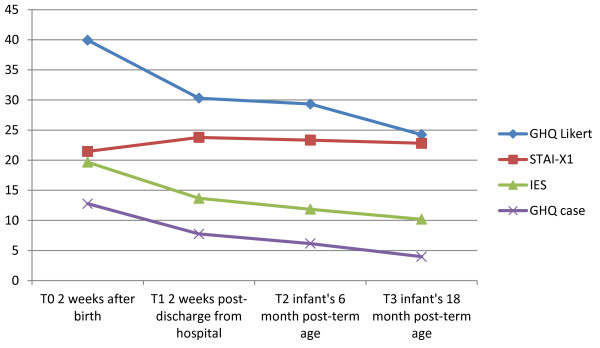
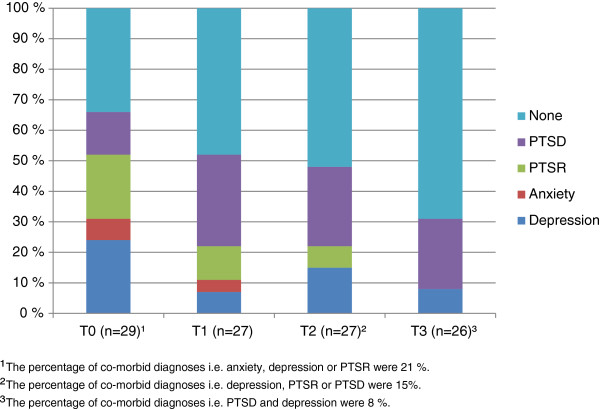
BACKGROUND: Several studies have reported significantly higher stress levels, both short and long terms, among mothers giving preterm birth compared with mothers giving birth at term. Stress, however, is a psychological phenomenon that may present as anxiety, depression and/or trauma reactions. In this study, the long-term mental health outcomes and the prevalence of anxiety, depression and trauma reactions in women experiencing preterm birth were explored. Interactional, main effect variables and predictors were identified. METHODS: Twenty-nine mothers of 35 premature children born before the 33rd week of pregnancy were assessed within 2 weeks postpartum (T0), 2 weeks after hospitalization (T1), 6 months post-term (T2), and 18 months post-term (T3). The standardized psychometric methods Impact of Event Scale (IES), General Health Questionnaire (GHQ) and State Anxiety Inventory (STAI-X1) assessed the maternal mental health outcomes. RESULTS: The maternal mental health problems except state anxiety decreased from T0 to T1, but remained high and stable at T3. The prevalence of posttraumatic stress reactions (PTSR) and posttraumatic stress disorder (PTSD) at T0 and T3 was 52% and 23%, respectively. We identified the time period between T0 and T1 to have a significant main effect on mental health outcomes. The predictors of higher levels of mental health problems were preeclampsia, previous psychological treatment, age, trait anxiety and infant's postnatal intraventricular haemorrhage. Bleeding in pregnancy predicted lower levels of mental health problems. CONCLUSIONS: The prevalence of maternal mental health problems remained high, emphasizing the importance of effective interventions.
Overview
The claims and statistics of this paper haven’t been checked yet.
Free: it reads the open-access text and checks the first 5 claims that cite a source we can check. Create a free account to check every claim.
Integrity signals
Registry
Cites
Statistics
Figures
Verification
Claims the paper makes
The claims and statistics of this paper haven’t been checked yet.
Free: it reads the open-access text and checks the first 5 claims that cite a source we can check. Create a free account to check every claim.
Claims other papers make about this one
Each is checked against this paper’s own text: does it say what the citing paper says it does?
The source backs part of the claim, not all of it — or backs it for a different population, condition or comparison.
In the citing paper
“Post-traumatic symptoms decrease from T1 (19.7 %) to T3 (10.2 %)”
From Parental stress and mental health outcomes following very preterm birth: A systematic review of recent findings (2024) · cites this paper as Misund et al., 2013
Experimental — accuracy not yet measuredThe source backs part of the claim, not all of it — or backs it for a different population, condition or comparison.
In the citing paper
“Additionally, PTSD can occur in 23 % of VLBW mothers at 20 months as well as 57 % of mothers of ELBW and 35 % of VLBW at three to five years (Misund et al., 2013, n = 29; Rodríguez et al., 2020, n = 146).”
From Parental stress and mental health outcomes following very preterm birth: A systematic review of recent findings (2024) · cites this paper as Misund et al., 2013
Experimental — accuracy not yet measuredThe source backs part of the claim, not all of it — or backs it for a different population, condition or comparison.
In the citing paper
“Anxiety increased from T1 (21.5 %) to T1 (23.8 %) and to T3 (22.8 %).”
From Parental stress and mental health outcomes following very preterm birth: A systematic review of recent findings (2024) · cites this paper as Misund et al., 2013
Experimental — accuracy not yet measuredThe source backs part of the claim, not all of it — or backs it for a different population, condition or comparison.
In the citing paper
“Most studies report descriptive results and show that in the period up to one year after birth, anxiety levels decrease (Misund et al., 2013), but remain elevated in 19 -27 % of parents of very pre mature children (Cambonie et al., 2017; Haeusslein et al., 2021; Hall et al., 2017; Vriend et al., 2021).”
From Parental stress and mental health outcomes following very preterm birth: A systematic review of recent findings (2024) · cites this paper as Misund et al., 2013
Experimental — accuracy not yet measuredThe cited source says what the claim attributes to it.
In the citing paper
“Two studies used the DSM-IV (Diagnostic and Statistical Manual of Mental Disorders, Fourth Edition) and the ICD-10 (WHO, 1993) as diagnostic tools for clinical PTSD (Barthel et al., 2020; Misund et al., 2013).”
From Parental stress and mental health outcomes following very preterm birth: A systematic review of recent findings (2024) · cites this paper as Misund et al., 2013
1 more claim about this paper
Create a free account to see every claim other papers make about this one.
Self-check
Percentages, sums and reported differences re-computed from the paper’s own numbers.
The self-check needs the paper’s full text.
Citations
Cites
(1970) · Cited by 24,983
Impact of Event Scale: A Measure of Subjective Stress
Horowitz, M., Wilner, N., & Alvarez, W. (1979) · Psychosomatic Medicine · doi:10.1097/00006842-197905000-00004 · Cited by 7,813 · cited 5×
“Sundin EC, Horowitz MJ: Horowitz's Impact of Event Scale evaluation of 20 years of use.”
MethodInfluential(1988) · NFER-Nelson eBooks · Cited by 5,560
Maternal Depression and Child Psychopathology: A Meta-Analytic Review
Goodman, S. H., Rouse, M. H., Connell, A. M., Broth, M. R., Hall, C. M., & Heyward, D. (2011) · Clinical Child and Family Psychology Review · doi:10.1007/s10567-010-0080-1 · Cited by 2,621 · cited 1×
“Parental mental health is found to be associated with children's cognitive, emotional, social and physical development [29].”
BackgroundSTAI manual for the State-trait anxiety inventory
Cd, S. (1970) · Medical Entomology and Zoology · Cited by 2,492
Predictors of Postpartum Depression: An Update
Beck, C. T. (2001) · Nursing Research · doi:10.1097/00006199-200109000-00004 · Cited by 1,915 · cited 1×
“Predictors of maternal psychological distress following term birth are less explored [35,36].”
BackgroundInfluentialSinger, L. T. (1999) · JAMA · doi:10.1001/jama.281.9.799 · Cited by 726 · cited 4×
“who found that maternal distress following preterm birth of a very low-birth weight child depended on the medical risk status, age and developmental outcome of the child [2].”
BackgroundInfluentialBrennan, P. A., Hammen, C. L., Andersen, M. J., Bor, W., Najman, J. M., & Williams, G. M. (2000) · Developmental Psychology · doi:10.1037//0012-1649.36.6.759 · Cited by 519
Prematurity, maternal stress and mother–child interactions
Muller-Nix, C., Forcada-Guex, M., Pierrehumbert, B., Jaunin, L., Borghini, A., & Ansermet, F. (2004) · Early Human Development · doi:10.1016/j.earlhumdev.2004.05.002 · Cited by 495 · cited 1×
“Further, the intensity of an unresolved trauma may have a mediating effect on later sleep and eating problems in the preterm infant [1,28].”
BackgroundThe Socioemotional Development of 5-year-old Children of Postnatally Depressed Mothers
Murray, L., Sinclair, D., Cooper, P., Ducournau, P., Turner, P., & Stein, A. (1999) · Journal of Child Psychology and Psychiatry · doi:10.1017/s002196309900476x · Cited by 485 · cited 1×
“Several studies of term babies have shown that maternal postpartum or chronic depressive symptoms correspond with poorer cognitive and behavioural child performance [30-34].”
Background
Cited by
Trumello, C., Candelori, C., Cofini, M., Cimino, S., Cerniglia, L., Paciello, M., & Babore, A. (2018) · Frontiers in Public Health · doi:10.3389/fpubh.2018.00359 · Cited by 201
“This result is in line with other ones that highlight elevated anxiety symptoms following a premature delivery (44, 45).”
ResultPre-eclampsia and cardiovascular disease
Chen, C. W., Jaffe, I. Z., & Karumanchi, S. A. (2014) · Cardiovascular Research · doi:10.1093/cvr/cvu018 · Cited by 194
Malouf, R., Harrison, S., Burton, H. A. L., Gale, C., Stein, A., Franck, L. S., & Alderdice, F. (2022) · eClinicalMedicine · doi:10.1016/j.eclinm.2021.101233 · Cited by 172
“Gestational age (GA) at birth was a specified inclusion criterion in 12 studies, published in 13 records24,25,27,28,32,33,38−41,43−45 but GA criteria differed across studies: <30 weeks;43,44 <32 weeks;27,32 <33 weeks;38,39 <34 weeks;41 <37 weeks;25,28,45,46 23 weeks to full-term .24,36,37GA was not reported in one stu…”
BackgroundMethodInfluentialMcKenzie-McHarg, K., Ayers, S., Ford, E., Horsch, A., Jomeen, J., Sawyer, A., Stramrood, C., Thomson, G., & Slade, P. (2015) · Journal of Reproductive and Infant Psychology · doi:10.1080/02646838.2015.1031646 · Cited by 158
“…prematurity, low social support, dysfunctional coping, pre-eclampsia, bleeding in pregnancy, and intraventricular haemorrhage in babies are associated with higher levels of PTSD symptoms (Misund et al., 2013; Shaw, Bernard, Storfer-Isser, Rhine, & Horwitz, 2013; Suttora, Spinelli, & Monzani, 2014).”
BackgroundWelch, M. G., Halperin, M. S., Austin, J., Stark, R. I., Hofer, M. A., Hane, A. A., & Myers, M. M. (2015) · Archives of Women s Mental Health · doi:10.1007/s00737-015-0502-7 · Cited by 154
Metadata
- Authors
- Misund, A. R., Nerdrum, P., Bråten, S., Pripp, A., & Diseth, T. H.
- Affiliations
- OsloMet – Oslo Metropolitan University (NO)
- University of Oslo (NO)
- Oslo University Hospital (NO)
- Corresponding author
- Misund, Aud R
- Venue
- Annals of General Psychiatry
- Published
- 2013
- Volume
- 12
- Issue
- 1
- Pages
- 33
- ISSN
- 1744-859X (ISSN-L)
- PMC
- PMC4175092
- OpenAlex
- W2121994571
- Cited by
- 73
- References
- 51
- Citations by year
- 2026: 2 · 2025: 4 · 2024: 11 · 2023: 6 · 2022: 4 · 2021: 7 · 2020: 7 · 2019: 5 · 2018: 4 · 2017: 8 · 2016: 6 · 2015: 7 · 2014: 2
- FWCI
- 5.11
- Type
- journal article
- Language
- en
- Open access
- gold
- doi.org
- Licence
- cc-by
- Locations
- Annals of General Psychiatry (publishedVersion, cc-by)
- Europe PMC (PubMed Central) (publishedVersion, cc-by)
- PubMed Central (publishedVersion, cc-by)
- PubMed (publishedVersion)
- NORA - Norwegian Open Research Archives (submittedVersion, cc-by)
- Topics
- Health Sciences › Medicine › Public Health, Environmental and Occupational Health › Maternal Mental Health During Pregnancy and Postpartum
- Health Sciences › Medicine › Pediatrics, Perinatology and Child Health › Infant Development and Preterm Care
- Health Sciences › Medicine › Pediatrics, Perinatology and Child Health › Maternal and Neonatal Healthcare
- Keywords
- preterm birth, maternal mental health, post-traumatic stress disorder, post-traumatic stress reaction, anxiety, depression, preeclampsia, intraventricular hemorrhage, bleeding in pregnancy, postpartum period, long-term outcomes, women
About these checks
Registry, retraction, Cites and statistics results are computed, not judged, with one exception: a printed reference that no index lists is read once by a model before it counts as a citation error. Claims are extracted by a model and kept only when their quote appears verbatim in the text; each cited source is then checked, with a model’s help, for whether it says what the claim relies on. Those verdicts can be wrong — read the claim’s quote and the cited source before relying on one.
Statistics and arithmetic are recomputed, not judged.
Confidence bands are shown only for fields calibrated on our annotated test set. None is calibrated yet, so no band is shown.
What counts as a claim ›How we measure confidence ›How we check this ›
Are you an author, or do you see a problem with this page? Request a review
Data sources
Bibliographic data: Semantic Scholar, OpenAlex, Crossref.
Contains information from the Semantic Scholar Academic Graph Datasets, made available under the ODC Attribution License (ODC-BY 1.0).
Semantic Scholar’s data is described in: Kinney, R., et al. (2023). The Semantic Scholar Open Data Platform. arXiv:2301.10140.
