

Meditation acutely improves psychomotor vigilance, and may decrease sleep need
Open accessThe DOI matches its Crossref record; 38 of the 38 references it cites were found in a registry or an index.
Abstract
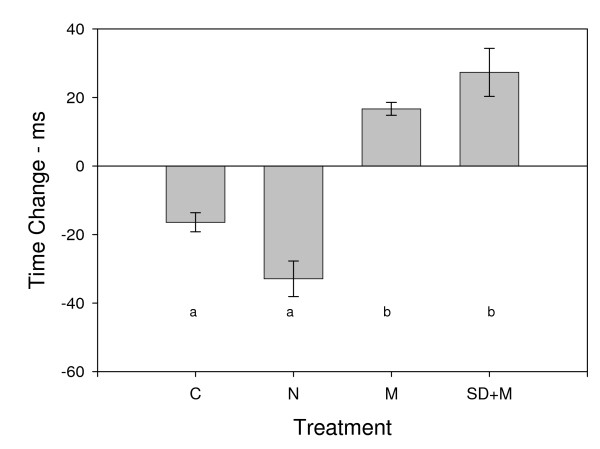
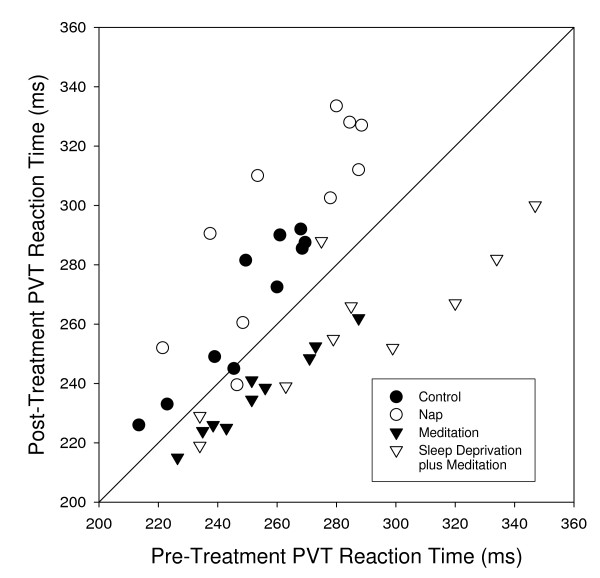
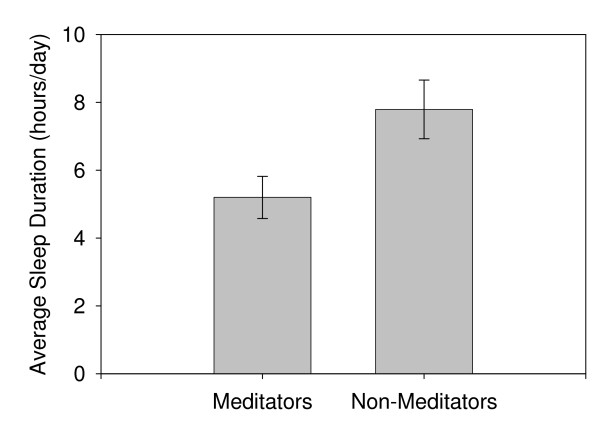
Background: A number of benefits from meditation have been claimed by those who practice various traditions, but few have been well tested in scientifically controlled studies. Among these claims are improved performance and decreased sleep need. Therefore, in these studies we assess whether meditation leads to an immediate performance improvement on a well validated psychomotor vigilance task (PVT), and second, whether longer bouts of meditation may alter sleep need. Methods: The primary study assessed PVT reaction times before and after 40 minute periods of mediation, nap, or a control activity using a within subject cross-over design. This study utilized novice meditators who were current university students (n = 10). Novice meditators completed 40 minutes of meditation, nap, or control activities on six different days (two separate days for each condition), plus one night of total sleep deprivation on a different night, followed by 40 minutes of meditation. A second study examined sleep times in long term experienced meditators (n = 7) vs. non-meditators (n = 23). Experienced meditators and controls were age and sex matched and living in the Delhi region of India at the time of the study. Both groups continued their normal activities while monitoring their sleep and meditation times. Results: Novice meditators were tested on the PVT before each activity, 10 minutes after each activity and one hour later. All ten novice meditators improved their PVT reaction times immediately following periods of meditation, and all but one got worse immediately following naps. Sleep deprivation produced a slower baseline reaction time (RT) on the PVT that still improved significantly following a period of meditation. In experiments with long-term experienced meditators, sleep duration was measured using both sleep journals and actigraphy. Sleep duration in these subjects was lower than control non-meditators and general population norms, with no apparent decrements in PVT scores. Conclusions: These results suggest that meditation provides at least a short-term performance improvement even in novice meditators. In long term meditators, multiple hours spent in meditation are associated with a significant decrease in total sleep time when compared with age and sex matched controls who did not meditate. Whether meditation can actually replace a portion of sleep or pay-off sleep debt is under further investigation.
Overview
The claims and statistics of this paper haven’t been checked yet.
Free: it reads the open-access text and checks the first 5 claims that cite a source we can check. Create a free account to check every claim.
Integrity signals
Registry
Cites
Statistics
Figures
Verification
Claims the paper makes
The claims and statistics of this paper haven’t been checked yet.
Free: it reads the open-access text and checks the first 5 claims that cite a source we can check. Create a free account to check every claim.
Claims other papers make about this one
Each is checked against this paper’s own text: does it say what the citing paper says it does?
The cited source says what the claim attributes to it.
In the citing paper
“Kaul et al.55 found that meditation naive university students who performed a 40-min FA mediation improved their performance on the psychomotor vigilance task (PVT) in comparison to a nap or a control activity.”
From Awakening is not a metaphor: the effects of Buddhist meditation practices on basic wakefulness (2014) · cites this paper as [55]
The cited source says what the claim attributes to it.
In the citing paper
“Sleep diaries indicated a significantly shorter average nocturnal sleep duration in meditators than controls (5.2 h vs. 7.8 h, P< 0.00001).”
From Awakening is not a metaphor: the effects of Buddhist meditation practices on basic wakefulness (2014) · cites this paper as [55]
In the citing paper
“This study also found that meditation improved decrements in PVT vigilance following a night of sleep deprivation, so that meditation practice increased wakefulness.”
From Awakening is not a metaphor: the effects of Buddhist meditation practices on basic wakefulness (2014) · cites this paper as [55]
Self-check
Percentages, sums and reported differences re-computed from the paper’s own numbers.
The self-check needs the paper’s full text.
Citations
Cites
Principles and Practice of Sleep Medicine
(2011) · Elsevier eBooks · doi:10.1016/c2009-0-59875-3 · Cited by 5,088
Sleep Homeostasis and Models of Sleep Regulation
Borb, A. A., & Achermann, P. (1999) · Journal of Biological Rhythms · doi:10.1177/074873099129000894 · Cited by 1,472
Long-term meditators self-induce high-amplitude gamma synchrony during mental practice
Lutz, A., Greischar, L. L., Rawlings, N. B., Ricard, M., & Davidson, R. J. (2004) · Proceedings of the National Academy of Sciences · doi:10.1073/pnas.0407401101 · Cited by 1,328 · cited 3×
“Among these claims are improvement in many types of performance and alterations in sleep and EEG patterns that have received considerable, but sometimes mixed, scientific support over the past few decades [3,9,22-25].”
BackgroundNormal Human Sleep: An Overview
Carskadon, M. A., & Dement, W. C. (2005) · Principles and Practice of Sleep Medicine · doi:10.1016/b0-72-160797-7/50009-4 · Cited by 995
Mental Training Affects Distribution of Limited Brain Resources
Slagter, H. A., Lutz, A., Greischar, L. L., Francis, A. D., Nieuwenhuis, S., Davis, J. M., & Davidson, R. J. (2007) · PLoS Biology · doi:10.1371/journal.pbio.0050138 · Cited by 757 · cited 1×
“This kind of more intense meditation training also appears critical to improvements in attentional tasks [28].”
BackgroundThe role of actigraphy in sleep medicine
Sadeh, A., & Acebo, C. (2002) · Sleep Medicine Reviews · doi:10.1053/smrv.2001.0182 · Cited by 720
Physiological effects of transcendental meditation
Wallace, R. K. (1970) · Science · doi:10.1126/science.167.3926.1751 · Cited by 653 · cited 1×
“Previous studies on meditation have documented clear changes in the EEG that are distinct from sleep and typical wake, as well as a variety of other physiological changes [1-5].”
BackgroundTassi, P., & Muzet, A. (2000) · Sleep Medicine Reviews · doi:10.1053/smrv.2000.0098 · Cited by 458
Spectral analysis of the EEG in meditation
Banquet, J. P. (1973) · Electroencephalography and Clinical Neurophysiology · doi:10.1016/0013-4694(73)90170-3 · Cited by 378
Cited by
Busch, V., Magerl, W., Kern, U., Haas, J., Hajak, G., & Eichhammer, P. (2012) · Pain Medicine · doi:10.1111/j.1526-4637.2011.01243.x · Cited by 251
Britton, W. B., Lepp, N. E., Niles, H. F., Rocha, T., Fisher, N. E., & Gold, J. S. (2014) · Journal of School Psychology · doi:10.1016/j.jsp.2014.03.002 · Cited by 249
Sleep, recovery, and metaregulation: explaining the benefits of sleep
Vyazovskiy, V. (2015) · Nature and Science of Sleep · doi:10.2147/nss.s54036 · Cited by 148
Awakening is not a metaphor: the effects of Buddhist meditation practices on basic wakefulness
Britton, W. B., Lindahl, J. R., Cahn, B. R., Davis, J. H., & Goldman, R. E. (2014) · Annals of the New York Academy of Sciences · doi:10.1111/nyas.12279 · Cited by 134
Ferrarelli, F., Smith, R., Dentico, D., Riedner, B. A., Zennig, C., Benca, R. M., Lutz, A., Davidson, R. J., & Tononi, G. (2013) · PLoS ONE · doi:10.1371/journal.pone.0073417 · Cited by 122
“[45]And finally, the type of meditation practice examined in the current study differs from the practice studied in these other studies.”
BackgroundResultBritton, W. B., Haynes, P. L., Fridel, K. W., & Bootzin, R. R. (2012) · Psychotherapy and Psychosomatics · doi:10.1159/000332755 · Cited by 81
DATTA, K., TRIPATHI, M., VERMA, M., MASIWAL, D., & MALLICK, H. N. (2021) · The National Medical Journal of India · doi:10.25259/nmji_63_19 · Cited by 80
Cincotta, A. L., Gehrman, P., Gooneratne, N. S., & Baime, M. J. (2011) · Stress and Health · doi:10.1002/smi.1370 · Cited by 67
Nature of Human IntelligencePreprint
Dayathilake, K. L. S. (2017) · PsyArXiv (OSF Preprints) · doi:10.31234/osf.io/t8cqn · Cited by 63
Oken, B. S., Wahbeh, H., Goodrich, E., Klee, D., Memmott, T., Miller, M., & Fu, R. (2017) · Mindfulness · doi:10.1007/s12671-016-0640-7 · Cited by 62
Effects of acute aerobic exercise or meditation on emotional regulation
Edwards, M. K., Rhodes, R. E., Mann, J. R., & Loprinzi, P. D. (2018) · Physiology & Behavior · doi:10.1016/j.physbeh.2017.12.037 · Cited by 56
Yoga Nidra: An innovative approach for management of chronic insomnia- A case report
Datta, K., Tripathi, M., & Mallick, H. N. (2017) · Sleep Science and Practice · doi:10.1186/s41606-017-0009-4 · Cited by 51
Nature of Human IntelligencePreprint
Dayathilake, K. L. S. (2017) · SSRN Electronic Journal · doi:10.2139/ssrn.3848408 · Cited by 47
Nature of Human IntelligencePreprint
Dayathilake, K. L. S. (2020) · PsyArXiv (OSF Preprints) · doi:10.31234/osf.io/nv98s · Cited by 47
Wong, K. F., Teng, J., Chee, M. W. L., Doshi, K., & Lim, J. (2018) · Frontiers in Human Neuroscience · doi:10.3389/fnhum.2018.00080 · Cited by 43
Neuroscience of the yogic theory of consciousness
Tripathi, V., & Bharadwaj, P. (2021) · Neuroscience of Consciousness · doi:10.1093/nc/niab030 · Cited by 41
Time, Touch, and Compassion: Effects on Autonomic Nervous System and Well-Being
Shaltout, H. A., Tooze, J. A., Rosenberger, E. L., & Kemper, K. J. (2012) · EXPLORE · doi:10.1016/j.explore.2012.02.001 · Cited by 39
Dispositional Mindfulness and Memory Problems: the Role of Perceived Stress and Sleep Quality
Brisbon, N. M., & Lachman, M. E. (2016) · Mindfulness · doi:10.1007/s12671-016-0607-8 · Cited by 38
Non-verbal communication of compassion: measuring psychophysiologic effects
Kemper, K. J., & Shaltout, H. A. (2011) · BMC Complementary and Alternative Medicine · doi:10.1186/1472-6882-11-132 · Cited by 32
“Most studies comparing long-term with novice meditation practitioners have noted differences [32,33,72,73].”
BackgroundBorragán, G., Deliens, G., Peigneux, P., & Leproult, R. (2017) · Journal of Environmental Psychology · doi:10.1016/j.jenvp.2017.03.008 · Cited by 29
Towards interactive mindfulness training using breathing based feedback
Pisa, A. M., Chernyshov, G., Nassou, A. F., & Kunze, K. S. (2017) · ACM International Joint Conference on Pervasive and Ubiquitous Computing (UbiComp) · doi:10.1145/3123024.3129268 · Cited by 29
Kemper, K. J., Powell, D. S., Helms, C. C., & Kim‐Shapiro, D. B. (2014) · EXPLORE · doi:10.1016/j.explore.2014.10.002 · Cited by 29
Portella, C. F. S., Sorpreso, I. C. E., de Assis, A. D. S. M., de Abreu, L. C., Soares, J. M., Baracat, E. C., Moraes, S. D. T. D. A., & Tanaka, A. C. D. (2020) · Advances in Integrative Medicine · doi:10.1016/j.aimed.2020.08.003 · Cited by 20
DiFrancesco, M. W., Dyk, T. R. V., Altaye, M., Drummond, S. P. A., & Beebe, D. W. (2019) · Scientific Reports · doi:10.1038/s41598-019-50180-6 · Cited by 18
Meditation: Empirical Research and Future Directions
MacDonald, D. A., WALSH, R. N., & Shapiro, S. L. (2013) · Wiley eBooks · doi:10.1002/9781118591277.ch24 · Cited by 17
The possible role of meditation in myofascial pain syndrome: A new hypothesis
Panta, P. (2017) · Indian Journal of Palliative Care · doi:10.4103/0973-1075.204239 · Cited by 17
Lin, M., Hsiao, P.-R., & Hsu, H. (2022) · Healthcare · doi:10.3390/healthcare10030559 · Cited by 16
Hsu, H., Tsao, L., & Lin, M. (2015) · Applied Nursing Research · doi:10.1016/j.apnr.2015.01.004 · Cited by 13
Improving the Feature Stability and Classification Performance of Bimodal Brain and Heart Biometrics
Palaniappan, R., Samraj, A., Sillitoe, I. P. W., Shira, T., & Paramesran, R. (2015) · Advances in intelligent systems and computing · doi:10.1007/978-3-319-28658-7_15 · Cited by 13
On the binaural brain entrainment indicating lower heart rate variability
Palaniappan, R., Phon-Amnuaisuk, S., & Eswaran, C. (2015) · International Journal of Cardiology · doi:10.1016/j.ijcard.2015.04.175 · Cited by 11
Chaudhary, I. S., Shyi, G. C. ‐., & Huang, S.-T. T. (2023) · Frontiers in Psychology · doi:10.3389/fpsyg.2023.1136983 · Cited by 10
Kohler, M. J., Rawlings, M., Kaeding, A., Banks, S., & Immink, M. A. (2017) · Journal of Cognitive Enhancement · doi:10.1007/s41465-017-0032-5 · Cited by 10
Thomas, E. M., Freeman, T. P., Poplutz, P., Howden, K., Hindocha, C., Bloomfield, M., & Kamboj, S. K. (2021) · Journal of Psychopharmacology · doi:10.1177/0269881121991835 · Cited by 10
George, P. T. (2017) · Sleep And Breathing · doi:10.1007/s11325-017-1505-6 · Cited by 9
Sleep-Based Brain Age Is Reduced in Advanced Inner Engineering Meditators
Banks, J. C., Hariri, S., Kveraga, K., Ouyang, A., Gallagher, K., Quadri, S. A., Tesh, R. A., Reed, P. U., THOMAS, R. J., Westover, M. B., et al. (2025) · Mindfulness · doi:10.1007/s12671-025-02583-y · Cited by 8
Mohammed, R. A. H. (2014) · Journal of Clinical Trials · doi:10.4172/2167-0870.1000206 · Cited by 8
Meditation, Sleep, and Performance
Guerriero, L. E., & O’Hara, B. F. (2019) · OBM Integrative and Complementary Medicine · doi:10.21926/obm.icm.1902031 · Cited by 7
Self-citationMindfulness-Based Mind Fitness Training (MMFT)
Larsen, K. L., & Stanley, E. A. (2019) · Routledge eBooks · doi:10.4324/9781315265438-6 · Cited by 7
Rodríguez, V., Medrano, C., & Plaza, I. (2018) · Journal of Healthcare Engineering · doi:10.1155/2018/7275049 · Cited by 7
Yoga as the “Next Wave” of Therapeutic Modalities For Treatment of Insomnia
Kennedy, S. (2014) · International Journal of Yoga Therapy · doi:10.17761/ijyt.24.1.82wu454283t15wt0 · Cited by 5
Spann, C. A. (2016) · UTA ResearchCommons (University of Texas Arlington) · Cited by 4
Meditation as a non-pharmacological treatment for narcolepsy: A literature review
Feng, F., Guo, H., Ding, G. A., & Yeung, A. (2025) · Sleep Medicine · doi:10.1016/j.sleep.2025.106651 · Cited by 4
Riedel, M. (2016) · theses.fr (ABES) · doi:10.70675/1ed2f6bbzd4a3z447bza051zbe3da3783596 · Cited by 4
Kozhuharova, M. (2014) · University of Regensburg Publication Server (University of Regensburg) · doi:10.5283/epub.29398 · Cited by 4
The Impact of Sleep on the Effectiveness of Meditation and Contemplative Prayer
Jeglič, U. (2022) · Studia Gdańskie · doi:10.26142/stgd-2022-011 · Cited by 4
Rescatando al sujeto: Una perspectiva budista sobre los estudios de la conciencia
Iverson, K. M. (2015) · Girasol/Revista humanidades · doi:10.15517/h.v5i2.21212 · Cited by 3
Mindfulness-Based Interventions in the Treatment of Physical Conditions
Goyal, M., & Rusch, H. L. (2020) · Oxford University Press eBooks · doi:10.1093/oxfordhb/9780198808640.013.34 · Cited by 3
Neuroscience of the Yogic Theory of Mind and ConsciousnessPreprint
Tripathi, V., & Bharadwaj, P. (2021) · PsyArXiv (OSF Preprints) · doi:10.31234/osf.io/ka73h · Cited by 3
THE EFFECTIVENESS OF MUSIC ON HUMAN BIOLOGICAL SIGNALS
Khazaei, D., Setarehdan, S. K., & Mehran, Y. Z. (2016) · Biomedical Engineering Applications Basis and Communications · doi:10.4015/s1016237216500022 · Cited by 2
Acompañando e intensificando la información entrante en el explorar generativo
Orcasitas, J. L. (2016) · UPM Digital Archive (Technical University of Madrid) · doi:10.20868/upm.thesis.39897 · Cited by 2
Barraquer, L. T., & Bàsica, E. I. D. L. U. A. D. B. D. D. P. (2016) · LA Referencia (Red Federada de Repositorios Institucionales de Publicaciones Científicas) · Cited by 2
Evolution of Human Intelligence: Psychological Science for a Better WorldPreprint
Dayathilake, K. L. S. (2021) · PsyArXiv (OSF Preprints) · doi:10.31234/osf.io/m3yrj · Cited by 1
Evolution of Human Intelligence; Psychological Science for a Better WorldPreprint
Dayathilake, K. L. S. (2023) · doi:10.33774/coe-2022-gq577-v2 · Cited by 1
IMPACT OF SHORT MEDITATION ON ATTENTIONAL PERFORMANCE
Guerriero, L. E. (2021) · UKnowledge (University of Kentucky) · doi:10.13023/etd.2021.357 · Cited by 1
Molina, E., Fernández‐Prieto, I., Andrés, P., & Parmentier, F. B. R. (2020) · PsyArXiv (OSF Preprints) · doi:10.31234/osf.io/8ynca · Cited by 2
Con antonio gala (estudios sobre su obra)
Castillo, J. N. R. (1996) · UNED repository · Cited by 1
EEG Brain Rhythms During Resting‐State Wakefulness and Sleep in Elderly Expert Meditators
Champetier, P., Hamel, A., André, C., Ourry, V., Lacroix, T., Rehel, S., Chauveau, L., Haudry, S., Bertran, F., Sayette, V. D. L., et al. (2025) · Journal of Sleep Research · doi:10.1111/jsr.70161 · Cited by 1
Materialism, Mysticism, and Ecocriticism
Tagnani, D. (2017) · English Language Notes · doi:10.1215/00138282-55.1-2.23 · Cited by 1
Rodríguez Ontiveros, V. H., Plaza García, I., & Medrano Sanchez, C. (2021) · Zaguan (Universidad de Zaragoza) · Cited by 1
Ecomysticism: Materialism and Mysticism in American Nature Writing
Tagnani, D. (2015) · Research Exchange (Washington State University) · Cited by 1
Guerriero, L. E., Dundon, S. R., Joshi, S., Stromberg, A. J., Sunderam, S., & O’Hara, B. F. (2023) · Authorea · doi:10.22541/au.169772763.32913548/v1
Self-citationالبصير, ن. ع. ا. ع. ا., & عرفان, أ. ع. ا. أ. (2022) · المجلة المصرية للدراسات النفسية · doi:10.21608/ejcj.2022.273343
MacDonald, D. A., WALSH, R. N., & Shapiro, S. L. (2026) · Wiley eBooks · doi:10.1002/9781394215683.ch23
Does Meditation Improve Cognition Through Sleep?Preprint
Rankaduwa, S., Owen, A. M., & Nichols, E. S. (2022) · PsyArXiv (OSF Preprints) · doi:10.31234/osf.io/d4czh
Daulatabad, V. S., Prafull, K., Estelle, H., Naveen, R., Afna, A., Anala, B., Neeraja, V., Magan, D., Bhargav, H., & John, N. (2026) · Annals of Neurosciences · doi:10.1177/09727531261453166
Wang, Q., Li, H., Wang, S., Lin, X., Zhu, X., Su, S., Sun, W., Sui, M., Lu, L., Deng, J., et al. (2026) · Journal of Affective Disorders · doi:10.1016/j.jad.2026.122433
Qualidade de vida e insônia na perimenopausa: meditação como estratégia de intervenção
Portella, C. F. S. (2014) · Digital Library of Theses and Dissertations (Universidade de São Paulo) · doi:10.11606/d.6.2014.tde-09042014-104755
Effects of Meditation on Learning Ability and Cognitive Functioning: A Systematic ReviewPreprint
Bezanson, D. (2019) · SSRN Electronic Journal · doi:10.2139/ssrn.3342880
The Effectiveness of Short Meditation on Attentional Performance: A Quick Classroom Activity
Guerriero, L. E., Joshi, S., & O’Hara, B. F. (2023) · Current Research in Complementary & Alternative Medicine · doi:10.29011/2577-2201.100203
Self-citationOrgasmic Meditation, Sleep, and Next-Day Somatic Distress: A 30-Day Observational Study
Griggs, C. (2026) · Cureus · doi:10.7759/cureus.118014
Valone, T. F. (2019) · Wiley eBooks · doi:10.1002/9781119227793.ch23
Champetier, P. (2023) · theses.fr (ABES) · doi:10.70675/323f5d1dz6fd3z49d7z9d48z77d2f3bf899e
Evolution of Human Intelligence; Psychological Science for a Better WorldPreprint
Dayathilake, K. L. S. (2024) · doi:10.33774/coe-2022-gq577-v3
Pak, S. C., & Ooi, S. L. (2019) · Charles Sturt University Research Output (CRO)
Chaudhary, I. S., Shyi, G. C.-W., & Huang, S.-T. T. (2023) · doi:10.3389/fpsyg.2023.1136983.s006
Godfrey-Kurtz, R. M. (2026) · Durham e-Theses (Durham University)
Psychomotor vigilance performance
Silva, M. A. (2021) · Elsevier eBooks · doi:10.1016/b978-0-12-822963-7.00046-3
A Proposal of Quantum Mechanism of Sleep
Sha, Z. G., & Xiu, R. (2026) · Reports in Advances of Physical Sciences · doi:10.1142/s2424942426500167
Making Things Easier by Making Them Harder: Can Listening at a Low Volume Improve Hearing?
Musser, A. (2019) · Digital Access to Scholarship at Harvard (DASH) (Harvard University)
Hadiyatika, E. L. (2017) · Digital Library UIN Sunan Kalijaga (Sunan Kalijaga State Islamic University)
Metadata
- Authors
- Kaul, P., Passafiume, J., Sargent, R. C., & O'Hara, B. F.
- Affiliations
- University of Kentucky (US)
- Venue
- Behavioral and Brain Functions
- Published
- 2010-07-29
- Volume
- 6
- Issue
- 1
- Pages
- 47-47
- ISSN
- 1744-9081 (ISSN-L)
- PMC
- PMC2919439
- OpenAlex
- W2124637688
- Cited by
- 65
- References
- 38
- Citations by year
- 2026: 3 · 2025: 3 · 2023: 4 · 2022: 3 · 2021: 7 · 2020: 4 · 2019: 4 · 2018: 3 · 2017: 9 · 2016: 4 · 2015: 5 · 2014: 5 · 2013: 3 · 2012: 3
- FWCI
- 3.17
- Type
- journal article
- Language
- en
- Open access
- gold
- doi.org
- Licence
- cc-by
- creativecommons.org/licenses/by/2.0 (tdm)
- Locations
- Behavioral and Brain Functions (publishedVersion, cc-by)
- PubMed Central (publishedVersion, cc-by)
- PubMed (publishedVersion)
- UKnowledge (University of Kentucky) (submittedVersion, cc-by)
- DOAJ (DOAJ: Directory of Open Access Journals) (submittedVersion, cc-by-sa)
- Funders
- University of Kentucky
- Topics
- Social Sciences › Psychology › Clinical Psychology › Mindfulness and Compassion Interventions
- Social Sciences › Psychology › Experimental and Cognitive Psychology › Sleep and Work-Related Fatigue
- Life Sciences › Neuroscience › Cognitive Neuroscience › Mind wandering and attention
- Keywords
- meditation, psychomotor vigilance, reaction time, sleep need, sleep duration, sleep deprivation, NAP, experienced meditators, novice meditators, sleep debt, performance improvement
- MeSH terms
- Adult, Female, Humans, India, Male, Medical Records, Middle Aged, Neuropsychological Tests, Psychomotor Performance, Reaction Time, Sleep, Sleep Deprivation, Time Factors, Cross-Over Studies, Meditation, Young Adult, Actigraphy
About these checks
Registry, retraction, Cites and statistics results are computed, not judged, with one exception: a printed reference that no index lists is read once by a model before it counts as a citation error. Claims are extracted by a model and kept only when their quote appears verbatim in the text; each cited source is then checked, with a model’s help, for whether it says what the claim relies on. Those verdicts can be wrong — read the claim’s quote and the cited source before relying on one.
Statistics and arithmetic are recomputed, not judged.
Confidence bands are shown only for fields calibrated on our annotated test set. None is calibrated yet, so no band is shown.
What counts as a claim ›How we measure confidence ›How we check this ›
Are you an author, or do you see a problem with this page? Request a review
Data sources
Bibliographic data: Semantic Scholar, OpenAlex, Crossref.
Contains information from the Semantic Scholar Academic Graph Datasets, made available under the ODC Attribution License (ODC-BY 1.0).
Semantic Scholar’s data is described in: Kinney, R., et al. (2023). The Semantic Scholar Open Data Platform. arXiv:2301.10140.
