

The DOI matches its Crossref record; 227 of the 228 references it cites were found in a registry or an index.
The Last Universal Common Ancestor: emergence, constitution and genetic legacy of an elusive forerunner
Open accessAbstract
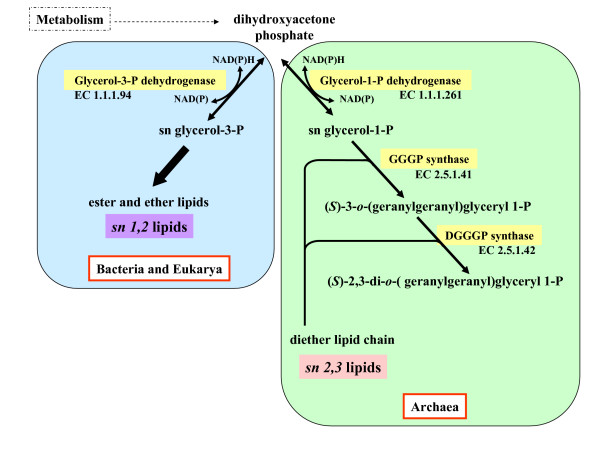
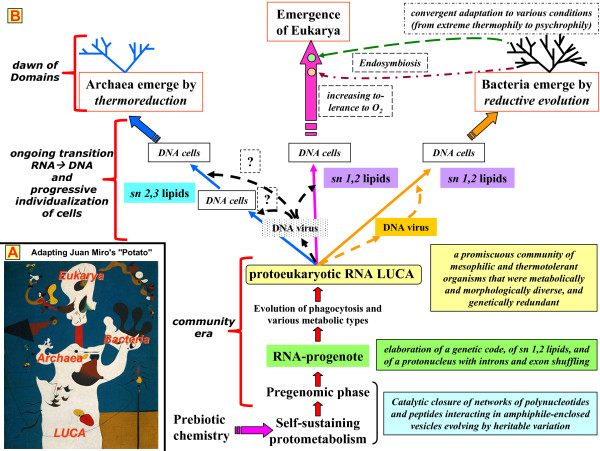
Background: Since the reclassification of all life forms in three Domains (Archaea, Bacteria, Eukarya), the identity of their alleged forerunner (Last Universal Common Ancestor or LUCA) has been the subject of extensive controversies: progenote or already complex organism, prokaryote or protoeukaryote, thermophile or mesophile, product of a protracted progression from simple replicators to complex cells or born in the cradle of "catalytically closed" entities? We present a critical survey of the topic and suggest a scenario. Results: LUCA does not appear to have been a simple, primitive, hyperthermophilic prokaryote but rather a complex community of protoeukaryotes with a RNA genome, adapted to a broad range of moderate temperatures, genetically redundant, morphologically and metabolically diverse. LUCA's genetic redundancy predicts loss of paralogous gene copies in divergent lineages to be a significant source of phylogenetic anomalies, i.e. instances where a protein tree departs from the SSU-rRNA genealogy; consequently, horizontal gene transfer may not have the rampant character assumed by many. Examining membrane lipids suggest LUCA had sn1,2 ester fatty acid lipids from which Archaea emerged from the outset as thermophilic by "thermoreduction," with a new type of membrane, composed of sn2,3 ether isoprenoid lipids; this occurred without major enzymatic reconversion. Bacteria emerged by reductive evolution from LUCA and some lineages further acquired extreme thermophily by convergent evolution. This scenario is compatible with the hypothesis that the RNA to DNA transition resulted from different viral invasions as proposed by Forterre. Beyond the controversy opposing "replication first" to metabolism first", the predictive arguments of theories on "catalytic closure" or "compositional heredity" heavily weigh in favour of LUCA's ancestors having emerged as complex, self-replicating entities from which a genetic code arose under natural selection. Conclusion: Life was born complex and the LUCA displayed that heritage. It had the "body "of a mesophilic eukaryote well before maturing by endosymbiosis into an organism adapted to an atmosphere rich in oxygen. Abundant indications suggest reductive evolution of this complex and heterogeneous entity towards the "prokaryotic" Domains Archaea and Bacteria. The word "prokaryote" should be abandoned because epistemologically unsound. Reviewers: This article was reviewed by Anthony Poole, Patrick Forterre, and Nicolas Galtier.
Overview
The claims and statistics of this paper haven’t been checked yet.
Run the check — free, no account needed. It reads the open-access text and checks the sources it cites.
Integrity signals
Registry
Cites
Statistics
Figures
Verification
Claims the paper makes
The claims and statistics of this paper haven’t been checked yet.
Run the check — free, no account needed. It reads the open-access text and checks the sources it cites.
Claims other papers make about this one
Each is checked against this paper’s own text: does it say what the citing paper says it does?
The check wasn’t confident either way, so it gives no verdict — never disputed.
In the citing paper
“LUCA is estimated to have lived 3.8–3.5 billion years ago (Glansdorff et al., 2008).”
From The Astrobiology Primer v2.0 (2016) · cites this paper as Glansdorff et al., 2008
Experimental — accuracy not yet measured
Self-check
Percentages, sums and reported differences re-computed from the paper’s own numbers.
The self-check needs the paper’s full text.
Citations
Cites
The Origins of Order: Self-Organization and Selection in Evolution
Kauffman, S. A. (1993) · doi:10.1093/oso/9780195079517.001.0001 · Cited by 7,855
Towards a natural system of organisms: proposal for the domains Archaea, Bacteria, and Eucarya.
Woese, C. R., Kandler, O., & Wheelis, M. L. (1990) · Proceedings of the National Academy of Sciences · doi:10.1073/pnas.87.12.4576 · Cited by 6,128
Phylogenetic structure of the prokaryotic domain: The primary kingdoms
Woese, C. R., & Fox, G. E. (1977) · Proceedings of the National Academy of Sciences · doi:10.1073/pnas.74.11.5088 · Cited by 4,131
Darwin's dangerous idea : evolution and the meanings of life
Dennett, D. C. (1995) · DigitalGeorgetown (Georgetown University Library) · Cited by 1,998
Phylogenetic Classification and the Universal Tree
Doolittle, W. F. (1999) · Science · doi:10.1126/science.284.5423.2124 · Cited by 1,888
Toward Automatic Reconstruction of a Highly Resolved Tree of Life
Ciccarelli, F. D., Doerks, T., von Mering, C., Creevey, C. J., Snel, B., & Bork, P. (2006) · Science · doi:10.1126/science.1123061 · Cited by 1,663
Deciphering the evolution and metabolism of an anammox bacterium from a community genome
Strous, M., Pelletier, É., Mangenot, S., Rattei, T., Lehner, A., Taylor, M. W., Horn, M., Daims, H., Mavel, D., Wincker, P., et al. (2006) · Nature · doi:10.1038/nature04647 · Cited by 1,357
A Serpentinite-Hosted Ecosystem: The Lost City Hydrothermal Field
Kelley, D. S., Karson, J. A., Früh-Green, G. L., Yoerger, D. R., Shank, T. M., Butterfield, D. A., Hayes, J. M., Schrenk, M. O., Olson, E. J., Proskurowski, G., et al. (2005) · Science · doi:10.1126/science.1102556 · Cited by 1,288
The Hydrogen Hypothesis for the First Eukaryote
Martin, W., & Müller, M. (1998) · Nature · doi:10.1038/32096 · Cited by 1,282
Archean Molecular Fossils and the Early Rise of Eukaryotes
Brocks, J. J., Logan, G. A., Buick, R., & Summons, R. E. (1999) · Science · doi:10.1126/science.285.5430.1033 · Cited by 1,275
Research works printed but not linked: 9
- Forterre P, Philippe H: Where is the root of the universal tree of life?. Bioessays. 1999, 21: 871-879. 10.1002/(SICI)1521-1878(199910)21:10<871::AID-BIES10>3.0.CO;2-Q. · DOI
- Glansdorff N, Xu Y: Phylogeny of extremophiles. Extremophilies in Encyclopedia of Life Support Systems (EOLSS). Edited by: Gerday C, Glansdorff N. 2004, Developed under the Auspicies of the UNESCO, Eolss Publishers, Oxford, UK, [http://www.eolss.net]
- Kandler O: The early diversification of life. Nobel Symposium No 84, Early Life on Earth. 1994, Columbia University Press, New York NY, 152-160.
- Forterre P: Strategies of extremophily in nucleic acids adaptation to high temperature. Extremophilies in Encyclopedia of Life Support Systems (EOLSS). Edited by: Gerday C, Glansdorff N. 2004, Developed under the auspicies of the UNESCO, Eolss Publishers, Oxford, UK, [http://www.eolss.net]
- Glansdorff N, Xu Y: Microbial life at low temperatures: mechanisms of adaptation and extreme biotopes. Implications for exobiology and the origin of life. Recent Res Devel Microbiol. 2002, 6: 1-21.
- Sakmann E: Physikalische Grundlagen der molekularen Organisation und Dynamik von Membranen. Biophysik. Edited by: Hoppe W, Lohmann W, Markl H, Ziegler H. 1982, Springer, Berlin, Germany, 439-471. 2
- Jensen RA: Evolution of metabolic pathways in enteric bacteria. Escherichia coli and Salmonella: Cellular and Molecular Biology. Edited by: Neidhardt DCFC. Washington: American Society for Microbiology press, 2649-2662.
- de Duve C: Blueprint for a Cell. Neil Patterson, Burlington. 1991
- Wachtershauser G: Before enzymes and templates. Microbiol Rev. 1988, 52: 452-484. · DOI · Paper page
Cited by
Sorted by citations
Items 101–200 of 268
A Missing Link: K-4 Biological Evolution Content Standards
Wagler, R. (2010) · Evolution Education and Outreach · doi:10.1007/s12052-010-0240-2 · Cited by 18
Primordial mimicry induces morphological change in Escherichia coli
Lu, H., Aida, H., Kurokawa, M., Chen, F., Xia, Y., Xu, J. C., Li, K., Ying, B., & Yomo, T. (2022) · Communications Biology · doi:10.1038/s42003-021-02954-w · Cited by 15
Arnoldt, H., Strogatz, S. H., & Timme, M. (2015) · Physical Review E · doi:10.1103/physreve.92.052909 · Cited by 17
Linde, M., Heyn, K., Merkl, R., Sterner, R., & Babinger, P. (2018) · Biochemistry · doi:10.1021/acs.biochem.7b01284 · Cited by 16
Takahashi, S., Okura, H., Chilka, P., Ghosh, S., & Sugimoto, N. (2020) · RSC Advances · doi:10.1039/d0ra06502a · Cited by 16
Symmetry Breaking of Phospholipids
Buchet, R., & Fiore, M. (2020) · Symmetry · doi:10.3390/sym12091488 · Cited by 16
2011 William Allan Award: Development and Evolution 1
Opitz, J. M. (2012) · The American Journal of Human Genetics · doi:10.1016/j.ajhg.2011.12.025 · Cited by 16
(2012) · SpringerReference · doi:10.1007/springerreference_205730 · Cited by 15
Phylogenomics Supports a Cellularly Structured Urancestor
Seufferheld, M. J., & Caetano‐Anollés, G. (2013) · Microbial Physiology · doi:10.1159/000346552 · Cited by 14
Gaïa, M., Cunha, V. D., & Forterre, P. (2018) · Grand challenges in biology and biotechnology · doi:10.1007/978-3-319-69078-0_3 · Cited by 16
Eukaryotization of the early biosphere: A biogeochemical aspect
Fedonkin, M. A. (2009) · Geochemistry International · doi:10.1134/s0016702909130011 · Cited by 15
Bisubstrate Function of RNA Polymerases Triggered by Molecular Crowding Conditions
Takahashi, S., Okura, H., & Sugimoto, N. (2019) · Biochemistry · doi:10.1021/acs.biochem.8b01204 · Cited by 14
Optimization Models and the Structure of the Genetic Code
Jestin, J., & Kempf, A. (2009) · Journal of Molecular Evolution · doi:10.1007/s00239-009-9287-5 · Cited by 14
Glansdorff, N., Xu, Y., & Labedan, B. (2009) · Journal of Molecular Evolution · doi:10.1007/s00239-009-9277-7 · Cited by 14
Self-citationEvolution of Cyclic Amidohydrolases: A Highly Diversified Superfamily
Barba, M., Glansdorff, N., & Labedan, B. (2013) · Journal of Molecular Evolution · doi:10.1007/s00239-013-9580-1 · Cited by 13
Self-citationReddy, J. S. K., & Pereira, C. (2017) · Journal of Integrative Neuroscience · doi:10.3233/jin-170064 · Cited by 13
Mikhailovsky, G. E., & Gordon, R. (2018) · Elsevier eBooks · doi:10.1016/b978-0-12-811940-2.00016-2 · Cited by 14
The Influence of Rickettsiologists on Post-Modern Microbiology
Georgiades, K., Merhej, V., & Raoult, D. (2011) · Frontiers in Cellular and Infection Microbiology · doi:10.3389/fcimb.2011.00008 · Cited by 13
Evolutionary origins of membrane proteins
Mulkidjanian, A. Y., & Galperin, M. Y. (2010) · Springer eBooks · doi:10.1007/978-3-7091-0045-5_1 · Cited by 12
Staley, J. T., & Fuerst, J. A. (2017) · Research in Microbiology · doi:10.1016/j.resmic.2017.01.001 · Cited by 12
McNichol, J. C., & Gordon, R. (2012) · Cellular origin and life in extreme habitats · doi:10.1007/978-94-007-2941-4_30 · Cited by 12
Abiogenic Syntheses of Lipoamino Acids and Lipopeptides and their Prebiotic Significance
Sproul, G. D. (2015) · Origins of Life and Evolution of Biospheres · doi:10.1007/s11084-015-9451-4 · Cited by 12
Identification and Characterisation of Simiate, a Novel Protein Linked to the Fragile X Syndrome
Derlig, K., Gießl, A., Brandstätter, J. H., Enz, R., & Dahlhaus, R. (2013) · PLoS ONE · doi:10.1371/journal.pone.0083007 · Cited by 12
Doolittle, W. F., & Zhaxybayeva, O. (2013) · Springer eBooks · doi:10.1007/978-3-642-30194-0_114 · Cited by 11
Natural History of DNA-Dependent DNA Polymerases: Multiple Pathways to the Origins of DNA
de Farías, S. T., Furtado, A. N. M., dos Santos, A. P., & José, M. V. (2023) · Viruses · doi:10.3390/v15030749 · Cited by 11
The evolution of proteome: From the primeval to the very dawn of LUCA
Palacios-Pérez, M., & José, M. V. (2019) · Biosystems · doi:10.1016/j.biosystems.2019.04.007 · Cited by 11
Molecular Ontology of Amino Acid Transport
Boudko, D. Y. (2009) · Humana Press eBooks · doi:10.1007/978-1-60327-229-2_16 · Cited by 10
Evolution of the archaea: emerging views on origins and phylogeny
Fournier, G. P., Dick, A. A., Williams, D. F., & Gogarten, J. P. (2010) · Research in Microbiology · doi:10.1016/j.resmic.2010.09.016 · Cited by 10
Identification of acetylated diether lipids in halophilic Archaea
Kropp, C., Lipp, J. S., Schmidt, A. L., Seisenberger, C., Linde, M., Hinrichs, K., & Babinger, P. (2022) · MicrobiologyOpen · doi:10.1002/mbo3.1299 · Cited by 9
Hyun, J. C., & Palsson, B. Ø. (2023) · Genome biology · doi:10.1186/s13059-023-03028-2 · Cited by 9
Chen, H., Zheng, F., Feng, X., Huang, Z., Yang, W., Zhang, C., Du, W., Makarova, K. S., Koonin, E. V., & Zeng, Z. (2025) · mLife · doi:10.1002/mlf2.70001 · Cited by 9
The interplay between RNA and DNA modifications : back to the RNA world
Forterre, P., & Grosjean, H. (2009) · HAL · Cited by 9
Eukaryote Evolution: The Importance of the Stem Group
Poole, A. M. (2010) · Wiley eBooks · doi:10.1002/9780470570418.ch4 · Cited by 10
A Unifying Scenario on the Origin and Evolution of Cellular and Viral DomainsPreprint
BANDEA, C. I. (2009) · Nature Precedings · doi:10.1038/npre.2009.3888.1 · Cited by 11
A Cosmological Neuroscientific Approach to the Soul of Multiverse
Ludvig, N. (2022) · Open Journal of Philosophy · doi:10.4236/ojpp.2022.123030 · Cited by 15
Integrative Perspectives: In Quest of a Coherent Framework for Origins of Life on Earth
Egel, R. (2011) · Springer eBooks · doi:10.1007/978-3-642-21625-1_12 · Cited by 8
Chopra, A., Lineweaver, C. H., Brocks, J. J., & Ireland, T. R. (2010) · Cited by 8
Buds of the tree: the highway to the last universal common ancestor
de Farías, S. T., & Prosdocimi, F. (2016) · International Journal of Astrobiology · doi:10.1017/s147355041600029x · Cited by 8
Forterre, P. (2010) · Wiley eBooks · doi:10.1002/9780470570418.ch3 · Cited by 8
Occurrence, Diversity of CRISPR-Cas Systems and Genotyping Implications
Pourcel, C., & Drevet, C. (2012) · Springer eBooks · doi:10.1007/978-3-642-34657-6_2 · Cited by 7
Purkait, D., Bandyopadhyay, D., & Mishra, P. P. (2021) · International Journal of Biological Macromolecules · doi:10.1016/j.ijbiomac.2020.12.194 · Cited by 7
Linde, M., Peterhoff, D., Sterner, R., & Babinger, P. (2016) · Journal of Biological Chemistry · doi:10.1074/jbc.m115.711994 · Cited by 7
Nichele, S., Giskeødegård, A., & Tufte, G. (2016) · Artificial Life · doi:10.1162/artl_a_00191 · Cited by 7
Guldan, H., Matysik, F., Bocola, M., Sterner, R., & Babinger, P. (2011) · Angewandte Chemie · doi:10.1002/ange.201101832 · Cited by 6
Fokkens, L., Hogeweg, P., & Snel, . (2012) · BMC Evolutionary Biology · doi:10.1186/1471-2148-12-99 · Cited by 6
Dunn, I. S. (2011) · Journal of Theoretical Biology · doi:10.1016/j.jtbi.2011.06.009 · Cited by 6
Origins of the Cellular Biosphere
Švorcová, J., Markoš, A., & Das, P. (2018) · Plant cell monographs · doi:10.1007/978-3-319-69944-8_12 · Cited by 7
Horikoshi, E., & Bull, A. T. (2011) · Cited by 6
BIOGENIC AND ANTHROPOGENIC MAGNETIC NANOPARTICLES IN THE PHLOEM SIEVE TUBES OF PLANTS
Gorobets, Y. I., Gorobets, S., Gorobets, O., Magerman, A., & Sharai, I. (2023) · Journal of Microbiology Biotechnology and Food Sciences · doi:10.55251/jmbfs.5484 · Cited by 5
Chen, H.-D., Fan, W., Kong, S.-G., & Lee, H.-C. (2010) · PLoS ONE · doi:10.1371/journal.pone.0009844 · Cited by 4
Origination of the Split Structure of Spliceosomal Genes from Random Genetic Sequences
Regulapati, R., Bhasi, A., Singh, C. K., & Senapathy, P. (2008) · PLoS ONE · doi:10.1371/journal.pone.0003456 · Cited by 5
Davis, L. K. (2019) · ACS Omega · doi:10.1021/acsomega.8b03100 · Cited by 5
Catalysis before Enzymes: Thiol-Rich Peptides as Molecular Diversity Providers on the Early Earth
Shalayel, I., Leqraa, N., Blandin, V., & Vallée, Y. (2023) · Diversity · doi:10.3390/d15020256 · Cited by 5
Space ethics to test directed panspermia
Makukov, M. A., & shCherbak, V. I. (2014) · Life Sciences in Space Research · doi:10.1016/j.lssr.2014.07.003 · Cited by 6
Gratia, J.-P. (2017) · Antonie van Leeuwenhoek · doi:10.1007/s10482-017-0916-5 · Cited by 5
Palacios-Pérez, M., Andrade-Díaz, F., & José, M. V. (2017) · Origins of Life and Evolution of Biospheres · doi:10.1007/s11084-017-9553-2 · Cited by 5
Regenerative Potential Across Species: An Eco-Evo-Devo Perspective
Coffman, J. A. (2019) · Elsevier eBooks · doi:10.1016/b978-0-12-814879-2.00008-x · Cited by 5
Egel, R. (2017) · Preprints.org · doi:10.20944/preprints201710.0153.v1 · Cited by 5
Reverse transcriptase and intron number evolution.
Zhou, K., Kuo, A., & Grigoriev, I. V. (2014) · Europe PMC (PubMed Central) · doi:10.3978/j.issn.2306-9759.2014.08.01 · Cited by 5
Understanding Aquatic Microbial Communities
Hurst, C. J. (2019) · Advances in environmental microbiology · doi:10.1007/978-3-030-16775-2_1 · Cited by 4
Takahashi, S., Matsumoto, S., Chilka, P., Ghosh, S., Okura, H., & Sugimoto, N. (2022) · Scientific Reports · doi:10.1038/s41598-022-05136-8 · Cited by 4
The influence of artificial and biogenic magnetic nanoparticles on the metabolism of fungi
(2021) · Functional materials · doi:10.15407/fm28.02.315 · Cited by 4
Biogenic magnetic nanoparticles in plantsPreprint
Gorobets, S., Gorobets, O., Magerman, A., Gorobets, Y. I., & Sharay, I. (2019) · arXiv (Cornell University) · doi:10.48550/arxiv.1901.07212 · Cited by 4
Sithamparam, M., Afrin, R., Tharumen, N., He, M.-J., Chen, C., Yi, R., Wang, P., Jia, T. Z., & Chandru, K. (2025) · ACS Bio & Med Chem Au · doi:10.1021/acsbiomedchemau.4c00082 · Cited by 3
Staley, J. T. (2013) · Journal of Astrobiology & Outreach · doi:10.4172/2332-2519.1000105 · Cited by 3
Sharov, A. A., & Tønnessen, M. (2021) · Biosemiotics/Biosemiotics. Bookseries · doi:10.1007/978-3-030-89484-9_4 · Cited by 3
16 Patterns of Diversification and Extinction
Etter, W. (2007) · Springer eBooks · doi:10.1007/978-3-540-33761-4_16 · Cited by 3
Origin of Life Scenarios: between Fantastic Luck and Marvelous Fine-Tuning
Bellini, T., Buscaglia, M., Soranno, A., & Zanchetta, G. (2012) · Archivio Istituzionale della Ricerca (Universita Degli Studi Di Milano) · Cited by 3
How Molecular Forces and Rotating Planets Create Life
Spitzer, J. J. (2021) · The MIT Press eBooks · doi:10.7551/mitpress/13595.001.0001 · Cited by 4
Dong, Y., Zhang, S., & Zhao, L. (2022) · Chinese Journal of Chemistry · doi:10.1002/cjoc.202100892 · Cited by 3
Bardini, T. (2015) · Terrain · doi:10.4000/terrain.15640 · Cited by 3
The structural proteome for the primordial glycolysis/gluconeogenesisPreprint
do Ó, I., do Rego, T. G., José, M. V., & de Farías, S. T. (2019) · bioRxiv (Cold Spring Harbor Laboratory) · doi:10.1101/706192 · Cited by 3
Phylogenetic Analysis: Early Evolution of Life
Sarma, H., Pradhan, S., Mattaparthi, V. S. K., & Kaushik, S. (2018) · Elsevier eBooks · doi:10.1016/b978-0-12-809633-8.20171-4 · Cited by 3
Conventional Oxygen Therapy: Technical and Physiological Issues
Lellouche, F., & L’Her, E. (2021) · Springer eBooks · doi:10.1007/978-3-030-42454-1_1 · Cited by 3
Sturgis, J. N. (2011) · Springer eBooks · doi:10.1007/978-3-642-21625-1_8 · Cited by 2
Thinking Machines versus Thinking Organisms
Gopych, P. M. (2013) · Communications in computer and information science · doi:10.1007/978-3-642-41013-0_8 · Cited by 2
András, P. (2011) · Lecture notes in computer science · doi:10.1007/978-3-642-21314-4_26 · Cited by 2
Bozorgmehr, J. H. (2010) · Complexity · doi:10.1002/cplx.20365 · Cited by 2
Early stages of phylogenesis of peptide regulation
Maryanovich, A. T. (2014) · Journal of Evolutionary Biochemistry and Physiology · doi:10.1134/s0022093014050111 · Cited by 2
Xie, J., & Wang, F. (2017) · Chinese Science Bulletin (Chinese Version) · doi:10.1360/n972016-00950 · Cited by 1
On the Evolution of the Biological Framework for Insight
Neidhöfer, C. (2021) · Philosophies · doi:10.3390/philosophies6020043 · Cited by 1
Reconstructing the Last Universal Common Ancestor
Poole, A. M. (2021) · Advances in astrobiology and biogeophysics · doi:10.1007/978-3-030-81039-9_9 · Cited by 4
Kalapos, M. P., & Lidia de, B. A. R. I. (2024) · Biosystems · doi:10.1016/j.biosystems.2024.105288 · Cited by 2
A Fundamentally New Perspective on the Origin and Evolution of LifePreprint
Liu, S. V. (2008) · arXiv (Cornell University) · doi:10.48550/arxiv.0811.3653 · Cited by 2
STOCKERT, J. C., & Horobin, R. W. (2025) · Acta Histochemica · doi:10.1016/j.acthis.2024.152226 · Cited by 1
Fuerst, J. A., & Sagulenko, E. (2013) · Humana Press eBooks · doi:10.1007/978-1-62703-502-6_11 · Cited by 1
A feedback model of evolutionary adaptation
Casagrande, D., Krajewski, W., & Viaro, U. (2015) · International Conference on Methods and Models in Automation and Robotics · doi:10.1109/mmar.2015.7283911 · Cited by 1
Blumenschine, R. J., & Leenen, A. (2016) · South African Journal of Science · doi:10.17159/sajs.2016/a0139 · Cited by 1
Evolvability, Complexity and Scalability of Cellular Evolutionary and Developmental Systems
Nichele, S. (2015) · Cited by 1
Comparative Genomics of Convergent Evolution
Martinez, C. L. F. (2019) · Springer proceedings in complexity · doi:10.1007/978-3-030-00075-2_12 · Cited by 1
Membranes Composed of Lipopeptides and Liponucleobases Inspired Protolife Evolution
Sproul, G. D. (2019) · Origins of Life and Evolution of Biospheres · doi:10.1007/s11084-019-09587-4 · Cited by 1
The Codon Usage in the Minimal Natural Cell
Pawłowski, P. H. (2021) · Origins of Life and Evolution of Biospheres · doi:10.1007/s11084-021-09616-1 · Cited by 1
Patterns of Diversification and Extinction
Etter, W. (2013) · Springer eBooks · doi:10.1007/978-3-642-27800-6_16-3 · Cited by 1
Prebiotic Amphiphiles: The Systems Chemistry Perspective
Fiore, M. (2022) · Royal Society of Chemistry eBooks · doi:10.1039/9781839164798-00269 · Cited by 1
Martian microbes research and lessons learnt for forensic science
Coleman, M. L. (2024) · Science & Justice · doi:10.1016/j.scijus.2024.02.005 · Cited by 1
Casimo, G., Longo, G. M., & Longo, S. (2025) · Astrobiology · doi:10.1089/ast.2024.0072 · Cited by 1
SETIin vivo: testing the we-are-them hypothesis
Makukov, M. A., & Shcherbak, V. I. (2017) · International Journal of Astrobiology · doi:10.1017/s1473550417000210 · Cited by 2
Large-deviation properties of the extended Moran model
Hartmann, A. K., & Huillet, T. (2018) · Physical review. E · doi:10.1103/physreve.98.042416 · Cited by 1
Ligrone, R. (2019) · Springer eBooks · doi:10.1007/978-3-030-16057-9_3 · Cited by 1
Ryan, F. (2020) · Results and problems in cell differentiation · doi:10.1007/978-3-030-51849-3_1 · Cited by 1
Metadata
- Authors
- Glansdorff, N., Xu, Y., & Labedan, B.
- Affiliations
- Vrije Universiteit Brussel (BE)
- Université Paris-Sud (FR)
- Corresponding author
- Labedan, Bernard
- Venue
- Biology Direct
- Published
- 2008-07-09
- Volume
- 3
- Issue
- 1
- Pages
- 29-29
- ISSN
- 1745-6150 (ISSN-L)
- PMC
- PMC2478661
- OpenAlex
- W2116103056
- Cited by
- 264
- References
- 228
- Citations by year
- 2026: 2 · 2025: 7 · 2024: 10 · 2023: 8 · 2022: 15 · 2021: 17 · 2020: 12 · 2019: 22 · 2018: 12 · 2017: 17 · 2016: 11 · 2015: 16 · 2014: 11 · 2013: 23 · 2012: 10
- FWCI
- 2.73
- Type
- journal article
- Language
- en
- Open access
- gold
- doi.org
- Licence
- cc-by
- Locations
- Biology Direct (publishedVersion, cc-by)
- Europe PMC (PubMed Central) (publishedVersion, cc-by)
- PubMed Central (publishedVersion, cc-by)
- PubMed (publishedVersion)
- HAL (submittedVersion)
- DOAJ (DOAJ: Directory of Open Access Journals) (submittedVersion, cc-by-sa)
- VUBIR (Vrije Universiteit Brussel) (submittedVersion)
- Funders
- Agence Nationale de la Recherche (ANR-05)
- Centre National de la Recherche Scientifique
- Fondation des Treilles
- Topics
- Physical Sciences › Physics and Astronomy › Astronomy and Astrophysics › Origins and Evolution of Life
- Life Sciences › Agricultural and Biological Sciences › Ecology, Evolution, Behavior and Systematics › Protist diversity and phylogeny
- Life Sciences › Biochemistry, Genetics and Molecular Biology › Molecular Biology › Genomics and Phylogenetic Studies
- Keywords
- last universal common ancestor, origin of life, RNA genome, gene redundancy, horizontal gene transfer, membrane lipids, ether lipids, RNA to DNA transition, viral entry, metabolism-first hypothesis, origin of the genetic code
- MeSH terms
- Archaea, Bacteria, Eukaryotic Cells, Biological Evolution, Phylogeny, Prokaryotic Cells
About these checks
Registry, retraction, Cites and statistics results are computed, not judged, with one exception: a printed reference that no index lists is read once by a model before it counts as a citation error. Claims are extracted by a model and kept only when their quote appears verbatim in the text; each cited source is then checked, with a model’s help, for whether it says what the claim relies on. Those verdicts can be wrong — read the claim’s quote and the cited source before relying on one.
Statistics and arithmetic are recomputed, not judged.
Confidence bands are shown only for fields calibrated on our annotated test set. None is calibrated yet, so no band is shown.
What counts as a claim ›How we measure confidence ›How we check this ›
Are you an author, or do you see a problem with this page? Request a review
