

An extension of the coevolution theory of the origin of the genetic code
Open accessThe DOI matches its Crossref record; 71 of the 71 references it cites were found in a registry or an index.
Abstract
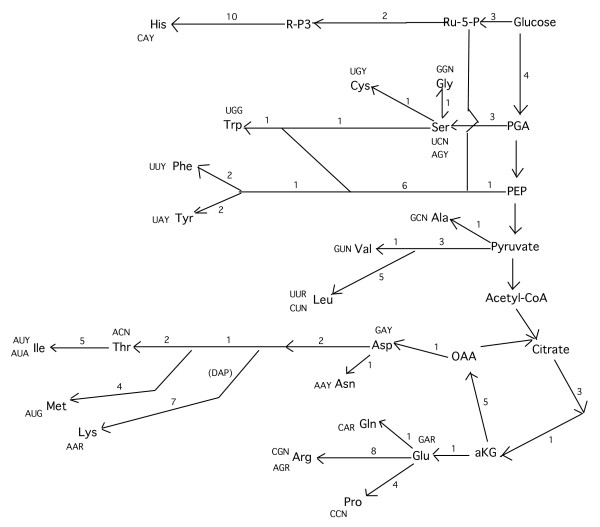
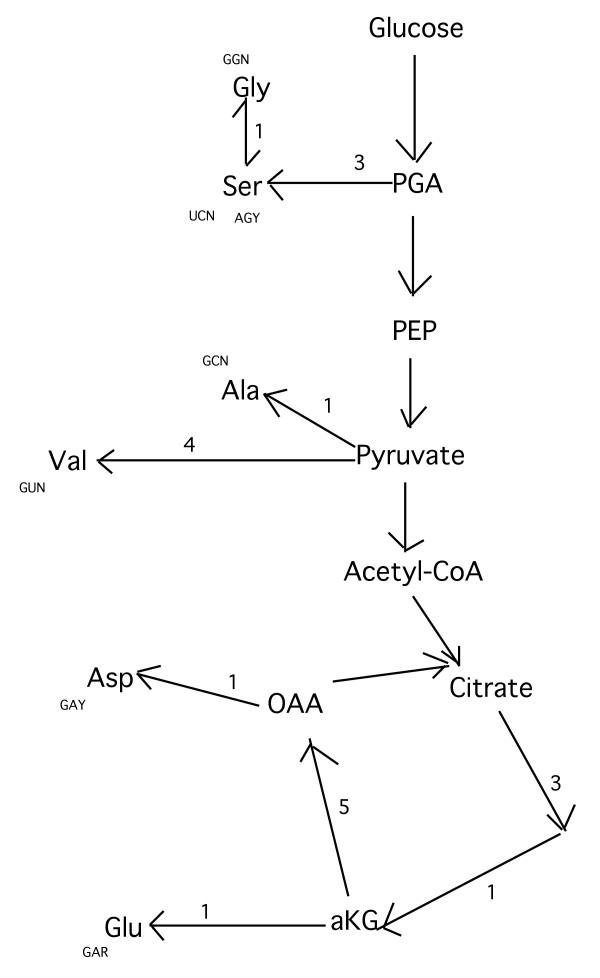
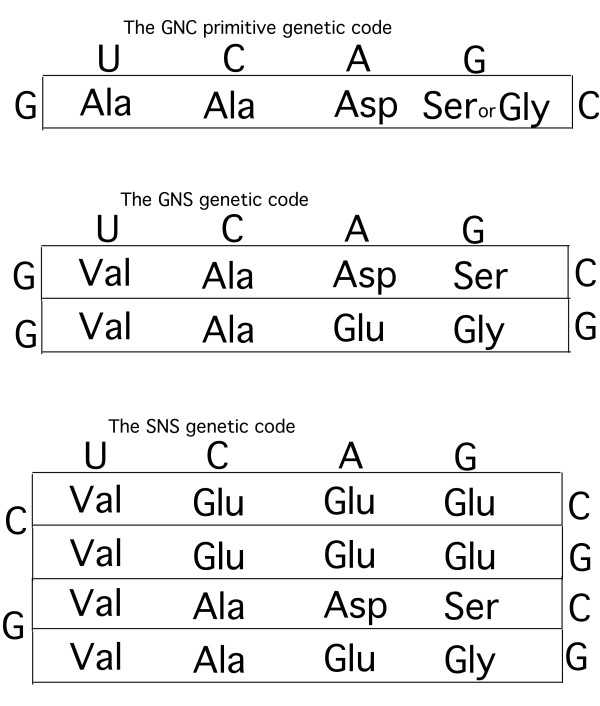
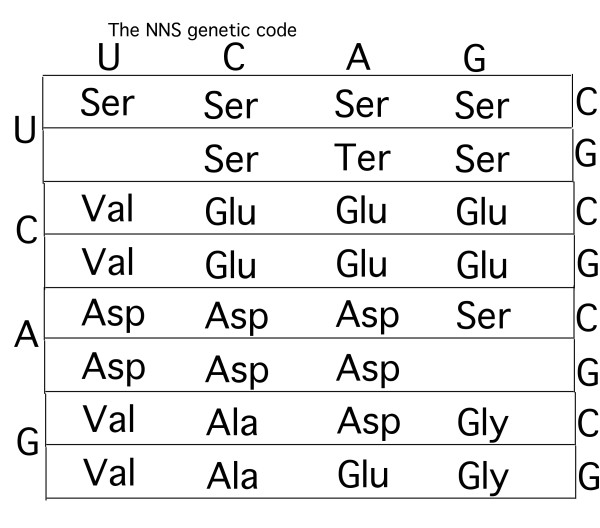
BACKGROUND: The coevolution theory of the origin of the genetic code suggests that the genetic code is an imprint of the biosynthetic relationships between amino acids. However, this theory does not seem to attribute a role to the biosynthetic relationships between the earliest amino acids that evolved along the pathways of energetic metabolism. As a result, the coevolution theory is unable to clearly define the very earliest phases of genetic code origin. In order to remove this difficulty, I here suggest an extension of the coevolution theory that attributes a crucial role to the first amino acids that evolved along these biosynthetic pathways and to their biosynthetic relationships, even when defined by the non-amino acid molecules that are their precursors. RESULTS: It is re-observed that the first amino acids to evolve along these biosynthetic pathways are predominantly those codified by codons of the type GNN, and this observation is found to be statistically significant. Furthermore, the close biosynthetic relationships between the sibling amino acids Ala-Ser, Ser-Gly, Asp-Glu, and Ala-Val are not random in the genetic code table and reinforce the hypothesis that the biosynthetic relationships between these six amino acids played a crucial role in defining the very earliest phases of genetic code origin. CONCLUSION: All this leads to the hypothesis that there existed a code, GNS, reflecting the biosynthetic relationships between these six amino acids which, as it defines the very earliest phases of genetic code origin, removes the main difficulty of the coevolution theory. Furthermore, it is here discussed how this code might have naturally led to the code codifying only for the domains of the codons of precursor amino acids, as predicted by the coevolution theory. Finally, the hypothesis here suggested also removes other problems of the coevolution theory, such as the existence for certain pairs of amino acids with an unclear biosynthetic relationship between the precursor and product amino acids and the collocation of Ala between the amino acids Val and Leu belonging to the pyruvate biosynthetic family, which the coevolution theory considered as belonging to different biosyntheses. REVIEWERS: This article was reviewed by Rob Knight, Paul Higgs (nominated by Laura Landweber), and Eugene Koonin.
Overview
The claims and statistics of this paper haven’t been checked yet.
Free: it reads the open-access text and checks the first 5 claims that cite a source we can check. Create a free account to check every claim.
Integrity signals
Registry
Cites
Statistics
Figures
Verification
Claims the paper makes
The claims and statistics of this paper haven’t been checked yet.
Free: it reads the open-access text and checks the first 5 claims that cite a source we can check. Create a free account to check every claim.
Claims other papers make about this one
Each is checked against this paper’s own text: does it say what the citing paper says it does?
The source backs part of the claim, not all of it — or backs it for a different population, condition or comparison.
In the citing paper
“Initially, four short oligonucleotides, each with a specific codon, were formed and joined in different combinations, specifying four amino acids, such as valine, alanine, aspartic acid, and glycine [88].”
From The Origin of Prebiotic Information System in the Peptide/RNA World: A Simulation Model of the Evolution of Translation and the Genetic Code (2019) · cites this paper as [88]
Experimental — accuracy not yet measuredThe source backs part of the claim, not all of it — or backs it for a different population, condition or comparison.
In the citing paper
“The GNC code defines the very earliest phases of the genetic code origin, reflecting the biosynthetic relationships between four amino acids and four codons (Table 1).”
From The Origin of Prebiotic Information System in the Peptide/RNA World: A Simulation Model of the Evolution of Translation and the Genetic Code (2019) · cites this paper as [88]
Experimental — accuracy not yet measuredThe source backs part of the claim, not all of it — or backs it for a different population, condition or comparison.
In the citing paper
“Here, we propose that the interaction between pre-tRNA and amino acids led to the development of the pre-mRNA strand and the primitive GNC genetic code [88,116].”
From The Origin of Prebiotic Information System in the Peptide/RNA World: A Simulation Model of the Evolution of Translation and the Genetic Code (2019) · cites this paper as [88]
Experimental — accuracy not yet measuredThe source backs part of the claim, not all of it — or backs it for a different population, condition or comparison.
In the citing paper
“The GNC hypothesis refers to the origin of genes. It suggests that the universal genetic code originated from a primitive four-amino acid system encoding primitive amino acids (glycine, alanine, valine, and aspartic acid) to create sequence-specific peptide chain [85,88].”
From The Origin of Prebiotic Information System in the Peptide/RNA World: A Simulation Model of the Evolution of Translation and the Genetic Code (2019) · cites this paper as [88]
Experimental — accuracy not yet measuredThe source backs part of the claim, not all of it — or backs it for a different population, condition or comparison.
In the citing paper
“The GNC codons include four codons (GGC, GCC, GAC, GUC), which code four primitive amino acids”
From The Origin of Prebiotic Information System in the Peptide/RNA World: A Simulation Model of the Evolution of Translation and the Genetic Code (2019) · cites this paper as [88]
Experimental — accuracy not yet measured
7 more claims about this paper
Create a free account to see every claim other papers make about this one.
Self-check
Percentages, sums and reported differences re-computed from the paper’s own numbers.
The self-check needs the paper’s full text.
Citations
Cites
The origin of the genetic code
Crick, F. H. C. (1968) · Journal of Molecular Biology · doi:10.1016/0022-2836(68)90392-6 · Cited by 2,320
Before enzymes and templates: theory of surface metabolism
Wächtershäuser, G. (1988) · Microbiological Reviews · doi:10.1128/mmbr.52.4.452-484.1988 · Cited by 1,242 · cited 6×
“Finally, if we consider that other works have been carried out on the importance of biosynthetic relationships between amino acids and the genetic code [18-39], we come to the conclusion that there can no longer be any doubts on the hypothesis that the origin of the organisation of the genetic code was affected by the…”
BackgroundInfluentialA co-evolution theory of the genetic code
Wong, J. T.-F. (1975) · Proceedings of the National Academy of Sciences · doi:10.1073/pnas.72.5.1909 · Cited by 649 · cited 15×
“Consequently the evolution of the genetic code could be clarified on the basis of the precursor-product relationships between amino acids in their biosyntheses [9].”
BackgroundInfluentialCoenzymes as fossils of an earlier metabolic state
White, H. B. (1976) · Journal of Molecular Evolution · doi:10.1007/bf01732468 · Cited by 493 · cited 1×
“the pathway to His starts with a reaction producing N'-5'-phosphoribosyl-ATP, which is held to be a fossil of RNA [43,70].”
BackgroundModern metabolism as a palimpsest of the RNA world
Benner, S. A., Ellington, A. D., & Tauer, A. (1989) · Proceedings of the National Academy of Sciences · doi:10.1073/pnas.86.18.7054 · Cited by 478 · cited 2×
“If logical-evolutionary analyses were conducted on these pathways and it was concluded that these were molecular fossils [33], it would not necessarily be true that the metabolic pathways of the RNA world are only speculations ([43,68]).”
BackgroundThe Origin of Genetic Information
Eigen, M., Gardiner, W., Schuster, P., & Winkler-Oswatitsch, R. (1981) · Scientific American · doi:10.1038/scientificamerican0481-88 · Cited by 353
Biosynthesis of Selenocysteine on Its tRNA in Eukaryotes
Xu, X.-M., Carlson, B. A., Mix, H., Zhang, Y., Saira, K., Glass, R. S., Berry, M. J., Gladyshev, V. N., & Hatfield, D. L. (2006) · PLoS Biology · doi:10.1371/journal.pbio.0050004 · Cited by 299 · cited 1×
“they share a common origin and so this pathways seems extremely ancient and is also very widespread, contrary to what the Reviewer says [66].”
ResultBlueprint for a cell - the nature and origin of life
(1991) · Choice Reviews Online · doi:10.5860/choice.28-5078 · Cited by 273 · cited 6×
“Finally, if we consider that other works have been carried out on the importance of biosynthetic relationships between amino acids and the genetic code [18-39], we come to the conclusion that there can no longer be any doubts on the hypothesis that the origin of the organisation of the genetic code was affected by the…”
BackgroundInfluentialThe Triplet Code From First Principles
Trifonov, E. N. (2004) · Journal of Biomolecular Structure and Dynamics · doi:10.1080/07391102.2004.10506975 · Cited by 246 · cited 4×
“I have introduced a reference for Trifonov's works [54].”
BackgroundMethodInfluentialEigen, M., & Winkler-Oswatitsch, R. (1981) · Naturwissenschaften · doi:10.1007/bf01047470 · Cited by 242
Research works printed but not linked: 3
- [2]Wong JT Xue H Self-perfecting evolution of heteropolymer building blocks and sequences as the basis of life Fundamentals of Life 2002 Editions scientifiques et medicales Elsevier SAS, Paris 55 64
- [44]Greenberg DM Metabolici Pathways 1969 III Academic Press, New York 247
- [45]Greenberg DM Metabolici Pathways 1961 II Academic Press, New York 177 181
Cited by
Items 101–159 of 159
Radványi, Á., & Kun, Á. (2021) · Life · doi:10.3390/life11080773 · Cited by 6
Palacios-Pérez, M., Andrade-Díaz, F., & José, M. V. (2017) · Origins of Life and Evolution of Biospheres · doi:10.1007/s11084-017-9553-2 · Cited by 5
Universal paralogs provide a window into evolution before the last universal common ancestor
Goldman, A. D., Fournier, G. P., & Kaçar, B. (2026) · Cell Genomics · doi:10.1016/j.xgen.2026.101140 · Cited by 5
Domains of life identified through genetic codes
Giulio, M. D. (2026) · Biosystems · doi:10.1016/j.biosystems.2026.105848 · Cited by 4
Ordering events in a developing genetic code
Yarus, M. (2024) · RNA Biology · doi:10.1080/15476286.2023.2299615 · Cited by 7
“However, this should not be read as an argument against selection against errors [25,26] or against a code co-evolving with amino acid synthesis pathways [27–30].”
The time of appearance of the genetic code
Giulio, M. D. (2024) · Biosystems · doi:10.1016/j.biosystems.2024.105159 · Cited by 7
Codon information value and codon transition-probability distributions in short-term evolution
Jiménez-Montaño, M. A., Coronel-Brizio, H. F., Hernández-Montoya, R., & Ramos, A. (2016) · Physica A Statistical Mechanics and its Applications · doi:10.1016/j.physa.2016.02.043 · Cited by 4
Models of genetic code structure evolution with variable number of coded labels
Pawlak, K., Wnętrzak, M., Mackiewicz, D., Mackiewicz, P., & Błażej, P. (2021) · Biosystems · doi:10.1016/j.biosystems.2021.104528 · Cited by 4
How ambiguity codes specify molecular descriptors and information flow in Code Biology
Štambuk, N., Konjevoda, P., & Štambuk, A. (2023) · Biosystems · doi:10.1016/j.biosystems.2023.105034 · Cited by 4
Lopez, A., Vauchez, A., Ajram, G., Shvetsova, A., Leveau, G., Fiore, M., & Strazewski, P. (2024) · Life · doi:10.3390/life14010108 · Cited by 5
“The key for evolving a chemical system to a biological system is and always was the emergence of an operational genetic code [65–67].”
BackgroundŠtambuk, N., Konjevoda, P., Brčić-Kostić, K., Baković, J., & Štambuk, A. (2023) · Biosystems · doi:10.1016/j.biosystems.2023.105030 · Cited by 4
Protein–RNA and protein–glycan recognitions in light of amino acid codes
Nahálka, J., Hrabárová, E., & Talafová, K. (2015) · Biochimica et Biophysica Acta (BBA) - General Subjects · doi:10.1016/j.bbagen.2015.06.013 · Cited by 5
The origin of the genetic code and origin of ideas
Giulio, M. D. (2021) · Journal of Theoretical Biology · doi:10.1016/j.jtbi.2021.110615 · Cited by 4
Probable relationship between partitions of the set of codons and the origin of the genetic code
Salinas, D. G., Gallardo, M. O., & Osorio, M. I. (2014) · Biosystems · doi:10.1016/j.biosystems.2014.01.007 · Cited by 3
Factors in Protobiomonomer Selection for the Origin of the Standard Genetic Code
Saralov, A. I. (2021) · Acta Biotheoretica · doi:10.1007/s10441-021-09420-4 · Cited by 3
“The synthesis of the five most ancient C2–C5 amino acids (# 1–5 Gly, Ala, Asp, Val, and Glu) is directly associated with metabolic transformation of simple nutrient compounds in five 752 A. I. Saralov 1 3 different branches with GI codons (Taylor and Coates 1989; Di Giulio 2008, 2017).”
BackgroundTrinity of G-tetrads and origin of translation
Kankia, B. I. (2022) · Biology Direct · doi:10.1186/s13062-022-00327-9 · Cited by 3
Alphabet cardinality and adaptive evolution
Srivastava, M., Rozhoňová, H., & Payne, J. L. (2023) · Journal of Physics A Mathematical and Theoretical · doi:10.1088/1751-8121/ad0200 · Cited by 7
The polyphyletic origins of glycyl-tRNA synthetase and lysyl-tRNA synthetase and their implications
Giulio, M. D. (2024) · Biosystems · doi:10.1016/j.biosystems.2024.105287 · Cited by 3
Novel amino acid distance matrices based on conductance measure
Štambuk, N., Fimmel, E., Konjevoda, P., Brčić-Kostić, K., Gračanin, A., & Saleh, H. (2024) · Biosystems · doi:10.1016/j.biosystems.2024.105355 · Cited by 3
Mutuality in Discrete and Compositional Information: Perspectives for Synthetic Genetic Codes
Guimarães, R. C. (2011) · Cognitive Computation · doi:10.1007/s12559-011-9116-1 · Cited by 3
Giulio, M. D. (2014) · Journal of Theoretical Biology · doi:10.1016/j.jtbi.2014.09.006 · Cited by 3
The proteomic origin of the genetic code
Caetano‐Anollés, G. (2026) · Expert Review of Proteomics · doi:10.1080/14789450.2026.2646677 · Cited by 2
“Wong’s coevolution theory linked codon assignments to the progressive emergence of amino acid biosynthetic pathways [41], and subsequent syntheses emphasized the code as an emergent property of early biological organization rather than a static mapping [42–44].”
On an RNA-Membrane Protogenome
Yarus, M. (2025) · Life · doi:10.3390/life15050692 · Cited by 2
The origins of ATP synthases, the identity of LUCA, and the progenote
Giulio, M. D. (2025) · Biosystems · doi:10.1016/j.biosystems.2025.105528 · Cited by 2
Giulio, M. D. (2023) · Biosystems · doi:10.1016/j.biosystems.2023.104838 · Cited by 2
The Origin and Early Evolution of Life: Prebiotic Chemistry of Biomolecules
Fiore, M. (2019) · MDPI eBooks · doi:10.3390/books978-3-03921-607-9 · Cited by 2
Aloqalaa, D. A., Kowalski, D. R., Błażej, P., Wnętrzak, M., Mackiewicz, D., & Mackiewicz, P. (2020) · Communications in computer and information science · doi:10.1007/978-3-030-46970-2_9 · Cited by 2
Dujon, B. (2021) · Comptes Rendus Biologies · doi:10.5802/crbiol.47 · Cited by 2
Giménez, J. A. M., & Tabarés‐Seisdedos, R. (2021) · Origins of Life and Evolution of Biospheres · doi:10.1007/s11084-021-09610-7 · Cited by 2
“1981; Hartman 1995; Brooks and Fresco 2003; Di Giulio 2008); that is, the primordial code used only these GNN codons.”
BackgroundA Fundamentally New Perspective on the Origin and Evolution of LifePreprint
Liu, S. V. (2008) · arXiv (Cornell University) · doi:10.48550/arxiv.0811.3653 · Cited by 2
“Coevolution/co-evolution (76-79) or “collective evolution” (80) has become a prominent theme in evolutionary studies (73, 81-93).”
BackgroundA formal model of molecular codes with respect to chemical reaction networks
Görlich, D. (2013) · Common Library Network (Der Gemeinsame Bibliotheksverbund) · Cited by 2
Mackiewicz, P. (2020) · BioEssays · doi:10.1002/bies.202000061 · Cited by 2
From initial RNA encoding to the Standard Genetic CodePreprint
Yarus, M. (2023) · bioRxiv (Cold Spring Harbor Laboratory) · doi:10.1101/2023.11.07.566042 · Cited by 2
“An RNA binding site selected for phenylalanine can either accept other planar aromatics, or reject tyrosine and tryptophan (Illangasekare and Yarus 2002).”
BackgroundInfluentialOrder of events in a developing genetic codePreprint
Yarus, M. (2023) · bioRxiv (Cold Spring Harbor Laboratory) · doi:10.1101/2022.12.31.522385 · Cited by 2
Molecular Complexity Constrained Early Amino Acid Recruitment into the Genetic Code
Hashmi, S. A., Chok, H., Cabrera, R., & Blanco, C. (2026) · Genome Biology and Evolution · doi:10.1093/gbe/evag012 · Cited by 1
Giulio, M. D. (2026) · Biosystems · doi:10.1016/j.biosystems.2026.105956 · Cited by 1
Genetic code noise immunity features: Degeneracy and frameshift correction
Borah, C., & Ali, T. (2022) · Gene Reports · doi:10.1016/j.genrep.2022.101707 · Cited by 1
Relational model of all genetic codes
Štambuk, N., Konjevoda, P., & Štambuk, A. (2025) · Biosystems · doi:10.1016/j.biosystems.2025.105600 · Cited by 1
Chatterjee, S., & Yadav, S. B. (2018) · Preprints.org · doi:10.20944/preprints201810.0127.v1
“We concur with previous researchers that multi-generations of amino acids were produced sequentially [69, 93, 95] as the code expanded, along with the pathways of amino acid biosynthesis.”
BackgroundMethodResultInfluentialA Computational Analysis of the Structure of the Genetic Code
Degagne, C. (2015) · MacSphere (McMaster University) · doi:10.71548/19593
Origins of life before the cell: echos from the past with broad implications in our future
Hernández, J., Osório, J. H., & Pérez, J. (2015) · Brazilian Journal of Biological Sciences
Barbieri, M. (2014) · Springer eBooks · doi:10.1007/978-3-319-14535-8_4
DNA Structure and Clifford Algebra
Stcherbic, V. V., & Buchatsky, L. P. (2015) · CRC Press eBooks · doi:10.1201/b19879-3
The Origin of the Genetic Code
Ikehara, K. (2021) · Springer eBooks · doi:10.1007/978-3-030-71087-3_7
Ikehara, K. (2021) · Springer eBooks · doi:10.1007/978-3-030-71087-3_5
Ikehara, K. (2021) · Springer eBooks · doi:10.1007/978-3-030-71087-3_4 · Cited by 1
Происхождение генетического кода и трансляции в рамках современных концепций происхождения жизни
Кондратьева, Л. Г., Дьячкова, М. С., & Galchenko, A. V. (2022) · Biochemistry (Moscow) · doi:10.31857/s0320972522010043
The Origin of Metabolism and GADV Hypothesis on the Origin of Life
Ikehara, K. (2023) · Wiley eBooks · doi:10.1002/9781119555568.ch4
Chatterjee, S. (2023) · Springer eBooks · doi:10.1007/978-3-031-23397-5_13
The First Gene Before DNA: The Digital Revolution
Chatterjee, S. (2023) · Springer eBooks · doi:10.1007/978-3-031-23397-5_12
Barbieri, M. (2024) · Biosemiotics/Biosemiotics. Bookseries · doi:10.1007/978-3-031-58484-8_7 · Cited by 1
Where Can We Find Approaches to Understanding Evolutionary Processes?
Knoflacher, M. (2024) · Springer eBooks · doi:10.1007/978-3-662-69423-7_3
The Cell as a Complex System and the S-Space Axiomatic Wave Model Adequacy Checking
(2024) · Advances in religious and cultural studies (ARCS) book series · doi:10.4018/978-1-6684-8509-5.ch002
The Informational Analogy and the Rna WorldPreprint
Herrerías, C. G. (2025) · SSRN Electronic Journal · doi:10.2139/ssrn.5277531
As many domains of life as there are genetic codesPreprint
Giulio, M. D. (2026) · SSRN Electronic Journal · doi:10.2139/ssrn.6439500
Protocode mats and living membranes: A new hypothesis for the origin of the standard genetic code
Nesterov‐Mueller, A., & Schmidt, D. (2026) · Biosystems · doi:10.1016/j.biosystems.2026.105849 · Cited by 1
“A controversial issue remains the principle of codon transfer from precursors to products (Di Giulio, 2008).”
In defense of the theory, as many domains of life as genetic codesPreprint
Giulio, M. D. (2026) · SSRN Electronic Journal · doi:10.2139/ssrn.7445928
How Strong Is the Case for the RNA World?
Higgs, P. G. (2026) · Life · doi:10.3390/life16101633
In defense of the theory, as many domains of life as genetic codes
Giulio, M. D. (2026) · Biosystems · doi:10.1016/j.biosystems.2026.105993
Metadata
- Authors
- Di Giulio, M.
- Venue
- Biology Direct
- Published
- 2008
- Volume
- 3
- Issue
- 1
- Pages
- 37
- ISSN
- 1745-6150 (ISSN-L)
- PMC
- PMC2538516
- OpenAlex
- W2138220095
- Cited by
- 158
- References
- 71
- Citations by year
- 2026: 11 · 2025: 5 · 2024: 10 · 2023: 14 · 2022: 12 · 2021: 16 · 2020: 4 · 2019: 7 · 2018: 12 · 2017: 7 · 2016: 11 · 2015: 10 · 2014: 12 · 2013: 9 · 2012: 2
- FWCI
- 3.11
- Type
- journal article
- Language
- en
- Open access
- gold
- doi.org
- Licence
- cc-by
- Locations
- Biology Direct (publishedVersion, cc-by)
- Europe PMC (PubMed Central) (publishedVersion, cc-by)
- PubMed Central (publishedVersion, cc-by)
- PubMed (publishedVersion)
- DOAJ (DOAJ: Directory of Open Access Journals) (submittedVersion)
- Topics
- Physical Sciences › Physics and Astronomy › Astronomy and Astrophysics › Origins and Evolution of Life
- Life Sciences › Biochemistry, Genetics and Molecular Biology › Molecular Biology › RNA and protein synthesis mechanisms
- Life Sciences › Biochemistry, Genetics and Molecular Biology › Genetics › Evolution and Genetic Dynamics
- Keywords
- origin of the genetic code, coevolution theory, amino acid biosynthesis, alanine, serine, glycine, aspartic acid, glutamate, valine
- MeSH terms
- Amino Acids, Codon, Genetic Code, Models, Genetic, Evolution, Molecular
About these checks
Registry, retraction, Cites and statistics results are computed, not judged, with one exception: a printed reference that no index lists is read once by a model before it counts as a citation error. Claims are extracted by a model and kept only when their quote appears verbatim in the text; each cited source is then checked, with a model’s help, for whether it says what the claim relies on. Those verdicts can be wrong — read the claim’s quote and the cited source before relying on one.
Statistics and arithmetic are recomputed, not judged.
Confidence bands are shown only for fields calibrated on our annotated test set. None is calibrated yet, so no band is shown.
What counts as a claim ›How we measure confidence ›How we check this ›
Are you an author, or do you see a problem with this page? Request a review
Data sources
Bibliographic data: Semantic Scholar, OpenAlex, Crossref.
Contains information from the Semantic Scholar Academic Graph Datasets, made available under the ODC Attribution License (ODC-BY 1.0).
Semantic Scholar’s data is described in: Kinney, R., et al. (2023). The Semantic Scholar Open Data Platform. arXiv:2301.10140.
