

An extension of the coevolution theory of the origin of the genetic code
Open accessThe DOI matches its Crossref record; 71 of the 71 references it cites were found in a registry or an index.
Abstract
BACKGROUND: The coevolution theory of the origin of the genetic code suggests that the genetic code is an imprint of the biosynthetic relationships between amino acids. However, this theory does not seem to attribute a role to the biosynthetic relationships between the earliest amino acids that evolved along the pathways of energetic metabolism. As a result, the coevolution theory is unable to clearly define the very earliest phases of genetic code origin. In order to remove this difficulty, I here suggest an extension of the coevolution theory that attributes a crucial role to the first amino acids that evolved along these biosynthetic pathways and to their biosynthetic relationships, even when defined by the non-amino acid molecules that are their precursors. RESULTS: It is re-observed that the first amino acids to evolve along these biosynthetic pathways are predominantly those codified by codons of the type GNN, and this observation is found to be statistically significant. Furthermore, the close biosynthetic relationships between the sibling amino acids Ala-Ser, Ser-Gly, Asp-Glu, and Ala-Val are not random in the genetic code table and reinforce the hypothesis that the biosynthetic relationships between these six amino acids played a crucial role in defining the very earliest phases of genetic code origin. CONCLUSION: All this leads to the hypothesis that there existed a code, GNS, reflecting the biosynthetic relationships between these six amino acids which, as it defines the very earliest phases of genetic code origin, removes the main difficulty of the coevolution theory. Furthermore, it is here discussed how this code might have naturally led to the code codifying only for the domains of the codons of precursor amino acids, as predicted by the coevolution theory. Finally, the hypothesis here suggested also removes other problems of the coevolution theory, such as the existence for certain pairs of amino acids with an unclear biosynthetic relationship between the precursor and product amino acids and the collocation of Ala between the amino acids Val and Leu belonging to the pyruvate biosynthetic family, which the coevolution theory considered as belonging to different biosyntheses. REVIEWERS: This article was reviewed by Rob Knight, Paul Higgs (nominated by Laura Landweber), and Eugene Koonin.
Overview
The claims and statistics of this paper haven’t been checked yet.
Free: it reads the open-access text and checks the first 5 claims that cite a source we can check. Create a free account to check every claim.
Integrity signals
Registry
Cites
Statistics
Figures
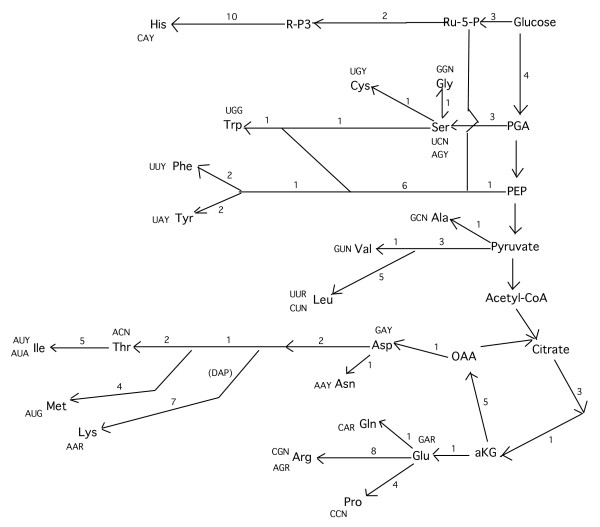
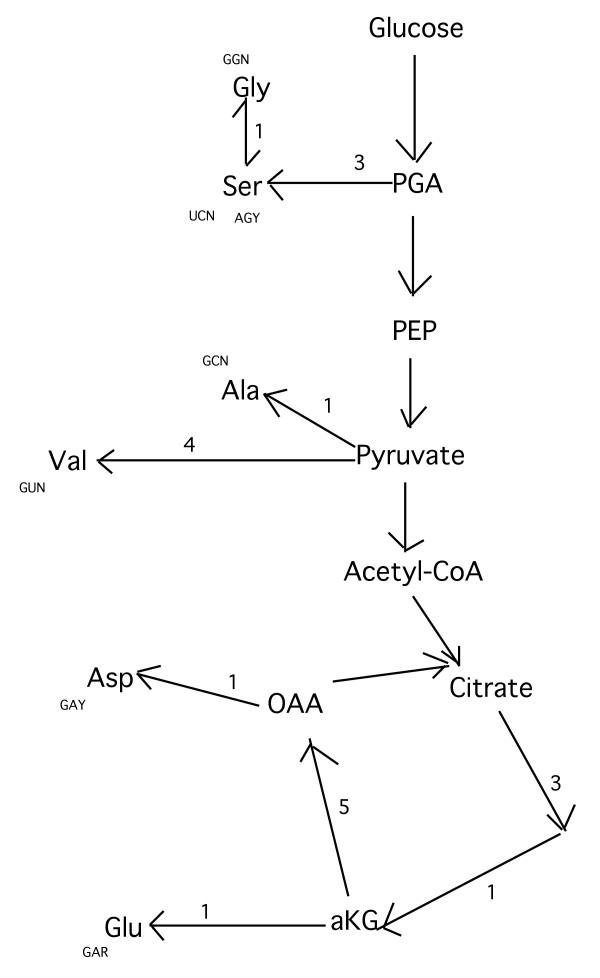
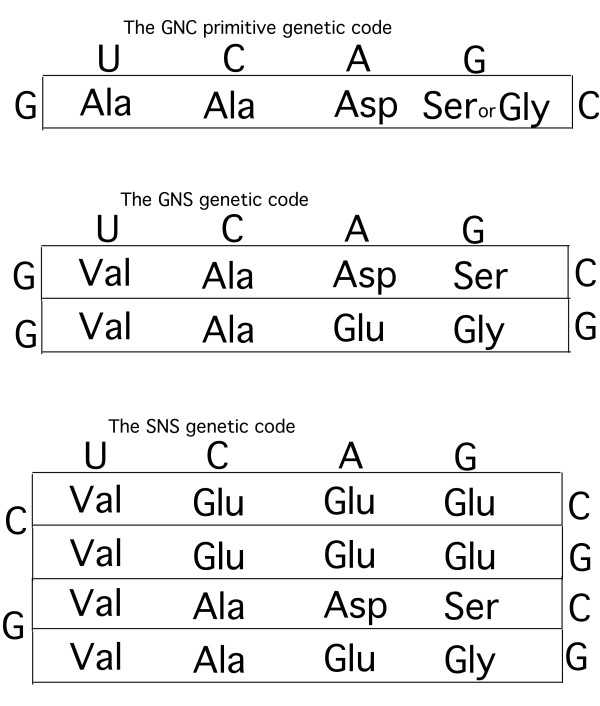
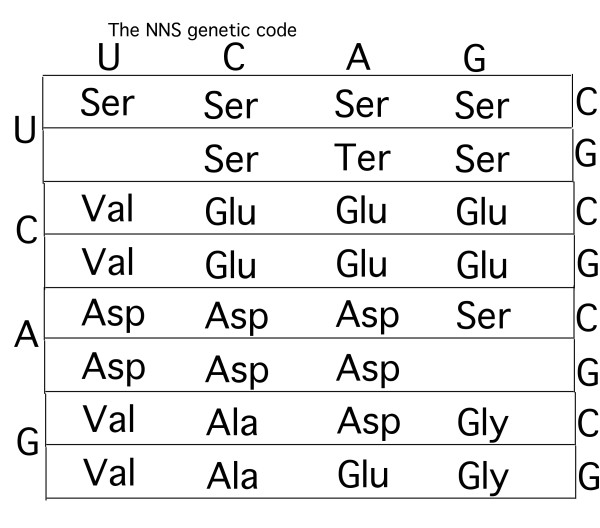
Verification
Claims the paper makes
The claims and statistics of this paper haven’t been checked yet.
Free: it reads the open-access text and checks the first 5 claims that cite a source we can check. Create a free account to check every claim.
Claims other papers make about this one
Each is checked against this paper’s own text: does it say what the citing paper says it does?
The source backs part of the claim, not all of it — or backs it for a different population, condition or comparison.
In the citing paper
“Initially, four short oligonucleotides, each with a specific codon, were formed and joined in different combinations, specifying four amino acids, such as valine, alanine, aspartic acid, and glycine [88].”
From The Origin of Prebiotic Information System in the Peptide/RNA World: A Simulation Model of the Evolution of Translation and the Genetic Code (2019) · cites this paper as [88]
Experimental — accuracy not yet measuredThe source backs part of the claim, not all of it — or backs it for a different population, condition or comparison.
In the citing paper
“The GNC code defines the very earliest phases of the genetic code origin, reflecting the biosynthetic relationships between four amino acids and four codons (Table 1).”
From The Origin of Prebiotic Information System in the Peptide/RNA World: A Simulation Model of the Evolution of Translation and the Genetic Code (2019) · cites this paper as [88]
Experimental — accuracy not yet measuredThe source backs part of the claim, not all of it — or backs it for a different population, condition or comparison.
In the citing paper
“Here, we propose that the interaction between pre-tRNA and amino acids led to the development of the pre-mRNA strand and the primitive GNC genetic code [88,116].”
From The Origin of Prebiotic Information System in the Peptide/RNA World: A Simulation Model of the Evolution of Translation and the Genetic Code (2019) · cites this paper as [88]
Experimental — accuracy not yet measuredThe source backs part of the claim, not all of it — or backs it for a different population, condition or comparison.
In the citing paper
“The GNC hypothesis refers to the origin of genes. It suggests that the universal genetic code originated from a primitive four-amino acid system encoding primitive amino acids (glycine, alanine, valine, and aspartic acid) to create sequence-specific peptide chain [85,88].”
From The Origin of Prebiotic Information System in the Peptide/RNA World: A Simulation Model of the Evolution of Translation and the Genetic Code (2019) · cites this paper as [88]
Experimental — accuracy not yet measuredThe source backs part of the claim, not all of it — or backs it for a different population, condition or comparison.
In the citing paper
“The GNC codons include four codons (GGC, GCC, GAC, GUC), which code four primitive amino acids”
From The Origin of Prebiotic Information System in the Peptide/RNA World: A Simulation Model of the Evolution of Translation and the Genetic Code (2019) · cites this paper as [88]
Experimental — accuracy not yet measured
7 more claims about this paper
Create a free account to see every claim other papers make about this one.
Self-check
Percentages, sums and reported differences re-computed from the paper’s own numbers.
The self-check needs the paper’s full text.
Citations
Cites
The origin of the genetic code
Crick, F. H. C. (1968) · Journal of Molecular Biology · doi:10.1016/0022-2836(68)90392-6 · Cited by 2,320
Before enzymes and templates: theory of surface metabolism
Wächtershäuser, G. (1988) · Microbiological Reviews · doi:10.1128/mmbr.52.4.452-484.1988 · Cited by 1,242 · cited 6×
“Finally, if we consider that other works have been carried out on the importance of biosynthetic relationships between amino acids and the genetic code [18-39], we come to the conclusion that there can no longer be any doubts on the hypothesis that the origin of the organisation of the genetic code was affected by the…”
BackgroundInfluentialA co-evolution theory of the genetic code
Wong, J. T.-F. (1975) · Proceedings of the National Academy of Sciences · doi:10.1073/pnas.72.5.1909 · Cited by 649 · cited 15×
“Consequently the evolution of the genetic code could be clarified on the basis of the precursor-product relationships between amino acids in their biosyntheses [9].”
BackgroundInfluentialCoenzymes as fossils of an earlier metabolic state
White, H. B. (1976) · Journal of Molecular Evolution · doi:10.1007/bf01732468 · Cited by 493 · cited 1×
“the pathway to His starts with a reaction producing N'-5'-phosphoribosyl-ATP, which is held to be a fossil of RNA [43,70].”
BackgroundModern metabolism as a palimpsest of the RNA world
Benner, S. A., Ellington, A. D., & Tauer, A. (1989) · Proceedings of the National Academy of Sciences · doi:10.1073/pnas.86.18.7054 · Cited by 478 · cited 2×
“If logical-evolutionary analyses were conducted on these pathways and it was concluded that these were molecular fossils [33], it would not necessarily be true that the metabolic pathways of the RNA world are only speculations ([43,68]).”
BackgroundThe Origin of Genetic Information
Eigen, M., Gardiner, W., Schuster, P., & Winkler-Oswatitsch, R. (1981) · Scientific American · doi:10.1038/scientificamerican0481-88 · Cited by 353
Biosynthesis of Selenocysteine on Its tRNA in Eukaryotes
Xu, X.-M., Carlson, B. A., Mix, H., Zhang, Y., Saira, K., Glass, R. S., Berry, M. J., Gladyshev, V. N., & Hatfield, D. L. (2006) · PLoS Biology · doi:10.1371/journal.pbio.0050004 · Cited by 299 · cited 1×
“they share a common origin and so this pathways seems extremely ancient and is also very widespread, contrary to what the Reviewer says [66].”
ResultBlueprint for a cell - the nature and origin of life
(1991) · Choice Reviews Online · doi:10.5860/choice.28-5078 · Cited by 273 · cited 6×
“Finally, if we consider that other works have been carried out on the importance of biosynthetic relationships between amino acids and the genetic code [18-39], we come to the conclusion that there can no longer be any doubts on the hypothesis that the origin of the organisation of the genetic code was affected by the…”
BackgroundInfluentialThe Triplet Code From First Principles
Trifonov, E. N. (2004) · Journal of Biomolecular Structure and Dynamics · doi:10.1080/07391102.2004.10506975 · Cited by 246 · cited 4×
“I have introduced a reference for Trifonov's works [54].”
BackgroundMethodInfluentialEigen, M., & Winkler-Oswatitsch, R. (1981) · Naturwissenschaften · doi:10.1007/bf01047470 · Cited by 242
Research works printed but not linked: 3
- [2]Wong JT Xue H Self-perfecting evolution of heteropolymer building blocks and sequences as the basis of life Fundamentals of Life 2002 Editions scientifiques et medicales Elsevier SAS, Paris 55 64
- [44]Greenberg DM Metabolici Pathways 1969 III Academic Press, New York 247
- [45]Greenberg DM Metabolici Pathways 1961 II Academic Press, New York 177 181
Cited by
Grosjean, H., de Crécy-Lagard, V., & Marck, C. (2010) · FEBS Letters · doi:10.1016/j.febslet.2009.11.052 · Cited by 298
An integrated, structure- and energy-based view of the genetic code
Grosjean, H., & Westhof, E. (2016) · Nucleic Acids Research · doi:10.1093/nar/gkw608 · Cited by 278
Origin and Evolution of the Universal Genetic Code
Koonin, E. V., & Novozhilov, A. S. (2017) · Annual Review of Genetics · doi:10.1146/annurev-genet-120116-024713 · Cited by 200
Higgs, P. G. (2009) · Biology Direct · doi:10.1186/1745-6150-4-16 · Cited by 137
“The recent extension of the coevolution theory [22] also proposes that the earliest amino acids were synthesized on tRNAs and that these were derived from the central metabolic pathways of glycolysis and the citric acid cycle.”
BackgroundInfluentialNitschke, W., & Russell, M. J. (2009) · Journal of Molecular Evolution · doi:10.1007/s00239-009-9289-3 · Cited by 132
“Several strongly different scenarios have been put forward describing this gene pooled community of cells and its influence on, and interaction with, the amino acid pool (Forterre 2002; Di Giulio 2003, 2008).”
BackgroundOn origin of genetic code and tRNA before translation
Rodin, A. S., Szathmáry, E., & Rodin, S. N. (2011) · Biology Direct · doi:10.1186/1745-6150-6-14 · Cited by 98
Coevolution Theory of the Genetic Code at Age Forty: Pathway to Translation and Synthetic Life
Wong, J., Ng, S.-K., Mat, W.-K., Hu, T., & Xue, H. (2016) · Life · doi:10.3390/life6010012 · Cited by 93
Koonin, E. (2017) · Life · doi:10.3390/life7020022 · Cited by 85
“The second theory, known as coevolution, holds that the genetic code is shaped by the precursor-product relationships between amino acids [57-60].”
BackgroundChatterjee, S., & Yadav, S. (2019) · Life · doi:10.3390/life9010025 · Cited by 80
“Here, we propose that the interaction between pre-tRNA and amino acids led to the development of the pre-mRNA strand and the primitive GNC genetic code [88,116].”
BackgroundResultInfluentialPathways of Genetic Code Evolution in Ancient and Modern Organisms
Sengupta, S., & Higgs, P. G. (2015) · Journal of Molecular Evolution · doi:10.1007/s00239-015-9686-8 · Cited by 68
“Biosynthetic pathways for amino acid synthesis are a key aspect of the coevolution theory of the genetic code (Wong 1975, 2005; Di Giulio 2008).”
BackgroundThe Last Universal Common Ancestor (LUCA) and the Ancestors of Archaea and Bacteria were Progenotes
Giulio, M. D. (2010) · Journal of Molecular Evolution · doi:10.1007/s00239-010-9407-2 · Cited by 66
“These half genes are interrupted in the same position where the intron of tRNA genes is present (Randau et al., 2005) and, therefore, also because of other peculiarities, they seem to be the very minigenes envisaged by this model (Di Giulio 1992, 1995, 1999a, 2004, 2006a, 2008a).”
BackgroundResultInfluentialHow Amino Acids and Peptides Shaped the RNA World
Van der Gulik, P., & Speijer, D. (2015) · Life · doi:10.3390/life5010230 · Cited by 55
“Nowadays the aspect of biosynthesis on the tRNA [7–9] is seen as the much more salient aspect of the theory.”
BackgroundCodon Size Reduction as the Origin of the Triplet Genetic Code
Baranov, P. V., Venin, M., & Provan, G. M. (2009) · PLoS ONE · doi:10.1371/journal.pone.0005708 · Cited by 58
The evolution of the genetic code: Impasses and challenges
Kun, Á., & Radványi, Á. (2017) · Biosystems · doi:10.1016/j.biosystems.2017.10.006 · Cited by 59
“The formation of amino acids by biosynthetic pathways guided the development of the genetic code (Di Giulio, 2008; Wong, 2007; Wong, 2005; Wong, 1975).”
BackgroundEvolution of the genetic code: The ambiguity-reduction theory
Barbieri, M. (2019) · Biosystems · doi:10.1016/j.biosystems.2019.104024 · Cited by 56
[GADV]-Protein World Hypothesis on the Origin of Life
Ikehara, K. (2014) · Origins of Life and Evolution of Biospheres · doi:10.1007/s11084-014-9383-4 · Cited by 47
Błażej, P., Wnętrzak, M., Mackiewicz, D., & Mackiewicz, P. (2018) · PLoS ONE · doi:10.1371/journal.pone.0201715 · Cited by 64
On Primordial Sense–Antisense Coding
Rodin, A. S., Rodin, S. N., & Carter, C. W. (2009) · Journal of Molecular Evolution · doi:10.1007/s00239-009-9288-4 · Cited by 45
“It should be noted here that the scenario of the code genesis starting from the complementarily encoded amino acids (such as Gly, Ala, Asp and Val) is consistent with the extended co-evolution scenario (Di Giulio, 2008).”
ResultThe optimality of the standard genetic code assessed by an eight-objective evolutionary algorithm
Wnętrzak, M., Błażej, P., Mackiewicz, D., & Mackiewicz, P. (2018) · BMC Evolutionary Biology · doi:10.1186/s12862-018-1304-0 · Cited by 52
Seligmann, H., & Warthi, G. (2017) · Computational and Structural Biotechnology Journal · doi:10.1016/j.csbj.2017.08.001 · Cited by 40
Exceptional error minimization in putative primordial genetic codes
Novozhilov, A. S., & Koonin, E. V. (2009) · Biology Direct · doi:10.1186/1745-6150-4-44 · Cited by 37
“The early ones are taken to be the 10 that are found in Miller and Urey experiments, which have previously been assumed by authors such as Wong [10] and Di Giulio [59].”
InfluentialDi Giulio, M. (2016) · Journal of Theoretical Biology · doi:10.1016/j.jtbi.2016.04.005 · Cited by 34
Bernhardt, H. S., & Patrick, W. M. (2014) · Journal of Molecular Evolution · doi:10.1007/s00239-014-9627-y · Cited by 33
“The co-evolutionary hypothesis (Wong 1975, 2005; Di Giulio 2008) and the anticodon-flipping model of Crick et al. (1976) both proposed a similar order of early amino acid incorporation to our model.”
MethodIkehara, K. (2016) · Life · doi:10.3390/life6010006 · Cited by 32
A Model for the Origin of the First mRNAs
Giulio, M. D. (2015) · Journal of Molecular Evolution · doi:10.1007/s00239-015-9691-y · Cited by 31
Biological evidence against the panspermia theory
Giulio, M. D. (2010) · Journal of Theoretical Biology · doi:10.1016/j.jtbi.2010.07.017 · Cited by 35
Wnętrzak, M., Błażej, P., & Mackiewicz, P. (2019) · Biosystems · doi:10.1016/j.biosystems.2019.04.012 · Cited by 35
Giulio, M. D. (2016) · Journal of Theoretical Biology · doi:10.1016/j.jtbi.2016.11.014 · Cited by 31
Self-Referential Encoding on Modules of Anticodon Pairs—Roots of the Biological Flow System
Guimarães, R. C. (2017) · Life · doi:10.3390/life7020016 · Cited by 29
The generation of meaningful information in molecular systems
Wills, P. R. (2016) · Philosophical Transactions of the Royal Society A Mathematical Physical and Engineering Sciences · doi:10.1098/rsta.2015.0066 · Cited by 28
Evolution of the Genetic Code: The Ribosome-Oriented Model
Barbieri, M. (2015) · Biological Theory · doi:10.1007/s13752-015-0225-z · Cited by 29
Origins of tmRNA: the missing link in the birth of protein synthesis?
Macé, K., & Gillet, R. (2016) · Nucleic Acids Research · doi:10.1093/nar/gkw693 · Cited by 26
Błażej, P., Wnętrzak, M., Mackiewicz, D., Gagat, P., & Mackiewicz, P. (2018) · Journal of Theoretical Biology · doi:10.1016/j.jtbi.2018.12.030 · Cited by 31
Giulio, M. D. (2014) · Journal of Molecular Evolution · doi:10.1007/s00239-014-9626-z · Cited by 23
“…is very ancient because it is related to the basic mechanism that structured the genetic code, that is to say, the one predicted by the coevolution theory (Wong 1975, 1976, 1988; Wachtershauser 1988; Danchin 1989; de Duve 1991; Di Giulio 1994, 1999, 1997, 2002, 2003, 2004, 2008a; Edwards 1996).”
BackgroundInfluentialChatterjee, S., & Yadav, S. B. (2022) · Life · doi:10.3390/life12060834 · Cited by 29
Giulio, M. D. (2018) · Journal of Theoretical Biology · doi:10.1016/j.jtbi.2018.01.025 · Cited by 21
van der Gulik, P. T. S., & Hoff, W. D. (2011) · Journal of Molecular Evolution · doi:10.1007/s00239-011-9470-3 · Cited by 24
Giulio, M. D. (2016) · Journal of Molecular Evolution · doi:10.1007/s00239-016-9760-x · Cited by 22
“…1997a, 2008), (ii) the absence of a deterministic mechanism that could have produced a similar pattern (Di Giulio 2016), and (iii) the biosynthetic pathways occurring on tRNA-like molecules (Wong 1998; Wachtershauser 1988; Danchin, 1989; de Duve 1991; Di Giulio 1994, 1997a, 1997b, 2002, 2008).”
BackgroundInfluentialGiulio, M. D. (2017) · Journal of Theoretical Biology · doi:10.1016/j.jtbi.2017.08.005 · Cited by 20
A qualitative criterion for identifying the root of the tree of life
Giulio, M. D. (2018) · Journal of Theoretical Biology · doi:10.1016/j.jtbi.2018.12.039 · Cited by 19
Kondratyeva, L. G., Dyachkova, M. S., & Galchenko, A. V. (2022) · Biochemistry (Moscow) · doi:10.1134/s0006297922020079 · Cited by 21
Theories of the origin of the genetic code: Strong corroboration for the coevolution theory
Giulio, M. D. (2024) · Biosystems · doi:10.1016/j.biosystems.2024.105217 · Cited by 20
Giulio, M. D. (2018) · Biosystems · doi:10.1016/j.biosystems.2018.05.002 · Cited by 23
On models of the genetic code generated by binary dichotomic algorithms
Gumbel, M., Fimmel, E., Danielli, A., & Strüngmann, L. (2014) · Biosystems · doi:10.1016/j.biosystems.2014.12.001 · Cited by 18
“the frozen accident theory developed by Crick ([4], [33]), the stereo-chemical-theory (originally proposed by Gamow [12]), the co-evolution theory ([36], [8]) or the adaptive theory ([18], [11]), ongoing research still addresses the question whether its structure re ects informational properties useful for error detec…”
BackgroundThe Self-Referential Genetic Code is Biologic and Includes the Error Minimization Property
Guimarães, R. C. (2015) · Origins of Life and Evolution of Biospheres · doi:10.1007/s11084-015-9417-6 · Cited by 18
Caldararo, F., & Giulio, M. D. (2022) · Biosystems · doi:10.1016/j.biosystems.2022.104613 · Cited by 20
Russell, M. J. (2023) · Frontiers in Microbiology · doi:10.3389/fmicb.2023.1145915 · Cited by 25
The Origin of the Genetic Code: Matter of Metabolism or Physicochemical Determinism?
Giulio, M. D. (2013) · Journal of Molecular Evolution · doi:10.1007/s00239-013-9593-9 · Cited by 19
Froese, T., Campos, J., Fujishima, K., Kiga, D., & Virgo, N. (2018) · Scientific Reports · doi:10.1038/s41598-018-21973-y · Cited by 20
A Realistic Model Under Which the Genetic Code is Optimal
Buhrman, H., van der Gulik, P. T. S., Klau, G. W., Schaffner, C., Speijer, D., & Stougie, L. (2013) · Journal of Molecular Evolution · doi:10.1007/s00239-013-9571-2 · Cited by 24
Giulio, M. D., & Amato, U. (2009) · Gene · doi:10.1016/j.gene.2008.12.018 · Cited by 18
Codon Distribution in Error-Detecting Circular Codes
Fimmel, E., & Strüngmann, L. (2016) · Life · doi:10.3390/life6010014 · Cited by 16
“• In the generalized co-evolution theory by Di Giulio [20,21], the SNS code (the letter S stands here for the strong nucleotide bases C or G, in contrast to weak nucleotide bases A or T) was suggested and consists of the following codons coding for the seven amino acids valine, glutamine, alanine,…”
BackgroundThe influence of different types of translational inaccuracies on the genetic code structure
Błażej, P., Wnętrzak, M., Mackiewicz, D., & Mackiewicz, P. (2019) · BMC Bioinformatics · doi:10.1186/s12859-019-2661-4 · Cited by 17
Aggarwal, N., Bandhu, A. V., & Sengupta, S. (2016) · Physical Biology · doi:10.1088/1478-3975/13/3/036007 · Cited by 15
Vujanovic, S., Vujanovic, J., & Vujanovic, V. (2022) · Microorganisms · doi:10.3390/microorganisms10112264 · Cited by 18
Perspectives in Glycomics and Lectin Engineering
Tkáč, J., Bertók, T., Nahálka, J., & Gemeiner, P. (2014) · Methods in molecular biology · doi:10.1007/978-1-4939-1292-6_37 · Cited by 17
Bandhu, A. V., Aggarwal, N., & Sengupta, S. (2013) · Origins of Life and Evolution of Biospheres · doi:10.1007/s11084-014-9353-x · Cited by 14
Maximal dinucleotide comma-free codes
Fimmel, E., & Strüngmann, L. (2015) · Journal of Theoretical Biology · doi:10.1016/j.jtbi.2015.10.022 · Cited by 14
“…standard genetic code table but were coding for less amino acids than today and were using less codons than the 64 possible ones, e.g. the primeval code, the RNYcode, SNS-code, and the NNS-code, that have been discussed in Di Giulio (2008, 2001), José et al. (2007), and Jolivet and Rothen (2001).”
MethodThe structure of the genetic code as an optimal graph clustering problem
Błażej, P., Kowalski, D. R., Mackiewicz, D., Wnętrzak, M., Aloqalaa, D. A., & Mackiewicz, P. (2022) · Journal of Mathematical Biology · doi:10.1007/s00285-022-01778-4 · Cited by 14
Giulio, M. D. (2021) · Biosystems · doi:10.1016/j.biosystems.2021.104449 · Cited by 12
Morgens, D. W., & Cavalcanti, A. R. O. (2013) · Journal of Molecular Evolution · doi:10.1007/s00239-013-9542-7 · Cited by 14
Protein–RNA recognition: Cracking the code
Nahálka, J. (2013) · Journal of Theoretical Biology · doi:10.1016/j.jtbi.2013.11.006 · Cited by 14
Coding From Binding? Molecular Interactions at the Heart of Translation
Žagrović, B., Adlhart, M., & Kapral, T. H. (2023) · Annual Review of Biophysics · doi:10.1146/annurev-biophys-090622-102329 · Cited by 15
Overview of the third special issue in code biology
Barbieri, M. (2021) · Biosystems · doi:10.1016/j.biosystems.2021.104553 · Cited by 12
Spontaneous Mutual Ordering of Nucleic Acids and Proteins
Wills, P. R. (2014) · Origins of Life and Evolution of Biospheres · doi:10.1007/s11084-014-9396-z · Cited by 11
Rosandić, M., & Paar, V. (2014) · Gene · doi:10.1016/j.gene.2014.04.009 · Cited by 13
A Non-neutral Origin for Error Minimization in the Origin of the Genetic Code
Giulio, M. D. (2018) · Journal of Molecular Evolution · doi:10.1007/s00239-018-9871-7 · Cited by 11
The genetic code is not universal
Giulio, M. D. (2024) · Biosystems · doi:10.1016/j.biosystems.2024.105382 · Cited by 11
The Origin of tRNA Deduced from Pseudomonas aeruginosa 5′ Anticodon-Stem Sequence
Ikehara, K. (2019) · Origins of Life and Evolution of Biospheres · doi:10.1007/s11084-019-09573-w · Cited by 12
“…tRNA hypothesis have been also proposed, assuming that tRNAwas created by ligation of two duplicated fragments or half-sized hairpin like RNA structures (Tanaka and Kikuchi 2001) and by transcription of split genes encoding two half-sized modern tRNA (di Giulio 2006, 2008b; Sugahara et al. 2009).”
BackgroundMethod[GADV]-Protein World Hypothesis on the Origin of Life
Ikehara, K. (2012) · Cellular origin and life in extreme habitats · doi:10.1007/978-94-007-2941-4_6 · Cited by 11
Entering the labyrinth: A hypothesis about the emergence of metabolism from protobiotic routes
Prosdocimi, F., & de Farías, S. T. (2022) · Biosystems · doi:10.1016/j.biosystems.2022.104751 · Cited by 11
Giulio, M. D., Moracci, M., & Cobucci‐Ponzano, B. (2014) · Journal of Theoretical Biology · doi:10.1016/j.jtbi.2014.05.037 · Cited by 10
Ying, J., Ding, R., Liu, Y., & Zhao, Y. (2021) · Chinese Journal of Chemistry · doi:10.1002/cjoc.202100120 · Cited by 11
Fundamental role of start/stop regulators in whole DNA and new trinucleotide classification
Rosandić, M., Paar, V., & Glunčić, M. (2013) · Gene · doi:10.1016/j.gene.2013.09.021 · Cited by 10
“…numerous hypotheses have been formulated (Crick, 1968; Wong, 1975; Gilbert, 1986; Knight and Landweber, 2000; Di Giulio, 2005; Jordan et al., 2005; Di Giulio, 2008; Higgs, 2009; Koonin and Novozhilov, 2009; Novozhilov and Koonin, 2009; Frenkel and Trifonov, 2012; Kawahara-Kobayashi et al., 2012).”
BackgroundFacchiano, A. M., & Giulio, M. D. (2018) · Journal of Theoretical Biology · doi:10.1016/j.jtbi.2018.09.021 · Cited by 8
Fitting the standard genetic code into its triplet table
Yarus, M. (2021) · Proceedings of the National Academy of Sciences · doi:10.1073/pnas.2021103118 · Cited by 9
Ikehara, K. (2023) · Genes · doi:10.3390/genes14020375 · Cited by 13
Relational model of the standard genetic code
Konjevoda, P., & Štambuk, N. (2021) · Biosystems · doi:10.1016/j.biosystems.2021.104529 · Cited by 9
A crescendo of competent coding (c3) contains the Standard Genetic Code
Yarus, M. (2022) · RNA · doi:10.1261/rna.079275.122 · Cited by 13
The key role of the elongation factors in the origin of the organization of the genetic code
Giulio, M. D. (2019) · Biosystems · doi:10.1016/j.biosystems.2019.04.009 · Cited by 9
Stability of the genetic code and optimal parameters of amino acids
Chechetkin, V. R., & Lobzin, V. V. (2010) · Journal of Theoretical Biology · doi:10.1016/j.jtbi.2010.10.015 · Cited by 12
Poptsova, M. S., Larionov, S. A., Ryadchenko, E. V., Rybalko, S., Захаров, И. А., & Loskutov, A. I. (2009) · PLoS ONE · doi:10.1371/journal.pone.0006396 · Cited by 9
“Lately, it was re-observed that the first amino acids are predominantly those codified by codons of the type GNN and that an early version of a primitive genetic code might only have the codons of the type GNC [31].”
Arguments against the stereochemical theory of the origin of the genetic code
Giulio, M. D. (2022) · Biosystems · doi:10.1016/j.biosystems.2022.104750 · Cited by 8
The Genetic Code Assembles via Division and Fusion, Basic Cellular Events
Yarus, M. (2023) · Life · doi:10.3390/life13102069 · Cited by 11
Frank, A., & Froese, T. (2018) · Origins of Life and Evolution of Biospheres · doi:10.1007/s11084-018-9559-4 · Cited by 11
Griffith, R. W. (2009) · Origins of Life and Evolution of Biospheres · doi:10.1007/s11084-009-9169-2 · Cited by 11
Giulio, M. D. (2025) · Biosystems · doi:10.1016/j.biosystems.2025.105636 · Cited by 5
Yafremava, L. S., Giulio, M. D., & Caetano‐Anollés, G. (2013) · Archaea · doi:10.1155/2013/680436 · Cited by 7
The Combinatorial Fusion Cascade to Generate the Standard Genetic Code
Nesterov‐Mueller, A., & Popov, R. (2021) · Life · doi:10.3390/life11090975 · Cited by 6
Fimmel, E., Gumbel, M., Starman, M., & Strüngmann, L. (2021) · Life · doi:10.3390/life11121338 · Cited by 6
Are Proposed Early Genetic Codes Capable of Encoding Viable Proteins?
Ángyán, A. F., Ortutay, C., & Gáspári, Z. (2014) · Journal of Molecular Evolution · doi:10.1007/s00239-014-9622-3 · Cited by 8
Glycocodon theory—the first table of glycocodons
Nahálka, J. (2012) · Journal of Theoretical Biology · doi:10.1016/j.jtbi.2012.05.010 · Cited by 7
The number of amino acids in a genetic code
Amikura, K., & Kiga, D. (2013) · RSC Advances · doi:10.1039/c3ra40609a · Cited by 7
Giulio, M. D. (2026) · Biosystems · doi:10.1016/j.biosystems.2026.105787 · Cited by 4
Basic principles of the genetic code extension
Błażej, P., Wnętrzak, M., Mackiewicz, D., & Mackiewicz, P. (2020) · Royal Society Open Science · doi:10.1098/rsos.191384 · Cited by 5
A Cofactor-Based Mechanism for the Origin of the Genetic Code
Giménez, J. A. M., & Tabarés‐Seisdedos, R. (2022) · Origins of Life and Evolution of Biospheres · doi:10.1007/s11084-022-09628-5 · Cited by 5
Metadata
- Authors
- Di Giulio, M.
- Venue
- Biology Direct
- Published
- 2008
- Volume
- 3
- Issue
- 1
- Pages
- 37
- ISSN
- 1745-6150 (ISSN-L)
- PMC
- PMC2538516
- OpenAlex
- W2138220095
- Cited by
- 158
- References
- 71
- Citations by year
- 2026: 11 · 2025: 5 · 2024: 10 · 2023: 14 · 2022: 12 · 2021: 16 · 2020: 4 · 2019: 7 · 2018: 12 · 2017: 7 · 2016: 11 · 2015: 10 · 2014: 12 · 2013: 9 · 2012: 2
- FWCI
- 3.11
- Type
- journal article
- Language
- en
- Open access
- gold
- doi.org
- Licence
- cc-by
- Locations
- Biology Direct (publishedVersion, cc-by)
- Europe PMC (PubMed Central) (publishedVersion, cc-by)
- PubMed Central (publishedVersion, cc-by)
- PubMed (publishedVersion)
- DOAJ (DOAJ: Directory of Open Access Journals) (submittedVersion)
- Topics
- Physical Sciences › Physics and Astronomy › Astronomy and Astrophysics › Origins and Evolution of Life
- Life Sciences › Biochemistry, Genetics and Molecular Biology › Molecular Biology › RNA and protein synthesis mechanisms
- Life Sciences › Biochemistry, Genetics and Molecular Biology › Genetics › Evolution and Genetic Dynamics
- Keywords
- origin of the genetic code, coevolution theory, amino acid biosynthesis, alanine, serine, glycine, aspartic acid, glutamate, valine
- MeSH terms
- Amino Acids, Codon, Genetic Code, Models, Genetic, Evolution, Molecular
About these checks
Registry, retraction, Cites and statistics results are computed, not judged, with one exception: a printed reference that no index lists is read once by a model before it counts as a citation error. Claims are extracted by a model and kept only when their quote appears verbatim in the text; each cited source is then checked, with a model’s help, for whether it says what the claim relies on. Those verdicts can be wrong — read the claim’s quote and the cited source before relying on one.
Statistics and arithmetic are recomputed, not judged.
Confidence bands are shown only for fields calibrated on our annotated test set. None is calibrated yet, so no band is shown.
What counts as a claim ›How we measure confidence ›How we check this ›
Are you an author, or do you see a problem with this page? Request a review
Data sources
Bibliographic data: Semantic Scholar, OpenAlex, Crossref.
Contains information from the Semantic Scholar Academic Graph Datasets, made available under the ODC Attribution License (ODC-BY 1.0).
Semantic Scholar’s data is described in: Kinney, R., et al. (2023). The Semantic Scholar Open Data Platform. arXiv:2301.10140.
