

An extension of the coevolution theory of the origin of the genetic code
Open accessThe DOI matches its Crossref record; 71 of the 71 references it cites were found in a registry or an index.
Abstract
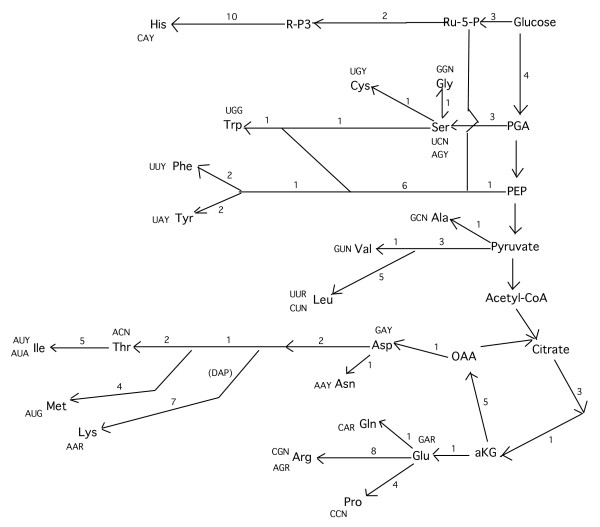
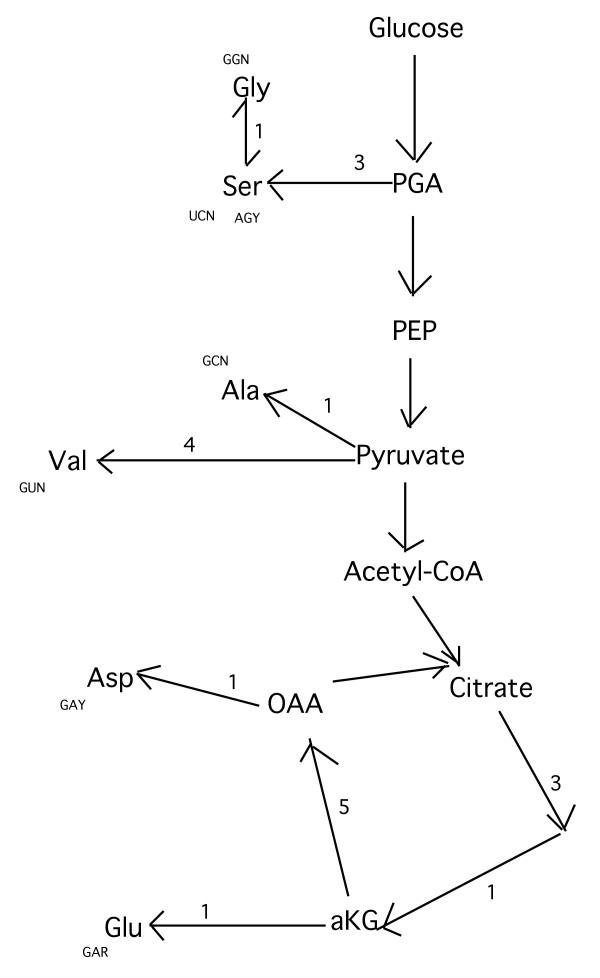
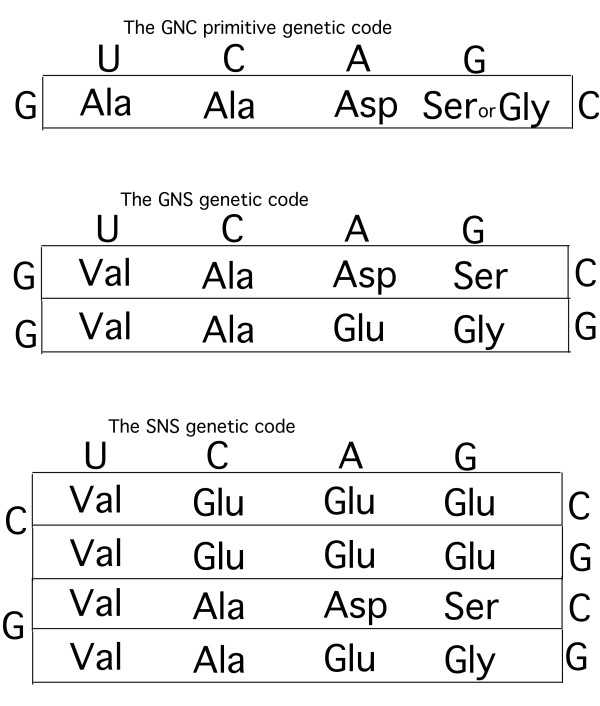
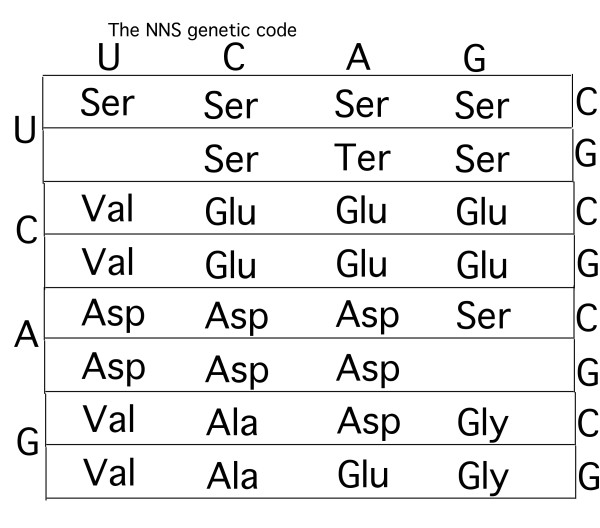
BACKGROUND: The coevolution theory of the origin of the genetic code suggests that the genetic code is an imprint of the biosynthetic relationships between amino acids. However, this theory does not seem to attribute a role to the biosynthetic relationships between the earliest amino acids that evolved along the pathways of energetic metabolism. As a result, the coevolution theory is unable to clearly define the very earliest phases of genetic code origin. In order to remove this difficulty, I here suggest an extension of the coevolution theory that attributes a crucial role to the first amino acids that evolved along these biosynthetic pathways and to their biosynthetic relationships, even when defined by the non-amino acid molecules that are their precursors. RESULTS: It is re-observed that the first amino acids to evolve along these biosynthetic pathways are predominantly those codified by codons of the type GNN, and this observation is found to be statistically significant. Furthermore, the close biosynthetic relationships between the sibling amino acids Ala-Ser, Ser-Gly, Asp-Glu, and Ala-Val are not random in the genetic code table and reinforce the hypothesis that the biosynthetic relationships between these six amino acids played a crucial role in defining the very earliest phases of genetic code origin. CONCLUSION: All this leads to the hypothesis that there existed a code, GNS, reflecting the biosynthetic relationships between these six amino acids which, as it defines the very earliest phases of genetic code origin, removes the main difficulty of the coevolution theory. Furthermore, it is here discussed how this code might have naturally led to the code codifying only for the domains of the codons of precursor amino acids, as predicted by the coevolution theory. Finally, the hypothesis here suggested also removes other problems of the coevolution theory, such as the existence for certain pairs of amino acids with an unclear biosynthetic relationship between the precursor and product amino acids and the collocation of Ala between the amino acids Val and Leu belonging to the pyruvate biosynthetic family, which the coevolution theory considered as belonging to different biosyntheses. REVIEWERS: This article was reviewed by Rob Knight, Paul Higgs (nominated by Laura Landweber), and Eugene Koonin.
Overview
The claims and statistics of this paper haven’t been checked yet.
Free: it reads the open-access text and checks the first 5 claims that cite a source we can check. Create a free account to check every claim.
Integrity signals
Registry
Cites
Statistics
Figures
Verification
Claims the paper makes
The claims and statistics of this paper haven’t been checked yet.
Free: it reads the open-access text and checks the first 5 claims that cite a source we can check. Create a free account to check every claim.
Claims other papers make about this one
Each is checked against this paper’s own text: does it say what the citing paper says it does?
The source backs part of the claim, not all of it — or backs it for a different population, condition or comparison.
In the citing paper
“Initially, four short oligonucleotides, each with a specific codon, were formed and joined in different combinations, specifying four amino acids, such as valine, alanine, aspartic acid, and glycine [88].”
From The Origin of Prebiotic Information System in the Peptide/RNA World: A Simulation Model of the Evolution of Translation and the Genetic Code (2019) · cites this paper as [88]
Experimental — accuracy not yet measuredThe source backs part of the claim, not all of it — or backs it for a different population, condition or comparison.
In the citing paper
“The GNC code defines the very earliest phases of the genetic code origin, reflecting the biosynthetic relationships between four amino acids and four codons (Table 1).”
From The Origin of Prebiotic Information System in the Peptide/RNA World: A Simulation Model of the Evolution of Translation and the Genetic Code (2019) · cites this paper as [88]
Experimental — accuracy not yet measuredThe source backs part of the claim, not all of it — or backs it for a different population, condition or comparison.
In the citing paper
“Here, we propose that the interaction between pre-tRNA and amino acids led to the development of the pre-mRNA strand and the primitive GNC genetic code [88,116].”
From The Origin of Prebiotic Information System in the Peptide/RNA World: A Simulation Model of the Evolution of Translation and the Genetic Code (2019) · cites this paper as [88]
Experimental — accuracy not yet measuredThe source backs part of the claim, not all of it — or backs it for a different population, condition or comparison.
In the citing paper
“The GNC hypothesis refers to the origin of genes. It suggests that the universal genetic code originated from a primitive four-amino acid system encoding primitive amino acids (glycine, alanine, valine, and aspartic acid) to create sequence-specific peptide chain [85,88].”
From The Origin of Prebiotic Information System in the Peptide/RNA World: A Simulation Model of the Evolution of Translation and the Genetic Code (2019) · cites this paper as [88]
Experimental — accuracy not yet measuredThe source backs part of the claim, not all of it — or backs it for a different population, condition or comparison.
In the citing paper
“The GNC codons include four codons (GGC, GCC, GAC, GUC), which code four primitive amino acids”
From The Origin of Prebiotic Information System in the Peptide/RNA World: A Simulation Model of the Evolution of Translation and the Genetic Code (2019) · cites this paper as [88]
Experimental — accuracy not yet measured
7 more claims about this paper
Create a free account to see every claim other papers make about this one.
Self-check
Percentages, sums and reported differences re-computed from the paper’s own numbers.
The self-check needs the paper’s full text.
Citations
Cites
The origin of the genetic code
Crick, F. H. C. (1968) · Journal of Molecular Biology · doi:10.1016/0022-2836(68)90392-6 · Cited by 2,320
Before enzymes and templates: theory of surface metabolism
Wächtershäuser, G. (1988) · Microbiological Reviews · doi:10.1128/mmbr.52.4.452-484.1988 · Cited by 1,242 · cited 6×
“Finally, if we consider that other works have been carried out on the importance of biosynthetic relationships between amino acids and the genetic code [18-39], we come to the conclusion that there can no longer be any doubts on the hypothesis that the origin of the organisation of the genetic code was affected by the…”
BackgroundInfluentialA co-evolution theory of the genetic code
Wong, J. T.-F. (1975) · Proceedings of the National Academy of Sciences · doi:10.1073/pnas.72.5.1909 · Cited by 649 · cited 15×
“Consequently the evolution of the genetic code could be clarified on the basis of the precursor-product relationships between amino acids in their biosyntheses [9].”
BackgroundInfluentialCoenzymes as fossils of an earlier metabolic state
White, H. B. (1976) · Journal of Molecular Evolution · doi:10.1007/bf01732468 · Cited by 493 · cited 1×
“the pathway to His starts with a reaction producing N'-5'-phosphoribosyl-ATP, which is held to be a fossil of RNA [43,70].”
BackgroundModern metabolism as a palimpsest of the RNA world
Benner, S. A., Ellington, A. D., & Tauer, A. (1989) · Proceedings of the National Academy of Sciences · doi:10.1073/pnas.86.18.7054 · Cited by 478 · cited 2×
“If logical-evolutionary analyses were conducted on these pathways and it was concluded that these were molecular fossils [33], it would not necessarily be true that the metabolic pathways of the RNA world are only speculations ([43,68]).”
BackgroundThe Origin of Genetic Information
Eigen, M., Gardiner, W., Schuster, P., & Winkler-Oswatitsch, R. (1981) · Scientific American · doi:10.1038/scientificamerican0481-88 · Cited by 353
Biosynthesis of Selenocysteine on Its tRNA in Eukaryotes
Xu, X.-M., Carlson, B. A., Mix, H., Zhang, Y., Saira, K., Glass, R. S., Berry, M. J., Gladyshev, V. N., & Hatfield, D. L. (2006) · PLoS Biology · doi:10.1371/journal.pbio.0050004 · Cited by 299 · cited 1×
“they share a common origin and so this pathways seems extremely ancient and is also very widespread, contrary to what the Reviewer says [66].”
ResultBlueprint for a cell - the nature and origin of life
(1991) · Choice Reviews Online · doi:10.5860/choice.28-5078 · Cited by 273 · cited 6×
“Finally, if we consider that other works have been carried out on the importance of biosynthetic relationships between amino acids and the genetic code [18-39], we come to the conclusion that there can no longer be any doubts on the hypothesis that the origin of the organisation of the genetic code was affected by the…”
BackgroundInfluentialThe Triplet Code From First Principles
Trifonov, E. N. (2004) · Journal of Biomolecular Structure and Dynamics · doi:10.1080/07391102.2004.10506975 · Cited by 246 · cited 4×
“I have introduced a reference for Trifonov's works [54].”
BackgroundMethodInfluentialEigen, M., & Winkler-Oswatitsch, R. (1981) · Naturwissenschaften · doi:10.1007/bf01047470 · Cited by 242
Beginnings of cellular life: Metabolism recapitulates biogenesis
Mason, S. (1993) · Trends in Biochemical Sciences · doi:10.1016/0968-0004(93)90195-s · Cited by 231
On earlier states of the biochemical system
Yčas, M. (1974) · Journal of Theoretical Biology · doi:10.1016/s0022-5193(74)80035-4 · Cited by 227
Coevolution theory of the genetic code at age thirty
Wong, J. T.-F. (2005) · BioEssays · doi:10.1002/bies.20208 · Cited by 219 · cited 4×
“It should also be borne in mind that as these amino acids are the most abundant in the experiments of prebiotic synthesis and in meteorites [40] they had already attracted the attention of researchers.”
BackgroundInfluentialRNA-dependent conversion of phosphoserine forms selenocysteine in eukaryotes and archaea
Yuan, J., Palioura, S., Salazar, J. C., Su, D., O'Donoghue, P., Hohn, M. J., Cardoso, A. M., Whitman, W. B., & Söll, D. (2006) · Proceedings of the National Academy of Sciences · doi:10.1073/pnas.0609703104 · Cited by 210 · cited 2×
“The pathway Ser->Sec is certainly homologous, at least between Archaea and Eukarya [64,65], and so it should be extremely ancient.”
BackgroundTaylor, F. J. R., & Coates, D. (1989) · Biosystems · doi:10.1016/0303-2647(89)90059-2 · Cited by 207 · cited 11×
“4 would be equally obvious because it is organised in rows, as Taylor and Coates suggest [11] the genetic code is organised.”
BackgroundMethodInfluential(1992) · Medical Entomology and Zoology · Cited by 204
The Case for an Error Minimizing Standard Genetic Code
Freeland, S. J., Wu, T., & Keulmann, N. (2003) · Origins of life and evolution of the biosphere · doi:10.1023/a:1025771327614 · Cited by 164 · cited 1×
“It is well known that neighbouring codons in the canonical code tend to specify similar amino acids and hence that the code seems to be optimized with respect to randomly reshuffled codes [63].”
BackgroundTHORPE, W. H. (1966) · Nature · doi:10.1038/210663b0 · Cited by 145 · cited 6×
“However, these seemed to be isolated and not totally clear observations and Jukes [6] did not believe they could be generalised for the entire genetic code.”
BackgroundInfluentialCoding coenzyme handles: a hypothesis for the origin of the genetic code.
Szathmáry, E. (1993) · Proceedings of the National Academy of Sciences · doi:10.1073/pnas.90.21.9916 · Cited by 136 · cited 1×
“Finally, if we consider that other works have been carried out on the importance of biosynthetic relationships between amino acids and the genetic code [18-39], we come to the conclusion that there can no longer be any doubts on the hypothesis that the origin of the organisation of the genetic code was affected by the…”
BackgroundOn the Coding of Genetic Information
Nirenberg, M. W., Jones, O. W., Leder, P., Clark, B. F. C., Sly, W. S., & Pestka, S. (1963) · Cold Spring Harbor Symposia on Quantitative Biology · doi:10.1101/sqb.1963.028.01.074 · Cited by 118 · cited 6×
“I have cited no less than 14 papers by other authors [5-13,16-22,34,37] which establish a relationship between the genetic code and the biosynthetic pathways of amino acids.”
BackgroundInfluentialJukes, T. H. (1966) · NASA Technical Reports Server (NASA) · Cited by 115
On the Origin of the Genetic Code
Giulio, M. D. (1997) · Journal of Theoretical Biology · doi:10.1006/jtbi.1996.0390 · Cited by 110
On the RNA World: Evidence in Favor of an Early Ribonucleopeptide World
Giulio, M. D. (1997) · Journal of Molecular Evolution · doi:10.1007/pl00006261 · Cited by 110 · cited 2×
“Indeed I have published papers on this very topic [59].”
BackgroundA Novel Theory on the Origin of the Genetic Code: A GNC-SNS Hypothesis
Ikehara, K., Omori, Y., Arai, R., & Hirose, A. (2002) · Journal of Molecular Evolution · doi:10.1007/s00239-001-0053-6 · Cited by 109 · cited 1×
“This is suggested by exploiting the results of Ikehara et al [48] who, for quite different reasons, suggested a genetic code origin that is, in some respects, similar.”
ResultCoevolution of genetic code and amino acid biosynthesis
Tze-Fei Wong, J. (1981) · Trends in Biochemical Sciences · doi:10.1016/0968-0004(81)90013-x · Cited by 95 · cited 1×
“Conclusion The coevolution theory [9] does not give a complete description of genetic code origin as it seems not to consider that the biosynthetic pathways of the amino acids that first entered the genetic code were important in the earliest phases of the origin of the code itself [9,40,52].”
BackgroundBlueprint for a Cell — The Nature and Origin of Life
Howland, J. (1991) · Biochemical Education · doi:10.1016/0307-4412(91)90070-o · Cited by 86
Origin of genetically encoded protein synthesis: a model based on selection for RNA peptidation
Wong, J. T.-F. (1991) · Origins of life and evolution of the biosphere · doi:10.1007/bf01809445 · Cited by 86 · cited 4×
“Peptidyl-tRNA has no function per se, but in some models it has been assumed that the entire catalysis of the protocell was originally performed by this intermediate [1-4].”
BackgroundInfluentialThe Codes of life: the rules of macroevolution
(2008) · Choice Reviews Online · doi:10.5860/choice.45-5558 · Cited by 83
Homeotopic transformation and the origin of translation
Danchin, A. (1989) · Progress in Biophysics and Molecular Biology · doi:10.1016/0079-6107(89)90010-2 · Cited by 83 · cited 6×
“Finally, if we consider that other works have been carried out on the importance of biosynthetic relationships between amino acids and the genetic code [18-39], we come to the conclusion that there can no longer be any doubts on the hypothesis that the origin of the organisation of the genetic code was affected by the…”
BackgroundInfluentialCorrelation between Coding-Triplets and Amino-Acids
Pelc, S. R. (1965) · Nature · doi:10.1038/207597a0 · Cited by 82 · cited 5×
“I have cited no less than 14 papers by other authors [5-13,16-22,34,37] which establish a relationship between the genetic code and the biosynthetic pathways of amino acids.”
BackgroundInfluentialThe origins of the genetic code
Dillon, L. S. (1973) · The Botanical Review · doi:10.1007/bf02859159 · Cited by 82
An Analysis of the Metabolic Theory of the Origin of the Genetic Code
Amirnovin, R. (1997) · Journal of Molecular Evolution · doi:10.1007/pl00006170 · Cited by 78 · cited 1×
“However, there have also been authors who have suggested that some aspects of the biosynthetic relationships between amino acids were not important in genetic code origin [14,15].”
BackgroundThe evolutionary history of Cys-tRNA Cys formation
O'Donoghue, P., Sethi, A., Woese, C. R., & Luthey-Schulten, Z. A. (2005) · Proceedings of the National Academy of Sciences · doi:10.1073/pnas.0509617102 · Cited by 76 · cited 1×
“The pathway Ser>Cys has also been suggested as being present in the LUCA [67], However, the pathway Ser->Cys has only been found in a few archebacteria and so its phylogenetic distribution would seem to indicate, given its phylogenetic rarity, that it is a derived trait, as the Reviewer claims.”
BackgroundGiulio, M. D., & Medugno, M. (1999) · Journal of Molecular Evolution · doi:10.1007/pl00006522 · Cited by 75 · cited 2×
“Finally, if we consider that other works have been carried out on the importance of biosynthetic relationships between amino acids and the genetic code [18-39], we come to the conclusion that there can no longer be any doubts on the hypothesis that the origin of the organisation of the genetic code was affected by the…”
BackgroundTesting a biosynthetic theory of the genetic code: Fact or artifact?
Ronneberg, T. A., Landweber, L. F., & Freeland, S. J. (2000) · Proceedings of the National Academy of Sciences · doi:10.1073/pnas.250403097 · Cited by 75 · cited 10×
“In order to eliminate some criticisms on certain pairs of amino acids that are in an unclear precursor-product relationship [14,16] and, above all, to provide a more complete description of the very earliest phases of genetic code origin, I have been forced to suggest the following theory.”
BackgroundMethodResultInfluentialOn the Evolution of the tRNA-Dependent Amidotransferases, GatCAB and GatDE
Sheppard, K., & Söll, D. G. (2008) · Journal of Molecular Biology · doi:10.1016/j.jmb.2008.01.016 · Cited by 72 · cited 1×
“See Sheppard et al [53] for further information.”
BackgroundReflections on the Origin of the Genetic Code: a Hypothesis
Di Giulio, M. (1998) · Journal of Theoretical Biology · doi:10.1006/jtbi.1997.0580 · Cited by 69
The Early Phases of Genetic Code Origin: Conjectures on the Evolution of Coded Catalysis
Giulio, M. D. (2003) · Origins of Life and Evolution of Biospheres · doi:10.1023/a:1025772828039 · Cited by 68 · cited 9×
“I also prefer the GNS codon because I believe that this took place at a very high temperature, thus favouring RNAs rich in G and C [3].”
BackgroundInfluentialAmino acid biogenesis, evolution of the genetic code and aminoacyl-tRNA synthetases
Klipcan, L., & Safro, M. G. (2004) · Journal of Theoretical Biology · doi:10.1016/j.jtbi.2004.01.014 · Cited by 68 · cited 1×
“Finally, if we consider that other works have been carried out on the importance of biosynthetic relationships between amino acids and the genetic code [18-39], we come to the conclusion that there can no longer be any doubts on the hypothesis that the origin of the organisation of the genetic code was affected by the…”
BackgroundHernández‐Montes, G., Díaz-Mejía, J. J., Pérez‐Rueda, E., & Segovia, L. (2008) · Genome biology · doi:10.1186/gb-2008-9-6-r95 · Cited by 64
Metabolic complexity in the RNA world and implications for the origin of protein synthesis
Gibson, T. J., & Lamond, A. I. (1990) · Journal of Molecular Evolution · doi:10.1007/bf02102448 · Cited by 55
Giulio, M. D. (2002) · Journal of Molecular Evolution · doi:10.1007/s00239-002-2357-6 · Cited by 54
Biosynthesis of selenocysteine on its tRNA in eukaryotes
Xu, X., Carlson, B. A., Mix, H., Zhang, Y., Saira, K., Glass, R. S., Berry, M. J., Gladyshev, V. N., & Hatfield, D. L. (2007) · The FASEB Journal · doi:10.1096/fasebj.21.5.a113-c · Cited by 51
On the Origin of Protein Synthesis: A Speculative Model Based on Hairpin RNA Structures
Giulio, M. D. (1994) · Journal of Theoretical Biology · doi:10.1006/jtbi.1994.1233 · Cited by 51
Giulio, M. D., & Medugno, M. (1998) · Journal of Molecular Evolution · doi:10.1007/pl00006341 · Cited by 51 · cited 5×
“Finally, if we consider that other works have been carried out on the importance of biosynthetic relationships between amino acids and the genetic code [18-39], we come to the conclusion that there can no longer be any doubts on the hypothesis that the origin of the organisation of the genetic code was affected by the…”
BackgroundInfluentialRamakrishnan, B., & Qasba, P. K. (2003) · Journal of Biomolecular Structure and Dynamics · doi:10.1080/07391102.2003.10506900 · Cited by 48
Metabolite Channeling in the Origin of Life
Edwards, M. R. (1996) · Journal of Theoretical Biology · doi:10.1006/jtbi.1996.0070 · Cited by 46 · cited 5×
“Finally, if we consider that other works have been carried out on the importance of biosynthetic relationships between amino acids and the genetic code [18-39], we come to the conclusion that there can no longer be any doubts on the hypothesis that the origin of the organisation of the genetic code was affected by the…”
BackgroundInfluentialGiulio, M. D. (1996) · Origins of Life and Evolution of Biospheres · doi:10.1007/bf01808222 · Cited by 44 · cited 1×
“Finally, if we consider that other works have been carried out on the importance of biosynthetic relationships between amino acids and the genetic code [18-39], we come to the conclusion that there can no longer be any doubts on the hypothesis that the origin of the organisation of the genetic code was affected by the…”
BackgroundThe Coevolution Theory of the Origin of the Genetic Code
Giulio, M. D. (1999) · Journal of Molecular Evolution · doi:10.1007/pl00006464 · Cited by 44
The origin of the genetic code
Giulio, M. D. (2000) · Trends in Biochemical Sciences · doi:10.1016/s0968-0004(99)01522-4 · Cited by 43
The coevolution theory of the origin of the genetic code
Giulio, M. D. (2004) · Physics of Life Reviews · doi:10.1016/j.plrev.2004.05.001 · Cited by 41
Amino acid modifications on tRNA †
Yuan, J., Sheppard, K., & Söll, D. G. (2008) · Acta Biochimica et Biophysica Sinica · doi:10.1111/j.1745-7270.2008.00435.x · Cited by 39
The Level and Landscape of Optimization in the Origin of the Genetic Code
Giulio, M. D., & Medugno, M. (2001) · Journal of Molecular Evolution · doi:10.1007/s002390010167 · Cited by 36 · cited 2×
“On other occasions, I have not failed to tackle the problem raised by the referee [55,56] (see also below)).”
BackgroundGiulio, M. D. (1995) · Origins of Life and Evolution of Biospheres · doi:10.1007/bf01582024 · Cited by 36 · cited 1×
“Finally, if we consider that other works have been carried out on the importance of biosynthetic relationships between amino acids and the genetic code [18-39], we come to the conclusion that there can no longer be any doubts on the hypothesis that the origin of the organisation of the genetic code was affected by the…”
BackgroundThe Robust Statistical Bases of the Coevolution Theory of Genetic Code Origin
Giulio, M. D., & Medugno, M. (2000) · Journal of Molecular Evolution · doi:10.1007/s002399910030 · Cited by 33
Catalytic RNA and the origin of genetic systems
Lamond, A. I., & Gibson, T. J. (1990) · Trends in Genetics · doi:10.1016/0168-9525(90)90148-y · Cited by 33 · cited 6×
“Furthermore, the metabolic complexity of the RNA world has also been discussed (see, for instance, references [42,43]).”
BackgroundResultInfluentialAminoacyl-tRNAs, the bacterial cell envelope, and antibiotics
RajBhandary, U. L., & Söll, D. G. (2008) · Proceedings of the National Academy of Sciences · doi:10.1073/pnas.0801193105 · Cited by 31
Bermúdez-Santana, C. I., Daza, É. E., & Andrade, E. (1999) · Journal of Theoretical Biology · doi:10.1006/jtbi.1998.0866 · Cited by 31 · cited 1×
“Finally, if we consider that other works have been carried out on the importance of biosynthetic relationships between amino acids and the genetic code [18-39], we come to the conclusion that there can no longer be any doubts on the hypothesis that the origin of the organisation of the genetic code was affected by the…”
BackgroundA Blind Empiricism Against the Coevolution Theory of the Origin of the Genetic Code
Giulio, M. D. (2001) · Journal of Molecular Evolution · doi:10.1007/s002390010259 · Cited by 29
β-Turn-driven early evolution: The genetic code and biosynthesis pathways
Jurka, J., & Smith, T. F. (1987) · Journal of Molecular Evolution · doi:10.1007/bf02100036 · Cited by 28 · cited 4×
“Finally, if we consider that other works have been carried out on the importance of biosynthetic relationships between amino acids and the genetic code [18-39], we come to the conclusion that there can no longer be any doubts on the hypothesis that the origin of the organisation of the genetic code was affected by the…”
BackgroundInfluentialChaley, M. B., Korotkov, E., & Phoenix, D. A. (1999) · Journal of Molecular Evolution · doi:10.1007/pl00006455 · Cited by 27 · cited 1×
“Finally, if we consider that other works have been carried out on the importance of biosynthetic relationships between amino acids and the genetic code [18-39], we come to the conclusion that there can no longer be any doubts on the hypothesis that the origin of the organisation of the genetic code was affected by the…”
BackgroundUrbina, D., Tang, B., & Higgs, P. G. (2006) · Journal of Molecular Evolution · doi:10.1007/s00239-005-0051-1 · Cited by 24 · cited 1×
“The difference between rows and columns shows up clearly when we look at the rates of evolution of 1st and 2nd position sites in proteins and the variability of these sites among species [62].”
BackgroundOrigin of glutaminyl-tRNA synthetase: An example of palimpsest?
Giulio, M. D. (1993) · Journal of Molecular Evolution · doi:10.1007/bf00170456 · Cited by 21 · cited 1×
“Finally, if we consider that other works have been carried out on the importance of biosynthetic relationships between amino acids and the genetic code [18-39], we come to the conclusion that there can no longer be any doubts on the hypothesis that the origin of the organisation of the genetic code was affected by the…”
BackgroundThe role of protein associated amino acid precursor molecules in the organization of genetic codons.
Miseta, A. (1989) · PubMed · Cited by 21
The phylogeny of trna molecules and the origin of the genetic code
Giulio, M. D. (1994) · Origins of Life and Evolution of Biospheres · doi:10.1007/bf01582018 · Cited by 20 · cited 1×
“Finally, if we consider that other works have been carried out on the importance of biosynthetic relationships between amino acids and the genetic code [18-39], we come to the conclusion that there can no longer be any doubts on the hypothesis that the origin of the organisation of the genetic code was affected by the…”
BackgroundWhy the Genetic Code Originated: Implications for the Origin of Protein Synthesis
Giulio, M. D. (2007) · Biosemiotics/Biosemiotics. Bookseries · doi:10.1007/978-1-4020-6340-4_4 · Cited by 19
From protoplanetary disks to prebiotic amino acids and the origin of the genetic code
Higgs, P. G., & Pudritz, R. E. (2007) · Cambridge University Press eBooks · doi:10.1017/cbo9780511536120.005 · Cited by 19
Giulio, M. D. (1992) · Origins of Life and Evolution of Biospheres · doi:10.1007/bf01810859 · Cited by 18 · cited 1×
“Finally, if we consider that other works have been carried out on the importance of biosynthetic relationships between amino acids and the genetic code [18-39], we come to the conclusion that there can no longer be any doubts on the hypothesis that the origin of the organisation of the genetic code was affected by the…”
BackgroundOn the origin of the genetic code
Giulio, M. D. (1992) · Trends in Ecology & Evolution · doi:10.1016/0169-5347(92)90067-l · Cited by 13
A possible origin of RNA catalysis in multienzyme complexes
Edwards, M. R. (1989) · Origins of Life and Evolution of Biospheres · doi:10.1007/bf01808288 · Cited by 11 · cited 3×
“that metabolism took place on tRNA-like molecules, has been hypothesised by other authors following arguments that might be totally different from those used here [41-43].”
BackgroundResultProblems and solutions guide to accompany Rawn Biochemistry
Lindquist, R. G. (1990) · Medical Entomology and Zoology · Cited by 2
Research works printed but not linked: 3
- Wong JT Xue H Self-perfecting evolution of heteropolymer building blocks and sequences as the basis of life Fundamentals of Life 2002 Editions scientifiques et medicales Elsevier SAS, Paris 55 64
- [44]Greenberg DM Metabolici Pathways 1969 III Academic Press, New York 247
- [45]Greenberg DM Metabolici Pathways 1961 II Academic Press, New York 177 181
Cited by
An integrated, structure- and energy-based view of the genetic code
Grosjean, H., & Westhof, E. (2016) · Nucleic Acids Research · doi:10.1093/nar/gkw608 · Cited by 278
Grosjean, H., de Crécy-Lagard, V., & Marck, C. (2010) · FEBS Letters · doi:10.1016/j.febslet.2009.11.052 · Cited by 298
Origin and Evolution of the Universal Genetic Code
Koonin, E. V., & Novozhilov, A. S. (2017) · Annual Review of Genetics · doi:10.1146/annurev-genet-120116-024713 · Cited by 200
Higgs, P. G. (2009) · Biology Direct · doi:10.1186/1745-6150-4-16 · Cited by 137
“The recent extension of the coevolution theory [22] also proposes that the earliest amino acids were synthesized on tRNAs and that these were derived from the central metabolic pathways of glycolysis and the citric acid cycle.”
BackgroundInfluentialNitschke, W., & Russell, M. J. (2009) · Journal of Molecular Evolution · doi:10.1007/s00239-009-9289-3 · Cited by 132
“Several strongly different scenarios have been put forward describing this gene pooled community of cells and its influence on, and interaction with, the amino acid pool (Forterre 2002; Di Giulio 2003, 2008).”
Background
Metadata
- Authors
- Di Giulio, M.
- Venue
- Biology Direct
- Published
- 2008
- Volume
- 3
- Issue
- 1
- Pages
- 37
- ISSN
- 1745-6150 (ISSN-L)
- PMC
- PMC2538516
- OpenAlex
- W2138220095
- Cited by
- 158
- References
- 71
- Citations by year
- 2026: 11 · 2025: 5 · 2024: 10 · 2023: 14 · 2022: 12 · 2021: 16 · 2020: 4 · 2019: 7 · 2018: 12 · 2017: 7 · 2016: 11 · 2015: 10 · 2014: 12 · 2013: 9 · 2012: 2
- FWCI
- 3.11
- Type
- journal article
- Language
- en
- Open access
- gold
- doi.org
- Licence
- cc-by
- Locations
- Biology Direct (publishedVersion, cc-by)
- Europe PMC (PubMed Central) (publishedVersion, cc-by)
- PubMed Central (publishedVersion, cc-by)
- PubMed (publishedVersion)
- DOAJ (DOAJ: Directory of Open Access Journals) (submittedVersion)
- Topics
- Physical Sciences › Physics and Astronomy › Astronomy and Astrophysics › Origins and Evolution of Life
- Life Sciences › Biochemistry, Genetics and Molecular Biology › Molecular Biology › RNA and protein synthesis mechanisms
- Life Sciences › Biochemistry, Genetics and Molecular Biology › Genetics › Evolution and Genetic Dynamics
- Keywords
- origin of the genetic code, coevolution theory, amino acid biosynthesis, alanine, serine, glycine, aspartic acid, glutamate, valine
- MeSH terms
- Amino Acids, Codon, Genetic Code, Models, Genetic, Evolution, Molecular
About these checks
Registry, retraction, Cites and statistics results are computed, not judged, with one exception: a printed reference that no index lists is read once by a model before it counts as a citation error. Claims are extracted by a model and kept only when their quote appears verbatim in the text; each cited source is then checked, with a model’s help, for whether it says what the claim relies on. Those verdicts can be wrong — read the claim’s quote and the cited source before relying on one.
Statistics and arithmetic are recomputed, not judged.
Confidence bands are shown only for fields calibrated on our annotated test set. None is calibrated yet, so no band is shown.
What counts as a claim ›How we measure confidence ›How we check this ›
Are you an author, or do you see a problem with this page? Request a review
Data sources
Bibliographic data: Semantic Scholar, OpenAlex, Crossref.
Contains information from the Semantic Scholar Academic Graph Datasets, made available under the ODC Attribution License (ODC-BY 1.0).
Semantic Scholar’s data is described in: Kinney, R., et al. (2023). The Semantic Scholar Open Data Platform. arXiv:2301.10140.
