

A four-column theory for the origin of the genetic code: tracing the evolutionary pathways that gave rise to an optimized code
Open accessThe DOI matches its Crossref record; 68 of the 68 references it cites were found in a registry or an index.
Abstract
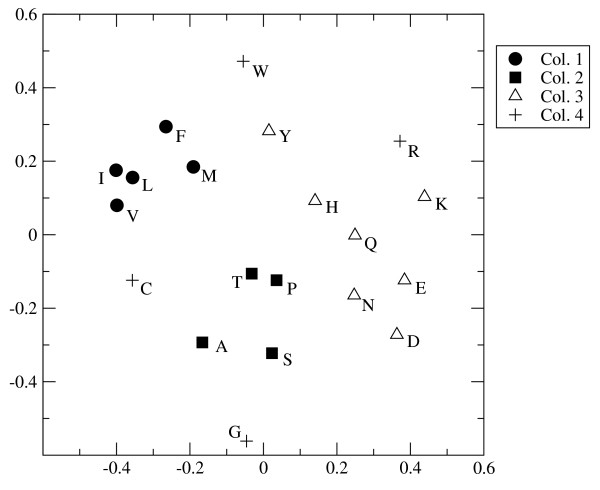
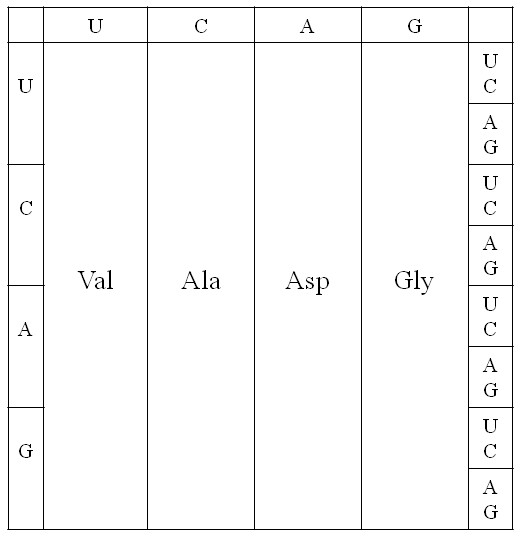
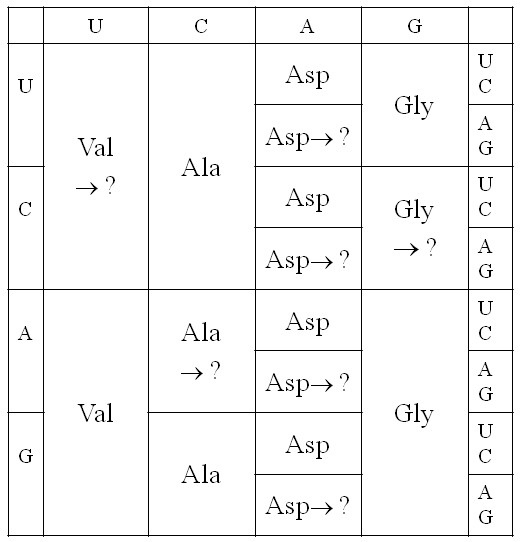
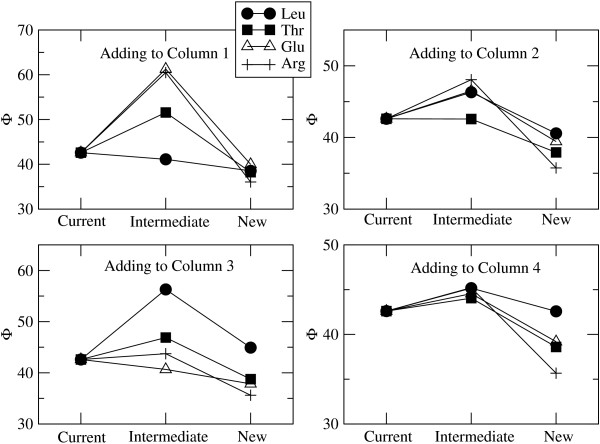
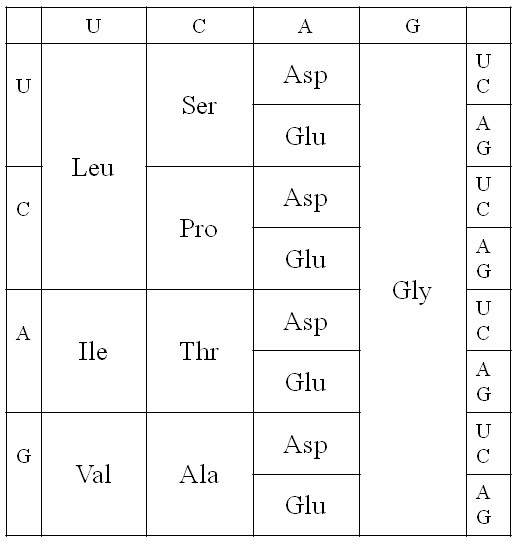
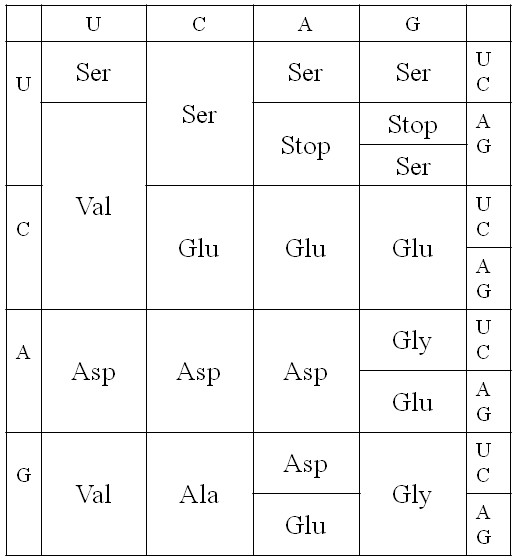
BACKGROUND: The arrangement of the amino acids in the genetic code is such that neighbouring codons are assigned to amino acids with similar physical properties. Hence, the effects of translational error are minimized with respect to randomly reshuffled codes. Further inspection reveals that it is amino acids in the same column of the code (i.e. same second base) that are similar, whereas those in the same row show no particular similarity. We propose a 'four-column' theory for the origin of the code that explains how the action of selection during the build-up of the code leads to a final code that has the observed properties. RESULTS: The theory makes the following propositions. (i) The earliest amino acids in the code were those that are easiest to synthesize non-biologically, namely Gly, Ala, Asp, Glu and Val. (ii) These amino acids are assigned to codons with G at first position. Therefore the first code may have used only these codons. (iii) The code rapidly developed into a four-column code where all codons in the same column coded for the same amino acid: NUN = Val, NCN = Ala, NAN = Asp and/or Glu, and NGN = Gly. (iv) Later amino acids were added sequentially to the code by a process of subdivision of codon blocks in which a subset of the codons assigned to an early amino acid were reassigned to a later amino acid. (v) Later amino acids were added into positions formerly occupied by amino acids with similar properties because this can occur with minimal disruption to the proteins already encoded by the earlier code. As a result, the properties of the amino acids in the final code retain a four-column pattern that is a relic of the earliest stages of code evolution. CONCLUSION: The driving force during this process is not the minimization of translational error, but positive selection for the increased diversity and functionality of the proteins that can be made with a larger amino acid alphabet. Nevertheless, the code that results is one in which translational error is minimized. We define a cost function with which we can compare the fitness of codes with varying numbers of amino acids, and a barrier function, which measures the change in cost immediately after addition of a new amino acid. We show that the barrier is positive if an amino acid is added into a column with dissimilar properties, but negative if an amino acid is added into a column with similar physical properties. Thus, natural selection favours the assignment of amino acids to the positions that they occupy in the final code.
Overview
The claims and statistics of this paper haven’t been checked yet.
Free: it reads the open-access text and checks the first 5 claims that cite a source we can check. Create a free account to check every claim.
Integrity signals
Registry
Cites
Statistics
Figures
Verification
Claims the paper makes
The claims and statistics of this paper haven’t been checked yet.
Free: it reads the open-access text and checks the first 5 claims that cite a source we can check. Create a free account to check every claim.
Claims other papers make about this one
Each is checked against this paper’s own text: does it say what the citing paper says it does?
The source backs part of the claim, not all of it — or backs it for a different population, condition or comparison.
In the citing paper
“Thus, robustness of the code to errors appears to be intrinsically coupled with enhancement of protein evolvability as previously suggested by some theoretical analyses (24, 32).”
From Origin and Evolution of the Universal Genetic Code (2017) · cites this paper as [32]
Experimental — accuracy not yet measuredThe source backs part of the claim, not all of it — or backs it for a different population, condition or comparison.
In the citing paper
“In contrast, the coevolution model, although producing some level of error minimization, was found to be inferior to the other scenarios; this was also demonstrated in an earlier analysis by Higgs (32).”
From Origin and Evolution of the Universal Genetic Code (2017) · cites this paper as [32]
Experimental — accuracy not yet measuredThe source backs part of the claim, not all of it — or backs it for a different population, condition or comparison.
In the citing paper
“In contrast, the coevolution model, although producing some level of error minimization, was substantially inferior to the other scenarios, as also demonstrated in an earlier analysis by Higgs [79].”
From Frozen Accident Pushing 50: Stereochemistry, Expansion, and Chance in the Evolution of the Genetic Code (2017) · cites this paper as [79]
Experimental — accuracy not yet measuredThe cited source says what the claim attributes to it.
In the citing paper
“Massey explored three distinct scenarios of the code expansion: the “2-1-3” model [78], which is similar to expansion schemes independently proposed by Higgs [79] and Francis [80], the ambiguity reduction model [81] and precursor-product scenario specified by the coevolution theory [57,59].”
From Frozen Accident Pushing 50: Stereochemistry, Expansion, and Chance in the Evolution of the Genetic Code (2017) · cites this paper as [79]
In the citing paper
“The 2-1-3 model and similar schemes posit that the code started from an ancestral stage, in which only the second base of the codon was informative, and expanded by assigning specificity to the first, and then, in some codon series, the third bases”
From Frozen Accident Pushing 50: Stereochemistry, Expansion, and Chance in the Evolution of the Genetic Code (2017) · cites this paper as [79]
Self-check
Percentages, sums and reported differences re-computed from the paper’s own numbers.
The self-check needs the paper’s full text.
Citations
Cites
A simple method for displaying the hydropathic character of a protein
Kyte, J., & Doolittle, R. F. (1982) · Journal of Molecular Biology · doi:10.1016/0022-2836(82)90515-0 · Cited by 22,843 · cited 1×
“Higgs and Attwood [31] defined a distance based on 8 properties from the protein folding literature (listed in columns 1–8 of Table 1, and see [32-37]).”
BackgroundProteins: Structures and Molecular Properties
Creighton, T. E. (1986) · Medical Entomology and Zoology · Cited by 2,645
The origin of the genetic code
Crick, F. H. C. (1968) · Journal of Molecular Biology · doi:10.1016/0022-2836(68)90392-6 · Cited by 2,320
King, J. L., & Jukes, T. H. (1969) · Science · doi:10.1126/science.164.3881.788 · Cited by 1,768
IDENTIFYING NONPOLAR TRANSBILAYER HELICES IN AMINO ACID SEQUENCES OF MEMBRANE PROTEINS
Engelman, D. M., Steitz, T. A., & Goldman, A. (1986) · Annual Review of Biophysics and Biophysical Chemistry · doi:10.1146/annurev.bb.15.060186.001541 · Cited by 1,504 · cited 1×
“Higgs and Attwood [31] defined a distance based on 8 properties from the protein folding literature (listed in columns 1–8 of Table 1, and see [32-37]).”
BackgroundProteins. Structures and molecular properties
(1984) · Analytical Biochemistry · doi:10.1016/0003-2697(84)90583-9 · Cited by 1,301 · cited 1×
“Higgs and Attwood [31] defined a distance based on 8 properties from the protein folding literature (listed in columns 1–8 of Table 1, and see [32-37]).”
BackgroundHydrophobicity of Amino Acid Residues in Globular Proteins
Rose, G. D., Geselowitz, A. R., Lesser, G. J., Lee, R. H., & Zehfus, M. H. (1985) · Science · doi:10.1126/science.4023714 · Cited by 1,175 · cited 2×
“Higgs and Attwood [31] defined a distance based on 8 properties from the protein folding literature (listed in columns 1–8 of Table 1, and see [32-37]).”
BackgroundInterior and surface of monomeric proteins
Miller, S., Janin, J., Lesk, A. M., & Chothia, C. (1987) · Journal of Molecular Biology · doi:10.1016/0022-2836(87)90038-6 · Cited by 949 · cited 2×
“Higgs and Attwood [31] defined a distance based on 8 properties from the protein folding literature (listed in columns 1–8 of Table 1, and see [32-37]).”
BackgroundA co-evolution theory of the genetic code
Wong, J. T.-F. (1975) · Proceedings of the National Academy of Sciences · doi:10.1073/pnas.72.5.1909 · Cited by 649 · cited 5×
“We agree with proponents of the coevolution theory of the code [19-22] that the evolution of biochemical synthesis pathways alongside the development of the code is important.”
BackgroundInfluentialThe genetic code is one in a million
Freeland, S. J., & Hurst, L. D. (1998) · Journal of Molecular Evolution · doi:10.1007/pl00006381 · Cited by 563 · cited 5×
“Following Freeland & Hurst [2], we will use a form of the error probability matrix that makes transition errors more frequent than transversion errors and makes -0.”
BackgroundMethodInfluential
Cited by
Items 101–138 of 138
Models of genetic code structure evolution with variable number of coded labels
Pawlak, K., Wnętrzak, M., Mackiewicz, D., Mackiewicz, P., & Błażej, P. (2021) · Biosystems · doi:10.1016/j.biosystems.2021.104528 · Cited by 4
Constraint on di-nucleotides by codon usage bias in bacterial genomes
Satapathy, S. S., Powdel, B. R., Dutta, M., Buragohain, A. K., & Ray, S. K. (2013) · Gene · doi:10.1016/j.gene.2013.11.098 · Cited by 3
“In this context the recent hypothesis of four-column theory of origin of the genetic code is interesting (Francis, 2013; Higgs, 2009).”
BackgroundFactors in Protobiomonomer Selection for the Origin of the Standard Genetic Code
Saralov, A. I. (2021) · Acta Biotheoretica · doi:10.1007/s10441-021-09420-4 · Cited by 3
“• The four-column theory by Higgs (2009) postulates that the modern structure of the canonical code has been inherited from the column structure of the early code, which was already largely optimized to prevent translation errors.”
BackgroundModel of Genetic Code Structure Evolution under Various Types of Codon Reading
Błażej, P., Pawlak, K., Mackiewicz, D., & Mackiewicz, P. (2022) · International Journal of Molecular Sciences · doi:10.3390/ijms23031690 · Cited by 3
Intracellular gene transfer and codon usage of cytoplasmic genomes in green plants
Zhang, T., Zhang, Y.-Y., Wang, X., Zhang, C.-Q., Shi, W., Fu, A., Fang, M., Zhang, X., & Li, Z. (2023) · Botanical Journal of the Linnean Society · doi:10.1093/botlinnean/boad017 · Cited by 3
Alphabet cardinality and adaptive evolution
Srivastava, M., Rozhoňová, H., & Payne, J. L. (2023) · Journal of Physics A Mathematical and Theoretical · doi:10.1088/1751-8121/ad0200 · Cited by 7
“An additional limitation of our study is that we did not take into consideration the genetic code, which influences both landscape topography [47] and the likelihood of various alphabet expansions [48–51].”
BackgroundMutuality in Discrete and Compositional Information: Perspectives for Synthetic Genetic Codes
Guimarães, R. C. (2011) · Cognitive Computation · doi:10.1007/s12559-011-9116-1 · Cited by 3
“construction of amino acid molecules followed by application of the optimization rationale to define the early set to have been encoded [43, 44], leading to the proposal that the 30C row attributions were the heads of the four columns.”
BackgroundMethodInfluentialSalinas, D. G., Gallardo, M. O., & Osorio, M. I. (2012) · Biosystems · doi:10.1016/j.biosystems.2012.02.007 · Cited by 3
Evolution of the Protein Repertoire
Goldman, A. D., Horst, J. A., Hung, L., & Samudrala, R. (2012) · Wiley-VCH eBooks · doi:10.1002/3527600906.mcb.200400157.pub2 · Cited by 3
Giulio, M. D. (2014) · Journal of Theoretical Biology · doi:10.1016/j.jtbi.2014.09.006 · Cited by 3
From peptides to DNA: All required steps can be catalyzed
Shi, L., Senissar, M., Leistner, K., Jers, C., & Mijakovic̀, I. (2026) · Proceedings of the National Academy of Sciences · doi:10.1073/pnas.2534387123 · Cited by 3
The proteomic origin of the genetic code
Caetano‐Anollés, G. (2026) · Expert Review of Proteomics · doi:10.1080/14789450.2026.2646677 · Cited by 2
“Subsequent quantitative demonstration of code optimization [38] – also formalized in population genetic [39] or evolutionary pathway [40] terms – interpreted the code as a near-optimal arrangement minimizing the phenotypic consequences of translational error.”
Giulio, M. D. (2023) · Biosystems · doi:10.1016/j.biosystems.2023.104838 · Cited by 2
Giménez, J. A. M., & Tabarés‐Seisdedos, R. (2021) · Origins of Life and Evolution of Biospheres · doi:10.1007/s11084-021-09610-7 · Cited by 2
“It has been suggested a rapid development of the code into a four-column code where all codons in the same column codes for the same amino acid; NUN = Val, NCN = Ala, NAN = Asp and/or Glu, and NGN = Gly (Higgs 2009).”
BackgroundLife Emerged as the “Protein/Metabolism-First” Theory ExpectsPreprint
Ikehara, K. (2018) · Preprints.org · doi:10.20944/preprints201811.0620.v1 · Cited by 1
Molecular Complexity Constrained Early Amino Acid Recruitment into the Genetic Code
Hashmi, S. A., Chok, H., Cabrera, R., & Blanco, C. (2026) · Genome Biology and Evolution · doi:10.1093/gbe/evag012 · Cited by 1
“…results indicate that the genetic code’s structure aligns mutational accessibility with similarity in molecular complexity, a pattern consistent with error-minimization principles (Haig and Hurst 1999; Higgs 2009) but derived here from intrinsic structure rather than physicochemical properties.”
InfluentialThe Codon Usage in the Minimal Natural Cell
Pawłowski, P. H. (2021) · Origins of Life and Evolution of Biospheres · doi:10.1007/s11084-021-09616-1 · Cited by 1
“According to the author, this is the best candidate to reasonably explain presented correlations, among other RNA-world hypotheses (Higgs 2009; Sengupta, and Higgs 2015; Lei and Burton 2020).”
BackgroundMierke, C. T. (2020) · Biological and medical physics, biomedical engineering · doi:10.1007/978-3-030-58532-7_11 · Cited by 1
Crick’s “Frozen accident theory” of the genetic code explored by Ising models
Lenstra, R., Lenstra, A. C., & José, M. V. (2025) · Journal of Theoretical Biology · doi:10.1016/j.jtbi.2025.112146 · Cited by 2
CMCpy: Genetic Code-Message Coevolution Models in Python
Becich, P. J., Stark, B. P., Bhat, H. S., & Ardell, D. H. (2013) · Evolutionary Bioinformatics · doi:10.4137/ebo.s11169 · Cited by 1
New Insight into the Diversity of Life's Building Blocks: Evenness, Not Variance
Caporaso, J. G., & Knight, R. D. (2011) · Astrobiology · doi:10.1089/ast.2011.2280 · Cited by 1
Codon usage bias of the overlapping genes in microbial genomes
Nair, P. (2010) · Tampere University Institutional Repository (Tampere University)
A Computational Analysis of the Structure of the Genetic Code
Degagne, C. (2015) · MacSphere (McMaster University) · doi:10.71548/19593
Fall 2009 Emergent States of Matter Term Essay
Skinner, S. O. (2009)
The Origin of the Genetic Code
Ikehara, K. (2021) · Springer eBooks · doi:10.1007/978-3-030-71087-3_7
Ikehara, K. (2021) · Springer eBooks · doi:10.1007/978-3-030-71087-3_3
Ikehara, K. (2021) · Springer eBooks · doi:10.1007/978-3-030-71087-3_5
The Origin of Metabolism and GADV Hypothesis on the Origin of Life
Ikehara, K. (2023) · Wiley eBooks · doi:10.1002/9781119555568.ch4
A Survey of the Battlefield for the Origin of Life
Gordon, R. (2024) · Wiley eBooks · doi:10.1002/9781119901228.ch11
How to Make a Transmembrane Domain at the Origin of Life
Gordon, R., & Gordon, N. K. (2024) · Wiley eBooks · doi:10.1002/9781119901228.ch7
Adl, S. M. (2024) · Elsevier eBooks · doi:10.1016/b978-0-323-95299-6.00004-4
Multiple nucleotide variants in genetic diagnosis: implications from 11,467 cases of hearing loss
Ai, F., Zeng, J., Zhang, Q. Y., Zhong, M., Chen, M., Liu, C., Cheng, J., Chen, L., Bu, F., & Yuan, H. (2025) · Journal of genetics and genomics/Journal of Genetics and Genomics · doi:10.1016/j.jgg.2025.03.012 · Cited by 1
Pawlak, K., Błażej, P., Mackiewicz, D., & Mackiewicz, P. (2025) · International Journal of Molecular Sciences · doi:10.3390/ijms26157176
“Undoubtedly, the inclusion of many amino acids with various properties was beneficial because it increased the diversity of synthesized proteins [10,15,53,58].”
Avoiding Catastrophic Mutations Accurately Predicts Amino Acid to Codon Pairing
Nonacs, P., & Nonacs, T. (2025) · Journal of Molecular Evolution · doi:10.1007/s00239-025-10294-0
“*Indicates that in a triplet codon all the 3rd letters code for the same amino acid The amino acid entry order is: V, G and A together as the first core code (Higgs 2009 ); the other doublets from Fig.”
InfluentialCircular codes in the evolution of the genetic code
Starman, M. (2020) · theses.fr (ABES) · doi:10.70675/3ab91a69z3546z4072zb7ddzbe17cd5be7f4
Protocode mats and living membranes: A new hypothesis for the origin of the standard genetic code
Nesterov‐Mueller, A., & Schmidt, D. (2026) · Biosystems · doi:10.1016/j.biosystems.2026.105849 · Cited by 1
“Higgs showed that a four-column theory with a primordial code of Gly, Ala, Asp, Glu, and Val fits well with coevolution predictions (Higgs, 2009).”
How Strong Is the Case for the RNA World?
Higgs, P. G. (2026) · Life · doi:10.3390/life16101633
Self-citationAhmadi, A. (2015) · MacSphere (McMaster University) · doi:10.71548/9902
Metadata
- Authors
- Higgs, P. G.
- Affiliations
- McMaster University (CA)
- Corresponding author
- Higgs, Paul G
- ORCID
- Higgs, Paul G
- Venue
- Biology Direct
- Published
- 2009
- Volume
- 4
- Issue
- 1
- Pages
- 16
- ISSN
- 1745-6150 (ISSN-L)
- PMC
- PMC2689856
- OpenAlex
- W2140139413
- Cited by
- 137
- References
- 68
- Citations by year
- 2026: 5 · 2025: 5 · 2024: 4 · 2023: 9 · 2022: 6 · 2021: 12 · 2020: 9 · 2019: 7 · 2018: 14 · 2017: 7 · 2016: 12 · 2015: 11 · 2014: 5 · 2013: 10 · 2012: 3
- FWCI
- 2.82
- Type
- journal article
- Language
- en
- Open access
- gold
- doi.org
- Licence
- cc-by
- Locations
- Biology Direct (publishedVersion, cc-by)
- PubMed Central (publishedVersion, cc-by)
- PubMed (publishedVersion)
- DOAJ (DOAJ: Directory of Open Access Journals) (submittedVersion)
- Funders
- Aspen Center for Physics
- Canada Research Chairs
- Topics
- Life Sciences › Biochemistry, Genetics and Molecular Biology › Molecular Biology › RNA and protein synthesis mechanisms
- Physical Sciences › Physics and Astronomy › Astronomy and Astrophysics › Origins and Evolution of Life
- Life Sciences › Biochemistry, Genetics and Molecular Biology › Genetics › Evolution and Genetic Dynamics
- Keywords
- origin of the genetic code, codon assignment, amino acid physicochemical properties, translational errors, code evolution, amino acid addition, code expansion, cost function, barrier function, natural selection, protein diversity
- MeSH terms
- Amino Acids, Codon, Genetic Code, Models, Genetic, Selection, Genetic, Evolution, Molecular, Amino Acid Substitution
About these checks
Registry, retraction, Cites and statistics results are computed, not judged, with one exception: a printed reference that no index lists is read once by a model before it counts as a citation error. Claims are extracted by a model and kept only when their quote appears verbatim in the text; each cited source is then checked, with a model’s help, for whether it says what the claim relies on. Those verdicts can be wrong — read the claim’s quote and the cited source before relying on one.
Statistics and arithmetic are recomputed, not judged.
Confidence bands are shown only for fields calibrated on our annotated test set. None is calibrated yet, so no band is shown.
What counts as a claim ›How we measure confidence ›How we check this ›
Are you an author, or do you see a problem with this page? Request a review
Data sources
Bibliographic data: Semantic Scholar, OpenAlex, Crossref.
Contains information from the Semantic Scholar Academic Graph Datasets, made available under the ODC Attribution License (ODC-BY 1.0).
Semantic Scholar’s data is described in: Kinney, R., et al. (2023). The Semantic Scholar Open Data Platform. arXiv:2301.10140.
