

Effectiveness of the psychological and pharmacological treatment of catastrophization in patients with fibromyalgia: a randomized controlled trial.
Open accessThe DOI matches its Crossref record; 45 of the 47 references it cites were found in a registry or an index; 3 of the 32 sources its claims cite were checked for support.
Abstract
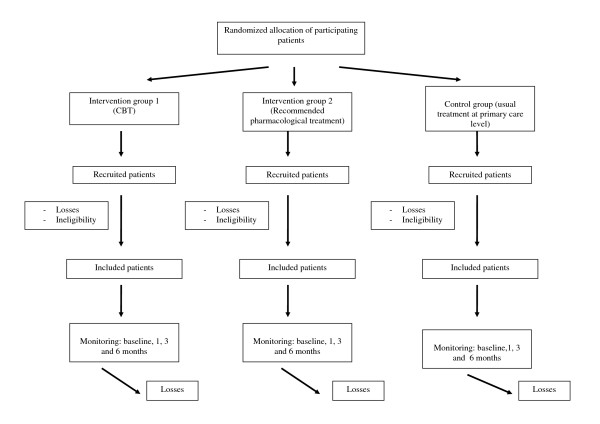
Background: Fibromyalgia is a prevalent and disabling disorder characterized by widespread pain and other symptoms such as insomnia, fatigue or depression. Catastrophization is considered a key clinical symptom in fibromyalgia; however, there are no studies on the pharmacological or psychological treatment of catastrophizing. The general aim of this study is to assess the effectiveness of cognitive-behaviour therapy and recommended pharmacological treatment for fibromyalgia (pregabalin, with duloxetine added where there is a comorbid depression), compared with usual treatment at primary care level.Method/design: Design: A multi-centre, randomized controlled trial involving three groups: the control group, consisting of usual treatment at primary care level, and two intervention groups, one consisting of cognitive-behaviour therapy, and the other consisting of the recommended pharmacological treatment for fibromyalgia.Setting: 29 primary care health centres in the city of Zaragoza, Spain.Sample: 180 patients, aged 18-65 years, able to understand and read Spanish, who fulfil criteria for primary fibromyalgia, with no previous psychological treatment, and no pharmacological treatment or their acceptance to discontinue it two weeks before the onset of the study.Intervention: Psychological treatment is based on the manualized protocol developed by Prof. Escobar et al, from the University of New Jersey, for the treatment of somatoform disorders, which has been adapted by our group for the treatment of fibromyalgia. It includes 10 weekly sessions of cognitive-behaviour therapy. Pharmacological therapy consists of the recommended pharmacological treatment for fibromyalgia: pregabalin (300-600 mg/day), with duloxetine (60-120 mg/day) added where there is a comorbid depression).Measurements: The following socio-demographic data will be collected: sex, age, marital status, education, occupation and social class. The diagnosis of psychiatric disorders will be made with the Structured Polyvalent Psychiatric Interview. Other instruments to be administered are the Pain Catastrophizing Scale, the Hamilton tests for Anxiety and for Depression, the Fibromyalgia Impact Questionnaire (FIQ), the EuroQuol-5 domains (EQ-5D), and the use of health and social services (CSRI). Assessments will be carried out at baseline, 1, 3, and 6 months. MAIN VARIABLE: Pain catastrophizing.Analysis: The analysis will be per intent to treat. We will use the general linear models of the SPSS version 15 statistical package, to analyse the effect of the treatment on the result variable (pain catastrophizing).Discussion: It is necessary to assess the effectiveness of pharmacological and psychological treatments for pain catastrophizing in fibromyalgia. This randomized clinical trial will determine whether both treatments are effective for this important prognostic variable in patients with fibromyalgia.Trial Registration: Current Controlled Trials ISRCTN10804772.
Overview
CoChat Summary
## TL;DR
This paper describes a multicentre randomized controlled trial to test whether cognitive-behaviour therapy or recommended pharmacological treatment reduces pain catastrophizing in fibromyalgia compared with usual primary care. At the time of the paper, it reports the trial protocol, not results.
## Key findings
- The study is designed as a three-arm randomized controlled trial with 180 patients total, 60 per group, comparing usual care, 10 weekly CBT sessions, and pregabalin 300–600 mg/day with duloxetine 60–120 mg/day added for comorbid depression.
- The main outcome is pain catastrophizing, measured with the Spanish version of the Pain Catastrophizing Scale.
- Follow-up assessments are scheduled at baseline, 1, 3, and 6 months.
- The authors state that the trial aims to detect a 20% or greater difference between groups, using alpha 0.05 and beta < 0.20; this implies 55 patients per group, increased to 60 to allow for 10% refusals.
## Methods
- Design: Multicentre randomized controlled trial with three branches: CBT, recommended pharmacological treatment, and treatment as usual in primary care; allocation is computer-generated and concealed.
- Sample/data: Recruitment from 29 primary care health centres in Zaragoza, Spain; eligible patients are 18–65 years, Spanish-reading, meet criteria for primary fibromyalgia, and have no prior psychological treatment and no current pharmacological treatment unless they agree to stop it 2 weeks before study start.
- Analysis: Planned intention-to-treat analysis using Kruskal-Wallis and chi-squared tests for baseline comparisons, general linear models for the main outcome, and linear mixed models for continuous process variables; cost-utility analysis will use gamma regression, OLS regressions, and 5,000 bootstrap replications.
## Limitations
- The paper states that there are no prior published studies on pharmacological or psychological treatment of catastrophizing in fibromyalgia, so the sample-size estimate is based on clinical experience rather than prior effect data.
- The authors note potential difficulties in recruitment because patients must discontinue pharmacological treatment, and potential changes in employment status may make results harder to interpret.
- Evident from the text: this is a protocol paper, so it reports planned methods and expected dates, not trial outcomes.
Model-written summary. Check it against the paper before relying on it.
Integrity signals
Registry
Cites
Statistics
Figures
Verification
Claims the paper makes
3 Valid · 0 Not valid · 23 Not checked · 9 Own results and interpretations
A conclusion the paper draws from its own results — it cites no other source for it, so there is none to check. The quote shows it is in the paper.
In the paper
“The strength of the study is that, to our knowledge, this is the first multi-centre, randomized, controlled trial of psychological and pharmacological treatments for pain catastrophizing in patients with fibromyalgia compared with usual treatment.”
§ Effectiveness of the psychological and pharmacological treatment of catastrophization in patients with fibromyalgia: a randomized controlled trial > Discussion
hedged- Asserted: passes — The authors put it forward as true.
- Checkable: passes — It can be checked against evidence.
- Load-bearing: passes — The paper’s conclusions depend on it.
- Based: passes — The paper gives a reason why it holds.
In the paper
“However, the effectiveness of treatments for fibromyalgia in catastrophizing has not been evaluated except in pilot studies [26].”
§ Effectiveness of the psychological and pharmacological treatment of catastrophization in patients with fibromyalgia: a randomized controlled trial > Discussion
What the sources say
- Not checked — no full text of the sourcecites [26] Rodero B Garcia Campayo J Casasnuevas B Sobradiel N Exposition in imagination as treatment of catastrophizing in fibromyalgia: a pilot study Actas Españolas Psiquiatr 2008 36 223 26 18461496
plain- Asserted: passes — The authors put it forward as true.
- Checkable: passes — It can be checked against evidence.
- Load-bearing: passes — The paper’s conclusions depend on it.
- Based: passes — The paper gives a reason why it holds.
In the paper
“Some of the consequences that have been associated with pain catastrophizing are more intense pain [6], heightened pain behaviour [7-9], greater analgesic consumption [10,11], reduced involvement in daily activities [3], occupational disability [12-14] and suicidal ideation [15].”
§ Effectiveness of the psychological and pharmacological treatment of catastrophization in patients with fibromyalgia: a randomized controlled trial > Background
What the sources say
- Not checked — no full text of the sourcecites [6] Sullivan MJL Bishop S Pivik J The Pain Catastrophizing Scale: development and validation Psychol Assess 1995 7 524 32 10.1037/1040-3590.7.4.524 source
plainstates an association- Asserted: passes — The authors put it forward as true.
- Checkable: passes — It can be checked against evidence.
- Load-bearing: passes — The paper’s conclusions depend on it.
- Based: passes — The paper gives a reason why it holds.
In the paper
“Catastrophization is considered a key clinical symptom in fibromyalgia; however, there are no studies on the pharmacological or psychological treatment of catastrophizing.”
- Also stated in: § Background · plain
“Catastrophization is considered a key clinical symptom in fibromyalgia and, in fact, the most used classification of fibromyalgia clinical subtypes includes catastrophization as one of the discriminating variables [22].”
§ Effectiveness of the psychological and pharmacological treatment of catastrophization in patients with fibromyalgia: a randomized controlled trial > Abstract > Background
What the sources say
- Not checked — no full text of the sourcecites [22] Giesecke T Williams DA Harris RE Subgrouping of fibromyalgia patients on the basis of pressure-pain thresholds and psychological factors Arthritis Rheum 2003 48 2916 2222 14558098 10.1002/art.11272 source
plain- Asserted: passes — The authors put it forward as true.
- Checkable: passes — It can be checked against evidence.
- Load-bearing: passes — The paper’s conclusions depend on it.
- Based: passes — The paper gives a reason why it holds.
- Also stated in: § Background · plain
1 reference still to check
A free account verifies the references that are still open.
- Probably not a substantial claim. 27
- It may state two separate claims as one. 12
Claims other papers make about this one
Each is checked against this paper’s own text: does it say what the citing paper says it does?
The cited source doesn’t support the claim as written.
In the citing paper
“Only five previous randomised, controlled trials assessed the efficacy of treatments on PC in FM patients [26-30], but none of them considered PC as the main outcome.”
From Effectiveness of cognitive behaviour therapy for the treatment of catastrophisation in patients with fibromyalgia: A randomised controlled trial (2011) · cites this paper as [30]
Checked by a reasoning model — may be wrong.
Experimental — accuracy not yet measuredThe source backs part of the claim, not all of it — or backs it for a different population, condition or comparison.
In the citing paper
“The effect sizes in our study are similar to those found in previous studies on the efficacy of CBT in FM patients and in a meta-analysis of psychological and pharmacological treatments for FM administered at primary and secondary levels of healthcare [30].”
From Effectiveness of cognitive behaviour therapy for the treatment of catastrophisation in patients with fibromyalgia: A randomised controlled trial (2011) · cites this paper as [30]
Experimental — accuracy not yet measuredThe source backs part of the claim, not all of it — or backs it for a different population, condition or comparison.
In the citing paper
“Accepting an α risk of 0.05 and P = 80% in a bilateral contrast, we needed 55 patients in each group [52]. Calculating 5% of refusals as found in previous studies [25-30], we needed a sample size of 58, which implies a total sample of 174 patients with FM.”
From Effectiveness of cognitive behaviour therapy for the treatment of catastrophisation in patients with fibromyalgia: A randomised controlled trial (2011) · cites this paper as [30]
Experimental — accuracy not yet measuredThe cited source says what the claim attributes to it.
In the citing paper
“The protocol of this study has been previously published [30].”
From Effectiveness of cognitive behaviour therapy for the treatment of catastrophisation in patients with fibromyalgia: A randomised controlled trial (2011) · cites this paper as [30]
The check wasn’t confident either way, so it gives no verdict — never disputed.
In the citing paper
“Many studies have demonstrated that pharmacological and psychological treatments are similarly effective in treating depression [30].”
From Effectiveness of cognitive behaviour therapy for the treatment of catastrophisation in patients with fibromyalgia: A randomised controlled trial (2011) · cites this paper as [30]
Experimental — accuracy not yet measured
1 more claim about this paper
Create a free account to see every claim other papers make about this one.
Citations
Cites
An Introduction to the Bootstrap
Efron, B., & Tibshirani, R. J. (1994) · doi:10.1201/9780429246593 · Cited by 40,500
Methods for the Economic Evaluation of Health Care Programmes
Drummond, M. E., Sculpher, M. J., Torrance, G. W., O’Brien, B. J., & Stoddart, G. L. (2005) · doi:10.1093/oso/9780198529446.001.0001 · Cited by 13,648
The assessment of anxiety states by rating
HAMILTON, M. (1959) · British Journal of Medical Psychology · doi:10.1111/j.2044-8341.1959.tb00467.x · Cited by 11,455 · cited 3×
“It has a Spanish validated version [32] Hamilton Rating Scale for Depression (HAM-D) [33].”
MethodThe american college of rheumatology 1990 criteria for the classification of fibromyalgia
Wolfe, F., Smythe, H. A., Yunus, M. B., Bennett, R. M., Bombardier, C., Goldenberg, D. L., Tugwell, P., Campbell, S. M., Abeles, M., Clark, P., et al. (1990) · Arthritis & Rheumatism · doi:10.1002/art.1780330203 · Cited by 9,563 · cited 3×
“Fibromyalgia is a prevalent and disabling disorder characterized by a history of widespread pain for at least threemonths andpatient reportingof tenderness in at least 11of18defined tenderpointswhendigitallypalpatedwithabout4kgperunit area of force [21].”
BackgroundMethodInfluentialThe Pain Catastrophizing Scale: Development and validation.
Sullivan, M. J. L., Bishop, S. R., & Pivik, J. (1995) · Psychological Assessment · doi:10.1037//1040-3590.7.4.524 · Cited by 8,227 · cited 7×
“Sullivan MJL, Bishop S and Pivik J: The Pain Catastrophizing Scale: development and validation.”
BackgroundMethodInfluentialStatistical Methods in Medical Research.
Armitage, P. (1972) · Biometrics · doi:10.2307/2556182 · Cited by 4,029
Rosenstiel, A. K., & Keefe, F. J. (1983) · Pain · doi:10.1016/0304-3959(83)90125-2 · Cited by 2,314 · cited 1×
“The PCS is a 13-item self-report questionnaire derived partially from the Coping Strategies Questionnaire [16] and other descriptions of catastrophization [1,18,19].”
MethodAn Introduction to the Bootstrap
Grimshaw, S. D., Efron, B., & Tibshirani, R. J. (1995) · Technometrics · doi:10.2307/1269918 · Cited by 2,095
(1991) · PubMed · Cited by 1,837
Coping with chronic pain: a critical review of the literature
Jensen, M. P., Turner, J. A., Romano, J. M., & Karoly, P. (1991) · Pain · doi:10.1016/0304-3959(91)90216-k · Cited by 835 · cited 1×
“Background The roleof catastrophizing inmediating responses topainhas received considerable attention in recent years [1-3] and a consistent relation between catastrophizing and distress reactions to painful stimulation has been demonstrated [3].”
BackgroundPain Catastrophizing and Kinesiophobia: Predictors of Chronic Low Back Pain
Picavet, H. S. J. (2002) · American Journal of Epidemiology · doi:10.1093/aje/kwf136 · Cited by 744 · cited 1×
“Some of the consequences that have been associated with pain catastrophizing are more intense pain [6], heightened pain behaviour [7-9], greater analgesic consumption [10,11], reduced involvement in daily activities [3], occupationaldisability [12-14]andsuicidal ideation [15].”
BackgroundKeefe, F. J., Lefebvre, J. C., Egert, J. R., Affleck, G., Sullivan, M. J., & Caldwell, D. S. (2000) · Pain · doi:10.1016/s0304-3959(00)00296-7 · Cited by 735 · cited 1×
“Some of the consequences that have been associated with pain catastrophizing are more intense pain [6], heightened pain behaviour [7-9], greater analgesic consumption [10,11], reduced involvement in daily activities [3], occupationaldisability [12-14]andsuicidal ideation [15].”
BackgroundPsychosocial Predictors of Outcome in Acute and Subchronic Low Back Trouble
Burton, A. K., Tillotson, K. M., Main, C. J., & Hollis, S. (1995) · Spine · doi:10.1097/00007632-199503150-00014 · Cited by 700 · cited 1×
“Some of the consequences that have been associated with pain catastrophizing are more intense pain [6], heightened pain behaviour [7-9], greater analgesic consumption [10,11], reduced involvement in daily activities [3], occupationaldisability [12-14]andsuicidal ideation [15].”
BackgroundCoping with rheumatoid arthritis pain: catastrophizing as a maladaptive strategy
Keefe, F. J., Brown, G. K., Wallston, K. A., & Caldwell, D. S. (1989) · Pain · doi:10.1016/0304-3959(89)90152-8 · Cited by 694 · cited 3×
“Theroleofcatastrophizinginmediatingresponsestopainhas received considerable attention in recent years [1-3] and a consistent relation between catastrophizing and distress reactions to painful stimulation has been demonstrated [ 3 ].”
BackgroundInfluentialCatastrophizing, pain, and disability in patients with soft-tissue injuries
Sullivan, M. J. L., Stanish, W., Waite, H., Sullivan, M., & Tripp, D. A. (1998) · Pain · doi:10.1016/s0304-3959(98)00097-9 · Cited by 593
Hamilton, M. (1980) · PubMed · Cited by 555
(1999) · PubMed · Cited by 548
Giesecke, T., Williams, D. A., Harris, R. E., Cupps, T. R., Tian, X., Tian, T. X., Gracely, R. H., & Clauw, D. J. (2003) · Arthritis & Rheumatism · doi:10.1002/art.11272 · Cited by 424 · cited 1×
“Catastrophization is considered a key clinical symptom in fibromyalgia and, in fact, the most used classification of fibromyalgia clinical subtypes includes catastrophization as one of the discriminating variables [22].”
BackgroundGarcía Campayo, J., Rodero, B., Alda, M., Sobradiel, N., Montero, J., & Moreno, S. (2008) · Medicina Clínica · doi:10.1157/13127277 · Cited by 422
Self-citationLobo, A., Chamorro, L., Luque, A., Dal-Ré, R., Badia, X., & Baró, E. (2002) · Medicina Clínica · doi:10.1016/s0025-7753(02)72429-9 · Cited by 362
Domingo‐Salvany, A., Regidor, E., Alonso, J., & Alvarez-Dardet, C. (2000) · PubMed · Cited by 339
Gender Differences in Pain and Pain Behavior: The Role of Catastrophizing
Sullivan, M. J. L., Tripp, D. A., & Santor, D. (2000) · Cognitive Therapy and Research · doi:10.1023/a:1005459110063 · Cited by 285 · cited 1×
“Some of the consequences that have been associated with pain catastrophizing are more intense pain [6], heightened pain behaviour [7-9], greater analgesic consumption [10,11], reduced involvement in daily activities [3], occupationaldisability [12-14]andsuicidal ideation [15].”
Background(2004) · PubMed · Cited by 274
Edwards, R. R., Haythornthwaite, J. A., Sullivan, M. J., & Fillingim, R. B. (2004) · Pain · doi:10.1016/j.pain.2004.07.012 · Cited by 250 · cited 1×
“Depressive thoughts are only present associated with depressive mood; however, catastrophism is considered a continuous psychological variable, normally distributed even in healthy individuals without pain or depression [17].”
BackgroundSpanos, N. P., Radtke-Bodorik, H. L., Ferguson, J. D., & Jones, B. (1979) · Journal of Abnormal Psychology · doi:10.1037/0021-843x.88.3.282 · Cited by 250 · cited 1×
“The PCS is a 13-item self-report questionnaire derived partially from the Coping Strategies Questionnaire [16] and other descriptions of catastrophization [1,18, 19 ].”
MethodUna propuesta de medida de la clase social
(2000) · Atención Primaria · doi:10.1016/s0212-6567(00)78518-0 · Cited by 241
A new validation of the Hamilton Rating Scale for depression
Ramos-Brieva, J. A., & Cordero-Villafafila, A. (1988) · Journal of Psychiatric Research · doi:10.1016/0022-3956(88)90024-6 · Cited by 238 · cited 1×
“It has a Spanish validated version [32]”
Spontaneous cognitive strategies for the control of clinical pain and stress
Chaves, J. F., & Brown, J. M. (1987) · Journal of Behavioral Medicine · doi:10.1007/bf00846540 · Cited by 187 · cited 2×
“The PCS is a 13-item self-report questionnaire derived partially from the Coping Strategies Questionnaire [16] and other descriptions of catastrophization [1,18,19].”
BackgroundMethodJacobsen, P. B., & Butler, R. W. (1996) · Journal of Behavioral Medicine · doi:10.1007/bf01858172 · Cited by 184 · cited 1×
“Some of the consequences that have been associated with pain catastrophizing are more intense pain [6], heightened pain behaviour [7-9], greater analgesic consumption [10,11], reduced involvement in daily activities [3], occupationaldisability [12-14]andsuicidal ideation [15].”
BackgroundPain-related catastrophizing as a risk factor for suicidal ideation in chronic pain
Edwards, R. R., Smith, M. T., Kudel, I., & Haythornthwaite, J. (2006) · Pain · doi:10.1016/j.pain.2006.07.004 · Cited by 182 · cited 1×
“Some of the consequences that have been associated with pain catastrophizing are more intense pain [6], heightened pain behaviour [7-9], greater analgesic consumption[10,11],reducedinvolvementindailyactivities [3],occupationaldisability[12-14]andsuicidalideation[ 15 ].”
BackgroundA comparison of multivariable regression models to analyse cost data
Dodd, S., Bassi, A., Bodger, K., & Williamson, P. (2006) · Journal of Evaluation in Clinical Practice · doi:10.1111/j.1365-2753.2006.00610.x · Cited by 180 · cited 1×
“Gamma modelling has been suggested as a suitable choice for analysing cost data, taking into account the skewing of the distribution of the cost data [41,42].”
MethodEconomic Evaluation of Mental Health Care
Knapp, M. (2001) · Contemporary Psychiatry · doi:10.1007/978-3-642-59519-6_16 · Cited by 177
A comparison of several regression models for analysing cost of CABG surgery
Austin, P. C., Ghali, W. A., & Tu, J. V. (2003) · Statistics in Medicine · doi:10.1002/sim.1442 · Cited by 161 · cited 1×
“Gamma modelling has been suggested as a suitable choice for analysing cost data, taking into account the skewing of the distribution of the cost data [41,42].”
MethodMcWilliams, L. A., & Asmundson, G. J. G. (2007) · Pain · doi:10.1016/j.pain.2006.07.020 · Cited by 135
Buenaver, L. F., Edwards, R. R., & Haythornthwaite, J. A. (2007) · Pain · doi:10.1016/j.pain.2006.08.018 · Cited by 113 · cited 1×
“It has been demonstrated that interpersonal mechanisms may not play a significant role in its development [4], while insecure attachment would be positively associated with it [5].”
BackgroundSevereijns, R., Vlaeyen, J. W. S., van den Hout, M. A., & Picavet, H. S. J. (2004) · Health Psychology · doi:10.1037/0278-6133.23.1.49 · Cited by 101 · cited 1×
“Some of the consequences that have been associated with pain catastrophizing are more intense pain [6], heightened pain behaviour [7-9], greater analgesic consumption [10,11], reduced involvement in daily activities [3], occupationaldisability [12-14]andsuicidal ideation [15].”
BackgroundIncreased use of safety-seeking behaviors in chronic back pain patients with high health anxiety
Tang, N. K. Y., Salkovskis, P. M., Poplavskaya, E., Wright, K. J., Hanna, M., & Hester, J. (2007) · Behaviour Research and Therapy · doi:10.1016/j.brat.2007.05.004 · Cited by 89 · cited 1×
“The very concept of catastrophizing has also been criticized, with some authors suggesting the need of new tools to assess it [ 45 ].”
BackgroundBuenaver, L. F., Edwards, R. R., Smith, M. T., Gramling, S. E., & Haythornthwaite, J. A. (2008) · The Journal of Pain · doi:10.1016/j.jpain.2007.11.005 · Cited by 82 · cited 3×
“The PCS is a 13-item self-report questionnaire derived partially from the Coping Strategies Questionnaire [16] and other descriptions of catastrophization [1,18,19].”
BackgroundMethodA meta-analysis of the efficacy of fibromyalgia treatment according to level of care
Garcia-Campayo, J., Magdalena, J., Magallón, R., Fernández-García, E., Salas, M., & Andrés, E. (2008) · Arthritis Research & Therapy · doi:10.1186/ar2455 · Cited by 76
Coping and Self‐Medication in a Community Sample of Junior High School Students
Bedard, G. B. V., Reid, G. J., McGrath, P. J., & Chambers, C. T. (1997) · Pain Research and Management · doi:10.1155/1997/254142 · Cited by 54 · cited 1×
“Some of the consequences that have been associated with pain catastrophizing are more intense pain [6], heightened pain behaviour [7-9], greater analgesic consumption [10,11], reduced involvement in daily activities [3], occupationaldisability [12-14]andsuicidal ideation [15].”
BackgroundA new interview for the multiaxial assessment of psychiatric morbidity in medical settings
Lobo, A., Campos, R., Pérez-Echeverría, M.-J., Izuzquiza, J., García-Campayo, J., Saz, P., & Marcos, G. (1993) · Psychological Medicine · doi:10.1017/s0033291700028592 · Cited by 45 · cited 3×
“The diagnosis of psychiatric disorders will be made with the Structured Polyvalent Psychiatric Interview [30], a psychiatric interview developed by our group and extensively used for the study of somatoform disorders, the group in which fibromyalgia is included in psychiatric classifications.”
MethodSelf-citationThe use of alternative medicines by somatoform disorder patients in Spain.
García‐Campayo, J., & Sanz-Carrillo, C. (2000) · Europe PMC (PubMed Central) · Cited by 28
Self-citationDeveloping an Intervention to Alter Catastrophizing in Persons With Fibromyalgia
Nelson, P. J., & Tucker, S. (2006) · Orthopaedic Nursing · doi:10.1097/00006416-200605000-00011 · Cited by 23 · cited 1×
“However, despite its importance, there is only one study on the psychological treatment of catastrophizing in which the only outcome assessed is the general satisfaction of thepatientandhis/herknowledgeaboutcatastrophizing[23].”
BackgroundEmerging pharmacological therapies for fibromyalgia.
Lawson, K. (2006) · PubMed · Cited by 23
(2008) · PubMed · Cited by 19
Self-citationGabapentin for the Treatment of Patients With Somatization Disorder
García‐Campayo, J., & Sanz-Carrillo, C. (2001) · The Journal of Clinical Psychiatry · doi:10.4088/jcp.v62n0612a · Cited by 15
Self-citation
Cited by
Psychological therapies for the management of chronic pain (excluding headache) in adults
Williams, A. C. D. C., Eccleston, C., & Morley, S. (2012) · Cochrane Database of Systematic Reviews · doi:10.1002/14651858.cd007407.pub3 · Cited by 1,634
Louw, A., Diener, I., Butler, D. S., & Puentedura, E. J. (2011) · Archives of Physical Medicine and Rehabilitation · doi:10.1016/j.apmr.2011.07.198 · Cited by 687
Acceptance and Commitment Therapy (ACT) for Chronic Pain: A Systematic Review and Meta-Analyses
Hughes, L. S., Clark, J., Colclough, J. A., Dale, E., & McMillan, D. (2017) · The Clinical Journal of Pain · doi:10.1097/ajp.0000000000000425 · Cited by 611
Mind and body therapy for fibromyalgia
Theadom, A., Cropley, M., Smith, H. E., Feigin, V. L., & McPherson, K. (2015) · Cochrane Database of Systematic Reviews · doi:10.1002/14651858.cd001980.pub3 · Cited by 128
Malfliet, A., Kregel, J., Meeus, M., Roussel, N., Danneels, L., Cagnie, B., Dolphens, M., & Nijs, J. (2018) · Physical Therapy · doi:10.1093/ptj/pzx092 · Cited by 100
Metadata
- Authors
- García-Campayo, J., Serrano-Blanco, A., Rodero, B., Magallón, R., Alda, M., Andrés, E., Luciano, J. V., & del Hoyo, Y. L.
- Affiliations
- Red de Investigación en Actividades Preventivas y Promoción de la Salud (ES)
- ORCID
- Luciano, Juan V
- Venue
- Trials
- Published
- 2009-04-23
- Volume
- 10
- Issue
- 1
- Pages
- 24-24
- ISSN
- 1745-6215 (ISSN-L)
- PMC
- PMC2689860
- OpenAlex
- W2168655355
- Cited by
- 30
- References
- 47
- Citations by year
- 2026: 1 · 2021: 1 · 2018: 2 · 2017: 3 · 2016: 2 · 2015: 2 · 2014: 4 · 2013: 3 · 2012: 4
- FWCI
- 2.47
- Type
- journal article
- Language
- en
- Open access
- gold
- doi.org
- Licence
- cc-by
- creativecommons.org/licenses/by/2.0 (tdm)
- Locations
- Trials (publishedVersion, cc-by)
- PubMed Central (publishedVersion, cc-by)
- PubMed (publishedVersion)
- DOAJ (DOAJ: Directory of Open Access Journals) (submittedVersion)
- Funders
- Instituto de Salud Carlos III
- Topics
- Health Sciences › Medicine › Psychiatry and Mental health › Fibromyalgia and Chronic Fatigue Syndrome Research
- Health Sciences › Health Professions › Physical Therapy, Sports Therapy and Rehabilitation › Musculoskeletal pain and rehabilitation
- Health Sciences › Medicine › Psychiatry and Mental health › Psychosomatic Disorders and Their Treatments
- Keywords
- fibromyalgia, pain catastrophizing, cognitive behavioral therapy, pregabalin, duloxetine, comorbid depression, primary care, treatment effectiveness, somatoform disorders, health-related quality of life, health care utilization, pain intensity, anxiety, primary fibromyalgia, usual care comparison, health technology assessment, cost-effectiveness
- MeSH terms
- Duloxetine Hydrochloride, Pregabalin, Adolescent, Adult, Aged, Analgesics, Antidepressive Agents, Combined Modality Therapy, Depression, Fibromyalgia, gamma-Aminobutyric Acid, Humans, Middle Aged, Pain, Pain Measurement, Psychiatric Status Rating Scales, Research Design, Spain, Thiophenes, Time Factors, Cognitive Behavioral Therapy, Treatment Outcome, Young Adult, Pain Management
About these checks
Registry, retraction, Cites and statistics results are computed, not judged, with one exception: a printed reference that no index lists is read once by a model before it counts as a citation error. Claims are extracted by a model and kept only when their quote appears verbatim in the text; each cited source is then checked, with a model’s help, for whether it says what the claim relies on. Those verdicts can be wrong — read the claim’s quote and the cited source before relying on one.
A language model drew the claims from the paper on 2026-10-11, under version 3 of the claim definition (model deepseek-v4.1-flash, prompt extract-v3).
A second model labelled each claim on 2026-10-11 (model jev-1.13-20260917, definition revision gold-guideline-v0.2).
Statistics and arithmetic are recomputed, not judged.
Confidence bands are shown only for fields calibrated on our annotated test set. None is calibrated yet, so no band is shown.
What counts as a claim ›How we measure confidence ›How we check this ›
Are you an author, or do you see a problem with this page? Request a review
Data sources
Bibliographic data: Semantic Scholar, OpenAlex, Crossref.
Contains information from the Semantic Scholar Academic Graph Datasets, made available under the ODC Attribution License (ODC-BY 1.0).
Semantic Scholar’s data is described in: Kinney, R., et al. (2023). The Semantic Scholar Open Data Platform. arXiv:2301.10140.
