

The DOI matches its Crossref record; 57 of the 57 references it cites were found in a registry or an index.
Study protocol for a randomized controlled trial comparing mindfulness-based cognitive therapy with maintenance anti-depressant treatment in the prevention of depressive relapse/recurrence: the PREVENT trial
Open accessAbstract
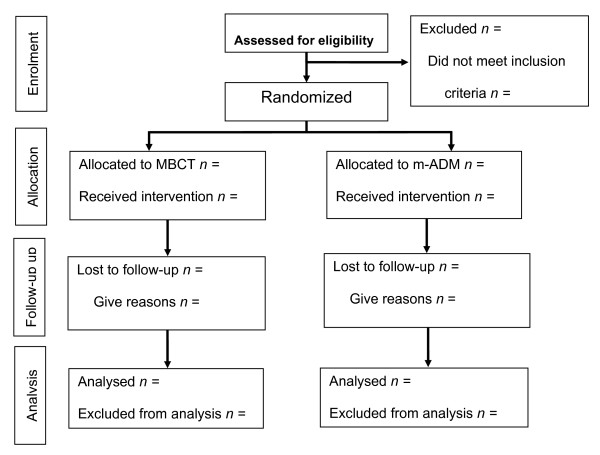
BACKGROUND: Depression is a common and distressing mental health problem that is responsible for significant individual disability and cost to society. Medication and psychological therapies are effective for treating depression and maintenance anti-depressants (m-ADM) can prevent relapse. However, individuals with depression often express a wish for psychological help that can help them recover from depression in the long-term. We need to develop psychological therapies that prevent depressive relapse/recurrence. A recently developed treatment, Mindfulness-based Cognitive Therapy (MBCT, see http://www.mbct.co.uk) shows potential as a brief group programme for people with recurring depression. In two studies it has been shown to halve the rates of depression recurring compared to usual care.This trial asks the policy research question, is MBCT superior to m-ADM in terms of: a primary outcome of preventing depressive relapse/recurrence over 24 months; and, secondary outcomes of (a) depression free days, (b) residual depressive symptoms, (c) antidepressant (ADM) usage, (d) psychiatric and medical co-morbidity, (e) quality of life, and (f) cost effectiveness? An explanatory research question asks is an increase in mindfulness skills the key mechanism of change? METHODS/DESIGN: The design is a single blind, parallel RCT examining MBCT vs. m-ADM with an embedded process study. To answer the main policy research question the proposed trial compares MBCT plus ADM-tapering with m-ADM for patients with recurrent depression. Four hundred and twenty patients with recurrent major depressive disorder in full or partial remission will be recruited through primary care. Depressive relapse/recurrence over two years is the primary outcome variable. The explanatory question will be addressed in two mutually informative ways: quantitative measurement of potential mediating variables pre/post-treatment and a qualitative study of service users' views and experiences. DISCUSSION: If the results of our exploratory trial are extended to this definitive trial, MBCT will be established as an alternative approach to maintenance anti-depressants for people with a history of recurrent depression. The process studies will provide evidence about the effective components which can be used to improve MBCT and inform theory as well as other therapeutic approaches. TRIAL REGISTRATION NUMBER: ISRCTN26666654.
Overview
The claims and statistics of this paper haven’t been checked yet.
Free: it reads the open-access text and checks the first 5 claims that cite a source we can check. Create a free account to check every claim.
Integrity signals
Registry
Cites
Statistics
Figures
Verification
Claims the paper makes
The claims and statistics of this paper haven’t been checked yet.
Free: it reads the open-access text and checks the first 5 claims that cite a source we can check. Create a free account to check every claim.
Claims other papers make about this one
Each is checked against this paper’s own text: does it say what the citing paper says it does?
The cited source doesn’t support the claim as written.
In the citing paper
“One hundred eighty-eight plwMND will be recruited from approximately 14 sites. This will allow detection of an effect size of 0.44 standard deviations, with a two-sided alpha of 5% and 90% power.”
From A randomised controlled trial of acceptance and commitment therapy plus usual care compared to usual care alone for improving psychological health in people with motor neuron disease (COMMEND): study protocol. (2022) · cites this paper as [60]
Checked by a reasoning model — may be wrong.
Experimental — accuracy not yet measuredThe source backs part of the claim, not all of it — or backs it for a different population, condition or comparison.
In the citing paper
“We used interaction terms to undertake predefi ned exploratory subgroup analyses on the primary outcome, across the stratifi cation variables (recruitment centre and baseline depression severity) and reported childhood abuse.12,32”
From Effectiveness and cost-effectiveness of mindfulness-based cognitive therapy compared with maintenance antidepressant treatment in the prevention of depressive relapse or recurrence (PREVENT): a randomised controlled trial (2015) · cites this paper as [32]
Experimental — accuracy not yet measuredThe cited source says what the claim attributes to it.
In the citing paper
“We aimed to recruit 188 people with motor neuron disease (94 per group) to have 90% power to detect an effect size of 0·44 SD, with a two-sided alpha of 5%, allowing for 20% attrition at 6 months post-randomisation, 36 an intraclass correlation coefficient of 0·01 among therapists (as used previously 37 ), and a correlation of 0·58 between baseline and 6 months post-randomisation for the”
Self-check
Percentages, sums and reported differences re-computed from the paper’s own numbers.
The self-check needs the paper’s full text.
Citations
Cites
An Introduction to the Bootstrap
Efron, B., & Tibshirani, R. J. (1994) · doi:10.1201/9780429246593 · Cited by 40,500
An Introduction to the Bootstrap
Efron, B., & Tibshirani, R. J. (1993) · doi:10.1007/978-1-4899-4541-9 · Cited by 21,230
EuroQol: a new facility for the measurement of health-related quality of life
(1990) · Health Policy · doi:10.1016/0168-8510(90)90421-9 · Cited by 15,736
Cognitive Therapy for Depression: (675542012-001)
(2012) · PsycEXTRA Dataset · doi:10.1037/e675542012-001 · Cited by 9,663
Murray, C. J., & Lopez, A. D. (1997) · The Lancet · doi:10.1016/s0140-6736(96)07492-2 · Cited by 7,007 · cited 1×
“WHO predicts that by 2020 depression will be the second leading cause of disability in the world [3].”
BackgroundEuroQol: the current state of play
Brooks, R. (1996) · Health Policy · doi:10.1016/0168-8510(96)00822-6 · Cited by 5,815 · cited 1×
“Quality of life will be assessed with the EQ-5D health-related quality of life measure [45,46].”
MethodConcurrent and Predictive Validity of a Self-reported Measure of Medication Adherence
Morisky, D. E., Green, L. W., & Levine, D. M. (1986) · Medical Care · doi:10.1097/00005650-198601000-00007 · Cited by 5,317 · cited 1×
“Medication adherence will be monitored through patients’ self-report using the Adult Service Use Schedule (AD-SUS) [33] and the Morisky Medication Adherence Instrument [34] and through manual checks of the GP practice databases at 12 and 24 month follow-ups.”
MethodCognitive Therapy of Depression
HOLLON, S. D., & BECK, A. T. (1979) · Cognitive-Behavioral Interventions · doi:10.1016/b978-0-12-404480-7.50012-5 · Cited by 4,685
Mindfulness training as a clinical intervention: a conceptual and empirical review
Baer, R. A. (2003) · Clinical Psychology: Science and Practice · doi:10.1093/clipsy.bpg015 · Cited by 4,577 · cited 1×
“Narrative reviews of the broad class of mindfulness-based approaches suggest that they produce substantial improvements on measures of depressive symptoms compared with control groups: Cohen’s d (or standardised mean difference) = .86, SD = .3 [ 18 ]; Cohen’ sd=.”
BackgroundMindfulness training as a clinical intervention: A conceptual and empirical review.
Baer, R. A. (2003) · Clinical Psychology: Science and Practice · doi:10.1093/clipsy/bpg015 · Cited by 4,576
Cited by
Mindfulness-based therapy: a comprehensive meta-analysis
Khoury, B., Lecomte, T., Fortin, G., Masse, M., Therien, P., Bouchard, V., Chapleau, M.-A., Paquin, K., & Hofmann, S. G. (2013) · Clinical Psychology Review · doi:10.1016/j.cpr.2013.05.005 · Cited by 2,003
“It is assumed that mindfulness is a central mechanism of MBT (e.g., Bränström, Kvillemo, Brandberg, & Moskowitz, 2010; Greeson et al., 2011; Kuyken et al., 2010; Shahar, Britton, Sbarra, Figueredo, & Bootzin, 2010) that might enhance positive affect, decrease negative affect, and reduce maladaptive…”
BackgroundKuyken, W., Hayes, R., Barrett, B., Byng, R., Dalgleish, T., Kessler, D., Lewis, G., Watkins, E., Brejcha, C., Cardy, J., et al. (2015) · The Lancet · doi:10.1016/s0140-6736(14)62222-4 · Cited by 527
“There is therefore a discrepancy between the published protocol that does not list the WHOQOL as a secondary outcome (Kuyken et al, 2010) and this outcome paper, which does report it.”
ResultSelf-citationWilliams, M. J., Dalgleish, T., Karl, A., & Kuyken, W. (2014) · Psychological Assessment · doi:10.1037/a0035566 · Cited by 321
Self-citationBockting, C. L., Hollon, S. D., Jarrett, R. B., Kuyken, W., & Dobson, K. (2015) · Clinical Psychology Review · doi:10.1016/j.cpr.2015.02.003 · Cited by 295
Self-citationMindfulness-Based Cognitive Therapy: Theory and Practice
Sipe, W. E. B., & Eisendrath, S. J. (2012) · The Canadian Journal of Psychiatry · doi:10.1177/070674371205700202 · Cited by 285
Metadata
- Authors
- Kuyken, W., Byford, S., Byng, R., Dalgleish, T., Lewis, G., Taylor, R., Watkins, E. R., Hayes, R., Lanham, P., Kessler, D., Morant, N., & Evans, A.
- Affiliations
- University of Exeter (GB)
- King's College London (GB)
- Peninsula College of Medicine and Dentistry (GB)
- MRC Cognition and Brain Sciences Unit (GB)
- University of Bristol (GB)
- University of London (GB)
- University of Cambridge (GB)
- Corresponding author
- Kuyken, Willem
- ORCID
- Venue
- Trials
- Published
- 2010-10-20
- Volume
- 11
- Issue
- 1
- Pages
- 99-99
- ISSN
- 1745-6215 (ISSN-L)
- PMC
- PMC2972263
- OpenAlex
- W2113827681
- Cited by
- 48
- References
- 56
- Citations by year
- 2024: 3 · 2023: 2 · 2022: 3 · 2021: 2 · 2020: 1 · 2019: 1 · 2018: 2 · 2017: 2 · 2016: 8 · 2015: 4 · 2014: 9 · 2013: 4 · 2012: 6
- FWCI
- 3.86
- Type
- journal article
- Language
- en
- Open access
- gold
- doi.org
- Licence
- cc-by
- creativecommons.org/licenses/by/2.0 (tdm)
- Locations
- Trials (publishedVersion, cc-by)
- PubMed Central (publishedVersion, cc-by)
- PubMed (publishedVersion)
- ENLIGHTEN (Jurnal Bimbingan dan Konseling Islam) (acceptedVersion)
- DOAJ (DOAJ: Directory of Open Access Journals) (submittedVersion)
- UCL Discovery (University College London) (submittedVersion)
- Figshare (submittedVersion)
- Research Portal (King's College London) (submittedVersion)
- Open Research Exeter (University of Exeter) (submittedVersion, cc-by)
- PEARL (University of Plymouth) (submittedVersion)
- Explore Bristol Research (submittedVersion)
- Bristol Research (University of Bristol) (submittedVersion)
- Apollo (University of Cambridge) (submittedVersion, cc-by)
- Funders
- National Institute for Health and Care Research (08/56/01)
- Bangor University
- National Institutes of Health
- Health Technology Assessment Programme (08/56/01)
- Topics
- Social Sciences › Psychology › Clinical Psychology › Mindfulness and Compassion Interventions
- Health Sciences › Medicine › Pharmacology (medical) › Treatment of Major Depression
- Social Sciences › Psychology › Experimental and Cognitive Psychology › Anxiety, Depression, Psychometrics, Treatment, Cognitive Processes
- Keywords
- mindfulness-based cognitive therapy, recurrent major depressive disorder, depression relapse prevention, antidepressant tapering, mechanisms of change, mindfulness skills, cost-effectiveness, quality of life, primary care
- MeSH terms
- Antidepressive Agents, Clinical Protocols, Cost-Benefit Analysis, Major Depressive Disorder, Humans, Quality of Life, Research Design, Time Factors, Cognitive Behavioral Therapy, Single-Blind Method, Drug Costs, Treatment Outcome, Health Care Costs, Secondary Prevention
About these checks
Registry, retraction, Cites and statistics results are computed, not judged, with one exception: a printed reference that no index lists is read once by a model before it counts as a citation error. Claims are extracted by a model and kept only when their quote appears verbatim in the text; each cited source is then checked, with a model’s help, for whether it says what the claim relies on. Those verdicts can be wrong — read the claim’s quote and the cited source before relying on one.
Statistics and arithmetic are recomputed, not judged.
Confidence bands are shown only for fields calibrated on our annotated test set. None is calibrated yet, so no band is shown.
What counts as a claim ›How we measure confidence ›How we check this ›
Are you an author, or do you see a problem with this page? Request a review
How to cite
Cite CoChat for the checks on this page, and the paper for its own findings.
- This page
- CoChat. (2026). Citation check: Study protocol for a randomized controlled trial comparing mindfulness-based cognitive therapy with maintenance anti-depressant treatment in the prevention of depressive relapse/recurrence: the PREVENT trial. https://app.cochat.ai/papers/10.1186/1745-6215-11-99
- The paper
- Kuyken, W., Byford, S., Byng, R., Dalgleish, T., Lewis, G., Taylor, R., Watkins, E. R., Hayes, R., Lanham, P., Kessler, D., Morant, N., & Evans, A. (2010). Study protocol for a randomized controlled trial comparing mindfulness-based cognitive therapy with maintenance anti-depressant treatment in the prevention of depressive relapse/recurrence: the PREVENT trial. Trials. https://doi.org/10.1186/1745-6215-11-99
Data sources
Bibliographic data: Semantic Scholar, OpenAlex, Crossref.
Contains information from the Semantic Scholar Academic Graph Datasets, made available under the ODC Attribution License (ODC-BY 1.0).
Semantic Scholar’s data is described in: Kinney, R., et al. (2023). The Semantic Scholar Open Data Platform. arXiv:2301.10140.
