

The DOI matches its Crossref record; 61 of the 63 references it cites were found in a registry or an index.
Preventing relapse in recurrent depression using mindfulness-based cognitive therapy, antidepressant medication or the combination: trial design and protocol of the MOMENT study
Open accessAbstract
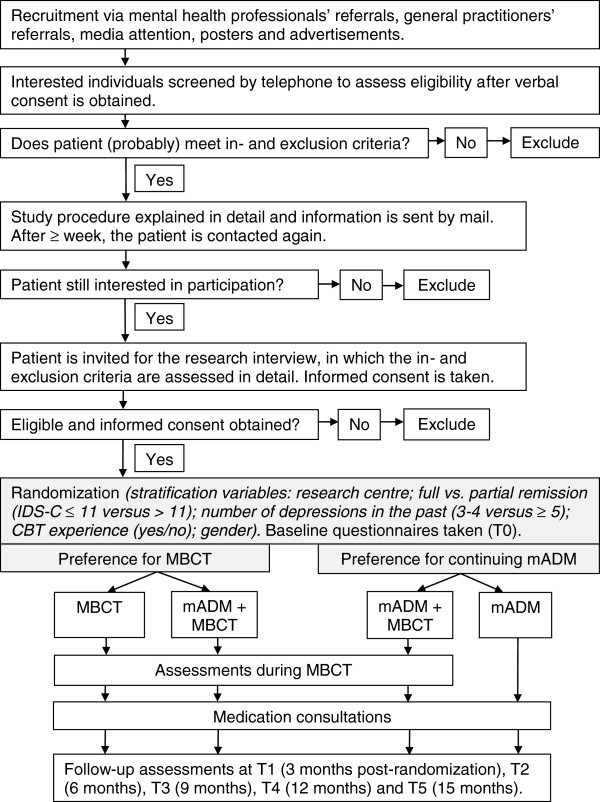
BACKGROUND: Depression is a common psychiatric disorder characterized by a high rate of relapse and recurrence. The most commonly used strategy to prevent relapse/recurrence is maintenance treatment with antidepressant medication (mADM). Recently, it has been shown that Mindfulness-Based Cognitive Therapy (MBCT) is at least as effective as mADM in reducing the relapse/recurrence risk. However, it is not yet known whether combination treatment of MBCT and mADM is more effective than either of these treatments alone. Given the fact that most patients have a preference for either mADM or for MBCT, the aim of the present study is to answer the following questions. First, what is the effectiveness of MBCT in addition to mADM? Second, how large is the risk of relapse/recurrence in patients withdrawing from mADM after participating in MBCT, compared to those who continue to use mADM after MBCT? METHODS/DESIGN: Two parallel-group, multi-center randomized controlled trials are conducted. Adult patients with a history of depression (3 or more episodes), currently either in full or partial remission and currently treated with mADM (6 months or longer) are recruited. In the first trial, we compare mADM on its own with mADM plus MBCT. In the second trial, we compare MBCT on its own, including tapering of mADM, with mADM plus MBCT. Follow-up assessments are administered at 3-month intervals for 15 months. Primary outcome is relapse/recurrence. Secondary outcomes are time to, duration and severity of relapse/recurrence, quality of life, personality, several process variables, and incremental cost-effectiveness ratio. DISCUSSION: Taking into account patient preferences, this study will provide information about a) the clinical and cost-effectiveness of mADM only compared with mADM plus MBCT, in patients with a preference for mADM, and b) the clinical and cost-effectiveness of withdrawing from mADM after MBCT, compared with mADM plus MBCT, in patients with a preference for MBCT. TRIAL REGISTRATION: ClinicalTrials.gov: NCT00928980.
Overview
The claims and statistics of this paper haven’t been checked yet.
Free: it reads the open-access text and checks the first 5 claims that cite a source we can check. Create a free account to check every claim.
Integrity signals
Registry
Cites
Statistics
Figures
Verification
Claims the paper makes
The claims and statistics of this paper haven’t been checked yet.
Free: it reads the open-access text and checks the first 5 claims that cite a source we can check. Create a free account to check every claim.
Claims other papers make about this one
Each is checked against this paper’s own text: does it say what the citing paper says it does?
The source backs part of the claim, not all of it — or backs it for a different population, condition or comparison.
In the citing paper
“It may therefore be useful to reassure HPs that the risk of relapse may be minimised if discontinuation is accompanied by appropriate psychological support (although there is still a need for further work on providing support for patients who are discontinuing antidepressants).34 38 39”
From Helping people discontinue long-term antidepressants: views of health professionals in UK primary care (2019) · cites this paper as [39]
Experimental — accuracy not yet measuredThe cited source says what the claim attributes to it.
In the citing paper
“For the sample size calculation we refer to the published protocol (Huijbers et al., 2012).A total of 96 participants (48 per group) was needed to demonstrate a difference of 25%, with a power of 0.80 and alpha of 0.05.”
From Adding mindfulness-based cognitive therapy to maintenance antidepressant medication for prevention of relapse/recurrence in major depressive disorder: Randomised controlled trial (2015) · cites this paper as Huijbers et al., 2012
Self-check
Percentages, sums and reported differences re-computed from the paper’s own numbers.
The self-check needs the paper’s full text.
Citations
Cites
Diagnostic and Statistical Manual of Mental Disorders
Williams, J. B. W., & First, M. (2013) · Encyclopedia of Social Work · doi:10.1093/acrefore/9780199975839.013.104 · Cited by 109,519
Preacher, K. J., & Hayes, A. F. (2008) · Behavior Research Methods · doi:10.3758/brm.40.3.879 · Cited by 34,117 · cited 2×
“In this subsample, we will test the mediating effect of adherence to MBCT, rumination, cognitive reactivity, mindfulness skills, and self-compassion, on depressive relapse/recurrence and depression severity as outcomes, using a multiple mediation model following the approach suggested by Preacher and Hayes [57].”
Diagnostic and Statistical Manual of Mental Disorders.
Widiger, T. A. (2000) · Encyclopedia of Psychology, Vol. 3. · doi:10.1037/10518-009 · Cited by 19,744
(1998) · The Journal of Clinical Psychiatry · Cited by 19,139
EuroQol: a new facility for the measurement of health-related quality of life
(1990) · Health Policy · doi:10.1016/0168-8510(90)90421-9 · Cited by 15,736
Depression and quality of life in older persons: A review
Sivertsen, H., Bjørkløf, G. H., Engedal, K., Selbæk, G., & Helvik, A.-S. (2015) · Dementia and Geriatric Cognitive Disorders · doi:10.1159/000437299 · Cited by 14,152
The benefits of being present: Mindfulness and its role in psychological well-being
Brown, K. W., & Ryan, R. M. (2003) · Journal of Personality and Social Psychology · doi:10.1037/0022-3514.84.4.822 · Cited by 13,448 · cited 1×
“The Mindful Attention Awareness Scale (MAAS [49]) is administered before each MBCT session to assess mindful attention in daily life.”
(1998) · PubMed · Cited by 10,216
Cognitive Therapy for Depression: (675542012-001)
(2012) · PsycEXTRA Dataset · doi:10.1037/e675542012-001 · Cited by 9,663
Development of the World Health Organization WHOQOL-BREF Quality of Life Assessment
THE WHOQOL GROUP (1998) · Psychological Medicine · doi:10.1017/s0033291798006667 · Cited by 7,933
Research works printed but not linked: 6
- National Institute for Clinical Excellence: Depression: management of depression in primary and secondary care. 2004, London: National Institute for Health and Clinical Excellence, NICE guidance
- First MB, Gibbon M, Spitzer RL, Williams JBW: User Guide for the Structured Clinical Interview for DSM-IV Axis 1 Disorders. 1996, Washington, DC: American Psychiatric Association
- Akkerhuis GW: Vertaling IDS. 1997, Utrecht: H.C. Rümke Groep
- Moleman P: Praktische psychofarmacologie. 2009, Houten: Prelum
- Costa PT, McCrae RR: Revised NEO Personality Inventory (NEO-PI-R) and the Five Factor Inventory (NEO-FFI): Professional Manual. 1992, Odessa, Florida: Psychological Assessment Resources Inc
- Oostenbrink JB, Bouwmans CAM, Koopmanschap MA, Rutten FFH: Handleiding voor kostenonderzoek. Methoden en standaard kostprijzen voor economische evaluaties in de gezondheidszorg. Geactualiseerde versie. 2004, Diemen: College voor zorgverzekeringen, 2004-
Cited by
Kuyken, W., Warren, F. C., Taylor, R. S., Whalley, B., Crane, C., Bondolfi, G., Hayes, R., Huijbers, M., Ma, H., Schweizer, S., et al. (2016) · JAMA Psychiatry · doi:10.1001/jamapsychiatry.2016.0076 · Cited by 821
Self-citationBockting, C. L., Hollon, S. D., Jarrett, R. B., Kuyken, W., & Dobson, K. (2015) · Clinical Psychology Review · doi:10.1016/j.cpr.2015.02.003 · Cited by 295
Self-citationCrane, R. S., Eames, C., Kuyken, W., Hastings, R. P., Williams, J. M. G., Bartley, T., Evans, A., Silverton, S., Soulsby, J. G., & Surawy, C. (2013) · Assessment · doi:10.1177/1073191113490790 · Cited by 255
“Such research is in progress as part of a large MBCT trial in the Netherlands (Huijbers et al., 2012).”
BackgroundMethodSelf-citationPsychological therapies for treatment-resistant depression in adults
Ijaz, S., Davies, P., Williams, C. J., Kessler, D., Lewis, G., & Wiles, N. (2018) · Cochrane Database of Systematic Reviews · doi:10.1002/14651858.cd010558.pub2 · Cited by 155
Sundquist, J., Lilja, Å., Palmér, K., Memon, A. A., Wang, X., Johansson, L. M., & Sundquist, K. (2015) · British Journal of Psychiatry · doi:10.1192/bjp.bp.114.150243 · Cited by 123
Metadata
- Authors
- Huijbers, M. J., Spijker, J., Donders, A. R. T., van Schaik, D. J., van Oppen, P., Ruhé, H. G., Blom, M. B. J., Nolen, W. A., Ormel, J., van der Wilt, G. J., Kuyken, W., Spinhoven, P., & Speckens, A. E. M.
- Affiliations
- Radboud University Nijmegen (NL)
- Pro Persona (NL)
- Amsterdam UMC Location University of Amsterdam (NL)
- Parnassia Groep (NL)
- University Medical Center Groningen (NL)
- University of Exeter (GB)
- Leiden University (NL)
- Corresponding author
- Huijbers, Marloes J
- ORCID
- Venue
- BMC Psychiatry
- Published
- 2012-08-27
- Volume
- 12
- Issue
- 1
- Pages
- 125-125
- ISSN
- 1471-244X (ISSN-L)
- PMC
- PMC3469366
- OpenAlex
- W2145168537
- Cited by
- 53
- References
- 63
- Citations by year
- 2025: 1 · 2024: 1 · 2022: 1 · 2021: 1 · 2020: 4 · 2019: 7 · 2018: 3 · 2017: 6 · 2016: 11 · 2015: 6 · 2014: 6 · 2013: 5 · 2012: 1
- FWCI
- 6.55
- Type
- journal article
- Language
- en
- Open access
- gold
- doi.org
- Licence
- Locations
- BMC Psychiatry (publishedVersion, cc-by)
- Europe PMC (PubMed Central) (publishedVersion, cc-by)
- PubMed Central (publishedVersion, cc-by)
- PubMed (publishedVersion)
- University of Groningen research database (University of Groningen / Centre for Information Technology) (publishedVersion, cc-by)
- Pure Amsterdam UMC (acceptedVersion, other-oa)
- Radboud Repository (Radboud University) (submittedVersion)
- Data Archiving and Networked Services (DANS) (submittedVersion)
- Leiden Repository (Leiden University) (submittedVersion)
- Digital Academic REpository of VU University Amsterdam (Vrije Universiteit Amsterdam) (submittedVersion)
- DOAJ (DOAJ: Directory of Open Access Journals) (submittedVersion)
- Radboud Repository (Radboud University) (submittedVersion, other-oa)
- University of Groningen research database (University of Groningen / Centre for Information Technology) (submittedVersion, other-oa)
- Data Archiving and Networked Services (DANS) (submittedVersion, other-oa)
- Funders
- ZonMw (170992903)
- Topics
- Social Sciences › Psychology › Clinical Psychology › Mindfulness and Compassion Interventions
- Health Sciences › Medicine › Pharmacology (medical) › Treatment of Major Depression
- Social Sciences › Psychology › Experimental and Cognitive Psychology › Anxiety, Depression, Psychometrics, Treatment, Cognitive Processes
- Keywords
- recurrent depression, relapse prevention, mindfulness-based cognitive therapy, combination therapy, antidepressant tapering, relapse and recurrence, cost-effectiveness, patient preferences, quality of life
- MeSH terms
- Adult, Antidepressive Agents, Clinical Protocols, Combined Modality Therapy, Cost-Benefit Analysis, Depressive Disorder, Humans, Research, Cognitive Behavioral Therapy, Treatment Outcome, Patient Selection, Secondary Prevention
About these checks
Registry, retraction, Cites and statistics results are computed, not judged, with one exception: a printed reference that no index lists is read once by a model before it counts as a citation error. Claims are extracted by a model and kept only when their quote appears verbatim in the text; each cited source is then checked, with a model’s help, for whether it says what the claim relies on. Those verdicts can be wrong — read the claim’s quote and the cited source before relying on one.
Statistics and arithmetic are recomputed, not judged.
Confidence bands are shown only for fields calibrated on our annotated test set. None is calibrated yet, so no band is shown.
What counts as a claim ›How we measure confidence ›How we check this ›
Are you an author, or do you see a problem with this page? Request a review
How to cite
Cite CoChat for the checks on this page, and the paper for its own findings.
- This page
- CoChat. (2026). Citation check: Preventing relapse in recurrent depression using mindfulness-based cognitive therapy, antidepressant medication or the combination: trial design and protocol of the MOMENT study. https://app.cochat.ai/papers/10.1186/1471-244x-12-125
- The paper
- Huijbers, M. J., Spijker, J., Donders, A. R. T., van Schaik, D. J., van Oppen, P., Ruhé, H. G., Blom, M. B. J., Nolen, W. A., Ormel, J., van der Wilt, G. J., Kuyken, W., Spinhoven, P., & Speckens, A. E. M. (2012). Preventing relapse in recurrent depression using mindfulness-based cognitive therapy, antidepressant medication or the combination: trial design and protocol of the MOMENT study. BMC Psychiatry. https://doi.org/10.1186/1471-244x-12-125
Data sources
Bibliographic data: Semantic Scholar, OpenAlex, Crossref.
Contains information from the Semantic Scholar Academic Graph Datasets, made available under the ODC Attribution License (ODC-BY 1.0).
Semantic Scholar’s data is described in: Kinney, R., et al. (2023). The Semantic Scholar Open Data Platform. arXiv:2301.10140.
