

Strategic use of new generation antidepressants for depression: SUN(^_^)D study protocol
Open accessThe DOI matches its Crossref record; 61 of the 61 references it cites were found in a registry or an index.
Abstract
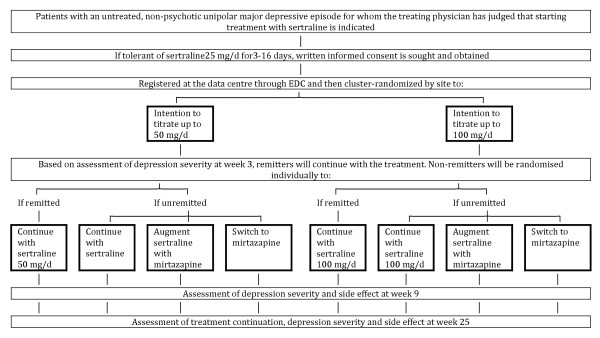
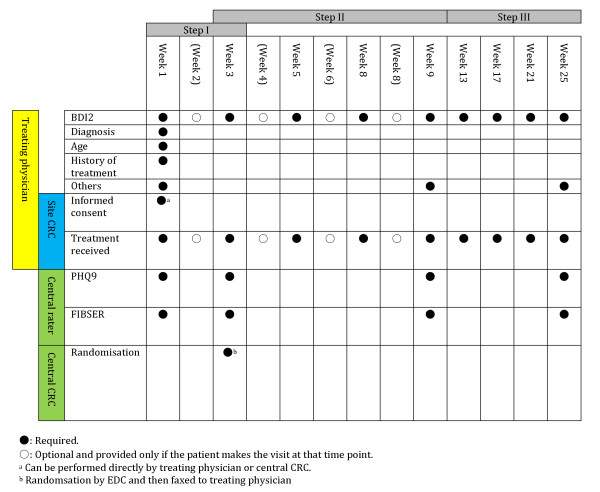
BACKGROUND: After more than half a century of modern psychopharmacology, with billions of dollars spent on antidepressants annually world-wide, we lack good evidence to guide our everyday decisions in conducting antidepressant treatment of patients with major depression. First we did not know which antidepressant to use as first line treatment. Second we do not know which dosage we should be aiming at with that antidepressant. Because more than half of the patients with major depression starting treatment do not remit after adequate trial with the first agent, they will need a second line treatment. Dose escalation, augmentation and switching are the three often recommended second line strategies but we do not know which is better than the others. Moreover, we do not know when to start considering this second line treatment.The recently published multiple-treatments meta-analysis of 12 new generation antidepressants has provided some partial answers to the first question. Starting with these findings, this proposed trial aims to establish the optimum 1st line and 2nd line antidepressant treatment strategy among adult patients with a non-psychotic unipolar major depressive episode. METHODS: SUN(^_^)D, the Strategic Use of New generation antidepressants for Depression, is an assessor-blinded, parallel-group, multi-centre randomised controlled trial. Step I is a cluster-randomised trial comparing titration up to the minimum vs maximum of the recommended dose range among patients starting with sertraline. The primary outcome is the change in the Patient Health Questionnaire (PHQ)-9 scores administered by a blinded rater via telephone at week 1 through 3. Step II is an individually randomised trial comparing staying on sertraline, augmentation of sertraline with mirtazapine, and switching to mirtazapine among patients who have not remitted on the first line treatment by week 3. The primary outcome is the change in the PHQ-9 scores at week 4 through 9. Step III represents a continuation phase to Steps I and II and aims to establish longer-term effectiveness and acceptability of the above-examined treatment strategies up to week 25. The trial is supported by the Grant-in-Aid by the Ministry of Health, Labour and Welfare, Japan. DISCUSSION: SUN(^_^)D promises to be a pragmatic large trial to answer important clinical questions that every clinician treating patients with major depression faces in his/her daily practices concerning its first- and second-line treatments. TRIAL REGISTRATION: ClinicalTrials.gov: NCT01109693.
Overview
The claims and statistics of this paper haven’t been checked yet.
Free: it reads the open-access text and checks the first 5 claims that cite a source we can check. Create a free account to check every claim.
Integrity signals
Registry
Cites
Statistics
Figures
Verification
Claims the paper makes
The claims and statistics of this paper haven’t been checked yet.
Free: it reads the open-access text and checks the first 5 claims that cite a source we can check. Create a free account to check every claim.
Claims other papers make about this one
Each is checked against this paper’s own text: does it say what the citing paper says it does?
The cited source says what the claim attributes to it.
In the citing paper
“Our information unfortunately cannot guide next-step choices after failure of such a first step (ie, they do not apply to treatment-resistant depression), for which well performed trials are scarce.29”
Self-check
Percentages, sums and reported differences re-computed from the paper’s own numbers.
The self-check needs the paper’s full text.
Citations
Cites
Statistical Power Analysis for the Behavioral Sciences
Muller, K. (1989) · Technometrics · doi:10.1080/00401706.1989.10488618 · Cited by 99,167
The PHQ-9: Validity of a brief depression severity measure
Kroenke, K., Spitzer, R. L., & Williams, J. B. W. (2001) · Journal of General Internal Medicine · doi:10.1046/j.1525-1497.2001.016009606.x · Cited by 44,910
Psychometric properties of the Beck Depression Inventory: Twenty-five years of evaluation
Beck, A. T., Steer, R. A., & Carbin, M. G. (1988) · Clinical Psychology Review · doi:10.1016/0272-7358(88)90050-5 · Cited by 11,696 · cited 1×
“In its 40 years of usage, the BDI has become one of the most widely used instruments for detecting possible depression in normal populations and for assessing severity of depression in diagnosed patients [44].”
MethodSpitzer, R. L. (1999) · JAMA · doi:10.1001/jama.282.18.1737 · Cited by 9,802
Kessler, R. C., Berglund, P., Demler, O., Jin, R., Koretz, D., Merikangas, K. R., Rush, A. J., Walters, E. E., & Wang, P. S. (2003) · JAMA · doi:10.1001/jama.289.23.3095 · Cited by 7,988 · cited 1×
“6% lifetime prevalence for American women and men [2] and with 16.”
BackgroundCohen, J. (1992) · Current Directions in Psychological Science · doi:10.1111/1467-8721.ep10768783 · Cited by 5,870
Higgins, S. M. F., Macken, A. P., Cullen, W., Saunders, J., Dunne, C. P., & O’Gorman, C. S. (2013) · PubMed · doi:10.34961/9953 · Cited by 4,808
Trivedi, M. H., Rush, A. J., Wisniewski, S. R., Nierenberg, A. A., Warden, D., Ritz, L., Norquist, G., Howland, R. H., Lebowitz, B., McGrath, P. J., et al. (2006) · American Journal of Psychiatry · doi:10.1176/appi.ajp.163.1.28 · Cited by 3,879 · cited 1×
“return to an euthymic state, after treatment with an adequate dose of antidepressant given for an adequate duration [14].”
BackgroundSelective publication of antidepressant trials and its influence on apparent efficacy
Turner, E. H., Matthews, A. M., Linardatos, E., Tell, R. A., & Rosenthal, R. (2008) · New England Journal of Medicine · doi:10.1056/nejmsa065779 · Cited by 2,435 · cited 1×
“3 [53] and the average effect size of all the health interventions examined in the Cochrane Library appears to be between 0.”
BackgroundThe ESEMeD/MHEDEA 2000 Investigators, Alonso, J., Angermeyer, M. C., Bernert, S., Bruffaerts, R., Brugha, T. S., Bryson, H., de Girolamo, G., de Graaf, R., Demyttenaere, K., et al. (2004) · Acta Psychiatrica Scandinavica · doi:10.1111/j.1600-0047.2004.00327.x · Cited by 1,819 · cited 1×
“Major depression is indeed one of the most prevalent mental disorders in the United States and Europe, with 16.2% and 6.6% lifetime prevalence for American women and men [2] and with 16.5% and 8.9% for European women and men [ 3 ].”
BackgroundInfluentialCipriani, A., Furukawa, T. A., Salanti, G., Geddes, J. R., Higgins, J. P., Churchill, R., Watanabe, N., Nakagawa, A., Omori, I. M., McGuire, H., et al. (2009) · The Lancet · doi:10.1016/s0140-6736(09)60046-5 · Cited by 1,654 · cited 1×
“However, in 2009, the research group from Japan, Italy and UK published the results of a systematic review of 117 RCTs (25928 subjects) of 12 new generation antidepressants in the acute phase treatment of major depression [13].”
BackgroundSelf-citationMonitoring Depression Treatment Outcomes With the Patient Health Questionnaire-9
L??we, B., Un??tzer, J., Callahan, C. M., Perkins, A. J., & Kroenke, K. (2004) · Medical Care · doi:10.1097/00005650-200412000-00006 · Cited by 1,354 · cited 2×
“The sensitivity to change is as good as or better than extant scales [42].”
BackgroundBupropion-SR, Sertraline, or Venlafaxine-XR after Failure of SSRIs for Depression
Rush, A. J., Trivedi, M. H., Wisniewski, S. R., Stewart, J. W., Nierenberg, A. A., Thase, M. E., Ritz, L., Biggs, M. M., Warden, D., Luther, J. F., et al. (2006) · New England Journal of Medicine · doi:10.1056/nejmoa052963 · Cited by 1,033 · cited 1×
“For example, the Sequenced Treatment Alternatives to Relieve Depression (STAR*D), which was funded by the NIMH and cost approximately 3 million dollars, examined five switching strategies and four augmentation strategies among the patients who had not achieved remission to the 1 line SSRI treatment but was unable to c…”
MethodPosner, K., Oquendo, M. A., Gould, M., Stanley, B., & Davies, M. (2007) · American Journal of Psychiatry · doi:10.1176/ajp.2007.164.7.1035 · Cited by 1,025 · cited 2×
“12) Suicidality as assessed with C-CASA between week 1 and week 9 13) Manic/hypomanic/mixed episode between week 1 and week 9 14) Serious adverse events between week 1 and week 9 Step II Patients: Patients whose major depressive episode did not remit (5 or more on PHQ9) at week 3 to the 1st line treatment with sertral…”
MethodWells, K. B., Sherbourne, C., Schoenbaum, M., Duan, N., Meredith, L., Unützer, J., Miranda, J., Carney, M. F., & Rubenstein, L. V. (2000) · JAMA · doi:10.1001/jama.283.2.212 · Cited by 1,021 · cited 1×
“5) A number of previous studies have repeatedly reported negligible to very small intra-cluster correlation coefficients [37,38].”
BackgroundMedication Augmentation after the Failure of SSRIs for Depression
Trivedi, M. H., Fava, M., Wisniewski, S. R., Thase, M. E., Quitkin, F., Warden, D., Ritz, L., Nierenberg, A. A., Lebowitz, B. D., Biggs, M. M., et al. (2006) · New England Journal of Medicine · doi:10.1056/nejmoa052964 · Cited by 1,002 · cited 1×
“For example, the Sequenced Treatment Alternatives to Relieve Depression (STAR*D), which was funded by the NIMH and cost approximately 3 million dollars, examined five switching strategies and four augmentation strategies among the patients who had not achieved remission to the 1 line SSRI treatment but was unable to c…”
MethodDistributed Disturbances in Brain Structure and Function in Schizophrenia
(2000) · American Journal of Psychiatry · doi:10.1176/ajp.157.1.1 · Cited by 969
Bruce, M. L., Ten Have, T. R., Reynolds III, C. F., Katz, I. I., Schulberg, H. C., Mulsant, B. H., Brown, G. K., McAvay, G. J., Pearson, J. L., & Alexopoulos, G. S. (2004) · JAMA · doi:10.1001/jama.291.9.1081 · Cited by 963 · cited 1×
“5) A number of previous studies have repeatedly reported negligible to very small intra-cluster correlation coefficients [37,38].”
BackgroundRelapse prevention with antidepressant drug treatment in depressive disorders: a systematic review
Geddes, J. R., Carney, S. M., Davies, C., Furukawa, T. A., Kupfer, D. J., Frank, E., & Goodwin, G. M. (2003) · The Lancet · doi:10.1016/s0140-6736(03)12599-8 · Cited by 945 · cited 1×
“A systematic review has unambiguously demonstrated that discontinuing antidepressants at the end of acute phase treatment can double the relapse/recurrence rates [34], and all the guidelines recommend continuation treatment of at least several months following acute phase treatment.”
BackgroundSelf-citationThe WHO World Mental Health Surveys: Global Perspectives on the Epidemiology of Mental Disorders
Kessler, R. C., & Üstün, T. B. (2008) · Cited by 872
Stone, M., Laughren, T., Jones, M. L., Levenson, M., Holland, P. C., Hughes, A., Hammad, T. A., Temple, R., & Rochester, G. (2009) · BMJ · doi:10.1136/bmj.b2880 · Cited by 609 · cited 1×
“Nb 1) A comprehensive systematic review and meta-analysis has shown that antidepressants increase suicidality in comparison with placebo for people under age 25 but decreases suicidality for people aged 25 or older [36].”
BackgroundSpitzer, R. L., Williams, J. B. W., & Kroenke, K. (2011) · PsycTESTS Dataset · doi:10.1037/t02598-000 · Cited by 581
Nelson, J. C., & Papakostas, G. I. (2009) · American Journal of Psychiatry · doi:10.1176/appi.ajp.2009.09030312 · Cited by 552 · cited 1×
“The ones with most randomized evidence include lithium augmentation [22], thyroid hormone augmentation [23] and augmentation with atypical antipsychotics [24].”
BackgroundTriiodothyronine Augmentation in the Treatment of Refractory Depression: A Meta-analysis
Aronson, R. (1996) · Archives of General Psychiatry · doi:10.1001/archpsyc.1996.01830090090013 · Cited by 488 · cited 1×
“The ones with most randomized evidence include lithium augmentation [22], thyroid hormone augmentation [23] and augmentation with atypical antipsychotics [24].”
BackgroundKroenke, K., Bair, M. J., Damush, T. M., Wu, J., Hoke, S., Sutherland, J., & Tu, W. (2009) · JAMA · doi:10.1001/jama.2009.723 · Cited by 447 · cited 1×
“Previous studies using PHQ9 in the acute phase treatment of major depression have shown that, on average, the PHQ9 scores will drop from 15 (SD = 5) at baseline to 10 (SD = 6) at end of treatment, with a mean change of 5 (SD = 5) [49-51].”
MethodMuramatsu, K., Kamijima, K., Yoshida, M., Otsubo, T., Miyaoka, H., Muramatsu, Y., & Gejyo, F. (2007) · Psychological Reports · doi:10.2466/pr0.101.3.952-960 · Cited by 433 · cited 1×
“The Japanese version has been established by Muramatsu through backtranslation [43].”
MethodSpitzer, R. L. (1999) · Medical Entomology and Zoology · Cited by 429
Assessing depression in primary care with the PHQ-9: Can it be carried out over the telephone?
Pinto-Meza, A., Serrano-Blanco, A., Peñarrubia, M. T., Blanco, E., & Haro, J. M. (2005) · Journal of General Internal Medicine · doi:10.1111/j.1525-1497.2005.0144.x · Cited by 347 · cited 1×
“92) [40] and internal consistency reliability (Cronbach’s alpha = 0.”
BackgroundCollaborative Care for Chronic Pain in Primary Care: A Cluster Randomized Trial
Dobscha, S. K., Corson, K., Perrin, N. A., Hanson, G. C., Leibowitz, R. Q., Doak, M. N., Dickinson, K. C., Sullivan, M. D., & Gerrity, M. S. (2009) · JAMA · doi:10.1001/jama.2009.377 · Cited by 330 · cited 1×
“Previous studies using PHQ9 in the acute phase treatment of major depression have shown that, on average, the PHQ9 scores will drop from 15 (SD = 5) at baseline to 10 (SD = 6) at end of treatment, with a mean change of 5 (SD = 5) [49-51].”
MethodBlier, P., Ward, H. E., Tremblay, P., Laberge, L., Hébert, C., & Bergeron, R. (2010) · American Journal of Psychiatry · doi:10.1176/appi.ajp.2009.09020186 · Cited by 316 · cited 1×
“Another RCT administered fluoxetine plus mirtazapine or fluoxetine alone from the beginning of the acute phase treatment and the remission rates were 25% vs 52% (p = 0.052) [ 33 ].”
BackgroundInfluentialSertraline versus other antidepressive agents for depression
Cipriani, A., La Ferla, T., Furukawa, T. A., Signoretti, A., Nakagawa, A., Churchill, R., McGuire, H., & Barbui, C. (2009) · Cochrane Database of Systematic Reviews · doi:10.1002/14651858.cd006117.pub2 · Cited by 305 · cited 1×
“2 line treatment Even if we optimize the 1 line antidepressant treatment strategy, more than half the patients cannot achieve remission [32].”
BackgroundSelf-citationSertraline versus other antidepressive agents for depression
Cipriani, A., La Ferla, T., Furukawa, T. A., Signoretti, A., Nakagawa, A., Churchill, R., McGuire, H., & Barbui, C. (2010) · Cochrane Database of Systematic Reviews · doi:10.1002/14651858.cd006117.pub4 · Cited by 299
Self-citationClinician-Assisted Internet-Based Treatment is Effective for Panic: A Randomized Controlled Trial
Wims, E., Titov, N., Andrews, G., & Choi, I. (2010) · Australian & New Zealand Journal of Psychiatry · doi:10.3109/00048671003614171 · Cited by 290 · cited 1×
“Previous studies using PHQ9 in the acute phase treatment of major depression have shown that, on average, the PHQ9 scores will drop from 15 (SD = 5) at baseline to 10 (SD = 6) at end of treatment, with a mean change of 5 (SD = 5) [49-51].”
MethodMuramatsu, K. (2007) · Psychological Reports · doi:10.2466/pr0.101.7.952-960 · Cited by 277
Clinical guidelines for the treatment of depressive disorders.
(2001) · PubMed · Cited by 274
Crossley, N. A., & Bauer, M. (2007) · The Journal of Clinical Psychiatry · doi:10.4088/jcp.v68n0617 · Cited by 246 · cited 1×
“The ones with most randomized evidence include lithium augmentation [22], thyroid hormone augmentation [23] and augmentation with atypical antipsychotics [24].”
BackgroundA double-blind, placebo-controlled study of antidepressant augementation with mirtazapine
Carpenter, L. L., Yasmin, S., & Price, L. H. (2002) · Biological Psychiatry · doi:10.1016/s0006-3223(01)01262-8 · Cited by 244 · cited 2×
“Other options include augmentation with mirtazapine/mianserin [21,25,26] and augmentation with pindolol [27].”
BackgroundGartlehner, G., Gaynes, B. N., Hansen, R. A., Thieda, P., DeVeaugh-Geiss, A., Krebs, E. E., Moore, C. G., Morgan, L., & Lohr, K. N. (2008) · Annals of Internal Medicine · doi:10.7326/0003-4819-149-10-200811180-00008 · Cited by 237 · cited 1×
“However, all the guidelines up to 2008, including the one by the American Psychiatric Association [7], the one by the Canadian Psychiatric Association [8], the one by the National Institute of Clinical Excellence in the United Kingdom [9] and the Japanese one [10], recommend that the choice of antidepressants be made…”
BackgroundClinician-Assisted Internet-Based Treatment is Effective for Depression: Randomized Controlled Trial
Perini, S., Titov, N., & Andrews, G. (2009) · Australian & New Zealand Journal of Psychiatry · doi:10.1080/00048670902873722 · Cited by 231 · cited 1×
“Previous studies using PHQ9 in the acute phase treatment of major depression have shown that, on average, the PHQ9 scores will drop from 15 (SD = 5) at baseline to 10 (SD = 6) at end of treatment, with a mean change of 5 (SD = 5) [49-51].”
MethodRuhé, H. G., Huyser, J., Swinkels, J. A., & Schene, A. H. (2006) · The Journal of Clinical Psychiatry · doi:10.4088/jcp.v67n1203 · Cited by 230 · cited 2×
“When different switching options are compared, switching to venlafaxine after failure to respond on an SSRI may be marginally better than switching to another SSRI but there was no strong evidence to recommend other classes of antidepressants [20].”
BackgroundResultCuijpers, P., van Straten, A., van Oppen, P., & Andersson, G. (2008) · The Journal of Clinical Psychiatry · doi:10.4088/jcp.v69n1102 · Cited by 219 · cited 1×
“Both pharmacotherapy and psychotherapy have been found to be equally effective in treating major depression [5] but the former remains the mainstay in everyday clinical practices due to its greater availability, tighter quality control and cheaper costs.”
BackgroundPartial Response and Nonresponse to Antidepressant Therapy: Current Approaches and Treatment Options
Hirschfeld, R. M. A., Montgomery, S. A., Aguglia, E., Amore, M., Delgado, P. L., Gastpar, M., Hawley, C., Kasper, S., Linden, M., Massana, J., et al. (2002) · The Journal of Clinical Psychiatry · doi:10.4088/jcp.v63n0913 · Cited by 193 · cited 1×
“Guidelines recommendations for the 2 line treatment include dose escalation, switching to a different antidepressant possibly from a different class and augmentation [9,15].”
BackgroundHiroe, T., Kojima, M., Yamamoto, I., Nojima, S., Kinoshita, Y., Hashimoto, N., Watanabe, N., Maeda, T., & Furukawa, T. A. (2005) · Psychiatry Research · doi:10.1016/j.psychres.2004.03.014 · Cited by 176 · cited 3×
“A rough guide for interpreting the changes in BDI2 scores may be [46]”
BackgroundMethodSelf-citationAdli, M., Baethge, C., Heinz, A., Langlitz, N., & Bauer, M. (2005) · European Archives of Psychiatry and Clinical Neuroscience · doi:10.1007/s00406-005-0579-5 · Cited by 174 · cited 1×
“First, with regard to dose escalation strategy, three systematic reviews have been published and all concluded that there is no evidence to suggest that dose escalation increases efficacy in comparison with continuing on the same dosage after failure to respond to the 1 line antidepressant [16-18].”
BackgroundQaseem, A., Snow, V., Denberg, T. D., Forciea, M. A., & Owens, D. K. (2008) · Annals of Internal Medicine · doi:10.7326/0003-4819-149-10-200811180-00007 · Cited by 165 · cited 2×
“For example, the guideline by the American College of Physicians [ 11 ] recommends that clinicians modify treatment if the patient does not have an adequate response to pharmacotherapy within 6 to 8 weeks of the initiation of therapy but this time frame appears to be based on the average length of clinical trials cond…”
BackgroundMean Beck Depression Inventory–II Scores by Severity of Major Depressive Episode
Steer, R. A., Brown, G. K., Beck, A. T., & Sanderson, W. C. (2001) · Psychological Reports · doi:10.2466/pr0.2001.88.3c.1075 · Cited by 148 · cited 1×
“0-13 Minimal 14-19 Mild 20-28 Moderate 29-63 Severe Two subsequent studies from the US and from Japan basically confirmed these interpretations [46,47].”
BackgroundClinical Guidelines for the Treatment of Depressive Disorders VII. Comorbidity
Enns, M. W., Swenson, J. R., McIntyre, R. S., Swinson, R. P., Kennedy, S. H., & The CANMAT Depression Work Group (2001) · The Canadian Journal of Psychiatry · doi:10.1177/070674372001460101007 · Cited by 136
Association Between Unreported Outcomes and Effect Size Estimates in Cochrane Meta-analyses
Furukawa, T. A., Watanabe, N., Omori, I. M., Montori, V. M., & Guyatt, G. H. (2007) · JAMA · doi:10.1001/jama.297.5.468-b · Cited by 115 · cited 1×
“4 [54], we consider this to be a clinically meaningful difference in effectiveness worth detecting in a large clinical trial.”
BackgroundSelf-citationFrom effect size into number needed to treat
Furukawa, T. A. (1999) · The Lancet · doi:10.1016/s0140-6736(99)01163-0 · Cited by 114
Self-citationLicht, R. W., & Qvitzau, S. (2002) · Psychopharmacology · doi:10.1007/s00213-002-0999-0 · Cited by 112 · cited 1×
“Other options include augmentation with mirtazapine/mianserin [21,25,26] and augmentation with pindolol [27].”
BackgroundFerreri, M., Lavergne, F., Berlin, I., Payan, C., & Puech, A. J. (2001) · Acta Psychiatrica Scandinavica · doi:10.1034/j.1600-0447.2001.00148.x · Cited by 108 · cited 2×
“0.10) [ 21 ]. When different switching options are compared, switching to venlafaxine after failure to respond on an SSRI may be marginally better than switching to another SSRI but there was no strong evidence to recommend other classes of antidepressants [20].”
BackgroundInfluentialAre we going to increase the use of antidepressants up to that of benzodiazepines?
Ciuna, A., Andretta, M., Corbari, L., Levi, D., Mirandola, M., Sorio, A., & Barbui, C. (2004) · European Journal of Clinical Pharmacology · doi:10.1007/s00228-004-0810-8 · Cited by 87 · cited 1×
“The dramatic rise in the consumption of antidepressants in developed countries in the past two decades has been mainly due to increase in use of SSRI, SNRI and other new generation antidepressants, which now are the most commonly prescribed antidepressants in the world [6].”
BackgroundWhale, R., Terao, T., Cowen, P., Freemantle, N., & Geddes, J. (2010) · Journal of Psychopharmacology · doi:10.1177/0269881108097714 · Cited by 68 · cited 1×
“Other options include augmentation with mirtazapine/mianserin [21,25,26] and augmentation with pindolol [27].”
BackgroundRuhé, H. G., Huyser, J., Swinkels, J. A., & Schene, A. H. (2006) · British Journal of Psychiatry · doi:10.1192/bjp.bp.105.018325 · Cited by 67 · cited 1×
“First, with regard to dose escalation strategy, three systematic reviews have been published and all concluded that there is no evidence to suggest that dose escalation increases efficacy in comparison with continuing on the same dosage after failure to respond to the 1 line antidepressant [16-18].”
BackgroundDoes increasing dose improve efficacyin patients with poor antidepressantresponse: a review
Corruble, E., & Guelfi, J. D. (2000) · Acta Psychiatrica Scandinavica · doi:10.1034/j.1600-0447.2000.101005343.x · Cited by 38 · cited 1×
“First, with regard to dose escalation strategy, three systematic reviews have been published and all concluded that there is no evidence to suggest that dose escalation increases efficacy in comparison with continuing on the same dosage after failure to respond to the 1 line antidepressant [16-18].”
BackgroundPapakostas, G. I., Charles, D., & Fava, M. (2010) · The World Journal of Biological Psychiatry · doi:10.3109/15622970701432528 · Cited by 36 · cited 2×
“Papakostas et al [30] published a systematic review of fixeddose trials comparing different starting doses of SSRIs.”
BackgroundLong-Term Treatment of Depression with Antidepressants: A Systematic Narrative Review
Furukawa, T. A., Cipriani, A., Barbui, C., & Geddes, J. R. (2007) · The Canadian Journal of Psychiatry · doi:10.1177/070674370705200902 · Cited by 33 · cited 1×
“Next, with regard to switching, we find two systematic reviews in the literature [19,20] both of which was able to identify only one RCT that directly compared continuing on the same drug and switching to another.”
ResultSelf-citationKawakami, N., Takeshima, T., Ono, Y., Uda, H., Nakane, Y., Nakamura, Y., Tachimori, H., Iwata, N., Nakane, H., Watanabe, M., et al. (2008) · Cited by 12
Self-citationAdequacy of continuation and maintenance treatments for major depression in Japan
Fujita, A., Azuma, H., Kitamura, T., Takahashi, K., Akechi, T., & Furukawa, T. A. (2008) · Journal of Psychopharmacology · doi:10.1177/0269881107079049 · Cited by 10 · cited 1×
“However, in reality, many patients do not stay on the continuation phase [35].”
BackgroundSelf-citationMEAN BECK DEPRESSION INVENTORY-II SCORES BY SEVERITY OF MAJOR DEPRESSIVE EPISODE
Steer, R. A. (2001) · Psychological Reports · doi:10.2466/pr0.88.4.1075-1076 · Cited by 9
Research works printed but not linked: 4
- NICE Depression: the treatment and management of depression in adults (partial update of NICE clinical guideline 23) 2009 London: National Institute for Clinical Excellence
- Motohashi N (Ed) Pharmacotherapy Algorithms for Mood Disorders 2003 Tokyo: Jihou
- Practice guideline for the treatment of patients with major depressive disorder (revision). American Psychiatric Association Am J Psychiatry 2000 157 4 Suppl 1 45 10767867
- Beck AT Steer RA Brown GK BDI-II: Beck Depression Inventory, Second Edition, Manual 1996 San Antonia: The Psychological Corporation
Cited by
Cipriani, A., Furukawa, T. A., Salanti, G., Chaimani, A., Atkinson, L. Z., Ogawa, Y., Leucht, S., Ruhe, H. G., Turner, E. H., Higgins, J. P. T., et al. (2018) · The Lancet · doi:10.1016/s0140-6736(17)32802-7 · Cited by 3,541
Self-citationCipriani, A., Furukawa, T. A., Salanti, G., Chaimani, A., Atkinson, L. Z., Ogawa, Y., Leucht, S., Ruhe, H. G., Turner, E. H., Higgins, J. P. T., et al. (2018) · Focus · doi:10.1176/appi.focus.16407 · Cited by 328
Self-citationPharmacological interventions for treatment-resistant depression in adults
Davies, P., Ijaz, S., Williams, C. J., Kessler, D., Lewis, G., & Wiles, N. (2019) · Cochrane Database of Systematic Reviews · doi:10.1002/14651858.cd010557.pub2 · Cited by 73
for the SUN☺D Investigators, Kato, T., Furukawa, T. A., Mantani, A., Kurata, K., Kubouchi, H., Hirota, S., Sato, H., Sugishita, K., Chino, B., et al. (2018) · BMC Medicine · doi:10.1186/s12916-018-1096-5 · Cited by 61
Self-citationChen, C., & Shan, W. (2019) · Psychiatry Research · doi:10.1016/j.psychres.2019.112595 · Cited by 49
Metadata
- Authors
- Furukawa, T. A., Akechi, T., Shimodera, S., Yamada, M., Miki, K., Watanabe, N., Inagaki, M., & Yonemoto, N.
- Affiliations
- Kyoto University (JP)
- Nagoya City University (JP)
- Kochi Medical School Hospital (JP)
- National Center of Neurology and Psychiatry (JP)
- Corresponding author
- Furukawa, Toshi A
- ORCID
- Venue
- Trials
- Published
- 2011-05-11
- Volume
- 12
- Issue
- 1
- Pages
- 116-116
- ISSN
- 1745-6215 (ISSN-L)
- PMC
- PMC3120681
- OpenAlex
- W2165827913
- Cited by
- 23
- References
- 60
- Citations by year
- 2024: 1 · 2021: 1 · 2020: 1 · 2019: 5 · 2018: 4 · 2015: 1 · 2014: 1 · 2013: 6 · 2012: 1
- FWCI
- 2.34
- Type
- journal article
- Language
- en
- Open access
- gold
- doi.org
- Licence
- cc-by
- creativecommons.org/licenses/by/2.0 (tdm)
- Locations
- Trials (publishedVersion, cc-by)
- PubMed Central (publishedVersion, cc-by)
- PubMed (publishedVersion)
- Institutional Repositories DataBase (IRDB) (submittedVersion, cc-by)
- DOAJ (DOAJ: Directory of Open Access Journals) (submittedVersion)
- Kyoto University Research Information Repository (Kyoto University) (submittedVersion, cc-by)
- Funders
- Ministry of Health, Labour and Welfare
- Topics
- Health Sciences › Medicine › Pharmacology (medical) › Treatment of Major Depression
- Health Sciences › Medicine › Psychiatry and Mental health › Mental Health Treatment and Access
- Social Sciences › Psychology › Experimental and Cognitive Psychology › Anxiety, Depression, Psychometrics, Treatment, Cognitive Processes
- Keywords
- major depressive disorder, first-line antidepressants, second-line therapy, dose titration, sertraline, mirtazapine, antidepressant augmentation, antidepressant switching, treatment-resistant depression, remission, PHQ-9
- MeSH terms
- Mirtazapine, Adult, Aged, Antidepressive Agents, Antidepressive Agents, Tricyclic, Major Depressive Disorder, Depressive Disorder, Major, Drug Administration Schedule, Female, Humans, Japan, Male, Mianserin, Middle Aged, Psychiatric Status Rating Scales, Surveys and Questionnaires, Research Design, Time Factors, Cluster Analysis, Treatment Outcome, Selective Serotonin Reuptake Inhibitors, Patient Selection, Sertraline, Drug Substitution
About these checks
Registry, retraction, Cites and statistics results are computed, not judged, with one exception: a printed reference that no index lists is read once by a model before it counts as a citation error. Claims are extracted by a model and kept only when their quote appears verbatim in the text; each cited source is then checked, with a model’s help, for whether it says what the claim relies on. Those verdicts can be wrong — read the claim’s quote and the cited source before relying on one.
Statistics and arithmetic are recomputed, not judged.
Confidence bands are shown only for fields calibrated on our annotated test set. None is calibrated yet, so no band is shown.
What counts as a claim ›How we measure confidence ›How we check this ›
Are you an author, or do you see a problem with this page? Request a review
Data sources
Bibliographic data: Semantic Scholar, OpenAlex, Crossref.
Contains information from the Semantic Scholar Academic Graph Datasets, made available under the ODC Attribution License (ODC-BY 1.0).
Semantic Scholar’s data is described in: Kinney, R., et al. (2023). The Semantic Scholar Open Data Platform. arXiv:2301.10140.
