

The DOI matches its Crossref record; 154 of the 156 references it cites were found in a registry or an index.
Predictors of remission in depression to individual and combined treatments (PReDICT): study protocol for a randomized controlled trial
Open accessAbstract
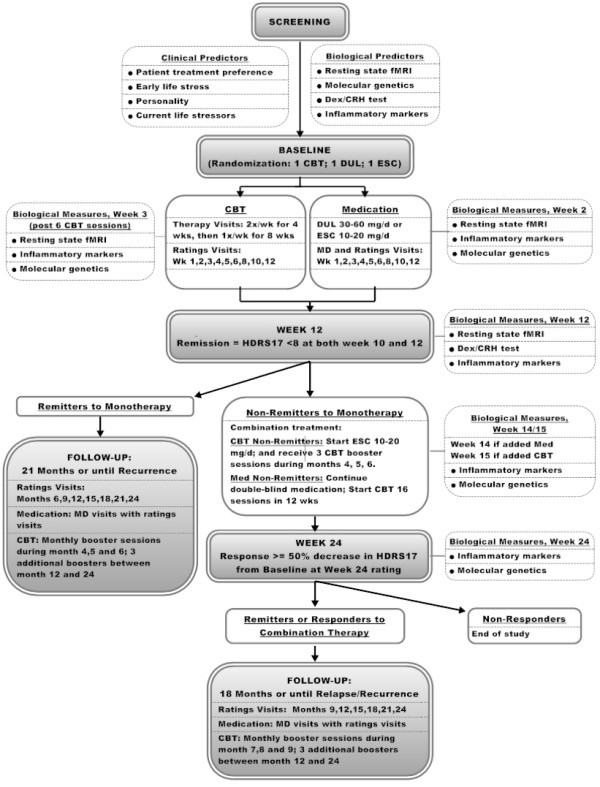
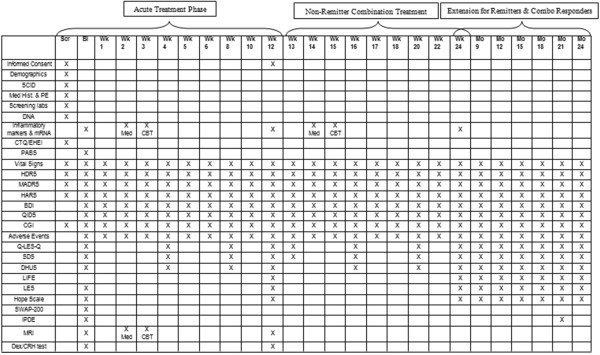
BACKGROUND: Limited controlled data exist to guide treatment choices for clinicians caring for patients with major depressive disorder (MDD). Although many putative predictors of treatment response have been reported, most were identified through retrospective analyses of existing datasets and very few have been replicated in a manner that can impact clinical practice. One major confound in previous studies examining predictors of treatment response is the patient's treatment history, which may affect both the predictor of interest and treatment outcomes. Moreover, prior treatment history provides an important source of selection bias, thereby limiting generalizability. Consequently, we initiated a randomized clinical trial designed to identify factors that moderate response to three treatments for MDD among patients never treated previously for the condition. METHODS/DESIGN: Treatment-naïve adults aged 18 to 65 years with moderate-to-severe, non-psychotic MDD are randomized equally to one of three 12-week treatment arms: (1) cognitive behavior therapy (CBT, 16 sessions); (2) duloxetine (30-60 mg/d); or (3) escitalopram (10-20 mg/d). Prior to randomization, patients undergo multiple assessments, including resting state functional magnetic resonance imaging (fMRI), immune markers, DNA and gene expression products, and dexamethasone-corticotropin-releasing hormone (Dex/CRH) testing. Prior to or shortly after randomization, patients also complete a comprehensive personality assessment. Repeat assessment of the biological measures (fMRI, immune markers, and gene expression products) occurs at an early time-point in treatment, and upon completion of 12-week treatment, when a second Dex/CRH test is also conducted. Patients remitting by the end of this acute treatment phase are then eligible to enter a 21-month follow-up phase, with quarterly visits to monitor for recurrence. Non-remitters are offered augmentation treatment for a second 12-week course of treatment, during which they receive a combination of CBT and antidepressant medication. Predictors of the primary outcome, remission, will be identified for overall and treatment-specific effects, and a statistical model incorporating multiple predictors will be developed to predict outcomes. DISCUSSION: The PReDICT study's evaluation of biological, psychological, and clinical factors that may differentially impact treatment outcomes represents a sizeable step toward developing personalized treatments for MDD. Identified predictors should help guide the selection of initial treatments, and identify those patients most vulnerable to recurrence, who thus warrant maintenance or combination treatments to achieve and maintain wellness.
Overview
The claims and statistics of this paper haven’t been checked yet.
Run the check — free, no account needed. It reads the open-access text and checks the sources it cites.
Integrity signals
Registry
Cites
Statistics
Figures
Verification
Claims the paper makes
The claims and statistics of this paper haven’t been checked yet.
Run the check — free, no account needed. It reads the open-access text and checks the sources it cites.
Claims other papers make about this one
Each is checked against this paper’s own text: does it say what the citing paper says it does?
In the citing paper
“They identify where an individual lies along a continuum of risk for illness progression (of the depressive illness or its underlying pathophysiology) and extension (additional complications beyond the syndrome of depression) 484,485 (Figure 8) and aid in reviewing the person's needs for intervention, including early intervention.”
From Time for united action on depression: a Lancet–World Psychiatric Association Commission (2022) · cites this paper as [484]
Self-check
Percentages, sums and reported differences re-computed from the paper’s own numbers.
The self-check needs the paper’s full text.
Citations
Cites
Statistical Power Analysis for the Behavioral Sciences
Muller, K. E., & Cohen, J. (1989) · Technometrics · doi:10.2307/1270020 · Cited by 99,603
Statistical power analysis for the behavioral sciences
Cohen, J. (1990) · Computers Environment and Urban Systems · doi:10.1016/0198-9715(90)90050-4 · Cited by 65,417
Regression shrinkage and selection via the lasso
Tibshirani, R. (1996) · Journal of the Royal Statistical Society Series B: Statistical Methodology · doi:10.1111/j.2517-6161.1996.tb02080.x · Cited by 51,482 · cited 1×
“phase will use various variable selection methods (for example, recursive partitioning [130,131]), as well as differ-”
An inventory for measuring depression
BECK, A. T. (1961) · Archives of General Psychiatry · doi:10.1001/archpsyc.1961.01710120031004 · Cited by 38,032 · cited 5×
“Abbreviations ACTH: Adrenocorticotropic hormone; AFSP: American Foundation for Suicide Prevention; AUC: Area under the curve; BDI: Beck Depression Inventory; BOLD: Blood oxygen level-dependent; BT: Behavioral therapy; CBT: Cognitive behavioral therapy; CGI-I: Clinical Global Impression of Improvement; CGI-S: Clinical…”
InfluentialClassification and Regression Trees.
Gordon, A. D., Breiman, L., Friedman, J. H., Olshen, R. A., & Stone, C. J. (1984) · Biometrics · doi:10.2307/2530946 · Cited by 23,867
Classification and Regression Trees.
Ryzin, J. V., Breiman, L., Friedman, J. H., Olshen, R. A., & Stone, C. J. (1986) · Journal of the American Statistical Association · doi:10.2307/2288003 · Cited by 21,030
Kessler, R. C., Berglund, P., Demler, O., Jin, R., Merikangas, K. R., & Walters, E. E. (2005) · Archives of General Psychiatry · doi:10.1001/archpsyc.62.6.593 · Cited by 20,391 · cited 1×
“females as males suffering from the disorder [1].”
A new depression scale designed to be sensitive to change
Montgomery, S. A., & Åsberg, M. (1979) · British Journal of Psychiatry · doi:10.1192/bjp.134.4.382 · Cited by 13,962 · cited 1×
“[52,53], Hamilton Anxiety Rating Scale (HARS) [54], and”
The assessment of anxiety states by rating
HAMILTON, M. (1959) · British Journal of Medical Psychology · doi:10.1111/j.2044-8341.1959.tb00467.x · Cited by 11,455 · cited 8×
“Abbreviations ACTH: Adrenocorticotropic hormone; AFSP: American Foundation for Suicide Prevention; AUC: Area under the curve; BDI: Beck Depression Inventory; BOLD: Blood oxygen level-dependent; BT: Behavioral therapy; CBT: Cognitive behavioral therapy; CGI-I: Clinical Global Impression of Improvement; CGI-S: Clinical…”
InfluentialCook, R. J., Dickens, B. M., & Fathalla, M. F. (2003) · Oxford University Press eBooks · doi:10.1093/acprof:oso/9780199241323.003.0025 · Cited by 10,825
Research works printed but not linked: 4
- National Committee for Quality Assurance: The State of Health Care Quality 2007. 2007, Washington, DC: National Committee for Quality Assurance, 20-21.
- First MB, Spitzer RL, Gibbon M, Williams JB: Structured Clinical Interview for DSM-IV Axis I Disorders-Patient Edition (SCID-I/P, Version 2.0). 1995, New York: Biometrics Research Department, New York State Psychiatric Institute
- Concepcion G, De la Cruz A: Structured Clinical Interview for DSM-IV-TR Axis I Disorders, Research Version, Patient Edition, (SCID-I/P), Spanish Translation. 2005, New York: Biometrics Research: New York State Psychiatric Institute
- Ritchie JC, Glover B, Ramsey C, Scott-Harrell P: A routine UPLC-MS//MS assay for the newer antidepressants. Ther Drug Monit. 2009, 31: 646-
Cited by
Sorted by citations
Items 101–136 of 136
Dunlop, B. W., Cha, J., Mayberg, H. S., Choi, K. S., Craighead, W. E., MahmoudianDehkordi, S., Bhattacharyya, S., Rush, A. J., & Kaddurah-Daouk, R. F. (2024) · bioRxiv (Cold Spring Harbor Laboratory) · doi:10.1101/2024.12.20.629637 · Cited by 4
Self-citationThomas, P. J., Leow, A., Klumpp, H., Phan, K. L., & Ajilore, O. (2021) · Cerebral Cortex · doi:10.1093/cercor/bhab314 · Cited by 3
Biomarker-Based Treatment Selection: A Precision Medicine Approach for Depression
Furman, J. L., & Trivedi, M. H. (2019) · Elsevier eBooks · doi:10.1016/b978-0-12-813333-0.00029-9 · Cited by 3
Kennedy, J. C., Dunlop, B. W., Baldwin, S., Liu, C. J., Mayberg, H. S., & Craighead, W. E. (2024) · Journal of Mood and Anxiety Disorders · doi:10.1016/j.xjmad.2024.100060 · Cited by 2
Self-citationGray, J. P., Price, L. R., Franklin, C. G., Leonardo, C. D., Chiang, F. L., Choi, K. S., Blangero, J., Glahn, D. C., Mayberg, H. S., & Fox, P. T. (2025) · Brain Organoid and Systems Neuroscience Journal · doi:10.1016/j.bosn.2025.04.008 · Cited by 2
“Despite controlling for these features, variability across MDD patients in regards to treatment response has still yet to demonstrate clear relationship to any clinical characteristics (Dunlop et al., 2012, 2017).”
Self-citationDunlop, B. W., Cha, J., Mayberg, H. S., Choi, K. S., Craighead, W. E., MahmoudianDehkordi, S., Bhattacharyya, S., Rush, A. J., & Kaddurah‐Daouk, R. (2025) · Journal of Neuropsychiatry · doi:10.1176/appi.neuropsych.20240222 · Cited by 7
Self-citationChapter 28. Precision Psychiatry
Williams, L. M., Ball, T. M., & Kircos, C. (2019) · American Psychiatric Association Publishing eBooks · doi:10.1176/appi.books.9781615372980.lr28 · Cited by 2
Interplay of Human Metabolome and Gut Microbiome in Major DepressionPreprint
Amin, N., Liu, J., Bonnechère, B., MehmoudianDehkordi, S., Arnold, M., Batra, R., Chiou, Y., Fernandes, M., Ikram, M. A., Kraaij, R., et al. (2022) · medRxiv · doi:10.1101/2022.06.21.22276700 · Cited by 2
Bhattacharyya, S., MahmoudianDehkordi, S., Sniatynski, M. J., Belenky, M., Marur, V. R., Rush, A. J., Craighead, W. E., Mayberg, H. S., Dunlop, B. W., Kristal, B. S., et al. (2024) · medRxiv · doi:10.1101/2024.04.02.24304677 · Cited by 2
Self-citationArgungu, Z. M., Alhaiti, A., & Jibreel, E. A. (2025) · International Journal of Social Psychiatry · doi:10.1177/00207640251405457 · Cited by 1
“However, some studies suggested that treatment preferences in RCT may not affect the outcome significantly (Dunlop et al., 2012).”
Williams, L. M., Ball, T. M., & Kircos, C. (2019) · American Psychiatric Association Publishing eBooks · doi:10.1176/appi.books.9781615371501.lr28 · Cited by 1
Lee, C. T., Palacios, J. E., Richards, D., Hanlon, A. K., Lynch, K., Harty, S., Claus, N., Swords, L., O’Keane, V., Stephan, K. E., et al. (2022) · doi:10.31234/osf.io/4j6z8 · Cited by 1
Fu, C. H. Y., Erus, G., Yong Fan, A., Antoniades, M., Arnone, D., Arnott, S. R., Chen, T., Choi, K. S., Fatt, C. C., Frey, B. N., et al. (2022) · Research Square · doi:10.21203/rs.3.rs-1608215/v1 · Cited by 1
Self-citationApplying Functional Imaging to Clinical Practice: Are We Making Progress Toward Its Promise?
Strakowski, S. M. (2023) · American Journal of Psychiatry · doi:10.1176/appi.ajp.20230013 · Cited by 1
Goveas, J. S. (2025) · American Journal of Geriatric Psychiatry · doi:10.1016/j.jagp.2025.02.006 · Cited by 1
Aas, M., Blokland, G. A. M., Chawner, S. J. R. A., Choi, S. W., Estrada, J., Forsingdal, A., Friedrich, M. U., Ganesham, S., Hall, L. S., Haslinger, D., et al. (2015) · Psychiatric Genetics · doi:10.1097/ypg.0000000000000112
Chopra, K. K. (2013) · TSpace (University of Toronto)
Rethorst, C. D. (2018) · Elsevier eBooks · doi:10.1016/b978-0-12-812605-9.00015-0
Root-Cause Analysis of Activation Cascade Differences in Brain Networks
Yao, Q., Chandrasekaran, M., & Dovrolis, C. (2022) · Lecture notes in computer science · doi:10.1007/978-3-031-15037-1_8
Tratamento da Depressão no Climatério
Rocha, R., Rennó, J., Ribeiro, H. L., Cantilino, A., Ribeiro, J. D. A. M., Demarque, R., Cavalsan, J. P., Valadares, G. C., & da Silva, A. G. (2013) · Debates em Psiquiatria · doi:10.25118/2763-9037.2013.v3.338
Leveraging Health Linkage Data From the UK Biobank—With Great Power Comes Great Responsibility—Reply
Amin, N., Kaddurah-Daouk, R. F., & van Duijn, C. M. (2023) · JAMA Psychiatry · doi:10.1001/jamapsychiatry.2023.2969
Gillespie, C. F., & Nemeroff, C. B. (2024) · Elsevier eBooks · doi:10.1016/b978-0-443-19176-3.00046-7
Self-citationKappelmann, N., Rein, M., Fietz, J., Mayberg, H. S., Craighead, W. E., Dunlop, B. W., Nemeroff, C. B., Keller, M., Klein, D. N., Arnow, B. A., et al. (2020) · Figshare · doi:10.6084/m9.figshare.12432305
Self-citationLee, C. T., Palacios, J. E., Richards, D., Hanlon, A. K., Lynch, K., Harty, S., Claus, N., Swords, L., O’Keane, V., Stephan, K. E., et al. (2023) · Figshare · doi:10.6084/m9.figshare.22612702
Kappelmann, N., Rein, M., Fietz, J., Mayberg, H. S., Craighead, W. E., Dunlop, B. W., Nemeroff, C. B., Keller, M., Klein, D. N., Arnow, B. A., et al. (2020) · Figshare · doi:10.6084/m9.figshare.12432329
Self-citationKappelmann, N., Rein, M., Fietz, J., Mayberg, H. S., Craighead, W. E., Dunlop, B. W., Nemeroff, C. B., Keller, M., Klein, D. N., Arnow, B. A., et al. (2020) · Figshare · doi:10.6084/m9.figshare.12432293
Self-citationLee, C. T., Palacios, J. E., Richards, D., Hanlon, A. K., Lynch, K., Harty, S., Claus, N., Swords, L., O’Keane, V., Stephan, K. E., et al. (2023) · Figshare · doi:10.6084/m9.figshare.22612705
Kappelmann, N., Rein, M., Fietz, J., Mayberg, H. S., Craighead, W. E., Dunlop, B. W., Nemeroff, C. B., Keller, M., Klein, D. N., Arnow, B. A., et al. (2020) · Figshare · doi:10.6084/m9.figshare.12432350
Self-citationKappelmann, N., Rein, M., Fietz, J., Mayberg, H. S., Craighead, W. E., Dunlop, B. W., Nemeroff, C. B., Keller, M., Klein, D. N., Arnow, B. A., et al. (2020) · Figshare · doi:10.6084/m9.figshare.12432290
Self-citationKappelmann, N., Rein, M., Fietz, J., Mayberg, H. S., Craighead, W. E., Dunlop, B. W., Nemeroff, C. B., Keller, M., Klein, D. N., Arnow, B. A., et al. (2020) · Figshare · doi:10.6084/m9.figshare.12432344
Self-citationKappelmann, N., Rein, M., Fietz, J., Mayberg, H. S., Craighead, W. E., Dunlop, B. W., Nemeroff, C. B., Keller, M., Klein, D. N., Arnow, B. A., et al. (2020) · Figshare · doi:10.6084/m9.figshare.12432323
Self-citationKappelmann, N., Rein, M., Fietz, J., Mayberg, H. S., Craighead, W. E., Dunlop, B. W., Nemeroff, C. B., Keller, M., Klein, D. N., Arnow, B. A., et al. (2020) · Figshare · doi:10.6084/m9.figshare.12432308
Self-citationKappelmann, N., Rein, M., Fietz, J., Mayberg, H. S., Craighead, W. E., Dunlop, B. W., Nemeroff, C. B., Keller, M., Klein, D. N., Arnow, B. A., et al. (2020) · Figshare · doi:10.6084/m9.figshare.12432317
Self-citationKappelmann, N., Rein, M., Fietz, J., Mayberg, H. S., Craighead, W. E., Dunlop, B. W., Nemeroff, C. B., Keller, M., Klein, D. N., Arnow, B. A., et al. (2020) · Figshare · doi:10.6084/m9.figshare.12432281
Self-citationKappelmann, N., Rein, M., Fietz, J., Mayberg, H. S., Craighead, W. E., Dunlop, B. W., Nemeroff, C. B., Keller, M., Klein, D. N., Arnow, B. A., et al. (2020) · Figshare · doi:10.6084/m9.figshare.12432338
Self-citation
Metadata
- Authors
- Dunlop, B. W., Binder, E. B., Cubells, J. F., Goodman, M. M., Kelley, M. E., Kinkead, B., Kutner, M., Nemeroff, C. B., Newport, D. J., Owens, M. J., Pace, T. W. W., Ritchie, J. C., Rivera, V. A., Westen, D., Craighead, W. E., & Mayberg, H. S.
- Affiliations
- Emory University (US)
- University of Miami (US)
- Corresponding author
- Dunlop, Boadie W
- ORCID
- Venue
- Trials
- Published
- 2012-07-09
- Volume
- 13
- Issue
- 1
- Pages
- 106-106
- ISSN
- 1745-6215 (ISSN-L)
- PMC
- PMC3539869
- OpenAlex
- W2140592967
- Cited by
- 136
- References
- 156
- Citations by year
- 2025: 8 · 2024: 10 · 2023: 15 · 2022: 12 · 2021: 9 · 2020: 18 · 2019: 12 · 2018: 10 · 2017: 8 · 2016: 9 · 2015: 5 · 2014: 7 · 2013: 10 · 2012: 2
- FWCI
- 5.60
- Type
- journal article
- Language
- en
- Open access
- gold
- doi.org
- Licence
- Locations
- Trials (publishedVersion, cc-by)
- PubMed Central (publishedVersion, cc-by)
- PubMed (publishedVersion)
- DOAJ (DOAJ: Directory of Open Access Journals) (submittedVersion)
- MPG.PuRe (Max Planck Society) (submittedVersion)
- Funders
- Eli Lilly and Company
- National Institutes of Health (5r01mh080880-05, UL1TR000454, RR0039, MH077083, RR025008, MH080880, RO1 MH080880)
- National Institute of Mental Health (K23MH086690, R01-MH080880, P50MH077083)
- National Center for Research Resources (UL1RR025008, RR025008, M01RR000039)
- National Center for Advancing Translational Sciences
- Topics
- Health Sciences › Medicine › Pharmacology (medical) › Treatment of Major Depression
- Social Sciences › Psychology › Experimental and Cognitive Psychology › Anxiety, Depression, Psychometrics, Treatment, Cognitive Processes
- Social Sciences › Psychology › Clinical Psychology › Psychotherapy Techniques and Applications
- Keywords
- major depressive disorder, predictors of treatment response, remission, cognitive behavioral therapy, duloxetine, escitalopram, treatment-naive patients, treatment selection, personalized treatment, recurrence, dexamethasone/corticotropin-releasing hormone test, resting-state fMRI, immunological markers, gene expression, personality, combination therapy, antidepressant augmentation
- MeSH terms
- Duloxetine Hydrochloride, Adolescent, Adult, Aged, Antidepressive Agents, Brain, Major Depressive Disorder, Drug Therapy, Combination, Female, Genetic Testing, Humans, Magnetic Resonance Imaging, Male, Middle Aged, Personality, Predictive Value of Tests, Remission Induction, Research Design, Thiophenes, Citalopram, Biomarkers, Treatment Outcome, Antidepressive Agents, Second-Generation, Young Adult
About these checks
Registry, retraction, Cites and statistics results are computed, not judged, with one exception: a printed reference that no index lists is read once by a model before it counts as a citation error. Claims are extracted by a model and kept only when their quote appears verbatim in the text; each cited source is then checked, with a model’s help, for whether it says what the claim relies on. Those verdicts can be wrong — read the claim’s quote and the cited source before relying on one.
Statistics and arithmetic are recomputed, not judged.
Confidence bands are shown only for fields calibrated on our annotated test set. None is calibrated yet, so no band is shown.
What counts as a claim ›How we measure confidence ›How we check this ›
Are you an author, or do you see a problem with this page? Request a review
