

A process for Decision-making after Pilot and feasibility Trials (ADePT): development following a feasibility study of a complex intervention for pelvic organ prolapse
Open accessThe DOI matches its Crossref record; 68 of the 71 references it cites were found in a registry or an index.
Abstract
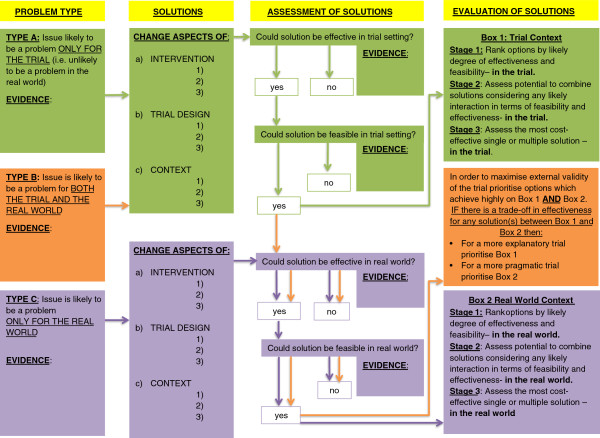
BACKGROUND: Current Medical Research Council (MRC) guidance on complex interventions advocates pilot trials and feasibility studies as part of a phased approach to the development, testing, and evaluation of healthcare interventions. In this paper we discuss the results of a recent feasibility study and pilot trial for a randomized controlled trial (RCT) of pelvic floor muscle training for prolapse (ClinicalTrials.gov: NCT01136889). The ways in which researchers decide to respond to the results of feasibility work may have significant repercussions for both the nature and degree of tension between internal and external validity in a definitive trial. METHODS: We used methodological issues to classify and analyze the problems that arose in the feasibility study. Four centers participated with the aim of randomizing 50 women. Women were eligible if they had prolapse of any type, of stage I to IV, and had a pessary successfully fitted. Postal questionnaires were administered at baseline, 6 months, and 7 months post-randomization. After identifying problems arising within the pilot study we then sought to locate potential solutions that might minimize the trade-off between a subsequent explanatory versus pragmatic trial. RESULTS: The feasibility study pointed to significant potential problems in relation to participant recruitment, features of the intervention, acceptability of the intervention to participants, and outcome measurement. Finding minimal evidence to support our decision-making regarding the transition from feasibility work to a trial, we developed a systematic process (A process for Decision-making after Pilot and feasibility Trials (ADePT)) which we subsequently used as a guide. The process sought to: 1) encourage the systematic identification and appraisal of problems and potential solutions; 2) improve the transparency of decision-making processes; and 3) reveal the tensions that exist between pragmatic and explanatory choices. CONCLUSIONS: We have developed a process that may aid researchers in their attempt to identify the most appropriate solutions to problems identified within future pilot and feasibility RCTs. The process includes three key steps: a decision about the type of problem, the identification of all solutions (whether addressed within the intervention, trial design or clinical context), and a systematic appraisal of these solutions.
Overview
The claims and statistics of this paper haven’t been checked yet.
Free: it reads the open-access text and checks the first 5 claims that cite a source we can check. Create a free account to check every claim.
Integrity signals
Registry
Cites
Statistics
Figures
Verification
Claims the paper makes
The claims and statistics of this paper haven’t been checked yet.
Free: it reads the open-access text and checks the first 5 claims that cite a source we can check. Create a free account to check every claim.
Claims other papers make about this one
Each is checked against this paper’s own text: does it say what the citing paper says it does?
The source backs part of the claim, not all of it — or backs it for a different population, condition or comparison.
In the citing paper
“As such, the establishment of progression criteria and the interpretation of pilot and feasibility study findings in the context of such criteria require stakeholder input [27].”
From Guidance for conducting feasibility and pilot studies for implementation trials (2020) · cites this paper as [27]
Experimental — accuracy not yet measuredThe source backs part of the claim, not all of it — or backs it for a different population, condition or comparison.
In the citing paper
“In many instances, the progression of implementation pilot studies will often require the input and agreement of stakeholders [27].”
From Guidance for conducting feasibility and pilot studies for implementation trials (2020) · cites this paper as [27]
Experimental — accuracy not yet measuredThe cited source says what the claim attributes to it.
In the citing paper
“Bugge et al recently provided further guidance on decision making after a pilot trial.”
From CONSORT 2010 statement: extension to randomised pilot and feasibility trials. (2016) · cites this paper as [52]
In the citing paper
“There is guidance on how to make this decision, which encourages the systematic identification and appraisal of problems and potential solutions and improves the transparency of decision-making processes [48].”
From Maximising the impact of qualitative research in feasibility studies for randomised controlled trials: guidance for researchers (2015) · cites this paper as [48]
Self-check
Percentages, sums and reported differences re-computed from the paper’s own numbers.
The self-check needs the paper’s full text.
Citations
Cites
Developing and evaluating complex interventions: the new Medical Research Council guidance
Craig, P., Dieppe, P., Macintyre, S., Michie, S., Nazareth, I., & Petticrew, M. (2008) · BMJ · doi:10.1136/bmj.a1655 · Cited by 10,995
Garber, C. E., Blissmer, B., Deschenes, M. R., Franklin, B. A., Lamonte, M. J., Lee, I.-M., Nieman, D. C., & Swain, D. P. (2011) · Medicine & Science in Sports & Exercise · doi:10.1249/mss.0b013e318213fefb · Cited by 9,319
The standardization of terminology of female pelvic organ prolapse and pelvic floor dysfunction
Bump, R. C., Mattiasson, A., Bø, K., Brubaker, L. P., DeLancey, J. O. L., Klarskov, P., Shull, B. L., & Smith, A. R. B. (1996) · American Journal of Obstetrics and Gynecology · doi:10.1016/s0002-9378(96)70243-0 · Cited by 4,275
Framework for design and evaluation of complex interventions to improve health
Campbell, M. (2000) · BMJ · doi:10.1136/bmj.321.7262.694 · Cited by 3,474 · cited 1×
“The 2000 version of the MRC framework for complex interventions suggests a linear process in which feasibility and pilot testing are conducted after a period of modeling and intervention definition, thus the intervention is largely defined [42,43].”
MethodDesign and analysis of pilot studies: recommendations for good practice
Lancaster, G. A., Dodd, S., & Williamson, P. R. (2004) · Journal of Evaluation in Clinical Practice · doi:10.1111/j..2002.384.doc.x · Cited by 2,572
Developing and Evaluating Complex Interventions: New Guidance
Craig, P., Dieppe, P. A., MacIntyre, S., Michie, S., Nazareth, I., & Petticrew, M. P. (2006) · UCL Discovery (University College London) · Cited by 1,989
Forsetlund, L., Bjørndal, A., Rashidian, A., Jamtvedt, G., O'Brien, M. A., Wolf, F. M., Davis, D., Odgaard-Jensen, J., & Oxman, A. D. (2009) · Cochrane Database of Systematic Reviews · doi:10.1002/14651858.cd003030.pub2 · Cited by 1,849 · cited 1×
“Additional file 1: Worked example using ADePT [51-69].”
MethodTunis (2003) · doi:10.1001/jama.290.12.1624 · Cited by 1,724
What is a pilot or feasibility study? A review of current practice and editorial policy
Arain, M., Campbell, M. J., Cooper, C. L., & Lancaster, G. A. (2010) · BMC Medical Research Methodology · doi:10.1186/1471-2288-10-67 · Cited by 1,483 · cited 2×
“This includes feasibility studies (asking questions about whether the study can be done) and pilot trials (a miniature version of the main trial), which aim to test aspects of study design and processes for the implementation of a larger main trial in the future [2,9,10].”
BackgroundMurray, E., Treweek, S., Pope, C., MacFarlane, A., Ballini, L., Dowrick, C., Finch, T., Kennedy, A., Mair, F., O'Donnell, C., et al. (2010) · BMC Medicine · doi:10.1186/1741-7015-8-63 · Cited by 1,478
Research works printed but not linked: 1
- Hagen S Glazener C Cook J Herbison P Toozs-Hobson P Further Properties of the Pelvic Organ Prolapse Symptom Score: Minimally Important Change and Test-retest Reliability 2010 Toronto: Proceedings of the 40th Annual Meeting of the International Continence Society
Cited by
Items 101–174 of 174
Abuhaloob, L., Helles, N., Mossey, P. A., & Freeman, R. (2021) · Pilot and Feasibility Studies · doi:10.1186/s40814-021-00827-x · Cited by 6
Remote maintenance cardiac rehabilitation (MAINTAIN): A protocol for a randomised feasibility study
Denton, F., Waddell, A., Kite, C., Hesketh, K. L., Atkinson, L., Cocks, M. S., Jones, H., Randeva, H. S., Davenport, N., Powell, R., et al. (2023) · Digital Health · doi:10.1177/20552076231152176 · Cited by 10
“The ADePT (A Process for Decision-making after Pilot and Feasibility Trials) 53 framework will be used to identify and examine any problems which arise with the methodology.”
Richmond, J. P., Kelly, M. G., Johnston, A., Murphy, P. J., O’Connor, L. L., Gillespie, P., Hobbins, A. P., Alvarez‐Iglesias, A., & Murphy, A. W. (2024) · Pilot and Feasibility Studies · doi:10.1186/s40814-024-01461-z · Cited by 4
Dhopte, P., Ahmed, S., Mayo, N. E., French, S., Quon, J. A., & Bussières, A. (2016) · Pilot and Feasibility Studies · doi:10.1186/s40814-016-0076-9 · Cited by 6
“the challenges in translating research into real-world settings [2, 3].”
BackgroundMental health research studies in Saudi Arabia for the years 2009-2019; a systematic scoping review.
Parentela, G. M. (2021) · Archives of Psychiatric Nursing · doi:10.1016/j.apnu.2021.01.001 · Cited by 5
das Nair, R., Mhizha-Murira, J. R., Topcu, G., Tindall, T., Bale, C., Moghaddam, N. G., Scheffler, G., Drummond, A. E., Fitzsimmons, D. F., & Evangelou, N. (2024) · Clinical Rehabilitation · doi:10.1177/02692155241284781 · Cited by 6
“The process for decision-making followed the ADePT framework 20 for identifying solutions to the issues identi fi ed.”
MethodSelf-administration of medication during hospitalization—a randomized pilot study
Sørensen, C. A., Olesen, C., Lisby, M., Enemark, U., & de Thurah, A. L. (2020) · Pilot and Feasibility Studies · doi:10.1186/s40814-020-00665-3 · Cited by 6
Rodrigues, A., Sniehotta, F. F., Birch‐Machin, M. A., Olivier, P. L., & Araújo‐Soares, V. (2018) · JMIR Dermatology · doi:10.2196/derma.8608 · Cited by 4
“A list of possible solutions to the problems identified within pilot and feasibility RCT was mapped (Table 3) following the algorithm for decision making after pilot and feasibility trials guidelines [33].”
MethodLygre, R. B., Gjestad, R., Norekvål, T. M., Mercer, S. W., & Elgen, I. B. (2023) · BMC Health Services Research · doi:10.1186/s12913-023-10250-y · Cited by 4
“…using Shanyinde et al. [33] suggestion of methodological issues that should be evaluated in the context of a future RCT, and Bugge et al.s [34] algorithm for decision-making after pilot and feasibility trials (ADePT) to suggest possible solutions to problems revealed by the feasibility…”
MethodMorrissey, E. C., O’Grady, L., Murphy, P. J., Byrne, M., Casey, M., Doheny, H. C., Dolan, E., Duane, S., Durand, H., Gillespie, P., et al. (2024) · BMC Family Practice · doi:10.1186/s12875-024-02635-7 · Cited by 4
Bolton, W. S., Sinha, R., Cooper, S., Adebola, O., Stephenson, E., Ewan, S., Hunsley, R., Kearton, V., Stevens, D., & Mathew, R. K. (2025) · Journal of NeuroEngineering and Rehabilitation · doi:10.1186/s12984-024-01499-3 · Cited by 3
“The reporting followed guidance from the 2016 CONSORT extension statement and a subsequent editorial for non-randomised feasibility studies [14, 15].”
Rhodin, R., Eklund, R., Hagström, A. S., Dyregrov, A., & Sveen, J. (2025) · Death Studies · doi:10.1080/07481187.2025.2513980 · Cited by 4
“For feasibility criteria, the ADePT framework (Bugge et al., 2013) was applied to enable systematic decision-making related to any feasibility issues and to assess potential solutions.”
Feasibility of in-home monitoring for people with glaucoma: the I-TRAC mixed-methods study
Stewart, C., Wu, H., Alagappan, U., Azuara‐Blanco, A., King, A. J., Tatham, A. J., Hernández, R. A., Lowe, B., Shotton, D., Appiah, N. E., et al. (2024) · Health Technology Assessment · doi:10.3310/gtwd6802 · Cited by 4
Poolman, M., Wright, S., Hendry, A., Goulden, N., Holmes, E., Byrne, A., Perkins, P., Hoare, Z., Nelson, A., Hiscock, J., et al. (2025) · BMJ Open · doi:10.1136/bmjopen-2024-084476 · Cited by 3
“21 Patient and public involvement Public contribution formed an integral part of the CARiAD trial and was part of each stage from development to dissemination.”
Abbasi, I. A., Ashari, H., Shamim, A., & Ariffin, A. S. (2023) · KnE Social Sciences · doi:10.18502/kss.v8i20.14633 · Cited by 1
Gopalakrishnan, L., Patil, S. R., Das, D., Paul, A., Sharma, P., Kachhwaha, A., Choudhary, U., & Diamond‐Smith, N. (2025) · Pilot and Feasibility Studies · doi:10.1186/s40814-025-01720-7 · Cited by 5
Donald, G., Lorimer, K., Lawrence, M., Stringer, J., Wong, R., Winter, A., & Flowers, P. (2020) · European Journal of Integrative Medicine · doi:10.1016/j.eujim.2020.101088 · Cited by 2
Chirwa, G., Chitalah, B. C., Nyali, J., Newby, C., Udedi, M. M., Hooper, R., & Jumbe, S. E. (2026) · Pilot and Feasibility Studies · doi:10.1186/s40814-026-01831-9 · Cited by 1
“…as ADePT will be used to classify and analyse problems arising from the feasibility study as an aid to identifying appropriate solutions, specifically, to clearly state whether the aims and objectives of our feasibility work have been met and are going to lead on to a future large-scale study [40].”
Khan, A., Goessmann, K., Scharpf, F., Shah, F. K. S., Kirika, A., Azhar, K., Yousafzai, A. W., Hoeffler, A., & Hecker, T. (2025) · BMC Public Health · doi:10.1186/s12889-025-23144-x · Cited by 3
“Based on these promising findings and the demonstrated feasibility and efficacy of ICC-T in other contexts, we proceed with testing the effectiveness of ICC-T in Pakistan in a definite cRCT [49].”
Johansson, N., Sarkadi, A., Isaksson, D., & Warner, G. (2025) · BMC Health Services Research · doi:10.1186/s12913-025-13753-y · Cited by 1
“The research team utilised the A process for Decision-making after Pilot and feasibility Trials (ADePT) framework [41] when making recommendations based on the pilot trial findings.”
Talati, Z., Kennare, J., Bear, N., Gibson, L. Y., Power, R., Kruger, V. Z., Silva, D. T., Prescott, S. L., & Davis, J. A. (2026) · Children · doi:10.3390/children13050581 · Cited by 1
“This has been created based on the ADePT framework, where 3 categories (green, amber, or red) are used to assess whether a study should progress from a pilot to an efficacy trial [53].”
Johansson, N., Sarkadi, A., Feldman, I., Price, A. M. H., Goldfeld, S. R., Salonen, T., Wijk, K., Isaksson, D., Kolic, E., Stenquist, S., et al. (2022) · BMC Public Health · doi:10.1186/s12889-022-14424-x · Cited by 1
Barrett, E., Gillespie, P., Newell, J., & Casey, D. (2023) · Journal of Aging and Physical Activity · doi:10.1123/japa.2022-0429 · Cited by 3
Heslehurst, N., McParlin, C., Sniehotta, F. F., Rankin, J. M., Crowe, L., & McColl, E. (2024) · Pilot and Feasibility Studies · doi:10.1186/s40814-024-01450-2 · Cited by 1
“We also used existing frameworks to interpret findings and identify solutions [46, 47].”
BackgroundMethodMorgan, A. R., Tang, A., Heisz, J. J., Thabane, L., & Richardson, J. A. (2025) · Disability and Rehabilitation · doi:10.1080/09638288.2025.2483470 · Cited by 1
“…the criteria for progression to a larger trial specified in our protocol. considering the recommendations highlighted by Bugge et al. in a process for Decision-making after Pilot and feasibility trials [82], we will outline some specific recommendations to improve the success of a future Rct.”
Evaluation of an internet based weight loss intervention
Sherrington, A. M. (2015) · Cited by 1
Feasibility of acceptance-based health coaching targeting food cravings in pregnancy
Blau, L. E. (2021) · Scholars Archive - University at Albany (University at Albany, State University of New York) · doi:10.54014/xev4-bzas · Cited by 3
Ketogenic Diets as an Adjuvant Therapy for Patients with Glioblastoma
Martin-Mcgill, K. (2019) · University of Liverpool · doi:10.17638/03052121
Pilot Studies in Clinical Research
Whitehead, A. L., & Julious, S. A. (2020) · Wiley eBooks · doi:10.1002/9781118445112.stat08205 · Cited by 2
Taggart, L., Johnston, A., Mulhall, P., Hassiotis, A., MURPHY, M. H., Slater, P. F., & Fitzpatrick, B. (2022) · SSRN Electronic Journal · doi:10.2139/ssrn.4065398
Authors, V. (2018) · The International Review of Research in Open and Distributed Learning · doi:10.19173/irrodl.v19i1.3811
Vijayavarathan-R, K. (2022) · Fróðskaparrit - Faroese Scientific Journal · doi:10.18602/0003 · Cited by 2
“Bugge et al. (2013) agreed that pilot trials are “a miniature version of the main trial, which aim to test aspects of study design and processes for the implementation of a larger main trial in the future” (p. 2).”
BackgroundMcGovern, R., Smart, D., Alderson, H., Fouweather, T., & Kaner, E. (2023) · Alcohol and Alcoholism · doi:10.1093/alcalc/agad076
“Where marginal results were reached, a process for decision making after pilot and feasibility trials was followed (Bugge et al .”
MethodBolton, W. S., Aruparayil, N., Bundu, I., Cundill, B., Pike, T., Darwood, R., Scott, J., Brown, J. M., & Jayne, D. G. (2023) · Journal of Surgical Simulation · doi:10.1102/2051-7726.2023.0008
Chapman, S. J., Ahmed, S., Cave, L., Morton, K., Tiernan, J. P., Limbert, S., Naylor, M., Vargas‐Palacios, A., Lonsdale, M. D. S., Davies, C. L., et al. (2024) · Colorectal Disease · doi:10.1111/codi.17210
Morgan, A. R., Tang, A., Heisz, J. J., Thabane, L., & Richardson, J. A. (2025) · Disability and Rehabilitation · doi:10.1080/09638288.2025.2484785
“These factors include participant recruitment, retention, intervention safety, adherence and acceptability [14,17].”
Graever, L., Mafra, P. C., Figueira, V. K., Miler, V. N., Sobreiro, J. D. S. L., da Silva, G. P. D. C., Issa, A. F. C., Savassi, L. C. M., Dias, M. B., Melo, M. M., et al. (2025) · JMIR Cardio · doi:10.2196/64438 · Cited by 4
“…intervention is feasible, with adjustments, as described in the A Process for Decision-Making After Pilot and Feasibility Trials model items adapting the intervention , adjusting the clinical context within which the intervention would be delivered , and amending elements of the trial design [71].”
Woodfield, M. J., Fortune, S. A., Cargo, T., Merry, S., & Hetrick, S. E. (2025) · Implementation Research and Practice · doi:10.1177/26334895251363418
“For example, Bugge et al. (2013) proposed an algorithm to aid decision-making around progressing pilot and feasibility trials, and Murray et al. (2010) described a tool to improve trial design and procedures, with implementation in mind.”
Paiva, E. M. D. C., Moura, C. D. C., Fonseca, N. D. S. M., & Garcia, A. C. M. (2025) · Advances in Integrative Medicine · doi:10.1016/j.aimed.2025.100559
Gameiro, S., Leone, D., D’Angelo, A., Veleva, Z., Morey, R. D., & Boivin, J. (2025) · BMJ Open · doi:10.1136/bmjopen-2025-101269
“Insights from this study can inform the implementation of other SBN training in fertility or other healthcare domains and improve understanding of the impact SBN training has on patient experience and outcomes.”
Yinusa, G., Surr, C., Thomas, S., Fenge, L., Howdon, D., Major, J., Heward, M., Taylor, G. T., Knight, H. P., Townson, J., et al. (2025) · Pilot and Feasibility Studies · doi:10.1186/s40814-025-01722-5
“We will assess and estimate key progression indicators (using the traffic light system as in Table 5) and obtain stakeholder input to support interpretation of findings and decisions regarding proceeding to a larger trial [52].”
Kirwan, C., Hynes, L., Hart, N. D., Mulligan, S., Leathem, C. S., McQuillan, L., Maxwell, M., Carr, E., Roche, K., Walkin, S., et al. (2022) · Figshare · doi:10.6084/m9.figshare.21273885
Additional file 2 of Guidance for conducting feasibility and pilot studies for implementation trials
Pearson, N., Naylor, P.-J., Ashe, M. C., Fernandez, M., Yoong, S. L., & Wolfenden, L. (2020) · Figshare · doi:10.6084/m9.figshare.13173941
Hester, K. L. M., Ryan, V., Newton, J., Rapley, T., & Soyza, A. D. (2020) · Figshare · doi:10.6084/m9.figshare.12133989
Heslehurst, N., McParlin, C., Sniehotta, F. F., Rankin, J., Crowe, L., & McColl, E. (2024) · Figshare · doi:10.6084/m9.figshare.26687312
Beardmore‐Gray, A., Vousden, N., Silverio, S. A., Charantimath, U., Katageri, G., Bellad, M., Chinkoyo, S., Vwalika, B., Goudar, S., Sandall, J., et al. (2021) · Figshare · doi:10.6084/m9.figshare.14721813
Hester, K. L. M., Ryan, V., Newton, J., Rapley, T., & Soyza, A. D. (2020) · Figshare · doi:10.6084/m9.figshare.12133995
Mellor, K., Dutton, S. J., Hopewell, S., & Albury, C. (2022) · Figshare · doi:10.6084/m9.figshare.19159065
Heslehurst, N., McParlin, C., Sniehotta, F. F., Rankin, J., Crowe, L., & McColl, E. (2024) · Figshare · doi:10.6084/m9.figshare.25329790
Hester, K. L. M., Ryan, V., Newton, J., Rapley, T., & Soyza, A. D. (2020) · Figshare · doi:10.6084/m9.figshare.12133992
Hester, K. L. M., Ryan, V., Newton, J., Rapley, T., & Soyza, A. D. (2020) · Figshare · doi:10.6084/m9.figshare.12133977
McHale, C., Cruickshank, S., Brown, T. J., Torrens, C., Armes, J., Fenlon, D., Banks, E., Kelsey, T., & Humphris, G. M. (2024) · Figshare · doi:10.6084/m9.figshare.24966054
Mellor, K., Dutton, S. J., Hopewell, S., & Albury, C. (2022) · Figshare · doi:10.6084/m9.figshare.19159068
Kirwan, C., Hynes, L., Hart, N. D., Mulligan, S., Leathem, C. S., McQuillan, L., Maxwell, M., Carr, E., Roche, K., Walkin, S., et al. (2022) · Figshare · doi:10.6084/m9.figshare.21273891
Taylor, P. J., Adeyemi, I., Marlow, K., Cottam, S., Airnes, Z., Hartley, S., Howells, V., Dunn, B. D., Elliott, R. A., Hann, M., et al. (2024) · Figshare · doi:10.6084/m9.figshare.26333288
Hester, K. L. M., Ryan, V., Newton, J., Rapley, T., & Soyza, A. D. (2020) · Figshare · doi:10.6084/m9.figshare.12133983
Heslehurst, N., McParlin, C., Sniehotta, F. F., Rankin, J., Crowe, L., & McColl, E. (2024) · Figshare · doi:10.6084/m9.figshare.26687315
Heslehurst, N., McParlin, C., Sniehotta, F. F., Rankin, J., Crowe, L., & McColl, E. (2024) · Figshare · doi:10.6084/m9.figshare.26687307
Additional file 1 of Guidance for conducting feasibility and pilot studies for implementation trials
Pearson, N., Naylor, P.-J., Ashe, M. C., Fernandez, M., Yoong, S. L., & Wolfenden, L. (2020) · Figshare · doi:10.6084/m9.figshare.13173938
Heslehurst, N., McParlin, C., Sniehotta, F. F., Rankin, J., Crowe, L., & McColl, E. (2024) · Figshare · doi:10.6084/m9.figshare.26687309
Kirwan, C., Hynes, L., Hart, N. D., Mulligan, S., Leathem, C. S., McQuillan, L., Maxwell, M., Carr, E., Roche, K., Walkin, S., et al. (2022) · Figshare · doi:10.6084/m9.figshare.21273888
Cowling, P., Hackney, R. G., Dube, B., Grainger, A., Biglands, J. D., Stanley, M., Song, D., Conaghan, P. G., & Kingsbury, S. R. (2020) · Figshare · doi:10.6084/m9.figshare.12096297
McHale, C., Cruickshank, S., Brown, T. J., Torrens, C., Armes, J., Fenlon, D., Banks, E., Kelsey, T., & Humphris, G. M. (2024) · Figshare · doi:10.6084/m9.figshare.24965946
Heslehurst, N., McParlin, C., Sniehotta, F. F., Rankin, J., Crowe, L., & McColl, E. (2024) · Figshare · doi:10.6084/m9.figshare.26687318
Beardmore‐Gray, A., Vousden, N., Silverio, S. A., Charantimath, U., Katageri, G., Bellad, M., Chinkoyo, S., Vwalika, B., Goudar, S., Sandall, J., et al. (2021) · Figshare · doi:10.6084/m9.figshare.14721804
Morrissey, E. C., Byrne, M., Casey, B., Casey, D., Gillespie, P., Hobbins, A. P., Lowry, M., McCarthy, E., Newell, J., Roshan, D., et al. (2022) · Figshare · doi:10.6084/m9.figshare.19327271
Beardmore‐Gray, A., Vousden, N., Silverio, S. A., Charantimath, U., Katageri, G., Bellad, M., Chinkoyo, S., Vwalika, B., Goudar, S., Sandall, J., et al. (2021) · Figshare · doi:10.6084/m9.figshare.14721810
Heslehurst, N., McParlin, C., Sniehotta, F. F., Rankin, J., Crowe, L., & McColl, E. (2024) · Figshare · doi:10.6084/m9.figshare.25329616
Löfving, S. G., Alsaqa, F., Sarkadi, A., Inge, E., Pérez‐Aronsson, A., Tökés, A., & Warner, G. (2026) · Pilot and Feasibility Studies · doi:10.1186/s40814-025-01753-y
“A process for Decision-making after Pilot and Feasibility Trials (ADePT) [34] was selected to support systematic decision-making in moving forward with the trial.”
Dudley, R. E. J., Sargeant, S., Gibbs, C., Prentice, L., McCartney, L., Aynsworth, C., Maskey, M., & Skeggs, A. L. (2026) · BMJ Open · doi:10.1136/bmjopen-2025-107535 · Cited by 1
“55 These criteria are being developed with the PPI group to help determine if a full trial is warranted but will likely include participant recruitment, adherence with the intervention, retention of participants, intervention fidelity and acceptability to assess the trial.”
Kleinlooh, S. T., Samaritter, R., Koes, B. W., Hoekstra, R., & Stubbe, J. (2026) · Pilot and Feasibility Studies · doi:10.1186/s40814-026-01816-8 · Cited by 1
“As a result, early-phase evaluation of feasibility and acceptability is strongly recommended during the initial stages of study and intervention development to identify methodological challenges and ensure that proposed designs are implementable in real-world clinical settings [5, 6, 8, 13, 34, 37].”
Thomas, M., Herring, L. Y., Davies, M. J., Wilde, L., Hall, V., Gray, L. J., Greenwood, S. A., Hadjiconstantinou, M., Hamza, M., Harris, A., et al. (2026) · PLoS ONE · doi:10.1371/journal.pone.0348372
Sexton, E. T. S., Ray, H. J., Frowen, J. J., Gough, K., Poon, W., Turnbull, S. P., Abo, S., Barton, M., Loeliger, J. M., & Ftanou, M. (2026) · Head & Neck · doi:10.1002/hed.70351
Metadata
- Authors
- Bugge, C., Williams, B., Hagen, S., Logan, J., Glazener, C., Pringle, S., & Sinclair, L.
- Affiliations
- University of Stirling (GB)
- Glasgow Caledonian University (GB)
- University of Aberdeen (GB)
- NHS Greater Glasgow and Clyde (GB)
- Corresponding author
- Bugge, Carol
- Venue
- Trials
- Published
- 2013
- Volume
- 14
- Issue
- 1
- Pages
- 353
- ISSN
- 1745-6215 (ISSN-L)
- PMC
- PMC3819659
- OpenAlex
- W2118255840
- Cited by
- 175
- References
- 71
- Citations by year
- 2026: 7 · 2025: 15 · 2024: 21 · 2023: 9 · 2022: 20 · 2021: 14 · 2020: 34 · 2019: 14 · 2018: 15 · 2017: 9 · 2016: 8 · 2015: 5 · 2014: 4
- FWCI
- 10.26
- Type
- journal article
- Language
- en
- Open access
- gold
- doi.org
- Licence
- cc-by
- Locations
- Trials (publishedVersion, cc-by)
- Europe PMC (PubMed Central) (publishedVersion, cc-by)
- PubMed Central (publishedVersion, cc-by)
- PubMed (publishedVersion)
- ENLIGHTEN (Jurnal Bimbingan dan Konseling Islam) (acceptedVersion)
- ResearchOnline (Glasgow Caledonian University) (acceptedVersion, cc-by)
- Aberdeen University Research Archive (Aberdeen University) (submittedVersion)
- Stirling Online Research Repository (University of Stirling) (submittedVersion, cc-by)
- Research Output (Edinburgh Napier University) (submittedVersion, cc-by)
- Edinburgh Napier Research Repository (Edinburgh Napier University) (submittedVersion, cc-by)
- ResearchOnline (submittedVersion, cc-by)
- Funders
- Wellbeing of Women
- Topics
- Health Sciences › Health Professions › General Health Professions › Health Policy Implementation Science
- Physical Sciences › Mathematics › Statistics and Probability › Statistical Methods in Clinical Trials
- Social Sciences › Sociology and Political Science › Delphi Technique in Research
- Keywords
- complex interventions, pelvic organ prolapse, pelvic floor muscle training, feasibility study, pilot trial, participant recruitment, treatment acceptability, outcome measurement, decision-making, trial design, research transparency
- MeSH terms
- Combined Modality Therapy, Feasibility Studies, Female, Humans, Pessaries, Pilot Projects, Surveys and Questionnaires, Research Design, Scotland, Time Factors, Treatment Outcome, Evidence-Based Medicine, Physical Therapy Modalities, Pelvic Organ Prolapse
About these checks
Registry, retraction, Cites and statistics results are computed, not judged, with one exception: a printed reference that no index lists is read once by a model before it counts as a citation error. Claims are extracted by a model and kept only when their quote appears verbatim in the text; each cited source is then checked, with a model’s help, for whether it says what the claim relies on. Those verdicts can be wrong — read the claim’s quote and the cited source before relying on one.
Statistics and arithmetic are recomputed, not judged.
Confidence bands are shown only for fields calibrated on our annotated test set. None is calibrated yet, so no band is shown.
What counts as a claim ›How we measure confidence ›How we check this ›
Are you an author, or do you see a problem with this page? Request a review
Data sources
Bibliographic data: Semantic Scholar, OpenAlex, Crossref.
Contains information from the Semantic Scholar Academic Graph Datasets, made available under the ODC Attribution License (ODC-BY 1.0).
Semantic Scholar’s data is described in: Kinney, R., et al. (2023). The Semantic Scholar Open Data Platform. arXiv:2301.10140.
