

A process for Decision-making after Pilot and feasibility Trials (ADePT): development following a feasibility study of a complex intervention for pelvic organ prolapse
Open accessThe DOI matches its Crossref record; 68 of the 71 references it cites were found in a registry or an index.
Abstract
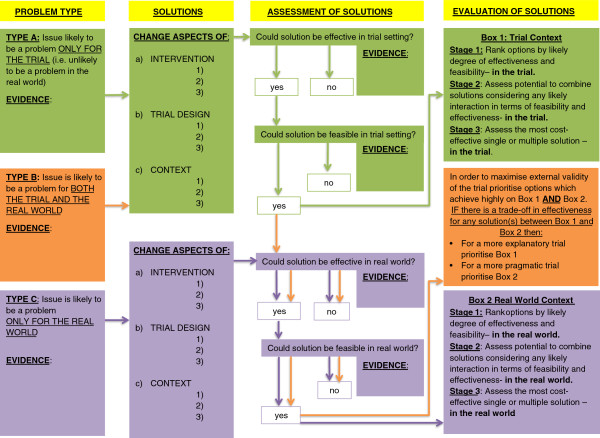
BACKGROUND: Current Medical Research Council (MRC) guidance on complex interventions advocates pilot trials and feasibility studies as part of a phased approach to the development, testing, and evaluation of healthcare interventions. In this paper we discuss the results of a recent feasibility study and pilot trial for a randomized controlled trial (RCT) of pelvic floor muscle training for prolapse (ClinicalTrials.gov: NCT01136889). The ways in which researchers decide to respond to the results of feasibility work may have significant repercussions for both the nature and degree of tension between internal and external validity in a definitive trial. METHODS: We used methodological issues to classify and analyze the problems that arose in the feasibility study. Four centers participated with the aim of randomizing 50 women. Women were eligible if they had prolapse of any type, of stage I to IV, and had a pessary successfully fitted. Postal questionnaires were administered at baseline, 6 months, and 7 months post-randomization. After identifying problems arising within the pilot study we then sought to locate potential solutions that might minimize the trade-off between a subsequent explanatory versus pragmatic trial. RESULTS: The feasibility study pointed to significant potential problems in relation to participant recruitment, features of the intervention, acceptability of the intervention to participants, and outcome measurement. Finding minimal evidence to support our decision-making regarding the transition from feasibility work to a trial, we developed a systematic process (A process for Decision-making after Pilot and feasibility Trials (ADePT)) which we subsequently used as a guide. The process sought to: 1) encourage the systematic identification and appraisal of problems and potential solutions; 2) improve the transparency of decision-making processes; and 3) reveal the tensions that exist between pragmatic and explanatory choices. CONCLUSIONS: We have developed a process that may aid researchers in their attempt to identify the most appropriate solutions to problems identified within future pilot and feasibility RCTs. The process includes three key steps: a decision about the type of problem, the identification of all solutions (whether addressed within the intervention, trial design or clinical context), and a systematic appraisal of these solutions.
Overview
The claims and statistics of this paper haven’t been checked yet.
Free: it reads the open-access text and checks the first 5 claims that cite a source we can check. Create a free account to check every claim.
Integrity signals
Registry
Cites
Statistics
Figures
Verification
Claims the paper makes
The claims and statistics of this paper haven’t been checked yet.
Free: it reads the open-access text and checks the first 5 claims that cite a source we can check. Create a free account to check every claim.
Claims other papers make about this one
Each is checked against this paper’s own text: does it say what the citing paper says it does?
The source backs part of the claim, not all of it — or backs it for a different population, condition or comparison.
In the citing paper
“As such, the establishment of progression criteria and the interpretation of pilot and feasibility study findings in the context of such criteria require stakeholder input [27].”
From Guidance for conducting feasibility and pilot studies for implementation trials (2020) · cites this paper as [27]
Experimental — accuracy not yet measuredThe source backs part of the claim, not all of it — or backs it for a different population, condition or comparison.
In the citing paper
“In many instances, the progression of implementation pilot studies will often require the input and agreement of stakeholders [27].”
From Guidance for conducting feasibility and pilot studies for implementation trials (2020) · cites this paper as [27]
Experimental — accuracy not yet measuredThe cited source says what the claim attributes to it.
In the citing paper
“Bugge et al recently provided further guidance on decision making after a pilot trial.”
From CONSORT 2010 statement: extension to randomised pilot and feasibility trials. (2016) · cites this paper as [52]
In the citing paper
“There is guidance on how to make this decision, which encourages the systematic identification and appraisal of problems and potential solutions and improves the transparency of decision-making processes [48].”
From Maximising the impact of qualitative research in feasibility studies for randomised controlled trials: guidance for researchers (2015) · cites this paper as [48]
Self-check
Percentages, sums and reported differences re-computed from the paper’s own numbers.
The self-check needs the paper’s full text.
Citations
Cites
Developing and evaluating complex interventions: the new Medical Research Council guidance
Craig, P., Dieppe, P., Macintyre, S., Michie, S., Nazareth, I., & Petticrew, M. (2008) · BMJ · doi:10.1136/bmj.a1655 · Cited by 10,995
Garber, C. E., Blissmer, B., Deschenes, M. R., Franklin, B. A., Lamonte, M. J., Lee, I.-M., Nieman, D. C., & Swain, D. P. (2011) · Medicine & Science in Sports & Exercise · doi:10.1249/mss.0b013e318213fefb · Cited by 9,319
The standardization of terminology of female pelvic organ prolapse and pelvic floor dysfunction
Bump, R. C., Mattiasson, A., Bø, K., Brubaker, L. P., DeLancey, J. O. L., Klarskov, P., Shull, B. L., & Smith, A. R. B. (1996) · American Journal of Obstetrics and Gynecology · doi:10.1016/s0002-9378(96)70243-0 · Cited by 4,275
Framework for design and evaluation of complex interventions to improve health
Campbell, M. (2000) · BMJ · doi:10.1136/bmj.321.7262.694 · Cited by 3,474 · cited 1×
“The 2000 version of the MRC framework for complex interventions suggests a linear process in which feasibility and pilot testing are conducted after a period of modeling and intervention definition, thus the intervention is largely defined [42,43].”
MethodDesign and analysis of pilot studies: recommendations for good practice
Lancaster, G. A., Dodd, S., & Williamson, P. R. (2004) · Journal of Evaluation in Clinical Practice · doi:10.1111/j..2002.384.doc.x · Cited by 2,572
Developing and Evaluating Complex Interventions: New Guidance
Craig, P., Dieppe, P. A., MacIntyre, S., Michie, S., Nazareth, I., & Petticrew, M. P. (2006) · UCL Discovery (University College London) · Cited by 1,989
Forsetlund, L., Bjørndal, A., Rashidian, A., Jamtvedt, G., O'Brien, M. A., Wolf, F. M., Davis, D., Odgaard-Jensen, J., & Oxman, A. D. (2009) · Cochrane Database of Systematic Reviews · doi:10.1002/14651858.cd003030.pub2 · Cited by 1,849 · cited 1×
“Additional file 1: Worked example using ADePT [51-69].”
MethodTunis (2003) · doi:10.1001/jama.290.12.1624 · Cited by 1,724
What is a pilot or feasibility study? A review of current practice and editorial policy
Arain, M., Campbell, M. J., Cooper, C. L., & Lancaster, G. A. (2010) · BMC Medical Research Methodology · doi:10.1186/1471-2288-10-67 · Cited by 1,483 · cited 2×
“This includes feasibility studies (asking questions about whether the study can be done) and pilot trials (a miniature version of the main trial), which aim to test aspects of study design and processes for the implementation of a larger main trial in the future [2,9,10].”
BackgroundMurray, E., Treweek, S., Pope, C., MacFarlane, A., Ballini, L., Dowrick, C., Finch, T., Kennedy, A., Mair, F., O'Donnell, C., et al. (2010) · BMC Medicine · doi:10.1186/1741-7015-8-63 · Cited by 1,478
A pragmatic–explanatory continuum indicator summary (PRECIS): a tool to help trial designers
Thorpe, K. E., Zwarenstein, M., Oxman, A. D., Treweek, S., Furberg, C. D., Altman, D. G., Tunis, S., Bergel, E., Harvey, I., Magid, D. J., et al. (2009) · Journal of Clinical Epidemiology · doi:10.1016/j.jclinepi.2008.12.011 · Cited by 1,389
Explanatory and Pragmatic Attitudes in Therapeutical Trials
Schwartz, D., & Lellouch, J. (2009) · Journal of Clinical Epidemiology · doi:10.1016/j.jclinepi.2009.01.012 · Cited by 1,252
Behavior change interventions delivered by mobile telephone short message service
Fjeldsoe, B. S., Marshall, A. L., & Miller, Y. D. (2009) · American Journal of Preventive Medicine · doi:10.1016/j.amepre.2008.09.040 · Cited by 1,213 · cited 1×
“Additional file 1: Worked example using ADePT [51-69].”
MethodText messaging as a tool for behavior change in disease prevention and management
Cole-Lewis, H., & Kershaw, T. (2010) · Epidemiologic Reviews · doi:10.1093/epirev/mxq004 · Cited by 1,190 · cited 1×
“Additional file 1: Worked example using ADePT [51-69].”
MethodExplanatory and pragmatic attitudes in therapeutical trials
Schwartz, D., & Lellouch, J. (1967) · Journal of Chronic Diseases · doi:10.1016/0021-9681(67)90041-0 · Cited by 1,185
Mobile phone-based interventions for smoking cessation
Whittaker, R., McRobbie, H., Bullen, C., Rodgers, A., & Gu, Y. (2016) · Cochrane Database of Systematic Reviews · doi:10.1002/14651858.cd006611.pub4 · Cited by 1,079
Green, L. W., & Glasgow, R. E. (2006) · Evaluation & the Health Professions · doi:10.1177/0163278705284445 · Cited by 922
Understanding controlled trials: What are pragmatic trials?
Roland, M., & Torgerson, D. J. (1998) · BMJ · doi:10.1136/bmj.316.7127.285 · Cited by 702
Recommendations for Planning Pilot Studies in Clinical and Translational Research
Moore, C. G., Carter, R. E., Nietert, P. J., & Stewart, P. W. (2011) · Clinical and Translational Science · doi:10.1111/j.1752-8062.2011.00347.x · Cited by 661 · cited 1×
“Given their importance, such studies ought to be carefully designed, with clear aims and objectives to support their own scientific validity in order to appropriately inform decisions regarding any future trial [16,17].”
BackgroundGlasgow, R. E., McKay, H. G., Piette, J. D., & Reynolds, K. D. (2001) · Patient Education and Counseling · doi:10.1016/s0738-3991(00)00186-5 · Cited by 648
Self-management education for patients with chronic obstructive pulmonary disease
Effing, T., Monninkhof, E. E., van der Valk, P. P. D. L. P. M., Zielhuis, G. G., Walters, E. H., van der Palen, J. J., & Zwerink, M. (2007) · Cochrane Database of Systematic Reviews · doi:10.1002/14651858.cd002990.pub2 · Cited by 536
Godwin, M., Ruhland, L., Casson, I., MacDonald, S., Delva, D., Birtwhistle, R., Lam, M., & Seguin, R. (2003) · BMC Medical Research Methodology · doi:10.1186/1471-2288-3-28 · Cited by 506
Consensus Development Methods: A Review of Best Practice in Creating Clinical Guidelines
Black, N., Murphy, M., Lamping, D., McKee, M., Sanderson, C., Askham, J., & Marteau, T. (1999) · Journal of Health Services Research & Policy · doi:10.1177/135581969900400410 · Cited by 451
A pragmatic-explanatory continuum indicator summary (PRECIS): a tool to help trial designers
Thorpe, K. E., Zwarenstein, M., Oxman, A. D., Treweek, S., Furberg, C. D., Altman, D. G., Tunis, S., Bergel, E., Harvey, I., Magid, D. J., et al. (2009) · Canadian Medical Association Journal · doi:10.1503/cmaj.090523 · Cited by 417
Individual patient education for people with type 2 diabetes mellitus
Duke, S.-A. S., Colagiuri, S., & Colagiuri, R. (2009) · Cochrane Database of Systematic Reviews · doi:10.1002/14651858.cd005268.pub2 · Cited by 361 · cited 1×
“Additional file 1: Worked example using ADePT [51-69].”
MethodWells, M., Williams, B., Treweek, S., Coyle, J., & Taylor, J. (2012) · Trials · doi:10.1186/1745-6215-13-95 · Cited by 297 · cited 1×
“However, the move towards more pragmatic trials has been largely fuelled by an increasing willingness to apply RCT methods to more complex interventions (which naturally tend to be less well-defined [45], more flexible [46], and more context-dependent [45]), and a recognized need to provide information of greater util…”
BackgroundSelf-citationHagen, S., Stark, D., Glazener, C., Dickson, S., Barry, S., Elders, A., Frawley, H., Galea, M. P., Logan, J., McDonald, A., et al. (2014) · The Lancet · doi:10.1016/s0140-6736(13)61977-7 · Cited by 258
Self-citationUsing financial incentives to achieve healthy behaviour
Marteau, T. M., Ashcroft, R. E., & Oliver, A. (2009) · BMJ · doi:10.1136/bmj.b1415 · Cited by 249
Brækken, I. H., Majida, M., Engh, M. E., & Bø, K. (2010) · American Journal of Obstetrics and Gynecology · doi:10.1016/j.ajog.2010.02.037 · Cited by 241 · cited 12×
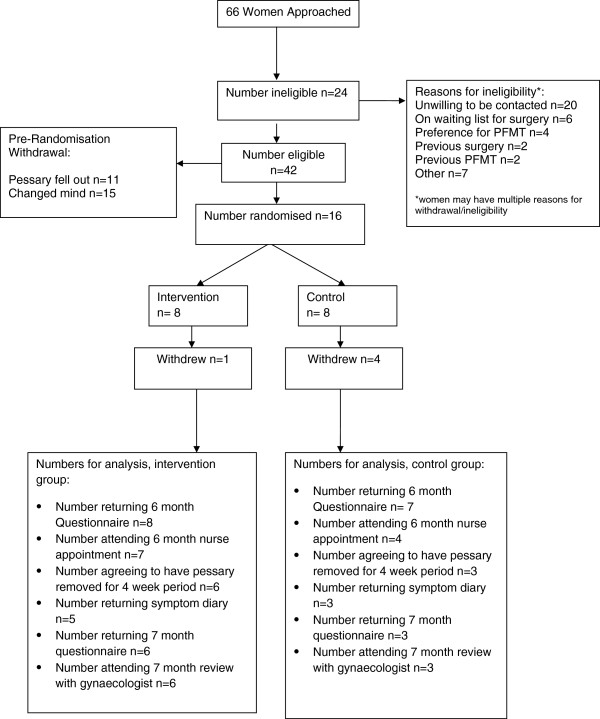
“Consenting participants were randomized into one of two groups: 1) PFMT (delivered by a specialist women's health physiotherapist at five appointments over 16 weeks) in conjunction with pessary management of their prolapse (intervention group); or 2) pessary management alone (control group).”
BackgroundInfluentialCompetitions and incentives for smoking cessation
Cahill, K., & Perera, R. (2011) · Cochrane Database of Systematic Reviews · doi:10.1002/14651858.cd004307.pub4 · Cited by 236
Comparisons of approaches to pelvic floor muscle training for urinary incontinence in women
Hay-Smith, E. J. C., Herderschee, R., Dumoulin, C., & Herbison, G. P. (2011) · Cochrane Database of Systematic Reviews · doi:10.1002/14651858.cd009508 · Cited by 230
Questions asked and answered in pilot and feasibility randomized controlled trials
Shanyinde, M., Pickering, R. M., & Weatherall, M. (2011) · BMC Medical Research Methodology · doi:10.1186/1471-2288-11-117 · Cited by 229 · cited 7×
“Results The results of applying the methodological issues as an analytic framework [15] to the exemplar study findings are presented under each of the 14 items summarized in Table 1.”
BackgroundMethodInfluentialA survey of pessary use by members of the american urogynecologic society
CUNDIFF, G. (2000) · Obstetrics & Gynecology · doi:10.1016/s0029-7844(00)00788-2 · Cited by 226
Mobile phone-based interventions for smoking cessation
Whittaker, R., Borland, R., Bullen, C., Lin, R. B., McRobbie, H., & Rodgers, A. (2009) · Cochrane Database of Systematic Reviews · doi:10.1002/14651858.cd006611.pub2 · Cited by 196
The Cooksey review of UK health research funding
Black, N. (2006) · BMJ · doi:10.1136/bmj.39059.444120.80 · Cited by 179
Glazener, C., Elders, A., MacArthur, C., Lancashire, R., Herbison, P., Hagen, S., Dean, N., Bain, C., Toozs‐Hobson, P., Richardson, K., et al. (2013) · BJOG: An International Journal of Obstetrics & Gynaecology · doi:10.1111/1471-0528.12075 · Cited by 145 · cited 1×
“The most appropriate outcomes to use were decided beforehand based on the experience of the researchers in other prolapse studies [26,29-31].”
BackgroundSelf-citationHanson, L.-A., Schulz, J. A., Flood, C. G., Cooley, B., & Tam, F. (2005) · International Urogynecology Journal · doi:10.1007/s00192-005-1362-x · Cited by 141
Gynecologists' patterns of prescribing pessaries.
Pott-Grinstein, E., & Newcomer, J. R. (2001) · PubMed · Cited by 134
A 5‐year prospective study of vaginal pessary use for pelvic organ prolapse
Lone, F., Thakar, R., Sultan, A. H., & Karamalis, G. (2011) · International Journal of Gynecology & Obstetrics · doi:10.1016/j.ijgo.2011.02.006 · Cited by 122
Hagen, S., Stark, D., Glazener, C., Sinclair, L., & Ramsay, I. (2009) · International Urogynecology Journal · doi:10.1007/s00192-008-0726-4 · Cited by 116 · cited 1×
“The most appropriate outcomes to use were decided beforehand based on the experience of the researchers in other prolapse studies [26,29-31].”
BackgroundSelf-citationDo Pessaries Prevent the Progression of Pelvic Organ Prolapse?
Handa, V. L., & Jones, M. (2002) · International Urogynecology Journal · doi:10.1007/s001920200078 · Cited by 105
Rapidly rising clinical trial costs worry researchers
Collier, R. (2009) · Canadian Medical Association Journal · doi:10.1503/cmaj.082041 · Cited by 94
MacPherson, H., Thorpe, L. N., & Thomas, K. J. (2006) · The Journal of Alternative and Complementary Medicine · doi:10.1089/acm.2006.12.873 · Cited by 93
Psychometric properties of the pelvic organ prolapse symptom score
Hagen, S., Glazener, C., Sinclair, L., Stark, D., & Bugge, C. (2009) · BJOG: An International Journal of Obstetrics & Gynaecology · doi:10.1111/j.1471-0528.2008.01903.x · Cited by 92
Self-citationHealth services research methods : a guide to best practice
Black, N. A. (1998) · Cited by 85
An, L. C., Bluhm, J. H., Foldes, S. S., Alesci, N. L., Klatt, C. M., Center, B. A., Nersesian, W. S., Larson, M. E., Ahluwalia, J. S., & Manley, M. W. (2008) · Archives of Internal Medicine · doi:10.1001/archinte.168.18.1993 · Cited by 78
Audit and feedback: effects on professional practice
Ivers, N., Yogasingam, S., Lacroix, M., Brown, K. A., Antony, J., Soobiah, C., Simeoni, M., Willis, T. A., Crawshaw, J., Antonopoulou, V., et al. (2025) · Cochrane Database of Systematic Reviews · doi:10.1002/14651858.cd000259.pub4 · Cited by 78
Study control, violators, inclusion criteria and defining explanatory and pragmatic trials
McMahon, A. D. (2002) · Statistics in Medicine · doi:10.1002/sim.1120 · Cited by 74
Cost-effective Primary Care–Based Strategies to Improve Smoking Cessation: More Value for Money
Salize, H. J., Merkel, S., Reinhard, I., Twardella, D., Mann, K., & Brenner, H. (2009) · Archives of Internal Medicine · doi:10.1001/archinternmed.2008.556 · Cited by 73
Thorstensson, C. A., Lohmander, L. S., Frobell, R. B., Roos, E. M., & Gooberman-Hill, R. (2009) · BMC Musculoskeletal Disorders · doi:10.1186/1471-2474-10-100 · Cited by 69
Brady, M., Stott, D. J., Norrie, J. D., Chalmers, C., George, B. S., Sweeney, P., & Langhorne, P. (2011) · Trials · doi:10.1186/1745-6215-12-168 · Cited by 68
Evaluation of vaginal pessary management: A UK-based survey
Gorti, M., Hudelist, G., & Simons, A. (2009) · Journal of Obstetrics and Gynaecology · doi:10.1080/01443610902719813 · Cited by 66
What kind of randomized trials do we need?
Zwarenstein, M., & Treweek, S. (2009) · Canadian Medical Association Journal · doi:10.1503/cmaj.082007 · Cited by 59
Metformin treatment in diabetes and heart failure: when academic equipoise meets clinical reality
Eurich, D. T., Tsuyuki, R. T., Majumdar, S. R., McAlister, F. A., Lewanczuk, R., Shibata, M. C., & Johnson, J. A. (2009) · Trials · doi:10.1186/1745-6215-10-12 · Cited by 55
Bugge, C., Hagen, S., & Thakar, R. (2012) · International Urogynecology Journal · doi:10.1007/s00192-012-1985-7 · Cited by 53
Self-citationStepped treatment of older adults on laxatives. The STOOL trial
Mihaylov, S. I., Stark, C. B., McColl, E., Steen, N., Vanoli, A., Rubin, G. P., Curless, R., Barton, R. E., & Bond, J. B. (2008) · Health Technology Assessment · doi:10.3310/hta12130 · Cited by 41
Sanada, H., Nakagami, G., Mizokami, Y., Minami, Y., Yamamoto, A., Oe, M., Kaitani, T., & Iizaka, S. (2009) · International Journal of Nursing Studies · doi:10.1016/j.ijnurstu.2009.08.001 · Cited by 41
Oxman, A. D., Lombard, C. J., Treweek, S. P., Gagnier, J. J., Maclure, M., & Zwarenstein, M. (2009) · Journal of Clinical Epidemiology · doi:10.1016/j.jclinepi.2008.08.015 · Cited by 37
Li, J. S., Colan, S. D., Sleeper, L. A., Newburger, J. W., Pemberton, V. L., Atz, A. M., Cohen, M. S., Golding, F., Klein, G. L., Lacro, R. V., et al. (2011) · American Heart Journal · doi:10.1016/j.ahj.2010.10.030 · Cited by 30
Jackson, C. J., Dixon-Woods, M., Eborall, H., Kenyon, S., Toozs-Hobson, P., & Tincello, D. G. (2010) · Clinical Trials · doi:10.1177/1740774510381286 · Cited by 29
A United Kingdom-wide survey of physiotherapy practice in the treatment of pelvic organ prolapse
Hagen, S., Stark, D., & Cattermole, D. (2004) · Physiotherapy · doi:10.1016/s0031-9406(03)00003-8 · Cited by 28
Self-citationImpact on quality of life after ring pessary use for pelvic organ prolapse
Manchana, T., & Bunyavejchevin, S. (2012) · International Urogynecology Journal · doi:10.1007/s00192-011-1634-6 · Cited by 28
Evidence-based Physiotherapy: The case for pragmatic randomised controlled trials
Wakefield, A. (2000) · Physiotherapy · doi:10.1016/s0031-9406(05)60827-9 · Cited by 28
Bilardi, J., Fairley, C. K., Temple-Smith, M. J., Pirotta, M. V., McNamee, K. M., Bourke, S., Gurrin, L. C., Hellard, M. E., Sanci, L. A., Wills, M. J., et al. (2010) · BMC Public Health · doi:10.1186/1471-2458-10-70 · Cited by 25
Oxman, A. D., Lombard, C. J., Treweek, S. P., Gagnier, J. J., Maclure, M., & Zwarenstein, M. (2009) · Journal of Clinical Epidemiology · doi:10.1016/j.jclinepi.2008.08.014 · Cited by 20
Allan, C., Radley, A., & Williams, B. (2012) · Journal of Health Services Research & Policy · doi:10.1258/jhsrp.2012.011084 · Cited by 18
Self-citationStocks, N., Allan, J. A., Frank, O. R., Williams, S., & Ryan, P. (2012) · BMC Family Practice · doi:10.1186/1471-2296-13-54 · Cited by 16
Hagen, S. (2012) · doi:10.1186/isrctn35911035 · Cited by 15
Self-citationCan you pay people to be healthy?
Wilkinson, E. (2008) · The Lancet · doi:10.1016/s0140-6736(08)60578-4 · Cited by 11
Lock, S. (2009) · BMJ · doi:10.1136/bmj.b983 · Cited by 3
Research works printed but not linked: 1
- Hagen S Glazener C Cook J Herbison P Toozs-Hobson P Further Properties of the Pelvic Organ Prolapse Symptom Score: Minimally Important Change and Test-retest Reliability 2010 Toronto: Proceedings of the 40th Annual Meeting of the International Continence Society
Cited by
CONSORT 2010 statement: extension to randomised pilot and feasibility trials.
Eldridge, S. M., Chan, C. L., Campbell, M. J., Bond, C. M., Hopewell, S., Thabane, L., & Lancaster, G. A. (2016) · BMJ · doi:10.1136/bmj.i5239 · Cited by 3,404
“Bugge et al have recently provided further guidance on decision making following a pilot trial.[51] In addition to the possibility of making changes to the trial protocol, investigators should also be aware that estimates of rates in pilot trials may be subject to considerable uncertainty so that it is best to be caut…”
CONSORT 2010 statement: extension to randomised pilot and feasibility trials
on behalf of the PAFS consensus group, Eldridge, S. M., Chan, C. L., Campbell, M. J., Bond, C. M., Hopewell, S., Thabane, L., & Lancaster, G. A. (2016) · Pilot and Feasibility Studies · doi:10.1186/s40814-016-0105-8 · Cited by 2,843
Eldridge, S. M., Lancaster, G. A., Campbell, M. J., Thabane, L., Hopewell, S., Coleman, C. L., & Bond, C. M. (2016) · PLOS ONE · doi:10.1371/journal.pone.0150205 · Cited by 1,581
“For example, Bugge et al in developing the ADEPT framework refer to the NIHR definitions and suggest that feasibility studies ask questions about ‘whether the study can be done’ while pilot trials are ‘(a miniature version of the main trial), which aim to test aspects of study design and processes for the implementati…”
MethodGuidance for conducting feasibility and pilot studies for implementation trials
Pearson, N., Naylor, P.-J., Ashe, M. C., Fernandez, M., Yoong, S. L., & Wolfenden, L. (2020) · Pilot and Feasibility Studies · doi:10.1186/s40814-020-00634-w · Cited by 475
O’Cathain, A., Hoddinott, P., Lewin, S., Thomas, K. J., Young, B., Adamson, J., Jansen, Y. J., Mills, N., Moore, G., & Donovan, J. L. (2015) · Pilot and Feasibility Studies · doi:10.1186/s40814-015-0026-y · Cited by 458
Metadata
- Authors
- Bugge, C., Williams, B., Hagen, S., Logan, J., Glazener, C., Pringle, S., & Sinclair, L.
- Affiliations
- University of Stirling (GB)
- Glasgow Caledonian University (GB)
- University of Aberdeen (GB)
- NHS Greater Glasgow and Clyde (GB)
- Corresponding author
- Bugge, Carol
- Venue
- Trials
- Published
- 2013
- Volume
- 14
- Issue
- 1
- Pages
- 353
- ISSN
- 1745-6215 (ISSN-L)
- PMC
- PMC3819659
- OpenAlex
- W2118255840
- Cited by
- 175
- References
- 71
- Citations by year
- 2026: 7 · 2025: 15 · 2024: 21 · 2023: 9 · 2022: 20 · 2021: 14 · 2020: 34 · 2019: 14 · 2018: 15 · 2017: 9 · 2016: 8 · 2015: 5 · 2014: 4
- FWCI
- 10.26
- Type
- journal article
- Language
- en
- Open access
- gold
- doi.org
- Licence
- cc-by
- Locations
- Trials (publishedVersion, cc-by)
- Europe PMC (PubMed Central) (publishedVersion, cc-by)
- PubMed Central (publishedVersion, cc-by)
- PubMed (publishedVersion)
- ENLIGHTEN (Jurnal Bimbingan dan Konseling Islam) (acceptedVersion)
- ResearchOnline (Glasgow Caledonian University) (acceptedVersion, cc-by)
- Aberdeen University Research Archive (Aberdeen University) (submittedVersion)
- Stirling Online Research Repository (University of Stirling) (submittedVersion, cc-by)
- Research Output (Edinburgh Napier University) (submittedVersion, cc-by)
- Edinburgh Napier Research Repository (Edinburgh Napier University) (submittedVersion, cc-by)
- ResearchOnline (submittedVersion, cc-by)
- Funders
- Wellbeing of Women
- Topics
- Health Sciences › Health Professions › General Health Professions › Health Policy Implementation Science
- Physical Sciences › Mathematics › Statistics and Probability › Statistical Methods in Clinical Trials
- Social Sciences › Sociology and Political Science › Delphi Technique in Research
- Keywords
- complex interventions, pelvic organ prolapse, pelvic floor muscle training, feasibility study, pilot trial, participant recruitment, treatment acceptability, outcome measurement, decision-making, trial design, research transparency
- MeSH terms
- Combined Modality Therapy, Feasibility Studies, Female, Humans, Pessaries, Pilot Projects, Surveys and Questionnaires, Research Design, Scotland, Time Factors, Treatment Outcome, Evidence-Based Medicine, Physical Therapy Modalities, Pelvic Organ Prolapse
About these checks
Registry, retraction, Cites and statistics results are computed, not judged, with one exception: a printed reference that no index lists is read once by a model before it counts as a citation error. Claims are extracted by a model and kept only when their quote appears verbatim in the text; each cited source is then checked, with a model’s help, for whether it says what the claim relies on. Those verdicts can be wrong — read the claim’s quote and the cited source before relying on one.
Statistics and arithmetic are recomputed, not judged.
Confidence bands are shown only for fields calibrated on our annotated test set. None is calibrated yet, so no band is shown.
What counts as a claim ›How we measure confidence ›How we check this ›
Are you an author, or do you see a problem with this page? Request a review
Data sources
Bibliographic data: Semantic Scholar, OpenAlex, Crossref.
Contains information from the Semantic Scholar Academic Graph Datasets, made available under the ODC Attribution License (ODC-BY 1.0).
Semantic Scholar’s data is described in: Kinney, R., et al. (2023). The Semantic Scholar Open Data Platform. arXiv:2301.10140.
