

The effectiveness of a suicide prevention app for indigenous Australian youths: study protocol for a randomized controlled trial.
Open accessThe DOI matches its Crossref record; 26 of the 28 references it cites were found in a registry or an index; 6 of the 25 sources its claims cite were checked for support.
Abstract
Background: Indigenous Australian youth (aged 15 to 34) have up to four times the risk of suicide compared with their non-Indigenous counterparts. Barriers to help-seeking include shame, feared loss of autonomy and negative attitudes towards healthcare providers. The use of mobile devices and apps continues to rise amongst young people, thus presenting opportunities to utilize these aids in overcoming help-seeking barriers. Apps have been shown to assist in several health-related areas, including weight loss and smoking cessation, although no apps have as yet been evaluated for suicide prevention. Moreover, there is a lack of research that scientifically evaluates suicide prevention interventions within Indigenous communities.Methods/design: In this study, a recently developed self-help app will be evaluated in a randomized controlled trial. The intervention is based on acceptance and commitment therapy and mindfulness-based cognitive behavioural therapy. It is aimed at participants who have suicidal thoughts but who are not actively suicidal. In total, 150 participants will be randomly allocated to the intervention-condition (N = 75) or to the wait-list control condition (N = 75). Questionnaires will be completed at baseline, post-test and 6 weeks follow-up. The primary outcome measure is a reduction in frequency and intensity of suicidal thoughts. Secondary outcome measures are the reduction of depression, anxiety and impulsivity.Discussion: This study is the first to evaluate the effectiveness of a self-help app for suicidal thoughts amongst young Indigenous people. Several limitations and strengths of the design are discussed.Trial Registration: Australian New Zealand Clinical Trials Registry (ANZCTR): ACTRN12613000104752.
Overview
CoChat Summary
## TL;DR
This paper is a study protocol for a randomized controlled trial of a self-help suicide prevention app for young Indigenous Australians with suicidal thoughts but without active suicidal intent. It plans to test whether the app reduces suicidal thinking and related symptoms, while also assessing feasibility, acceptability, uptake, adherence, and safety.
## Key findings
- The trial will enroll up to 150 participants, randomized 75 to the intervention and 75 to wait-list control.
- The primary outcome is a reduction in the frequency and intensity of suicidal thoughts; secondary outcomes are reductions in depression, anxiety, and impulsivity.
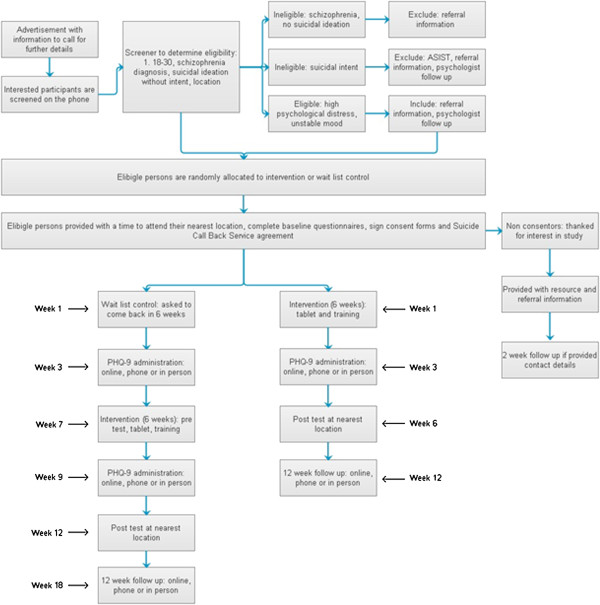
- Eligibility includes being aged 18 to 30, having had suicidal thoughts in the past two weeks, and not being severely suicidal; participants with immediate intent and a plan are excluded and receive Applied Suicide Intervention Skills Training.
- The protocol specifies assessments at baseline, post-test, and 6-week follow-up, and the analysis will use intention-to-treat with Cohen’s d for relative improvement and Bonferroni correction for secondary outcomes.
## Methods
- Design: Randomized controlled trial comparing a self-help app with a wait-list control; the control group receives access after 6 weeks. The study is described as a pilot randomized controlled trial.
- Sample/data: Up to 150 Indigenous Australian youths recruited via the Black Dog Institute website and volunteer registry, social networking ads, and partner organizations in Broome and Armidale; remote participants may use couriered tablets and telephone induction.
- Analysis: Intention-to-treat analysis following BMJ/CONSORT guidance; missing follow-up data imputed by regression imputation or multiple imputation; effect size assessed with Cohen’s d.
## Limitations
- The paper states that online interventions tend to have a high attrition rate, and dropout may introduce selection bias and threaten validity.
- It states that none of the measures provides a psychiatric diagnosis; the authors note this is intentional to keep measures minimal and support retention, but it is still a limitation of the protocol.
- Evident from the text: this is a protocol, so it reports planned methods rather than trial outcomes.
Model-written summary. Check it against the paper before relying on it.
Integrity signals
Registry
Cites
Statistics
Figures
Verification
Claims the paper makes
0 Valid · 5 Not valid · 12 Not checked · 9 Own results and interpretations
The cited sources that could be checked couldn’t confirm or dispute this claim.
In the paper
“Despite fears that focusing on suicidal ideation might give rise to further suicidal thoughts and even attempts, there is no evidence to validate this idea [15,28].”
§ The effectiveness of a suicide prevention app for indigenous Australian youths: study protocol for a randomized controlled trial > Discussion
What the sources say
- Could not verifycites [15] van Spijker BAJ van Straten A Kerkhof AJFM The effectiveness of a web-based self-help intervention to reduce suicidal thoughts: a randomized controlled trial Trials 2010 11 25 10.1186/1745-6215-11-25 20214777 PMC2841163 sourceExperimental — accuracy not yet measured
The Discussion addresses the K10 as a measure of psychological distress, and the scale description lists its questions; neither discusses whether focusing on suicidal ideation causes further thoughts or attempts. Searches for suicidal ideation and for whether asking about suicide increases risk found no passage addressing that claim. (LLM, conf=0.75)
- Not matchedcites [28] Gould MS Marrocco FA Kleinman M Thomas JG Mostkoff K Cote J Davies M Evaluating iatrogenic risk of youth suicide screening programs. A randomized controlled trial JAMA 2005 293 1635 1643 10.1001/jama.293.13.1635 15811983
We don’t have this paper’s reference list.
plain- Asserted: passes — The authors put it forward as true.
- Checkable: passes — It can be checked against evidence.
- Load-bearing: passes — The paper’s conclusions depend on it.
- Based: passes — The paper gives a reason why it holds.
- Could not verify
A claim is checked only against the cited paper’s full text, never its abstract, and none is available for its sources.
In the paper
“There is evidence that cognitive behavioural therapy, dialectical behaviour therapy and other cognitive interventions (that is, schema focused and problem solving therapies) are effective in reducing self-harm and suicidal behaviours [6,7].”
§ The effectiveness of a suicide prevention app for indigenous Australian youths: study protocol for a randomized controlled trial > Background
What the sources say
- Not checked — no full text of the sourcecites [6] Tarrier N Taylor K Gooding P Cognitive-behavioral interventions to reduce suicide behavior: a systematic review and meta-analysis Behav Modif 2008 32 77 108 10.1177/0145445507304728 18096973 source
- Not checked — no full text of the sourcecites [7] Weinberg I Ronningstam E Goldblatt MJ Schechter M Wheelis J Maltsberger JT Strategies in treatment of suicidality: identification of common and treatment-specific interventions in empirically supported treatment manuals J Clin Psychiatry 2010 71 699 706 10.4088/JCP.08m04840blu 20573329 source
plainstates a cause- Asserted: passes — The authors put it forward as true.
- Checkable: passes — It can be checked against evidence.
- Load-bearing: unclear — It is unclear whether the paper’s conclusions depend on it.
- Based: passes — The paper gives a reason why it holds.
What the paper did — it cites no source for this, so there is none to check. The quote shows it is in the paper.
In the paper
“Power analysis for the primary outcome measure indicates that 98 participants are needed for a medium effect size.”
§ The effectiveness of a suicide prevention app for indigenous Australian youths: study protocol for a randomized controlled trial > Methods/Design > Sample size
hedgedn = 98- Asserted: passes — The authors put it forward as true.
- Checkable: passes — It can be checked against evidence.
- Load-bearing: passes — The paper’s conclusions depend on it.
- Based: passes — The paper gives a reason why it holds.
In the paper
“Only 14% of Indigenous people who had a diagnosable mental illness at the time of suicide sought prior mental health treatment [3].”
§ The effectiveness of a suicide prevention app for indigenous Australian youths: study protocol for a randomized controlled trial > Background
What the sources say
- Not checked — no full text of the sourcecites [3] Isaacs AN Pyett P Oakley-Browne MA Gruis H Waples-Crowe P Barriers and facilitators to the utilization of adult mental health services by Australia’s indigenous people: seeking a way forward Int J Ment Health Nurs 2012 19 75 82 20367644 source
plain- Asserted: passes — The authors put it forward as true.
- Checkable: passes — It can be checked against evidence.
- Load-bearing: passes — The paper’s conclusions depend on it.
- Based: passes — The paper gives a reason why it holds.
A conclusion the paper draws from its own results — it cites no other source for it, so there is none to check. The quote shows it is in the paper.
In the paper
“although the internet has gone some way to addressing help-seeking barriers in some communities, portable devices and apps may provide a more accessible means of support.”
§ The effectiveness of a suicide prevention app for indigenous Australian youths: study protocol for a randomized controlled trial > Background
hedgedstates a possible cause- Asserted: passes — The authors put it forward as true.
- Checkable: passes — It can be checked against evidence.
- Load-bearing: passes — The paper’s conclusions depend on it.
- Based: passes — The paper gives a reason why it holds.
- Rests on an assumption not shown here.
1 more claim
Create a free account to see all 26 claims and every source verdict.
- It may state two separate claims as one. 14
- Probably not a substantial claim. 10
Claims other papers make about this one
Each is checked against this paper’s own text: does it say what the citing paper says it does?
The source backs part of the claim, not all of it — or backs it for a different population, condition or comparison.
In the citing paper
“Few evidence based culturally specific e-mental health treatment programs are available for Aboriginal and Torres Strait Islander people (Dingwall et al., 2015; Titov et al., 2018); with only one specific for Aboriginal and Torres Strait Islander youth (Shand et al., 2013).”
From Drafting the Aboriginal and Islander Mental Health Initiative for Youth (AIMhi-Y) App: Results of a formative mixed methods study (2020) · cites this paper as Shand et al., 2013
Experimental — accuracy not yet measuredThe cited source says what the claim attributes to it.
In the citing paper
“Mobile technology has been incorporated into health promotion programs targeting various health behaviors. Initiatives have targeted new parents [34], physical activity and nutrition [35-37], alcohol [38], suicide prevention [39], and mental health [40,41].”
From Theory-Based Design and Development of a Socially Connected, Gamified Mobile App for Men About Breastfeeding (Milk Man) (2016) · cites this paper as [39]
In the citing paper
“Security is considered by many to be “paramount and drive all other considerations” when designing interventions [14,23,32].”
From Acceptability of Mental Health Apps for Aboriginal and Torres Strait Islander Australians: A Qualitative Study (2016) · cites this paper as [23]
Citations
Cites
The PHQ-9: Validity of a brief depression severity measure
Kroenke, K., Spitzer, R. L., & Williams, J. B. W. (2001) · Journal of General Internal Medicine · doi:10.1046/j.1525-1497.2001.016009606.x · Cited by 44,910
KESSLER, R. C., ANDREWS, G., COLPE, L. J., HIRIPI, E., MROCZEK, D. K., NORMAND, S.-L. T., WALTERS, E. E., & ZASLAVSKY, A. M. (2002) · Psychological Medicine · doi:10.1017/s0033291702006074 · Cited by 10,327 · cited 1×
“The scale has been used across several populations [19] and is a valid and reliable instrument sensitive to the detection of mental health conditions within the population [20].”
MethodScreening for serious mental illness in the general population
Kessler, R. C., Barker, P. R., Colpe, L. J., Epstein, J. F., Gfroerer, J. C., Hiripi, E., Howes, M. J., Normand, S.-L. T., Manderscheid, R. W., Walters, E. E., et al. (2003) · Archives of General Psychiatry · doi:10.1001/archpsyc.60.2.184 · Cited by 5,692 · cited 6×
“Eligible participants who have indicated distress (by scoring >19 on the PHQ-9 or >29 on the K10) will still be admitted to the study, but will be referred to support services.”
BackgroundMethodInfluentialCross-national prevalence and risk factors for suicidal ideation, plans and attempts
Nock, M. K., Borges, G., Bromet, E. J., Alonso, J., Angermeyer, M., Beautrais, A., Bruffaerts, R., Chiu, W. T., de Girolamo, G., Gluzman, S., et al. (2008) · British Journal of Psychiatry · doi:10.1192/bjp.bp.107.040113 · Cited by 2,654 · cited 1×
“ideation go on to make a plan, and 29% attempt suicide [5].”
BackgroundHayes, S. C. (2004) · Behavior Therapy · doi:10.1016/s0005-7894(04)80013-3 · Cited by 2,493
Interpreting scores on the Kessler Psychological Distress Scale (K10)
Andrews, G., & Slade, T. (2001) · Australian and New Zealand Journal of Public Health · doi:10.1111/j.1467-842x.2001.tb00310.x · Cited by 2,021 · cited 1×
“The scale has been used across several populations [19] and is a valid and reliable instrument sensitive to the detection of mental health conditions within the population [20].”
MethodCosting psychiatric interventions.
Beecham, J. K., & Knapp, M. R. J. (1992) · Kent Academic Repository (University of Kent) · Cited by 710
Slade, M., & Thornicroft, G. (2025) · Oxford Textbook of Community Mental Health · doi:10.1093/med/9780198898818.003.0007 · Cited by 679
Acceptance and commitment therapy: A meta-analytic review
Powers, M. B., Zum Vörde Sive Vörding, M. B., & Emmelkamp, P. M. G. (2009) · Psychotherapy and Psychosomatics · doi:10.1159/000190790 · Cited by 619
Evaluating Iatrogenic Risk of Youth Suicide Screening Programs: A Randomized Controlled Trial
Gould, M. S., Marrocco, F. A., Kleinman, M., Thomas, J. G., Mostkoff, K., Cote, J., & Davies, M. (2005) · JAMA · doi:10.1001/jama.293.13.1635 · Cited by 522 · cited 1×
“Despite fears that focusing on suicidal ideation might give rise to further suicidal thoughts and even attempts, there is no evidence to validate this idea [15,28].”
BackgroundThe Hopelessness Depression Symptom Questionnaire
Metalsky, G. I., & Joiner, T. E. (1997) · Cognitive Therapy and Research · doi:10.1023/a:1021882717784 · Cited by 401
Joiner, T. E., Pfaff, J. J., & Acres, J. G. (2002) · Behaviour Research and Therapy · doi:10.1016/s0005-7967(01)00017-1 · Cited by 387 · cited 1×
“The scale has good reliability and validity [23,24] specifically amongst a group of 15 to 24-year-old general practice patients [25].”
BackgroundCognitive-Behavioral Interventions to Reduce Suicide Behavior: A Systematic Review and Meta-Analysis
Tarrier, N., Taylor, K., & Gooding, P. (2008) · Behavior Modification · doi:10.1177/0145445507304728 · Cited by 384 · cited 1×
“dence that cognitive behavioural therapy, dialectical behaviour therapy and other cognitive interventions (that is, schema focused and problem solving therapies) are effective in reducing self-harm and suicidal behaviours [6,7].”
BackgroundBrinkborg, H., Michanek, J., Hesser, H., & Berglund, G. (2011) · Behaviour Research and Therapy · doi:10.1016/j.brat.2011.03.009 · Cited by 235 · cited 1×
“Acceptance and commitment therapy has been found to be efficacious in a number of mental health domains, including depression [10], anxiety [11] and stress [12].”
BackgroundMindfulness‐Based cognitive therapy for prevention of recurrence of suicidal behavior
Williams, J. M. G., Duggan, D. S., Crane, C., & Fennell, M. J. V. (2006) · Journal of Clinical Psychology · doi:10.1002/jclp.20223 · Cited by 235 · cited 1×
“Mindfulness-based cognitive therapy has also shown promising results in reducing suicidal ideation [8].”
BackgroundBohlmeijer, E. T., Fledderus, M., Rokx, T. A. J. J., & Pieterse, M. E. (2011) · Behaviour Research and Therapy · doi:10.1016/j.brat.2010.10.003 · Cited by 232 · cited 1×
“Acceptance and commitment therapy has been found to be efficacious in a number of mental health domains, including depression [10], anxiety [11] and stress [12].”
BackgroundArch, J. J., Wolitzky-Taylor, K. B., Eifert, G. H., & Craske, M. G. (2012) · Behaviour Research and Therapy · doi:10.1016/j.brat.2012.04.007 · Cited by 194 · cited 1×
“Acceptance and commitment therapy has been found to be efficacious in a number of mental health domains, including depression [10], anxiety [11] and stress [12].”
BackgroundClifford, A. C., Doran, C. M., & Tsey, K. (2013) · BMC Public Health · doi:10.1186/1471-2458-13-463 · Cited by 186 · cited 1×
“An international systematic review of suicide prevention for Indigenous populations identified only three studies based in Australia, none of which were controlled trials [16].”
BackgroundA comparison of two methods of collecting economic data in primary care
Patel, A., Rendu, A., Moran, P., Leese, M., Mann, A., & Knapp, M. (2005) · Family Practice · doi:10.1093/fampra/cmi027 · Cited by 149 · cited 1×
“It can be tailored to suit the data requirements, thus the following domains will be captured within this study: GP consultations, practice nurse visits, use of hospital services for physical or mental health problems, mental health helpline contacts, psychiatric crisis support team contacts, social worker contacts, c…”
BackgroundIsaacs, A. N., Pyett, P., Oakley‐Browne, M. A., Gruis, H., & Waples‐Crowe, P. (2010) · International Journal of Mental Health Nursing · doi:10.1111/j.1447-0349.2009.00647.x · Cited by 128
Disentangling the Interrelations Between Hopelessness, Loneliness, and Suicidal Ideation
Joiner, T. E., & Rudd, M. D. (1996) · Suicide and Life-Threatening Behavior · doi:10.1111/j.1943-278x.1996.tb00253.x · Cited by 121 · cited 1×
“The scale has good reliability and validity [23,24] specifically amongst a group of 15 to 24-year-old general practice patients [25].”
BackgroundSuicide in Indigenous People in Queensland, Australia: Trends and Methods, 1994–2007
De Leo, D., Sveticic, J., & Milner, A. (2011) · Australian & New Zealand Journal of Psychiatry · doi:10.3109/00048674.2011.570310 · Cited by 103 · cited 1×
“Compared with their non-Indigenous counterparts, Indigenous youth aged 15 to 24 have four times the risk of suicide, with those aged 25 to 34 having almost three times the risk [2].”
BackgroundJoiner, T. E., & Rudd, M. D. (1995) · Suicide and Life-Threatening Behavior · doi:10.1111/j.1943-278x.1995.tb00927.x · Cited by 96 · cited 1×
“The scale has good reliability and validity [23,24] specifically amongst a group of 15 to 24-year-old general practice patients [25].”
Backgroundvan Spijker, B. A. J., van Straten, A., & Kerkhof, A. J. F. M. (2010) · Trials · doi:10.1186/1745-6215-11-25 · Cited by 85
Weinberg, I., Ronningstam, E., Goldblatt, M. J., Schechter, M., Wheelis, J., & Maltsberger, J. T. (2010) · The Journal of Clinical Psychiatry · doi:10.4088/jcp.08m04840blu · Cited by 55
The Aboriginal suicide and self-harm help-seeking quandary
Farrelly, T. (2008) · Aboriginal health worker · Cited by 24
Factor structure of the Barratt impulsiveness scale
Patton, J. H., Stanford, M. S., & Barratt, E. S. (1995) · Journal of Clinical Psychology · doi:10.1002/1097-4679(199511)51:6<768::aid-jclp2270510607>3.0.co;2-1 · cited 2×
“83 and has been used with undergraduate students, substance abuse patients, prison inmates and general psychiatric patients [21].”
BackgroundMethod
Research works printed but not linked: 1
- Pietrzak E McLaughlin R The Effectiveness of Online Suicide Prevention Programs, 1998–2009: A Literature Review 2009 Brisbane: Centre for Military and Veterans Health
Cited by
Social connectedness, mental health and the adolescent brain
Lamblin, M., Murawski, C., Whittle, S., & Fornito, A. (2017) · Neuroscience & Biobehavioral Reviews · doi:10.1016/j.neubiorev.2017.05.010 · Cited by 330
“…smartphone apps are tailored to offer personalized and targeted support as an adjunct to traditional mental health treatments (Ali et al., 2015; Rice et al., 2014), and are of particular utility for engaging teens who are socially or geographically isolated (Berry et al., 2016; Shand et al., 2013).”
A systematic assessment of smartphone tools for suicide prevention
Larsen, M. E., Nicholas, J., & Christensen, H. (2016) · PLoS ONE · doi:10.1371/journal.pone.0152285 · Cited by 289
“There is also an absence of efficacy data for apps related to suicide prevention, although the publication of designs [5], proof-of-concept results [6], and protocols for evaluation studies [7] are indicative of the future research direction.”
BackgroundTighe, J., Shand, F., Ridani, R., Mackinnon, A., De La Mata, N., & Christensen, H. (2017) · BMJ Open · doi:10.1136/bmjopen-2016-013518 · Cited by 227
“The study protocol has been published.(16)”
Self-citationSmartphone Apps for the Treatment of Mental Disorders: Systematic Review
Miralles, I., Granell, C., Díaz-Sanahuja, L., Van Woensel, W., Bretón-López, J., Mira, A., Castilla, D., & Casteleyn, S. (2020) · JMIR mHealth and uHealth · doi:10.2196/14897 · Cited by 188
“For the benefit of the research community, Table 2 lists the concrete studies (by app name, when available; if the app name was not found, we put N/A) per mental disorder.”
BackgroundPovey, J., Mills, P. P. J. R., Dingwall, K. M., Lowell, A., Singer, J., Rotumah, D., Bennett-Levy, J., & Nagel, T. (2016) · Journal of Medical Internet Research · doi:10.2196/jmir.5314 · Cited by 121
“Two culturally responsive e-mental health tools have recently been developed with local input: the AIMhi Stay Strong iPad app and the ibobbly suicide prevention app [22,23].”
Metadata
- Authors
- Shand, F. L., Ridani, R., Tighe, J., & Christensen, H.
- Affiliations
- Black Dog Institute (AU)
- Corresponding author
- Shand, Fiona L
- Venue
- Trials
- Published
- 2013
- Volume
- 14
- Issue
- 1
- Pages
- 396
- ISSN
- 1745-6215 (ISSN-L)
- PMC
- PMC4222891
- OpenAlex
- W2057565730
- Cited by
- 69
- References
- 28
- Citations by year
- 2025: 1 · 2024: 3 · 2023: 2 · 2022: 3 · 2021: 4 · 2020: 11 · 2019: 4 · 2018: 8 · 2017: 10 · 2016: 13 · 2015: 6 · 2014: 4
- FWCI
- 8.52
- Type
- journal article
- Language
- en
- Open access
- gold
- doi.org
- Licence
- cc-by
- Locations
- Trials (publishedVersion, cc-by)
- PubMed Central (publishedVersion, cc-by)
- PubMed (publishedVersion)
- Funders
- Australian Government
- University of New South Wales
- Samsung
- Young and Well Cooperative Research Centre
- Topics
- Social Sciences › Psychology › Clinical Psychology › Suicide and Self-Harm Studies
- Social Sciences › Psychology › Applied Psychology › Digital Mental Health Interventions
- Social Sciences › Psychology › Clinical Psychology › Mindfulness and Compassion Interventions
- Keywords
- suicide prevention, mobile health apps, self-help intervention, suicidal ideation, help-seeking barriers, acceptance and commitment therapy, depression, anxiety, impulsivity
- MeSH terms
- Suicide Prevention, Adolescent, Adult, Australia, Clinical Protocols, Data Collection, Humans, Research Design, Outcome Assessment, Health Care, Sample Size, Population Groups, Young Adult
About these checks
Registry, retraction, Cites and statistics results are computed, not judged, with one exception: a printed reference that no index lists is read once by a model before it counts as a citation error. Claims are extracted by a model and kept only when their quote appears verbatim in the text; each cited source is then checked, with a model’s help, for whether it says what the claim relies on. Those verdicts can be wrong — read the claim’s quote and the cited source before relying on one.
The claim verdicts this report counts are experimental: their accuracy is not yet measured.
A language model drew the claims from the paper on 2026-10-11, under version 3 of the claim definition (model deepseek-v4.1-flash, prompt extract-v3).
A second model labelled each claim on 2026-10-11 (model jev-1.13-20260917, definition revision gold-guideline-v0.2).
Cited sources are checked with a language model’s help (gpt-6-sol).
Statistics and arithmetic are recomputed, not judged.
Confidence bands are shown only for fields calibrated on our annotated test set. None is calibrated yet, so no band is shown.
What counts as a claim ›How we measure confidence ›How we check this ›
Are you an author, or do you see a problem with this page? Request a review
Data sources
Bibliographic data: Semantic Scholar, OpenAlex, Crossref.
Contains information from the Semantic Scholar Academic Graph Datasets, made available under the ODC Attribution License (ODC-BY 1.0).
Semantic Scholar’s data is described in: Kinney, R., et al. (2023). The Semantic Scholar Open Data Platform. arXiv:2301.10140.
