

The DOI matches its Crossref record; 47 of the 47 references it cites were found in a registry or an index.
Parasites of importance for human health in Nigerian dogs: high prevalence and limited knowledge of pet owners
Open accessAbstract
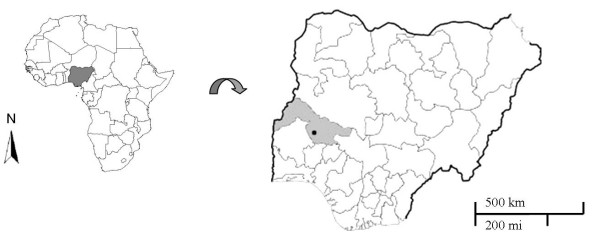
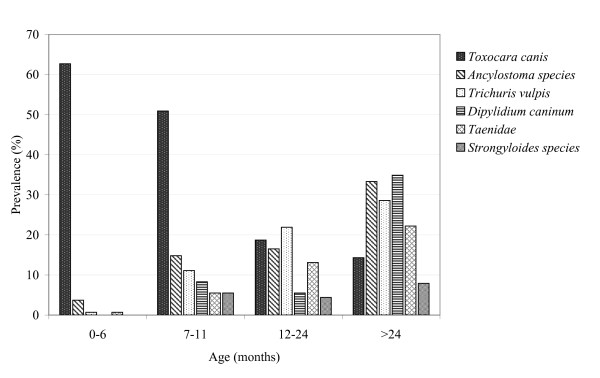
Background: Dogs are the most common pet animals worldwide. They may harbour a wide range of parasites with zoonotic potential, thus causing a health risk to humans. In Nigeria, epidemiological knowledge on these parasites is limited. Methods: In a community-based study, we examined 396 dogs in urban and rural areas of Ilorin (Kwara State, Central Nigeria) for ectoparasites and intestinal helminths. In addition, a questionnaire regarding knowledge and practices was applied to pet owners. Results: Nine ectoparasite species belonging to four taxa and six intestinal helminth species were identified: fleas (Ctenocephalides canis, Pulex irritans, Tunga penetrans), mites (Demodex canis, Otodectes sp.,Sarcoptes scabiei var.canis), ticks (Rhipicephalus sanguineus, Ixodes sp.), and lice (Trichodectes canis); and Toxocara canis, Ancylostoma sp.,Trichuris vulpis, Dipylidium caninum, Taenidae and Strongyloides sp. Overall prevalence of ectoparasites was 60.4% and of intestinal helminths 68.4%. The occurrence of C. canis, R. sanguineus, T. canis, Ancylostoma sp. and T. vulpis was most common (prevalence 14.4% to 41.7%). Prevalence patterns in helminths were age-dependent, with T. canis showing a decreasing prevalence with age of host, and a reverse trend in other parasite species. Knowledge regarding zoonoses was very limited and the diseases not considered a major health problem. Treatment with antiparasitic drugs was more frequent in urban areas. Conclusion: Parasites of importance for human health were highly prevalent in Nigerian dogs. Interventions should include health education provided to dog owners and the establishment of a program focusing on zoonotic diseases.
Overview
The claims and statistics of this paper haven’t been checked yet.
Run the check — free, no account needed. It reads the open-access text and checks the sources it cites.
Integrity signals
Registry
Cites
Statistics
Figures
Verification
Claims the paper makes
The claims and statistics of this paper haven’t been checked yet.
Run the check — free, no account needed. It reads the open-access text and checks the sources it cites.
Claims other papers make about this one
Each is checked against this paper’s own text: does it say what the citing paper says it does?
The source backs part of the claim, not all of it — or backs it for a different population, condition or comparison.
In the citing paper
“thus the incidence of trichurosis is higher in adult dogs, which also have higher parasitic burdens than younger animals [3,5-8].”
From Are we paying too much attention to cardio-pulmonary nematodes and neglecting old-fashioned worms like Trichuris vulpis? (2011) · cites this paper as [7]
Experimental — accuracy not yet measuredIn the citing paper
“Eggs are a constant source of (re-)infection for dogs living in contaminated environments”
From Are we paying too much attention to cardio-pulmonary nematodes and neglecting old-fashioned worms like Trichuris vulpis? (2011) · cites this paper as [7]
Self-check
Percentages, sums and reported differences re-computed from the paper’s own numbers.
The self-check needs the paper’s full text.
Citations
Cites
Effects of environmental change on emerging parasitic diseases
Patz, J. A., Graczyk, T. K., Geller, N., & Vittor, A. Y. (2000) · International Journal for Parasitology · doi:10.1016/s0020-7519(00)00141-7 · Cited by 1,206
The role of companion animals in the emergence of parasitic zoonoses
Robertson, I. D., Irwin, P. J., Lymbery, A. J., & Thompson, R. C. A. (2000) · International Journal for Parasitology · doi:10.1016/s0020-7519(00)00134-x · Cited by 353
McCarthy, J., & Moore, T. A. (2000) · International Journal for Parasitology · doi:10.1016/s0020-7519(00)00122-3 · Cited by 254
Prevalence of intestinal parasites in dogs from São Paulo State, Brazil
Oliveira-Sequeira, T. C. G., do Amarante, A. F. T., Ferrari, T. B., & Nunes, L. C. (2002) · Veterinary Parasitology · doi:10.1016/s0304-4017(01)00575-1 · Cited by 234
Habluetzel, A., Traldi, G., Ruggieri, S., Attili, A., Scuppa, P., Marchetti, R., Menghini, G., & Esposito, F. (2003) · Veterinary Parasitology · doi:10.1016/s0304-4017(03)00082-7 · Cited by 214
Coutinho, M. T. Z., Bueno, L. L., Sterzik, A., Fujiwara, R. T., Botelho, J. R., de María, M., Genaro, O., & Linardi, P. M. (2004) · Veterinary Parasitology · doi:10.1016/j.vetpar.2004.11.011 · Cited by 213
Estimation of canine intestinal parasites in Córdoba (Spain) and their risk to public health
Martínez-Moreno, F. J., Hernandez, S. A., López-Cobos, E., Becerra, C., Acosta, I., & Martínez‐Moreno, Á. (2006) · Veterinary Parasitology · doi:10.1016/j.vetpar.2006.08.004 · Cited by 212
Observations on the development of Toxocara canis(Werner, 1782) in the dog
Sprent, J. F. A. (1958) · Parasitology · doi:10.1017/s0031182000021168 · Cited by 201
Rhipicephalus sanguineus (Acari: Ixodidae), the brown dog tick, parasitizing humans in Brazil
Dantas‐Torres, F., Figueredo, L. A., & Brandão-Filho, S. P. (2006) · Revista da Sociedade Brasileira de Medicina Tropical · doi:10.1590/s0037-86822006000100012 · Cited by 197
Fontanarrosa, M. F., Vezzani, D., Basabe, J., & Eiras, D. F. (2006) · Veterinary Parasitology · doi:10.1016/j.vetpar.2005.11.012 · Cited by 181
Molyneux, D. H. (2004) · The Lancet · doi:10.1016/s0140-6736(04)16728-7 · Cited by 162
The animal reservoir of Tunga penetrans in severely affected communities of north‐east Brazil
Heukelbach, J., Costa, A. M. L., Wilcke, T., Mencke, N., & Feldmeier, H. (2004) · Medical and Veterinary Entomology · doi:10.1111/j.0269-283x.2004.00532.x · Cited by 134
Self-citationEcological analysis and description of the intestinal helminths present in dogs in Mexico City
Eguía-Aguilar, P., Cruz-Reyes, A., & Maya, J. J. M. (2004) · Veterinary Parasitology · doi:10.1016/j.vetpar.2004.10.004 · Cited by 130
SEASONAL VARIATION OF TUNGIASIS IN AN ENDEMIC COMMUNITY
Heukelbach, J., Wilcke, T., Harms, G., & Feldmeier, H. (2005) · American Journal of Tropical Medicine and Hygiene · doi:10.4269/ajtmh.2005.72.145 · Cited by 123
Self-citationCompanion animal parasitology: a clinical perspective
Irwin, P. J. (2002) · International Journal for Parasitology · doi:10.1016/s0020-7519(01)00361-7 · Cited by 106
Helminths in dogs from a peri-urban resource-limited community in Free State Province, South Africa
Minnaar, W. N., Krecek, R. C., & Fourie, L. J. (2002) · Veterinary Parasitology · doi:10.1016/s0304-4017(02)00155-3 · Cited by 105
Coutinho, M. T. Z., & Linardi, P. M. (2007) · Veterinary Parasitology · doi:10.1016/j.vetpar.2007.04.008 · Cited by 99
The epidemiology of ocular toxocariasis
Taylor, M. R. H. (2001) · Journal of Helminthology · doi:10.1079/joh200175 · Cited by 85
Akao, N., & Ohta, N. (2007) · Parasitology International · doi:10.1016/j.parint.2007.01.009 · Cited by 78
Fleas parasitizing domestic dogs in Georgia, USA: Species composition and seasonal abundance
Durden, L. A., Judy, T. N., Martin, J. E., & Spedding, L. S. (2005) · Veterinary Parasitology · doi:10.1016/j.vetpar.2005.03.016 · Cited by 72
Fleas parasitizing domestic dogs in Spain
Gracia, M. J., Calvete, C., Estrada, R., Castillo, J. A., Peribáñez, M. A., & Lucientes, J. (2007) · Veterinary Parasitology · doi:10.1016/j.vetpar.2007.10.006 · Cited by 71
Ectoparasitic species from Canis familiaris (Linné) in Buenos Aires province, Argentina
González, A., Castro, D., & González, S. E. (2004) · Veterinary Parasitology · doi:10.1016/j.vetpar.2003.12.001 · Cited by 69
Heukelbach, J., Mencke, N., & Feldmeier, H. (2002) · Tropical Medicine & International Health · doi:10.1046/j.1365-3156.2002.00961.x · Cited by 62
Self-citationPigs are the most important animal reservoir for Tunga penetrans (jigger flea) in rural Nigeria
Ugbomoiko, U. S., Ariza, L., & Heukelbach, J. (2008) · Tropical Doctor · doi:10.1258/td.2007.070352 · Cited by 58
Self-citationHeukelbach, J., Walton, S. F., & Feldmeier, H. (2005) · Current Infectious Disease Reports · doi:10.1007/s11908-005-0012-2 · Cited by 58
Self-citationParasites of stray dogs in the Rabat region, Morocco
Pandey, V., Dakkak, A., & Elmamoune, M. (1987) · Annals of Tropical Medicine and Parasitology · doi:10.1080/00034983.1987.11812090 · Cited by 53
Gastrointestinal nematodes in dogs from Debre Zeit, Ethiopia
Yacob, H. T., Ayele, T., Fikru, R., & Basu, A. K. (2007) · Veterinary Parasitology · doi:10.1016/j.vetpar.2007.06.007 · Cited by 51
Malgor, R., Oku, Y., Gallardo, R., & Yarzábal, L. (1996) · Parasite · doi:10.1051/parasite/1996032131 · Cited by 48
Forresteer, J. E., & Scott, M. E. (1990) · Parasitology · doi:10.1017/s003118200006131x · Cited by 44
Intestinal parasitic infections of dogs in the Nsukka area of Enugu State, Nigeria
Anene, B. M., Nnaji, T. O., & Chime, A. B. (1996) · Preventive Veterinary Medicine · doi:10.1016/0167-5877(95)00527-7 · Cited by 43
Morrison, G. (2001) · Postgraduate Medicine · doi:10.3810/pgm.2001.07.970 · Cited by 42
Epidemiology of intestinal helminth parasites of dogs in Ibadan, Nigeria
Sowemimo, O. A., & Asaolu, S. O. (2007) · Journal of Helminthology · doi:10.1017/s0022149x07875924 · Cited by 42
A longitudinal study on cutaneous larva migrans in an impoverished Brazilian township
Heukelbach, J., Wilcke, T., Meier, A., Moura, R. C. S., & Feldmeier, H. (2003) · Travel Medicine and Infectious Disease · doi:10.1016/j.tmaid.2003.10.003 · Cited by 41
Self-citationPost-Parturient Infection of the Bitch with Toxocara canis
Sprent, J. F. A. (1961) · Journal of Parasitology · doi:10.2307/3275307 · Cited by 40
Bryson, N. R., Horak, I. G., Höhn, E., & Louw, J. P. (2000) · Journal of the South African Veterinary Association · doi:10.4102/jsava.v71i3.709 · Cited by 40
Studies on the prevalence of gastro-intestinal helminths of dogs in Calabar, Nigeria.
Ugochukwu, E. I., & Ejimadu, K. N. (1985) · PubMed · Cited by 37
Pitchford, R. J., & Visser, P. S. (1975) · Transactions of the Royal Society of Tropical Medicine and Hygiene · doi:10.1016/0035-9203(75)90126-1 · Cited by 36
Ctenocephalides canis infestation of sheep and goats
Obasaju, M. F., & Otesile, E. B. (1980) · Tropical Animal Health and Production · doi:10.1007/bf02242620 · Cited by 30
Veterinary research and human health.
Dohoo, I. R., McDonell, W. N., Rhodes, C., & Elazhary, Y. (1998) · Europe PMC (PubMed Central) · Cited by 25
A survey of the ectoparasitic infestations of dogs in Nigeria
Dipeolu, O. O. (1975) · Journal of Small Animal Practice · doi:10.1111/j.1748-5827.1975.tb05725.x · Cited by 25
Omudu, E. A., & Amuta, E. U. (2007) · Journal of the South African Veterinary Association · doi:10.4102/jsava.v78i1.285 · Cited by 23
Canine toxocariasis and the associated environmental contamination of urban areas in eastern Nigeria
Chiejina, S. N., & Ekwe, T. O. (1986) · Veterinary Parasitology · doi:10.1016/0304-4017(86)90019-1 · Cited by 21
The epidemiology of echinococcus infection in Kaduna State, Nigeria
Dada, B. J. O., Adegboye, D. S., & Mohammed, A. (1979) · Veterinary Record · doi:10.1136/vr.104.14.312 · Cited by 15
Ectoparasitic infestation of dogs in Bendel State, Nigeria.
Ugochukwu, E. I., & Nnadozie, C. C. (1985) · PubMed · Cited by 15
The incidence of Echinococcus infection in dogs, sheep and goats slaughtered in Ibadan, Nigeria.
Ayanwale, F. O., Dipeolu, O. O., & Esuruoso, G. O. (1982) · PubMed · Cited by 12
Dada, B. J. O. (1980) · Journal of Helminthology · doi:10.1017/s0022149x00006805 · Cited by 9
CARACTERIZACIÓN DE LA ESTRUCTURA IDSTOLÓGICA DE LOS ÓRGANOS LINFOIDES EN ALPACAS ( Lama pacos)
Fernández, T. D., Luis Tabacchi, N., Nieves Sandoval, C., Rosa Perales, C., & Santillán, A. G. (2014) · Revista de Investigaciones Veterinarias del Perú · doi:10.15381/rivep.v10i2.6679 · Cited by 2
Research works printed but not linked: 3
- Dakkak A: Echinococcus-hydatidiosis in North Africa: geographical distribution of species and strains and prevalence in man and animals. Guidelines for diagnosis, surveillance and control of echinococcosis. Veterinary Public Health, World Health Organization, Geneva Switzerland 1992.
- Olufemi BE, Bobade PA: Prevalence of gastrointestinal helminth parasites of dogs in Ibadan, Nigeria. Nig Vet J. 1979, 23: 21-25.
- Estares L, Chavez A, Casas E: Prevalencia de ectoparasitos de Canis familiaris en los dos distritos de San Juan de Lurigancho, San Martin de Porres Comas e Independencia de Lima Metropolitana. Revista de Investigaciones Veterinarias del Perú. 1999, 10: 1-9.
Cited by
Sorted by citations
Larval development of Toxocara canis in dogs
Schnieder, T., Laabs, E.-M., & Welz, C. (2010) · Veterinary Parasitology · doi:10.1016/j.vetpar.2010.10.027 · Cited by 158
Traversa, D. (2011) · Parasites & Vectors · doi:10.1186/1756-3305-4-32 · Cited by 148
Fleas as parasites of the family Canidae
Dobler, G., & Pfeffer, M. (2011) · Parasites & Vectors · doi:10.1186/1756-3305-4-139 · Cited by 116
Rousseau, J., Castro, A., Novo, T., & Maia, C. (2022) · Parasites & Vectors · doi:10.1186/s13071-022-05243-5 · Cited by 84
Mateus, T. L., CASTRO, A. O., Niza‐Ribeiro, J., & Vieira‐Pinto, M. (2014) · International Journal of Environmental Research and Public Health · doi:10.3390/ijerph110909050 · Cited by 80
Metadata
- Authors
- Ugbomoiko, U. S., Ariza, L., & Heukelbach, J.
- Affiliations
- University of Ilorin (NG)
- Universidade Federal do Ceará (BR)
- Venue
- BMC Veterinary Research
- Published
- 2008-12
- Volume
- 4
- Issue
- 1
- Pages
- 49-49
- ISSN
- 1746-6148 (ISSN-L)
- PMC
- PMC2615757
- OpenAlex
- W1976050178
- Cited by
- 146
- References
- 47
- Citations by year
- 2026: 3 · 2025: 4 · 2024: 4 · 2023: 10 · 2022: 14 · 2021: 12 · 2020: 8 · 2019: 12 · 2018: 12 · 2017: 7 · 2016: 10 · 2015: 13 · 2014: 9 · 2013: 3 · 2012: 5
- FWCI
- 4.75
- Type
- journal article
- Language
- en
- Open access
- gold
- doi.org
- Licence
- cc-by
- Locations
- BMC Veterinary Research (publishedVersion, cc-by)
- PubMed Central (publishedVersion, cc-by)
- PubMed (publishedVersion)
- ResearchOnline at James Cook University (James Cook University) (submittedVersion)
- DOAJ (DOAJ: Directory of Open Access Journals) (submittedVersion)
- Funders
- Coordenação de Aperfeiçoamento de Pessoal de Nível Superior
- Conselho Nacional de Desenvolvimento Científico e Tecnológico
- Topics
- Life Sciences › Immunology and Microbiology › Parasitology › Parasitic infections in humans and animals
- Life Sciences › Immunology and Microbiology › Parasitology › Helminth infection and control
- Life Sciences › Immunology and Microbiology › Parasitology › Vector-borne infectious diseases
- Keywords
- canine parasites, zoonoses, ectoparasites, intestinal helminths, Toxocara canis, Ctenocephalides canis, Rhipicephalus sanguineus, Trichodectes canis, Ancylostoma, Trichuris vulpis, Dipylidium caninum, Strongyloides, health education, Ilorin, Nigeria
- MeSH terms
- Animals, Arthropods, Dog Diseases, Dogs, Ectoparasitic Infestations, Female, Siphonaptera, Helminths, Humans, Intestinal Diseases, Parasitic, Health Knowledge, Attitudes, Practice, Phthiraptera, Male, Mites, Nigeria, Population Density, Surveys and Questionnaires, Rural Population, Ticks, Urban Population, Zoonoses, Prevalence
About these checks
Registry, retraction, Cites and statistics results are computed, not judged, with one exception: a printed reference that no index lists is read once by a model before it counts as a citation error. Claims are extracted by a model and kept only when their quote appears verbatim in the text; each cited source is then checked, with a model’s help, for whether it says what the claim relies on. Those verdicts can be wrong — read the claim’s quote and the cited source before relying on one.
Statistics and arithmetic are recomputed, not judged.
Confidence bands are shown only for fields calibrated on our annotated test set. None is calibrated yet, so no band is shown.
What counts as a claim ›How we measure confidence ›How we check this ›
Are you an author, or do you see a problem with this page? Request a review
