

A conceptual framework for implementation fidelity
Open accessThe DOI matches its Crossref record; 40 of the 41 references it cites were found in a registry or an index; 3 of the 55 sources its claims cite were checked for support.
Abstract
Implementation fidelity refers to the degree to which an intervention or programme is delivered as intended. Only by understanding and measuring whether an intervention has been implemented with fidelity can researchers and practitioners gain a better understanding of how and why an intervention works, and the extent to which outcomes can be improved. The authors undertook a critical review of existing conceptualisations of implementation fidelity and developed a new conceptual framework for understanding and measuring the process. The resulting theoretical framework requires testing by empirical research. Implementation fidelity is an important source of variation affecting the credibility and utility of research. The conceptual framework presented here offers a means for measuring this variable and understanding its place in the process of intervention implementation.
Overview
CoChat Summary
## TL;DR
The paper proposes a new conceptual framework for implementation fidelity, arguing that fidelity is not just adherence but is also shaped by intervention complexity, facilitation strategies, quality of delivery, and participant responsiveness. It is based on a critical review of the literature, and the authors call for empirical testing of the framework.
## Key findings
- Implementation fidelity is defined as the degree to which an intervention or programme is delivered as intended, and the paper argues it is an important source of variation affecting the credibility and utility of research.
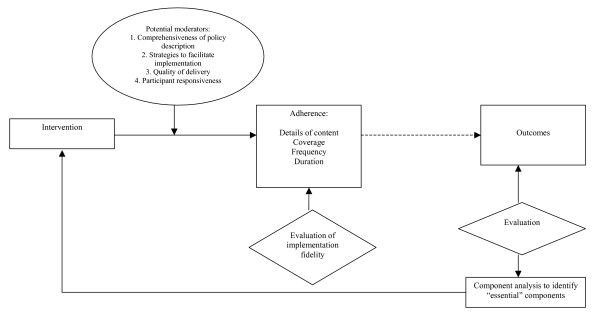
- The framework identifies adherence as the bottom-line measure of fidelity, with subcategories of content, frequency, duration, and coverage (dose).
- The authors argue that fidelity may be moderated by four factors: intervention complexity, facilitation strategies, quality of delivery, and participant responsiveness.
- The paper notes that most implementation-fidelity studies focus only on adherence, while few measure quality of delivery or participant responsiveness; it also says such research rarely reports high implementation fidelity and often falls short of the ideal.
## Methods
- The paper reports a critical review of existing conceptualisations of implementation fidelity and relevant empirical studies, reviews, and theoretical pieces.
- The literature search used the databases Applied Social Sciences Index and Abstracts, CINAHL, International Bibliography of the Social Sciences, MEDLINE, and the Social Science Citation Index, plus scanned references and conference abstracts/presentations.
- The review focused principally on research published from 2002 to 2007.
## Limitations
- The authors explicitly state that the framework is theoretical and requires testing by empirical research.
- They also state that no study has yet measured the moderating effect of facilitation strategies on implementation fidelity, and that the role of quality of delivery as a moderator has not been explored in the literature to date.
- Evident from the text: the paper is a critical review rather than a primary empirical study, so it does not provide new data testing the framework.
Model-written summary. Check it against the paper before relying on it.
Integrity signals
Registry
Cites
Statistics
Figures
Verification
Claims the paper makes
3 Valid · 2 Not valid · 19 Not checked · 32 Own results and interpretations
Every source the paper cites for this claim was checked and supports it.
In the paper
“a study of guidelines intended for General Practitioners (GPs) found that detailed and clear recommendations were almost twice as likely to be followed as vague and non-specific recommendations [23].”
§ A conceptual framework for implementation fidelity > Background > A conceptual framework: elements and relationships
What the sources say
- Supportedcites [23] Grol R Dalhuijsen J Thomas S Veld C Rutten G Mokkink H Attributes of clinical guidelines that influence use of guidelines in general practice: observational study Brit Med J 1998 317 858 861 9748183 PMC31096 source
Table 1 reports that general practitioners followed vague, non-specific recommendations in 36% of decisions, versus 67% for recommendations that were not vague or non-specific—about 1.9 times as often. It also reports 67% compliance for recommendations described concretely and precisely, supporting the claim's characterization as detailed and clear. Page numbers were not available in our copy. (LLM, conf=0.94)
plainstates an association- Asserted: passes — The authors put it forward as true.
- Checkable: passes — It can be checked against evidence.
- Load-bearing: passes — The paper’s conclusions depend on it.
- Based: passes — The paper gives a reason why it holds.
- Supported
None of the sources cited for this claim have been checked yet.
In the paper
“It has been demonstrated that the fidelity with which an intervention is implemented affects how well it succeeds [1-5].”
§ A conceptual framework for implementation fidelity > Background
What the sources say
- Not checked — no full text of the sourcecites [1] Dusenbury L Brannigan R Falco M Hansen W A review of research on fidelity of implementation: Implications for drug abuse prevention in school settings Health Educ Res 2003 18 237 256 12729182 10.1093/her/18.2.237 source
- Not checked — no full text of the sourcecites [2] Dane A Schneider B Program integrity in primary and early secondary prevention: Are implementation effects out of control Clin Psychol Rev 1998 18 23 45 9455622 10.1016/S0272-7358(97)00043-3 source
- Not checked — no full text of the sourcecites [3] Elliot D Mihalic S Issues in disseminating and replicating effective prevention programs Prev Sci 2004 5 47 53 15058912 10.1023/B:PREV.0000013981.28071.52 source
- Not matchedcites [4] Mihalic S The importance of implementation fidelity Emotional & Behavioral Disorders in Youth 2004 4 83 86 and 99–105.
Its entry has no title and year that we can search by.
- Not checked yetcites [5] Mihalic S The importance of implementation fidelity Blueprints Violence Prevention Initiative 2002 Boulder, Colorado
states a cause- Asserted: passes — The authors put it forward as true.
- Checkable: passes — It can be checked against evidence.
- Load-bearing: passes — The paper’s conclusions depend on it.
- Based: passes — The paper gives a reason why it holds.
None of the sources cited for this claim have been checked yet.
In the paper
“Implementation fidelity acts as a potential moderator of the relationship between interventions and their intended outcomes.”
§ A conceptual framework for implementation fidelity > Background
What the sources say
- Not checked — no full text of the sourcecites [1] Dusenbury L Brannigan R Falco M Hansen W A review of research on fidelity of implementation: Implications for drug abuse prevention in school settings Health Educ Res 2003 18 237 256 12729182 10.1093/her/18.2.237 source
- Not checked — no full text of the sourcecites [2] Dane A Schneider B Program integrity in primary and early secondary prevention: Are implementation effects out of control Clin Psychol Rev 1998 18 23 45 9455622 10.1016/S0272-7358(97)00043-3 source
- Not checked — no full text of the sourcecites [3] Elliot D Mihalic S Issues in disseminating and replicating effective prevention programs Prev Sci 2004 5 47 53 15058912 10.1023/B:PREV.0000013981.28071.52 source
- Not matchedcites [4] Mihalic S The importance of implementation fidelity Emotional & Behavioral Disorders in Youth 2004 4 83 86 and 99–105.
Its entry has no title and year that we can search by.
- Not checked yetcites [5] Mihalic S The importance of implementation fidelity Blueprints Violence Prevention Initiative 2002 Boulder, Colorado
hedgedstates a possible cause- Asserted: passes — The authors put it forward as true.
- Checkable: passes — It can be checked against evidence.
- Load-bearing: passes — The paper’s conclusions depend on it.
- Based: passes — The paper gives a reason why it holds.
In the paper
“Unless such an evaluation is made, it cannot be determined whether a lack of impact is due to poor implementation or inadequacies inherent in the programme itself, a so-called Type III error [11]”
§ A conceptual framework for implementation fidelity > Background
What the sources say
- Not checked — no full text of the sourcecites [11] Dobson L Cook T Avoiding Type III error in program evaluation: results from a field experiment Evaluation and Program Planning 1980 3 269 276 10.1016/0149-7189(80)90042-7 source
plainstates a cause- Asserted: passes — The authors put it forward as true.
- Checkable: passes — It can be checked against evidence.
- Load-bearing: passes — The paper’s conclusions depend on it.
- Based: passes — The paper gives a reason why it holds.
None of the sources cited for this claim have been checked yet.
In the paper
“two studies examining programmes to help people with mental health issues obtain employment found that employment outcomes among their study groups were weakest for those in poorly implemented programmes [6,7].”
§ A conceptual framework for implementation fidelity > Background
What the sources say
- Not checked — no full text of the sourcecites [6] McGrew J Griss M Concurrent and predictive validity of two scales to assess the fidelity of implementation of supported employment Psychiatr Rehab J 2005 29 41 47 10.2975/29.2005.41.47 16075696 source
- Not checked yetcites [7] Resnick B Neale M Rosenheck R Impact of public support payments, intensive psychiatric community care, and program fidelity on employment outcomes for people with severe mental illness J Nerv Ment Dis 2003 191 139 144 12637839 10.1097/00005053-200303000-00001 source
plainstates an association- Asserted: passes — The authors put it forward as true.
- Checkable: passes — It can be checked against evidence.
- Load-bearing: passes — The paper’s conclusions depend on it.
- Based: passes — The paper gives a reason why it holds.
22 more claims
Create a free account to see all 56 claims and to verify the 10 references still open.
- Probably not a substantial claim. 21
- It may state two separate claims as one. 8
Claims other papers make about this one
Each is checked against this paper’s own text: does it say what the citing paper says it does?
The source backs part of the claim, not all of it — or backs it for a different population, condition or comparison.
In the citing paper
“They are key indicators of whether a program is appropriate/acceptable for the intended audience and context, whether there are enough resources to support delivery, and whether it is being used (Carroll et al., 2007).”
From Intervention Programs Targeting the Mental Health, Professional Burnout, and/or Wellbeing of School Teachers: Systematic Review and Meta-Analyses (2023) · cites this paper as Carroll et al., 2007
Experimental — accuracy not yet measuredThe source backs part of the claim, not all of it — or backs it for a different population, condition or comparison.
In the citing paper
“They acknowledged that adaptations are likely to occur in real-world implementation, but the question on how to address this issue while measuring fidelity remained unanswered.”
From A modified theoretical framework to assess implementation fidelity of adaptive public health interventions (2015) · cites this paper as [15]
Experimental — accuracy not yet measuredThe cited source says what the claim attributes to it.
In the citing paper
“Fidelity and adherence are important in the translation of research to practice when implementing programs in the real-world.”
From Intervention Programs Targeting the Mental Health, Professional Burnout, and/or Wellbeing of School Teachers: Systematic Review and Meta-Analyses (2023) · cites this paper as Carroll et al., 2007
The cited source says what the claim attributes to it.
In the citing paper
“Evidence from a review of eHealth innovations [12] indicates that centralised diffusion systems such as those considered here were more effective in disseminating authoritative evidence and preserving the ‘fidelity’ [20] of interventions, but less successful in terms of adopter engagement, partly because of strict limits on the extent to which implementation could be modified to address the”
From Beyond pilotitis: taking digital health interventions to the national level in China and Uganda (2017) · cites this paper as [20]
The cited source says what the claim attributes to it.
In the citing paper
“The modified Carroll et al.’s framework we propose may permit a comprehensive assessment of the implementation fidelity-adaptation balance required when implementing adaptive interventions, but more empirical research is needed to validate it.”
From A modified theoretical framework to assess implementation fidelity of adaptive public health interventions (2015) · cites this paper as [15]
5 more claims about this paper
Create a free account to see every claim other papers make about this one.
Citations
Cites
Bellg, A. J., Treatment Fidelity Workgroup of the NIH Behavior Change Consortium, Borrelli, B., Resnick, B., Hecht, J., Minicucci, D. S., Ory, M., Ogedegbe, G., Orwig, D., Ernst, D., et al. (2004) · Health Psychology · doi:10.1037/0278-6133.23.5.443 · Cited by 2,620
Dusenbury, L. (2003) · Health Education Research · doi:10.1093/her/18.2.237 · Cited by 1,671
Dane, A. V., & Schneider, B. H. (1998) · Clinical Psychology Review · doi:10.1016/s0272-7358(97)00043-3 · Cited by 1,557
Reeves, M. (1993) · Cited by 903
Grol, R., Dalhuijsen, J., Thomas, S., Veld, C. I. ‘., Rutten, G., & Mokkink, H. (1998) · BMJ · doi:10.1136/bmj.317.7162.858 · Cited by 877 · cited 1×
“For example, a study of guidelines intended for General Practitioners (GPs) found that detailed and clear recommendations were almost twice as likely to be followed as vague and non-specific recommendations [23].”
Issues in Disseminating and Replicating Effective Prevention Programs
Elliott, D. S., & Mihalic, S. (2004) · Prevention Science · doi:10.1023/b:prev.0000013981.28071.52 · Cited by 794 · cited 6×
“Such strategies included the provision of manuals, guidelines, training, monitoring and feedback, capacity building, and incentives [ 3 ,6,8,17].”
InfluentialProcess evaluation on quality improvement interventions
Hulscher, M. E. J. L. (2003) · Quality and Safety in Health Care · doi:10.1136/qhc.12.1.40 · Cited by 348
Drug therapy in the elderly: what doctors believe and patients actually do
Barat, I., Andreasen, F., & Damsgaard, E. M. S. (2001) · British Journal of Clinical Pharmacology · doi:10.1046/j.0306-5251.2001.01401.x · Cited by 334 · cited 3×
“For example, it has been found that implementation fidelity of prescribed drug interventions for elderly people in the community can be low because these patients deliberately fail to comply with their prescribed regimens [ 31-33 ].”
InfluentialForgatch, M. S., Patterson, G. R., & DeGarmo, D. S. (2005) · Behavior Therapy · doi:10.1016/s0005-7894(05)80049-8 · Cited by 320
The fidelity‐adaptation debate: Implications for the implementation of public sector social programs
Blakely, C. H., Mayer, J. P., Gottschalk, R. G., Schmitt, N., Davidson, W. S., Roitman, D. B., & Emshoff, J. G. (1987) · American Journal of Community Psychology · doi:10.1007/bf00922697 · Cited by 297 · cited 2×
“Indeed, the proadaptation perspective implies that successful interventions are those that adapt to local needs [22].”
Research works printed but not linked: 3
- Medical Research Council A framework for the development and evaluation of RCTs for complex interventions to improve health 2000 London: Medical Research Council
- Rogers EM Diffusion of Innovation 2003 Fifth New York, NY: Free Press
- Herzog S Wright P Addressing the fidelity of personal and social responsibility model implementation Res Q Exerc Sport 2005 A 76
Cited by
Items 1,801–1,900 of 2,543
Psychodrama: A Creative Method to Survive and Thrive
Orkibi, H. (2025) · Cambridge University Press eBooks · doi:10.1017/9781009378338 · Cited by 8
Miller, H. V., & Miller, J. M. (2025) · American Journal of Criminal Justice · doi:10.1007/s12103-025-09850-7 · Cited by 1
Puschner, B., Stiawa, M., Peters, M., Angerer, P., Rapp, F., Junne, F., Genrich, M., Müller, A., Maatouk, I., Helaß, M., et al. (2025) · BMC Public Health · doi:10.1186/s12889-025-24101-4 · Cited by 3
Ayers, S. L., Ignacio, M., Begay-Kroupa, J., Oesterle, S., Okamoto, S. K., Reep, Z. K., June, D., & Kulis, S. (2025) · Frontiers in Public Health · doi:10.3389/fpubh.2025.1618341 · Cited by 1
Implementation Fidelity in Early Intervention for Eating Disorders—A Multisite Pilot Study
Hyam, L., Gallagher, L., Tsivos, Z., Macnab, S., Kirton, B., Palmer, E., Killackey, E. J., Allen, K. L., & Schmidt, U. H. (2025) · Behavioral Sciences · doi:10.3390/bs15111521
Chau, L. W., Murphy, J., Nguyen, V. C., Tran, H. N., Minas, H., Lam, R. W. M., Hayashi, K., Nguyen, T. U. O. N. G., Krebs, E., & O'Neil, J. (2026) · BMC Health Services Research · doi:10.1186/s12913-026-15031-x · Cited by 1
From Policy to Practice: Implementation of Georgia's Medicaid Family Planning Waiver Program
Blake, S. (2013) · Digital Archive @ GSU · doi:10.57709/4042502 · Cited by 2
Eaves, J., & Gnich, W. (2013) · BMC Health Services Research · doi:10.1186/1472-6963-13-425 · Cited by 2
Pivotal Response Treatment for Children with Autism in School Settings: A Review of the Literature
Kim, N. (2016) · Cited by 1
Local initiatives to access emergency obstetric and neonatal care in Burkina Faso
Yaméogo, W. M. E., Ouédraogo, T. M., & Kouanda, S. (2016) · International Journal of Gynecology & Obstetrics · doi:10.1016/j.ijgo.2016.08.003 · Cited by 4
Roseno, A., Duffrin, M. W., & Stage, V. C. (2017) · Health Behavior and Policy Review · doi:10.14485/hbpr.4.5.9 · Cited by 1
Roberts, R., Fawcett, L., & Searle, A. (2018) · Journal of Happiness Studies · doi:10.1007/s10902-018-9971-5 · Cited by 4
Hicks, N. M., McGrew, K. B., Heston, J. L., & Kelly, E. H. (2018) · Cited by 3
Heany, J., Torres, J. M. C., Zagar, C., et al. (2018) · Maternal and Child Health Journal · doi:10.1007/s10995-018-2538-6 · Cited by 1
Harwood, R., O’Brien, R. F., Goldberg, S. E., Allwood, R., Pilnick, A., Beeke, S., Thomson, L., Murray, M., Parry, R. H., Kearney, F. C., et al. (2018) · Cited by 1
Holguin, E. (2018) · UNM’s Digital Repository (University of New Mexico) · Cited by 1
Wakeford, L. (2017) · Carolina Digital Repository (University of North Carolina at Chapel Hill) · doi:10.17615/4tem-rq35 · Cited by 1
Kerins, C., Houghton, C., McHugh, S., Geaney, F., Toomey, E. C., Hayes, C. B., Perry, I. J., & Kelly, C. N. M. (2019) · International Journal of Qualitative Methods · doi:10.1177/1609406919878339 · Cited by 6
Caron, V., Paquet, A., & Bérubé, A. (2019) · Revue de psychoéducation · doi:10.7202/1066145ar · Cited by 6
Gyem, K., Ahmad, R. A., & Mahendradhata, Y. (2020) · Journal of Global Health Reports · doi:10.29392/001c.14140 · Cited by 2
Sahay, J., Sahay, S., & Mukherjee, A. S. (2020) · IFIP advances in information and communication technology · doi:10.1007/978-3-030-64697-4_15 · Cited by 16
Adolescent Drug Misuse Prevention: Challenges in School-Based Programming
Scheier, L. M. (2020) · Cambridge University Press eBooks · doi:10.1017/9781108632591.021 · Cited by 1
Measurement, Prevention, and Treatment of Exercise Addiction
Hausenblas, H. A., Mann, D. T. Y., & Downs, D. S. (2020) · Cambridge University Press eBooks · doi:10.1017/9781108632591.036 · Cited by 4
Comparing fidelity monitoring methods in an evidence-based parenting intervention
Tiwari, A., Whitaker, D. J., & Self‐Brown, S. (2021) · Journal of Children s Services · doi:10.1108/jcs-01-2020-0005 · Cited by 4
Ensuring Implementation Fidelity Is Essential for Quality Improvement
O’Leary, K. J., & Barnard, C. (2021) · The Joint Commission Journal on Quality and Patient Safety · doi:10.1016/j.jcjq.2021.03.001 · Cited by 3
Decision Making: Going Beyond the Data
Maxwell, G. S. (2021) · The enabling power of assessment · doi:10.1007/978-3-030-63539-8_9 · Cited by 2
Martin, R. C. (2021) · STARS (University of Central Florida) · Cited by 1
Factors Influencing Fidelity to a Calorie Posting Policy in Public Hospitals: A Mixed Methods Study
Kerins, C., Kelly, C. N. M., Reardon, C. M., Houghton, C., Toomey, E. C., Hayes, C. B., Geaney, F., Perry, I. J., McSharry, J., & McHugh, S. (2021) · Frontiers in Public Health · doi:10.3389/fpubh.2021.707668 · Cited by 1
Ibrahim, H., & Ng’weshemi, S. K. (2021) · OALib · doi:10.4236/oalib.1107979 · Cited by 1
The Need for Multidimensional and Longitudinal Teacher Training
Luther, V. L., & Peterson-Ahmad, M. B. (2021) · Advances in higher education and professional development book series · doi:10.4018/978-1-7998-9047-8.ch001 · Cited by 1
Haber, Y., Fu, S. S., Rogers, E., Richter, K., Tenner, C. T., Dognin, J. S., Goldfeld, K. S., Gold, H. T., & Sherman, S. E. (2022) · Contemporary Clinical Trials · doi:10.1016/j.cct.2022.106716 · Cited by 1
Translational Research: Bridging the Chasm Between New Knowledge and Useful Knowledge
Kemp, L. (2019) · Springer eBooks · doi:10.1007/978-981-10-5251-4_72 · Cited by 2
Chambers, R. A., Kemp, C. G., Edwards, A., Rosenstock, S., Lee, A., Pinal, L., Cosen, E., Larzelere, F., & Tingey, L. (2023) · Prevention Science · doi:10.1007/s11121-023-01501-9 · Cited by 3
Assessing fidelity of community-tuberculosis programme in the central region of Burkina Faso
Donessouné, F. M. G., Sossa, O. G., Compaoré, R., Yaméogo, E. W. M., Tougri, H., & Kouanda, S. (2023) · African Evaluation Journal · doi:10.4102/aej.v11i1.613 · Cited by 1
Chaturvedi, S. (2015) · Figshare · Cited by 1
Gately, R. (2014) · University of Birmingham Institutional Research Archive (University of Birmingham) · Cited by 1
Hauer, E. (2013) · DiVA (Digitala Vetenskapliga Arkivet) · Cited by 2
Bunkenborg, G. (2014) · Lund University Publications (Lund University) · Cited by 7
Lee, A. M. (2012) · Louisiana State University · doi:10.31390/gradschool_dissertations.1090 · Cited by 1
Kindergarten Kickstart: Outcomes of a Research-Based Summer Pre-K Program
Blumenstock, S. R. (2016) · doi:10.14418/wes01.1.1234 · Cited by 1
Meitheal and Child and Family Support Networks : Process and Outcomes Study
Rodríguez, L., Cassidy, A., & Devaney, C. (2018) · doi:10.52516/fmtz3899 · Cited by 1
Evaluating Structural Interventions
Hensen, B., Dringus, S., Eakle, R., Remme, M., & Hargreaves, J. (2018) · Oxford University Press eBooks · doi:10.1093/oso/9780190675486.003.0012 · Cited by 1
Predictive and Concurrent Validity of the Tiered Fidelity Inventory (TFI)
Kim, J. (2019) · Scholars' Bank (University of Oregon) · Cited by 1
The Global Conference on Education and Research: Volume 3
James, W. B., & Çobanoğlu, C. (2019) · Conference proceedings · doi:10.5038/2572-6374-v3
Reyes, J. (2020) · Sussex Research Online (University of Sussex) · Cited by 1
Group Antenatal Care in Rwanda: Examining Successes and Challenges in Implementation
Singh, K. (2020) · eScholarship (California Digital Library) · Cited by 4
Luz, R. A. (2019) · Digital Library of Theses and Dissertations (Universidade de São Paulo) · doi:10.11606/t.7.2019.tde-22022021-161513 · Cited by 3
Implementation of School-Based Vision Care in an Urban District
Neitzel, A. J. (2018) · Cited by 1
Raaijmakers, L. G. M. (2014) · Research Publications (Maastricht University) · doi:10.26481/dis.20141210lr · Cited by 1
Beuf, T. L. F. D. (2022) · Research Publications (Maastricht University) · doi:10.26481/dis.20220404td · Cited by 2
Akiba, C. F., Powell, B. J., Pence, B. W., Muessig, K. E., Golin, C. E., & Go, V. F.-L. (2022) · Research Square · doi:10.21203/rs.3.rs-1626073/v1 · Cited by 1
Olsson, T. M., Schwarz, U. V. T., Hasson, H., Vira, E. G., & Sundell, K. (2022) · Research Square · doi:10.21203/rs.3.rs-2184012/v1 · Cited by 1
Oog voor diep begrip: Onderzoek naar het tekstbegrip van vwo-leerlingen
Rooijackers, P. J. H. (2023) · Utrecht University Repository (Utrecht University) · doi:10.33540/1643 · Cited by 13
Grosch, K., Haeckl, S., Rau, H. A., & Preuss, P. (2023) · SSRN Electronic Journal · doi:10.2139/ssrn.4476255 · Cited by 3
Cooper, Z., & Johnson, L. C. M. (2024) · Research Square · doi:10.21203/rs.3.rs-4085224/v1 · Cited by 1
Foote, H., Bowen, A., Cotterill, S., & Patchwood, E. (2024) · medRxiv · doi:10.1101/2024.09.05.24313107 · Cited by 1
Balogun, M. R., Kumah, E. A., Adaramoye, V. O., Eboreime, E., Ameh, C., & Afolabi, B. B. (2025) · medRxiv · doi:10.1101/2025.06.13.25329470 · Cited by 1
Baskerville, N. B. (2009) · UWSpace (University of Waterloo) · Cited by 4
Beerthuizen, M. G. C. J., de Wied, M. A., & de Castro, B. O. (2011) · Scientific Research and Documentation Center (WODC) (Scientific Research and Documentation Center) · Cited by 1
A qualitative phenomenological study of the implementation of concept-based instruction
Fair, C. G. (2014) · ProQuest Demo Repository · Cited by 4
Supervision in the Psychological Therapies
Dartnall, E. (2013) · City Research Online (City University London) · Cited by 2
Mol an Ãfâ?oige/Family Preservation: final evaluation report.
Coen, L., Canavan, J., & Brennan, M. A. (2012)
Kilburn, M. R., & Cannon, J. S. (2011) · RAND Corporation eBooks · doi:10.7249/wr884
Valente, J. R. (2010) · Digital Archive @ GSU · doi:10.57709/1420851
Evaluation of the Gold Coast Hospital Avoidance Program: Interim Report
Green, J. P., Quinsey, K., Thompson, C., Masso, M. R., Owen, A., Grootemaat, P. E., & Eagar, K. M. (2008)
Implementation of a Complex Improvement Program in Aged Care
Hasson, H., & Topo, P. (2014) · International perspectives on aging · doi:10.1007/978-3-319-06650-9_14
Application of the Public Health Model for Musculoskeletal Injury Prevention Within the Military
Cameron, K. L. (2015) · Springer eBooks · doi:10.1007/978-1-4939-2984-9_14
Implementation of coordinated healthy lifestyle promotion in primary care : Process and outcomes
Thomas, K. (2015) · Linköping University medical dissertations · doi:10.3384/diss.diva-121492
The psychological determinants of healthy eating and physical activity among adolescents in Dubai
Vyas, L. M. (2014) · University of Bedfordshire Repository (University of Bedfordshire)
Spino, M. A. (2013) · OhioLink ETD Center (Ohio Library and Information Network)
Overzicht van onderzoek naar de PIJ-maatregel tussen 2006-2011
Kempes, M. M. (2012) · Scientific Research and Documentation Center (WODC) (Scientific Research and Documentation Center)
Characteristics of Effective & Ineffective Adolescent Health Interventions with a Parental Component
McAteer, J., Jepson, R. G., Wright, D. G., & Jackson, C. (2014)
Implementation science: issues of fidelity to consider in community nursing
Hanafin, S., & O'Reilly, E. D. (2015) · British Journal of Community Nursing · doi:10.12968/bjcn.2015.20.9.437
Psychometric Investigation of the Check-In, Check- Out Fidelity of Implementation Measure
Sullivan, E. A. (2015) · Digital Commons - DU (University of Denver) · Cited by 1
Fletcher, S. K. (2010) · Carolina Digital Repository (University of North Carolina at Chapel Hill) · doi:10.17615/z4r8-ze07
Reasons for the practical approach of lung health
Torres, Y. M., Delis, I., Pérez, L. A., et al. (2011) · Revista cubana de higiene y epidemiología
Design for the Mother and Infant Home Visiting Program: Evaluation Strong Start
Michalopoulos, C., Lee, H., Snell, E. K., Crowne, S. S., Filene, J. H., Fox, M. K., Kranker, K., Mijanovich, T., Gill, L., & DUGGAN, A. K. (2015) · Mathematica Policy Research Reports
Strydom, S. J. (2014) · Open University of Cape Town (University of Cape Town) · Cited by 1
Bradley, D. K. F. (2015) · Open Access at Essex (University of Essex)
The application of transformational leadership theory to parenting and adolescent health promotion
Morton, K. (2011) · cIRcle (University of British Columbia) · doi:10.14288/1.0077001
AN EVALUATION OF POLICY, PROVISION AND PRACTICE IN SECONDARY SCHOOLS
Ngarari, J. M. (2010)
Kim, H., & Nah, E. (2015) · 보건교육·건강증진학회지 · doi:10.14367/kjhep.2015.32.4.37
Christmas, P. (2016) · University of Birmingham Institutional Research Archive (University of Birmingham)
Pyle, D. (2021) · Digital Commons - USU (Utah State University) · doi:10.26076/97fe-4440
Brugman, D., & Gibbs, J. C. (2010)
Testing the Feasibility of Fidelity Evaluation in a Multisite, Multiprogram Initiative
Cornish, D. L., Losch, M. E., & Avery, M. (2016) · American Journal of Sexuality Education · doi:10.1080/15546128.2016.1170648
Adekunle, A. O. (2016) · University of Hertfordshire Research Archive (University of Hertfordshire) · doi:10.18745/th.17183
COMPASS Implementation Quality
Ruble, L. A., & McGrew, J. H. (2015) · SpringerBriefs in psychology · doi:10.1007/978-3-319-18555-2_5
Hanley, S. (2015) · Carolina Digital Repository (University of North Carolina at Chapel Hill) · doi:10.17615/p8w2-m615
Marshall, L. M. (2016) · Digital Commons - University of South Florida (University of South Florida)
How to Sustain Quality Improvements in Sedation Practice?*
Ista, E., & van Dijk, M. (2016) · Pediatric Critical Care Medicine · doi:10.1097/pcc.0000000000000886
Jeske, S. (2015) · TSpace (University of Toronto)
Magers, M. (2013) · STARS (University of Central Florida)
The Implementation of Support Calls in a Pilot Childhood Obesity Intervention
Hou, X. (2017) · VTechWorks (Virginia Tech) · Cited by 1
Educator and learners' experiences of a high school health education programme
Sauls, B. L.-A., & Frantz, J. M. (2014) · African Journal for Physical Health Education Recreation and Dance
Delivery of Therapist's Intervention to the Education of Ayres Sensory Integration{(R)}(ASI{(R)})
Shin, Y.-N., & Hong, E. (2014) · Journal of Korean Society of Sensory Integration Therapists · doi:10.18064/jkasi.2014.12.1.013
Merlo, G. (2017) · Queensland University of Technology · doi:10.5204/thesis.eprints.103657
Metadata
- Authors
- Carroll, C., Patterson, M., Wood, S., Booth, A., Rick, J., & Balain, S.
- Affiliations
- University of Sheffield (GB)
- Corresponding author
- Carroll, Christopher
- Venue
- Implementation Science
- Published
- 2007-11-30
- Volume
- 2
- Issue
- 1
- Pages
- 40-40
- ISSN
- 1748-5908 (ISSN-L)
- PMC
- PMC2213686
- OpenAlex
- W2167997731
- Cited by
- 2,559
- References
- 41
- Citations by year
- 2026: 224 · 2025: 237 · 2024: 245 · 2023: 232 · 2022: 212 · 2021: 284 · 2020: 249 · 2019: 169 · 2018: 105 · 2017: 121 · 2016: 96 · 2015: 104 · 2014: 100 · 2013: 72 · 2012: 43
- FWCI
- 23.60
- Type
- journal article
- Language
- en
- Open access
- gold
- doi.org
- Licence
- Locations
- Implementation Science (publishedVersion, cc-by)
- PubMed Central (publishedVersion, cc-by)
- PubMed (publishedVersion)
- White Rose Research Online (University of Leeds, The University of Sheffield, University of York) (acceptedVersion)
- DOAJ (DOAJ: Directory of Open Access Journals) (submittedVersion)
- Leicester Research Archive (University of Leicester) (submittedVersion)
- Funders
- Fondazione Italiana per la ricerca sulle Malattie del Pancreas
- Topics
- Health Sciences › Health Professions › General Health Professions › Health Policy Implementation Science
- Social Sciences › Public Administration › Evaluation and Performance Assessment
- Social Sciences › Sociology and Political Science › Delphi Technique in Research
- Keywords
- implementation fidelity, conceptual framework, intervention delivery, fidelity assessment, research credibility, intervention effectiveness, implementation process
About these checks
Registry, retraction, Cites and statistics results are computed, not judged, with one exception: a printed reference that no index lists is read once by a model before it counts as a citation error. Claims are extracted by a model and kept only when their quote appears verbatim in the text; each cited source is then checked, with a model’s help, for whether it says what the claim relies on. Those verdicts can be wrong — read the claim’s quote and the cited source before relying on one.
The claim verdicts this report counts are experimental: their accuracy is not yet measured.
A language model drew the claims from the paper on 2026-10-10, under version 3 of the claim definition (model deepseek-v4.1-flash, prompt extract-v3).
A second model labelled each claim on 2026-10-10 (model jev-1.13-20260917, definition revision gold-guideline-v0.2).
Cited sources are checked with a language model’s help (gpt-6-sol).
Statistics and arithmetic are recomputed, not judged.
Confidence bands are shown only for fields calibrated on our annotated test set. None is calibrated yet, so no band is shown.
What counts as a claim ›How we measure confidence ›How we check this ›
Are you an author, or do you see a problem with this page? Request a review
Data sources
Bibliographic data: Semantic Scholar, OpenAlex, Crossref.
Contains information from the Semantic Scholar Academic Graph Datasets, made available under the ODC Attribution License (ODC-BY 1.0).
Semantic Scholar’s data is described in: Kinney, R., et al. (2023). The Semantic Scholar Open Data Platform. arXiv:2301.10140.
