

A conceptual framework for implementation fidelity
Open accessThe DOI matches its Crossref record; 40 of the 41 references it cites were found in a registry or an index; 3 of the 55 sources its claims cite were checked for support.
Abstract
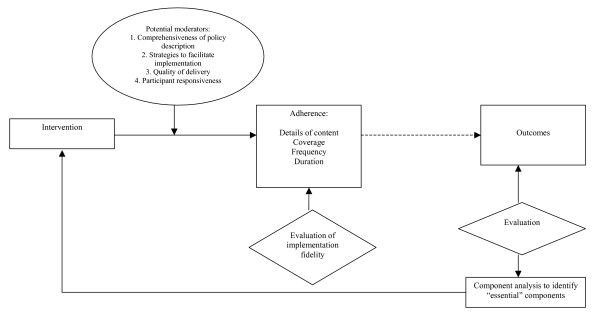
Implementation fidelity refers to the degree to which an intervention or programme is delivered as intended. Only by understanding and measuring whether an intervention has been implemented with fidelity can researchers and practitioners gain a better understanding of how and why an intervention works, and the extent to which outcomes can be improved. The authors undertook a critical review of existing conceptualisations of implementation fidelity and developed a new conceptual framework for understanding and measuring the process. The resulting theoretical framework requires testing by empirical research. Implementation fidelity is an important source of variation affecting the credibility and utility of research. The conceptual framework presented here offers a means for measuring this variable and understanding its place in the process of intervention implementation.
Overview
CoChat Summary
## TL;DR
The paper proposes a new conceptual framework for implementation fidelity, arguing that fidelity is not just adherence but is also shaped by intervention complexity, facilitation strategies, quality of delivery, and participant responsiveness. It is based on a critical review of the literature, and the authors call for empirical testing of the framework.
## Key findings
- Implementation fidelity is defined as the degree to which an intervention or programme is delivered as intended, and the paper argues it is an important source of variation affecting the credibility and utility of research.
- The framework identifies adherence as the bottom-line measure of fidelity, with subcategories of content, frequency, duration, and coverage (dose).
- The authors argue that fidelity may be moderated by four factors: intervention complexity, facilitation strategies, quality of delivery, and participant responsiveness.
- The paper notes that most implementation-fidelity studies focus only on adherence, while few measure quality of delivery or participant responsiveness; it also says such research rarely reports high implementation fidelity and often falls short of the ideal.
## Methods
- The paper reports a critical review of existing conceptualisations of implementation fidelity and relevant empirical studies, reviews, and theoretical pieces.
- The literature search used the databases Applied Social Sciences Index and Abstracts, CINAHL, International Bibliography of the Social Sciences, MEDLINE, and the Social Science Citation Index, plus scanned references and conference abstracts/presentations.
- The review focused principally on research published from 2002 to 2007.
## Limitations
- The authors explicitly state that the framework is theoretical and requires testing by empirical research.
- They also state that no study has yet measured the moderating effect of facilitation strategies on implementation fidelity, and that the role of quality of delivery as a moderator has not been explored in the literature to date.
- Evident from the text: the paper is a critical review rather than a primary empirical study, so it does not provide new data testing the framework.
Model-written summary. Check it against the paper before relying on it.
Integrity signals
Registry
Cites
Statistics
Figures
Verification
Claims the paper makes
3 Valid · 2 Not valid · 19 Not checked · 32 Own results and interpretations
Every source the paper cites for this claim was checked and supports it.
In the paper
“a study of guidelines intended for General Practitioners (GPs) found that detailed and clear recommendations were almost twice as likely to be followed as vague and non-specific recommendations [23].”
§ A conceptual framework for implementation fidelity > Background > A conceptual framework: elements and relationships
What the sources say
- Supportedcites [23] Grol R Dalhuijsen J Thomas S Veld C Rutten G Mokkink H Attributes of clinical guidelines that influence use of guidelines in general practice: observational study Brit Med J 1998 317 858 861 9748183 PMC31096 source
Table 1 reports that general practitioners followed vague, non-specific recommendations in 36% of decisions, versus 67% for recommendations that were not vague or non-specific—about 1.9 times as often. It also reports 67% compliance for recommendations described concretely and precisely, supporting the claim's characterization as detailed and clear. Page numbers were not available in our copy. (LLM, conf=0.94)
plainstates an association- Asserted: passes — The authors put it forward as true.
- Checkable: passes — It can be checked against evidence.
- Load-bearing: passes — The paper’s conclusions depend on it.
- Based: passes — The paper gives a reason why it holds.
- Supported
None of the sources cited for this claim have been checked yet.
In the paper
“It has been demonstrated that the fidelity with which an intervention is implemented affects how well it succeeds [1-5].”
§ A conceptual framework for implementation fidelity > Background
What the sources say
- Not checked — no full text of the sourcecites [1] Dusenbury L Brannigan R Falco M Hansen W A review of research on fidelity of implementation: Implications for drug abuse prevention in school settings Health Educ Res 2003 18 237 256 12729182 10.1093/her/18.2.237 source
- Not checked — no full text of the sourcecites [2] Dane A Schneider B Program integrity in primary and early secondary prevention: Are implementation effects out of control Clin Psychol Rev 1998 18 23 45 9455622 10.1016/S0272-7358(97)00043-3 source
- Not checked — no full text of the sourcecites [3] Elliot D Mihalic S Issues in disseminating and replicating effective prevention programs Prev Sci 2004 5 47 53 15058912 10.1023/B:PREV.0000013981.28071.52 source
- Not matchedcites [4] Mihalic S The importance of implementation fidelity Emotional & Behavioral Disorders in Youth 2004 4 83 86 and 99–105.
Its entry has no title and year that we can search by.
- Not checked yetcites [5] Mihalic S The importance of implementation fidelity Blueprints Violence Prevention Initiative 2002 Boulder, Colorado
states a cause- Asserted: passes — The authors put it forward as true.
- Checkable: passes — It can be checked against evidence.
- Load-bearing: passes — The paper’s conclusions depend on it.
- Based: passes — The paper gives a reason why it holds.
None of the sources cited for this claim have been checked yet.
In the paper
“Implementation fidelity acts as a potential moderator of the relationship between interventions and their intended outcomes.”
§ A conceptual framework for implementation fidelity > Background
What the sources say
- Not checked — no full text of the sourcecites [1] Dusenbury L Brannigan R Falco M Hansen W A review of research on fidelity of implementation: Implications for drug abuse prevention in school settings Health Educ Res 2003 18 237 256 12729182 10.1093/her/18.2.237 source
- Not checked — no full text of the sourcecites [2] Dane A Schneider B Program integrity in primary and early secondary prevention: Are implementation effects out of control Clin Psychol Rev 1998 18 23 45 9455622 10.1016/S0272-7358(97)00043-3 source
- Not checked — no full text of the sourcecites [3] Elliot D Mihalic S Issues in disseminating and replicating effective prevention programs Prev Sci 2004 5 47 53 15058912 10.1023/B:PREV.0000013981.28071.52 source
- Not matchedcites [4] Mihalic S The importance of implementation fidelity Emotional & Behavioral Disorders in Youth 2004 4 83 86 and 99–105.
Its entry has no title and year that we can search by.
- Not checked yetcites [5] Mihalic S The importance of implementation fidelity Blueprints Violence Prevention Initiative 2002 Boulder, Colorado
hedgedstates a possible cause- Asserted: passes — The authors put it forward as true.
- Checkable: passes — It can be checked against evidence.
- Load-bearing: passes — The paper’s conclusions depend on it.
- Based: passes — The paper gives a reason why it holds.
In the paper
“Unless such an evaluation is made, it cannot be determined whether a lack of impact is due to poor implementation or inadequacies inherent in the programme itself, a so-called Type III error [11]”
§ A conceptual framework for implementation fidelity > Background
What the sources say
- Not checked — no full text of the sourcecites [11] Dobson L Cook T Avoiding Type III error in program evaluation: results from a field experiment Evaluation and Program Planning 1980 3 269 276 10.1016/0149-7189(80)90042-7 source
plainstates a cause- Asserted: passes — The authors put it forward as true.
- Checkable: passes — It can be checked against evidence.
- Load-bearing: passes — The paper’s conclusions depend on it.
- Based: passes — The paper gives a reason why it holds.
None of the sources cited for this claim have been checked yet.
In the paper
“two studies examining programmes to help people with mental health issues obtain employment found that employment outcomes among their study groups were weakest for those in poorly implemented programmes [6,7].”
§ A conceptual framework for implementation fidelity > Background
What the sources say
- Not checked — no full text of the sourcecites [6] McGrew J Griss M Concurrent and predictive validity of two scales to assess the fidelity of implementation of supported employment Psychiatr Rehab J 2005 29 41 47 10.2975/29.2005.41.47 16075696 source
- Not checked yetcites [7] Resnick B Neale M Rosenheck R Impact of public support payments, intensive psychiatric community care, and program fidelity on employment outcomes for people with severe mental illness J Nerv Ment Dis 2003 191 139 144 12637839 10.1097/00005053-200303000-00001 source
plainstates an association- Asserted: passes — The authors put it forward as true.
- Checkable: passes — It can be checked against evidence.
- Load-bearing: passes — The paper’s conclusions depend on it.
- Based: passes — The paper gives a reason why it holds.
22 more claims
Create a free account to see all 56 claims and to verify the 10 references still open.
- Probably not a substantial claim. 21
- It may state two separate claims as one. 8
Claims other papers make about this one
Each is checked against this paper’s own text: does it say what the citing paper says it does?
The source backs part of the claim, not all of it — or backs it for a different population, condition or comparison.
In the citing paper
“They are key indicators of whether a program is appropriate/acceptable for the intended audience and context, whether there are enough resources to support delivery, and whether it is being used (Carroll et al., 2007).”
From Intervention Programs Targeting the Mental Health, Professional Burnout, and/or Wellbeing of School Teachers: Systematic Review and Meta-Analyses (2023) · cites this paper as Carroll et al., 2007
Experimental — accuracy not yet measuredThe source backs part of the claim, not all of it — or backs it for a different population, condition or comparison.
In the citing paper
“They acknowledged that adaptations are likely to occur in real-world implementation, but the question on how to address this issue while measuring fidelity remained unanswered.”
From A modified theoretical framework to assess implementation fidelity of adaptive public health interventions (2015) · cites this paper as [15]
Experimental — accuracy not yet measuredThe cited source says what the claim attributes to it.
In the citing paper
“Fidelity and adherence are important in the translation of research to practice when implementing programs in the real-world.”
From Intervention Programs Targeting the Mental Health, Professional Burnout, and/or Wellbeing of School Teachers: Systematic Review and Meta-Analyses (2023) · cites this paper as Carroll et al., 2007
The cited source says what the claim attributes to it.
In the citing paper
“Evidence from a review of eHealth innovations [12] indicates that centralised diffusion systems such as those considered here were more effective in disseminating authoritative evidence and preserving the ‘fidelity’ [20] of interventions, but less successful in terms of adopter engagement, partly because of strict limits on the extent to which implementation could be modified to address the”
From Beyond pilotitis: taking digital health interventions to the national level in China and Uganda (2017) · cites this paper as [20]
The cited source says what the claim attributes to it.
In the citing paper
“The modified Carroll et al.’s framework we propose may permit a comprehensive assessment of the implementation fidelity-adaptation balance required when implementing adaptive interventions, but more empirical research is needed to validate it.”
From A modified theoretical framework to assess implementation fidelity of adaptive public health interventions (2015) · cites this paper as [15]
5 more claims about this paper
Create a free account to see every claim other papers make about this one.
Citations
Cites
Bellg, A. J., Treatment Fidelity Workgroup of the NIH Behavior Change Consortium, Borrelli, B., Resnick, B., Hecht, J., Minicucci, D. S., Ory, M., Ogedegbe, G., Orwig, D., Ernst, D., et al. (2004) · Health Psychology · doi:10.1037/0278-6133.23.5.443 · Cited by 2,620
Dusenbury, L. (2003) · Health Education Research · doi:10.1093/her/18.2.237 · Cited by 1,671
Dane, A. V., & Schneider, B. H. (1998) · Clinical Psychology Review · doi:10.1016/s0272-7358(97)00043-3 · Cited by 1,557
Reeves, M. (1993) · Cited by 903
Grol, R., Dalhuijsen, J., Thomas, S., Veld, C. I. ‘., Rutten, G., & Mokkink, H. (1998) · BMJ · doi:10.1136/bmj.317.7162.858 · Cited by 877 · cited 1×
“For example, a study of guidelines intended for General Practitioners (GPs) found that detailed and clear recommendations were almost twice as likely to be followed as vague and non-specific recommendations [23].”
Issues in Disseminating and Replicating Effective Prevention Programs
Elliott, D. S., & Mihalic, S. (2004) · Prevention Science · doi:10.1023/b:prev.0000013981.28071.52 · Cited by 794 · cited 6×
“Such strategies included the provision of manuals, guidelines, training, monitoring and feedback, capacity building, and incentives [ 3 ,6,8,17].”
InfluentialProcess evaluation on quality improvement interventions
Hulscher, M. E. J. L. (2003) · Quality and Safety in Health Care · doi:10.1136/qhc.12.1.40 · Cited by 348
Drug therapy in the elderly: what doctors believe and patients actually do
Barat, I., Andreasen, F., & Damsgaard, E. M. S. (2001) · British Journal of Clinical Pharmacology · doi:10.1046/j.0306-5251.2001.01401.x · Cited by 334 · cited 3×
“For example, it has been found that implementation fidelity of prescribed drug interventions for elderly people in the community can be low because these patients deliberately fail to comply with their prescribed regimens [ 31-33 ].”
InfluentialForgatch, M. S., Patterson, G. R., & DeGarmo, D. S. (2005) · Behavior Therapy · doi:10.1016/s0005-7894(05)80049-8 · Cited by 320
The fidelity‐adaptation debate: Implications for the implementation of public sector social programs
Blakely, C. H., Mayer, J. P., Gottschalk, R. G., Schmitt, N., Davidson, W. S., Roitman, D. B., & Emshoff, J. G. (1987) · American Journal of Community Psychology · doi:10.1007/bf00922697 · Cited by 297 · cited 2×
“Indeed, the proadaptation perspective implies that successful interventions are those that adapt to local needs [22].”
Research works printed but not linked: 3
- Medical Research Council A framework for the development and evaluation of RCTs for complex interventions to improve health 2000 London: Medical Research Council
- Rogers EM Diffusion of Innovation 2003 Fifth New York, NY: Free Press
- Herzog S Wright P Addressing the fidelity of personal and social responsibility model implementation Res Q Exerc Sport 2005 A 76
Cited by
Items 2,001–2,100 of 2,543
Parenting UR Teens - a randomised trial of a parenting programme for parents of teenagers
Dunlop, L., & Macdonald, G. M. (2015) · http://isrctn.com/ · doi:10.1186/isrctn17944198
Tailor Implementation Strategies
BN, M. M. B. H., & Graham, F. I. D. (2021) · Wiley eBooks · doi:10.1002/9781119123316.ch11
The Court Services and Offender Supervision Agency (CSOSA)
(2019) · Advances in public policy and administration (APPA) book series · doi:10.4018/978-1-7998-1147-3.ch004
Sidani, S., & Braden, C. J. (2021) · Wiley eBooks · doi:10.1002/9781119610113.ch9
Sørensen, E. (2020) · Oxford University Press eBooks · doi:10.1093/oso/9780198777953.003.0001
Sussman, S. Y. (2020) · Cambridge University Press eBooks · doi:10.1017/9781108632591.042
Lamming, L., Crosswaite, K., Faisal, M., McDonach, E., Montague, J., Mohammed, M. A., Cracknell, A. L., Lovatt, A., & Slater, B. (2021) · Research Square · doi:10.21203/rs.3.rs-513298/v1
(2012) · Les Presses de l'Université de Montréal eBooks · doi:10.4000/books.pum.6033
Roman, V. R. (2016) · Digital Repository Service (Northeastern University) · doi:10.17760/d20239055 · Cited by 1
Jankowski, E. (2019) · American Educational Research Association Annual Meeting (AERA) · doi:10.3102/1440136
Linthwaite, B., Kronfli, N., Lessard, D., Engler, K., Ruppenthal, L., Bourbonnière, E., Obas, N., Brown, M., Lebouché, B., & Cox, J. (2022) · AIDS and Behavior · doi:10.1007/s10461-022-03888-y
Lee, C., Otunla, A. A., Brennan, Aronson, J. K., & Nunan, D. (2022) · medRxiv · doi:10.1101/2022.10.30.22281709
Milot, M. (2022) · Journal of Workplace Behavioral Health · doi:10.1080/15555240.2022.2142132
Translation and Prevention in Family Science
Kogan, S. M., & Barton, A. W. (2022) · Springer eBooks · doi:10.1007/978-3-030-92002-9_52
Asiones, N. G. (2021) · Scientia - The International Journal on the Liberal Arts · doi:10.57106/scientia.v10i2.133 · Cited by 1
Solli, R., Øiestad, B. E., Aanesen, F., Sowden, G., Wynne‐Jones, G., & Grotle, M. (2022) · Physiotherapy Practice and Research · doi:10.3233/ppr-220698
Evaluatie van het proces van implementatie
Hulscher, M., & Wensing, M. (2023) · Bohn Stafleu van Loghum eBooks · doi:10.1007/978-90-368-2909-0_22
Developing and testing complex behaviour change interventions to support proactive deprescribingPreprint
Scott, S., Martin‐Kerry, J., & Bhattacharya, D. (2023) · doi:10.22541/au.167533812.22614700/v1
Yu, R., & Sims, W. A. (2023) · Preventing School Failure Alternative Education for Children and Youth · doi:10.1080/1045988x.2023.2177983 · Cited by 1
O'BRIEN, A. (2023) · Cronfa (Swansea University) · doi:10.23889/suthesis.63004
Fidelity of Implementation: Meta‐Assessment Remodeled
Brown, C. L. (2023) · Assessment Update · doi:10.1002/au.30339
Green, S. M. C., Hall, L., Rousseau, N., et al. (2023) · Research Open (London South Bank University) · doi:10.3310/nihropenres.14463.r29031
Green, S. M. C., Hall, L., Rousseau, N., et al. (2023) · NIHR Open Research · doi:10.3310/nihropenres.14463.r28987
Green, S. M. C., Hall, L., Rousseau, N., et al. (2023) · Research Open (London South Bank University) · doi:10.3310/nihropenres.14552.r29196
Canine-Assisted Interventions: Insights from the B.A.R.K. Program and Future Research Directions
Binfet, J.-T. (2023) · Nebraska Symposium on Motivation/The Nebraska symposium on motivation · doi:10.1007/978-3-031-29789-2_6 · Cited by 2
Green, S. M. C., Hall, L., Rousseau, N., et al. (2023) · NIHR Open Research · doi:10.3310/nihropenres.14552.r29195
Cluxton‐Keller, F., & BRUCE, M. L. (2023) · The Journal of Perinatal Education · doi:10.1891/jpe-2021-0022
Tripathy, S., Shetty, A. P., Hansda, U., Nanda Kumar, P., Sahoo, A. K., Mahalingam, V. N., Mahapatra, S., Mitra, J. K., Rao, P. B., Sanyal, K., et al. (2023) · Wellcome Open Research · doi:10.12688/wellcomeopenres.19340.1
Speaking truth about power: Are underpowered trials undercutting evaluation of new care models?
Davis, A., Adams, J., McGlynn, E. A., et al. (2023) · Journal of Evaluation in Clinical Practice · doi:10.1111/jep.13894
Opioid Overdose: Intervention Strategies
Brandt, L. (2023) · Oxford University Press eBooks · doi:10.1093/oxfordhb/9780197618431.013.31
Ensuring Treatment Fidelity and Clean Data Collection
Mariani, M., & Chance, E. (2023) · Oxford University Press eBooks · doi:10.1093/oso/9780197650134.003.0012
Greene, M. C., Bonz, A. G., Cristobal, M., et al. (2023) · Cambridge Prisms Global Mental Health · doi:10.1017/gmh.2023.37.pr9
Greene, M. C., Bonz, A. G., Cristobal, M., et al. (2023) · Cambridge Prisms Global Mental Health · doi:10.1017/gmh.2023.37.pr8
Greene, M. C., Bonz, A. G., Cristobal, M., et al. (2023) · Cambridge Prisms Global Mental Health · doi:10.1017/gmh.2023.37.pr7
Greene, M. C. (2023) · Cambridge Prisms Global Mental Health · doi:10.1017/gmh.2023.37.pr6
Greene, M. C., Bonz, A. G., Cristobal, M., et al. (2023) · Cambridge Prisms Global Mental Health · doi:10.1017/gmh.2023.37.pr5
Greene, M. C., Bonz, A. G., Cristobal, M., et al. (2023) · Cambridge Prisms Global Mental Health · doi:10.1017/gmh.2023.37.pr4
Greene, M. C., Bonz, A. G., Cristobal, M., et al. (2023) · Cambridge Prisms Global Mental Health · doi:10.1017/gmh.2023.37.pr3
Greene, M. C., Bonz, A. G., Cristobal, M., et al. (2023) · Cambridge Prisms Global Mental Health · doi:10.1017/gmh.2023.37.pr2
Greene, M. C. (2023) · Cambridge Prisms Global Mental Health · doi:10.1017/gmh.2023.37.pr1
Liu, Y., Wadey, C. A., BARKER, A. R., & Williams, C. A. (2023) · Research Square · doi:10.21203/rs.3.rs-3160656/v1
Eker, C., & Şenel-Öksüz, E. (2023) · Kalem Uluslararasi Egitim ve Insan Bilimleri Dergisi · doi:10.23863/kalem.2023.263
A primer to implementation science and potential applications to precision medicine
Hearld, L. R. (2023) · Elsevier eBooks · doi:10.1016/b978-0-12-824010-6.00064-2
Sa’id, I. I. M., Hotung, N., Benton, M., Nadal, I. P., Baharom, A., Prina, M. A., Yusof, B. N. M., Goldsmith, K., Ching, S. M., Forbes, A., et al. (2023) · doi:10.2196/preprints.51718
Slattery, E. J., Butler, D., Marshall, K., Barrett, M., Hyland, N., O'Leary, M. R., & McAvinue, L. P. (2023) · doi:10.31234/osf.io/75y4c
Pingray, V., Williams, C., Al‐beity, F. M. A., Abalos, E. J., Arulkumaran, S., Nabhan, A. F., Blumenfeld, A., Carvalho, B., Deneux‐Tharaux, C., Downe, S. M., et al. (2023) · medRxiv · doi:10.1101/2023.09.08.23295283
Carboni, C., Irene, J. M., Galindo, M. S., Lorraine, P., Lambert, Y., Bardon, T., Stephen, V., Martha, S.-M., Jane, M. B., Douine, M., et al. (2023) · medRxiv · doi:10.1101/2023.10.10.23296813
Obsessive-Compulsive Related Disorders (OCRD) Across the Lifespan
Prochwicz, K., Löchner, C., & Grünblatt, E. (2023) · Frontiers research topics · doi:10.3389/978-2-8325-3751-0
Secondary school MTSS framework implemented with fidelity: a case study
Kirk, J. N. (2023) · Digital Repository Service (Northeastern University) · doi:10.17760/d20486940
Assessing the implementation level of advance care planning– the first comprehensive fidelity scalePreprint
Westbye, S. F., Romøren, M., Ahmed, M., Hermansen, K. B., Brøderud, L., Wahl, A. K., Sævareid, T. J. L., Thoresen, L., & Pedersen, R. (2023) · Research Square · doi:10.21203/rs.3.rs-3610212/v1
A Framework for Implementing National Respiratory Guidelines in Wales
Jefferies, R. (2023) · Cronfa (Swansea University) · doi:10.23889/suthesis.65359
ALSulaiman, M. A. (2023) · مجلة کلیة التربیة فى العلوم النفسیة · doi:10.21608/jfeps.2023.340513
Nursing Student Journal Club Fidelity
Gibbons, C., Bourque, J., & Aubry, T. (2024) · Quality Advancement in Nursing Education - Avancées en formation infirmière · doi:10.17483/2368-6669.1405
Evaluation of a Two-Tiered Coaching Programme for Parents of Young Autistic Children
van Noorden, L. E. (2024) · Open Access Victoria University of Wellington | Te Herenga Waka (Figshare) · doi:10.26686/wgtn.25303966 · Cited by 1
Grosch, K., Haeckl, S., Rau, H. A., & Preuss, P. (2024) · SSRN Electronic Journal · doi:10.2139/ssrn.4788651
Asmare, L., Yigzaw, Z. A., & Alemu, T. (2024) · Journal of AIDS and HIV Treatment · doi:10.33696/aids.6.049
Twohig, P. A., Peeraphatdit, T. B., Samson, K. K., Schissel, M. E., Smith, L. M., Ashford, A., Freese, L., & McCashland, T. M. (2024) · Digestive Diseases and Sciences · doi:10.1007/s10620-024-08445-2
LogicalOutcomes Evaluation Planning HandbookPreprint
Kerr, G., & Llewelyn, S. (2024) · SSRN Electronic Journal · doi:10.2139/ssrn.4815131
Sørensen, E. (2020) · Oxford University Press eBooks · doi:10.1093/oso/9780198777953.002.0003
Sørensen, E. (2020) · Oxford University Press eBooks · doi:10.1093/oso/9780198777953.002.0006
Sørensen, E. (2020) · Oxford University Press eBooks · doi:10.1093/oso/9780198777953.002.0007
Sørensen, E. (2020) · Oxford University Press eBooks · doi:10.1093/oso/9780198777953.002.0004
Creating Fluid Spaces for Online Instructors to Support Two Types of Diverse Learners
Lay, C. D., & Pinnegar, S. (2024) · Self-study of teaching and teacher education practices (Print)/Self-study of teaching and teacher education practices · doi:10.1007/978-3-031-58097-0_8
AYDIN, E., & Kangalgil, M. (2024) · Research Square · doi:10.21203/rs.3.rs-4376445/v1
Amankwaa, I., Maude, R., & Skinner, J. (2024) · Research Square · doi:10.21203/rs.3.rs-4489352/v1
PhD, M. I. A., MPhil, S. G., Owusu, M., Boateng, D., Fidelis Atibila;, R. N., & Maude, R. (2024) · Research Square · doi:10.21203/rs.3.rs-4490058/v1 · Cited by 1
Kalolo, A., Kesale, A. M., Anasel, M. G., Kapologwe, N., Jaribu, J., Mujaya, S., & Kengia, J. T. (2024) · PLoS ONE · doi:10.1371/journal.pone.0303552
Interventiotutkimuksen toteuttaminen sosiaalipalveluissa
Ristolainen, H., Isoniemi, H., Moisio, M., et al. (2024) · Janus Sosiaalipolitiikan ja sosiaalityön tutkimuksen aikakauslehti · doi:10.30668/janus.141735
Models of Care in Forensic Psychiatry
Kennedy, H. G. (2024) · Cambridge University Press eBooks · doi:10.1017/9781911623809.008 · Cited by 1
Evaluation of performance of diabetes care initiatives implemented in Cambodia
Te, V. (2024) · doi:10.63028/10067/2029940151162165141 · Cited by 1
Samanta, J., Dhar, J., & Facciorusso, A. (2024) · Clinical Gastroenterology and Hepatology · doi:10.1016/j.cgh.2024.06.011
Carvalho, M., Hawkes, R. E., Hadjiconstantinou, M., Byrne, M., French, D., & McSharry, J. (2024) · Translational Behavioral Medicine · doi:10.1093/tbm/ibae033
Emery, R. L., Oo, M., Anderson-Badbade, S., Grzejszczak, L., Rogers, P., Chang, H.-C., Grout, R. W., Anzalone, S., Ngwangwa, K., East, J., et al. (2024) · Research Square · doi:10.21203/rs.3.rs-4492080/v1
Ogolla, B. A., Ongeri, L., Oboke, E. N., Getahun, M., Kinyua, J., Oluoch, I., Oduor, J., & Afulani, P. A. (2024) · Advances in Global Health · doi:10.1525/agh.2024.2318429 · Cited by 2
Nimani, T. D., Muluneh, E., Asrade, G., et al. (2024) · INQUIRY The Journal of Health Care Organization Provision and Financing · doi:10.1177/00469580241273244
Lowers, V., Young, B., & Harris, R. V. (2024) · Research Square · doi:10.21203/rs.3.rs-4925848/v1
Velalagan, R., Wu, W. T., John, J. R., Lin, P., & Eapen, V. (2026) · BMC Psychiatry · doi:10.1186/s12888-026-08579-9 · Cited by 1
Process Mapping to Support the Implementation of a Regional Strategy to Address the Opioid Epidemic
Liu, Y., Farr, S. L., Spertus, J. A., Olds, D. M., LaPierre, T. A., & Hagle, H. (2024) · Healthcare · doi:10.3390/healthcare12191995 · Cited by 2
Recherche sur ou recherche de la mise en œuvre ?
Ridde, V., & Dagenais, C. (2024) · Global Health Promotion · doi:10.1177/17579759241283746
The Role and Nature of Fidelity in Theory-Practice Advancement
Ramful, A., & Jorgensen, R. (2024) · Springer international handbooks of education · doi:10.1007/978-3-031-51474-6_12
The Inner Workings of Registered Reports
Dienes, Z. P. (2024) · Cambridge University Press eBooks · doi:10.1017/9781009000796.015 · Cited by 11
Harvesting Success: Exploring Performance Metrics for Corporate Entrepreneurship Units
Lang, C., Heinzelmann, N., Ortt, R., & Baltes, G. H. (2024) · IEEE International Conference on Engineering, Technology and Innovation (ICE/ITMC) · doi:10.1109/ice/itmc61926.2024.10794249
Clark, A. T., Willems, B., Hurt, B., et al. (2024) · Clinical Neurology and Neurosurgery · doi:10.1016/j.clineuro.2024.108706
Internet-Based Cognitive Rehabilitation for Working Cancer Survivors: A Process Evaluation
Klaver, K. M., Duijts, S. F. A., Geusgens, C. A. V., Aarts, M. J. B., Ponds, R., van der Beek, A. J., & Schagen, S. B. (2025) · Journal of Occupational and Environmental Medicine · doi:10.1097/jom.0000000000003312 · Cited by 2
Fredens, M., Terkildsen, M. D., Grønkjær, M., Toft, U., Hawkins, J. L., & Nielsen, C. P. (2025) · Research Square · doi:10.21203/rs.3.rs-5677797/v1
Steiner, R. (2021) · University of North Texas Digital Library (University of North Texas) · doi:10.12794/metadc1873648
Costa, T. A., Rochitte, E., Rochitte, C. E., & Lima, B. B. (2025) · Elsevier eBooks · doi:10.1016/b978-0-323-91790-2.00090-3
Fitzhugh, C., Jones, H., Foweather, L., Lip, G. Y. H., Gupta, D., Mills, M. T., & Buckley, B. J. R. (2025) · BMJ Open · doi:10.1136/bmjopen-2024-088460
Mubanga, C., Silumbwe, A., Munakampe, M. N., Lubeya, M. K., & Zulu, J. M. (2025) · Global Implementation Research and Applications · doi:10.1007/s43477-024-00144-4
Mockshell, J., Ritter, T. N., & Garrett, J. (2025) · Food and Nutrition Bulletin · doi:10.1177/03795721241312275 · Cited by 1
Tuning in to Kids Together: Piloting an Emotion‐Focused Coparenting Program
Ambrosi, C. C., Kavanagh, P. S., Evans, S., & Havighurst, S. S. (2025) · Family Process · doi:10.1111/famp.70002 · Cited by 3
Pétein, C., Chevallereau, T., Aikpitanyi, J., Evrard, P., Tubeuf, S., Henrard, S., & Spinewine, A. (2025) · BMJ Open · doi:10.1136/bmjopen-2024-085434 · Cited by 1
Balter, A.-S., Moloney, M., Ma, C., Lee, A., Pierre, S., Parkes, S., Pulat, D., Racine, N. M., & Andrade, B. F. (2025) · PLoS ONE · doi:10.1371/journal.pone.0319398 · Cited by 4
Fully Latent Principal Stratification With Measurement Models
Lee, S., Sales, A., Kang, H., & Whittaker, T. A. (2025) · Journal of Educational and Behavioral Statistics · doi:10.3102/10769986251321428
Metadata
- Authors
- Carroll, C., Patterson, M., Wood, S., Booth, A., Rick, J., & Balain, S.
- Affiliations
- University of Sheffield (GB)
- Corresponding author
- Carroll, Christopher
- Venue
- Implementation Science
- Published
- 2007-11-30
- Volume
- 2
- Issue
- 1
- Pages
- 40-40
- ISSN
- 1748-5908 (ISSN-L)
- PMC
- PMC2213686
- OpenAlex
- W2167997731
- Cited by
- 2,559
- References
- 41
- Citations by year
- 2026: 224 · 2025: 237 · 2024: 245 · 2023: 232 · 2022: 212 · 2021: 284 · 2020: 249 · 2019: 169 · 2018: 105 · 2017: 121 · 2016: 96 · 2015: 104 · 2014: 100 · 2013: 72 · 2012: 43
- FWCI
- 23.60
- Type
- journal article
- Language
- en
- Open access
- gold
- doi.org
- Licence
- Locations
- Implementation Science (publishedVersion, cc-by)
- PubMed Central (publishedVersion, cc-by)
- PubMed (publishedVersion)
- White Rose Research Online (University of Leeds, The University of Sheffield, University of York) (acceptedVersion)
- DOAJ (DOAJ: Directory of Open Access Journals) (submittedVersion)
- Leicester Research Archive (University of Leicester) (submittedVersion)
- Funders
- Fondazione Italiana per la ricerca sulle Malattie del Pancreas
- Topics
- Health Sciences › Health Professions › General Health Professions › Health Policy Implementation Science
- Social Sciences › Public Administration › Evaluation and Performance Assessment
- Social Sciences › Sociology and Political Science › Delphi Technique in Research
- Keywords
- implementation fidelity, conceptual framework, intervention delivery, fidelity assessment, research credibility, intervention effectiveness, implementation process
About these checks
Registry, retraction, Cites and statistics results are computed, not judged, with one exception: a printed reference that no index lists is read once by a model before it counts as a citation error. Claims are extracted by a model and kept only when their quote appears verbatim in the text; each cited source is then checked, with a model’s help, for whether it says what the claim relies on. Those verdicts can be wrong — read the claim’s quote and the cited source before relying on one.
The claim verdicts this report counts are experimental: their accuracy is not yet measured.
A language model drew the claims from the paper on 2026-10-10, under version 3 of the claim definition (model deepseek-v4.1-flash, prompt extract-v3).
A second model labelled each claim on 2026-10-10 (model jev-1.13-20260917, definition revision gold-guideline-v0.2).
Cited sources are checked with a language model’s help (gpt-6-sol).
Statistics and arithmetic are recomputed, not judged.
Confidence bands are shown only for fields calibrated on our annotated test set. None is calibrated yet, so no band is shown.
What counts as a claim ›How we measure confidence ›How we check this ›
Are you an author, or do you see a problem with this page? Request a review
Data sources
Bibliographic data: Semantic Scholar, OpenAlex, Crossref.
Contains information from the Semantic Scholar Academic Graph Datasets, made available under the ODC Attribution License (ODC-BY 1.0).
Semantic Scholar’s data is described in: Kinney, R., et al. (2023). The Semantic Scholar Open Data Platform. arXiv:2301.10140.
