

The DOI matches its Crossref record; 67 of the 75 references it cites were found in a registry or an index.
A theory of organizational readiness for change
Open accessAbstract
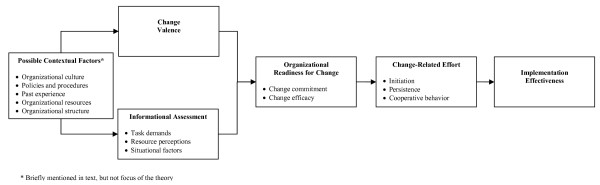
BACKGROUND: Change management experts have emphasized the importance of establishing organizational readiness for change and recommended various strategies for creating it. Although the advice seems reasonable, the scientific basis for it is limited. Unlike individual readiness for change, organizational readiness for change has not been subject to extensive theoretical development or empirical study. In this article, I conceptually define organizational readiness for change and develop a theory of its determinants and outcomes. I focus on the organizational level of analysis because many promising approaches to improving healthcare delivery entail collective behavior change in the form of systems redesign--that is, multiple, simultaneous changes in staffing, work flow, decision making, communication, and reward systems. DISCUSSION: Organizational readiness for change is a multi-level, multi-faceted construct. As an organization-level construct, readiness for change refers to organizational members' shared resolve to implement a change (change commitment) and shared belief in their collective capability to do so (change efficacy). Organizational readiness for change varies as a function of how much organizational members value the change and how favorably they appraise three key determinants of implementation capability: task demands, resource availability, and situational factors. When organizational readiness for change is high, organizational members are more likely to initiate change, exert greater effort, exhibit greater persistence, and display more cooperative behavior. The result is more effective implementation. SUMMARY: The theory described in this article treats organizational readiness as a shared psychological state in which organizational members feel committed to implementing an organizational change and confident in their collective abilities to do so. This way of thinking about organizational readiness is best suited for examining organizational changes where collective behavior change is necessary in order to effectively implement the change and, in some instances, for the change to produce anticipated benefits. Testing the theory would require further measurement development and careful sampling decisions. The theory offers a means of reconciling the structural and psychological views of organizational readiness found in the literature. Further, the theory suggests the possibility that the strategies that change management experts recommend are equifinal. That is, there is no 'one best way' to increase organizational readiness for change.
Overview
The claims and statistics of this paper haven’t been checked yet.
Run the check — free, no account needed. It reads the open-access text and checks the sources it cites.
Integrity signals
Registry
Cites
Statistics
Figures
Verification
Claims the paper makes
The claims and statistics of this paper haven’t been checked yet.
Run the check — free, no account needed. It reads the open-access text and checks the sources it cites.
Claims other papers make about this one
Each is checked against this paper’s own text: does it say what the citing paper says it does?
In the citing paper
“Weiner’s theory of organisational readiness to change [71] proposes that readiness depends on collective behaviour change linked to two key factors, described as change commitment (wanting to change) and change efficacy (able to change).”
From PARIHS revisited: from heuristic to integrated framework for the successful implementation of knowledge into practice (2015) · cites this paper as [71]
In the citing paper
“Weiner’s organizational theory of innovation implementation suggests that leaders are critical in creating readiness for change, ensuring innovation-values fit, and developing plans, practices, structures, and strategies to support implementation (Weiner, 2009).”
From The Roles of System and Organizational Leadership in System-Wide Evidence-Based Intervention Sustainment: A Mixed-Method Study (2016) · cites this paper as Weiner, 2009
In the citing paper
“Organizational readiness for change theory postulates that a higher level of organizational readiness increases the success of innovation adoption and decreases the risk of failure (Snyder-Halpern 2001;Weiner 2009).”
From Ready or not, AI comes—an interview study of organizational AI readiness factors (2021) · cites this paper as Weiner 2009
Self-check
Percentages, sums and reported differences re-computed from the paper’s own numbers.
The self-check needs the paper’s full text.
Citations
Cites
Self-efficacy: The exercise of control
Bandura, A., Freeman, W. H., & Lightsey, R. (1999) · Journal of Cognitive Psychotherapy · doi:10.1891/0889-8391.13.2.158 · Cited by 46,835
(1975) · PhilPapers (PhilPapers Foundation) · Cited by 36,737
Psychometric theory (2nd ed.).
Sitgreaves, R. (1979) · Contemporary Psychology · doi:10.1037/018882 · Cited by 14,384
(1964) · Medical Entomology and Zoology · Cited by 10,439
Commitment in the workplace: toward a general model
Meyer, J. P., & Herscovitch, L. (2001) · Human Resource Management Review · doi:10.1016/s1053-4822(00)00053-x · Cited by 3,856
Self-Efficacy: A Theoretical Analysis of Its Determinants and Malleability
Gist, M. E., & Mitchell, T. R. (1992) · Academy of Management Review · doi:10.5465/amr.1992.4279530 · Cited by 3,713
Field Theory in Social Science: Selected Theoretical Papers.
Price, D. O., Lewin, K., & Cartwright, D. (1951) · American Sociological Review · doi:10.2307/2087618 · Cited by 3,519
Exercise of Human Agency Through Collective Efficacy
Bandura, A. (2000) · Current Directions in Psychological Science · doi:10.1111/1467-8721.00064 · Cited by 3,294
The Challenge of Innovation Implementation
Klein, K. J., & Sorra, J. S. (1996) · The Academy of Management Review · doi:10.2307/259164 · Cited by 2,113
Creating Readiness for Organizational Change
Armenakis, A. A., Harris, S. G., & Mossholder, K. W. (1993) · Human Relations · doi:10.1177/001872679304600601 · Cited by 2,061
Commitment to organizational change: Extension of a three-component model.
Herscovitch, L., & Meyer, J. P. (2002) · Journal of Applied Psychology · doi:10.1037/0021-9010.87.3.474 · Cited by 1,663
Levels issues in theory development, data collection and analysis
Klein, K. J., Dansereau, F., & Hall, R. J. (1994) · The Academy of Management Review · doi:10.2307/258703 · Cited by 1,607
From Micro to Meso: Critical Steps in Conceptualizing and Conducting Multilevel Research
Klein, K. J., & Kozlowski, S. W. J. (2000) · Organizational Research Methods · doi:10.1177/109442810033001 · Cited by 1,473
Field Theory in Social Science: Selected Theoretical Papers
Lewin, K., & Cartwright, D. (1975) · Medical Entomology and Zoology · Cited by 1,417
SCHNEIDER, B., GOLDSTIEIN, H. W., & SMITH, D. B. (1995) · Personnel Psychology · doi:10.1111/j.1744-6570.1995.tb01780.x · Cited by 1,346
Readiness for Organizational Change
Holt, D. T., Armenakis, A. A., Feild, H. S., & Harris, S. G. (2007) · The Journal of Applied Behavioral Science · doi:10.1177/0021886306295295 · Cited by 1,254
Assessing organizational readiness for change
Lehman, W. E. K., Greener, J. M., & Simpson, D. D. (2002) · Journal of Substance Abuse Treatment · doi:10.1016/s0740-5472(02)00233-7 · Cited by 863
Jones, R. A., Jimmieson, N. L., & Griffiths, A. (2005) · Journal of Management Studies · doi:10.1111/j.1467-6486.2005.00500.x · Cited by 837
Weiner, B. J., Amick, H., & Lee, S.-Y. D. (2008) · Medical Care Research and Review · doi:10.1177/1077558708317802 · Cited by 786
Self-citationEby, L. T. D. T., Adams, D. M., Russell, J. E. A., & Gaby, S. H. (2000) · Human Relations · doi:10.1177/0018726700533006 · Cited by 763
Crafting a change message to create transformational readiness
Armenakis, A. A., & Harris, S. G. (2002) · Journal of Organizational Change Management · doi:10.1108/09534810210423080 · Cited by 686
The change masters : innovation and entrepreneurship in the American corporation
Kanter, R. M. (1984) · Simon and Schuster eBooks · Cited by 600
Maddux, J. E. (1995) · The Plenum series in social/clinical psychology · doi:10.1007/978-1-4419-6868-5_1 · Cited by 463
(2002) · Computers in health care · doi:10.1007/978-1-4613-0069-4 · Cited by 425
Madsen, S. R., Miller, D. I., & John, C. R. (2005) · Human Resource Development Quarterly · doi:10.1002/hrdq.1134 · Cited by 424
Weiner, B. J., Lewis, M. A., & Linnan, L. A. (2008) · Health Education Research · doi:10.1093/her/cyn019 · Cited by 404
Self-citationDishman, R. (2004) · Preventive Medicine · doi:10.1016/j.ypmed.2003.12.007 · Cited by 373
Self-care self-efficacy, quality of life, and depression after stroke
Robinson-Smith, G., Johnston, M. V., & Allen, J. (2000) · Archives of Physical Medicine and Rehabilitation · doi:10.1053/mr.2000.3863 · Cited by 293
Toward a Comprehensive Definition of Readiness for Change: A Review of Research and Instrumentation
Holt, D. T., Armenakis, A. A., Harris, S. R., & Feild, H. S. (2007) · Research in organizational change and development · doi:10.1016/s0897-3016(06)16009-7 · Cited by 266
Development and validation of a scale measuring self‐efficacy of current and former smokers
Etter, J., Bergman, M. M., Humair, J., & Perneger, T. (2000) · Addiction · doi:10.1046/j.1360-0443.2000.9569017.x · Cited by 260
No magic targets! Changing clinical practice to become more evidence based
Dopson, S., FitzGerald, L., Ferlie, E., Gabbay, J., & Locock, L. (2010) · Health Care Management Review · doi:10.1097/hmr.0b013e3181c88e79 · Cited by 248
No Magic Targets! Changing Clinical Practice To Become More Evidence Based
Dopson, S., Fitzgerald, L., Ferlie, E. B., Gabbay, J., & Locock, L. (2002) · Health Care Management Review · doi:10.1097/00004010-200207000-00005 · Cited by 218
Snyder‐Halpern, R. (2001) · International Journal of Medical Informatics · doi:10.1016/s1386-5056(01)00179-4 · Cited by 177
Taket, A. R. (1992) · Cited by 163
Ingersoll, G. L., Kirsch, J. C., Merk, S. E., & Lightfoot, J. (2000) · JONA The Journal of Nursing Administration · doi:10.1097/00005110-200001000-00004 · Cited by 138
Assessing and Enhancing Readiness for Change: Implications for Technology Transfer
Backer, T. E. (1995) · PsycEXTRA Dataset · doi:10.1037/e495742006-003 · Cited by 119
Meta-analysis of the effects of psychoeducational care in adults with asthma
Devine, E. C. (1996) · Research in Nursing & Health · doi:10.1002/(sici)1098-240x(199610)19:5 · Cited by 118
Research in Organizational Change and Development
Pasmore, W. A., Shani, A. B., & Woodman, R. W. (2011) · Research in organizational change and development · doi:10.1108/s0897-3016(2011)19 · Cited by 116
Dishman, R. K., Motl, R. W., Saunders, R. P., Dowda, M. C., Felton, G., Ward, D. S., & Pate, R. R. (2002) · Preventive Medicine · doi:10.1006/pmed.2001.0959 · Cited by 112
Sathe, V. (1985) · Medical Entomology and Zoology · Cited by 108
Chonko, L. B., Jones, E., Roberts, J. A., & Dubinsky, A. J. (2002) · Journal of Personal Selling and Sales Management · doi:10.1080/08853134.2002.10754311 · Cited by 108
Stages of change and integrated service delivery.
Levesque, D. A., Prochaska, J. M., & Prochaska, J. O. (1999) · Consulting psychology journal · doi:10.1037/1061-4087.51.4.226 · Cited by 107
Exploring the implications of vision, appropriateness, and execution of organizational change
Cole, M. S., Harris, S. G., & Bernerth, J. B. (2006) · Leadership & Organization Development Journal · doi:10.1108/01437730610677963 · Cited by 102
Gaining and maintaining commitment to large-scale change in healthcare organizations
Narine, L., & Persaud, D. D. (2003) · Health Services Management Research · doi:10.1258/095148403322167933 · Cited by 101
Gee, S. (1993) · Long Range Planning · doi:10.1016/0024-6301(93)90220-a · Cited by 101
Research in Organizational Change and Development
Pasmore, W. A., & Woodman, R. W. (2005) · Research in organizational change and development · doi:10.1016/s0897-3016(2005)15 · Cited by 96
Toward a Scale-Up Model for Replicating New Approaches to Schooling
Adelman, H. S., & Taylor, L. K. (1997) · Journal of Educational and Psychological Consultation · doi:10.1207/s1532768xjepc0802_6 · Cited by 89
Organizational stages and processes of change for continuous quality improvement in health care.
Levesque, D. A., Prochaska, J. M., Prochaska, J. O., Dewart, S. R., Hamby, L. S., & Weeks, W. B. (2001) · Consulting psychology journal · doi:10.1037/1061-4087.53.3.139 · Cited by 80
Reinventing the Academic Health Center
Kirch, D. G., Grigsby, R. K., Zolko, W. W., Moskowitz, J. H., Hefner, D. S., Souba, W. W., Carubia, J. M., & Baron, S. D. (2005) · Academic Medicine · doi:10.1097/00001888-200511000-00003 · Cited by 58
An assessment of the readiness of hospice organizations to accept technological innovation
Oliver, D. R. P., & Demiris, G. (2004) · Journal of Telemedicine and Telecare · doi:10.1258/135763304323070832 · Cited by 49
Understanding Hospital Readiness for Computerized Physician Order Entry
Stablein, D., Welebob, E. M., Johnson, E. M., Metzger, J. B., Burgess, R. J., & Classen, D. C. (2003) · The Joint Commission Journal on Quality and Safety · doi:10.1016/s1549-3741(03)29041-9 · Cited by 47
Receptivity to Change in a General Medical Practice
Newton, J., Graham, J., McLoughlin, K., & Moore, A. (2003) · British Journal of Management · doi:10.1111/1467-8551.00271 · Cited by 35
Amatayakul, M. K. (2005) · PubMed · Cited by 35
Leung, D. Y. P., Chan, S. S. C., Lau, C. B., Wong, V. C. W., & Lam, T. (2008) · Nicotine & Tobacco Research · doi:10.1080/14622200802238928 · Cited by 30
Creating readiness and involvement.
Ej, O., & Fiol, C. M. (2006) · PubMed · Cited by 27
Finkelstein, J., Lapshin, O., & Cha, E. (2008) · Journal of Medical Internet Research · doi:10.2196/jmir.1089 · Cited by 24
Managing the human side of change in VA's transformation.
Backer, T. E. (1997) · PubMed · Cited by 15
Readiness, Action, and Resolve for Change
Hardison, C. (1998) · Quality Management in Health Care · doi:10.1097/00019514-199806020-00006 · Cited by 13
Demiris, G., Courtney, K. L., & Meyer, W. (2007) · Journal of Innovation in Health Informatics · doi:10.14236/jhi.v15i1.643 · Cited by 13
The challenge of implementation
Mansell, J. (2010) · Tizard Learning Disability Review · doi:10.5042/tldr.2010.0587 · Cited by 12
Bloom, J. R., Devers, K. J., Wallace, N. T., et al. (2000) · The Journal of Behavioral Health Services & Research · doi:10.1007/bf02287825 · Cited by 12
Measuring Organizational Readiness for Nursing Research Programs
Snyder‐Halpern, R. (1998) · Western Journal of Nursing Research · doi:10.1177/019394599802000207 · Cited by 12
Successful change: renaissance without revolution.
Yt, S., & Whitaker, C. (1994) · PubMed · Cited by 10
Assessing home care agencies' readiness for telehealth.
Demiris, G., Patrick, T. B., & Khatri, N. (2003) · PubMed · Cited by 8
The Cleveland Clinic??s Magnet Experience
Kuhar, P. A., Lewicki, L. J., Modic, M. B., et al. (2004) · Orthopaedic Nursing · doi:10.1097/00006416-200411000-00008 · Cited by 8
System analyzes readiness for integrated delivery.
Cassidy, J. (1994) · PubMed · Cited by 8
Predictors of Home Care Readiness for Managed Care: A Multivariate Analysis
Medley, T. W., & Nickel, J. T. (2000) · Home Health Care Services Quarterly · doi:10.1300/j027v18n02_02 · Cited by 7
Research works printed but not linked: 5
- Kotter JP: Leading change. 1996, Boston: Harvard Business Press
- Bandura A: Social foundations of thought and action: a social cognitive theory. 1986, Englewood Cliffs, N.J.: Prentice-Hall
- Turner D, Crawford M: Change Power: Capabilities that Drive Corporate Renewal. 1998, Warriewood, Australia: Business & Professional Publishing
- Nunnally JC: Psychometric theory. 1978, New York: McGraw-Hill, 2
- Elise LL, Steven VO: A measure of self-care self-efficacy. 1996, 19: 421-429.
Cited by
Sorted by citations
Making sense of implementation theories, models and frameworks
Nilsen, P. (2015) · Implementation Science · doi:10.1186/s13012-015-0242-0 · Cited by 4,447
Advancing a Conceptual Model of Evidence-Based Practice Implementation in Public Service Sectors
Aarons, G. A., Hurlburt, M., & Horwitz, S. M. (2011) · Administration and Policy in Mental Health and Mental Health Services Research · doi:10.1007/s10488-010-0327-7 · Cited by 3,240
Harvey, G., & Kitson, A. (2015) · Implementation Science · doi:10.1186/s13012-016-0398-2 · Cited by 1,271
Organizational readiness for implementing change: a psychometric assessment of a new measure
Shea, C., Jacobs, S., Esserman, D. A., Bruce, K., & Weiner, B. (2014) · Implementation Science · doi:10.1186/1748-5908-9-7 · Cited by 785
Self-citationTowards a general theory of implementation
May, C. (2013) · Implementation Science · doi:10.1186/1748-5908-8-18 · Cited by 656
Metadata
- Authors
- Weiner, B. J.
- Affiliations
- University of North Carolina at Chapel Hill (US)
- Corresponding author
- Weiner, Bryan J
- ORCID
- Weiner, Bryan J
- Venue
- Implementation Science
- Published
- 2009-10-19
- Volume
- 4
- Issue
- 1
- Pages
- 67-67
- ISSN
- 1748-5908 (ISSN-L)
- PMC
- PMC2770024
- OpenAlex
- W2170135023
- Cited by
- 2,268
- References
- 75
- Citations by year
- 2026: 264 · 2025: 182 · 2024: 224 · 2023: 190 · 2022: 229 · 2021: 233 · 2020: 187 · 2019: 153 · 2018: 141 · 2017: 108 · 2016: 84 · 2015: 85 · 2014: 76 · 2013: 52 · 2012: 28
- FWCI
- 33.09
- Type
- journal article
- Language
- en
- Open access
- gold
- doi.org
- Licence
- Locations
- Implementation Science (publishedVersion, cc-by)
- PubMed Central (publishedVersion, cc-by)
- PubMed (publishedVersion)
- DOAJ (DOAJ: Directory of Open Access Journals) (submittedVersion)
- Funders
- National Cancer Institute (R01CA124402)
- Topics
- Social Sciences › Business, Management and Accounting › Organizational Behavior and Human Resource Management › Organizational Change and Leadership
- Health Sciences › Health Professions › General Health Professions › Health Policy Implementation Science
- Social Sciences › Business, Management and Accounting › Organizational Behavior and Human Resource Management › Organizational Management and Change
- Keywords
- organizational preparedness, change management, commitment to change, change efficacy, health care delivery improvement, task demands, resource availability, situational factors, implementation capability, organizational change theory
About these checks
Registry, retraction, Cites and statistics results are computed, not judged, with one exception: a printed reference that no index lists is read once by a model before it counts as a citation error. Claims are extracted by a model and kept only when their quote appears verbatim in the text; each cited source is then checked, with a model’s help, for whether it says what the claim relies on. Those verdicts can be wrong — read the claim’s quote and the cited source before relying on one.
Statistics and arithmetic are recomputed, not judged.
Confidence bands are shown only for fields calibrated on our annotated test set. None is calibrated yet, so no band is shown.
What counts as a claim ›How we measure confidence ›How we check this ›
Are you an author, or do you see a problem with this page? Request a review
