

The DOI matches its Crossref record; 67 of the 75 references it cites were found in a registry or an index.
A theory of organizational readiness for change
Open accessAbstract
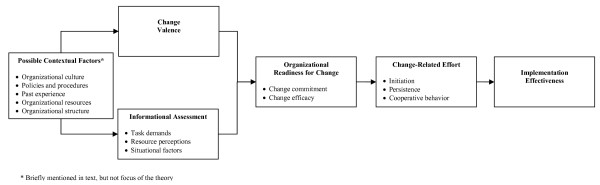
BACKGROUND: Change management experts have emphasized the importance of establishing organizational readiness for change and recommended various strategies for creating it. Although the advice seems reasonable, the scientific basis for it is limited. Unlike individual readiness for change, organizational readiness for change has not been subject to extensive theoretical development or empirical study. In this article, I conceptually define organizational readiness for change and develop a theory of its determinants and outcomes. I focus on the organizational level of analysis because many promising approaches to improving healthcare delivery entail collective behavior change in the form of systems redesign--that is, multiple, simultaneous changes in staffing, work flow, decision making, communication, and reward systems. DISCUSSION: Organizational readiness for change is a multi-level, multi-faceted construct. As an organization-level construct, readiness for change refers to organizational members' shared resolve to implement a change (change commitment) and shared belief in their collective capability to do so (change efficacy). Organizational readiness for change varies as a function of how much organizational members value the change and how favorably they appraise three key determinants of implementation capability: task demands, resource availability, and situational factors. When organizational readiness for change is high, organizational members are more likely to initiate change, exert greater effort, exhibit greater persistence, and display more cooperative behavior. The result is more effective implementation. SUMMARY: The theory described in this article treats organizational readiness as a shared psychological state in which organizational members feel committed to implementing an organizational change and confident in their collective abilities to do so. This way of thinking about organizational readiness is best suited for examining organizational changes where collective behavior change is necessary in order to effectively implement the change and, in some instances, for the change to produce anticipated benefits. Testing the theory would require further measurement development and careful sampling decisions. The theory offers a means of reconciling the structural and psychological views of organizational readiness found in the literature. Further, the theory suggests the possibility that the strategies that change management experts recommend are equifinal. That is, there is no 'one best way' to increase organizational readiness for change.
Overview
The claims and statistics of this paper haven’t been checked yet.
Run the check — free, no account needed. It reads the open-access text and checks the sources it cites.
Integrity signals
Registry
Cites
Statistics
Figures
Verification
Claims the paper makes
The claims and statistics of this paper haven’t been checked yet.
Run the check — free, no account needed. It reads the open-access text and checks the sources it cites.
Claims other papers make about this one
Each is checked against this paper’s own text: does it say what the citing paper says it does?
In the citing paper
“Weiner’s theory of organisational readiness to change [71] proposes that readiness depends on collective behaviour change linked to two key factors, described as change commitment (wanting to change) and change efficacy (able to change).”
From PARIHS revisited: from heuristic to integrated framework for the successful implementation of knowledge into practice (2015) · cites this paper as [71]
In the citing paper
“Weiner’s organizational theory of innovation implementation suggests that leaders are critical in creating readiness for change, ensuring innovation-values fit, and developing plans, practices, structures, and strategies to support implementation (Weiner, 2009).”
From The Roles of System and Organizational Leadership in System-Wide Evidence-Based Intervention Sustainment: A Mixed-Method Study (2016) · cites this paper as Weiner, 2009
In the citing paper
“Organizational readiness for change theory postulates that a higher level of organizational readiness increases the success of innovation adoption and decreases the risk of failure (Snyder-Halpern 2001;Weiner 2009).”
From Ready or not, AI comes—an interview study of organizational AI readiness factors (2021) · cites this paper as Weiner 2009
Self-check
Percentages, sums and reported differences re-computed from the paper’s own numbers.
The self-check needs the paper’s full text.
Citations
Cites
Self-efficacy: The exercise of control
Bandura, A., Freeman, W. H., & Lightsey, R. (1999) · Journal of Cognitive Psychotherapy · doi:10.1891/0889-8391.13.2.158 · Cited by 46,835
(1975) · PhilPapers (PhilPapers Foundation) · Cited by 36,737
Psychometric theory (2nd ed.).
Sitgreaves, R. (1979) · Contemporary Psychology · doi:10.1037/018882 · Cited by 14,384
(1964) · Medical Entomology and Zoology · Cited by 10,439
Commitment in the workplace: toward a general model
Meyer, J. P., & Herscovitch, L. (2001) · Human Resource Management Review · doi:10.1016/s1053-4822(00)00053-x · Cited by 3,856
Self-Efficacy: A Theoretical Analysis of Its Determinants and Malleability
Gist, M. E., & Mitchell, T. R. (1992) · Academy of Management Review · doi:10.5465/amr.1992.4279530 · Cited by 3,713
Field Theory in Social Science: Selected Theoretical Papers.
Price, D. O., Lewin, K., & Cartwright, D. (1951) · American Sociological Review · doi:10.2307/2087618 · Cited by 3,519
Exercise of Human Agency Through Collective Efficacy
Bandura, A. (2000) · Current Directions in Psychological Science · doi:10.1111/1467-8721.00064 · Cited by 3,294
The Challenge of Innovation Implementation
Klein, K. J., & Sorra, J. S. (1996) · The Academy of Management Review · doi:10.2307/259164 · Cited by 2,113
Creating Readiness for Organizational Change
Armenakis, A. A., Harris, S. G., & Mossholder, K. W. (1993) · Human Relations · doi:10.1177/001872679304600601 · Cited by 2,061
Research works printed but not linked: 5
- Kotter JP: Leading change. 1996, Boston: Harvard Business Press
- Bandura A: Social foundations of thought and action: a social cognitive theory. 1986, Englewood Cliffs, N.J.: Prentice-Hall
- Turner D, Crawford M: Change Power: Capabilities that Drive Corporate Renewal. 1998, Warriewood, Australia: Business & Professional Publishing
- Nunnally JC: Psychometric theory. 1978, New York: McGraw-Hill, 2
- Elise LL, Steven VO: A measure of self-care self-efficacy. 1996, 19: 421-429.
Cited by
Sorted by citations
Making sense of implementation theories, models and frameworks
Nilsen, P. (2015) · Implementation Science · doi:10.1186/s13012-015-0242-0 · Cited by 4,447
Advancing a Conceptual Model of Evidence-Based Practice Implementation in Public Service Sectors
Aarons, G. A., Hurlburt, M., & Horwitz, S. M. (2011) · Administration and Policy in Mental Health and Mental Health Services Research · doi:10.1007/s10488-010-0327-7 · Cited by 3,240
Harvey, G., & Kitson, A. (2015) · Implementation Science · doi:10.1186/s13012-016-0398-2 · Cited by 1,271
Organizational readiness for implementing change: a psychometric assessment of a new measure
Shea, C., Jacobs, S., Esserman, D. A., Bruce, K., & Weiner, B. (2014) · Implementation Science · doi:10.1186/1748-5908-9-7 · Cited by 785
Self-citationTowards a general theory of implementation
May, C. (2013) · Implementation Science · doi:10.1186/1748-5908-8-18 · Cited by 656
Change Readiness: A Multilevel Review
Rafferty, A. E., Jimmieson, N. L., & Armenakis, A. A. (2013) · Journal of Management · doi:10.1177/0149206312457417 · Cited by 679
Ready or not, AI comes—an interview study of organizational AI readiness factors
Jöhnk, J., Weißert, M., & Wyrtki, K. (2021) · Business & Information Systems Engineering · doi:10.1007/s12599-020-00676-7 · Cited by 637
Aarons, G. A., Ehrhart, M. G., & Farahnak, L. R. (2014) · Implementation Science · doi:10.1186/1748-5908-9-45 · Cited by 559
Ehrhart, M. G., Aarons, G. A., & Farahnak, L. R. (2014) · Implementation Science · doi:10.1186/s13012-014-0157-1 · Cited by 502
Clarity out of chaos: Use of theory in implementation research
Damschroder, L. J. (2020) · Psychiatry Research · doi:10.1016/j.psychres.2019.06.036 · Cited by 422
Action, actor, context, target, time (AACTT): a framework for specifying behaviour
Presseau, J., McCleary, N., Lorencatto, F., Patey, A. M., Grimshaw, J. M., & Francis, J. J. (2019) · Implementation Science · doi:10.1186/s13012-019-0951-x · Cited by 411
Petersson, L., Larsson, I., Nygren, J. M., Nilsen, P., Neher, M., Reed, J. E., Tyskbo, D., & Svedberg, P. (2022) · BMC Health Services Research · doi:10.1186/s12913-022-08215-8 · Cited by 434
Lokuge, S., Sedera, D., Grover, V., & Xu, D. (2018) · Information & Management · doi:10.1016/j.im.2018.09.001 · Cited by 540
Personalized early detection and prevention of breast cancer: ENVISION consensus statement
Pashayan, N., Antoniou, A. C., Ivanuš, U., Esserman, L. J., Easton, D. F., French, D., Sroczynski, G., Hall, P. N., Cuzick, J. M., Evans, D. G., et al. (2020) · Nature Reviews Clinical Oncology · doi:10.1038/s41571-020-0388-9 · Cited by 455
Aarons, G. A., Ehrhart, M. G., Farahnak, L. R., & Hurlburt, M. S. (2015) · Implementation Science · doi:10.1186/s13012-014-0192-y · Cited by 435
Clohessy, T., & Acton, T. (2019) · Industrial Management & Data Systems · doi:10.1108/imds-08-2018-0365 · Cited by 436
A guiding framework and approach for implementation research in substance use disorders treatment.
Damschroder, L. J., & Hagedorn, H. J. (2011) · Psychology of Addictive Behaviors · doi:10.1037/a0022284 · Cited by 427
Matthew‐Maich, N., Harris, L., Ploeg, J., Markle‐Reid, M., Valaitis, R. K., Ibrahim, S., Gafni, A., & Isaacs, S. (2016) · JMIR mhealth and uhealth · doi:10.2196/mhealth.5127 · Cited by 409
Klaic, M., Kapp, S., Hudson, P., Chapman, W. W., Denehy, L., Story, D., & Francis, J. (2022) · Implementation Science · doi:10.1186/s13012-021-01171-7 · Cited by 443
A PRACTICAL IMPLEMENTATION SCIENCE HEURISTIC FOR ORGANIZATIONAL READINESS: R = MC 2
Scaccia, J., Cook, B. S., Lamont, A. E., Wandersman, A., Castellow, J., Katz, J., & Beidas, R. S. (2015) · Journal of Community Psychology · doi:10.1002/jcop.21698 · Cited by 414
Nilsén, P., Seing, I., Ericsson, C., Birken, S. A., & Schildmeijer, K. G. I. (2020) · BMC Health Services Research · doi:10.1186/s12913-020-4999-8 · Cited by 391
Golden, S. D., McLeroy, K. R., Green, L. W., Earp, J. A., & Lieberman, L. (2015) · Health Education & Behavior · doi:10.1177/1090198115575098 · Cited by 350
Integrating the organizational change literature: a model for successful change
Haddad, S., & Kotnour, T. (2015) · Journal of Organizational Change Management · doi:10.1108/jocm-11-2013-0215 · Cited by 391
Finch, T. L., Girling, M., May, C. R., Mair, F. S., Murray, E., Treweek, S., McColl, E., Steen, I. N., Cook, C., Vernazza, C. R., et al. (2018) · BMC Medical Research Methodology · doi:10.1186/s12874-018-0591-x · Cited by 337
Making Sense of Implementation Theories, Models, and Frameworks
Nilsén, P. (2020) · Springer eBooks · doi:10.1007/978-3-030-03874-8_3 · Cited by 343
Rycroft-Malone, J., Seers, K., Chandler, J., Hawkes, C. A., Crichton, N., Allen, C., Bullock, I., & Strunin, L. (2013) · Implementation Science · doi:10.1186/1748-5908-8-28 · Cited by 303
Aarons, G. A., Green, A. E., Trott, E., Willging, C. E., Torres, E. M., Ehrhart, M. G., & Roesch, S. C. (2016) · Administration and Policy in Mental Health and Mental Health Services Research · doi:10.1007/s10488-016-0751-4 · Cited by 251
Designing and undertaking randomised implementation trials: guide for researchers
Wolfenden, L., Foy, R., Presseau, J., Grimshaw, J., Ivers, N. M., Powell, B. J., Taljaard, M., Wiggers, J., Sutherland, R., Nathan, N., et al. (2021) · BMJ · doi:10.1136/bmj.m3721 · Cited by 287
Digital readiness assessment of Italian SMEs: a case-study research
Pirola, F., Cimini, C., & Pinto, R. (2019) · Journal of Manufacturing Technology Management · doi:10.1108/jmtm-09-2018-0305 · Cited by 284
Farahnak, L. R., Ehrhart, M. G., Torres, E. M., & Aarons, G. A. (2019) · Journal of Leadership & Organizational Studies · doi:10.1177/1548051818824529 · Cited by 345
Lennon, M. R., Bouamrane, M.-M., Devlin, A. M., O'Connor, S., O'Donnell, C., Chetty, U., Agbakoba, R., Bikker, A., Grieve, E., Finch, T., et al. (2017) · Journal of Medical Internet Research · doi:10.2196/jmir.6900 · Cited by 264
Readiness factors for lean implementation in healthcare settings – a literature review
Al-Balushi, S. M., Sohal, A. S., Singh, P. J., Al-Hajri, A., Al-Farsi, Y. M., & Al-Abri, R. K. (2014) · Journal of Health Organization and Management · doi:10.1108/jhom-04-2013-0083 · Cited by 253
Planning for Implementation Success Using RE-AIM and CFIR Frameworks: A Qualitative Study
King, D. K., Shoup, J. A., Raebel, M. A., Anderson, C. B., Wagner, N. M., Ritzwoller, D. P., & Bender, B. G. (2020) · Frontiers in Public Health · doi:10.3389/fpubh.2020.00059 · Cited by 273
Baker, C. N., Brown, S. M., Wilcox, P. D., Overstreet, S., & Arora, P. G. (2015) · School Mental Health · doi:10.1007/s12310-015-9161-0 · Cited by 256
Instrumentation issues in implementation science
Martinez, R. G., Lewis, C. C., & Weiner, B. J. (2014) · Implementation Science · doi:10.1186/s13012-014-0118-8 · Cited by 243
Self-citationContext and implementation: A concept analysis towards conceptual maturity
Pfadenhauer, L. M., Mozygemba, K., Gerhardus, A., Hofmann, B., Booth, A., Lysdahl, K. B., Tummers, M., Burns, J., & Rehfuess, E. A. (2015) · Zeitschrift für Evidenz, Fortbildung und Qualität im Gesundheitswesen · doi:10.1016/j.zefq.2015.01.004 · Cited by 189
Vaughn, V. M., Saint, S. K., Krein, S. L., Forman, J. H., Meddings, J. A., Ameling, J. M., Winter, S. M., Townsend, W. A., & Chopra, V. (2018) · BMJ Quality & Safety · doi:10.1136/bmjqs-2017-007573 · Cited by 187
Miake-Lye, I. M., Delevan, D. M., Ganz, D. A., Mittman, B. S., & Finley, E. P. (2020) · BMC Health Services Research · doi:10.1186/s12913-020-4926-z · Cited by 170
Implementation science in resource-poor countries and communities
Yapa, H. M., & Bärnighausen, T. (2018) · Implementation Science · doi:10.1186/s13012-018-0847-1 · Cited by 170
Lyon, A. R., Brewer, S. K., & Areán, P. A. (2020) · American Psychologist · doi:10.1037/amp0000652 · Cited by 152
Yaqub, M., & Alsabban, A. (2023) · Sustainability · doi:10.3390/su15118553 · Cited by 180
Improving patient discharge and reducing hospital readmissions by using Intervention Mapping
Hesselink, G., Zegers, M., Vernooij-Dassen, M. J. F. J., Barach, P. R., Kalkman, C. J., Flink, M., Ön, G., Olsson, M., Bergenbrant, S., Orrego, C., et al. (2014) · BMC Health Services Research · doi:10.1186/1472-6963-14-389 · Cited by 193
Andersen, H., Røvik, K. A., & Ingebrigtsen, T. (2014) · BMJ Open · doi:10.1136/bmjopen-2013-003873 · Cited by 163
Moir, T. (2018) · Frontiers in Education · doi:10.3389/feduc.2018.00061 · Cited by 191
Factors influencing organizational agility in higher education
Menon, S., & Suresh, M. (2020) · Benchmarking An International Journal · doi:10.1108/bij-04-2020-0151 · Cited by 189
Gökalp, E., Gökalp, M. O., & Çoban, S. (2020) · Information Systems Management · doi:10.1080/10580530.2020.1812014 · Cited by 160
Porritt, K. A., McArthur, A., Lockwood, C. S., & Munn, Z. (2022) · International Journal of Evidence-Based Healthcare · doi:10.1097/xeb.0000000000000361 · Cited by 153
Blockchain Adoption: Technological, Organisational and Environmental Considerations
Clohessy, T., Acton, T., & Rogers, N. (2018) · Springer eBooks · doi:10.1007/978-3-319-98911-2_2 · Cited by 171
Metwally, D., Ruiz‐Palomino, P., Metwally, M., & Gartzia, L. (2019) · Frontiers in Psychology · doi:10.3389/fpsyg.2019.02493 · Cited by 198
Nilsén, P., Wallerstedt, B., Behm, L., & Ahlström, G. (2018) · Implementation Science · doi:10.1186/s13012-017-0699-0 · Cited by 147
Shelton, R. C., Lee, M., Brotzman, L., Wolfenden, L., Nathan, N., & Wainberg, M. L. (2020) · International Journal of Behavioral Medicine · doi:10.1007/s12529-020-09848-x · Cited by 148
Krein, S. L., Damschroder, L. J., Kowalski, C. P., Forman, J. H., Hofer, T. P., & Saint, S. K. (2010) · Social Science & Medicine · doi:10.1016/j.socscimed.2010.07.041 · Cited by 141
Bunce, A., Gruß, I., Davis, J. V., Cowburn, S., Cohen, D. J., Oakley, J., & Gold, R. B. (2020) · Implementation Science · doi:10.1186/s13012-020-01048-1 · Cited by 151
Vaishnavi, V., Suresh, M., & Dutta, P. (2019) · Benchmarking An International Journal · doi:10.1108/bij-06-2018-0161 · Cited by 153
Gagnon, M., Attieh, R., Ghandour, E., Légaré, F., Ouimet, M., Estabrooks, C., & Grimshaw, J. (2014) · PLoS ONE · doi:10.1371/journal.pone.0114338 · Cited by 119
Kowalski, C., Lee, S.-Y. D., Schmidt, A. G., Wesselmann, S., Wirtz, M. A., Pfaff, H., & Ernstmann, N. (2015) · BMC Health Services Research · doi:10.1186/s12913-015-0707-5 · Cited by 132
Hendy, J., Chrysanthaki, T., Barlow, J., Knapp, M., Rogers, A., Sanders, C., Bower, P., Bowen, R., Fitzpatrick, R., Bardsley, M., et al. (2012) · BMC Health Services Research · doi:10.1186/1472-6963-12-403 · Cited by 130
Positioning change readiness in knowledge management research
Rusly, F. H., Corner, J. L., & Sun, P. Y. T. (2012) · Journal of Knowledge Management · doi:10.1108/13673271211218906 · Cited by 156
Kirst, M. J., Im, J., Burns, T., Baker, G. R., Goldhar, J., O'Campo, P. J., Wojtak, A., & Wodchis, W. P. (2017) · International Journal for Quality in Health Care · doi:10.1093/intqhc/mzx095 · Cited by 131
Alami, H., Lehoux, P., Denis, J., Motulsky, A., Petitgand, C., Savoldelli, M., Rouquet, R., Gagnon, M., Roy, D. A., & Fortin, J. (2020) · Journal of Health Organization and Management · doi:10.1108/jhom-03-2020-0074 · Cited by 156
Wang, G., Wong, E., Nilsen, P., Chung, V., Tian, Y., & Yeoh, E. (2023) · Implementation Science · doi:10.1186/s13012-023-01296-x · Cited by 125
Hagermoser Sanetti, L. M., & Collier-Meek, M. A. (2019) · Journal of School Psychology · doi:10.1016/j.jsp.2019.07.008 · Cited by 129
Ruel, S., & Baz, J. E. (2021) · International Journal of Production Research · doi:10.1080/00207543.2021.1962559 · Cited by 125
What supports physiotherapists’ use of research in clinical practice? A qualitative study in Sweden
Dannapfel, P., Peolsson, A. L. C., & Nilsén, P. (2013) · Implementation Science · doi:10.1186/1748-5908-8-31 · Cited by 119
Pigosso, D. C. A., & McAloone, T. C. (2021) · Sustainable Production and Consumption · doi:10.1016/j.spc.2021.05.011 · Cited by 139
Engagement in research: an innovative three-stage review of the benefits for health-care performance
Hanney, S. R., Boaz, A., Jones, T. H., & Soper, B. (2013) · Health Services and Delivery Research · doi:10.3310/hsdr01080 · Cited by 121
Tools to support evidence-informed public health decision making
Yost, J., Dobbins, M., Traynor, R., DeCorby, K., Workentine, S., & Greco, L. (2014) · BMC Public Health · doi:10.1186/1471-2458-14-728 · Cited by 116
Implementation of Virtual Reality in Health Professions Education: Scoping Review
Lie, S. S., Helle, N., Sletteland, N. V., Vikman, M. D., & Bonsaksen, T. (2023) · JMIR Medical Education · doi:10.2196/41589 · Cited by 131
Health Promotion in Smaller Workplaces in the United States
Harris, J. R., Hannon, P. A., Beresford, S. A. A., Linnan, L. A., & McLellan, D. L. (2014) · Annual Review of Public Health · doi:10.1146/annurev-publhealth-032013-182416 · Cited by 118
Sheard, L., Marsh, C., O'Hara, J. K., et al. (2017) · Social Science & Medicine · doi:10.1016/j.socscimed.2017.02.005 · Cited by 117
Jacob, C., Sánchez-Vázquez, A., & Ivory, C. J. (2020) · JMIR mhealth and uhealth · doi:10.2196/18072 · Cited by 120
An artificial intelligence (AI)-readiness and adoption framework for AgriTech firms
Issa, H., Jabbouri, R., & Palmer, M. (2022) · Technological Forecasting and Social Change · doi:10.1016/j.techfore.2022.121874 · Cited by 145
Zimmerman, L., Lounsbury, D. W., Rosen, C. S., Kimerling, R. E., Trafton, J. A., & Lindley, S. E. (2016) · Administration and Policy in Mental Health and Mental Health Services Research · doi:10.1007/s10488-016-0754-1 · Cited by 125
Employee Resistance To Organizational Change
Bateh, J., Castaneda, M. E., & Farah, J. E. (2013) · International Journal of Management & Information Systems (IJMIS) · doi:10.19030/ijmis.v17i2.7715 · Cited by 113
Wang, T., Olivier, D. F., & Chen, P. (2020) · International Journal of Leadership in Education · doi:10.1080/13603124.2020.1818131 · Cited by 208
Digital organisational readiness: experiences from manufacturing companies
Machado, C. G., Winroth, M., Almström, P., Öberg, A. E., Kurdve, M., & Almashalah, S. Y. (2021) · Journal of Manufacturing Technology Management · doi:10.1108/jmtm-05-2019-0188 · Cited by 128
An attention-based view of AI assimilation in public sector organizations: The case of Saudi Arabia
Alshahrani, A., Dennehy, D., & Mäntymäki, M. (2022) · Government Information Quarterly · doi:10.1016/j.giq.2021.101617 · Cited by 106
Harvey, G., & Kitson, A. (2015) · International Journal of Health Policy and Management · doi:10.15171/ijhpm.2015.54 · Cited by 103
Kemp, C. G., Weiner, B. J., Sherr, K., Kupfer, L. E., Cherutich, P., Wilson, D. J., Geng, E., & Wasserheit, J. N. (2018) · AIDS · doi:10.1097/qad.0000000000001897 · Cited by 104
Self-citationFinley, E. P., Garcia, H. A., Ketchum, N. S., McGeary, D. D., McGeary, C. A., Stirman, S. W., & Peterson, A. L. (2014) · Psychological Services · doi:10.1037/ser0000014 · Cited by 102
Antecedents of blockchain adoption: An integrative framework
Clohessy, T., Treiblmaier, H., Acton, T., & Rogers, N. (2020) · Strategic Change · doi:10.1002/jsc.2360 · Cited by 114
Flynn, R., Rotter, T., Hartfield, D. S., Newton, A. S., & Scott, S. D. (2019) · BMC Health Services Research · doi:10.1186/s12913-019-4744-3 · Cited by 103
Building information modeling acceptance and readiness assessment in Taiwanese architectural firms
Juan, Y., Lai, W.-Y., & Shih, S.-G. (2016) · Journal of Civil Engineering and Management · doi:10.3846/13923730.2015.1128480 · Cited by 96
Hannon, P. A., Garson, G., Harris, J. R., Hammerback, K., Sopher, C. J., & Clegg-Thorp, C. (2012) · Journal of Occupational and Environmental Medicine · doi:10.1097/jom.0b013e3182717cf2 · Cited by 97
Enhancing Readiness for Change by Enhancing Mindfulness
Gärtner, C. (2013) · Journal of Change Management · doi:10.1080/14697017.2013.768433 · Cited by 107
How to achieve the desired outcomes of advance care planning in nursing homes: a theory of change
Gilissen, J., Pivodic, L., Gastmans, C., Stichele, R. V., Deliëns, L., Breuer, E., & den Block, L. V. (2018) · BMC Geriatrics · doi:10.1186/s12877-018-0723-5 · Cited by 98
Leeman, J., Calancie, L., Kegler, M. C., Escoffery, C. T., Herrmann, A. K., Thatcher, E., Hartman, M. A., & Fernandez, M. E. (2017) · Health Education & Behavior · doi:10.1177/1090198115610572 · Cited by 90
A conceptual model to guide research on the activities and effects of innovation champions
Shea, C. M. (2021) · Implementation Research and Practice · doi:10.1177/2633489521990443 · Cited by 92
Organizational Context and Capabilities for Integrating Care: A Framework for Improvement
Evans, J. M., Grudniewicz, A., Baker, G. R., & Wodchis, W. P. (2016) · International Journal of Integrated Care · doi:10.5334/ijic.2416 · Cited by 91
e-Health readiness assessment factors and measuring tools: A systematic review
Yusif, S., Hafeez‐Baig, A., & Soar, J. (2017) · International Journal of Medical Informatics · doi:10.1016/j.ijmedinf.2017.08.006 · Cited by 99
Organizational Interventions for Health and Well-being
Martin, A., & LaMontagne, A. (2018) · Routledge eBooks · doi:10.4324/9781315410494 · Cited by 99
Bartlett, J. D., & Drust, B. (2020) · European Journal of Sport Science · doi:10.1080/17461391.2020.1842511 · Cited by 91
Nilsén, P., Schildmeijer, K. G. I., Ericsson, C., Seing, I., & Birken, S. A. (2019) · Implementation Science · doi:10.1186/s13012-019-0902-6 · Cited by 88
Pingali, S. R., Singha, S., Arunachalam, S., & Pedada, K. (2023) · Journal of Business Research · doi:10.1016/j.jbusres.2023.113973 · Cited by 155
Hinchcliff, R., Greenfield, D., Westbrook, J. I., et al. (2013) · BMC Health Services Research · doi:10.1186/1472-6963-13-437 · Cited by 88
Norris, J. M., White, D. E., Nowell, L., Mrklas, K., & Stelfox, H. (2017) · Implementation Science · doi:10.1186/s13012-017-0625-5 · Cited by 82
Alley, Z. M., Chapman, J. E., Schaper, H., & Saldana, L. (2023) · Implementation Science · doi:10.1186/s13012-023-01285-0 · Cited by 86
The impact of self‐efficacy on employees' ability to accept new technology in an Iraqi university
Alnoor, A., Al‐Abrrow, H., Abdullah, H. O., & Abbas, S. (2019) · Global Business and Organizational Excellence · doi:10.1002/joe.21984 · Cited by 86
Shaw, R. J., Kaufman, M. A., Bosworth, H. B., Weiner, B. J., Zullig, L. L., Lee, S. Y. D., Kravetz, J. D., Rakley, S., Roumie, C. L., Bowen, M. E., et al. (2013) · Implementation Science · doi:10.1186/1748-5908-8-106 · Cited by 83
Self-citationTeam-Based Care with Pharmacists to Improve Blood Pressure: a Review of Recent Literature
Kennelty, K. A., Polgreen, L. A., & Carter, B. L. (2018) · Current Hypertension Reports · doi:10.1007/s11906-018-0803-0 · Cited by 84
Metadata
- Authors
- Weiner, B. J.
- Affiliations
- University of North Carolina at Chapel Hill (US)
- Corresponding author
- Weiner, Bryan J
- ORCID
- Weiner, Bryan J
- Venue
- Implementation Science
- Published
- 2009-10-19
- Volume
- 4
- Issue
- 1
- Pages
- 67-67
- ISSN
- 1748-5908 (ISSN-L)
- PMC
- PMC2770024
- OpenAlex
- W2170135023
- Cited by
- 2,268
- References
- 75
- Citations by year
- 2026: 264 · 2025: 182 · 2024: 224 · 2023: 190 · 2022: 229 · 2021: 233 · 2020: 187 · 2019: 153 · 2018: 141 · 2017: 108 · 2016: 84 · 2015: 85 · 2014: 76 · 2013: 52 · 2012: 28
- FWCI
- 33.09
- Type
- journal article
- Language
- en
- Open access
- gold
- doi.org
- Licence
- Locations
- Implementation Science (publishedVersion, cc-by)
- PubMed Central (publishedVersion, cc-by)
- PubMed (publishedVersion)
- DOAJ (DOAJ: Directory of Open Access Journals) (submittedVersion)
- Funders
- National Cancer Institute (R01CA124402)
- Topics
- Social Sciences › Business, Management and Accounting › Organizational Behavior and Human Resource Management › Organizational Change and Leadership
- Health Sciences › Health Professions › General Health Professions › Health Policy Implementation Science
- Social Sciences › Business, Management and Accounting › Organizational Behavior and Human Resource Management › Organizational Management and Change
- Keywords
- organizational preparedness, change management, commitment to change, change efficacy, health care delivery improvement, task demands, resource availability, situational factors, implementation capability, organizational change theory
About these checks
Registry, retraction, Cites and statistics results are computed, not judged, with one exception: a printed reference that no index lists is read once by a model before it counts as a citation error. Claims are extracted by a model and kept only when their quote appears verbatim in the text; each cited source is then checked, with a model’s help, for whether it says what the claim relies on. Those verdicts can be wrong — read the claim’s quote and the cited source before relying on one.
Statistics and arithmetic are recomputed, not judged.
Confidence bands are shown only for fields calibrated on our annotated test set. None is calibrated yet, so no band is shown.
What counts as a claim ›How we measure confidence ›How we check this ›
Are you an author, or do you see a problem with this page? Request a review
