

The DOI matches its Crossref record; 93 of the 95 references it cites were found in a registry or an index.
The meaning and measurement of implementation climate
Open accessAbstract
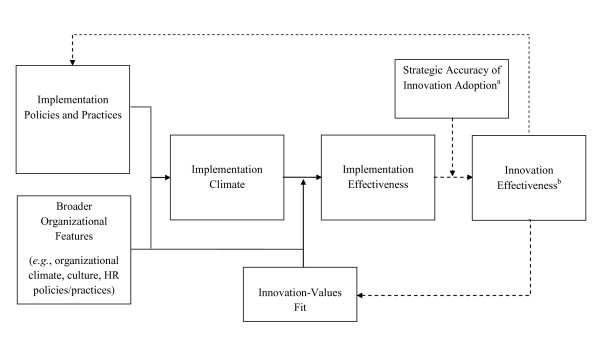
BACKGROUND: Climate has a long history in organizational studies, but few theoretical models integrate the complex effects of climate during innovation implementation. In 1996, a theoretical model was proposed that organizations could develop a positive climate for implementation by making use of various policies and practices that promote organizational members' means, motives, and opportunities for innovation use. The model proposes that implementation climate--or the extent to which organizational members perceive that innovation use is expected, supported, and rewarded--is positively associated with implementation effectiveness. The implementation climate construct holds significant promise for advancing scientific knowledge about the organizational determinants of innovation implementation. However, the construct has not received sufficient scholarly attention, despite numerous citations in the scientific literature. In this article, we clarify the meaning of implementation climate, discuss several measurement issues, and propose guidelines for empirical study. DISCUSSION: Implementation climate differs from constructs such as organizational climate, culture, or context in two important respects: first, it has a strategic focus (implementation), and second, it is innovation-specific. Measuring implementation climate is challenging because the construct operates at the organizational level, but requires the collection of multi-dimensional perceptual data from many expected innovation users within an organization. In order to avoid problems with construct validity, assessments of within-group agreement of implementation climate measures must be carefully considered. Implementation climate implies a high degree of within-group agreement in climate perceptions. However, researchers might find it useful to distinguish implementation climate level (the average of implementation climate perceptions) from implementation climate strength (the variability of implementation climate perceptions). It is important to recognize that the implementation climate construct applies most readily to innovations that require collective, coordinated behavior change by many organizational members both for successful implementation and for realization of anticipated benefits. For innovations that do not possess these attributes, individual-level theories of behavior change could be more useful in explaining implementation effectiveness. SUMMARY: This construct has considerable value in implementation science, however, further debate and development is necessary to refine and distinguish the construct for empirical use.
Overview
The claims and statistics of this paper haven’t been checked yet.
Run the check — free, no account needed. It reads the open-access text and checks the sources it cites.
Integrity signals
Registry
Cites
Statistics
Figures
Verification
Claims the paper makes
The claims and statistics of this paper haven’t been checked yet.
Run the check — free, no account needed. It reads the open-access text and checks the sources it cites.
Claims other papers make about this one
Each is checked against this paper’s own text: does it say what the citing paper says it does?
In the citing paper
“Indeed, there is a recognition that equifinality [82] is common in complex systems governing implementation.”
From “Scaling-out” evidence-based interventions to new populations or new health care delivery systems (2017) · cites this paper as [82]
Self-check
Percentages, sums and reported differences re-computed from the paper’s own numbers.
The self-check needs the paper’s full text.
Citations
Cites
Damschroder, L. J., Aron, D. C., Keith, R. E., Kirsh, S. R., Alexander, J. A., & Lowery, J. C. (2009) · Implementation Science · doi:10.1186/1748-5908-4-50 · Cited by 14,496
Research in Organizational Behavior
Hammer, E. R., Cummings, L. L., & Staw, B. M. (1984) · Academy of Management Review · doi:10.2307/258300 · Cited by 11,176
ASSESSING THE WORK ENVIRONMENT FOR CREATIVITY.
AMABILE, T. M., CONTI, R., COON, H., LAZENBY, J., & HERRON, M. (1996) · Academy of Management Journal · doi:10.2307/256995 · Cited by 6,029
Estimating within-group interrater reliability with and without response bias
James, L. R., Demaree, R. G., & Wolf, G. (1984) · Journal of Applied Psychology · doi:10.1037/0021-9010.69.1.85 · Cited by 4,774
Toward a cognitive social learning reconceptualization of personality
Mischel, W. (1973) · Psychological Review · doi:10.1037/h0035002 · Cited by 3,181
Chan, D. K. (1998) · Journal of Applied Psychology · doi:10.1037/0021-9010.83.2.234 · Cited by 2,981
Safety climate in industrial organizations: Theoretical and applied implications.
Zohar, D. M. (1980) · Journal of Applied Psychology · doi:10.1037/0021-9010.65.1.96 · Cited by 2,687
Aggregation bias in estimates of perceptual agreement.
James, L. R. (1982) · Journal of Applied Psychology · doi:10.1037/0021-9010.67.2.219 · Cited by 2,139
The Challenge of Innovation Implementation
Klein, K. J., & Sorra, J. S. (1996) · The Academy of Management Review · doi:10.2307/259164 · Cited by 2,113
Organizational Climate and Culture
Ehrhart, M. G. (2016) · The SAGE Encyclopedia of Theory in Psychology · doi:10.4135/9781483346274.n219 · Cited by 2,055
Linking service climate and customer perceptions of service quality: Tests of a causal model.
Schneider, B. N., White, S. S., & Paul, M. C. (1998) · Journal of Applied Psychology · doi:10.1037/0021-9010.83.2.150 · Cited by 1,754
Levels issues in theory development, data collection and analysis
Klein, K. J., Dansereau, F., & Hall, R. J. (1994) · The Academy of Management Review · doi:10.2307/258703 · Cited by 1,607
Zohar, D. M. (2000) · Journal of Applied Psychology · doi:10.1037/0021-9010.85.4.587 · Cited by 1,557
From Micro to Meso: Critical Steps in Conceptualizing and Conducting Multilevel Research
Klein, K. J., & Kozlowski, S. W. J. (2000) · Organizational Research Methods · doi:10.1177/109442810033001 · Cited by 1,473
Motivation and Organizational Climate
Smith, O. W., Smith, P. C., Litwin, G. H., & Stringer, R. A. (1969) · The American Journal of Psychology · doi:10.2307/1420456 · Cited by 1,372
Employee and customer perceptions of service in banks: Replication and extension.
Schneider, B., & Bowen, D. E. (1985) · Journal of Applied Psychology · doi:10.1037/0021-9010.70.3.423 · Cited by 1,344
Patterson, M., West, M. A., Shackleton, V., Dawson, J., Lawthom, R., Maitlis, S., Robinson, D. L., & Wallace, A. M. (2005) · Journal of Organizational Behavior · doi:10.1002/job.312 · Cited by 1,318
Glick, W. H. (1985) · The Academy of Management Review · doi:10.5465/amr.1985.4279045 · Cited by 1,286
Thirty years of safety climate research: Reflections and future directions
Zohar, D. M. (2010) · Accident Analysis & Prevention · doi:10.1016/j.aap.2009.12.019 · Cited by 1,270
Schneider, B., & Reichers, A. E. (1983) · Personnel Psychology · doi:10.1111/j.1744-6570.1983.tb00500.x · Cited by 1,195
Organizational climate: A review of theory and research.
James, L. R., & Jones, A. P. (1974) · Psychological Bulletin · doi:10.1037/h0037511 · Cited by 1,099
ORGANIZATIONAL CLIMATES: AN ESSAY 1
Schneider, B. (1975) · Personnel Psychology · doi:10.1111/j.1744-6570.1975.tb01386.x · Cited by 1,030
Jones, A. P., & James, L. R. (1979) · Organizational Behavior and Human Performance · doi:10.1016/0030-5073(79)90056-4 · Cited by 824
Zohar, D. M. (2002) · Journal of Organizational Behavior · doi:10.1002/job.130 · Cited by 819
Climate strength: a new direction for climate research.
Schneider, B., Salvaggio, A. N., & Ferrer, M. S. (2002) · Journal of Applied Psychology · doi:10.1037/0021-9010.87.2.220 · Cited by 775
Climate for Creativity: A Quantitative Review
Hunter, S. T., Bedell, K. E., & Mumford, M. D. (2007) · Creativity Research Journal · doi:10.1080/10400410709336883 · Cited by 709
JUSTICE IN TEAMS: ANTECEDENTS AND CONSEQUENCES OF PROCEDURAL JUSTICE CLIMATE
Colquitt, J. A., Noe, R. A., & JACKSON, C. L. (2002) · Personnel Psychology · doi:10.1111/j.1744-6570.2002.tb00104.x · Cited by 703
Employee and Customer Perceptions of Service in Banks
Schneider, B., Parkington, J. J., & Buxton, V. M. (1980) · Administrative Science Quarterly · doi:10.2307/2392454 · Cited by 645
A CASE FOR PROCEDURAL JUSTICE CLIMATE: DEVELOPMENT AND TEST OF A MULTILEVEL MODEL.
Naumann, S. E., & Bennett, N. J. (2000) · Academy of Management Journal · doi:10.2307/1556416 · Cited by 642
Implementing computerized technology: An organizational analysis.
Klein, K. J., Conn, A. B., & Sorra, J. S. (2001) · Journal of Applied Psychology · doi:10.1037/0021-9010.86.5.811 · Cited by 615
Glisson, C., Landsverk, J., Schoenwald, S., Kelleher, K., Hoagwood, K. E., Mayberg, S., Green, P., & The Research Network on Youth Mental Health (2008) · Administration and Policy in Mental Health and Mental Health Services Research · doi:10.1007/s10488-007-0148-5 · Cited by 608
Integration of climate and leadership: Examination of a neglected issue.
Kozlowski, S. W. J., & Doherty, M. L. (1989) · Journal of Applied Psychology · doi:10.1037/0021-9010.74.4.546 · Cited by 586
Zohar, D. M., & Luria, G. (2004) · Journal of Applied Psychology · doi:10.1037/0021-9010.89.2.322 · Cited by 561
Klein, K. J., Conn, A. B., Smith, D. B., & Sorra, J. (2001) · Journal of Applied Psychology · doi:10.1037/0021-9010.86.1.3 · Cited by 511
Organizational Climate: Measures, Research and Contingencies
Hellriegel, D., & Slocum, J. W. (1974) · Academy of Management Journal · doi:10.2307/254979 · Cited by 483
Diffusion of Innovations in Health Service Organisations: A Systematic Literature Review
Greenhalgh, T., Robert, G., Bate, P., Macfarlane, F., & Kyriakidou, O. (2007) · Cited by 453
Implementation of Evidence-based Practice in Child Welfare: Service Provider Perspectives
Aarons, G. A., & Palinkas, L. A. (2007) · Administration and Policy in Mental Health and Mental Health Services Research · doi:10.1007/s10488-007-0121-3 · Cited by 450
Organizational Climate and Culture
Ehrhart, M. G., Schneider, B., & Macey, W. H. (2013) · Routledge eBooks · doi:10.4324/9781315857664 · Cited by 415
An examination of the antecedents and moderator influences of climate strength.
González‐Romá, V., Silla, J. M. P., & Tordera, N. (2002) · Journal of Applied Psychology · doi:10.1037/0021-9010.87.3.465 · Cited by 394
Dishman, R. (2004) · Preventive Medicine · doi:10.1016/j.ypmed.2003.12.007 · Cited by 373
Determinants of Implementation Effectiveness
Helfrich, C. D., Weiner, B. J., McKinney, M. M., & Minasian, L. M. (2007) · Medical Care Research and Review · doi:10.1177/1077558707299887 · Cited by 311
Self-citationInterrater Agreement Reconsidered: An Alternative to the rwg Indices
Brown, R. D., & Hauenstein, N. M. A. (2005) · Organizational Research Methods · doi:10.1177/1094428105275376 · Cited by 299
Aarons, G. A. (2005) · Child and Adolescent Psychiatric Clinics of North America · doi:10.1016/j.chc.2004.04.008 · Cited by 296
Self-care self-efficacy, quality of life, and depression after stroke
Robinson-Smith, G., Johnston, M. V., & Allen, J. (2000) · Archives of Physical Medicine and Rehabilitation · doi:10.1053/mr.2000.3863 · Cited by 293
Self-citationSharing knowledge through intranets: a study of organizational culture and intranet implementation
Ruppel, C. P., & Harrington, S. J. (2001) · IEEE Transactions on Professional Communication · doi:10.1109/47.911131 · Cited by 287
A Review of Instruments Assessing Creative and Innovative Environments Within Organizations
Mathisen, G. E., & Einarsen, S. V. (2004) · Creativity Research Journal · doi:10.1207/s15326934crj1601_12 · Cited by 285
A note on organizational climate
Guion, R. M. (1973) · Organizational Behavior and Human Performance · doi:10.1016/0030-5073(73)90041-x · Cited by 283
The Creative Climate: Its Determinants and Effects at a Swedish University
Ekvall, G., & Ryhammar, L. (1999) · Creativity Research Journal · doi:10.1207/s15326934crj1204_8 · Cited by 267
Development and validation of a scale measuring self‐efficacy of current and former smokers
Etter, J., Bergman, M. M., Humair, J., & Perneger, T. (2000) · Addiction · doi:10.1046/j.1360-0443.2000.9569017.x · Cited by 260
Glisson, C. A., Schoenwald, S. K., Kelleher, K. J., Landsverk, J. A., Hoagwood, K., Mayberg, S. W., & Green, P. (2007) · Administration and Policy in Mental Health and Mental Health Services Research · doi:10.1007/s10488-007-0152-9 · Cited by 245
Group Size and Measures of Group-Level Properties: An Examination of Eta-Squared and ICC Values
Bliese, P. D., & Halverson, R. R. (1998) · Journal of Management · doi:10.1177/014920639802400202 · Cited by 241
Composing Group-Level Constructs From Individual-Level Survey Data
van Mierlo, H., Vermunt, J. K., & Rutte, C. G. (2008) · Organizational Research Methods · doi:10.1177/1094428107309322 · Cited by 240
Mayer, D. M., Nishii, L. H., Schneider, B. N., & Goldstein, H. W. (2007) · Personnel Psychology · doi:10.1111/j.1744-6570.2007.00096.x · Cited by 231
Team climate, climate strength and team performance. A longitudinal study
González‐Romá, V., Fortes‐Ferreira, L., & Silla, J. M. P. (2008) · Journal of Occupational and Organizational Psychology · doi:10.1348/096317908x370025 · Cited by 211
Healthcare climate: A framework for measuring and improving patient safety*
Zohar, D. M., Livne, Y., Tenne-Gazit, O., Admi, H., & Donchin, Y. (2007) · Critical Care Medicine · doi:10.1097/01.ccm.0000262404.10203.c9 · Cited by 200
The Confidence in Diabetes Self-Care Scale
van der Ven, N. C. W., Weinger, K., Yi, J., Pouwer, F., Adèr, H., van der Ploeg, H. M., & Snoek, F. J. (2003) · Diabetes Care · doi:10.2337/diacare.26.3.713 · Cited by 180
Statistical properties of the rWG(J) index of agreement.
Cohen, A., Doveh, E., & Eick, U. (2001) · Psychological Methods · doi:10.1037/1082-989x.6.3.297 · Cited by 167
Situational Outlook Questionnaire: A Measure of the Climate for Creativity and Change
Isaksen, S. G., Lauer, K. J., & Ekvall, G. (1999) · Psychological Reports · doi:10.2466/pr0.1999.85.2.665 · Cited by 157
Climate strength – How leaders form consensus
Luria, G. (2008) · The Leadership Quarterly · doi:10.1016/j.leaqua.2007.12.004 · Cited by 137
Organizational Climate and Culture
Goethals, G. R., J.Sorenson, G., & Burns, J. M. (2004) · Encyclopedia of Leadership · doi:10.4135/9781412952392.n260 · Cited by 137
Evidence-based practice implementation and staff emotional exhaustion in children's services
Aarons, G. A., Fettes, D. L., Flores, L. E., & Sommerfeld, D. H. (2009) · Behaviour Research and Therapy · doi:10.1016/j.brat.2009.07.006 · Cited by 127
Pullig, C., Maxham, J. G., & Hair, J. F. (2002) · Journal of Business Research · doi:10.1016/s0148-2963(00)00159-4 · Cited by 119
Meta-analysis of the effects of psychoeducational care in adults with asthma
Devine, E. C. (1996) · Research in Nursing & Health · doi:10.1002/(sici)1098-240x(199610)19:5 · Cited by 118
Recent Issues Regarding rWG, rWG, rWG(J), and rWG(J)
LeBreton, J. M., James, L. R., & Lindell, M. K. (2004) · Organizational Research Methods · doi:10.1177/1094428104272181 · Cited by 118
Dishman, R. K., Motl, R. W., Saunders, R. P., Dowda, M. C., Felton, G., Ward, D. S., & Pate, R. R. (2002) · Preventive Medicine · doi:10.1006/pmed.2001.0959 · Cited by 112
Psychological climate: A comparison of organizational and individual level referents
Baltes, B. B., Zhdanova, L. S., & Parker, C. P. (2009) · Human Relations · doi:10.1177/0018726709103454 · Cited by 106
Response: Organizations Are Not Central Tendencies: Shadowboxing in the Dark, Round 2
Glick, W. H. (1988) · Academy of Management Review · doi:10.5465/amr.1988.4306813 · Cited by 102
Implementing computer technology: a multiorganizational test of Klein and Sorra’s model
Holahan, P. J., Aronson, Z. H., Jurkat, M. P., & Schoorman, F. D. (2004) · Journal of Engineering and Technology Management · doi:10.1016/j.jengtecman.2003.12.003 · Cited by 100
Newman, D., & Sin, H.-P. (2009) · Organizational Research Methods · doi:10.1177/1094428106298969 · Cited by 94
Translating research into evidence‐based practice
Minasian, L. M., Carpenter, W. R., Weiner, B. J., Anderson, D. E., McCaskill‐Stevens, W., Nelson, S. A., Whitman, C. G., Kelaghan, J. W., O’Mara, A. M., & Kaluzny, A. D. (2010) · Cancer · doi:10.1002/cncr.25248 · Cited by 86
Self-citationChorpita, B. F., & Regan, J. (2009) · Behaviour Research and Therapy · doi:10.1016/j.brat.2009.07.002 · Cited by 75 · cited 1×
“Although innovation-values fit seems to have garnered more attention, especially among mental health and substance abuse researchers [2-9], implementation climate is arguably the more important construct, both in terms of its role in Klein and Sorra’s [1] theory and for its potential to bring theoretical and empirical…”
BackgroundProcedural Justice Climate in New Product Development Teams: Antecedents and Consequences
Akgün, A. E., Keski̇n, H., & Byrne, J. C. (2010) · Journal of Product Innovation Management · doi:10.1111/j.1540-5885.2010.00773.x · Cited by 70
Osei-Bryson, K.-M., Dong, L., & Ngwenyama, O. K. (2008) · Information Systems Journal · doi:10.1111/j.1365-2575.2008.00309.x · Cited by 69
Testing Agreement for Multi-Item Scales With the Indices r WG(J) and AD M(J)
Cohen, A., Doveh, E., & Nahum-Shani, I. B. (2007) · Organizational Research Methods · doi:10.1177/1094428107300365 · Cited by 69
Hypothesized Interdependence, Assumed Independence
Glick, W. H., & Roberts, K. H. (1984) · Academy of Management Review · doi:10.5465/amr.1984.4277611 · Cited by 69
Testing Klein and Sorra’s innovation implementation model: An empirical examination
Dong, L., Neufeld, D. J., & Higgins, C. D. (2008) · Journal of Engineering and Technology Management · doi:10.1016/j.jengtecman.2008.10.006 · Cited by 65
Smith, B. D., & Mogro‐Wilson, C. (2007) · Children and Youth Services Review · doi:10.1016/j.childyouth.2006.06.002 · Cited by 64
Oser, C. B., Knudsen, H. K., Staton, M., & Leukefeld, C. G. (2009) · Drug and Alcohol Dependence · doi:10.1016/j.drugalcdep.2008.12.008 · Cited by 59
Quality and strength of patient safety climate on medical-surgical units
Hughes, L., Chang, Y., & Mark, B. A. (2009) · Health Care Management Review · doi:10.1097/01.hmr.0000342976.07179.3a · Cited by 59
Avoiding the “Fallacy of the Wrong Level”
Dansereau, F., Cho, J., & Yammarino, F. J. (2006) · Group & Organization Management · doi:10.1177/1059601106291131 · Cited by 55
SITUATIONAL OUTLOOK QUESTIONNAIRE: A MEASURE OF THE CLIMATE FOR CREATIVITY AND CHANGE
Isaksen, S. G. (1999) · Psychological Reports · doi:10.2466/pr0.85.6.665-674 · Cited by 45
Promoting systems change in the health care response to domestic violence
Allen, N. E., Lehrner, A. L., Mattison, E., Miles, T., & Russell, A. (2006) · Journal of Community Psychology · doi:10.1002/jcop.20137 · Cited by 44
(2020) · Springer eBooks · doi:10.1007/978-3-030-39903-0_300951 · Cited by 44
Smith, B. D., & Mogro‐Wilson, C. (2008) · Administration in Social Work · doi:10.1300/j147v32n02_02 · Cited by 42
Oser, C. B., Knudsen, H. K., Staton, M., Taxman, F. S., & Leukefeld, C. G. (2008) · Drug and Alcohol Dependence · doi:10.1016/j.drugalcdep.2008.11.005 · Cited by 40
Statistical properties of the r-sub(WG(J) ) index of agreement.
Cohen, A., Doveh, E., & Eick, U. (2001) · Psychological Methods · doi:10.1037//1082-989x.6.3.297 · Cited by 32
Leung, D. Y. P., Chan, S. S. C., Lau, C. B., Wong, V. C. W., & Lam, T. (2008) · Nicotine & Tobacco Research · doi:10.1080/14622200802238928 · Cited by 30
Finkelstein, J., Lapshin, O., & Cha, E. (2008) · Journal of Medical Internet Research · doi:10.2196/jmir.1089 · Cited by 24
The Effects of Managed Care and Competition on Community-Based Clinical Research
Carpenter, W. R., Weiner, B. J., Kaluzny, A. D., Domino, M. E., & Lee, S.-Y. D. (2006) · Medical Care · doi:10.1097/01.mlr.0000220269.65196.72 · Cited by 20
Self-citationLin, S.-P., Tang, T.-W., Li, C., Wu, C.-M., & Lin, H.-H. (2007) · Psychological Reports · doi:10.2466/pr0.101.1.67-78 · Cited by 20
Adapting clinical trials networks to promote cancer prevention and control research
Weiner, B. J., McKinney, M. M., & Carpenter, W. R. (2005) · Cancer · doi:10.1002/cncr.21548 · Cited by 12
Self-citationThe Teesside Cancer Family History Service: change management and innovation at cancer network level
Brennan, P., Claber, O., & Shaw, T. (2007) · Familial Cancer · doi:10.1007/s10689-007-9125-0 · Cited by 8
Research works printed but not linked: 2
- Zohar D: Safety climate in industrial organizations -- theoretical and applied implications. Journal of Applied Psychology. 1980, 65: 96-102. · DOI
- Dansereau F, Cho J, Yammarino FJ: Avoiding the "Fallacy of the wrong level" - A within and between analysis (WABA) approach. Group & Organization Management. 2006, 31: 536-577. 10.1177/1059601106291131. · DOI
Cited by
Sorted by citations
Damschroder, L. J., Reardon, C. M., Opra Widerquist, M. A., & Lowery, J. (2022) · Implementation Science · doi:10.1186/s13012-021-01181-5 · Cited by 784
Ehrhart, M. G., Aarons, G. A., & Farahnak, L. R. (2014) · Implementation Science · doi:10.1186/s13012-014-0157-1 · Cited by 502
Ten recommendations for using implementation frameworks in research and practice
Moullin, J. C., Dickson, K. S., Stadnick, N. A., Albers, B., Nilsen, P., Broder-Fingert, S., Mukasa, B., & Aarons, G. A. (2020) · Implementation Science Communications · doi:10.1186/s43058-020-00023-7 · Cited by 488
“Scaling-out” evidence-based interventions to new populations or new health care delivery systems
Aarons, G. A., Sklar, M., Mustanski, B., Benbow, N., & Brown, C. H. (2017) · Implementation Science · doi:10.1186/s13012-017-0640-6 · Cited by 399
Finch, T. L., Girling, M., May, C. R., Mair, F. S., Murray, E., Treweek, S., McColl, E., Steen, I. N., Cook, C., Vernazza, C. R., et al. (2018) · BMC Medical Research Methodology · doi:10.1186/s12874-018-0591-x · Cited by 337
Metadata
- Authors
- Weiner, B. J., Belden, C. M., Bergmire, D. M., & Johnston, M.
- Affiliations
- University of North Carolina at Chapel Hill (US)
- Corresponding author
- Weiner, Bryan J
- Venue
- Implementation Science
- Published
- 2011-07-22
- Volume
- 6
- Issue
- 1
- Pages
- 78-78
- ISSN
- 1748-5908 (ISSN-L)
- PMC
- PMC3224582
- OpenAlex
- W2153210627
- Cited by
- 260
- References
- 95
- Citations by year
- 2026: 12 · 2025: 14 · 2024: 36 · 2023: 24 · 2022: 31 · 2021: 23 · 2020: 15 · 2019: 17 · 2018: 22 · 2017: 17 · 2016: 10 · 2015: 12 · 2014: 10 · 2013: 8 · 2012: 8
- FWCI
- 16.05
- Type
- journal article
- Language
- en
- Open access
- gold
- doi.org
- Licence
- Locations
- Implementation Science (publishedVersion, cc-by)
- Europe PMC (PubMed Central) (publishedVersion, cc-by)
- PubMed Central (publishedVersion, cc-by)
- PubMed (publishedVersion)
- Carolina Digital Repository (University of North Carolina at Chapel Hill) (submittedVersion)
- Carolina Digital Repository (University of North Carolina at Chapel Hill) (submittedVersion, cc-by)
- DOAJ (DOAJ: Directory of Open Access Journals) (submittedVersion)
- UNC Libraries
- Funders
- National Cancer Institute (R01CA124402)
- Topics
- Health Sciences › Health Professions › General Health Professions › Health Policy Implementation Science
- Social Sciences › Business, Management and Accounting › Organizational Behavior and Human Resource Management › Organizational Change and Leadership
- Health Sciences › Health Professions › General Health Professions › Health Sciences Research and Education
- Keywords
- implementation climate, innovation implementation, implementation effectiveness, construct validity, measurement, climate strength, organizational climate, organizational culture
- MeSH terms
- Cooperative Behavior, Diffusion of Innovation, Health Plan Implementation, Humans, Medical Oncology, Models, Theoretical, Organizational Innovation, Organizational Culture, Biomedical Research
About these checks
Registry, retraction, Cites and statistics results are computed, not judged, with one exception: a printed reference that no index lists is read once by a model before it counts as a citation error. Claims are extracted by a model and kept only when their quote appears verbatim in the text; each cited source is then checked, with a model’s help, for whether it says what the claim relies on. Those verdicts can be wrong — read the claim’s quote and the cited source before relying on one.
Statistics and arithmetic are recomputed, not judged.
Confidence bands are shown only for fields calibrated on our annotated test set. None is calibrated yet, so no band is shown.
What counts as a claim ›How we measure confidence ›How we check this ›
Are you an author, or do you see a problem with this page? Request a review
