

The DOI matches its Crossref record; 19 of the 19 references it cites were found in a registry or an index.
What helps and hinders midwives in engaging with pregnant women about stopping smoking? A cross-sectional survey of perceived implementation difficulties among midwives in the North East of England
Open accessAbstract
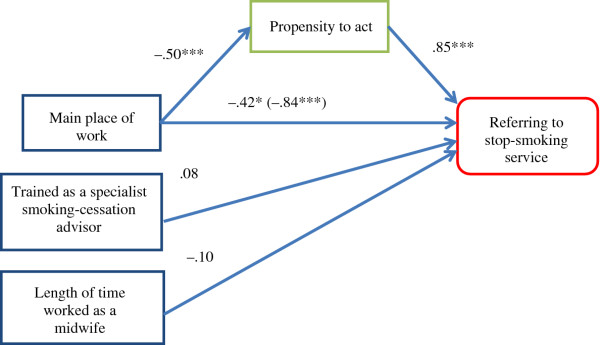
Background: Around 5,000 miscarriages and 300 perinatal deaths per year result from maternal smoking in the United Kingdom. In the northeast of England, 22% of women smoke at delivery compared to 14% nationally. Midwives have designated responsibilities to help pregnant women stop smoking. We aimed to assess perceived implementation difficulties regarding midwives’ roles in smoking cessation in pregnancy. Methods: A self-completed, anonymous survey was sent to all midwives in northeast England (n = 1,358) that explores the theoretical explanations for implementation difficulties of four behaviours recommended in the National Institute for Health and Clinical Excellence (NICE) guidance: (a) asking a pregnant woman about her smoking behaviour, (b) referring to the stop-smoking service, (c) giving advice about smoking behaviour, and (d) using a carbon monoxide monitor. Questions covering Michie et al.’s theoretical domain framework (TDF), describing 11 domains of hypothesised behavioural determinants (i.e., ‘knowledge’, ‘skills’, ‘social/professional role/identity’, ‘beliefs about capabilities’, ‘beliefs about consequences’, ‘motivation and goals’, ‘memory’, ‘attention and decision processes’, ‘environmental context and resources’, ‘social influences’, ‘emotion’, and ‘self-regulation/action planning’), were used to describe perceived implementation difficulties, predict self-reported implementation behaviours, and explore relationships with demographic and professional variables. Results: The overall response rate was 43% (n = 589). The number of questionnaires analysed was 364, following removal of the delivery-unit midwives, who are not directly involved in providing smoking-cessation services. Participants reported few implementation difficulties, high levels of motivation for all four behaviours and identified smoking-cessation work with their role. Midwives were less certain about the consequences of, and the environmental context and resources available for, engaging in this work relative to other TDF domains. All domains were highly correlated. A principal component analysis showed that a single factor (‘propensity to act’), derived from all domains, explained 66% of variance in theoretical domain measures. The ‘propensity to act’ was predictive of the self-reported behaviour ‘Refer all women who smoke……to NHS Stop Smoking Services’ and mediated the relationship between demographic variables, such as midwives’ main place of work, and behaviour. Conclusions: Our findings advance understanding of what facilitates and inhibits midwives’ guideline implementation behaviours in relation to smoking cessation and will inform the development of current practice and new interventions. Using the TDF as a self-completion questionnaire is innovative, and this study supports previous research that the TDF is an appropriate tool to understand the behaviour of healthcare professionals.
Overview
The claims and statistics of this paper haven’t been checked yet.
Run the check — free, no account needed. It reads the open-access text and checks the sources it cites.
Integrity signals
Registry
Cites
Statistics
Figures
Verification
Claims the paper makes
The claims and statistics of this paper haven’t been checked yet.
Run the check — free, no account needed. It reads the open-access text and checks the sources it cites.
Claims other papers make about this one
Each is checked against this paper’s own text: does it say what the citing paper says it does?
The cited source says what the claim attributes to it.
In the citing paper
“The framework has been used in a number of studies and was demonstrated to be useful for the development of qualitative [32,33] and quantitative [34-36] measurement tools to assess potential implementation behavior determinants.”
From Discriminant content validity of a theoretical domains framework questionnaire for use in implementation research (2014) · cites this paper as [35]
In the citing paper
“Furthermore, the questionnaires were developed to assess determinants of specific implementation behaviors in specific settings (i.e., tobacco use prevention and smoking cessation in dental healthcare [34], smoking cessation in maternal care [35], and different types of patient safety behaviors in hospitals [36])”
From Discriminant content validity of a theoretical domains framework questionnaire for use in implementation research (2014) · cites this paper as [35]
In the citing paper
“and internal consistency reliability was low [34] or could be improved [35,36].”
From Discriminant content validity of a theoretical domains framework questionnaire for use in implementation research (2014) · cites this paper as [35]
Self-check
Percentages, sums and reported differences re-computed from the paper’s own numbers.
The self-check needs the paper’s full text.
Citations
Cites
Preacher, K. J., & Hayes, A. F. (2008) · Behavior Research Methods · doi:10.3758/brm.40.3.879 · Cited by 34,117
Making psychological theory useful for implementing evidence based practice: a consensus approach
Michie, S. (2005) · Quality and Safety in Health Care · doi:10.1136/qshc.2004.011155 · Cited by 3,440
Bowling, A. (1998) · Journal of Psychophysiology · doi:10.1027//0269-8803.14.2.126 · Cited by 1,443
Godin, G., Bélanger-Gravel, A., Eccles, M., & Grimshaw, J. (2008) · Implementation Science · doi:10.1186/1748-5908-3-36 · Cited by 1,096
Hackshaw, A. K., Rodeck, C. H., & Boniface, S. (2011) · Human Reproduction Update · doi:10.1093/humupd/dmr022 · Cited by 684
Sheldon, T., Cullum, N. A., Dawson, D., Lankshear, A. J., Lowson, K., Watt, I. S., West, P. A., Wright, D., & Wright, J. (2004) · BMJ · doi:10.1136/bmj.329.7473.999 · Cited by 436
Using theories of behaviour change to inform interventions for addictive behaviours
Webb, T. L., Sniehotta, F. F., & Michie, S. (2010) · Addiction · doi:10.1111/j.1360-0443.2010.03028.x · Cited by 359
Self-citationDo self- reported intentions predict clinicians' behaviour: a systematic review
Eccles, M. P., Hrisos, S., Francis, J., Kaner, E. F., Dickinson, H. O., Beyer, F., & Johnston, M. (2006) · Implementation Science · doi:10.1186/1748-5908-1-28 · Cited by 350
Francis, J. J., Stockton, C., Eccles, M. P., Johnston, M., Cuthbertson, B. H., Grimshaw, J. M., Hyde, C., Tinmouth, A., & Stanworth, S. J. (2009) · British Journal of Health Psychology · doi:10.1348/135910708x397025 · Cited by 230
Hendry, C. (2003) · Nurse Researcher · doi:10.7748/nr.10.2.81.s11 · Cited by 211
Research works printed but not linked: 2
- National Institute for Health and Clinical Excellence: Public health guidance 26, How to stop smoking in pregnancy and following childbirth. 2010
- Baxter S, Blank L, Guillaume L, Messina J, Everson-Hock E, Burrows J: Systematic review of how to stop smoking in pregnancy and following childbirth. Review 2: Factors aiding delivery of effective interventions. 2009, The University of Sheffield School of Health and Related Research
Cited by
Sorted by citations
Items 101–138 of 138
Khong, L. A. M., Buckley, A., Johnson, W., & Cavalheri, V. (2019) · PLoS ONE · doi:10.1371/journal.pone.0219875 · Cited by 2
Responding to Illegal Drug Use in Acute Care: Patient Needs and Perspectives
Kosteniuk, B. (2020) · ERA: Education and Research Archive (University of Alberta) · doi:10.7939/r3-tne7-1j27 · Cited by 2
Shrubsole, K., Levine, R., Lynch, E. A., Briffa, C., Pierce, J. E., Trebilcock, M., Do, C.-A., Wallace, S. J., & Power, E. (2025) · International Journal of Speech-Language Pathology · doi:10.1080/17549507.2025.2573342 · Cited by 1
Surgeon behaviors related to engaging patients in smoking cessation at the time of elective surgery
Lussiez, A. D., Zondlak, A. N., Hsu, P. J., Delaney, L. D., Vitous, C. A., Telem, D. A., & Rubyan, M. A. (2023) · The American Journal of Surgery · doi:10.1016/j.amjsurg.2023.04.008 · Cited by 1
Delakovia, T., Katsaounou, P. A., Sarantaki, A., Bakou, A., Lykeridou, A., & Diamanti, A. (2025) · Tobacco Prevention & Cessation · doi:10.18332/tpc/205916 · Cited by 1
Wittek, M., Manke-Reimers, F., & Schmitt, E. (2022) · International Journal of Environmental Research and Public Health · doi:10.3390/ijerph192316198 · Cited by 1
Akiba, C. F., Powell, B. J., Pence, B. W., Muessig, K. E., Golin, C. E., & Go, V. F.-L. (2022) · Research Square · doi:10.21203/rs.3.rs-1626073/v1 · Cited by 1
Blackburn, M. (2015) · The University of Bath Online Publications Store (The University of Bath)
Kolodko, J. (2026) · Warwick Research Archive Portal (University of Warwick) · doi:10.82444/warw.33795745
Exploring vaccine decision-making to identify and address barriers to vaccine uptake in Ireland
Marshall, S. M. (2020) · Cork Open Research Archive (University College Cork, Ireland)
Sexton, D. W. (2015) · Deep Blue (University of Michigan)
Implementation behavior of communities regarding relatives caring for people with dementia
Wittek, M., Manke-Reimers, F., & Schmitt, E. (2023) · Zeitschrift für Gerontologie und Geriatrie · doi:10.1007/s00391-023-02232-w
Kwok, G., Senger, A., Sharma, A., Mandato, I., & Devine, K. A. (2023) · Research Square · doi:10.21203/rs.3.rs-3571508/v1
Daly, J., Doherty, E. L., Tully, B., Wiggers, J. H., Hollis, J., Licata, M., Foster, M., Tzelepis, F., Lecathelinais, C., & Kingsland, M. (2024) · BMJ Open · doi:10.1136/bmjopen-2023-076725
Israeli dentists’ knowledge, attitudes, and practices regarding smoking cessation care
Vishnevsky, T., Aperman-Itzhak, T., Tayeb, I., & Bar‐Zeev, Y. (2024) · Israel Journal of Health Policy Research · doi:10.1186/s13584-024-00653-5
Marsden, D. L., Boyle, K., Birnie, J., Buzio, A., Dunne, J., Hill, K. M., Lambkin, D., Lever, S., Minett, F., Ormond, S., et al. (2025) · BMC Health Services Research · doi:10.1186/s12913-025-13309-0
Passey, M. E., Longman, J. M., Adams, C., Johnston, J. J., Simms, J., & Rolfe, M. (2020) · Figshare · doi:10.6084/m9.figshare.12134190
Wearn, A., Haste, A., Haighton, C., Mallion, V., & Rodrigues, A. M. (2021) · Figshare · doi:10.6084/m9.figshare.14634194
Smith, L. A., Dyson, J., Watson, J., & Schölin, L. (2021) · Figshare · doi:10.6084/m9.figshare.14037634
Wong, E., Mavondo, F., Horvat, L., McKinlay, L., & Fisher, J. (2022) · Figshare · doi:10.6084/m9.figshare.19289920
Middleton, N., Hadjigeorgiou, E., Kolokotroni, O., Christodoulides, V., Koliandri, I., Nicolaou, C., Papadopoulou, M., Kouta, C., Karanikola, M., & Baum, A. (2022) · Figshare · doi:10.6084/m9.figshare.21285566
Wearn, A., Haste, A., Haighton, C., Mallion, V., & Rodrigues, A. M. (2021) · Figshare · doi:10.6084/m9.figshare.14634197
Middleton, N., Hadjigeorgiou, E., Kolokotroni, O., Christodoulides, V., Koliandri, I., Nicolaou, C., Papadopoulou, M., Kouta, C., Karanikola, M., & Baum, A. (2022) · Figshare · doi:10.6084/m9.figshare.21285560
Middleton, N., Hadjigeorgiou, E., Kolokotroni, O., Christodoulides, V., Koliandri, I., Nicolaou, C., Papadopoulou, M., Kouta, C., Karanikola, M., & Baum, A. (2022) · Figshare · doi:10.6084/m9.figshare.21285554
Middleton, N., Hadjigeorgiou, E., Kolokotroni, O., Christodoulides, V., Koliandri, I., Nicolaou, C., Papadopoulou, M., Kouta, C., Karanikola, M., & Baum, A. (2022) · Figshare · doi:10.6084/m9.figshare.21285557
Romanowski, K., Cook, V. J., Gilbert, M., & Johnston, J. C. (2023) · Figshare · doi:10.6084/m9.figshare.23797364
Kwok, G., Senger, A., Sharma, A., Mandato, I., & Devine, K. A. (2024) · Figshare · doi:10.6084/m9.figshare.26322642
Smith, L. A., Dyson, J., Watson, J., & Schölin, L. (2021) · Figshare · doi:10.6084/m9.figshare.14037637
Romanowski, K., Cook, V. J., Gilbert, M., & Johnston, J. C. (2023) · Figshare · doi:10.6084/m9.figshare.23797367
Middleton, N., Hadjigeorgiou, E., Kolokotroni, O., Christodoulides, V., Koliandri, I., Nicolaou, C., Papadopoulou, M., Kouta, C., Karanikola, M., & Baum, A. (2022) · Figshare · doi:10.6084/m9.figshare.21285569
Smith, L. A., Dyson, J., Watson, J., & Schölin, L. (2021) · Figshare · doi:10.6084/m9.figshare.14037631
Kwok, G., Senger, A., Sharma, A., Mandato, I., & Devine, K. A. (2024) · Figshare · doi:10.6084/m9.figshare.26322759
Jones, S. E., Hamilton, S., Bell, R., Araújo-Soares, V., & White, M. (2020) · Figshare · doi:10.6084/m9.figshare.13059406
Self-citationMiddleton, N., Hadjigeorgiou, E., Kolokotroni, O., Christodoulides, V., Koliandri, I., Nicolaou, C., Papadopoulou, M., Kouta, C., Karanikola, M., & Baum, A. (2022) · Figshare · doi:10.6084/m9.figshare.21285563
Passey, M. E., Longman, J. M., Adams, C., Johnston, J. J., Simms, J., & Rolfe, M. I. (2020) · Figshare · doi:10.6084/m9.figshare.12134196
Process evaluation of a national initiative to detect cancer early in Scotland
Calanzani, N., Weller, D., & Campbell, C. (2026) · Journal of Cancer Policy · doi:10.1016/j.jcpo.2026.100801
Metadata
- Authors
- Beenstock, J., Sniehotta, F. F., White, M., Bell, R., Milne, E. M., & Araujo-Soares, V.
- Affiliations
- Newcastle University (GB)
- Durham University (GB)
- Corresponding author
- Sniehotta, Falko F
- Venue
- Implementation Science
- Published
- 2012-04-24
- Volume
- 7
- Issue
- 1
- Pages
- 36-36
- ISSN
- 1748-5908 (ISSN-L)
- PMC
- PMC3465235
- OpenAlex
- W2062076253
- Cited by
- 138
- References
- 19
- Citations by year
- 2026: 3 · 2025: 7 · 2024: 9 · 2023: 11 · 2022: 17 · 2021: 13 · 2020: 16 · 2019: 9 · 2018: 12 · 2017: 9 · 2016: 6 · 2015: 14 · 2014: 6 · 2013: 4 · 2012: 2
- FWCI
- 5.57
- Type
- journal article
- Language
- en
- Open access
- gold
- doi.org
- Licence
- Locations
- Implementation Science (publishedVersion, cc-by)
- Europe PMC (PubMed Central) (publishedVersion, cc-by)
- PubMed Central (publishedVersion, cc-by)
- PubMed (publishedVersion)
- DOAJ (DOAJ: Directory of Open Access Journals) (submittedVersion)
- Newcastle University ePrints (Newcastle Univesity) (cc-by)
- Funders
- United Kingdom Clinical Research Collaboration
- Cancer Research UK
- National Institute for Health and Care Research
- British Heart Foundation
- Medical Research Council
- Economic and Social Research Council (ES/G007470/1)
- Topics
- Health Sciences › Medicine › Public Health, Environmental and Occupational Health › Smoking Behavior and Cessation
- Health Sciences › Health Professions › General Health Professions › Health Policy Implementation Science
- Social Sciences › Psychology › Applied Psychology › Behavioral Health and Interventions
- Keywords
- midwives, smoking cessation during pregnancy, implementation barriers, NICE guidelines, smoking cessation referral, carbon monoxide monitoring, guideline implementation, maternal smoking, perinatal outcomes, North East England, NHS Stop Smoking Services, social influence, emotions, self-regulation
- MeSH terms
- Cross-Sectional Studies, England, Female, Humans, Health Knowledge, Attitudes, Practice, Midwifery, Pregnancy, Prenatal Care, Referral and Consultation, Smoking Cessation, Health Care Surveys, Guideline Adherence, Principal Component Analysis
About these checks
Registry, retraction, Cites and statistics results are computed, not judged, with one exception: a printed reference that no index lists is read once by a model before it counts as a citation error. Claims are extracted by a model and kept only when their quote appears verbatim in the text; each cited source is then checked, with a model’s help, for whether it says what the claim relies on. Those verdicts can be wrong — read the claim’s quote and the cited source before relying on one.
Statistics and arithmetic are recomputed, not judged.
Confidence bands are shown only for fields calibrated on our annotated test set. None is calibrated yet, so no band is shown.
What counts as a claim ›How we measure confidence ›How we check this ›
Are you an author, or do you see a problem with this page? Request a review
