

The DOI matches its Crossref record; 19 of the 19 references it cites were found in a registry or an index.
What helps and hinders midwives in engaging with pregnant women about stopping smoking? A cross-sectional survey of perceived implementation difficulties among midwives in the North East of England
Open accessAbstract
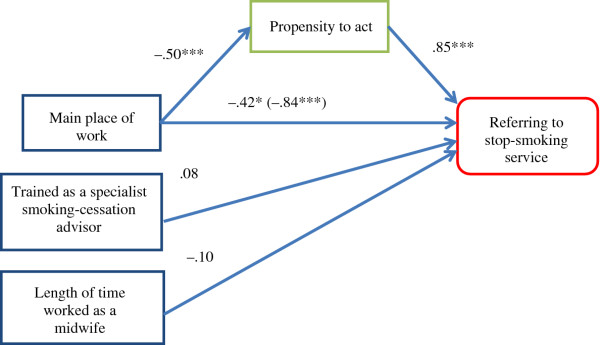
Background: Around 5,000 miscarriages and 300 perinatal deaths per year result from maternal smoking in the United Kingdom. In the northeast of England, 22% of women smoke at delivery compared to 14% nationally. Midwives have designated responsibilities to help pregnant women stop smoking. We aimed to assess perceived implementation difficulties regarding midwives’ roles in smoking cessation in pregnancy. Methods: A self-completed, anonymous survey was sent to all midwives in northeast England (n = 1,358) that explores the theoretical explanations for implementation difficulties of four behaviours recommended in the National Institute for Health and Clinical Excellence (NICE) guidance: (a) asking a pregnant woman about her smoking behaviour, (b) referring to the stop-smoking service, (c) giving advice about smoking behaviour, and (d) using a carbon monoxide monitor. Questions covering Michie et al.’s theoretical domain framework (TDF), describing 11 domains of hypothesised behavioural determinants (i.e., ‘knowledge’, ‘skills’, ‘social/professional role/identity’, ‘beliefs about capabilities’, ‘beliefs about consequences’, ‘motivation and goals’, ‘memory’, ‘attention and decision processes’, ‘environmental context and resources’, ‘social influences’, ‘emotion’, and ‘self-regulation/action planning’), were used to describe perceived implementation difficulties, predict self-reported implementation behaviours, and explore relationships with demographic and professional variables. Results: The overall response rate was 43% (n = 589). The number of questionnaires analysed was 364, following removal of the delivery-unit midwives, who are not directly involved in providing smoking-cessation services. Participants reported few implementation difficulties, high levels of motivation for all four behaviours and identified smoking-cessation work with their role. Midwives were less certain about the consequences of, and the environmental context and resources available for, engaging in this work relative to other TDF domains. All domains were highly correlated. A principal component analysis showed that a single factor (‘propensity to act’), derived from all domains, explained 66% of variance in theoretical domain measures. The ‘propensity to act’ was predictive of the self-reported behaviour ‘Refer all women who smoke……to NHS Stop Smoking Services’ and mediated the relationship between demographic variables, such as midwives’ main place of work, and behaviour. Conclusions: Our findings advance understanding of what facilitates and inhibits midwives’ guideline implementation behaviours in relation to smoking cessation and will inform the development of current practice and new interventions. Using the TDF as a self-completion questionnaire is innovative, and this study supports previous research that the TDF is an appropriate tool to understand the behaviour of healthcare professionals.
Overview
The claims and statistics of this paper haven’t been checked yet.
Run the check — free, no account needed. It reads the open-access text and checks the sources it cites.
Integrity signals
Registry
Cites
Statistics
Figures
Verification
Claims the paper makes
The claims and statistics of this paper haven’t been checked yet.
Run the check — free, no account needed. It reads the open-access text and checks the sources it cites.
Claims other papers make about this one
Each is checked against this paper’s own text: does it say what the citing paper says it does?
The cited source says what the claim attributes to it.
In the citing paper
“The framework has been used in a number of studies and was demonstrated to be useful for the development of qualitative [32,33] and quantitative [34-36] measurement tools to assess potential implementation behavior determinants.”
From Discriminant content validity of a theoretical domains framework questionnaire for use in implementation research (2014) · cites this paper as [35]
In the citing paper
“Furthermore, the questionnaires were developed to assess determinants of specific implementation behaviors in specific settings (i.e., tobacco use prevention and smoking cessation in dental healthcare [34], smoking cessation in maternal care [35], and different types of patient safety behaviors in hospitals [36])”
From Discriminant content validity of a theoretical domains framework questionnaire for use in implementation research (2014) · cites this paper as [35]
In the citing paper
“and internal consistency reliability was low [34] or could be improved [35,36].”
From Discriminant content validity of a theoretical domains framework questionnaire for use in implementation research (2014) · cites this paper as [35]
Self-check
Percentages, sums and reported differences re-computed from the paper’s own numbers.
The self-check needs the paper’s full text.
Citations
Cites
Preacher, K. J., & Hayes, A. F. (2008) · Behavior Research Methods · doi:10.3758/brm.40.3.879 · Cited by 34,117
Making psychological theory useful for implementing evidence based practice: a consensus approach
Michie, S. (2005) · Quality and Safety in Health Care · doi:10.1136/qshc.2004.011155 · Cited by 3,440
Bowling, A. (1998) · Journal of Psychophysiology · doi:10.1027//0269-8803.14.2.126 · Cited by 1,443
Godin, G., Bélanger-Gravel, A., Eccles, M., & Grimshaw, J. (2008) · Implementation Science · doi:10.1186/1748-5908-3-36 · Cited by 1,096
Hackshaw, A. K., Rodeck, C. H., & Boniface, S. (2011) · Human Reproduction Update · doi:10.1093/humupd/dmr022 · Cited by 684
Sheldon, T., Cullum, N. A., Dawson, D., Lankshear, A. J., Lowson, K., Watt, I. S., West, P. A., Wright, D., & Wright, J. (2004) · BMJ · doi:10.1136/bmj.329.7473.999 · Cited by 436
Using theories of behaviour change to inform interventions for addictive behaviours
Webb, T. L., Sniehotta, F. F., & Michie, S. (2010) · Addiction · doi:10.1111/j.1360-0443.2010.03028.x · Cited by 359
Self-citationDo self- reported intentions predict clinicians' behaviour: a systematic review
Eccles, M. P., Hrisos, S., Francis, J., Kaner, E. F., Dickinson, H. O., Beyer, F., & Johnston, M. (2006) · Implementation Science · doi:10.1186/1748-5908-1-28 · Cited by 350
Francis, J. J., Stockton, C., Eccles, M. P., Johnston, M., Cuthbertson, B. H., Grimshaw, J. M., Hyde, C., Tinmouth, A., & Stanworth, S. J. (2009) · British Journal of Health Psychology · doi:10.1348/135910708x397025 · Cited by 230
Hendry, C. (2003) · Nurse Researcher · doi:10.7748/nr.10.2.81.s11 · Cited by 211
Research works printed but not linked: 2
- National Institute for Health and Clinical Excellence: Public health guidance 26, How to stop smoking in pregnancy and following childbirth. 2010
- Baxter S, Blank L, Guillaume L, Messina J, Everson-Hock E, Burrows J: Systematic review of how to stop smoking in pregnancy and following childbirth. Review 2: Factors aiding delivery of effective interventions. 2009, The University of Sheffield School of Health and Related Research
Cited by
Sorted by citations
Atkins, L., Francis, J., Islam, R., O’Connor, D., Patey, A., Ivers, N., Foy, R., Duncan, E. M., Colquhoun, H., Grimshaw, J. M., et al. (2017) · Implementation Science · doi:10.1186/s13012-017-0605-9 · Cited by 3,819
“Examples of questionnaire studies include investigating facilitators and barriers to hand hygiene [33], providing tobacco use prevention and cessation counselling among dental providers [34] and midwives engaging with pregnant women to stop smoking [35].”
BackgroundMichie, S., Wood, C. E., Johnston, M., Abraham, C., Francis, J. J., & Hardeman, W. (2015) · Health Technology Assessment · doi:10.3310/hta19990 · Cited by 680
Psychosocial interventions for supporting women to stop smoking in pregnancy
Chamberlain, C., O'Mara-Eves, A., Porter, J., Coleman, T., Perlen, S. M., Thomas, J., & McKenzie, J. E. (2017) · Cochrane Database of Systematic Reviews · doi:10.1002/14651858.cd001055.pub5 · Cited by 650
Birken, S. A., Powell, B. J., Presseau, J., Kirk, M. A., Lorencatto, F., Gould, N. J., Shea, C. M., Weiner, B. J., Francis, J., Yu, Y., et al. (2017) · Implementation Science · doi:10.1186/s13012-016-0534-z · Cited by 387
Huijg, J. M., Gebhardt, W. A., Crone, M. R., Dusseldorp, E., & Presseau, J. (2014) · Implementation Science · doi:10.1186/1748-5908-9-11 · Cited by 385
Cane, J., Richardson, M., Johnston, M., Ladha, R., & Michie, S. (2015) · British Journal of Health Psychology · doi:10.1111/bjhp.12102 · Cited by 376
Craig, P., Di Ruggiero, E., Frohlich, K. L., Mykhalovskiy, E., White, M., on behalf of the Canadian Institutes of Health Research (CIHR)–National Institute for Health Research (NIHR) Context Guidance Authors Group (listed alphabetically), Campbell, R., Cummins, S., Edwards, N., Hunt, K., et al. (2018) · doi:10.3310/cihr-nihr-01 · Cited by 370
Self-citationA systematic review of empirical studies examining mechanisms of implementation in health
Lewis, C. C., Boyd, M. R., Walsh-Bailey, C., Lyon, A. R., Beidas, R., Mittman, B., Aarons, G. A., Weiner, B. J., & Chambers, D. A. (2020) · Implementation Science · doi:10.1186/s13012-020-00983-3 · Cited by 363
Huijg, J. M., Gebhardt, W. A., Dusseldorp, E., Verheijden, M. W., van der Zouwe, N., Middelkoop, B. J., & Crone, M. R. (2014) · Implementation Science · doi:10.1186/1748-5908-9-33 · Cited by 378
Psychosocial interventions for supporting women to stop smoking in pregnancy
Chamberlain, C., O'Mara-Eves, A., Oliver, S., Caird, J. R., Perlen, S. M., Eades, S. J., & Thomas, J. (2013) · Cochrane Database of Systematic Reviews · doi:10.1002/14651858.cd001055.pub4 · Cited by 251
the Canada PRIME Plus Team, Patey, A. M., Islam, R., Francis, J. J., Bryson, G. L., & Grimshaw, J. M. (2012) · Implementation Science · doi:10.1186/1748-5908-7-52 · Cited by 237
Developing Behavior Change Interventions for Self-Management in Chronic Illness
Araújo‐Soares, V., Hankonen, N. E., Presseau, J., Rodrigues, A., & Sniehotta, F. F. (2018) · European Psychologist · doi:10.1027/1016-9040/a000330 · Cited by 259
Self-citationWilkinson, S. A., Thomas, S., Phillips, C. J., Marshall, A. P., Chaves, N. J., Jankelowitz, S. K., Lin, I. B., Loy, C. T., Rees, G., Sakzewski, L., et al. (2015) · Journal of Multidisciplinary Healthcare · doi:10.2147/jmdh.s78458 · Cited by 247
Mazza, D., Chapman, A., & Michie, S. (2013) · BMC Health Services Research · doi:10.1186/1472-6963-13-36 · Cited by 207
Defining and assessing context in healthcare implementation studies: a systematic review
Rogers, L., Brún, A. D., & McAuliffe, É. (2020) · BMC Health Services Research · doi:10.1186/s12913-020-05212-7 · Cited by 167
Raising the topic of weight in general practice: perspectives of GPs and primary care nurses
Blackburn, M., Stathi, A., Keogh, E., & Eccleston, C. (2015) · BMJ Open · doi:10.1136/bmjopen-2015-008546 · Cited by 143
Richardson, M. A., Khouja, C., Sutcliffe, K., & Thomas, J. (2019) · BMJ Open · doi:10.1136/bmjopen-2018-024950 · Cited by 135
Explaining clinical behaviors using multiple theoretical models
Eccles, M., Grimshaw, J., MacLennan, G., Bonetti, D. L., Glidewell, L., Pitts, N. B., Steen, N., Thomas, R. E., Walker, A. E., & Johnston, M. (2012) · Implementation Science · doi:10.1186/1748-5908-7-99 · Cited by 108
Ogeil, R. P., Chakraborty, S. P., Young, A. C., & Lubman, D. I. (2020) · BMC Family Practice · doi:10.1186/s12875-019-1070-0 · Cited by 94
Sharpe, T., Alsahlanee, A., Ward, K. D., & Doyle, F. (2018) · The Journal of Smoking Cessation · doi:10.1017/jsc.2017.25 · Cited by 83
McDonald, S., O’Brien, N., White, M. J., & Sniehotta, F. F. (2015) · International Journal of Behavioral Nutrition and Physical Activity · doi:10.1186/s12966-015-0186-4 · Cited by 82
Self-citationGrady, A., Seward, K., Finch, M., Fielding, A., Stacey, F. G., Jones, J. Z., Wolfenden, L., & Yoong, S. L. (2017) · Journal of Nutrition Education and Behavior · doi:10.1016/j.jneb.2017.09.023 · Cited by 65
McParlin, C., Bell, R., Robson, S. C., Muirhead, C. R., & Araújo‐Soares, V. (2016) · Midwifery · doi:10.1016/j.midw.2016.09.015 · Cited by 59
Self-citationDevelopment and initial validation of the Influences on Patient Safety Behaviours Questionnaire
Taylor, N., Parveen, S., Robins, V., Slater, B., & Lawton, R. (2013) · Implementation Science · doi:10.1186/1748-5908-8-81 · Cited by 58
Patey, A. M., Fontaine, G., Francis, J., McCleary, N., Presseau, J., & Grimshaw, J. (2022) · Psychology and Health · doi:10.1080/08870446.2022.2100887 · Cited by 70
Bell, R., Glinianaia, S. V., van der Waal, Z., Close, A. J., Moloney, E., Jones, S. E., Araújo‐Soares, V., Hamilton, S., Milne, E. M. G., Shucksmith, J., et al. (2017) · Tobacco Control · doi:10.1136/tobaccocontrol-2016-053476 · Cited by 61
Self-citationLongman, J. M., Adams, C., Johnston, J. J., & Passey, M. E. (2017) · Midwifery · doi:10.1016/j.midw.2017.12.016 · Cited by 55
McLellan, J., O’Carroll, R. E., Cheyne, H., & Dombrowski, S. U. (2019) · Implementation Science · doi:10.1186/s13012-019-0913-3 · Cited by 58
Atkins, L., Hunkeler, E. M., Jensen, C. D., Michie, S., Lee, J. K., Doubeni, C. A., Zauber, A. G., Levin, T. R., Quinn, V. P., & Corley, D. A. (2016) · Gastrointestinal Endoscopy · doi:10.1016/j.gie.2015.08.075 · Cited by 54
Roberts, N., Hooper, G., Lorencatto, F., Storr, W., & Spivey, M. (2017) · Scandinavian Journal of Trauma Resuscitation and Emergency Medicine · doi:10.1186/s13049-017-0437-2 · Cited by 61
Presseau, J., Byrne-Davis, L. M. T., Hotham, S., Lorencatto, F., Potthoff, S., Atkinson, L., Bull, E. R., Dima, A. L., van Dongen, A., French, D., et al. (2021) · Health Psychology Review · doi:10.1080/17437199.2020.1866638 · Cited by 60
With the PMC study team, Templeton, A. R., Young, L. C., Bish, A., Gnich, W., Cassie, H., Treweek, S. P., Bonetti, D. L., Stirling, D., MacPherson, L. M. D., et al. (2015) · Implementation Science · doi:10.1186/s13012-015-0366-2 · Cited by 45
Zhang, L. M., & Hale, J. (2022) · Sustainability · doi:10.3390/su141710821 · Cited by 40
The Acute Aphasia IMplementation Study (AAIMS): a pilot cluster randomized controlled trial
Shrubsole, K., Worrall, L. E., Power, E., & O’Connor, D. A. (2018) · International Journal of Language & Communication Disorders · doi:10.1111/1460-6984.12419 · Cited by 39
Gnich, W., Bonetti, D. L., Sherriff, A., Sharma, S., Conway, D. I., & Macpherson, L. M. D. (2015) · Community Dentistry And Oral Epidemiology · doi:10.1111/cdoe.12151 · Cited by 38
Alageel, S., Gulliford, M. C., McDermott, L., & Wright, A. J. (2018) · BMC Family Practice · doi:10.1186/s12875-018-0860-0 · Cited by 38
Naughton, F., Hopewell, S., Sinclair, L., McCaughan, D., McKell, J., & Bauld, L. (2018) · British Journal of Health Psychology · doi:10.1111/bjhp.12314 · Cited by 36
Bain, E., Bubner, T., Ashwood, P., Ryswyk, E. V., Simmonds, L., Reid, S. M., Middleton, P., & Crowther, C. A. (2015) · BMC Pregnancy and Childbirth · doi:10.1186/s12884-015-0618-9 · Cited by 34
Kosteniuk, B., Salvalaggio, G., McNeil, R., Brooks, H. L., Dong, K. A., Twan, S., Brouwer, J., & Hyshka, E. (2021) · International Journal of Drug Policy · doi:10.1016/j.drugpo.2021.103275 · Cited by 34
Sohanpal, R., Rivas, C. A., Steed, L., MacNeill, V., Kuan, V., Edwards, E. A., Griffiths, C., Eldridge, S. M., Taylor, S. J., & Walton, R. T. (2016) · BMJ Open · doi:10.1136/bmjopen-2015-010921 · Cited by 32
Smoking in pregnancy: pathophysiology of harm and current evidence for monitoring and cessation
McDonnell, B. P., & Regan, C. (2019) · The Obstetrician & Gynaecologist · doi:10.1111/tog.12585 · Cited by 34
Young, L. J., Shrubsole, K., Worrall, L. E., & Power, E. (2018) · Aphasiology · doi:10.1080/02687038.2018.1443201 · Cited by 29
Huijg, J. M., Dusseldorp, E., Gebhardt, W. A., Verheijden, M. W., van der Zouwe, N., Middelkoop, B. J., Duijzer, G., & Crone, M. R. (2014) · Physical Therapy · doi:10.2522/ptj.20130457 · Cited by 29
A scoping review of implementation of health-focused interventions in vulnerable populations
Daniels, S. I., Cheng, H. L., Gray, C. P., Kim, B., Stave, C. D., & Midboe, A. M. (2022) · Translational Behavioral Medicine · doi:10.1093/tbm/ibac025 · Cited by 31
Jones, S. E., Hamilton, S., Bell, R., Araújo‐Soares, V., Glinianaia, S. V., Milne, E. M. G., White, M. J., Willmore, M., & Shucksmith, J. S. (2019) · BMC Health Services Research · doi:10.1186/s12913-019-4122-1 · Cited by 27
Self-citationShrubsole, K., Worrall, L. E., & Power, E. (2018) · Aphasiology · doi:10.1080/02687038.2018.1510112 · Cited by 26
Gould, G. S., Twyman, L., Stevenson, L., Gribbin, G. R., Bonevski, B., Palazzi, K. L., & Bar‐Zeev, Y. (2019) · BMJ Open · doi:10.1136/bmjopen-2018-026037 · Cited by 26
Akiba, C. F., Powell, B. J., Pence, B. W., Muessig, K. E., Golin, C. E., & Go, V. F.-L. (2022) · Implementation Science Communications · doi:10.1186/s43058-022-00365-4 · Cited by 27
Passey, M. E., Longman, J. M., Adams, C., Johnston, J. J., Simms, J., & Rolfe, M. I. (2020) · BMC Pregnancy and Childbirth · doi:10.1186/s12884-020-02912-0 · Cited by 25
Wong, E., Mavondo, F., Horvat, L., McKinlay, L., & Fisher, J. (2022) · BMC Health Services Research · doi:10.1186/s12913-022-07630-1 · Cited by 24
Tzelepis, F., Daly, J., Dowe, S., Bourke, A., Gillham, K. E., & Freund, M. (2016) · Nicotine & Tobacco Research · doi:10.1093/ntr/ntw286 · Cited by 23
Patton, D., Ryan, C. A., & Hughes, C. M. (2020) · Research in Social and Administrative Pharmacy · doi:10.1016/j.sapharm.2020.03.004 · Cited by 23
What are we measuring and why? Using theory to guide perinatal research and measurement
Ayers, S., & Olander, E. K. (2013) · Journal of Reproductive and Infant Psychology · doi:10.1080/02646838.2013.834041 · Cited by 27
Gnich, W., Sherriff, A., Bonetti, D. L., Conway, D. I., & MacPherson, L. M. D. (2018) · Implementation Science · doi:10.1186/s13012-018-0775-0 · Cited by 22
Passey, M. E., Adams, C., Paul, C. L., Atkins, L., & Longman, J. M. (2021) · Implementation Science Communications · doi:10.1186/s43058-021-00235-5 · Cited by 21
Smith, L. A., Dyson, J., Watson, J., & Schölin, L. (2021) · BMC Pregnancy and Childbirth · doi:10.1186/s12884-021-03583-1 · Cited by 21
Kenny, E., McNamara, Á., Noone, C., & Byrne, M. (2020) · British Journal of Health Psychology · doi:10.1111/bjhp.12419 · Cited by 19
Lépine, J., Portocarrero, M. E. L., Delanoë, A., Robitaille, H., Lévesque, I., Rousseau, F., Wilson, B. J., Giguere, A. M. C., & Légaré, F. (2016) · BMC Pregnancy and Childbirth · doi:10.1186/s12884-016-1053-2 · Cited by 17
Jones, S. E., Hamilton, S., Bell, R., Araújo‐Soares, V., & White, M. J. (2020) · BMC Public Health · doi:10.1186/s12889-020-09608-2 · Cited by 17
Self-citationGriffiths, S. E., Naughton, F., & Brown, K. (2021) · British Journal of Health Psychology · doi:10.1111/bjhp.12574 · Cited by 17
Hopman, P., Springvloet, L., de Jong, S. D. J., & van Laar, M. (2018) · Midwifery · doi:10.1016/j.midw.2018.12.015 · Cited by 16
Alcohol guidelines for pregnant women: barriers and enablers for midwives to deliver advice.
Schölin, L., Watson, J., Dyson, J., & Smith, L. A. (2019) · Cited by 16
Manikam, L., Hoy, A. R., Fosker, H., Wong, M. H. Y., Banerjee, J., Lakhanpaul, M., Knight, A., & Littlejohns, P. (2015) · BMC Medical Education · doi:10.1186/s12909-015-0510-3 · Cited by 16
Healthcare Providers’ Views on Digital Smoking Cessation Interventions for Pregnant Women
Tombor, I., Neale, J., Shahab, L., Ruiz, M. A., & West, R. (2014) · The Journal of Smoking Cessation · doi:10.1017/jsc.2014.6 · Cited by 15
Barriers and facilitators to implementing the CURE stop smoking project: a qualitative study
Wearn, A., Haste, A., Haighton, C., Mallion, V., & Rodrigues, A. (2021) · BMC Health Services Research · doi:10.1186/s12913-021-06504-2 · Cited by 14
Communicating Risks of Adjuvant Chemotherapy for Breast Cancer: Getting Beyond the Laundry List
Brauer, E. R., Long, E. F., Melnikow, J. A., Ravdin, P. M., & Ganz, P. A. (2018) · Journal of Oncology Practice · doi:10.1200/jop.18.00162 · Cited by 13
Murphy, K., Steyn, K., & Mathews, C. (2015) · International Journal of Nursing Studies · doi:10.1016/j.ijnurstu.2015.08.004 · Cited by 13
Manikam, L., Hoy, A. R., Fosker, H., Wong, M. H. Y., Banerjee, J., Lakhanpaul, M., Knight, A., & Littlejohns, P. (2016) · BMC Medical Education · doi:10.1186/s12909-016-0557-9 · Cited by 13
Grady, A., Barnes, C., Wolfenden, L., Lecathelinais, C., & Yoong, S. L. (2020) · Journal of Medical Internet Research · doi:10.2196/22036 · Cited by 12
Clinton‐McHarg, T., Gibson, L., Bartlem, K. M., Murray, S. R., Ryall, J., Orr, M., Ford, J., & Bowman, J. (2022) · International Journal of Environmental Research and Public Health · doi:10.3390/ijerph19084458 · Cited by 15
Smoking Patterns and Receipt of Cessation Services Among Pregnant Women in Argentina and Uruguay
Berrueta, M. B., Morello, P., Alemán, A., Tong, V. T., Johnson, C., Dietz, P. M., Farr, S. L., Mazzoni, A., Colomar, M., Ciganda, A., et al. (2015) · Nicotine & Tobacco Research · doi:10.1093/ntr/ntv145 · Cited by 12
A Bibliometric Analysis of Research Articles on Midwifery Based on the Web of Science
Li, T., Zeng, Y., Fan, X., Yang, J., Yang, C., Xiong, Q., & Liu, P. (2023) · Journal of Multidisciplinary Healthcare · doi:10.2147/jmdh.s398218 · Cited by 13
Talking about smoking cessation with pregnant women: Exploring midwives' accounts
Reardon, R., & Grogan, S. (2016) · British Journal of Midwifery · doi:10.12968/bjom.2016.24.1.38 · Cited by 9
Dilworth, S., Doherty, E., Mallise, C., Licata, M., Hollis, J. L., Wynne, O., Lane, C., Wolfenden, L., Wiggers, J., & Kingsland, M. (2024) · Implementation Science Communications · doi:10.1186/s43058-024-00655-z · Cited by 9
Healthcare provider interventions to support medication adherence: state-of-the-science overview
Crawshaw, J., & McCleary, N. (2025) · Frontiers in Pharmacology · doi:10.3389/fphar.2025.1567967 · Cited by 16
Hwang, J. H. A., Downing, M. G., Specht, R. A. G., & Ponsford, J. L. (2024) · Brain Impairment · doi:10.1071/ib23068 · Cited by 8
Shrubsole, K. (2019) · Disability and Rehabilitation · doi:10.1080/09638288.2019.1691666 · Cited by 8
Vinogradov, R., Smith, V., Hiu, S. K. W., McParlin, C., Farnworth, A., & Araújo‐Soares, V. (2023) · Midwifery · doi:10.1016/j.midw.2023.103860 · Cited by 10
Middleton, N., Hadjigeorgiou, E., Kolokotroni, O., Christodoulides, V., Koliandri, I., Nicolaou, C., Papadopoulou, M., Kouta, C., Karanikola, M. N. K., Baum, A., et al. (2022) · BMC Health Services Research · doi:10.1186/s12913-022-08599-7 · Cited by 8
Fullerton, J. T., Butler, M., Aman, C., & Reid, T. (2018) · Women and Birth · doi:10.1016/j.wombi.2018.08.166 · Cited by 7
Cahir, C., Dombrowski, S. U., Kennedy, M. J., Sharp, L., & Bennett, K. (2017) · Psychology and Health · doi:10.1080/08870446.2017.1296151 · Cited by 8
Tatton, C., & Lloyd, J. (2023) · BMC Public Health · doi:10.1186/s12889-023-17378-w · Cited by 7
Lantta, T., Anttila, M., Varpula, J., & Valimaki, M. A. (2020) · International Journal of Mental Health Nursing · doi:10.1111/inm.12815 · Cited by 6
Kwok, G., Senger, A., Sharma, A., Mandato, I., & Devine, K. A. (2024) · Implementation Science Communications · doi:10.1186/s43058-024-00612-w · Cited by 5
Imad, N., Hall, A. E., Nathan, N., Shoesmith, A., Pearson, N., Lum, M., Grady, A., Nolan, E., & Yoong, S. (2025) · International Journal of Behavioral Nutrition and Physical Activity · doi:10.1186/s12966-024-01699-z · Cited by 7
Shrubsole, K., Wallace, S. J., Isaksen, J., Copland, D. A., & Power, E. (2025) · Topics in Stroke Rehabilitation · doi:10.1080/10749357.2025.2532412 · Cited by 5
Small, S. P., Maddigan, J., Swab, M., & Jarvis, K. (2022) · JBI Evidence Synthesis · doi:10.11124/jbies-22-00052 · Cited by 5
Basterfield, L., Machaira, T., Jones, D., Rapley, T., Araújo‐Soares, V., Cameron, N., & Azevedo, L. B. (2023) · Children · doi:10.3390/children10010145 · Cited by 9
Willingness to Oppose Smoking among Pregnant Women
Olejniczak, D., Klimiuk, K., Religioni, U., Staniszewska, A., Pańczyk, M., Nowacka, A., Mularczyk-Tomczewska, P., Krzych-Fałta, E., Korcala-Wichary, A., & Balwicki, Ł. (2021) · International Journal of Environmental Research and Public Health · doi:10.3390/ijerph182111636 · Cited by 4
Zigbuo-Wenzler, E., Magwood, G., Mueller, M., & Fraser, A. M. (2020) · BMC Health Services Research · doi:10.1186/s12913-020-4890-7 · Cited by 4
Alsweiler, J. M., Crowther, C. A., & Harding, J. E. (2017) · BMJ Open · doi:10.1136/bmjopen-2017-017516 · Cited by 4
Giglia, R. C., & Reibel, T. (2019) · Australian Journal of Primary Health · doi:10.1071/py18103 · Cited by 4
Romanowski, K., Cook, V. J., Gilbert, M., & Johnston, J. C. (2023) · BMC Health Services Research · doi:10.1186/s12913-023-09835-4 · Cited by 3
Zhu, X., Lee, M. K., Weiser, E., Griffin, J. M., Limburg, P. J., & Rutten, L. J. F. (2021) · Implementation Science Communications · doi:10.1186/s43058-021-00221-x · Cited by 3
Kurko, T. (2015) · Työväentutkimus Vuosikirja · Cited by 3
Shrubsole, K., McCullough, C., Chandler, A., McSween, M., Levine, R., O’Brien, K., Copland, D. A., & Dignam, J. K. (2026) · BMC Health Services Research · doi:10.1186/s12913-026-14329-0 · Cited by 2
Development and Validation of a Multidimensional Instrument: Assessing Barriers to Dietary Practices
Zigbuo-Wenzler, E., Magwood, G., Mueller, M., & Fraser, A. M. (2020) · Journal of Nursing Measurement · doi:10.1891/jnm-d-18-00099 · Cited by 2
Knowles, N., Elliott, M., Cline, A., & Poole, H. M. (2024) · Perspectives in Public Health · doi:10.1177/17579139241231213 · Cited by 2
Smoking Pregnant Woman: Individual, Family, and Primary Healthcare Aspects
Ruţă, F. D., Georgescu, I. M., Moldovan, G., Avram, L., Onișor, D. M., & Ábrám, Z. (2025) · Healthcare · doi:10.3390/healthcare13091005 · Cited by 2
O’Connell, M. A., & Duaso, M. J. (2014) · Research Portal (King's College London) · Cited by 2
Metadata
- Authors
- Beenstock, J., Sniehotta, F. F., White, M., Bell, R., Milne, E. M., & Araujo-Soares, V.
- Affiliations
- Newcastle University (GB)
- Durham University (GB)
- Corresponding author
- Sniehotta, Falko F
- Venue
- Implementation Science
- Published
- 2012-04-24
- Volume
- 7
- Issue
- 1
- Pages
- 36-36
- ISSN
- 1748-5908 (ISSN-L)
- PMC
- PMC3465235
- OpenAlex
- W2062076253
- Cited by
- 138
- References
- 19
- Citations by year
- 2026: 3 · 2025: 7 · 2024: 9 · 2023: 11 · 2022: 17 · 2021: 13 · 2020: 16 · 2019: 9 · 2018: 12 · 2017: 9 · 2016: 6 · 2015: 14 · 2014: 6 · 2013: 4 · 2012: 2
- FWCI
- 5.57
- Type
- journal article
- Language
- en
- Open access
- gold
- doi.org
- Licence
- Locations
- Implementation Science (publishedVersion, cc-by)
- Europe PMC (PubMed Central) (publishedVersion, cc-by)
- PubMed Central (publishedVersion, cc-by)
- PubMed (publishedVersion)
- DOAJ (DOAJ: Directory of Open Access Journals) (submittedVersion)
- Newcastle University ePrints (Newcastle Univesity) (cc-by)
- Funders
- United Kingdom Clinical Research Collaboration
- Cancer Research UK
- National Institute for Health and Care Research
- British Heart Foundation
- Medical Research Council
- Economic and Social Research Council (ES/G007470/1)
- Topics
- Health Sciences › Medicine › Public Health, Environmental and Occupational Health › Smoking Behavior and Cessation
- Health Sciences › Health Professions › General Health Professions › Health Policy Implementation Science
- Social Sciences › Psychology › Applied Psychology › Behavioral Health and Interventions
- Keywords
- midwives, smoking cessation during pregnancy, implementation barriers, NICE guidelines, smoking cessation referral, carbon monoxide monitoring, guideline implementation, maternal smoking, perinatal outcomes, North East England, NHS Stop Smoking Services, social influence, emotions, self-regulation
- MeSH terms
- Cross-Sectional Studies, England, Female, Humans, Health Knowledge, Attitudes, Practice, Midwifery, Pregnancy, Prenatal Care, Referral and Consultation, Smoking Cessation, Health Care Surveys, Guideline Adherence, Principal Component Analysis
About these checks
Registry, retraction, Cites and statistics results are computed, not judged, with one exception: a printed reference that no index lists is read once by a model before it counts as a citation error. Claims are extracted by a model and kept only when their quote appears verbatim in the text; each cited source is then checked, with a model’s help, for whether it says what the claim relies on. Those verdicts can be wrong — read the claim’s quote and the cited source before relying on one.
Statistics and arithmetic are recomputed, not judged.
Confidence bands are shown only for fields calibrated on our annotated test set. None is calibrated yet, so no band is shown.
What counts as a claim ›How we measure confidence ›How we check this ›
Are you an author, or do you see a problem with this page? Request a review
