

A systematic review of hand hygiene improvement strategies: a behavioural approach
Open accessThe DOI matches its Crossref record; 77 of the 79 references it cites were found in a registry or an index.
Abstract
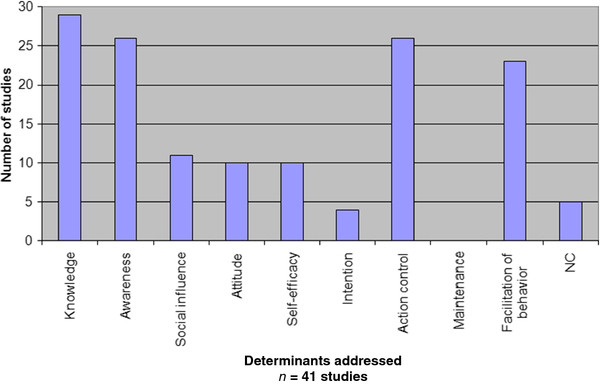
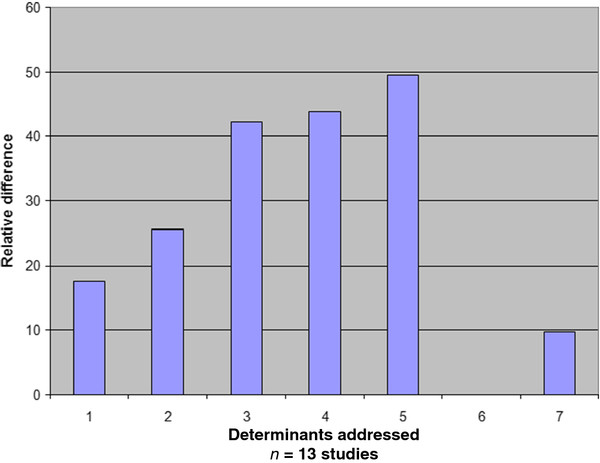
BACKGROUND: Many strategies have been designed and evaluated to address the problem of low hand hygiene (HH) compliance. Which of these strategies are most effective and how they work is still unclear. Here we describe frequently used improvement strategies and related determinants of behaviour change that prompt good HH behaviour to provide a better overview of the choice and content of such strategies. METHODS: Systematic searches of experimental and quasi-experimental research on HH improvement strategies were conducted in Medline, Embase, CINAHL, and Cochrane databases from January 2000 to November 2009. First, we extracted the study characteristics using the EPOC Data Collection Checklist, including study objectives, setting, study design, target population, outcome measures, description of the intervention, analysis, and results. Second, we used the Taxonomy of Behavioural Change Techniques to identify targeted determinants. RESULTS: We reviewed 41 studies. The most frequently addressed determinants were knowledge, awareness, action control, and facilitation of behaviour. Fewer studies addressed social influence, attitude, self-efficacy, and intention. Thirteen studies used a controlled design to measure the effects of HH improvement strategies on HH behaviour. The effectiveness of the strategies varied substantially, but most controlled studies showed positive results. The median effect size of these strategies increased from 17.6 (relative difference) addressing one determinant to 49.5 for the studies that addressed five determinants. CONCLUSIONS: By focussing on determinants of behaviour change, we found hidden and valuable components in HH improvement strategies. Addressing only determinants such as knowledge, awareness, action control, and facilitation is not enough to change HH behaviour. Addressing combinations of different determinants showed better results. This indicates that we should be more creative in the application of alternative improvement activities addressing determinants such as social influence, attitude, self-efficacy, or intention.
Overview
The claims and statistics of this paper haven’t been checked yet.
Free: it reads the open-access text and checks the first 5 claims that cite a source we can check. Create a free account to check every claim.
Integrity signals
Registry
Cites
Statistics
Figures
Verification
Claims the paper makes
The claims and statistics of this paper haven’t been checked yet.
Free: it reads the open-access text and checks the first 5 claims that cite a source we can check. Create a free account to check every claim.
Claims other papers make about this one
Each is checked against this paper’s own text: does it say what the citing paper says it does?
The cited source says what the claim attributes to it.
In the citing paper
“There is, however, a substantial literature on aspects of context, relevant to implementation research.”
From Implementation, context and complexity (2016) · cites this paper as [3]
Self-check
Percentages, sums and reported differences re-computed from the paper’s own numbers.
The self-check needs the paper’s full text.
Citations
Cites
From best evidence to best practice: effective implementation of change in patients' care
Grol, R., & Grimshaw, J. (2003) · The Lancet · doi:10.1016/s0140-6736(03)14546-1 · Cited by 4,531
Self-citationEffectiveness and efficiency of guideline dissemination and implementation strategies
Grimshaw, J., Thomas, R., MacLennan, G., Fraser, C., Ramsay, C., Vale, L., Whitty, P., Eccles, M., Matowe, L., Shirran, L., et al. (2004) · Health Technology Assessment · doi:10.3310/hta8060 · Cited by 3,044 · cited 1×
“Improving HH compliance implies behaviour change; therefore, application of knowledge from the behavioural and social sciences appears valuable [23-25].”
Estimating Health Care-Associated Infections and Deaths in U.S. Hospitals, 2002
Klevens, R. M., Edwards, J. R., Richards, C. L., Horan, T. C., Gaynes, R. P., Pollock, D. A., & Cardo, D. M. (2007) · Public Health Reports® · doi:10.1177/003335490712200205 · Cited by 2,960
A conceptual framework for implementation fidelity
Carroll, C., Patterson, M., Wood, S., Booth, A., Rick, J., & Balain, S. (2007) · Implementation Science · doi:10.1186/1748-5908-2-40 · Cited by 2,559
A taxonomy of behavior change techniques used in interventions
Abraham, C., & Michie, S. (2008) · Health Psychology · doi:10.1037/0278-6133.27.3.379 · Cited by 2,525 · cited 4×
“Abraham C, Michie S: A taxonomy of behavior change techniques used in interventions.”
InfluentialEffectiveness of a hospital-wide programme to improve compliance with hand hygiene
Pittet, D., Hugonnet, S., Harbarth, S., Mourouga, P., Sauvan, V., Touveneau, S., & Perneger, T. V. (2000) · The Lancet · doi:10.1016/s0140-6736(00)02814-2 · Cited by 2,524
Bero, L. A., Grilli, R., Grimshaw, J. M., Harvey, E., Oxman, A. D., & Thomson, M. A. (1998) · BMJ · doi:10.1136/bmj.317.7156.465 · Cited by 2,396
Making health care safer: a critical analysis of patient safety practices.
Shojania, K. G., Duncan, B. W., McDonald, K. M., Wachter, R. M., & Markowitz, A. J. (2001) · PubMed Central · Cited by 1,612
Intervention Mapping: A Process for Developing Theory and Evidence-Based Health Education Programs
Bartholomew, L. K., Parcel, G. S., & Kok, G. (1998) · Health Education & Behavior · doi:10.1177/109019819802500502 · Cited by 1,102 · cited 3×
“These determinants are derived from an integration of theoretical constructs from prevailing behaviour (change) theories that have been found predictive of a range of different health behaviours [28].”
Compliance with Handwashing in a Teaching Hospital
Pittet, D., Mourouga, P., Perneger, T. V., & Program, A. T. M. O. T. I. C. (1999) · Annals of Internal Medicine · doi:10.7326/0003-4819-130-2-199901190-00006 · Cited by 996
Research works printed but not linked: 3
- EPOC Data collection checklist Cochrane Effective Practice and Organisation of Care Group, Alain M: University of Ottawa: Institute of Population Health; Revised by Laura McAuley – with input from Craig Ramsay 2002 Last updated: Jun 2012. URL: http://epoc.cochrane.org/sites/epoc.cochrane.org/files/uploads/datacollectionchecklist.pdf
- Alain M EPOC Data abstraction form University of Ottawa: Institute of Population Health 2002 Last updated: Jun 2012. URL: http://epoc.cochrane.org/data-extraction
- Brock V The impact of performance feedback on handwashing behaviors PhD thesis 2002 Birmingham: University of Alabama
Cited by
Items 201–266 of 266
Isma, M. (2023) · INOSR EXPERIMENTAL SCIENCES · doi:10.59298/inosres/2023/2.10.1000 · Cited by 1
Thom, J. M., Bowen, S. E., Yang, Y., Devarajan, S., Doran, H., Zampetis, M., Papakonstantinou, T., McDonagh, M., McPhedran, R., Toombs, B., et al. (2024) · Behavioural Public Policy · doi:10.1017/bpp.2023.33 · Cited by 2
Hygiene system modeling for toileting in schools
Crocker, J., Walters, J. P., Chipungu, J., Bhagwan, J., Dione, M. M., Dreibelbis, R., Dumlao, M. C., Faruque, A. S. G., Flint-O’Kane, M., Gautam, O. P., et al. (2025) · International Journal of Hygiene and Environmental Health · doi:10.1016/j.ijheh.2025.114667 · Cited by 2
Ziasheikholeslami, N., Razavian, F., Vafaei, K., & Esmkhani, S. (2016) · DOAJ (DOAJ: Directory of Open Access Journals) · Cited by 6
Exploring new approaches to improve hand hygiene monitoring in healthcare
Mackrill, J., Dawson, C., Garvey, B., & Gould, D. J. (2017) · Infection Disease & Health · doi:10.1016/j.idh.2016.12.004 · Cited by 1
Moreira, N. R., de Souza, D. J., Ferreira, M. B. G., Senne, E. C. V. D., Paiva, L., & Contim, D. (2017) · Revista Família Ciclos de Vida e Saúde no Contexto Social · doi:10.18554/refacs.v5i3.2439 · Cited by 1
Smith, C. G. (2020) · British Journal of Healthcare Management · doi:10.12968/bjhc.2019.0120 · Cited by 1
Health-Care-Associated Infections Management, sow the seed of good habits: a grounded theory study.
Taffurelli, C., Camacho, V. C., Adriano, G., Brazzioli, C., Clemente, S., Corda, M., Mari, R. D., Grasso, V., Juranty, B., Sarli, L., et al. (2019) · Acta bio-medica dell'Ateneo parmense/Acta biomedica · doi:10.23750/abm.v90i6-s.8642 · Cited by 1
Views of Medical Students and Medical Specialty Trainees on Hand Hygiene
Çoşkun, Ö., Kıyak, Y. S., Sik, S., Toksoz, F., Can, A., & Budakoğlu, I. İ. (2020) · Klimik Dergisi/Klimik Journal · doi:10.5152/kd.2020.32 · Cited by 1
Behavioral intervention strategies to nudge hand hygiene
Mengxi, G. U. O., & ZHANG, N. (2022) · Advances in Psychological Science · doi:10.3724/sp.j.1042.2022.00863 · Cited by 3
Knowledge and Practice of Hand Hygiene Among Dental Undergraduates: A Cross-Sectional Study
Hisham, K. B., Fauzi, N. M., Baharuddin, I., & Noorjamal, N. (2023) · Compendium of Oral Science · doi:10.24191/cos.v10i1.21624 · Cited by 2
Poobalan, N., Sivathasen, C., & Selvarajah, S. (2023) · EAS Journal of Medicine and Surgery · doi:10.36349/easjms.2023.v05i03.001
Heinrich, E. (2014) · K-State Research Exchange (Kansas State University) · Cited by 1
Rees, L. (2016) · Open Access Victoria University of Wellington | Te Herenga Waka (Figshare) · doi:10.26686/wgtn.17057921 · Cited by 2
Moiwo, M. M., Kamara, G. N., Kamara, D., Kamara, I. F., Sevalie, S., Koroma, Z., Kamara, K. N., Kamara, M. N., Kamara, R. Z., Kpagoi, S. S. T. K., et al. (2023) · Preprints.org · doi:10.20944/preprints202307.0082.v1 · Cited by 1
Ng’ambi, D., Matorera, R., O’Byrne, T., Feasey, N., & Tancred, T. (2026) · Research Square · doi:10.21203/rs.3.rs-9114915/v1 · Cited by 1
Handdesinfektion- hinder och följsamhet
Bothin, L., & Brudefors, R. (2014) · Uppsala University Publications (Uppsala University)
Factors cognitius relacionats amb el compliment d'higiene de mans. Impacte d'una campanya multimodal
Monistrol, O., Escobar-Bravo, M. Á., Riera, M., Font, R., Nicolás, C., Freixas, N., & Calbo, E. (2013) · LA Referencia (Red Federada de Repositorios Institucionales de Publicaciones Científicas)
Söderström, F. (2014) · DiVA (University of Gävle)
Kingston, L., O’Connell, N. H., & Dunne, C. P. (2016) · Journal of Hospital Infection · doi:10.1016/j.jhin.2016.06.007
IMPROVING HAND HYGIENE IN THE CLINICAL SETTING A BEST PRACTICE APPROACH
Maciel, C. L. (2016) · UA Campus Repository (The University of Arizona)
Psychologie der Händehygiene-Compliance: Von der Motivation zum Verhalten
von Lengerke, T., Schulz-Stübner, S., Chaberny, I. F., & Lutze, B. (2017) · Zahnmedizin up2date · doi:10.1055/s-0043-110495
Improvement work as a coursework requirement in nursing training can improve nursing competence
Sægrov, S. (2017) · Journal of Nursing Education and Practice · doi:10.5430/jnep.v7n12p132
Albutt, A. (2018) · White Rose eTheses Online (University of Leeds, The University of Sheffield, University of York) · Cited by 1
Camacho‐Moreno, G., Pardo, Y., Moreno, V., Martínez, J., Cortés, N., Castro, M., Runza, H., Huérfano, V., & Machado, J. (2018) · Revista Médica Sanitas · doi:10.26852/01234250.8
Increasing Hand Hygiene Performance in Health Care Workers with Electronic Real-time Prompting
Pong, S. M. (2019) · TSpace (University of Toronto) · Cited by 2
Antibiotics resistance and mitigation strategies in healthcare settings: A scoping reviewPreprint
Okeah, B. O., Morrison, V., & Huws, J. C. (2020) · medRxiv · doi:10.1101/2020.07.02.20144915
Nalule, Y., Pors, P., Samol, C., Ret, S., Leang, S., Ir, P., Macintyre, A. K., & Dreibelbis, R. (2021) · Research Square · doi:10.21203/rs.3.rs-971007/v1
“Our intervention addressed multiple identi�ed determinants of a wide range of relevant target groups which may explain its apparent success (13, 34, 37–40).”
Complexe implementatiestrategieën
Hulscher, M., Wensing, M., & Grol, R. P. T. M. (2017) · Bohn Stafleu van Loghum eBooks · doi:10.1007/978-90-368-1732-5_18
Self-citationHongsuwan, M., Srisamang, P., Nuntalohit, S., Luangasanatip, N., Lim, C., Day, N., Limmathurotsakul, D., & Cooper, B. S. (2022) · medRxiv · doi:10.1101/2022.11.24.22282731 · Cited by 1
Complexe implementatiestrategieën
Hulscher, M., & Wensing, M. (2023) · Bohn Stafleu van Loghum eBooks · doi:10.1007/978-90-368-2909-0_18
Self-citationKrosta, K. M. E., Tomsic, I., Stolz, M., Krauth, C., Chaberny, I. F., & von Lengerke, T. (2023) · Research Square · doi:10.21203/rs.3.rs-3199535/v1
Could humor improve hand hygiene?
de la Rosa‐Zamboni, D., & Guerrero-Díaz, A. C. (2023) · Enfermedades Infecciosas y Microbiología Clínica · doi:10.1016/j.eimc.2023.08.006
Ranger, M., Dumartin, C., Nasso, R., Péfau, M., Parneix, P., & Venier, A.-G. (2023) · Journal of Infection Prevention · doi:10.1177/17571774231208305 · Cited by 1
Could humor improve hand hygiene?
de la Rosa‐Zamboni, D., & Guerrero-Díaz, A. C. (2023) · Enfermedades infecciosas y microbiologia clinica (English ed ) · doi:10.1016/j.eimce.2023.08.002
Krosta, K. M. E., Tomsic, I., Stolz, M., Krauth, C., Chaberny, I. F., & von Lengerke, T. (2023) · Research Square · doi:10.21203/rs.3.rs-3199535/v2
Fofanah, B. D., Kamara, I. F., Kallon, C., Kamara, R. Z., Nuwagira, I. B., Musoke, R., Tengbe, S. M., Lakoh, S., Korji, M., Sheriff, B., et al. (2024) · Research Square · doi:10.21203/rs.3.rs-4373166/v1
Héma, A., Somé, A. S., Traoré, M. L., Sanou, S., Kafando, V., Poda, A., Meda, C., & Savadogo, L. G. B. (2024) · Research Square · doi:10.21203/rs.3.rs-4430550/v1 · Cited by 1
Santos, S. D., Domelier-Valentin, A.-S., Farizon, M., van der Mee-Marquet, N. L., Allaire, A., Allemon-Dewulf, S., Azzam, A., Barbut, F., Bauer, M., Bayon, V., et al. (2024) · Antimicrobial Resistance and Infection Control · doi:10.1186/s13756-024-01467-5
The Effect of Legitimacy Training on Audience Legitimacy
Langley, B., & Ariel, B. (2024) · Springer eBooks · doi:10.1007/978-3-031-74367-2_6
New shine on an old habit: a pilot study on a glow soap faucet system
Kubas, L., Swenson, A., Penn, S., Christenson, K., Tjepkes, J., Ziegenfuss, J. Y., Aga, R. C., & Christenson, J. K. (2025) · Journal of Hospital Infection · doi:10.1016/j.jhin.2025.07.016
Evaluating the impact of a national handwashing campaign in Wales using propensity score matching
Christensen, A., Greene, G., Davies, A. R., & Mugweni, E. (2025) · Discover Public Health · doi:10.1186/s12982-025-01200-6
Gon, G., de Barra, M., Dansero, L., Nash, S., & Campbell, O. M. R. (2020) · Figshare · doi:10.6084/m9.figshare.13323938
Houben, F., den Heijer, C. D. J., van Hensbergen, M., Dukers–Muijrers, N. H. T. M., de Bont, E. G. P. M., & Hoebe, C. J. P. A. (2024) · Figshare · doi:10.6084/m9.figshare.26686572
Farizon, M., dos Santos, S., Richard, L., Petiteau, A., Valentin, A.-S., & van der Mee-Marquet, N. L. (2024) · Figshare · doi:10.6084/m9.figshare.26623963
Farizon, M., dos Santos, S., Richard, L., Petiteau, A., Valentin, A.-S., & van der Mee-Marquet, N. L. (2024) · Figshare · doi:10.6084/m9.figshare.26623966
Sands, M., Aiken, A. M., Cumming, O., & Aunger, R. V. (2020) · Figshare · doi:10.6084/m9.figshare.13346580
Sobhan, S., Müller‐Hauser, A. A., Huda, T. M. N., Waid, J. L., Gautam, O. P., Gon, G., Wendt, A. S., & Gabrysch, S. (2022) · Figshare · doi:10.6084/m9.figshare.19711120
Sobhan, S., Müller‐Hauser, A. A., Huda, T. M. N., Waid, J. L., Gautam, O. P., Gon, G., Wendt, A. S., & Gabrysch, S. (2022) · Figshare · doi:10.6084/m9.figshare.19711126
Sobhan, S., Müller‐Hauser, A. A., Huda, T. M. N., Waid, J. L., Gautam, O. P., Gon, G., Wendt, A. S., & Gabrysch, S. (2022) · Figshare · doi:10.6084/m9.figshare.19711132
Houben, F., den Heijer, C. D. J., van Hensbergen, M., Dukers–Muijrers, N. H. T. M., de Bont, E. G. P. M., & Hoebe, C. J. P. A. (2024) · Figshare · doi:10.6084/m9.figshare.26686569
Gon, G., de Barra, M., Dansero, L., Nash, S., & Campbell, O. M. R. (2020) · Figshare · doi:10.6084/m9.figshare.13323941
Sands, M., Aiken, A. M., Cumming, O., & Aunger, R. V. (2020) · Figshare · doi:10.6084/m9.figshare.13346577
Tartari, E., Garlasco, J., Mezerville, M. H.-D., Ling, M. L., Márquez-Villarreal, H., Seto, W.-H., Simon, A., Hennig, T.-J., & Pittet, D. (2024) · Figshare · doi:10.6084/m9.figshare.25649392
Sobhan, S., Müller‐Hauser, A. A., Huda, T. M. N., Waid, J. L., Gautam, O. P., Gon, G., Wendt, A. S., & Gabrysch, S. (2022) · Figshare · doi:10.6084/m9.figshare.19711123
Sands, M., Aiken, A. M., Cumming, O., & Aunger, R. V. (2020) · Figshare · doi:10.6084/m9.figshare.13346574
Sobhan, S., Müller‐Hauser, A. A., Huda, T. M. N., Waid, J. L., Gautam, O. P., Gon, G., Wendt, A. S., & Gabrysch, S. (2022) · Figshare · doi:10.6084/m9.figshare.19711129
Nalule, Y., Buxton, H., Ir, P., Leang, S., Macintyre, A., Pors, P., Samol, C., & Dreibelbis, R. (2021) · Figshare · doi:10.6084/m9.figshare.14803958
Nalule, Y., Buxton, H., Ir, P., Leang, S., Macintyre, A., Pors, P., Samol, C., & Dreibelbis, R. (2021) · Figshare · doi:10.6084/m9.figshare.14803964
Khaild, M., Shafouri, N. S. T. A., & Nassri, A. A. (2026) · Cureus · doi:10.7759/cureus.102156
“Embedding daily audits with immediate feedback fosters accountability and continuous learning [26,27], supporting the view that iterative feedback loops are critical for sustained improvement in infection prevention practices [19,21].”
Lutainulwa, E. W., Mohamed, H., Mbishi, J. V., Akoko, L., & Mshiu, J. J. (2026) · Discover Public Health · doi:10.1186/s12982-026-01614-w · Cited by 1
Jiang, W., Li, X., Cao, L., Zhang, Y., Zhou, P., Song, C., Chen, X., Xie, Y., & Tang, J. (2026) · Frontiers in Public Health · doi:10.3389/fpubh.2026.1755052
“This persistent “know-do” gap indicates that hand hygiene behavior is a complex phenomenon influenced by multiple factors, necessitating investigation through systematic behavioral science frameworks to identify its key determinants and inform effective intervention strategies (7).”
Lee, S. M., & Lee, G. E. (2026) · BMC Nursing · doi:10.1186/s12912-026-05034-8
“This finding aligns with that of Huis et al. [7], who reported that interventions targeting self-efficacy alongside social influence, attitudes, and intentions had a greater effect than knowledge-focused approaches.”
InfluentialBlomgren, P., Hultin, L., Westerbergh, J., & Hjelm, K. (2026) · International Journal of Nursing Studies Advances · doi:10.1016/j.ijnsa.2026.100639
“Previous reviews highlight the influence of social norms, self-efficacy, and peer reinforcement, underscoring the importance of leadership and visible role modelling in sustaining adherence (Luangasanatip et al., 2015; Huis et al., 2012).”
Azizoğlu, H., Akaltun, H., & Gürkan, Z. (2026) · The Journal of Continuing Education in Nursing · doi:10.3928/00220124-20260506-03
Çalık, A., & Ersoy, S. (2026) · Journal of Evaluation in Clinical Practice · doi:10.1111/jep.70684
Metadata
- Authors
- Huis, A., van Achterberg, T., de Bruin, M., Grol, R., Schoonhoven, L., & Hulscher, M.
- Affiliations
- Radboud University Medical Center (NL)
- Corresponding author
- Huis, Anita
- Venue
- Implementation Science
- Published
- 2012-09-14
- Volume
- 7
- Issue
- 1
- Pages
- 92-92
- ISSN
- 1748-5908 (ISSN-L)
- PMC
- PMC3517511
- OpenAlex
- W2117285256
- Cited by
- 267
- References
- 79
- Citations by year
- 2026: 10 · 2025: 10 · 2024: 21 · 2023: 22 · 2022: 20 · 2021: 22 · 2020: 34 · 2019: 23 · 2018: 18 · 2017: 24 · 2016: 18 · 2015: 23 · 2014: 12 · 2013: 9 · 2012: 1
- FWCI
- 1.79
- Type
- journal article
- Language
- en
- Open access
- gold
- doi.org
- Licence
- Locations
- Implementation Science (publishedVersion, cc-by)
- Europe PMC (PubMed Central) (publishedVersion, cc-by)
- PubMed Central (publishedVersion, cc-by)
- PubMed (publishedVersion)
- UvA-DARE (University of Amsterdam) (acceptedVersion, other-oa)
- ePrints Soton (University of Southampton) (acceptedVersion)
- Socio-Environmental Systems Modeling (acceptedVersion)
- Lirias (KU Leuven) (submittedVersion, other-oa)
- DOAJ (DOAJ: Directory of Open Access Journals) (submittedVersion)
- Radboud Repository (Radboud University) (submittedVersion)
- Radboud Repository (Radboud University) (submittedVersion, other-oa)
- Data Archiving and Networked Services (DANS) (submittedVersion, other-oa)
- Funders
- ZonMw (94517101)
- Topics
- Health Sciences › Medicine › Infectious Diseases › Infection Control in Healthcare
- Health Sciences › Health Professions › General Health Professions › Health Policy Implementation Science
- Social Sciences › Psychology › Applied Psychology › Behavioral Health and Interventions
- Keywords
- hand hygiene, hand hygiene compliance, behaviour change interventions, knowledge and awareness, action control, social influence, self-efficacy, intention, infection control
- MeSH terms
- Attitude of Health Personnel, Behavior, Cross Infection, Hand Disinfection, Humans, Health Knowledge, Attitudes, Practice, Personnel, Hospital, Social Environment, Infection Control, Self Efficacy
About these checks
Registry, retraction, Cites and statistics results are computed, not judged, with one exception: a printed reference that no index lists is read once by a model before it counts as a citation error. Claims are extracted by a model and kept only when their quote appears verbatim in the text; each cited source is then checked, with a model’s help, for whether it says what the claim relies on. Those verdicts can be wrong — read the claim’s quote and the cited source before relying on one.
Statistics and arithmetic are recomputed, not judged.
Confidence bands are shown only for fields calibrated on our annotated test set. None is calibrated yet, so no band is shown.
What counts as a claim ›How we measure confidence ›How we check this ›
Are you an author, or do you see a problem with this page? Request a review
Data sources
Bibliographic data: Semantic Scholar, OpenAlex, Crossref.
Contains information from the Semantic Scholar Academic Graph Datasets, made available under the ODC Attribution License (ODC-BY 1.0).
Semantic Scholar’s data is described in: Kinney, R., et al. (2023). The Semantic Scholar Open Data Platform. arXiv:2301.10140.
