

Measuring factors affecting implementation of health innovations: a systematic review of structural, organizational, provider, patient, and innovation level measures
Open accessThe DOI matches its Crossref record; 165 of the 165 references it cites were found in a registry or an index; 12 of the 74 sources its claims cite were checked for support.
Abstract
BACKGROUND: Two of the current methodological barriers to implementation science efforts are the lack of agreement regarding constructs hypothesized to affect implementation success and identifiable measures of these constructs. In order to address these gaps, the main goals of this paper were to identify a multi-level framework that captures the predominant factors that impact implementation outcomes, conduct a systematic review of available measures assessing constructs subsumed within these primary factors, and determine the criterion validity of these measures in the search articles. METHOD: We conducted a systematic literature review to identify articles reporting the use or development of measures designed to assess constructs that predict the implementation of evidence-based health innovations. Articles published through 12 August 2012 were identified through MEDLINE, CINAHL, PsycINFO and the journal Implementation Science. We then utilized a modified five-factor framework in order to code whether each measure contained items that assess constructs representing structural, organizational, provider, patient, and innovation level factors. Further, we coded the criterion validity of each measure within the search articles obtained. RESULTS: Our review identified 62 measures. Results indicate that organization, provider, and innovation-level constructs have the greatest number of measures available for use, whereas structural and patient-level constructs have the least. Additionally, relatively few measures demonstrated criterion validity, or reliable association with an implementation outcome (e.g., fidelity). DISCUSSION: In light of these findings, our discussion centers on strategies that researchers can utilize in order to identify, adapt, and improve extant measures for use in their own implementation research. In total, our literature review and resulting measures compendium increases the capacity of researchers to conceptualize and measure implementation-related constructs in their ongoing and future research.
Overview
CoChat Summary
TL;DR
This systematic review proposes a five-factor multi-level framework (structural, organizational, provider, patient, innovation) for constructs hypothesized to affect implementation outcomes and identifies 62 measures assessing them. It finds that organizational, provider, and innovation measures are most available, while structural and patient measures are scarce, and that criterion validity is rarely demonstrated.
Key findings
- The review identified 62 measures; most (42; 67.7%) assessed only one factor, and only one measure—the Barriers and Facilitators Assessment Instrument—included items for all five factors.
- Provider-level constructs were assessed by 35 measures (56.5%), organizational-level by 37 (59.7%), and innovation-level by 16 (25.8%); structural-level and patient-level constructs were each assessed by only 5 measures (8.1%).
- Almost half of measures (30; 48.4%) showed no criterion validity in the original validation study or search articles; among the 32 measures with criterion validity examined, adoption was the most frequent outcome (29 of 32; 90.1%), fidelity was examined in 5 of 32 (15.6%), and no studies examined implementation cost, penetration, or sustainability.
- Most measures (47; 75.8%) were developed and/or implemented in healthcare-related settings.
Methods
- Systematic literature review searching MEDLINE, PsycINFO, CINAHL, and Implementation Science through 12 August 2012, using implementation science, health, and measure-related keywords and database restrictions.
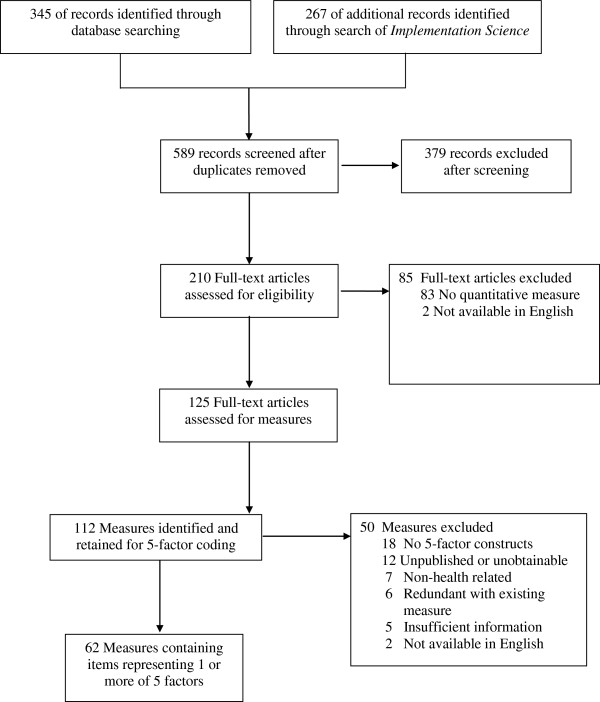
- Search yielded 589 unique peer-reviewed records; 210 full-text articles were reviewed, yielding 125 full-text articles from which 112 measures were extracted and 62 measures retained.
- Measures were item-coded for whether they contained two or more items assessing structural, organizational, provider, patient, or innovation factors; criterion validity was coded by identifying implementation outcomes (adoption, fidelity, implementation cost, penetration, sustainability) and whether measures significantly predicted them. Inter-rater reliability across coding stages ranged from 87% to 100% agreement.
Limitations
- The authors state that search strategies affect located articles and conclusions: use of MEDLINE, CINAHL, PsycINFO, and Implementation Science may miss relevant literature in databases such as ERIC or Business Source Complete; keyword and database restrictions, lack of truncation/spelling variants, and limiting to two instrument-related fields may have omitted relevant studies and measures.
- The authors state that criterion validity was assessed only from articles identified in the current search, not from separate exhaustive searches for each of the 62 measures, so criterion validity findings are based on a sampling of the literature; they also note recently developed scales may show weak criterion validity because they have been evaluated less frequently.
- Evident from the text: the review excluded non-health-related innovations, unpublished/unobtainable measures, foreign-language measures, and qualitative measures, which may further narrow the compendium beyond the authors’ stated database and keyword limitations.
Model-written summary. Check it against the paper before relying on it.
Integrity signals
Registry
Cites
Statistics
Figures
Verification
Claims the paper makes
10 Valid · 1 Not valid · 31 Not checked · 52 Own results and interpretations
Every source the paper cites for this claim was checked and supports it.
In the paper
“And, the measures used to assess these constructs are frequently developed without direct connection to substantive theory or guiding frameworks and with minimal analysis of psychometric properties, such as internal reliability and construct validity [12].”
§ Measuring factors affecting implementation of health innovations: a systematic review of structural, organizational, provider, patient, and innovation level measures > Background
What the sources say
- Supportedcites [12] Squires JE Estabrooks CA O'Rourke HM Gustavsson P Newburn-Cook CV Wallin L A systematic review of the psychometric properties of self-report research utilization measures used in healthcare Implem Sci 2011 6 83 PMC3169486 21794144 source
Split into 2 atoms — 2 confirmed, 0 partially supported, 0 disputed, 0 misattributed, 0 unverifiable. Expand the claim to see per-atom verdicts.
plain- Asserted: passes — The authors put it forward as true.
- Checkable: passes — It can be checked against evidence.
- Load-bearing: passes — The paper’s conclusions depend on it.
- Based: passes — The paper gives a reason why it holds.
- Supported
Every source the paper cites for this claim was checked and supports it.
In the paper
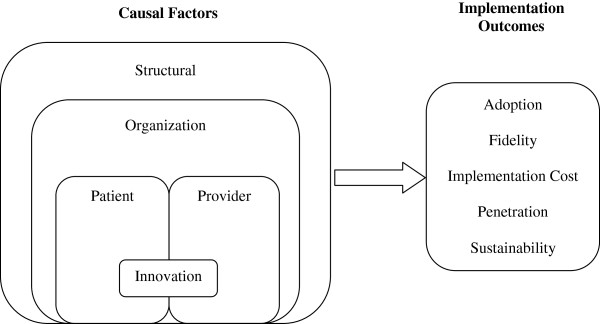
“The right side of the figure depicts the implementation outcomes—such as adoption, fidelity, implementation cost, penetration, and sustainability [6] — that are affected by the causal factors.”
§ Measuring factors affecting implementation of health innovations: a systematic review of structural, organizational, provider, patient, and innovation level measures > Background > A multi-level framework guiding implementation science research
What the sources say
- Supportedcites [6] Proctor E Silmere H Raghavan R Hovmand P Aarons G Bunger A Griffey R Hensley M Outcomes for implementation research: Conceptual distinctions, measurement challenges, and research agenda Adm Policy Ment Hlth 2011 38 65 76 PMC3068522 20957426 source
The citation follows the list of examples, and the paper identifies adoption, fidelity, implementation cost, penetration, and sustainability as implementation outcomes. The claim about causal factors appears to describe the citing document’s figure rather than something attributed to this source. The Taxonomy of Implementation Outcomes and Level of Analysis for Outcomes passages establish the identification; page numbers were not provided. (LLM, conf=0.92)
plainstates a cause- Asserted: passes — The authors put it forward as true.
- Checkable: passes — It can be checked against evidence.
- Load-bearing: passes — The paper’s conclusions depend on it.
- Based: passes — The paper gives a reason why it holds.
- Supported
The cited sources support only part of this claim — read each source’s verdict below.
In the paper
“Patient-level variables such as behavioral risk factors (e.g., alcohol use [29]) and motivation [30,31] often moderate the retention in and efficacy of behavioral risk reduction interventions.”
§ Measuring factors affecting implementation of health innovations: a systematic review of structural, organizational, provider, patient, and innovation level measures > Background > A multi-level framework guiding implementation science research
What the sources say
- Partly supportedcites [29] Kalichman SC Cain D Eaton L Jooste S Simbayi LC Randomized Clinical Trial of Brief Risk Reduction Counseling for Sexually Transmitted Infection Clinic Patients in Cape Town, South Africa Am J Public Health 2011 101 e9 e17 21778486 PMC3154219 sourceExperimental — accuracy not yet measured
The Discussion (page not provided) says alcohol use significantly moderated intervention outcomes, with effects less robust and durable for heavier drinkers. The paper also reports missed baseline sessions, but does not show that alcohol use moderated retention. The motivation claim is attached to other citations and is not assessed here. (LLM, conf=0.86)
- Partly supportedcites [30] Noguchi K Albarracin D Durantini MR Glasman LR Who participates in which health promotion programs? A meta-analysis of motivations underlying enrollment and retention in HIV-prevention interventions Psychol Bull 2007 133 955 975 17967090 PMC4803277 sourceExperimental — accuracy not yet measured
The Results report that prior motivation and condom use were associated with retention, and that these relationships varied with intervention content. But the paper measured enrollment and completion of HIV-prevention programs, not whether patient-level variables moderated the interventions’ efficacy in reducing risk behavior. Its findings also do not establish the claim across behavioral risk-reduction interventions generally. (LLM, conf=0.88)
- Partly supportedcites [31] Vernon SW Bartholomew LK McQueen A Bettencourt JL Greisinger A Coan SP Lairson D Chan W Hawley ST Myers RE A randomized controlled trial of a tailored interactive computer-delivered intervention to promote colorectal cancer screening: sometimes more is just the same nn Behav Med 2011 41 284 299 PMC3265931 21271365 sourceExperimental — accuracy not yet measured
The Results (Moderator Analyses; page unavailable) report that baseline stage of change, a measure of readiness, moderated the intervention’s effect on colorectal cancer screening. The Results (Preliminary Analyses; page unavailable) also report that participants who dropped out were less likely to have been in the contemplation stage. These findings support a role for motivation in this trial, but do not establish that it often moderates retention and efficacy across behavioral risk-reduction interventions. (LLM, conf=0.86)
plainstates a possible cause- Asserted: passes — The authors put it forward as true.
- Checkable: passes — It can be checked against evidence.
- Load-bearing: unclear — It is unclear whether the paper’s conclusions depend on it.
- Based: passes — The paper gives a reason why it holds.
- Partly supported
The sources with a verdict support this claim; the rest weren’t checked yet, have no full text we could read, or their verdicts aren’t rated yet.
In the paper
“Many of these measures assessed constructs outlined in Roger’s diffusion of innovations theory [18] such as relative advantage, compatibility, complexity, trialability, and observability [26].”
§ Measuring factors affecting implementation of health innovations: a systematic review of structural, organizational, provider, patient, and innovation level measures > Results > Factors assessed
What the sources say
- Not checked yetcites [18] Rogers EM Diffusion of innovations 5th edn 2003 New York: Free Press
- Supportedcites [26] Scott S Plotnikoff R Karunamuni N Bize R Rodgers W Factors influencing the adoption of an innovation: An examination of the uptake of the Canadian Heart Health Kit (HHK) Implem Sci 2008 3 41 Article included in review PMC2567341 18831766 source
The Background identifies relative advantage, compatibility, complexity, trialability, and observability as the five attributes in Rogers’ diffusion of innovations theory. Methods > Questionnaire states that the study assessed attributes of the innovation using measures for each of those five constructs. (LLM, conf=0.95)
plain- Asserted: passes — The authors put it forward as true.
- Checkable: passes — It can be checked against evidence.
- Load-bearing: unclear — It is unclear whether the paper’s conclusions depend on it.
- Based: passes — The paper gives a reason why it holds.
Every source the paper cites for this claim was checked and supports it.
In the paper
“we did come across a number of articles that included these outcomes (e.g., number of bloodstream infections [83]) alone or in combination with other implementation outcomes.”
§ Measuring factors affecting implementation of health innovations: a systematic review of structural, organizational, provider, patient, and innovation level measures > Discussion > Criterion validity
What the sources say
- Supportedcites [83] Chan K Hsu Y-J Lubomski L Marsteller J Validity and usefulness of members reports of implementation progress in a quality improvement initiative: findings from the Team Check-up Tool (TCT) Implem Sci 2011 6 115 Article included in review PMC3205035 21967862 source
The cited paper is exactly the kind of article the citing sentence offers it as an example of: its Methods > Validation measures describe collecting 'the number of CLABSIs occurring within an ICU and number of catheter-line days ... monthly by the hospital infection preventionist', and the Abstract's Measures list CLABSI rate alongside the Team Check-up Tool implementation measures (intervention activities, unit-level prevention behaviours, barriers to team progress). Results > Measure validity then analyse time to first quarter with no CLABSI in combination with infection prevention behaviour outcomes, so a patient health outcome appears in combination with implementation outcomes rather than alone. (LLM, conf=0.86)
plain- Asserted: passes — The authors put it forward as true.
- Checkable: passes — It can be checked against evidence.
- Load-bearing: unclear — It is unclear whether the paper’s conclusions depend on it.
- Based: passes — The paper gives a reason why it holds.
- Supported
52 more claims · 2 with their cited sources checked
Create a free account to see all 94 claims and to verify the 62 references still open.
- It may state two separate claims as one. 12
- Probably not a substantial claim. 28
- The quote only partly states this claim. 1
Claims other papers make about this one
Each is checked against this paper’s own text: does it say what the citing paper says it does?
The source backs part of the claim, not all of it — or backs it for a different population, condition or comparison.
In the citing paper
“we situate our intervention domain at the nexus of all the domains because intervention characteristics can both influence and be influenced by the other factors—a position also supported by the CFIR [32, 35].”
From Barriers and facilitators to implementation of evidence-based task-sharing mental health interventions in low- and middle-income countries: a systematic review using implementation science frameworks (2022) · cites this paper as [35]
Experimental — accuracy not yet measuredThe source backs part of the claim, not all of it — or backs it for a different population, condition or comparison.
In the citing paper
“An update of that review in 2010 focused explicitly on organizational-level adoption and mainstreaming of technological innovations [3]. It identified some new literature on organizational-level routinization [4], but little new evidence on scale-up, spread, or sustainability—a finding that has been confirmed by other reviews since [5-9].”
From Beyond Adoption: A New Framework for Theorizing and Evaluating Nonadoption, Abandonment, and Challenges to the Scale-Up, Spread, and Sustainability of Health and Care Technologies (2017) · cites this paper as [6]
Experimental — accuracy not yet measuredThe source backs part of the claim, not all of it — or backs it for a different population, condition or comparison.
In the citing paper
“Existing instrument reviews are limited in scope, methods, and findings.”
From The Society for Implementation Research Collaboration Instrument Review Project: A methodology to promote rigorous evaluation (2016) · cites this paper as [5]
Experimental — accuracy not yet measuredThe source backs part of the claim, not all of it — or backs it for a different population, condition or comparison.
In the citing paper
“Second, existing methodologies for instrument reviews are narrowly focused and only provide limited psychometric assessments of the instruments.”
From The Society for Implementation Research Collaboration Instrument Review Project: A methodology to promote rigorous evaluation (2016) · cites this paper as [5]
Experimental — accuracy not yet measuredThe cited source says what the claim attributes to it.
In the citing paper
“Systematic reviews of implementation context measures have been conducted, all of which have found significant gaps and signal the continued need for measure validation and development [89–95].”
From The updated consolidated framework for implementation research based on user feedback (2022) · cites this paper as [89]
9 more claims about this paper
Create a free account to see every claim other papers make about this one.
Self-check
Percentages, sums and reported differences re-computed from the paper’s own numbers.
Each contradiction between two passages listed here was confirmed by an independent check.
Rated minor: it would not touch a result — a value no result rests on, a p-value that stays on the same side of the significance level, or a conflict that is clerical, resolved elsewhere in the paper, or outside its own findings.
In the paper
§ Measuring factors affecting implementation of health innovations: a systematic review of structural, organizational, provider, patient, and innovation level measures > Method > Measure and criterion validity coding
“the Organizational Readiness for Change scale [45] assesses several features of structural context in which drug treatment centers exist, including facility structure (independent versus part of a parent organization) and characteristics of the service area (rural, suburban, or urban).”
§ Measuring factors affecting implementation of health innovations: a systematic review of structural, organizational, provider, patient, and innovation level measures > Results > Literature search results
“| Organizational Readiness for Change [45] | | X | X | | | O: Institutional resources, Organizational climate, motivational readiness | [45] | None | Mental Health/ Substance Abuse |”
Rated minor: it would not touch a result — a value no result rests on, a p-value that stays on the same side of the significance level, or a conflict that is clerical, resolved elsewhere in the paper, or outside its own findings.
In the paper
§ Measuring factors affecting implementation of health innovations: a systematic review of structural, organizational, provider, patient, and innovation level measures > Background > A multi-level framework guiding implementation science research
“with one identifying unifying constructs from empirical results [20] and the other identifying unifying constructs from existing conceptual frameworks [19]”
§ Measuring factors affecting implementation of health innovations: a systematic review of structural, organizational, provider, patient, and innovation level measures > Background > A multi-level framework guiding implementation science research
“Durlak and DuPre [19] reviewed meta-analyses and additional quantitative reports examining the predictors of successful implementation from over 500 studies. In contrast, Damschroder et al.[20] reviewed 19 existing implementation theories and frameworks”
Citations
Cites
The theory of planned behavior
Ajzen, I. (1991) · Organizational Behavior and Human Decision Processes · doi:10.1016/0749-5978(91)90020-t · Cited by 90,587
Rogers, E. M., Singhal, A., & Quinlan, M. M. (2019) · An Integrated Approach to Communication Theory and Research · doi:10.4324/9780203710753-35 · Cited by 37,322
Social Cognitive Theory: An Agentic Perspective
Bandura, A. (2001) · Annual Review of Psychology · doi:10.1146/annurev.psych.52.1.1 · Cited by 15,510
Damschroder, L. J., Aron, D. C., Keith, R. E., Kirsh, S. R., Alexander, J. A., & Lowery, J. C. (2009) · Implementation Science · doi:10.1186/1748-5908-4-50 · Cited by 14,496 · cited 5×
“, community-level [19]; outer-setting [20]), organizational(i.”
BackgroundInfluentialHealth Behavior and Health Education: Theory, Research, and Practice
(1992) · Annals of Internal Medicine · doi:10.7326/0003-4819-116-4-350_1 · Cited by 13,207
Organizational Culture and Leadership
Tierney, W. G., & Schein, E. H. (1986) · The Academy of Management Review · doi:10.2307/258322 · Cited by 9,601
Stages and processes of self-change of smoking: Toward an integrative model of change.
Prochaska, J. O., & DiClemente, C. C. (1983) · Journal of Consulting and Clinical Psychology · doi:10.1037/0022-006x.51.3.390 · Cited by 9,098
Proctor, E., Silmere, H., Raghavan, R., Hovmand, P., Aarons, G., Bunger, A., Griffey, R., & Hensley, M. (2011) · Administration and Policy in Mental Health and Mental Health Services Research · doi:10.1007/s10488-010-0319-7 · Cited by 8,721 · cited 7×
“For example, fidelity, or ‘the degree to which an intervention was implemented as it was prescribed in the original protocol or as it was intended by the program developers’ [6], necessarily involves and is affected by patient-level factors.”
BackgroundMethodInfluentialDiffusion of Innovations in Service Organizations: Systematic Review and Recommendations
GREENHALGH, T., ROBERT, G., MACFARLANE, F., BATE, P., & KYRIAKIDOU, O. (2004) · The Milbank Quarterly · doi:10.1111/j.0887-378x.2004.00325.x · Cited by 7,448 · cited 1×
“It involves attention to a wide array of multi-level variables related to the innovation itself, the local implementation context, and the behavioral strategies used to implement the innovation [8,9].”
MethodEvaluating the public health impact of health promotion interventions: the RE-AIM framework.
Glasgow, R. E., Vogt, T. M., & Boles, S. M. (1999) · American Journal of Public Health · doi:10.2105/ajph.89.9.1322 · Cited by 7,217 · cited 1×
“More recently, however, many frameworks have converged to outline a set of multi-level factors that are hypothesized to impact implementation outcomes [9,16-18].”
Background
Research works printed but not linked: 13
- Grimshaw J Improving the scientific basis of health care research dissemination and implementation 2007 Paper presented at the NIH Conference on Building the Sciences of Dissemination and Implementation in the Service of: Public Health
- Rogers EM Diffusion of innovations 5th edn 2003 New York: Free Press
- Peters MA Harmsen M Laurant MGH Wensing M Ruimte voor verandering? Knelpunten en mogelijkheden voor verbeteringen in de patiëntenzorg [Room for improvement? Barriers to and facilitators for improvement of patient care] 2002 Nijmegen, the Netherlands: Centre for Quality of Care Research (WOK), Radboud University Nijmegen Medical Centre Article included in review
- American Psychological Association National Council on Measurement in Education, American Educational Research Association: Standards for educational and psychological testing 1999 Washington, DC: American Educational Research Association
- Pain K Hagler P Warren S Development of an instrument to evaluate the research orientation of clinical professionals Can J Rehabil 1996 9 93 100 Article included in review
- Thompson CJ Extent and factors influencing research utilization among critical care nurses 1997 Texas Woman's University Unpublished doctoral dissertation
- Meissner HI Proceedings from the 3rd Annual NIH Conference on the Science of Dissemination and Implementation: Methods and Measurement 2010 Bethesda, MD
- Rogers EM Diffusion of innovations 4th edn 1995 4 New York: Free Press
- Facione PA Facione CF The California Critical Thinking Disposition Inventory: Test manual 1992 Millbrae, CA: California Academic Press Article included in review
- Estrada N Verran J Nursing practice environments: Strengthening the future of health systems: learning organizations and evidence-based practice by RNs Commun Nurs Res 2007 40 187 Article included in review
- Fineout-Overholt E Melnyk BM Organizational Culture and Readiness for System-Wide Implementation of EBP (OCR-SIEP) scale 2006 Gilbert, AZ: ARCC llc Publishing Article included in review
- Melnyk BM Fineout-Overholt E Giggleman M EBP organizational culture, EBP implementation, and intent to leave in nurses and health professionals Commun Nurs Res 2010 43 310 Article included in review
- James LR Sells SB Magnusson D Psychological climate The situation: An interactional perspective 1981 Hillsdale, NJ: Lawrence Erlbaum Article included in review
Cited by
Items 201–300 of 959
Anguzu, R., Cassidy, L. D., Beyer, K. M. M., Babikako, H. M., Walker, R. J., & Dickson‐Gómez, J. (2022) · BMC Health Services Research · doi:10.1186/s12913-022-07669-0 · Cited by 39
Hodge, L. M., Turner, K. M. T., Sanders, M. R., & Filus, A. (2017) · The Journal of Behavioral Health Services & Research · doi:10.1007/s11414-016-9505-z · Cited by 38
“, adoption, fidelity, penetration, or sustainability).(63) In fact, there is limited evidence of reliability and validity for most measures of organizational factors that impact adoption, implementation, or sustainment of programs.”
BackgroundLewis, C. C., Mettert, K., & Lyon, A. R. (2021) · Implementation Research and Practice · doi:10.1177/2633489521994197 · Cited by 38
“Both studies concluded, across the domains they reviewed, that the state of measurement was only emerging, with only 38% of measures across both studies demonstrating any evidence of reliability and validity (45% of those in Chor et al., 2015; 25% of those in Chaudoir et al., 2013).”
MethodResultInfluence of leadership on implementing Dementia Care Mapping: A multiple case study
Quasdorf, T., & Bartholomeyczik, S. (2017) · Dementia · doi:10.1177/1471301217734477 · Cited by 38
From pilot project to system solution: innovation, spread and scale for health system leaders
Shaw, J., Tepper, J. D., & Martin, D. (2018) · BMJ Leader · doi:10.1136/leader-2017-000055 · Cited by 38
Leonardsen, A. L., Moen, E. K., Karlsøen, G., & Hovland, T. (2019) · Nursing Reports · doi:10.4081/nursrep.2019.8041 · Cited by 38
Trends in bariatric surgery, 2002–2012: do changes parallel the obesity trend?
Johnson, E. E., Simpson, A. N., Harvey, J., Lockett, M. A., Byrne, K. T., & Simpson, K. N. (2015) · Surgery for Obesity and Related Diseases · doi:10.1016/j.soard.2015.07.009 · Cited by 37
Kononowech, J., Hagedorn, H., Hall, C., Helfrich, C. D., Lambert‐Kerzner, A., Miller, S. C., Sales, A. E., & Damschroder, L. J. (2021) · Implementation Science Communications · doi:10.1186/s43058-021-00121-0 · Cited by 37
Hudon, C., Chouinard, M., Bisson, M., Brousselle, A., Lambert, M., Danish, A., Rodríguez, C., & Sabourin, V. (2022) · International Journal of Integrated Care · doi:10.5334/ijic.5652 · Cited by 37
van der Kleij, R., Coster, N., Verbiest, M. E. A., van Assema, P., Paulussen, T. G., Reis, R., & Crone, M. R. (2015) · Obesity Reviews · doi:10.1111/obr.12273 · Cited by 40
Elsey, H., Khanal, S., Manandhar, S., Sah, D., Baral, S., Siddiqi, K., & Newell, J. N. (2015) · Implementation Science · doi:10.1186/s13012-016-0466-7 · Cited by 37
Innovation in healthcare services: notes on the limits of field research
Costa, L. S. (2016) · Cadernos de Saúde Pública · doi:10.1590/0102-311x00151915 · Cited by 36
Factors Associated with Effective Implementation: Research and Practical Implications
Barwick, M. A., Dubrowski, R., & Damschroder, L. J. (2020) · Springer eBooks · doi:10.1007/978-3-030-03874-8_4 · Cited by 36
Punnett, L., Nobrega, S., Zhang, Y., Rice, S., Gore, R. J., & Kurowski, A. (2020) · BMC Public Health · doi:10.1186/s12889-020-09551-2 · Cited by 36
Dauner, K. N., & Loomer, L. (2021) · BMC Health Services Research · doi:10.1186/s12913-021-06859-6 · Cited by 38
Implementing integrated models of care: the importance of the macro-level context
Ashton, T. (2015) · International Journal of Integrated Care · doi:10.5334/ijic.2247 · Cited by 36
Investigating healthcare IT innovations: a “conceptual blending” approach
Cranfield, S., Hendy, J., Reeves, B. C., Hutchings, A., Collin, S. M., & Fulop, N. (2015) · Journal of Health Organization and Management · doi:10.1108/jhom-08-2015-0121 · Cited by 36
Victor Mugabe, K. (2021) · Technical Innovations & Patient Support in Radiation Oncology · doi:10.1016/j.tipsro.2021.03.004 · Cited by 35
“Survey questions were adopted from validated questionnaires [11,12,13,14].”
MethodLake, J. K., Tablon Modica, P., Chan, V., & Weiss, J. A. (2020) · Autism · doi:10.1177/1362361320918754 · Cited by 35
Highfield, L., Valerio, M. A., Fernandez, M. E., & Eldridge-Bartholomew, L. K. (2018) · Frontiers in Public Health · doi:10.3389/fpubh.2018.00300 · Cited by 35
Harkko, J., Sipilä, N., Nordquist, H., Lallukka, T. M., Appelqvist‐Schmidlechner, K., Donnelly, M., & Kouvonen, A. M. (2023) · Implementation Science · doi:10.1186/s13012-023-01316-w · Cited by 35
Steege, L. M. B., Pinekenstein, B. J., Rainbow, J. G., & Knudsen, É. N. A. (2017) · JONA The Journal of Nursing Administration · doi:10.1097/nna.0000000000000519 · Cited by 36
The Intersection of Implementation Science and Pharmacy Practice Transformation
Smith, M., Blanchard, C., & Vuernick, E. L. (2019) · Annals of Pharmacotherapy · doi:10.1177/1060028019867253 · Cited by 35
Curry, S. J., Grossman, D. C., Whitlock, E. P., & Cantu, A. G. (2014) · Annals of Internal Medicine · doi:10.7326/m13-2128 · Cited by 35
Cho, E., Wood, P. K., Taylor, E., Hausman, E. M., Andrews, J. H., & Hawley, K. M. (2018) · Administration and Policy in Mental Health and Mental Health Services Research · doi:10.1007/s10488-018-0896-4 · Cited by 35
Siegle, A., Villalobos, M., Bossert, J., Krug, K., Hagelskamp, L., Krisam, J., Handtke, V., Deis, N., Jünger, J., Wensing, M., et al. (2018) · Trials · doi:10.1186/s13063-018-2814-1 · Cited by 34
Huijg, J. M., Dusseldorp, E., Gebhardt, W. A., Verheijden, M. W., van der Zouwe, N., Middelkoop, B. J., Duijzer, G., & Crone, M. R. (2014) · Physical Therapy · doi:10.2522/ptj.20130457 · Cited by 34
Scholten, N., Pfaff, H., Lehmann, H. C., Fink, G. R., & Karbach, U. (2015) · Implementation Science · doi:10.1186/s13012-014-0196-7 · Cited by 33
Wang, B., STANTON, B. F., Deveaux, L., Lunn, S., Rolle, G., Adderley, R., Poitier, M., Koci, V., Marshall, S. P., & Gomez, P. (2017) · Implementation Science · doi:10.1186/s13012-016-0539-7 · Cited by 33
Variations in the Delivery of Emergency General Surgery Care in the Era of Acute Care Surgery
Daniel, V. T., Ingraham, A. M., Khubchandani, J. A., Ayturk, D., Kiefe, C. I., & Santry, H. P. (2018) · The Joint Commission Journal on Quality and Patient Safety · doi:10.1016/j.jcjq.2018.04.012 · Cited by 33
Jean, E., Guerra, S. S., Contandriopoulos, D., Perroux, M., Kilpatrick, K., & Zabalegui, A. (2019) · Nursing Outlook · doi:10.1016/j.outlook.2019.02.002 · Cited by 33
Madrigal, L., Manders, O. C., Kegler, M. C., Haardörfer, R., Piper, S., Blais, L. M., Weber, M. B., & Escoffery, C. (2022) · Implementation Science Communications · doi:10.1186/s43058-022-00350-x · Cited by 34
Williams, N. J. (2015) · Implementation Science · doi:10.1186/s13012-016-0417-3 · Cited by 33
Access to innovative radiotherapy: how to make it happen from an economic perspective?
Lievens, Y. N. (2017) · Acta Oncologica · doi:10.1080/0284186x.2017.1348622 · Cited by 33
McKillop, A., Shaw, J., Sheridan, N., Gray, C. S., Carswell, P., Wodchis, W. P., Connolly, M. J., Denis, J., Baker, G. R., & Kenealy, T. W. (2017) · International Journal of Integrated Care · doi:10.5334/ijic.2516 · Cited by 32
Shared Decision-Making and Self-Directed Care
Salyers, M. P., & Zisman‐Ilani, Y. (2019) · Springer eBooks · doi:10.1007/978-3-030-11908-9_8 · Cited by 33
Malham, S. A., Touati, N., Maillet, L., Gaboury, I., Loignon, C., & Breton, M. (2017) · International Journal of Family Medicine · doi:10.1155/2017/1595406 · Cited by 32
Khadjesari, Z., Vitoratou, S., Sevdalis, N., & Hull, L. (2017) · BMJ Open · doi:10.1136/bmjopen-2017-017972 · Cited by 32
Maisto, S. A., Kirouac, M., & Witkiewitz, K. A. (2014) · Journal of Studies on Alcohol and Drugs · doi:10.15288/jsad.2014.75.799 · Cited by 32
Scheerman, K., Mesters, J. W., Borger, J. N., Meskers, C. G. M., & Maier, A. B. (2020) · Nursing Open · doi:10.1002/nop2.588 · Cited by 31
de Jong, R. W., Boezeman, E. J., Chesnaye, N. C., Bemelman, F. J., Massy, Z. A., Jager, K. J., Stel, V. S., & de Boer, A. G. E. M. (2021) · Nephrology Dialysis Transplantation · doi:10.1093/ndt/gfab300 · Cited by 31
Wong, J. H. K., Näswall, K., Pawsey, F., Chase, J. G., & Malinen, S. K. (2023) · BMJ Innovations · doi:10.1136/bmjinnov-2022-001003 · Cited by 31
Boustani, M. A., van der Marck, M. A., Adams, N., Azar, J., Holden, R. J., Vollmar, H. C., Wang, S., Williams, C. M., Alder, C. A., Suarez, S., et al. (2018) · Academic Medicine · doi:10.1097/acm.0000000000002497 · Cited by 31
Halley, M. C., Petersen, J., Nasrallah, C., Szwerinski, N., Romanelli, R., & Azar, K. M. J. (2020) · Journal of General Internal Medicine · doi:10.1007/s11606-020-05744-y · Cited by 30
Williams, S. L., McSharry, J., Taylor, C., Dale, J. R., Michie, S., & French, D. (2019) · British Journal of Health Psychology · doi:10.1111/bjhp.12392 · Cited by 30
Social Prescribing Programmes to Prevent or Delay Frailty in Community-Dwelling Older Adults
Smith, T. O., Jimoh, F. O., Cross, J., Allan, L. M., Corbett, A., Sadler, E., Khondoker, M. R., Whitty, J. A., Valderas, J. M., & Fox, C. (2019) · Geriatrics · doi:10.3390/geriatrics4040065 · Cited by 30
Santesson, A. H. E., Bäckström, M., Holmberg, R. G., Perrin, S. G., & Jarbin, H. (2020) · BMC Medical Research Methodology · doi:10.1186/s12874-020-01126-4 · Cited by 30
Facilitators and Barriers to Implementing Sustainability in Oral Health Care
Volgenant, C. M. C., Bras, S., & Persoon, I. F. (2022) · International Dental Journal · doi:10.1016/j.identj.2022.08.002 · Cited by 30
Factors influencing the implementation of evidence in Chinese nursing practice
Cheng, L., Broome, M. E., Feng, S., & Hu, Y. (2017) · Journal of Clinical Nursing · doi:10.1111/jocn.14053 · Cited by 30
Qiao, S., Li, X., Zhou, Y., Shen, Z., & STANTON, B. F. (2018) · PLoS ONE · doi:10.1371/journal.pone.0202166 · Cited by 32
Innovation or rebranding, acute care surgery diffusion will continue
Collins, C., Pringle, P. L., & Santry, H. P. (2015) · Journal of Surgical Research · doi:10.1016/j.jss.2015.03.046 · Cited by 29
Innovation efficiency: a bibliometric review and future research agenda
Zeng, J., Soriano, D. R., & Ren, J. (2021) · Asia Pacific Business Review · doi:10.1080/13602381.2021.1858591 · Cited by 29
Scheerman, K., Schoenmakers, A. H. C., Meskers, C. G. M., & Maier, A. B. (2021) · Geriatric Nursing · doi:10.1016/j.gerinurse.2021.02.013 · Cited by 29
Pilar, M. R., Jost, E., Walsh‐Bailey, C., Powell, B. J., Mazzucca, S., Eyler, A. A., Purtle, J., Allen, P. M., & Brownson, R. C. (2022) · Implementation Research and Practice · doi:10.1177/26334895221141116 · Cited by 30
Hanson, R. F., Saunders, B. E., Peer, S. O., Ralston, E., Moreland, A. D., Schoenwald, S. K., & Chapman, J. E. (2018) · Children and Youth Services Review · doi:10.1016/j.childyouth.2018.09.038 · Cited by 29
Setting priorities for healthcare interventions in Indonesia: a comprehensive conceptual framework
Alfaqeeh, M., Zakiyah, N., Postma, M. J., & Suwantika, A. A. (2025) · International Journal for Equity in Health · doi:10.1186/s12939-025-02668-z · Cited by 28
van Leijen‐Zeelenberg, J. E., van Raak, A., Ruwaard, D., & Vrijhoef, H. J. (2013) · International Journal of Integrated Care · doi:10.5334/ijic.1467 · Cited by 27
Merkel, S., Eikermann, M., Neugebauer, E. A. M., & von Bandemer, S. (2015) · Implementation Science · doi:10.1186/s13012-015-0330-1 · Cited by 27
Response and Adherence of Nursing Home Residents to a Nutrition/Exercise Intervention
Karlsson, E., Grönstedt, H. K., Irving, G. F., Franzén, E., Luiking, Y. C., Seiger, Å., Vikström, S., Wimo, A. B., Cederholm, T., & Boström, A. (2021) · Journal of the American Medical Directors Association · doi:10.1016/j.jamda.2021.04.001 · Cited by 28
Breton, M., Brousselle, A., Boivin, A., Loignon, C., Touati, N., Dubois, C., Nour, K., Berbiche, D., & Roberge, D. (2014) · Implementation Science · doi:10.1186/s13012-014-0117-9 · Cited by 27
Hamzeh, J., Pluye, P., Bush, P. L., Ruchon, C., Vedel, I., & Hudon, C. (2018) · Evaluation and Program Planning · doi:10.1016/j.evalprogplan.2018.12.003 · Cited by 27
Advancing Implementation Science Measurement
Lewis, C. C., & Dorsey, C. N. (2020) · Springer eBooks · doi:10.1007/978-3-030-03874-8_9 · Cited by 27
Optimizing Implementation in Cancer Control (OPTICC): protocol for an implementation science center
Lewis, C. C., Hannon, P. A., Klasnja, P., Baldwin, L., Hawkes, R. J., Blackmer, J., & Johnson, A. N. (2021) · Implementation Science Communications · doi:10.1186/s43058-021-00117-w · Cited by 27
Gervais, M.-J., Marion, C., Dagenais, C., Chiocchio, F., & Houlfort, N. (2015) · Research Evaluation · doi:10.1093/reseval/rvv034 · Cited by 27
Controlling Chronic Diseases Through Evidence-Based Decision Making: A Group-Randomized Trial
Brownson, R. C., Allen, P. M., Jacob, R. R., deRuyter, A. J., Lakshman, M., Reis, R. S., & Yan, Y. (2017) · Preventing Chronic Disease · doi:10.5888/pcd14.170326 · Cited by 27
Bertone, M. P., & Witter, S. (2015) · Social Science & Medicine · doi:10.1016/j.socscimed.2015.07.028 · Cited by 26
“However, several studies (Chaudoir et al., 2013; Durlak and DuPre, 2008) confirm that implementation does”
BackgroundGehring, N. D., McGrath, P., Wozney, L., Soleimani, A., Bennett, K., Hartling, L., Huguet, A., Dyson, M. P., & Newton, A. S. (2017) · Implementation Science · doi:10.1186/s13012-017-0608-6 · Cited by 26
“However, the difficulty in grouping these metrics within the implementation outcomes further confirms the lack of agreement regarding constructs hypothesized to affect implementation success and the identifiable measures of these constructs [80].”
BackgroundSpagnolo, J., Champagne, F., Leduc, N., Piat, M., Melki, W., Charfi, F., & Laporta, M. (2017) · BMC Health Services Research · doi:10.1186/s12913-017-1992-y · Cited by 26
Lee, H., Hall, A. E., Nathan, N., Reilly, K., Seward, K., Williams, C. M., Yoong, S. L., Finch, M., Wiggers, J., & Wolfenden, L. (2018) · Implementation Science · doi:10.1186/s13012-018-0734-9 · Cited by 27
Walker, T. J., Rodriguez, S. A., Vernon, S. W., Savas, L. S., Frost, E. L., & Fernández, M. E. (2019) · BMC Health Services Research · doi:10.1186/s12913-019-4021-5 · Cited by 25
Rachmani, E., Lin, M., Hsu, C., Jumanto, J., Iqbal, U., Shidik, G. F., & Noersasongko, E. (2020) · International Journal of Medical Informatics · doi:10.1016/j.ijmedinf.2020.104155 · Cited by 25
Bariatric surgery implementation trends in the USA from 2002 to 2012
Johnson, E. E., Simpson, A. N., Harvey, J., & Simpson, K. N. (2015) · Implementation Science · doi:10.1186/s13012-016-0382-x · Cited by 25
Creeping Through the Backdoor: Disruption in Medicine and Health
Shaw, B., & Chisholm, O. (2020) · Frontiers in Pharmacology · doi:10.3389/fphar.2020.00818 · Cited by 25
Hoben, M., Mahler, C., Bär, M., Berger, S. J., Squires, J. E., Estabrooks, C. A., & Behrens, J. (2013) · BMC Health Services Research · doi:10.1186/1472-6963-13-478 · Cited by 25
Network Meta-Analysis for Complex Social Interventions: Problems and Potential
Grant, E. S., & Calderbank-Batista, T. (2013) · Journal of the Society for Social Work and Research · doi:10.5243/jsswr.2013.25 · Cited by 24
Grimes, K. E. L., Ebasone, P. V., Dzudié, A., Nash, D., Wainberg, M. L., Pence, B. W., Barrington, C., Pefura, E. W. Y., Yotebieng, M., Anastos, K., et al. (2024) · BMC Health Services Research · doi:10.1186/s12913-024-10775-w · Cited by 24
Spagnolo, J., Beauséjour, M., Fleury, M., Clément, J.-F., Gamache, C., Sauvé, C., Couture, L., Fleet, R. P., Knight, S., Gilbert, C., et al. (2022) · BMC Family Practice · doi:10.1186/s12875-022-01634-w · Cited by 24
van der Laag, P. J., Dorhout, B. G., Heeren, A. A., Veenhof, C., Barten, D., & Schoonhoven, L. (2023) · Frontiers in Public Health · doi:10.3389/fpubh.2023.1253267 · Cited by 25
Scovil, C. Y., Flett, H. M., McMillan, L. T., Delparte, J. J., Leber, D. J., Brown, J., & Burns, A. S. (2014) · Journal of Spinal Cord Medicine · doi:10.1179/2045772314y.0000000247 · Cited by 24
Lambooij, M., & Koster, F. (2015) · Implementation Science · doi:10.1186/s13012-016-0435-1 · Cited by 24
ReSpAct group, Hoekstra, F., Offenbeek, V. M., Dekker, R., Hettinga, F. J., Hoekstra, T., van der Woude, L. H. V., & van der Schans, C. P. (2017) · Implementation Science · doi:10.1186/s13012-017-0667-8 · Cited by 24
Evaluating the Implementation and Delivery of a Social Prescribing Intervention: A Research Protocol
Pescheny, J. V., Pappas, Y., & Randhawa, G. (2018) · International Journal of Integrated Care · doi:10.5334/ijic.3087 · Cited by 24
Scovil, C. Y., Delparte, J. J., Walia, S., Flett, H. M., Guy, S. D., Wallace, M., Burns, A. S., Wolfe, D. L., Wolfe, D. L., Kras‐Dupuis, A., et al. (2018) · Archives of Physical Medicine and Rehabilitation · doi:10.1016/j.apmr.2018.07.444 · Cited by 24
Beck, A. L., Boggs, J. M., Alem, A., Coleman, K. J., Rossom, R. C., Neely, C., Williams, M. D., Ferguson, R., & Solberg, L. I. (2018) · The Journal of the American Board of Family Medicine · doi:10.3122/jabfm.2018.05.170102 · Cited by 24
Rajić, A., & Young, I. (2013) · The Atrium (University of Guelph) · Cited by 24
Implementing a Rapid, Two‐Step Delirium Screening Protocol in Acute Care: Barriers and Facilitators
Husser, E. K., Fick, D. M., Boltz, M. P., Shrestha, P., Siuta, J., Malloy, S. M., Overstreet, A., LESLIE, D. L., Ngo, L. H., Jung, Y., et al. (2021) · Journal of the American Geriatrics Society · doi:10.1111/jgs.17026 · Cited by 23
Applying concepts from “rapid” and “agile” implementation to advance implementation research
Quanbeck, A., Garza, R. H., & Park, L. (2022) · Implementation Science Communications · doi:10.1186/s43058-022-00366-3 · Cited by 23
Quitmann, C., Sauerborn, R., Danquah, I., & Herrmann, A. (2023) · The Journal of Climate Change and Health · doi:10.1016/j.joclim.2023.100247 · Cited by 23
Koorts, H., Timperio, A. F., Lonsdale, C., Ridgers, N. D., Lubans, D. R., Gatta, J. D., Bauman, A. E., Telford, A., Barnett, L. M., Lamb, K. E., et al. (2023) · BMJ Open · doi:10.1136/bmjopen-2023-078410 · Cited by 23
Measuring Organizational Capacity to Accelerate Health Care Innovation in Academic Health Centers
Lombardi, M. M., Spratling, R. G., Pan, W., & Shapiro, S. (2017) · Quality Management in Health Care · doi:10.1097/qmh.0000000000000157 · Cited by 23
Providing continuity of care to a specific population: Attracting new family physicians.
Roy, A., Breton, M., & Loslier, J. (2016) · PubMed · Cited by 23
A Review of Implementation Outcome Measures of School‐Based Physical Activity Interventions
Shah, S., Allison, K. R., Schoueri‐Mychasiw, N., Pach, B., Manson, H. E., & Vu‐Nguyen, K. (2017) · Journal of School Health · doi:10.1111/josh.12514 · Cited by 23
Piat, M., Sofouli, E., Wainwright, M., Albert, H., Rivest, M.-P., Casey, R., LeBlanc, S., Labonté, L., O’Rourke, J. J., & Kasdorf, S. (2022) · Evaluation and Program Planning · doi:10.1016/j.evalprogplan.2022.102054 · Cited by 22
Ramanadhan, S., Mahtani, S. L., Kirk, S., Lee, M., Weese, M., Mita, C., & Brandt, H. M. (2022) · Journal of Clinical and Translational Science · doi:10.1017/cts.2022.426 · Cited by 22
Driving Innovation: Reviewing the Role of Rewards
Darmaki, S. J. A., Omar, R., & Ismail, W. K. W. (2019) · Journal of Human Resource and Sustainability Studies · doi:10.4236/jhrss.2019.73027 · Cited by 22
Tierney, A. A., Haverfield, M. C., McGovern, M. P., & Zulman, D. M. (2019) · Journal of General Internal Medicine · doi:10.1007/s11606-019-05586-3 · Cited by 22
Barriers to engagement in implementation science research: a national survey
Stevens, E. R., Shelley, D., & Boden-Albala, B. M. (2020) · Translational Behavioral Medicine · doi:10.1093/tbm/ibz193 · Cited by 22
Kalolo, A., Kapologwe, N., Samky, H., & Kibusi, S. M. (2021) · The International Journal of Health Planning and Management · doi:10.1002/hpm.3402 · Cited by 22
Hahlweg, P., Lindig, A., Frerichs, W., Zill, J. M., Hanken, H., Müller, V., Peters, M.-C., & Scholl, I. (2023) · BMC Health Services Research · doi:10.1186/s12913-023-09778-w · Cited by 21
Turcotte, P., Carrier, A., & Levasseur, M. (2019) · Canadian Journal of Occupational Therapy · doi:10.1177/0008417419832338 · Cited by 21
Metadata
- Authors
- Chaudoir, S. R., Dugan, A. G., & Barr, C. H.
- Affiliations
- College of the Holy Cross (US)
- University of Connecticut (US)
- Corresponding author
- Chaudoir, Stephenie R
- Venue
- Implementation Science
- Published
- 2013-02-17
- Volume
- 8
- Issue
- 1
- Pages
- 22-22
- ISSN
- 1748-5908 (ISSN-L)
- PMC
- PMC3598720
- OpenAlex
- W2143900697
- Semantic Scholar
- 9193bae8cbdc5da77d5f18b44dced4be2b9f818a
- Cited by
- 800
- References
- 165
- Citations by year
- 2026: 25 · 2025: 33 · 2024: 56 · 2023: 60 · 2022: 62 · 2021: 96 · 2020: 88 · 2019: 68 · 2018: 76 · 2017: 78 · 2016: 38 · 2015: 53 · 2014: 49 · 2013: 17
- FWCI
- 6.30
- Type
- journal article
- Language
- en
- Open access
- gold
- doi.org
- Licence
- Locations
- Implementation Science (publishedVersion, cc-by)
- Europe PMC (PubMed Central) (publishedVersion, cc-by)
- PubMed Central (publishedVersion, cc-by)
- PubMed (publishedVersion)
- OpenCommons - UConn (University of Connecticut) (submittedVersion)
- Funders
- University of Connecticut
- Topics
- Health Sciences › Health Professions › General Health Professions › Health Policy Implementation Science
- Health Sciences › Health Professions › General Health Professions › Health Sciences Research and Education
- Health Sciences › Medicine › Public Health, Environmental and Occupational Health › Clinical practice guidelines implementation
- Keywords
- implementation research, implementation outcomes, implementation measures, criterion validity, structural factors, organizational factors, provider factors, patient factors, multi-level framework, fidelity
- MeSH terms
- Delivery of Health Care, Diffusion of Innovation, Health Services Research, Humans, Organizational Innovation, Evidence-Based Practice
About these checks
Registry, retraction, Cites and statistics results are computed, not judged, with one exception: a printed reference that no index lists is read once by a model before it counts as a citation error. Claims are extracted by a model and kept only when their quote appears verbatim in the text; each cited source is then checked, with a model’s help, for whether it says what the claim relies on. Those verdicts can be wrong — read the claim’s quote and the cited source before relying on one.
The claim verdicts this report counts are experimental: their accuracy is not yet measured.
A language model drew the claims from the paper on 2026-10-04, under version 3 of the claim definition (model deepseek-v4.1-flash, prompt extract-v3).
A second model labelled each claim on 2026-10-04 (model jev-1.13-20260917, definition revision gold-guideline-v0.2).
Cited sources are checked with a language model’s help (qwen3.8-omni-flash and gpt-6-sol).
Statistics and arithmetic are recomputed, not judged.
Confidence bands are shown only for fields calibrated on our annotated test set. None is calibrated yet, so no band is shown.
What counts as a claim ›How we measure confidence ›How we check this ›
Are you an author, or do you see a problem with this page? Request a review
Data sources
Bibliographic data: Semantic Scholar, OpenAlex, Crossref.
Contains information from the Semantic Scholar Academic Graph Datasets, made available under the ODC Attribution License (ODC-BY 1.0).
Semantic Scholar’s data is described in: Kinney, R., et al. (2023). The Semantic Scholar Open Data Platform. arXiv:2301.10140.
