

Typhoid intestinal perforations at a University teaching hospital in Northwestern Tanzania: A surgical experience of 104 cases in a resource-limited setting.
Open accessThe DOI matches its Crossref record; 53 of the 53 references it cites were found in a registry or an index.
Abstract
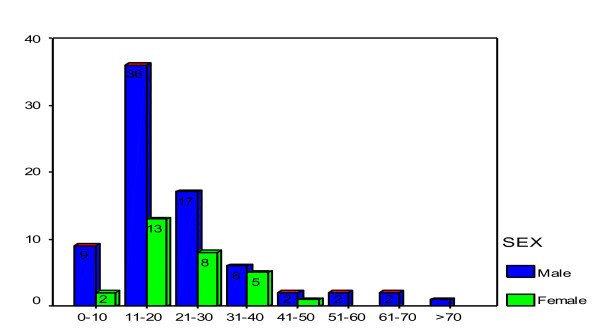
BACKGROUND: Typhoid intestinal perforation is still prevalent in many developing countries. Despite the advances in the management, the outcome in these patients in resource limited countries is still very poor. This study was to review our experiences on the surgical management of typhoid intestinal perforation and to determine the prognostic factors for mortality in our local setting. METHODS: This was a combined retrospective and prospective study of patients who were operated for typhoid intestinal perforation at Bugando Medical Centre between August 2006 and September 2011. Data collected were analyzed using SPSS computer software version 15. RESULTS: A total of 104 patients were studied representing 8.7% of typhoid fever cases. Males were affected twice more than the females (2.6:1). Their ages ranged from 8 to 76 years with a median age of 18.5 years. The peak age incidence was in the 11-20 years age group. Fever and abdominal pain were the most common presenting symptoms and majority of the patients (80.8%) perforated between within 14 days of illness. Chest and abdominal radiographs revealed pneumoperitonium in 74.7% of cases. Ultrasound showed free peritoneal collection in 85.7% of cases. Nine (10.2%) patients were HIV positive with a median CD4+ count of 261 cells/μl. The perforation-surgery interval was more than 72 hours in 90(86.5%) patients. The majority of patients (84.6%) had single perforations and ileum was the most common part of the bowel affected occurring in 86.2% of cases. Simple closure of the perforations was the most commonly performed procedure accounting for 78.8% of cases. Postoperative complication rate was 39.4% and surgical site infection was the most frequent complication in 55.5% of cases. Mortality rate was 23.1% and it was statistically significantly associated with delayed presentation, inadequate antibiotic treatment prior to admission, shock on admission, HIV positivity, low CD4 count (< 200 cells/μl), high ASA classes (III-V), delayed operation, multiple perforations, severe peritoneal contamination and presence of postoperative complications (P < 0.001). The median overall length of hospital stay was 28 days. CONCLUSION: Typhoid intestinal perforation is still endemic in our setting and carries high morbidity and mortality. This study has attempted to determine the factors that statistically influence mortality in typhoid perforation in our environment. Appropriate measures focusing at these factors are vital in order to deliver optimal care for these patients in this region.
Overview
The claims and statistics of this paper haven’t been checked yet.
Free: it reads the open-access text and checks the first 5 claims that cite a source we can check. Create a free account to check every claim.
Integrity signals
Registry
Cites
Statistics
Figures
Verification
Claims the paper makes
The claims and statistics of this paper haven’t been checked yet.
Free: it reads the open-access text and checks the first 5 claims that cite a source we can check. Create a free account to check every claim.
Claims other papers make about this one
Each is checked against this paper’s own text: does it say what the citing paper says it does?
The source backs part of the claim, not all of it — or backs it for a different population, condition or comparison.
In the citing paper
“Among hospital survivors, the delayed admission group had a longer hospital stay, higher mortality, and higher rates of mechanical ventilation and central venous catherization.”
From Surviving Sepsis Campaign: International Guidelines for Management of Sepsis and Septic Shock 2021. (2021) · cites this paper as [87]
Experimental — accuracy not yet measuredThe source backs part of the claim, not all of it — or backs it for a different population, condition or comparison.
In the citing paper
“Limited data from resource-limited settings suggest that timely administration of antimicrobials in patients with sepsis and septic shock is beneficial and potentially feasible [121–126].”
From Surviving sepsis campaign: international guidelines for management of sepsis and septic shock 2021 (2021) · cites this paper as [121]
Experimental — accuracy not yet measuredThe check wasn’t confident either way, so it gives no verdict — never disputed.
In the citing paper
“Mortality increased when ED stay exceeded 6 hours (17% vs 12.9%, p < 0.001).”
From Surviving Sepsis Campaign: International Guidelines for Management of Sepsis and Septic Shock 2021. (2021) · cites this paper as [87]
Experimental — accuracy not yet measured
Self-check
Percentages, sums and reported differences re-computed from the paper’s own numbers.
The self-check needs the paper’s full text.
Citations
Cites
Principles and Practice of Infectious Diseases.
(1991) · Annals of Internal Medicine · doi:10.7326/0003-4819-114-9-818_5 · Cited by 12,025
Mandell, Douglas, and Bennett's Principles and Practice of Infectious Diseases
(2015) · Elsevier eBooks · doi:10.1016/c2012-1-00075-6 · Cited by 2,577
The global burden of typhoid fever.
(2004) · Europe PMC (PubMed Central) · Cited by 1,965
ASA classification and perioperative variables as predictors of postoperative outcome
Wolters, U., Wolf, T., Stützer, H., & Schröder, T. (1996) · British Journal of Anaesthesia · doi:10.1093/bja/77.2.217 · Cited by 1,073
Multidrug-Resistant Salmonella typhi: A Worldwide Epidemic
Rowe, B., Ward, L. R., & Threlfall, E. J. (1997) · Clinical Infectious Diseases · doi:10.1093/clinids/24.supplement_1.s106 · Cited by 405 · cited 1×
“typhi resulting from inappropriate and indiscriminate use of antibiotics are among the hallmarks of the disease [6,18].”
BackgroundCurrent concepts in the diagnosis and treatment of typhoid fever
Bhutta, Z. A. (2006) · BMJ · doi:10.1136/bmj.333.7558.78 · Cited by 375
Mawalla, B., Mshana, S. E., Chalya, P. L., Imirzalioglu, C., & Mahalu, W. (2011) · BMC Surgery · doi:10.1186/1471-2482-11-21 · Cited by 260 · cited 1×
“However, a recent study done in our centre has shown resistance of the organisms to this combination and highly sensitive to Imipenem and meropenem [51].”
BackgroundSelf-citationSalmonella Species, Including Salmonella Typhi
PEGUES, D. A., & MILLER, S. I. (2010) · Mandell, Douglas, and Bennett's Principles and Practice of Infectious Diseases · doi:10.1016/b978-0-443-06839-3.00223-x · Cited by 253
Principles of Medicine in Africa
(2013) · Cambridge University Press eBooks · doi:10.1017/cbo9780511751660 · Cited by 120
The prognostic factors in typhoid ileal perforation: a prospective study of 50 patients.
Adesunkanmi, A. R. K., & Ajao, O. G. (1997) · PubMed · Cited by 114
Research works printed but not linked: 2
- Kotan C Kosem M Tuncer I Kisli E Sönmez R Çıkman Ö Söylemez Ö Arslantürk H Typhoid intestinal perforation: Review of 11 cases Kolon Rektum Hast Derg 2000 7 6 10
- Khan SH Aziz SA Ul-Haq MI Perforated peptic ulcers: A review of 36 cases Professional Med J 2011 7 1 124 127
Cited by
Surviving sepsis campaign: international guidelines for management of sepsis and septic shock 2021
Evans, L., Rhodes, A., Alhazzani, W., Antonelli, M., Coopersmith, C. M., French, C., Machado, F. R., Mcintyre, L., Ostermann, M., Prescott, H. C., et al. (2021) · Intensive Care Medicine · doi:10.1007/s00134-021-06506-y · Cited by 5,082
Surviving Sepsis Campaign: International Guidelines for Management of Sepsis and Septic Shock 2021.
Evans, L., Rhodes, A., Alhazzani, W., Antonelli, M., Coopersmith, C. M., French, C., Machado, F. R., Mcintyre, L., Ostermann, M., Prescott, H. C., et al. (2021) · Critical Care Medicine · doi:10.1097/ccm.0000000000005337 · Cited by 2,935
Mogasale, V., Maskery, B., Ochiai, R. L., Lee, J. S., Mogasale, V. V., Ramani, E., Kim, Y. E., Park, J. K., & Wierzba, T. F. (2014) · The Lancet Global Health · doi:10.1016/s2214-109x(14)70301-8 · Cited by 569
Surviving Sepsis Campaign: International Guidelines for Management of Sepsis and Septic Shock 2026
Prescott, H. C., Antonelli, M., Alhazzani, W., Møller, M. H., Alshamsi, F., Azevedo, L. C. P., Belley-Cote, E., De Waele, J., Derde, L., Dionne, J. C., et al. (2026) · Intensive Care Medicine · doi:10.1007/s00134-026-08361-1 · Cited by 141
Complications and mortality of typhoid fever: A global systematic review and meta-analysis
Marchello, C. S., Birkhold, M., & Crump, J. A. (2020) · Journal of Infection · doi:10.1016/j.jinf.2020.10.030 · Cited by 140
Surviving Sepsis campaign: international guidelines for Management of Sepsis and Septic Shock 2026
Prescott, H. C., Antonelli, M., Alhazzani, W., Møller, M. H., Alshamsi, F., Azevedo, L. C. P., Belley-Cote, E., De Waele, J., Derde, L., Dionne, J. C., et al. (2026) · Critical Care Medicine · doi:10.1097/ccm.0000000000007075 · Cited by 117
The Burden of Typhoid Fever in Sub-Saharan Africa: A Perspective
Kim, C. L., Espinoza, L. M. C., Vannice, K. S., Tadesse, B. T., Owusu-Dabo, E., Rakotozandrindrainy, R., Jani, I. V., Teferi, M., Soura, A. B., Lunguya, O., et al. (2022) · Research and Reports in Tropical Medicine · doi:10.2147/rrtm.s282461 · Cited by 81
“Typhi).65 Vaccination campaigns carried out in endemic areas might limit not only the incidence but also the spread of typhoid fever, thereby reducing the need for antibiotics and the development of AMR.”
BackgroundInfluentialFatima, M., Kumar, S., Hussain, M., Memon, N. M., Vighio, A., Syed, M. A., Chaudhry, A., Hussain, Z., Baig, Z. I., Baig, M. A., et al. (2021) · JMIR Public Health and Surveillance · doi:10.2196/27268 · Cited by 52
“Even though many advancements have been made in patient care, morbidity and mortality rates remain high among patients with typhoid perforation, especially in low- and middle-income countries [10,11].”
BackgroundPoint-of-Care Ultrasound: Applications in Low- and Middle-Income Countries
Tran, T. T., Hlaing, M., & Krause, M. (2021) · Current anesthesiology reports · doi:10.1007/s40140-020-00429-y · Cited by 49
“A study performed in Tanzania looked at the prognostic factors for mortality in patients who presented with bowel perforation secondary to typhoid [38].”
BackgroundZhang, J., Yan, W., Dong, Y., Luo, X., Miao, H., Maimaijuma, T., Xu, X., Jiang, H., Huang, Z., Qi, L., et al. (2024) · Journal of Thoracic Disease · doi:10.21037/jtd-24-1191 · Cited by 53
“Limited data from resource-limited context suggest that timely administration of antibiotics is beneficial and potentially feasible in patients with sepsis and septic shock (123-128).”
The unrecognized burden of typhoid fever
Obaro, S., Tam, P. I., & Mintz, E. D. (2016) · Expert Review of Vaccines · doi:10.1080/14760584.2017.1255553 · Cited by 47
“Although the surgical literature is replete with case reports and case series [71,72], very few studies have examined risk factors for TIP in acute TF [73].”
BackgroundInfluentialMabewa, A. A., Seni, J., Chalya, P. L., Mshana, S. E., & Gilyoma, J. M. (2015) · World Journal of Emergency Surgery · doi:10.1186/s13017-015-0042-5 · Cited by 37
“Francis Hospital Nsambya Kampala-Uganda [21] and other two previous studies in the same hospital [10, 11].”
BackgroundResultSelf-citationIntra-abdominal sepsis—Epidemiology, aetiology and management
Hadley, G. P. (2014) · Seminars in Pediatric Surgery · doi:10.1053/j.sempedsurg.2014.06.008 · Cited by 36
For the sepsis in resource-limited settings–expert consensus recommendations group of the European Society of Intensive Care Medicine (ESICM) and the Mahidol-Oxford Research Unit (MORU) in Bangkok, T., Thwaites, C. L., Lundeg, G., & Dondorp, A. M. (2016) · Intensive Care Medicine · doi:10.1007/s00134-016-4415-3 · Cited by 35
“We found weak evidence that timely surgery was beneficial in typhoidal gastro-intestinal perforations [5, 12].”
Caronna, R., Boukari, A. K., Zaongo, D., Hessou, T. K., Gayito, R. C., Ahononga, C., Adeniran, S., & Priuli, G. (2013) · BMC Gastroenterology · doi:10.1186/1471-230x-13-102 · Cited by 26
“This last datum can be interpreted as a result of late access of the patient to a hospital, which many authors also consider to be a relevant factor for increased mortality [9,10,13,17,18,20,21,25,34,36-38].”
BackgroundResultInfluentialMabula, J. B., Chalya, P. L., Mchembe, M. D., Kihunrwa, A., Massinde, A. N., Chandika, A. B., & Gilyoma, J. M. (2012) · World Journal of Emergency Surgery · doi:10.1186/1749-7922-7-29 · Cited by 31
“The management of stoma remains difficult in developing countries because of the shortage of suitable equipment in this respect and peristomal ulceration remains a major problem [35].”
BackgroundSelf-citationHamad, D. M., Yousef, Y., Caminsky, N., Guadagno, E., Tran, V. A., Laberge, J., Emil, S. G. S., & Poenaru, D. (2019) · Journal of Pediatric Surgery · doi:10.1016/j.jpedsurg.2019.11.001 · Cited by 28
A plausible explanation for male dominance in typhoid ileal perforation
Khan, M. (2012) · Clinical and Experimental Gastroenterology · doi:10.2147/ceg.s36569 · Cited by 33
Collaborative, G., Anyomih, T. T. K., Drake, T. M., Glasbey, J., Fitzgerald, J., Ots, R., Harrison, E. M., Tabiri, S., Bhangu, A. A., Ademuyiwa, A. O., et al. (2018) · World Journal of Surgery · doi:10.1007/s00268-018-4624-8 · Cited by 18
Abbas, A., Laverde, R., Yap, A., Stephens, C. Q., Samad, L., Seyi‐Olajide, J. O., Ameh, E. A., Ozgediz, D., Lakhoo, K., Bickler, S. W., et al. (2023) · World Journal of Surgery · doi:10.1007/s00268-023-07097-z · Cited by 21
“[13, 14].”
Qazi, S. H., Yousafzai, M. T., Saddal, N. S., Dehraj, I. F., Thobani, R., Akhtar, A., Syed, J. R., Kazi, A. M., Hotwani, A., Rahman, N., et al. (2020) · Clinical Infectious Diseases · doi:10.1093/cid/ciaa1309 · Cited by 25
“The study reported male preponderance and higher incidence in the age group 11–20 years old [26].”
BackgroundGosselin, R. A., Charles, A. G., Joshipura, M., Mkandawire, N. C., Mock, C., Price, R. R., & Spiegel, D. A. (2015) · World Bank, Washington, DC eBooks · doi:10.1596/978-1-4648-0346-8_ch3 · Cited by 15
Typhoid ileal perforation in a semi-urban tertiary health institution in north-eastern Nigeria
Grema, B. A., Aliyu, I., Michael, G. C., Abubakar, M. I.-O., Fikin, A., Abubakar, B. M., & Olusegun, S. (2018) · South African Family Practice · doi:10.1080/20786190.2018.1481604 · Cited by 14
“Typhoid ileal perforation occurs by the end of the second week or early in the third week,9 but in developing countries with greater disease burden it tends to occur earlier in the second week of illness; Chalya et al.27 suggested depressed immunity, virulent isolates different from those from developed countries, hyp…”
BackgroundResultPredictors of mortality in children with typhoid ileal perforation in a Nigerian tertiary hospital
Talabi, A. O., Etonyeaku, A. C., Sowande, O. A., Olowookere, S. A., & Adejuyigbe, O. A. (2014) · Pediatric Surgery International · doi:10.1007/s00383-014-3592-9 · Cited by 14
“The mean hospital stay of 21 days for children who survived agrees with those of other studies [2, 5, 10].”
BackgroundResultBirkhold, M., Datta, S., Pak, G. D., Im, J., Ogundoyin, O. O., Olulana, D. I., Lawal, T. A., Afuwape, O., Kehinde, A. O., Phoba, M.-F., et al. (2023) · Open Forum Infectious Diseases · doi:10.1093/ofid/ofad138 · Cited by 18
Infection management in patients with sepsis and septic shock in resource-limited settings
Thwaites, L., Lundeg, G., & Dondorp, A. M. (2016) · Intensive Care Medicine · doi:10.1007/s00134-016-4547-5 · Cited by 12
Khalilur Rahman, A., Krishnaswamy, J., Muthukumaran, G., & Jayaprakash, S. P. (2018) · International Surgery Journal · doi:10.18203/2349-2902.isj20180027 · Cited by 11
Spectrum of complications in childhood Enteric Fever as reported in a Tertiary Care Hospital
Iftikhar, A., Bari, A., Jabeen, U., & Bano, I. (2018) · Pakistan Journal of Medical Sciences · doi:10.12669/pjms.345.15262 · Cited by 11
Ogbuanya, A. U.-O., Ugwu, N. B., Enemuo, V. C., Nnadozie, U. U., Eni, U. E., Ewah, R. L., Ajuluchuku, E. U., Umezurike, D. A., & Onah, L. N. (2023) · African Journal of Emergency Medicine · doi:10.1016/j.afjem.2023.08.005 · Cited by 10
“Majority of the previous discussions on this subject in Africa were based on “ all age ranges or limits ” and not on standardized chronological age entities like elderly, middle-aged or young patients [23-25, 29 , 30 ].”
BackgroundTyphoid intestinal perforation: Analysis of the outcome of surgical treatment in Kano, Nigeria
Anyanwu, L.-J., Sheshe, A., Mohammad, A., Muhammad, A. B., & Obaro, S. (2018) · Archives of Medicine and Health Sciences · doi:10.4103/amhs.amhs_119_17 · Cited by 10
“[2,20] It has been shown that the volume of purulent/feculent matter contained within the peritoneal cavity is an indication of the magnitude of peritoneal contamination.[2,4] In this present study, a peritoneal aspirate volume >1000 ml was significantly associated with a postoperative mortality.”
BackgroundResultInfluentialAnyanwu, L.-J. C., Mohammad, A., Abdullahi, L., Farinyaro, A. U., & Obaro, S. (2017) · Journal of Pediatric Surgery · doi:10.1016/j.jpedsurg.2017.11.058 · Cited by 9
Complications and mortality of typhoid fever: an updated global systematic review and meta-analysis
Murthy, S., Hagedoorn, N. N., Faigan, S., Rathan, M. D., Marchello, C. S., & Crump, J. A. (2025) · The Lancet Infectious Diseases · doi:10.1016/s1473-3099(25)00551-1 · Cited by 14
Case Report: Typhoid Fever Complicated by Ileal Perforation in an Urban Slum of Dhaka, Bangladesh
Khanam, F., Darton, T. C., Ross, A. G., Zaman, K., Pollard, A. J., Clemens, J. D., & Qadri, F. (2021) · American Journal of Tropical Medicine and Hygiene · doi:10.4269/ajtmh.20-1448 · Cited by 8
Typhoid perforation: Post-operative Intensive Care Unit care and outcome
Akinwale, M. O., Sanusi, A. A., & Adebayo, O. K. (2016) · African Journal of Paediatric Surgery · doi:10.4103/0189-6725.194664 · Cited by 8
“typhi.[3] The systemic involvement in typhoid fever can result in extra‐intestinal complications such as encephalopathy, meningitis, hepatitis, myocarditis and pneumonia while the most common gastrointestinal complication is haemorrhage.”
BackgroundInfluentialInfection Management in Patients with Sepsis and Septic Shock in Resource-Limited Settings
Thwaites, L., Lundeg, G., Dondorp, A. M., Adhikari, N. K. J., Nakibuuka, J., Jawa, R. S., Mer, M., Murthy, S., Schultz, M. J., Thien, B. N., et al. (2019) · Springer eBooks · doi:10.1007/978-3-030-03143-5_8 · Cited by 12
Health Considerations for HIV-Infected International Travelers
Bourque, D. L., Solomon, D. A., & Sax, P. E. (2019) · Current Infectious Disease Reports · doi:10.1007/s11908-019-0672-y · Cited by 6
Adejumo, A., Alegbejo-Olarinoye, M., Akims, S., & Akanbi, O. O. (2024) · Annals of African Medicine · doi:10.4103/aam.aam_111_23 · Cited by 7
Allodé, A. S., Dossou, F. M., Hodonou, A. M., Seto, M., Gbéssi, D. G., Sambo, B. T., & Olory-Togbé, J.-L. (2017) · International Surgery Journal · doi:10.18203/2349-2902.isj20171145 · Cited by 5
“Various surgical methods are controversial in the literature.(17,18) The one-time treatment is favored by authors even though both techniques usually employed, sleeve resection and excision-suture, are those which cause digestive complications such as enterocutaneous fistulae.”
MethodSurgical management and prognosis of perforation secondary to typhoid fever
Jain, S., Meena, L. N., & Ram, P. (2016) · Tropical Gastroenterology · doi:10.7869/tg.336 · Cited by 5
Agrawal, P., & Imbisat, M. Z. (2019) · International Surgery Journal · doi:10.18203/2349-2902.isj20195179 · Cited by 5
Extensively Drug-Resistant Salmonella typhi Infection: From Pill to Scalpel
Rahim, F., Amin, S., Noor, M. S., Hadi, K. N., & Aftab, S. (2022) · Cureus · doi:10.7759/cureus.25840 · Cited by 5
“Discussion The surgical complications of typhoid fever cause significant morbidity and mortality in many parts of Africa and Asia where standard medical facilities are not yet readily available [12].”
BackgroundAnupama Pujar, K. (2013) · JOURNAL OF CLINICAL AND DIAGNOSTIC RESEARCH · doi:10.7860/jcdr/2013/6632.3366 · Cited by 4
Typhoid intestinal perforations in Northern Ghana
Kuubiere, C. B., Mogre, V., Majeed, S. F., & Alhassan, A. (2014) · DOAJ (DOAJ: Directory of Open Access Journals) · Cited by 4
Sepsis Management in Resource-Limited Settings
Arslantaş, M. K., & Özdemir, H. (2019) · Anesthesia & Analgesia · doi:10.1213/ane.0000000000004536 · Cited by 4
Surgical Management of Typhoid Ileum Perforations: A Systematic Review
Patel, A., Kelly, P. M., & Mulenga, M. (2019) · Medical Journal of Zambia · doi:10.55320/mjz.46.4.245 · Cited by 4
Transfer factor treatment in management of peritonitis condition: An experimental study in rat
Habar, T. R., Islam, A. A., Hatta, M., Warsinggih, W., Mahmudi, A., Massi, M. N., Bukhari, A., Kusmayadi, D. D., Diposarosa, R., & Mappiwali, A. (2021) · Annals of Medicine and Surgery · doi:10.1016/j.amsu.2021.102755 · Cited by 4
“7%) and obstruction with or without intestinal gangrene was present in 9 (13%) [9,10].”
BackgroundIndia, J. (2015) · Kenyatta University Institutional Repository (Kenyatta University) · Cited by 4
Hagedoorn, N. N., Birkhold, M., Murthy, S., Faigan, S., Rathan, M. D., Marchello, C. S., & Crump, J. A. (2024) · medRxiv · doi:10.1101/2024.06.28.24309663 · Cited by 6
Small bowel perforations: Review of 33 cases
Seth, S., & Agrawal, K. (2016) · Medical Journal of Dr D Y Patil University · doi:10.4103/0975-2870.177656 · Cited by 3
Occurrence of typhoid among the local population of district Dir Lower: A laboratory based study
Hussain, A., Ahmad, T., Ullah, I., Khan, M. M., Rahim, F., Ohia, C., & Jadoon, M. A. (2019) · Polish Annals of Medicine · doi:10.29089/2019.19.00071 · Cited by 3
Typhoid and paratyphoid fever co-infection in children from an urban slum of Delhi
Dutta, A., More, D., Tupaki‐Sreepurna, A., Sinha, B., Goyal, N. P., & Rongsen‐Chandola, T. (2020) · IDCases · doi:10.1016/j.idcr.2020.e00717 · Cited by 3
“This co-infection may be more common than suspected and is often missed due to indistinguishable clinical features [14,15].”
BackgroundProfile of Abdominal Surgical Complications of Enteric Fever in Children in a Developing Country
Chukwubuike, K. (2020) · Sudan Journal of Medical Sciences · doi:10.18502/sjms.v15i3.7275 · Cited by 3
“This finding has also been reported by other series on typhoid intestinal perforation [20, 21].”
ResultSingh, M., Dalal, S., & Gera, M. (2021) · International Surgery Journal · doi:10.18203/2349-2902.isj20213982 · Cited by 3
Typhoid ileal perforation in a semi-urban tertiary health institution in north-eastern Nigeria
Grema, B. A., Aliyu, I., Michael, G. C., Abubakar, M. I.-O., Fikin, A. G., Abubakar, B. M., & Olusegun, S. (2018) · South African Family Practice · doi:10.4102/safp.v60i5.4921 · Cited by 3
Faruku, N., Sarkinfada, F., Hafiz, T. R., Magaji, U. F., Idris, A. K., Musa, S., Umar, K., Khalid, I. M., Nura, M. S., Sani, N. M., et al. (2024) · Dutse Journal of Pure and Applied Sciences · doi:10.4314/dujopas.v10i1c.25 · Cited by 4
“This outcome is similar to the research conducted by Chalya (2012), Charles et al .”
ResultSaini, P., Gupta, P., Sharma, A., Agarwal, N. K., Kaur, N., & Gupta, A. (2013) · Tropical Doctor · doi:10.1177/0049475513489827 · Cited by 3
“Cecum and ascending colon may be affected by direct bacterial invasion(11) but, otherwise, colonic involvement is very rare.(5,11) Thus, with a post-operative diagnosis of enteric ileal perforation, it may not be injudicious to assume that there is a miniscule chance of finding an abnormality on a contrast study in th…”
BackgroundKungu, F., Attipoe, I. M., & Donkor, E. S. (2026) · International Health · doi:10.1093/inthealth/ihag022 · Cited by 3
Pilot Case Series Demonstrating Unsuspected Ulceration in Perforated Ileum from Typhoid Fever
Johnson, O. K. (2016) · Journal of Gastrointestinal & Digestive System · doi:10.4172/2161-069x.1000445 · Cited by 2
Peritonitis in Children: Experience in a Tertiary Hospital in Enugu, Nigeria
Emeka, C. K. (2020) · Clinical surgery research communications · doi:10.31491/csrc.2020.09.056 · Cited by 2
“A study conducted in Tanzania also adopted this method of treatment for typhoid intestinal perforation ([21]).”
MethodPediatric Stomas: A Study in a Teaching Hospital, Our Experience
Nkiruka, O., & Unebike, E. W. (2023) · Journal of Clinical and Medical Reviews · doi:10.58489/2836-2330/010 · Cited by 2
Godefroy, N. B., Muhumuza, J., Molen, S. F., Waziri, M. A., Kagenderezo, B. P., Vahwere, B. M., Sikakulya, F. K., Mauricio, W., Wandabwa, J., Kagoro, F. B., et al. (2024) · Perioperative Medicine · doi:10.1186/s13741-024-00425-4 · Cited by 2
Dry Gangrene in Children with Typhoid Intestinal Perforation: A Report of Two Cases
Anyanwu, L.-J. C., Mohammad, A., Abdullahi, L., Ibrahim, M. U., Farinyaro, A. U., Aliyu, M. S., & Obaro, S. (2018) · Case Reports in Surgery · doi:10.1155/2018/7097014 · Cited by 2
“Also, the diagnosis of typhoid intestinal perforation in these patients was made on the basis of clinical history of fever followed by an abdominal pain and the intraoperative findings of intraperitoneal soiling and an oval perforation in the long axis of the antimesenteric border of the ileum, which was acutely infla…”
BackgroundTyphoid Perforation Associated With Rectal Bleeding in HIV- Infected Patient
Weledji, E. P., Lemoupa, S. M., Njunda, A. L., & Nsagha, D. S. (2014) · Gastroenterología y Hepatología · doi:10.3968/gh.v1i1.5257 · Cited by 2
“The process involves both bacterial factors and the host inflammatory response([4]).”
BackgroundA Clinical Profile of Typhoid Perforation of Bowel in a Tertiary Care Centre
Bhamre, S., & Chandak, S. S. (2016) · MVP Journal of Medical Sciences · doi:10.18311/mvpjms/2016/v3/i2/726 · Cited by 2
Kadia, B. M., Aroke, D., Abanda, M. H., Njim, T. N., & Dimala, C. A. (2017) · Case Reports in Surgery · doi:10.1155/2017/9424237 · Cited by 2
“Studies reviewing operative management of TIP in other resource-poor settings report surgical site infection as the most frequent postoperative complication of TIP repair [5, 26, 27].”
BackgroundInfluentialMohamed, A., El-Hany, A., Mohammed, S., & Hassan, A. (2020) · Assiut Scientific Nursing Journal · doi:10.21608/asnj.2020.80844 · Cited by 3
Coinfection of Typhoid Fever With Tuberculosis: A Challenge to Surgical Management
Anusha, D., Sundaramurthi, S., Vijayakumar, C., Elamurugan, T., & Jagdish, S. (2020) · Cureus · doi:10.7759/cureus.8540 · Cited by 2
“Ultrasound evaluation of the abdomen can reveal free fluid with particulate matter, bowel dilatation, and enlarged mesenteric lymph nodes [6].”
BackgroundKhorwal, B., Yadav, K. S., Joshi, V., Irfan, I., Sharma, M. K., & Bhaskar, M. (2015) · Journal of Evolution of Medical and Dental Sciences · doi:10.14260/jemds/2015/2217 · Cited by 2
Mujahid, N. S., Mohammed, Y., Yusuf, I., Sani, N. M., Abdulkadi̇r, B., Nasiru, M., & Wada, M. (2020) · UMYU Journal of Microbiology Research (UJMR) · doi:10.47430/ujmr.2052.016 · Cited by 1
Emeka, C. K. (2021) · Global Journal of Perioperative Medicine · doi:10.17352/gjpm.000009 · Cited by 1
“Other studies on typhoid perforation also reported primary closure of intestinal perforation as an effective treatment modality [20,21].”
BackgroundTropical Infectious Disease Medicine for Surgeons: A Primer
Steffes, B. C., & Juckett, R. G. (2017) · Springer eBooks · doi:10.1007/978-3-319-49482-1_15 · Cited by 1
Bennett, A. N., Cole, A. L., & Gunn, J. S. (2026) · Infection and Immunity · doi:10.1128/iai.00028-26 · Cited by 1
Atamanalp, S. S., Özoğul, B., Kısaoğlu, A., Arslan, S., Korkut, E., & Karadeniz, E. (2015) · Eurasian Journal of Medicine · doi:10.5152/eurasianjmed.2015.136 · Cited by 1
“Early surgical intervention reduces the prognosis in TIP, and as a surgical procedure, primary closure is preferred in proper cases, while ileostomy is advised in patients with severe abdominal contamination or with ischemic, inflamed, and oedematous intestine [3-5, 7, 8, 10-14], as was applied in our series.”
MethodCaecal typhoid perforation: case report
Sree, S., & Utaal, M. S. (2016) · International Surgery Journal · doi:10.18203/2349-2902.isj20162861 · Cited by 1
Typhoid ileal perforation in Shisong, Northwestern Cameroon
Alegbeleye, B. J. (2019) · doi:10.36811/osjs.2019.110003 · Cited by 1
“9% of enteric fever cases [54-58], but in West Africa, higher rates of 10%-33% have been reported [50-53].”
BackgroundChanania, R. K., Goyal, L., Gupta, S., Chanania, G., & Heer, S. (2022) · Annals of International medical and Dental Research · doi:10.53339/aimdr.2022.8.1.15 · Cited by 1
FREQUENCY OF LEAKAGE AFTER PRIMARY REPAIR OF TYPHOID ILEAL PERFORATION
Muqeem, M., Asghar, I., Kumari, P., Khatoon, S., Shaikh, A., & Fatima, S. (2024) · Journal of Population Therapeutics and Clinical Pharmacology · doi:10.53555/jptcp.v31i1.4214 · Cited by 1
Ascaris Peritonitis in a Pediatric Patient With Typhoid Fever
Tumwesige, C., Nek, A. J., Daniel, O., Meghoo, C., & Ebine, J. (2025) · Cureus · doi:10.7759/cureus.81813 · Cited by 1
“The two surgical techniques commonly used to manage enteric perforations are primary repair and intestinal resection with anastomosis [14].”
InfluentialIsolated Rectal Perforation Presenting as Peritonitis in a Child with Enteric Fever
Chaubey, D., Verma, A., Pandey, A., & Gupta, A. (2017) · Journal of Child Science · doi:10.1055/s-0037-1606571 · Cited by 1
Marwah, S. (2017) · Hot topics in acute care surgery and trauma · doi:10.1007/978-3-319-59704-1_10 · Cited by 1
Sravanam, P., Massenga, A., Bugimbi, M., Mirambo, M. M., & Chalya, P. L. (2018) · Tanzania journal of health research/Tanzania Journal of Health Research · doi:10.4314/thrb.v20i4.2 · Cited by 1
Self-citationTyphoid Intestinal Perforation in Children: Still a Persistent Problem in a Developing Country
Emeka, C. K. (2020) · Clinical surgery research communications · doi:10.31491/csrc.2020.06.052 · Cited by 1
“This was recorded in 89% of our patients similar to the reports of other workers [25, 26].”
BackgroundResultInfluentialElectrohomoeopathy Medicine in Covid-19 A Multicenter Clinical Observational Study
Pandey, S. K., Jat, R., & Singh, H. (2021) · Journal of Clinical Case Studies Reviews & Reports · doi:10.47363/jccsr/2020(3)160 · Cited by 1
Kazuma, S. M. E., Chirengendure, B., Musonda, P., Musowoya, J., Chibwe, F., Mumbwe, M. C., & Inambao, M. (2021) · East and Central African journal of surgery · doi:10.4314/ecajs.v26i1.7 · Cited by 1
Ouedraogo, S., Ouangré, E., Zida, M., Diallo, I., & Béré, B. (2019) · Research Square · doi:10.21203/rs.2.9680/v1 · Cited by 1
“Indeed, mortality reaches 20% in some series [10,11,20].”
BackgroundSani, M. N., Mohammed, Y., Yusuf, I., Sani, N. M., Abdulkadi̇r, B., & Wada, M. (2020) · Research Square · doi:10.21203/rs.3.rs-89772/v1 · Cited by 1
Quealee, C., Abraha, D., Kabuye, U., Kiswezi, A., & Ibe, U. M. (2024) · Research Square · doi:10.21203/rs.3.rs-4271956/v1 · Cited by 1
Antibiotics, Antivirals, and Antifungals in Critical Care
Shamshirsaz, A. A., & Vaught, A. “. J. (2024) · Wiley eBooks · doi:10.1002/9781119820260.ch19 · Cited by 1
Akireddy, R. G. R., Kumar, K., & Daivavaram, D. G. J. P. (2016) · IOSR Journal of Dental and Medical Sciences · doi:10.9790/0853-1509050116
Role of ileostomy in ileal perforation and its complications
Tharwani, K., & Bharaney, R. P. (2016) · Hellenic Journal of Surgery · doi:10.1007/s13126-016-0341-7
“Pneumoperitoneum has been reported in 52% to 82% in the studies by Archampong, Vaidyanathan, Hadley, Tacylidiz, Chalya and Chaterjee [23,14,21,22,19,24].”
BackgroundInfluentialRaghupathy, R., Lakshmypathy, L., Vaithiswaran, A., Franklin, A., & Kailasam, S. (2016) · Journal of Evolution of Medical and Dental Sciences · doi:10.14260/jemds/2016/1361
Radiological diagnosis of pneumoperitoneum in children with typhoid intestinal perforation
Anyanwu, L.-J. C., Mohammad, A., Saleh, M. K., Abdullahi, L., Farinyaro, A. U., & Obaro, S. (2018) · East and Central African journal of surgery · doi:10.4314/ecajs.v22i2.7
“22 (2) Table 1: Summary of radiographic findings in 54 cases of pneumoperitoneum in children, resulting from typhoid intestinal perforation Sign No.”
BackgroundInfluentialFinal clinical outcome after interventional procedures in enteric perforations with peritonitis
Singh, J., & Singh, R. P. (2013) · JOURNAL OF GASTROINTESTINAL INFECTIONS · doi:10.5005/jogi-3-1-55
Mahesh, P., Ali, S. A. S., Kaludi, Z. A., & Moosa, F. A. (2019) · The Professional Medical Journal · doi:10.29309/tpmj/2019.26.10.1566
“6 Median: 30 Mode: 30 Range: 85(5-90) Enlarge mesenteric lymph”
Emeka, C. K. (2020) · Advances in Surgical Sciences · doi:10.11648/j.ass.20200801.11
Management of traumatic and non traumatic hollow visceral perforation in North India
Pal, N., Mishra, V., Amit, J., Poonam, P., & Jain, U. (2020) · International Journal of Scientific Reports · doi:10.18203/issn.2454-2156.intjscirep20200195
“The diagnosis of typhoid intestinal perforation was made by clinical evaluation, laboratory investigation, radiological investigations and operative findings such as perforation on antimesenteric borde.(18) Among the less common sites of perforations in the present study are, five patients of gall bladder, perforation…”
MethodVerma, R. K., Ahamad, M. N., Mandal, N. S., Kamini, S., & Jana, D. (2020) · INTERNATIONAL JOURNAL OF SCIENTIFIC RESEARCH · doi:10.36106/ijsr/2436742
“As for wound infection was concerned two (2) were in primary closure group and four (4) were in ileostomy group.”
BackgroundPerforazione ileale da febbre tifoide
Piqué, M., Ladisa, E., Brasili, L., Putoto, G., & Iughetti, L. (2021) · Medico e Bambino - Pagine Elettroniche · doi:10.53126/mebxxiv280
Generalized peritonitis lead to shock: Diagnosis and management
Gofur, N. R. P., Gofur, A. R. P., tyas, S., Gofur, R. N. R. P., Kahdina, M., & Putri, H. M. (2021) · doi:10.52768/jjgastro/1004
Sani, M. N., Mohammed, Y., Yusuf, I., Sani, N. M., Abdulkadi̇r, B., & Wada, M. (2020) · doi:10.21203/rs.3.rs-71755/v1
“A serious complication of typhoid fever is perforation of the intestine and remains a signi cant surgical problem in developing countries where patients usually perforated within 14 days of illness (Chalya et al., 2012).”
Background
Metadata
- Authors
- Chalya, P. L., Mabula, J. B., Koy, M., Kataraihya, J. B., Jaka, H., Mshana, S. E., Mirambo, M., Mchembe, M. D., Giiti, G., & Gilyoma, J. M.
- Affiliations
- Catholic University of Health and Allied Sciences (TZ)
- Muhimbili University of Health and Allied Sciences (TZ)
- Corresponding author
- Chalya, Phillipo L
- Venue
- World Journal of Emergency Surgery
- Published
- 2012
- Volume
- 7
- Issue
- 1
- Pages
- 4
- ISSN
- 1749-7922 (ISSN-L)
- PMC
- PMC3311140
- OpenAlex
- W2120127772
- Cited by
- 123
- References
- 53
- Citations by year
- 2026: 9 · 2025: 5 · 2024: 11 · 2023: 12 · 2022: 6 · 2021: 12 · 2020: 14 · 2019: 10 · 2018: 9 · 2017: 6 · 2016: 12 · 2015: 5 · 2014: 6 · 2013: 4 · 2012: 2
- FWCI
- 4.38
- Type
- journal article
- Language
- en
- Open access
- gold
- doi.org
- Licence
- cc-by
- Locations
- World Journal of Emergency Surgery (publishedVersion, cc-by)
- Europe PMC (PubMed Central) (publishedVersion, cc-by)
- PubMed Central (publishedVersion, cc-by)
- PubMed (publishedVersion)
- IHI Repository (acceptedVersion)
- DOAJ (DOAJ: Directory of Open Access Journals) (submittedVersion, cc-by-sa)
- Topics
- Health Sciences › Medicine › Surgery › Abdominal Surgery and Complications
- Life Sciences › Agricultural and Biological Sciences › Food Science › Salmonella and Campylobacter epidemiology
- Health Sciences › Medicine › Surgery › Gastrointestinal disorders and treatments
- Keywords
- typhoid fever, surgical management, mortality prognostic factors, postoperative complications, surgical site infection, delayed presentation, HIV coinfection, CD4 count, pneumoperitoneum, resource-limited settings, postoperative mortality, length of hospital stay, perforation closure, peritoneal contamination, ASA physical status
About these checks
Registry, retraction, Cites and statistics results are computed, not judged, with one exception: a printed reference that no index lists is read once by a model before it counts as a citation error. Claims are extracted by a model and kept only when their quote appears verbatim in the text; each cited source is then checked, with a model’s help, for whether it says what the claim relies on. Those verdicts can be wrong — read the claim’s quote and the cited source before relying on one.
Statistics and arithmetic are recomputed, not judged.
Confidence bands are shown only for fields calibrated on our annotated test set. None is calibrated yet, so no band is shown.
What counts as a claim ›How we measure confidence ›How we check this ›
Are you an author, or do you see a problem with this page? Request a review
Data sources
Bibliographic data: Semantic Scholar, OpenAlex, Crossref.
Contains information from the Semantic Scholar Academic Graph Datasets, made available under the ODC Attribution License (ODC-BY 1.0).
Semantic Scholar’s data is described in: Kinney, R., et al. (2023). The Semantic Scholar Open Data Platform. arXiv:2301.10140.
