

Typhoid intestinal perforations at a University teaching hospital in Northwestern Tanzania: A surgical experience of 104 cases in a resource-limited setting.
Open accessThe DOI matches its Crossref record; 53 of the 53 references it cites were found in a registry or an index.
Abstract
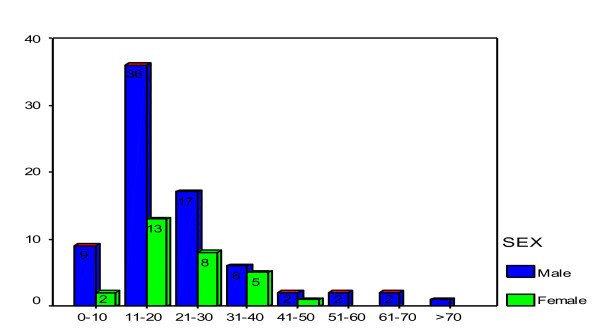
BACKGROUND: Typhoid intestinal perforation is still prevalent in many developing countries. Despite the advances in the management, the outcome in these patients in resource limited countries is still very poor. This study was to review our experiences on the surgical management of typhoid intestinal perforation and to determine the prognostic factors for mortality in our local setting. METHODS: This was a combined retrospective and prospective study of patients who were operated for typhoid intestinal perforation at Bugando Medical Centre between August 2006 and September 2011. Data collected were analyzed using SPSS computer software version 15. RESULTS: A total of 104 patients were studied representing 8.7% of typhoid fever cases. Males were affected twice more than the females (2.6:1). Their ages ranged from 8 to 76 years with a median age of 18.5 years. The peak age incidence was in the 11-20 years age group. Fever and abdominal pain were the most common presenting symptoms and majority of the patients (80.8%) perforated between within 14 days of illness. Chest and abdominal radiographs revealed pneumoperitonium in 74.7% of cases. Ultrasound showed free peritoneal collection in 85.7% of cases. Nine (10.2%) patients were HIV positive with a median CD4+ count of 261 cells/μl. The perforation-surgery interval was more than 72 hours in 90(86.5%) patients. The majority of patients (84.6%) had single perforations and ileum was the most common part of the bowel affected occurring in 86.2% of cases. Simple closure of the perforations was the most commonly performed procedure accounting for 78.8% of cases. Postoperative complication rate was 39.4% and surgical site infection was the most frequent complication in 55.5% of cases. Mortality rate was 23.1% and it was statistically significantly associated with delayed presentation, inadequate antibiotic treatment prior to admission, shock on admission, HIV positivity, low CD4 count (< 200 cells/μl), high ASA classes (III-V), delayed operation, multiple perforations, severe peritoneal contamination and presence of postoperative complications (P < 0.001). The median overall length of hospital stay was 28 days. CONCLUSION: Typhoid intestinal perforation is still endemic in our setting and carries high morbidity and mortality. This study has attempted to determine the factors that statistically influence mortality in typhoid perforation in our environment. Appropriate measures focusing at these factors are vital in order to deliver optimal care for these patients in this region.
Overview
The claims and statistics of this paper haven’t been checked yet.
Free: it reads the open-access text and checks the first 5 claims that cite a source we can check. Create a free account to check every claim.
Integrity signals
Registry
Cites
Statistics
Figures
Verification
Claims the paper makes
The claims and statistics of this paper haven’t been checked yet.
Free: it reads the open-access text and checks the first 5 claims that cite a source we can check. Create a free account to check every claim.
Claims other papers make about this one
Each is checked against this paper’s own text: does it say what the citing paper says it does?
The source backs part of the claim, not all of it — or backs it for a different population, condition or comparison.
In the citing paper
“Among hospital survivors, the delayed admission group had a longer hospital stay, higher mortality, and higher rates of mechanical ventilation and central venous catherization.”
From Surviving Sepsis Campaign: International Guidelines for Management of Sepsis and Septic Shock 2021. (2021) · cites this paper as [87]
Experimental — accuracy not yet measuredThe source backs part of the claim, not all of it — or backs it for a different population, condition or comparison.
In the citing paper
“Limited data from resource-limited settings suggest that timely administration of antimicrobials in patients with sepsis and septic shock is beneficial and potentially feasible [121–126].”
From Surviving sepsis campaign: international guidelines for management of sepsis and septic shock 2021 (2021) · cites this paper as [121]
Experimental — accuracy not yet measuredThe check wasn’t confident either way, so it gives no verdict — never disputed.
In the citing paper
“Mortality increased when ED stay exceeded 6 hours (17% vs 12.9%, p < 0.001).”
From Surviving Sepsis Campaign: International Guidelines for Management of Sepsis and Septic Shock 2021. (2021) · cites this paper as [87]
Experimental — accuracy not yet measured
Self-check
Percentages, sums and reported differences re-computed from the paper’s own numbers.
The self-check needs the paper’s full text.
Citations
Cites
Principles and Practice of Infectious Diseases.
(1991) · Annals of Internal Medicine · doi:10.7326/0003-4819-114-9-818_5 · Cited by 12,025
Mandell, Douglas, and Bennett's Principles and Practice of Infectious Diseases
(2015) · Elsevier eBooks · doi:10.1016/c2012-1-00075-6 · Cited by 2,577
The global burden of typhoid fever.
(2004) · Europe PMC (PubMed Central) · Cited by 1,965
ASA classification and perioperative variables as predictors of postoperative outcome
Wolters, U., Wolf, T., Stützer, H., & Schröder, T. (1996) · British Journal of Anaesthesia · doi:10.1093/bja/77.2.217 · Cited by 1,073
Multidrug-Resistant Salmonella typhi: A Worldwide Epidemic
Rowe, B., Ward, L. R., & Threlfall, E. J. (1997) · Clinical Infectious Diseases · doi:10.1093/clinids/24.supplement_1.s106 · Cited by 405 · cited 1×
“typhi resulting from inappropriate and indiscriminate use of antibiotics are among the hallmarks of the disease [6,18].”
BackgroundCurrent concepts in the diagnosis and treatment of typhoid fever
Bhutta, Z. A. (2006) · BMJ · doi:10.1136/bmj.333.7558.78 · Cited by 375
Mawalla, B., Mshana, S. E., Chalya, P. L., Imirzalioglu, C., & Mahalu, W. (2011) · BMC Surgery · doi:10.1186/1471-2482-11-21 · Cited by 260 · cited 1×
“However, a recent study done in our centre has shown resistance of the organisms to this combination and highly sensitive to Imipenem and meropenem [51].”
BackgroundSelf-citationSalmonella Species, Including Salmonella Typhi
PEGUES, D. A., & MILLER, S. I. (2010) · Mandell, Douglas, and Bennett's Principles and Practice of Infectious Diseases · doi:10.1016/b978-0-443-06839-3.00223-x · Cited by 253
Principles of Medicine in Africa
(2013) · Cambridge University Press eBooks · doi:10.1017/cbo9780511751660 · Cited by 120
The prognostic factors in typhoid ileal perforation: a prospective study of 50 patients.
Adesunkanmi, A. R. K., & Ajao, O. G. (1997) · PubMed · Cited by 114
Research works printed but not linked: 2
- Kotan C Kosem M Tuncer I Kisli E Sönmez R Çıkman Ö Söylemez Ö Arslantürk H Typhoid intestinal perforation: Review of 11 cases Kolon Rektum Hast Derg 2000 7 6 10
- Khan SH Aziz SA Ul-Haq MI Perforated peptic ulcers: A review of 36 cases Professional Med J 2011 7 1 124 127
Cited by
Items 101–126 of 126
Emeka, C. K. (2021) · World Journal of Clinical Surgery · doi:10.52338/wjsurgy.2021.1007
Augustin, G. (2014) · Springer eBooks · doi:10.1007/978-3-319-05422-3_11
Frequency of Anastomosis Leak in Primary Repair in Ileal Perforation
Shah, M., Iftikhar, M., Jan, Y., Khan, S. A., & Shahzadi, S. (2022) · Journal of Gandhara Medical and Dental Science · doi:10.37762/jgmds.9-3.301
Postpartum Typhoid Intestinal Perforation
Lawal, A. O., Dare, J. K., OLABINJO, H., Adenuga, A. T., Olayinka, B., & AREMU, I. (2022) · Medical Journal of Zambia · doi:10.55320/mjz.49.2.1135
Rahmati, S. (2023) · International Journal of Current Science Research and Review · doi:10.47191/ijcsrr/v6-i2-89
Emeka, C. K. (2023) · Journal of Surgery and Postoperative Care · doi:10.58489/2836-8657/006
Damaskos, D., Ewing, A. S., & Sayers, J. (2023) · Springer eBooks · doi:10.1007/978-3-031-22599-4_74
Shreckengost, C. S. H., Ludi, E. K., Srinivasan, J. K., & Love, T. P. (2023) · Springer eBooks · doi:10.1007/978-3-031-25596-0_35
Mora, S. M. G., Acosta, G. I. M., Macías, E. Y. M., & Montoya, W. J. M. (2023) · PUERTO MADERO EDITORIAL eBooks · doi:10.55204/pmea.40.c97
ANALYSIS OF RISK FACTORS FOR ENTERIC PERFORATION IN CASES OF TYPHOID FEVER
Hussain, S., Shah, J., Bahadri, M. M. S., Jamal, M. A., Zeb, D. M., Ansari, S., Ahmed, D. M., & Khan, D. N. A. (2023) · doi:10.53555//jptcp.v30i17.2720
Halder, P. P., Ranjit, P., Das, B. G., & Sarkar, S. D. (2024) · Sri Lanka Journal of Child Health · doi:10.4038/sljch.v53i1.10691
“In our study, of 53 abdominal complications 14 had intestinal perforation which constituted 6% of total complications, significantly higher than the prevalence noted in study by Chalya PL, et al 21 .”
ResultKadidiatou Folly DIALLO, E. A. (2023) · JOURNAL AFRICAIN DE CHIRURGIE · doi:10.61585/pud-jafrchir-v7n409
Mushi, D. (2021) · Journal of Clinical Case Studies Reviews & Reports · doi:10.47363/jccsr/2021(3)160
Lire, I., Ntanga, M. N., Banza, M. I., Catherine, S., Nday, G. I., & Kalau, W. A. (2024) · Revue de l'infirmier congolais. · doi:10.62126/zqrx.20248111
Tariq, A., Khan, M., Khan, A. Y. W., Rehman, H., Shah, S. A., Noorullah, Ubaidullah, Din, M. N., Mohsin, M., Waseh, A., et al. (2025) · Indus journal of bioscience research. · doi:10.70749/ijbr.v3i6.1628
Ehiagwina, L. A., Tagar, E., Kpolugbo, J., Odion, C., Irekpita, E., & Odigie, V. I. (2025) · University of Toronto Medical Journal · doi:10.33137/utmj.v102i2.43731
Hussan, S., Shabbir, A., Aftab, M. F., Rauf, A., Akhtar, N., & Rasheed, U. (2025) · Biological and Clinical Sciences Research Journal · doi:10.54112/bcsrj.v6i11.2076
A mouse model for studying chronic Salmonella Typhi infection and anti-biofilm interventions
Cole, A. L., Woolard, K., Sorge, A., Melander, C., & Gunn, J. S. (2025) · mBio · doi:10.1128/mbio.03476-25
Godefroy, N. B., Muhumuza, J., Molen, S. F., Waziri, M. A., Kagenderezo, B. P., Vahwere, B. M., Sikakulya, F. K., Mauricio, W., Wandabwa, J., Francois, B. K., et al. (2024) · Figshare · doi:10.6084/m9.figshare.26094387
SakthiVel, M., Kumar, S. I. S., Shantharam, R. V., Rahuman, A. S. A. A., & Ramadas, A. N. (2026) · Journal of Surgery Research and Practice · doi:10.46889/jsrp.2026.7103
Point of care ultrasound in acute settings – a narrative review
Olszewski, E., Olusanya, O., Olusanya, O., & Yusuff, H. O. (2024) · Journal of Global Medicine · doi:10.51496/jogm.v4.145
Short Outcome of Secondary Peritonitis at Referral Hospitals in 2023-2024 Sana’a City, Yemen
Amry, A. A., Obadiel, Y. A., Al-Agi, A., Albaddai, N., & AL-Nahari, A. (2025) · Arab Board Medical Journal · doi:10.4103/abmj.abmj_45_24
Ayenigba, A. A., & Shittu, R. O. (2026) · Journal of Statistical Sciences and Computational Intelligence · doi:10.64497/jssci.85
Typhoid Fever Surgical Outcomes in West Africa Improved with Ileostomies: A Single-Hospital Study
Ferguson, D., Nattier, B., Filipi, C. J., & Dilsaver, D. B. (2026) · Journal of the West African College of Surgeons · doi:10.4103/jwas.jwas_8_25
“…laparotomy for typhoid perforation at HOH, with an average mortality rate reported in the literature being approximately 20% [4-7, 11, 13 , 17, 19 , 22-24 Given difficult history taking, low health literacy and inadequate hospital records, there were no significant differences in the…”
Adindu, C., Agodirin, S., Nasir, A. A., Olowookere, S. O., Saidu, A. I., Abdulkareem, J. F., Abdulraheem, N., Abdur-Rahman, L., Jimoh, N. O., Obarakpo, B. N., et al. (2026) · Journal of Surgical Research · doi:10.1016/j.jss.2026.03.114
Fluoroquinolone-resistant Salmonella Typhi presenting as ileal perforation in a traveler
Khan, M. A. Q. S., Hajjar, L. A. N. H., Jora, G., Nyaz, A. A., Khalil, M. O., Alfahim, F. A., Khalid, M. Z., & Picazo-Yeste, J. (2026) · Journal of Surgical Case Reports · doi:10.1093/jscr/rjag557
“Intestinal perforation is a severe complication of typhoid fever, typically involving the terminal ileum due to necrosis of Peyer’s patches, leading to ulceration and perforation [ 2, 4].”
Metadata
- Authors
- Chalya, P. L., Mabula, J. B., Koy, M., Kataraihya, J. B., Jaka, H., Mshana, S. E., Mirambo, M., Mchembe, M. D., Giiti, G., & Gilyoma, J. M.
- Affiliations
- Catholic University of Health and Allied Sciences (TZ)
- Muhimbili University of Health and Allied Sciences (TZ)
- Corresponding author
- Chalya, Phillipo L
- Venue
- World Journal of Emergency Surgery
- Published
- 2012
- Volume
- 7
- Issue
- 1
- Pages
- 4
- ISSN
- 1749-7922 (ISSN-L)
- PMC
- PMC3311140
- OpenAlex
- W2120127772
- Cited by
- 123
- References
- 53
- Citations by year
- 2026: 9 · 2025: 5 · 2024: 11 · 2023: 12 · 2022: 6 · 2021: 12 · 2020: 14 · 2019: 10 · 2018: 9 · 2017: 6 · 2016: 12 · 2015: 5 · 2014: 6 · 2013: 4 · 2012: 2
- FWCI
- 4.38
- Type
- journal article
- Language
- en
- Open access
- gold
- doi.org
- Licence
- cc-by
- Locations
- World Journal of Emergency Surgery (publishedVersion, cc-by)
- Europe PMC (PubMed Central) (publishedVersion, cc-by)
- PubMed Central (publishedVersion, cc-by)
- PubMed (publishedVersion)
- IHI Repository (acceptedVersion)
- DOAJ (DOAJ: Directory of Open Access Journals) (submittedVersion, cc-by-sa)
- Topics
- Health Sciences › Medicine › Surgery › Abdominal Surgery and Complications
- Life Sciences › Agricultural and Biological Sciences › Food Science › Salmonella and Campylobacter epidemiology
- Health Sciences › Medicine › Surgery › Gastrointestinal disorders and treatments
- Keywords
- typhoid fever, surgical management, mortality prognostic factors, postoperative complications, surgical site infection, delayed presentation, HIV coinfection, CD4 count, pneumoperitoneum, resource-limited settings, postoperative mortality, length of hospital stay, perforation closure, peritoneal contamination, ASA physical status
About these checks
Registry, retraction, Cites and statistics results are computed, not judged, with one exception: a printed reference that no index lists is read once by a model before it counts as a citation error. Claims are extracted by a model and kept only when their quote appears verbatim in the text; each cited source is then checked, with a model’s help, for whether it says what the claim relies on. Those verdicts can be wrong — read the claim’s quote and the cited source before relying on one.
Statistics and arithmetic are recomputed, not judged.
Confidence bands are shown only for fields calibrated on our annotated test set. None is calibrated yet, so no band is shown.
What counts as a claim ›How we measure confidence ›How we check this ›
Are you an author, or do you see a problem with this page? Request a review
Data sources
Bibliographic data: Semantic Scholar, OpenAlex, Crossref.
Contains information from the Semantic Scholar Academic Graph Datasets, made available under the ODC Attribution License (ODC-BY 1.0).
Semantic Scholar’s data is described in: Kinney, R., et al. (2023). The Semantic Scholar Open Data Platform. arXiv:2301.10140.
