

Effects of alpha-calcitonin gene-related peptide on osteoprotegerin and receptor activator of nuclear factor-κB ligand expression in MG-63 osteoblast-like cells exposed to polyethylene particles
Open accessThe DOI matches its Crossref record; 41 of the 42 references it cites were found in a registry or an index.
Abstract
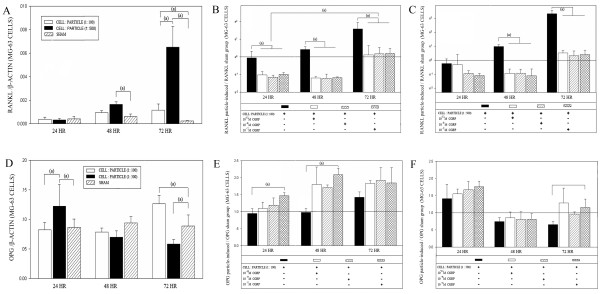
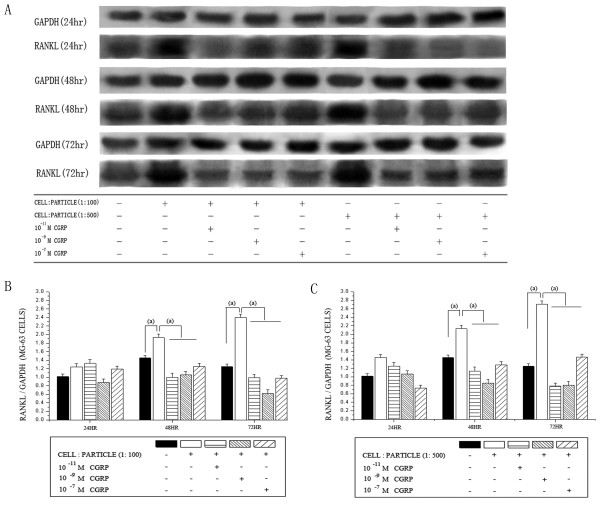
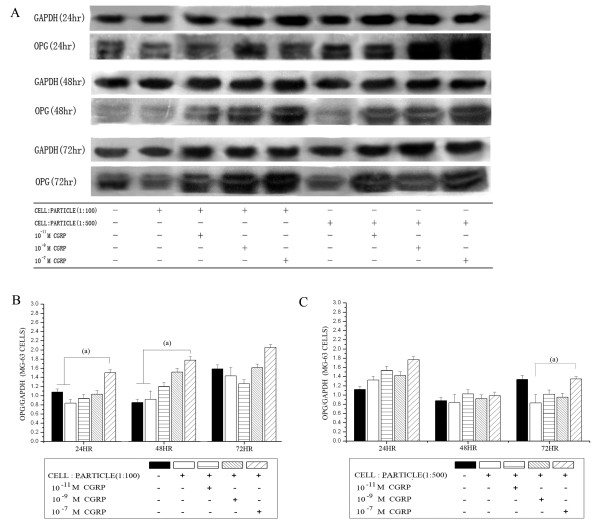
Background: Recent studies demonstrated an impact of the nervous system on particle-induced osteolysis, the major cause of aseptic loosening of joint replacements. Methods: In this study of MG-63 osteoblast-like cells we analyzed the influence of ultra-high molecular weight polyethylene (UHMWPE) particles and the neurotransmitter alpha-calcitonin gene-related peptide (CGRP) on the osteoprotegerin/receptor activator of nuclear factor-κB ligand/receptor activator of nuclear factorκB (OPG/RANKL/RANK) system. MG-63 cells were stimulated by different UHMWPE particle concentrations (1:100, 1:500) and different doses of alpha-CGRP (10-7 M, 10-9 M, 10-11 M). RANKL and OPG mRNA expression and protein levels were measured by RT-PCR and Western blot. Results: Increasing particle concentrations caused an up-regulation of RANKL after 72 hours. Alpha-CGRP showed a dose-independent depressive effect on particle-induced expression of RANKL mRNA in both cell-particle ratios. RANKL gene transcripts were significantly (P < 0.05) decreased by alpha-CGRP treatment after 48 and 72 hours. OPG mRNA was significantly down-regulated in a cell-particle ratio of 1:500 after 72 hours. Alpha-CGRP concentrations of 10-7 M lead to an up-regulation of OPG protein. Conclusion: In conclusion, a possible osteoprotective influence of the neurotransmitter alpha-CGRP on particle stimulated osteoblast-like cells could be shown. Alpha-CGRP might be important for bone metabolism under conditions of particle-induced osteolysis.
Overview
The claims and statistics of this paper haven’t been checked yet.
Free: it reads the open-access text and checks the first 5 claims that cite a source we can check. Create a free account to check every claim.
Integrity signals
Registry
Cites
Statistics
Figures
Verification
Claims the paper makes
The claims and statistics of this paper haven’t been checked yet.
Free: it reads the open-access text and checks the first 5 claims that cite a source we can check. Create a free account to check every claim.
Claims other papers make about this one
Each is checked against this paper’s own text: does it say what the citing paper says it does?
The source backs part of the claim, not all of it — or backs it for a different population, condition or comparison.
In the citing paper
“In both cell types, UHMWPE particles induced RANKL expression and inhibited the expression of OPG, whereas CGRP reduced UHMWPE-induced RANKL expression, suggesting an indirect inhibition of particle-induced bone resorption.”
From The Activity of Peptides of the Calcitonin Family in Bone (2019) · cites this paper as [224]
Experimental — accuracy not yet measured
Self-check
Percentages, sums and reported differences re-computed from the paper’s own numbers.
The self-check needs the paper’s full text.
Citations
Cites
Minireview: The OPG/RANKL/RANK System
Khosla, S. (2001) · Endocrinology · doi:10.1210/endo.142.12.8536 · Cited by 1,515 · cited 2×
“The OPG/RANKL/RANK system plays a key role in the cross-talk between osteoblasts and osteoclasts [12,13].”
Yasuda, H., Shima, N., Nakagawa, N., Mochizuki, S.-I., Yano, K., Fujise, N., Sato, Y., Goto, M., Yamaguchi, K., Kuriyama, M., et al. (1998) · Endocrinology · doi:10.1210/endo.139.3.5837 · Cited by 1,201 · cited 2×
“The OPG/RANKL/RANK system plays a key role in the cross-talk between osteoblasts and osteoclasts [12,13].”
Hofbauer, L. C., Khosla, S., Dunstan, C. R., Lacey, D. L., Boyle, W. J., & Riggs, B. L. (2000) · Journal of Bone and Mineral Research · doi:10.1359/jbmr.2000.15.1.2 · Cited by 1,173 · cited 1×
“RANKL and OPG are members of a ligand-receptor system that directly regulates osteoclast differentiation and bone resorption, and both are produced and secreted by osteoblastic lineage cells [13,14].”
Theoleyre, S., Wittrant, Y., Tat, S. K., Fortun, Y., Redini, F., & Heymann, D. (2004) · Cytokine & Growth Factor Reviews · doi:10.1016/j.cytogfr.2004.06.004 · Cited by 663 · cited 1×
“This may have an impact on the bone mass outcome at each remodeling cycle [34].”
The signaling adaptors and pathways activated by TNF superfamily
Dempsey, P. W., Doyle, S. E., He, J. Q., & Cheng, G. (2003) · Cytokine & Growth Factor Reviews · doi:10.1016/s1359-6101(03)00021-2 · Cited by 504 · cited 1×
“Several pathways regulating the function of bone remodeling have been reported in the past, including TNFalpha/TNFR/TRAF1 and IL-6/CD126/JAK/STAT [30,31].”
WIMALAWANSA, S. J. (1996) · Endocrine Reviews · doi:10.1210/edrv-17-5-533 · Cited by 494 · cited 1×
“It acts as a potent vasodilatator, as a neurotrophic effector and as a mediator in the neurogenic inflammatory response [7,8].”
Brain, S. D., & Williams, T. J. (1985) · British Journal of Pharmacology · doi:10.1111/j.1476-5381.1985.tb11107.x · Cited by 447 · cited 1×
“expressed in brain tissue, adrenal and pituitary glands, the exocrine pancreas, peripheral tissue and on osteoblasts [9-11].”
Amylin, Calcitonin Gene-Related Peptide, Calcitonin, and Adrenomedullin: A Peptide Superfamily
Wimalawansa, S. J. (1997) · Critical Reviews™ in Neurobiology · doi:10.1615/critrevneurobiol.v11.i2-3.40 · Cited by 424 · cited 1×
“It acts as a potent vasodilatator, as a neurotrophic effector and as a mediator in the neurogenic inflammatory response [7,8].”
Substance P- and CGRP-immunoreactive nerves in bone
Bjurholm, A., Kreicbergs, A., Brodin, E., & Schultzberg, M. (1988) · Peptides · doi:10.1016/0196-9781(88)90023-x · Cited by 386 · cited 1×
“expressed in brain tissue, adrenal and pituitary glands, the exocrine pancreas, peripheral tissue and on osteoblasts [9-11].”
Jacobs, J. J., Roebuck, K. A., Archibeck, M., Hallab, N. J., & Glant, T. T. (2001) · Clinical Orthopaedics and Related Research · doi:10.1097/00003086-200112000-00008 · Cited by 367 · cited 1×
“Analog to the literature, high RANKL levels and low OPG levels can cause a stimulation of osteoclasts [12,19].”
Extracellular pH Regulates Bone Cell Function , ,
Arnett, T. R. (2008) · The Journal of Nutrition · doi:10.1093/jn/138.2.415s · Cited by 347 · cited 1×
“bone matrix that stimulate osteoblasts to promote or inhibit bone formation [32,33].”
Clover, J., & Gowen, M. (1994) · Bone · doi:10.1016/8756-3282(94)90305-0 · Cited by 315 · cited 1×
“These commercially available MG-63 osteosarcoma cells are often used as model for the osteoblastic phenotype because of their rapid growth and their homogeneity in the cell circle [36-40], but the OPG/RANKL/RANK system in vivo interacts between both osteoblasts and osteoclasts.”
Anatomy and surface geometry of the patellofemoral joint in the axial plane
Stäubli, H.-U., Dürrenmatt, U., Porcellini, B., & Rauschning, W. (1999) · The Journal of Bone and Joint Surgery. British volume · doi:10.1302/0301-620x.81b3.0810452 · Cited by 209
The role of peptides and receptors of the calcitonin family in the regulation of bone metabolism
Naot, D., & Cornish, J. (2008) · Bone · doi:10.1016/j.bone.2008.07.003 · Cited by 182 · cited 1×
“On the one hand, alpha-CGRP has been shown to be a physiological activator of bone formation [21].”
Decreased Bone Formation and Osteopenia in Mice Lacking α-Calcitonin Gene-Related Peptide
Schinke, T., Liese, S., Priemel, M., Haberland, M., Schilling, A. F., Catala-Lehnen, P., Blicharski, D., Rueger, J. M., Gagel, R. F., Emeson, R. B., et al. (2004) · Journal of Bone and Mineral Research · doi:10.1359/jbmr.040915 · Cited by 177 · cited 2×
“[22-24,28].”
BackgroundEffects of calcitonin, amylin, and calcitonin gene-related peptide on osteoclast development
Cornish, J., Callon, K. E., Bava, U., Kamona, S. A., Cooper, G. J. S., & Reid, I. R. (2001) · Bone · doi:10.1016/s8756-3282(01)00494-x · Cited by 173 · cited 1×
“[22-24,28].”
Calcitonin gene-related peptide inhibits osteoclastic bone resorption: A comparative study
Zaidi, M., Fuller, K., Bevis, P. J. R., GainesDas, R. E., Chambers, T. J., & MacIntyre, I. (1987) · Calcified Tissue International · doi:10.1007/bf02555699 · Cited by 165 · cited 1×
“Moreover, alpha-CGRP inhibits the differentiation and recruitment of osteoclast precursors [25,26].”
Targeted Expression of Calcitonin Gene-Related Peptide to Osteoblasts Increases Bone Density in Mice
Ballica, R., Valentijn, K., Khachatryan, A., Guerder, S., Kapadia, S., Gundberg, C., Gilligan, J., Flavell, R. A., & Vignery, A. (1999) · Journal of Bone and Mineral Research · doi:10.1359/jbmr.1999.14.7.1067 · Cited by 133
Comparison of the Effects of Calcitonin Gene-Related Peptide and Amylin on Osteoblasts
Dr. Cornish, J., Callon, K. E., Lin, C. Q., Xiao, C. L., Gamble, G. D., Cooper, G. J. S., & Reid, I. R. (1999) · Journal of Bone and Mineral Research · doi:10.1359/jbmr.1999.14.8.1302 · Cited by 121 · cited 1×
“found that osteoblasts respond to alpha-CGRP by increased growth [22].”
Particles and Periimplant Bone Resorption
Bauer, T. W. (2002) · Clinical Orthopaedics and Related Research · doi:10.1097/00003086-200212000-00016 · Cited by 116 · cited 1×
“Mechanical wear in the joint of a total hip replacement is responsible for a severe inflammatory reaction due to the release of cytokines and other soluble mediators that favor osteoclast generation, bone resorption and, in turn, prosthetic loosening [1].”
Rakshit, D. S., LY, K., Sengupta, T. K., Nestor, B. J., Sculco, T. P., Ivashkiv, L. B., & Purdue, P. E. (2006) · Journal of Bone and Joint Surgery · doi:10.2106/jbjs.e.00711 · Cited by 83 · cited 1×
“Several pathways regulating the function of bone remodeling have been reported in the past, including TNFalpha/TNFR/TRAF1 and IL-6/CD126/JAK/STAT [30,31].”
Calcitonin Deficiency in Mice Progressively Results in High Bone Turnover
Huebner, A. K., Schinke, T., Priemel, M., Schilling, S., Schilling, A. F., Emeson, R. B., Rueger, J. M., & Amling, M. (2006) · Journal of Bone and Mineral Research · doi:10.1359/jbmr.060820 · Cited by 81
Dean, D. D., Schwartz, Z., Liu, Y., Blanchard, C. R., Agrawal, C. M., Mabrey, J. D., Sylvia, V. L., Lohmann, C. H., & Boyan, B. D. (1999) · Journal of Bone and Joint Surgery · doi:10.2106/00004623-199904000-00002 · Cited by 75 · cited 1×
“The osteoblast function can be described by alkaline phosphatase specific activity [15].”
Itonaga, I., Sabokbar, A., Murray, D. W., & Athanasou, N. A. (2000) · Annals of the Rheumatic Diseases · doi:10.1136/ard.59.1.26 · Cited by 74 · cited 1×
“The results of our study correspond to the findings that macrophage-osteoclast differentiation occurs in the presence of soluble RANKL and that this process is inhibited by OPG [20].”
Implant wear induces inflammation, but not osteoclastic bone resorption, in RANK–/– mice
Ren, W., Wu, B., Peng, X., Hua, J., Hao, H., & Wooley, P. H. (2006) · Journal of Orthopaedic Research® · doi:10.1002/jor.20190 · Cited by 69 · cited 1×
“Our finding gives further support to previous reports of a linkage between neurotransmitters and particle-induced osteolysis [2,4,18].”
Akopian, A., Demulder, A., Ouriaghli, F. E., Corazza, F., Fondu, P., & Bergmann, P. (2000) · Peptides · doi:10.1016/s0196-9781(00)00185-6 · Cited by 68 · cited 1×
“Moreover, alpha-CGRP inhibits the differentiation and recruitment of osteoclast precursors [ 25 ,26].”
Villa, I., Mrak, E., Rubinacci, A., Ravasi, F., & Guidobono, F. (2006) · American Journal of Physiology-Cell Physiology · doi:10.1152/ajpcell.00354.2005 · Cited by 68
Sensory nerves in the interface membrane of aseptic loose hip prostheses
Ahmed, M., Bergström, J. P., Lundblad, H., Gillespie, W. J., & Andris Kreicbergs, A. (1998) · Journal of Bone and Joint Surgery - British Volume · doi:10.1302/0301-620x.80b1.8138 · Cited by 49
Human calcitonin gene-related peptide possesses weak inhibitory potency of bone resorptionin vitro
Yamamoto, I., Kitamura, N., Aoki, J., Shigeno, C., Hino, M., Asonuma, K., Torizuka, K., Fujii, N., Otaka, A., & Yajima, H. (1986) · Calcified Tissue International · doi:10.1007/bf02555747 · Cited by 47 · cited 1×
“expressed in brain tissue, adrenal and pituitary glands, the exocrine pancreas, peripheral tissue and on osteoblasts [9-11].”
Sato, S., Futakuchi, M., Ogawa, K., Asamoto, M., Nakao, K., Asai, K., & Shirai, T. (2008) · Cancer Science · doi:10.1111/j.1349-7006.2007.00690.x · Cited by 46 · cited 1×
“bone matrix that stimulate osteoblasts to promote or inhibit bone formation [32,33].”
Characterization of vitamin D receptor immunoreactivity in human bone cells
Langub, M. C., Reinhardt, T. A., Horst, R. L., Malluche, H. H., & Koszewski, N. J. (2000) · Bone · doi:10.1016/s8756-3282(00)00335-5 · Cited by 43 · cited 1×
“These commercially available MG-63 osteosarcoma cells are often used as model for the osteoblastic phenotype because of their rapid growth and their homogeneity in the cell circle [36-40], but the OPG/RANKL/RANK system in vivo interacts between both osteoblasts and osteoclasts.”
Beaumont, K. C., Pittner, R. A., Moore, C. X., Wolfe‐Lopez, D., Prickett, K. S., Young, A. A., & RINK, T. J. (1995) · British Journal of Pharmacology · doi:10.1111/j.1476-5381.1995.tb14991.x · Cited by 41
Pseudosynovial fluid from loosened total hip prosthesis induces osteoclast formation
Mandelin, J., Liljeström, M., Li, T., Ainola, M., Hukkanen, M., Salo, J., Santavirta, S. S., & Konttinen, Y. T. (2005) · Journal of Biomedical Materials Research Part B Applied Biomaterials · doi:10.1002/jbm.b.30244 · Cited by 33
Polyethylene Particle–Induced Bone Resorption in α-Calcitonin Gene–Related Peptide–Deficient Mice
Wedemeyer, C., Neuerburg, C., Pfeiffer, A., Heckelei, A., Bylski, D., von Knoch, F., Schinke, T., Hilken, G., Gosheger, G., von Knoch, M., et al. (2007) · Journal of Bone and Mineral Research · doi:10.1359/jbmr.070408 · Cited by 32
Self-citationLeighton, B., & FOOT, E. A. (1995) · Biochemical Journal · doi:10.1042/bj3070707 · Cited by 30
Größe und Form kommerziell erhältlicher Polyethylenpartikel für In-vitro- und In-vivo-Versuche
von Knoch, M., Sprecher, C., Barden, B., Saxler, G., Löer, F., & Wimmer, M. (2004) · Zeitschrift für Orthopädie und ihre Grenzgebiete · doi:10.1055/s-2004-822589 · Cited by 28
Parreno, J., & Hart, D. A. (2009) · Biochemistry and Cell Biology · doi:10.1139/o09-052 · Cited by 18 · cited 1×
“These commercially available MG-63 osteosarcoma cells are often used as model for the osteoblastic phenotype because of their rapid growth and their homogeneity in the cell circle [36-40], but the OPG/RANKL/RANK system in vivo interacts between both osteoblasts and osteoclasts.”
Luo, X., Liao, E.-Y., Su, X., & Wu, X. (2004) · Journal of Bone and Mineral Metabolism · doi:10.1007/s00774-003-0442-6 · Cited by 16
Wiontzek, M., Matziolis, G., Schuchmann, S., Gaber, T., Krocker, D., Duda, G. N., Gr, B., Perka, C., & Buttgereit, F. (2006) · PubMed · Cited by 12
Chen, F., Hsu, T., Hu, C., Wang, W., Wang, K.-C., & Teng, L.-F. (2006) · Taiwanese Journal of Obstetrics and Gynecology · doi:10.1016/s1028-4559(09)60248-5 · Cited by 11 · cited 1×
“cells [29].”
Qian, Y., Zeng, B.-F., Zhang, X., & Jiang, Y. (2008) · Acta Orthopaedica · doi:10.1080/17453670710015238 · Cited by 9 · cited 1×
“The discovery of calcitonin gene-related peptide (CGRP) -immunoreactive nerve fibres in the interface membrane and elevated CGRP levels in synovial fluids of loosened arthoplasty suggested a linkage between the nervous system and aseptic loosening [2,3].”
Cited by
The Activity of Peptides of the Calcitonin Family in Bone
Naot, D., Musson, D. S., & Cornish, J. (2019) · Physiological Reviews · doi:10.1152/physrev.00066.2017 · Cited by 141
Calcitonin and Bone Physiology: In Vitro, In Vivo, and Clinical Investigations
Xie, J., Guo, J., Kanwal, Z., Wu, M., Lv, X., Ibrahim, N. A., Li, P., Buabeid, M. A., Arafa, E. A., & Sun, Q. (2020) · International Journal of Endocrinology · doi:10.1155/2020/3236828 · Cited by 83
“An in vitro study was conducted on osteoblasts and osteoblast-like cell line MG-63 to study the influence of CGRP on the catabolism induced by ultra-huge molecular weight polyethene (UHMWPE) particles [109, 110].”
ZHOU, R., YUAN, Z., LIU, J., & LIU, J. (2016) · Molecular Medicine Reports · doi:10.3892/mmr.2016.5117 · Cited by 60
Fang, Z., Yang, Q., Xiong, W., Li, G., Liao, H., Xiao, J., & Li, F. (2013) · PLoS ONE · doi:10.1371/journal.pone.0072738 · Cited by 34
Wei, J., Jian, W., Gong, Y., & Zeng, R. (2015) · Molecular Medicine Reports · doi:10.3892/mmr.2015.3637 · Cited by 37
“CT promotes cartilage formation through the ERK1/2 signaling pathway (44), and CGRP is able to promote the expression of the osteoblast OPG gene (45).”
Metadata
- Authors
- Xu, J., Kauther, M. D., Hartl, J., Wedemeyer, C., & Study was performed at the University of Duisburg - Essen, G.
- Affiliations
- University of Duisburg-Essen (DE)
- Corresponding author
- Kauther, Max D
- Venue
- Journal of Orthopaedic Surgery and Research
- Published
- 2010-11-04
- Volume
- 5
- Issue
- 1
- Pages
- 83-83
- ISSN
- 1749-799X (ISSN-L)
- PMC
- PMC2988016
- OpenAlex
- W2106027251
- Cited by
- 18
- References
- 42
- Citations by year
- 2023: 1 · 2020: 1 · 2019: 2 · 2018: 2 · 2017: 2 · 2016: 2 · 2015: 2 · 2014: 2 · 2013: 2 · 2012: 1
- FWCI
- 1.35
- Type
- journal article
- Language
- en
- Open access
- gold
- doi.org
- Licence
- cc-by
- Locations
- Journal of Orthopaedic Surgery and Research (publishedVersion, cc-by)
- PubMed Central (publishedVersion, cc-by)
- PubMed (publishedVersion)
- DOAJ (DOAJ: Directory of Open Access Journals) (submittedVersion, cc-by-sa)
- Funders
- Universität Duisburg-Essen
- Topics
- Health Sciences › Medicine › Surgery › Orthopaedic implants and arthroplasty
- Life Sciences › Biochemistry, Genetics and Molecular Biology › Molecular Biology › Bone Metabolism and Diseases
- Health Sciences › Medicine › Rheumatology › Osteoarthritis Treatment and Mechanisms
- Keywords
- alpha-calcitonin gene-related peptide, osteoprotegerin, RANKL, RANK, particle-induced osteolysis, aseptic loosening, osteoblast-like cells, MG-63 cells, osteoprotection
About these checks
Registry, retraction, Cites and statistics results are computed, not judged, with one exception: a printed reference that no index lists is read once by a model before it counts as a citation error. Claims are extracted by a model and kept only when their quote appears verbatim in the text; each cited source is then checked, with a model’s help, for whether it says what the claim relies on. Those verdicts can be wrong — read the claim’s quote and the cited source before relying on one.
Statistics and arithmetic are recomputed, not judged.
Confidence bands are shown only for fields calibrated on our annotated test set. None is calibrated yet, so no band is shown.
What counts as a claim ›How we measure confidence ›How we check this ›
Are you an author, or do you see a problem with this page? Request a review
Data sources
Bibliographic data: Semantic Scholar, OpenAlex, Crossref.
Contains information from the Semantic Scholar Academic Graph Datasets, made available under the ODC Attribution License (ODC-BY 1.0).
Semantic Scholar’s data is described in: Kinney, R., et al. (2023). The Semantic Scholar Open Data Platform. arXiv:2301.10140.
