

Oxygen dependence of metabolic fluxes and energy generation of Saccharomyces cerevisiae CEN.PK113-1A
Open accessThe DOI matches its Crossref record; 82 of the 83 references it cites were found in a registry or an index.
Abstract
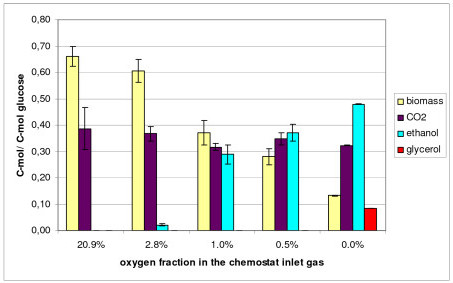
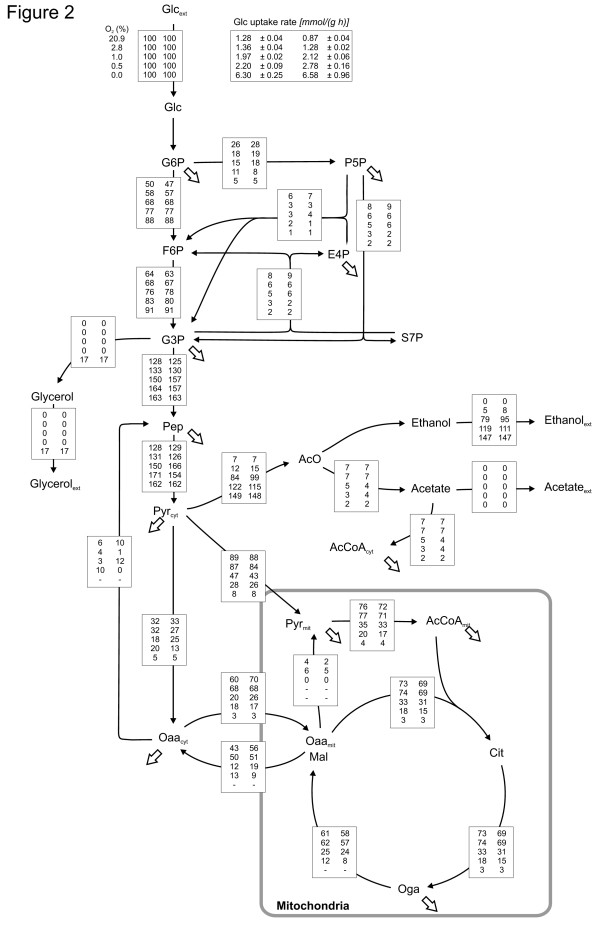
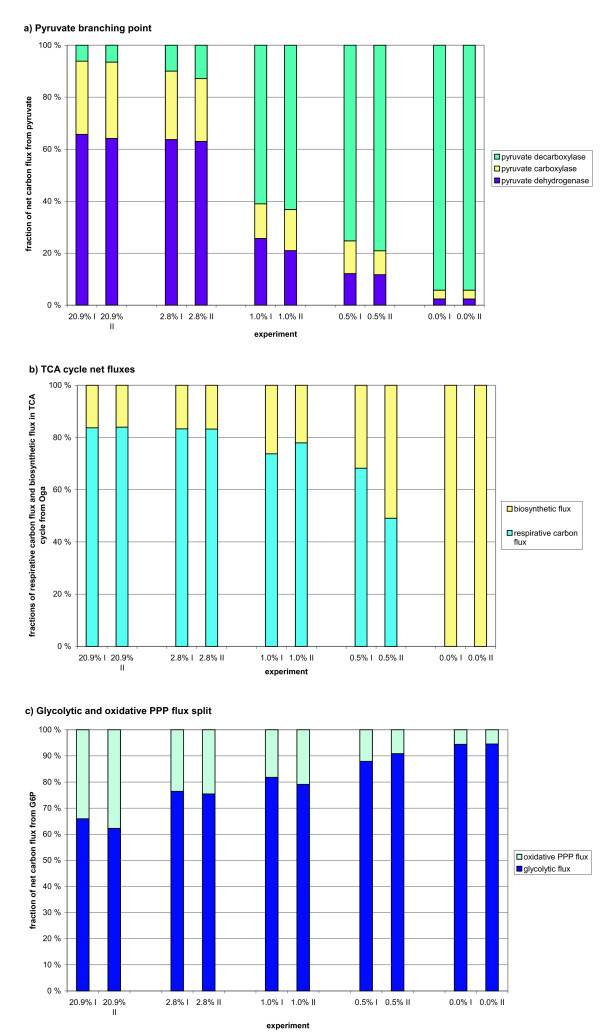
BACKGROUND: The yeast Saccharomyces cerevisiae is able to adjust to external oxygen availability by utilizing both respirative and fermentative metabolic modes. Adjusting the metabolic mode involves alteration of the intracellular metabolic fluxes that are determined by the cell's multilevel regulatory network. Oxygen is a major determinant of the physiology of S. cerevisiae but understanding of the oxygen dependence of intracellular flux distributions is still scarce. RESULTS: Metabolic flux distributions of S. cerevisiae CEN.PK113-1A growing in glucose-limited chemostat cultures at a dilution rate of 0.1 h-1 with 20.9%, 2.8%, 1.0%, 0.5% or 0.0% O2 in the inlet gas were quantified by 13C-MFA. Metabolic flux ratios from fractional [U-13C]glucose labelling experiments were used to solve the underdetermined MFA system of central carbon metabolism of S. cerevisiae.While ethanol production was observed already in 2.8% oxygen, only minor differences in the flux distribution were observed, compared to fully aerobic conditions. However, in 1.0% and 0.5% oxygen the respiratory rate was severely restricted, resulting in progressively reduced fluxes through the TCA cycle and the direction of major fluxes to the fermentative pathway. A redistribution of fluxes was observed in all branching points of central carbon metabolism. Yet only when oxygen provision was reduced to 0.5%, was the biomass yield exceeded by the yields of ethanol and CO2. Respirative ATP generation provided 59% of the ATP demand in fully aerobic conditions and still a substantial 25% in 0.5% oxygenation. An extensive redistribution of fluxes was observed in anaerobic conditions compared to all the aerobic conditions. Positive correlation between the transcriptional levels of metabolic enzymes and the corresponding fluxes in the different oxygenation conditions was found only in the respirative pathway. CONCLUSION: 13C-constrained MFA enabled quantitative determination of intracellular fluxes in conditions of different redox challenges without including redox cofactors in metabolite mass balances. A redistribution of fluxes was observed not only for respirative, respiro-fermentative and fermentative metabolisms, but also for cells grown with 2.8%, 1.0% and 0.5% oxygen. Although the cellular metabolism was respiro-fermentative in each of these low oxygen conditions, the actual amount of oxygen available resulted in different contributions through respirative and fermentative pathways.
Overview
The claims and statistics of this paper haven’t been checked yet.
Free: it reads the open-access text and checks the first 5 claims that cite a source we can check. Create a free account to check every claim.
Integrity signals
Registry
Cites
Statistics
Figures
Verification
Claims the paper makes
The claims and statistics of this paper haven’t been checked yet.
Free: it reads the open-access text and checks the first 5 claims that cite a source we can check. Create a free account to check every claim.
Claims other papers make about this one
Each is checked against this paper’s own text: does it say what the citing paper says it does?
In the citing paper
“By including proteomics in the enzyme‐constrained model, we attained a solution with similar exchange fluxes to those predicted by the purely metabolic model (Appendix Fig S11) and able to predict with similar performance when compared to flux data quantified by 13C metabolic flux analysis (Jouhten et al, 2008; Appendix Table S5 and Fig S12).”
From Improving the phenotype predictions of a yeast genome‐scale metabolic model by incorporating enzymatic constraints (2017) · cites this paper as Jouhten et al, 2008
Self-check
Percentages, sums and reported differences re-computed from the paper’s own numbers.
The self-check needs the paper’s full text.
Citations
Cites
Verduyn, C., Postma, E., Scheffers, W. A., & Van Dijken, J. P. (1992) · Yeast · doi:10.1002/yea.320080703 · Cited by 1,510 · cited 1×
“Yeast were grown in defined minimal medium [66], with 10 g glucose l-1 as carbon source, and supplemented with 10 mg ergosterol l-1 and 420 mg Tween 80 l-1 (a source of oleic acid).”
MethodYeast Carbon Catabolite Repression
Gancedo, J. M. (1998) · Microbiology and Molecular Biology Reviews · doi:10.1128/mmbr.62.2.334-361.1998 · Cited by 1,273 · cited 1×
“cerevisiae becomes restricted, not only when oxygen availability is limited, but also in fully aerobic conditions when there is an excess of repressive carbon source [12-16].”
BackgroundHIF-1 Regulates Cytochrome Oxidase Subunits to Optimize Efficiency of Respiration in Hypoxic Cells
Fukuda, R., Zhang, H., Kim, J.-W., Shimoda, L., Dang, C. V., & Semenza, G. L. (2007) · Cell · doi:10.1016/j.cell.2007.01.047 · Cited by 1,225
Metabolic Engineering: Principles and Methodologies
Stephanopoulos, G. N., Aristidou, A. A., & Nielsen, J. (1998) · Thammasat University Digital Collections · Cited by 1,171
Genome-Scale Reconstruction of the Saccharomyces cerevisiae Metabolic Network
Förster, J., Famili, I., Fu, P., Palsson, B. Ø., & Nielsen, J. (2003) · Genome Research · doi:10.1101/gr.234503 · Cited by 1,069 · cited 2×
“Since the redox cofactor NADH is one of the hub metabolites in the organism-wide network of metabolic reactions [29], the regulation of redox homeostasis encompasses all the metabolic pathways.”
BackgroundThe proteome of Saccharomyces cerevisiae mitochondria
Sickmann, A., Reinders, J., Wagner, Y., Joppich, C., Zahedi, R., Meyer, H. E., Schönfisch, B., Perschil, I., Chacinska, A., Guiard, B., et al. (2003) · Proceedings of the National Academy of Sciences · doi:10.1073/pnas.2135385100 · Cited by 895 · cited 1×
“1) enzymes have both been isolated in the mitochodrial proteome [73], PDH bypass could also be partially located in mitochondria and contribute directly to the formation of AcCoAmit.”
BackgroundThe Crabtree Effect: A Regulatory System in Yeast
DE DEKEN, R. H. (1966) · Journal of General Microbiology · doi:10.1099/00221287-44-2-149 · Cited by 876 · cited 1×
“cerevisiae becomes restricted, not only when oxygen availability is limited, but also in fully aerobic conditions when there is an excess of repressive carbon source [12-16].”
Pyruvate Metabolism inSaccharomyces cerevisiae
PRONK, J. T., YDE STEENSMA, H., & VAN DIJKEN, J. P. (1996) · Yeast · doi:10.1002/(sici)1097-0061(199612)12:16<1607::aid-yea70>3.0.co;2-4 · Cited by 792
Systematic evaluation of objective functions for predicting intracellular fluxes in Escherichia coli
Schuetz, R., Kuepfer, L., & Sauer, U. (2007) · Molecular Systems Biology · doi:10.1038/msb4100162 · Cited by 677 · cited 1×
“Linear programming can be used to solve the MFA system if a biologically meaningful objective function is formulated [22].”
MethodIssel-Tarver, L., Christie, K. R., Dolinski, K., Andrada, R., Balakrishnan, R., Ball, C. A., Binkley, G., Dong, S., Dwight, S. S., Fisk, D. G., et al. (2002) · Methods in Enzymology · doi:10.1016/s0076-6879(02)50972-1 · Cited by 672
Research works printed but not linked: 2
- Oura E The effect of aeration on the growth energetics and biochemical composition of baker's yeast 1972 PhD thesis. Helsinki University, Helsinki, Finland
- Lange HC Quantitative Physiology of S cerevisiae using Metabolic Network Analysis 2002 PhD thesis. Technical University Delft, Delft, The Netherlands
Cited by
Items 101–131 of 131
Gene-centric constraint of metabolic modelsPreprint
Fyson, N., Kim, M. K., Lun, D. S., & Colijn, C. (2017) · bioRxiv (Cold Spring Harbor Laboratory) · doi:10.1101/116558 · Cited by 5
Gallo, A., Larcher, R., Schneider, R., Barbero, A., Tonidandel, L., Pradal, M., Farines, V., Galéote, V., & Román, T. (2025) · Food Microbiology · doi:10.1016/j.fm.2025.104881 · Cited by 9
Ong, J., Pence, J., Molik, D. C., Shepherd, H. A. M., & Goodson, H. V. (2021) · PLoS ONE · doi:10.1371/journal.pone.0235303 · Cited by 3
Lindfors, E., Jouhten, P., Oja, M., Rintala, E., Orešič, M., & Penttilä, M. E. (2014) · BMC Systems Biology · doi:10.1186/1752-0509-8-16 · Cited by 4
Self-citationCascante, M., Benito, A., de Mas, I. M., Centelles, J. J., Miranda, A., & de Atauri, P. (2013) · Springer eBooks · doi:10.1007/978-3-319-01008-3_12 · Cited by 3
Effects of oxygen provision on the physiology of baker's yeast Saccharomyces cerevisiae
Rintala, E. (2010) · Helda - University of Helsinki Institutional Repository · Cited by 5
Self-citationFang, G. H., Zhou, X., Ran, C. L., Jin, C. X., Bu, S., Chen, Y., Gong, Y., Hu, Z., Song, F. B., Luo, J., et al. (2025) · The Science of The Total Environment · doi:10.1016/j.scitotenv.2025.178921 · Cited by 3
Labelling Analysis for 13C MFA Using NMR Spectroscopy
Jouhten, P., & Maaheimo, H. (2014) · Methods in molecular biology · doi:10.1007/978-1-4939-1170-7_9 · Cited by 2
Self-citationShin, N., Oh, J., Han, Y. S., Lim, G., Joo, J. C., Jeon, W.-Y., Ahn, J., Kim, H. T., Bhatia, S. K., & Yang, Y. (2025) · Analytical Biochemistry · doi:10.1016/j.ab.2025.115879 · Cited by 1
Wang, F., Wang, D., Hu, S., Li, X., & Hong, J. (2026) · Current Research in Food Science · doi:10.1016/j.crfs.2026.101348 · Cited by 1
“As aeration increases, the metabolic pattern of yeast may shift from fermentation to respiration, leading to a decrease in glucose utilization rate (Jouhten et al., 2008).”
Wang, X., Wang, Y., Zhuang, Y., Wang, G., & Lu, H. (2026) · Nature Communications · doi:10.1038/s41467-026-73744-3 · Cited by 8
“The carbon fl ux was predominantly redirected towards glycolysis/gluconeogenesis to support growth, while the tricarboxylic acid (TCA) cycle operated as a minimized, branched pathway for biosynthesis rather than energy generation 42 .”
Next-Generation Genome-Scale Models Incorporating Multilevel ‘Omics Data: From Yeast to Human
Çakır, T., Kökrek, E., Avşar, G., Abdik, E., & Pir, P. (2019) · Methods in molecular biology · doi:10.1007/978-1-4939-9736-7_20 · Cited by 2
Molecular basis of stress resistance in Saccharomyces cerevisiae
Heer, D. (2009) · Repository for Publications and Research Data (ETH Zurich) · doi:10.3929/ethz-a-006032739 · Cited by 1
Gambacorta, F. V., Dietrich, J. J., Yan, Q., & Pfleger, B. F. (2020) · Current Opinion in Chemical Biology · doi:10.1016/j.cbpa.2020.10.006 · Cited by 1
Long Lasting Reversibility of the Mitochondrial Permeability Transition in Saccharomyces cerevisiaePreprint
Morales‐García, L., Ricardez-García, C., Castañeda-Támez, P., Chiquete‐Félix, N., & Uribe‐Carvajal, S. (2021) · Preprints.org · doi:10.20944/preprints202106.0731.v1 · Cited by 1
Línea Troncal metabolómica Saccharomyces cerevisiae
Albiol, J., García, R. G., & Vázquez, F. (2010) · DIGITAL.CSIC (Spanish National Research Council (CSIC))
Running Title: Impact of oxygen on wine yeast physiology. 3
Aceituno, F. F., Orellana, M., Torres, J., Mendoza, S. N., Slater, A. W., Melo, F., & Agosin, E. E. (2012)
Pangestu, R., Kahar, P., Ogino, C., & Kondo, A. (2023) · doi:10.22541/au.168912366.67826585/v1
Muñiz-Paredes, F. R., Ishchuk, O. P., & Petranović, D. (2025) · Journal of Biotechnology · doi:10.1016/j.jbiotec.2025.01.020
Cao, W., Wang, G., Lu, H., Ouyang, L., Chu, J., Sui, Y., & Zhuang, Y. (2020) · Figshare · doi:10.6084/m9.figshare.12082749
Cao, W., Wang, G., Lu, H., Ouyang, L., Chu, J., Sui, Y., & Zhuang, Y. (2020) · Figshare · doi:10.6084/m9.figshare.12082740
Sinha, N., van Schothorst, E. M., Hooiveld, G. J. E. J., Keijer, J., dos Santos, V. A. P. M., & Diez, M. S. (2021) · Figshare · doi:10.6084/m9.figshare.17089596
Cao, W., Wang, G., Lu, H., Ouyang, L., Chu, J., Sui, Y., & Zhuang, Y. (2020) · Figshare · doi:10.6084/m9.figshare.12082743
Additional file 1 of PHB production from cellobiose with Saccharomyces cerevisiae
Ylinen, A., de Ruijter, J. C., Jouhten, P., & Penttilä, M. (2022) · Figshare · doi:10.6084/m9.figshare.20115384
Self-citationSinha, N., van Schothorst, E. M., Hooiveld, G. J. E. J., Keijer, J., dos Santos, V. A. P. M., & Diez, M. S. (2021) · Figshare · doi:10.6084/m9.figshare.17089599
Sinha, N., van Schothorst, E. M., Hooiveld, G. J. E. J., Keijer, J., dos Santos, V. A. P. M., & Diez, M. S. (2021) · Figshare · doi:10.6084/m9.figshare.17089590
Cadière, A. (2010) · theses.fr (ABES) · doi:10.70675/71b2c9a3zd6f1z4ebdzb945z9d8ab613075d · Cited by 1
GENKI: A generative framework for scalable and robust metabolic kinetic modeling
Xenios, S., Doulaveris, A., Trokanas, N., Mexis, K., & Kokossis, A. C. (2026) · Metabolic Engineering · doi:10.1016/j.ymben.2026.102530
Ramos, M. D. N., Zangirolami, T. C., Sandri, J. P., de Carvalho, B. T., Sertori, M. C., Thevelein, J. M., Guimarães, J. R., & Milessi, T. S. (2026) · BioEnergy Research · doi:10.1007/s12155-026-11068-2
“Consequently, the production of hydrolytic enzymes can also be influenced once the supply of key precursors generated in TCA cycle and other pathways becomes less limited during aerobic cultivation [46, 47 ].”
Metadata
- Authors
- Jouhten, P., Rintala, E., Huuskonen, A., Tamminen, A., Toivari, M., Wiebe, M., Ruohonen, L., Penttilä, M., & Maaheimo, H.
- Affiliations
- VTT Technical Research Centre of Finland (FI)
- Corresponding author
- Jouhten, Paula
- Venue
- BMC Systems Biology
- Published
- 2008-07-09
- Volume
- 2
- Issue
- 1
- Pages
- 60-60
- ISSN
- 1752-0509 (ISSN-L)
- PMC
- PMC2507709
- OpenAlex
- W2017951535
- Cited by
- 131
- References
- 79
- Citations by year
- 2026: 5 · 2025: 7 · 2024: 2 · 2023: 4 · 2022: 4 · 2021: 14 · 2020: 9 · 2019: 4 · 2018: 8 · 2017: 5 · 2016: 6 · 2015: 4 · 2014: 15 · 2013: 7 · 2012: 11
- FWCI
- 3.56
- Type
- journal article
- Language
- en
- Open access
- gold
- doi.org
- Licence
- cc-by
- creativecommons.org/licenses/by/2.0 (tdm)
- Locations
- BMC Systems Biology (publishedVersion, cc-by)
- PubMed Central (publishedVersion, cc-by)
- PubMed (publishedVersion)
- DOAJ (DOAJ: Directory of Open Access Journals) (submittedVersion)
- Funders
- Academy of Finland (204369)
- Tekes
- Topics
- Life Sciences › Biochemistry, Genetics and Molecular Biology › Molecular Biology › Microbial Metabolic Engineering and Bioproduction
- Life Sciences › Biochemistry, Genetics and Molecular Biology › Molecular Biology › Fungal and yeast genetics research
- Life Sciences › Biochemistry, Genetics and Molecular Biology › Cancer Research › Cancer, Hypoxia, and Metabolism
- Keywords
- Saccharomyces cerevisiae, oxygen dependence, metabolic flux distribution, central carbon metabolism, anaerobic metabolism, ATP production, ethanol production, biomass yield, TCA cycle, glucose-limited chemostat, oxygen availability, redox cofactors
- MeSH terms
- Carbon, Carbon Isotopes, Citric Acid Cycle, Culture Media, Energy Metabolism, Glycolysis, Oxygen, Pentose Phosphate Pathway, Saccharomyces cerevisiae, Staining and Labeling, Transcription, Genetic, Pyruvic Acid, Intracellular Space
About these checks
Registry, retraction, Cites and statistics results are computed, not judged, with one exception: a printed reference that no index lists is read once by a model before it counts as a citation error. Claims are extracted by a model and kept only when their quote appears verbatim in the text; each cited source is then checked, with a model’s help, for whether it says what the claim relies on. Those verdicts can be wrong — read the claim’s quote and the cited source before relying on one.
Statistics and arithmetic are recomputed, not judged.
Confidence bands are shown only for fields calibrated on our annotated test set. None is calibrated yet, so no band is shown.
What counts as a claim ›How we measure confidence ›How we check this ›
Are you an author, or do you see a problem with this page? Request a review
Data sources
Bibliographic data: Semantic Scholar, OpenAlex, Crossref.
Contains information from the Semantic Scholar Academic Graph Datasets, made available under the ODC Attribution License (ODC-BY 1.0).
Semantic Scholar’s data is described in: Kinney, R., et al. (2023). The Semantic Scholar Open Data Platform. arXiv:2301.10140.
