

Oxygen dependence of metabolic fluxes and energy generation of Saccharomyces cerevisiae CEN.PK113-1A
Open accessThe DOI matches its Crossref record; 82 of the 83 references it cites were found in a registry or an index.
Abstract
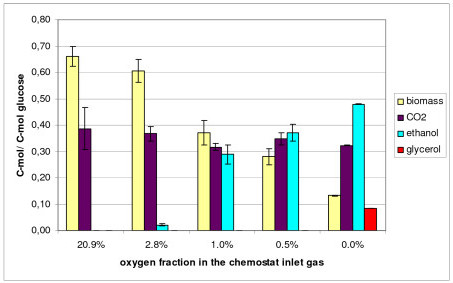
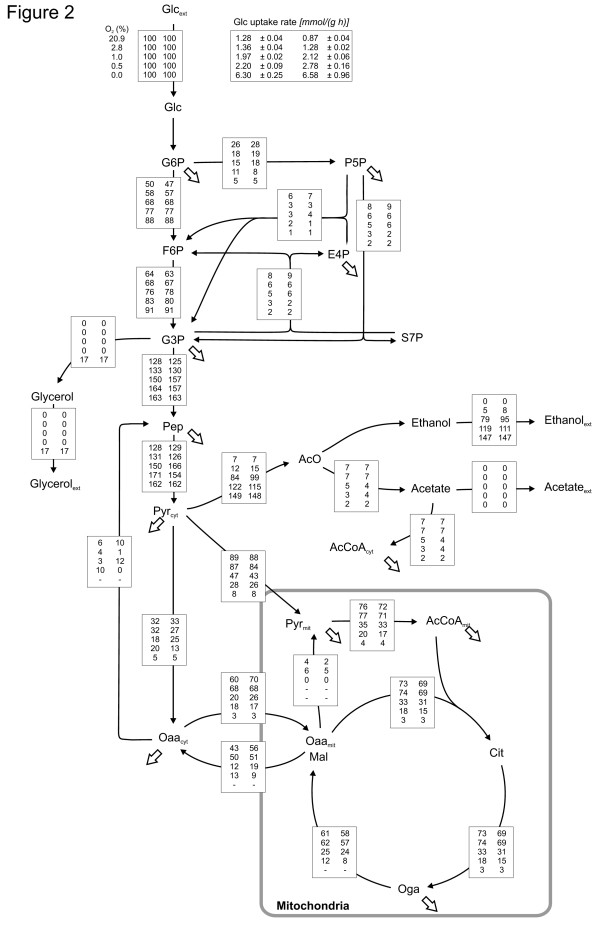
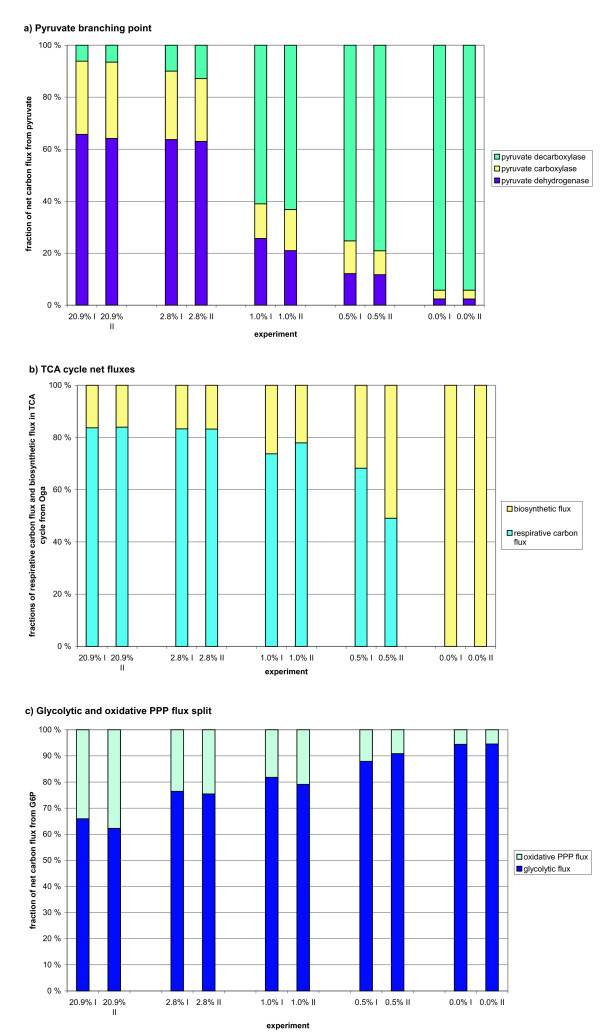
BACKGROUND: The yeast Saccharomyces cerevisiae is able to adjust to external oxygen availability by utilizing both respirative and fermentative metabolic modes. Adjusting the metabolic mode involves alteration of the intracellular metabolic fluxes that are determined by the cell's multilevel regulatory network. Oxygen is a major determinant of the physiology of S. cerevisiae but understanding of the oxygen dependence of intracellular flux distributions is still scarce. RESULTS: Metabolic flux distributions of S. cerevisiae CEN.PK113-1A growing in glucose-limited chemostat cultures at a dilution rate of 0.1 h-1 with 20.9%, 2.8%, 1.0%, 0.5% or 0.0% O2 in the inlet gas were quantified by 13C-MFA. Metabolic flux ratios from fractional [U-13C]glucose labelling experiments were used to solve the underdetermined MFA system of central carbon metabolism of S. cerevisiae.While ethanol production was observed already in 2.8% oxygen, only minor differences in the flux distribution were observed, compared to fully aerobic conditions. However, in 1.0% and 0.5% oxygen the respiratory rate was severely restricted, resulting in progressively reduced fluxes through the TCA cycle and the direction of major fluxes to the fermentative pathway. A redistribution of fluxes was observed in all branching points of central carbon metabolism. Yet only when oxygen provision was reduced to 0.5%, was the biomass yield exceeded by the yields of ethanol and CO2. Respirative ATP generation provided 59% of the ATP demand in fully aerobic conditions and still a substantial 25% in 0.5% oxygenation. An extensive redistribution of fluxes was observed in anaerobic conditions compared to all the aerobic conditions. Positive correlation between the transcriptional levels of metabolic enzymes and the corresponding fluxes in the different oxygenation conditions was found only in the respirative pathway. CONCLUSION: 13C-constrained MFA enabled quantitative determination of intracellular fluxes in conditions of different redox challenges without including redox cofactors in metabolite mass balances. A redistribution of fluxes was observed not only for respirative, respiro-fermentative and fermentative metabolisms, but also for cells grown with 2.8%, 1.0% and 0.5% oxygen. Although the cellular metabolism was respiro-fermentative in each of these low oxygen conditions, the actual amount of oxygen available resulted in different contributions through respirative and fermentative pathways.
Overview
The claims and statistics of this paper haven’t been checked yet.
Free: it reads the open-access text and checks the first 5 claims that cite a source we can check. Create a free account to check every claim.
Integrity signals
Registry
Cites
Statistics
Figures
Verification
Claims the paper makes
The claims and statistics of this paper haven’t been checked yet.
Free: it reads the open-access text and checks the first 5 claims that cite a source we can check. Create a free account to check every claim.
Claims other papers make about this one
Each is checked against this paper’s own text: does it say what the citing paper says it does?
In the citing paper
“By including proteomics in the enzyme‐constrained model, we attained a solution with similar exchange fluxes to those predicted by the purely metabolic model (Appendix Fig S11) and able to predict with similar performance when compared to flux data quantified by 13C metabolic flux analysis (Jouhten et al, 2008; Appendix Table S5 and Fig S12).”
From Improving the phenotype predictions of a yeast genome‐scale metabolic model by incorporating enzymatic constraints (2017) · cites this paper as Jouhten et al, 2008
Self-check
Percentages, sums and reported differences re-computed from the paper’s own numbers.
The self-check needs the paper’s full text.
Citations
Cites
Verduyn, C., Postma, E., Scheffers, W. A., & Van Dijken, J. P. (1992) · Yeast · doi:10.1002/yea.320080703 · Cited by 1,510 · cited 1×
“Yeast were grown in defined minimal medium [66], with 10 g glucose l-1 as carbon source, and supplemented with 10 mg ergosterol l-1 and 420 mg Tween 80 l-1 (a source of oleic acid).”
MethodYeast Carbon Catabolite Repression
Gancedo, J. M. (1998) · Microbiology and Molecular Biology Reviews · doi:10.1128/mmbr.62.2.334-361.1998 · Cited by 1,273 · cited 1×
“cerevisiae becomes restricted, not only when oxygen availability is limited, but also in fully aerobic conditions when there is an excess of repressive carbon source [12-16].”
BackgroundHIF-1 Regulates Cytochrome Oxidase Subunits to Optimize Efficiency of Respiration in Hypoxic Cells
Fukuda, R., Zhang, H., Kim, J.-W., Shimoda, L., Dang, C. V., & Semenza, G. L. (2007) · Cell · doi:10.1016/j.cell.2007.01.047 · Cited by 1,225
Metabolic Engineering: Principles and Methodologies
Stephanopoulos, G. N., Aristidou, A. A., & Nielsen, J. (1998) · Thammasat University Digital Collections · Cited by 1,171
Genome-Scale Reconstruction of the Saccharomyces cerevisiae Metabolic Network
Förster, J., Famili, I., Fu, P., Palsson, B. Ø., & Nielsen, J. (2003) · Genome Research · doi:10.1101/gr.234503 · Cited by 1,069 · cited 2×
“Since the redox cofactor NADH is one of the hub metabolites in the organism-wide network of metabolic reactions [29], the regulation of redox homeostasis encompasses all the metabolic pathways.”
BackgroundThe proteome of Saccharomyces cerevisiae mitochondria
Sickmann, A., Reinders, J., Wagner, Y., Joppich, C., Zahedi, R., Meyer, H. E., Schönfisch, B., Perschil, I., Chacinska, A., Guiard, B., et al. (2003) · Proceedings of the National Academy of Sciences · doi:10.1073/pnas.2135385100 · Cited by 895 · cited 1×
“1) enzymes have both been isolated in the mitochodrial proteome [73], PDH bypass could also be partially located in mitochondria and contribute directly to the formation of AcCoAmit.”
BackgroundThe Crabtree Effect: A Regulatory System in Yeast
DE DEKEN, R. H. (1966) · Journal of General Microbiology · doi:10.1099/00221287-44-2-149 · Cited by 876 · cited 1×
“cerevisiae becomes restricted, not only when oxygen availability is limited, but also in fully aerobic conditions when there is an excess of repressive carbon source [12-16].”
Pyruvate Metabolism inSaccharomyces cerevisiae
PRONK, J. T., YDE STEENSMA, H., & VAN DIJKEN, J. P. (1996) · Yeast · doi:10.1002/(sici)1097-0061(199612)12:16<1607::aid-yea70>3.0.co;2-4 · Cited by 792
Systematic evaluation of objective functions for predicting intracellular fluxes in Escherichia coli
Schuetz, R., Kuepfer, L., & Sauer, U. (2007) · Molecular Systems Biology · doi:10.1038/msb4100162 · Cited by 677 · cited 1×
“Linear programming can be used to solve the MFA system if a biologically meaningful objective function is formulated [22].”
MethodIssel-Tarver, L., Christie, K. R., Dolinski, K., Andrada, R., Balakrishnan, R., Ball, C. A., Binkley, G., Dong, S., Dwight, S. S., Fisk, D. G., et al. (2002) · Methods in Enzymology · doi:10.1016/s0076-6879(02)50972-1 · Cited by 672
Research works printed but not linked: 2
- Oura E The effect of aeration on the growth energetics and biochemical composition of baker's yeast 1972 PhD thesis. Helsinki University, Helsinki, Finland
- Lange HC Quantitative Physiology of S cerevisiae using Metabolic Network Analysis 2002 PhD thesis. Technical University Delft, Delft, The Netherlands
Cited by
Sánchez, B. J., Zhang, C., Nilsson, A., Lahtvee, P., Kerkhoven, E. J., & Nielsen, J. (2017) · Molecular Systems Biology · doi:10.15252/msb.20167411 · Cited by 466
Machado, D., & Herrgård, M. (2014) · PLoS Computational Biology · doi:10.1371/journal.pcbi.1003580 · Cited by 411
“Fluxomic data for the same conditions could be obtained from a separate publication [44].”
Systems-level analysis of mechanisms regulating yeast metabolic flux
Hackett, S. R., Zanotelli, V. R. T., Xu, W., Goya, J., Park, J. O., Perlman, D. H., Gibney, P. A., Botstein, D., Storey, J. D., & Rabinowitz, J. D. (2016) · Science · doi:10.1126/science.aaf2786 · Cited by 294
The molecular biology of fruity and floral aromas in beer and other alcoholic beverages
Holt, S., Miks, M. H., de Carvalho, B. T., Foulquié-Moreno, M. R., & Thevelein, J. M. (2019) · FEMS Microbiology Reviews · doi:10.1093/femsre/fuy041 · Cited by 296
Production of succinic acid by metabolically engineered microorganisms
Ahn, J. H., Jang, Y.-S., & Lee, S. Y. (2016) · Current Opinion in Biotechnology · doi:10.1016/j.copbio.2016.02.034 · Cited by 293
Bordel, S., Agren, R., & Nielsen, J. (2010) · PLoS Computational Biology · doi:10.1371/journal.pcbi.1000859 · Cited by 185
A multi-level study of recombinant Pichia pastoris in different oxygen conditions
Baumann, K., Carnicer, M., Dragosits, M., Graf, A. B., Stadlmann, J., Jouhten, P., Maaheimo, H., Gasser, B., Albiol, J., Mattanovich, D., et al. (2010) · BMC Systems Biology · doi:10.1186/1752-0509-4-141 · Cited by 168
Self-citationHeer, D., Heine, D., & Sauer, U. (2009) · Applied and Environmental Microbiology · doi:10.1128/aem.01649-09 · Cited by 164
Glycolic acid production in the engineered yeasts Saccharomyces cerevisiae and Kluyveromyces lactis
Koivistoinen, O. M., Kuivanen, J., Barth, D., Turkia, H., Pitkänen, J., Penttilä, M. E., & Richard, P. (2013) · Microbial Cell Factories · doi:10.1186/1475-2859-12-82 · Cited by 148
Self-citationCadière, A., Ortiz-Julien, A., Camarasa, C., & Dequin, S. (2011) · Metabolic Engineering · doi:10.1016/j.ymben.2011.01.008 · Cited by 141
Fluxomics – connecting ‘omics analysis and phenotypes
Winter, G., & Krömer, J. O. (2013) · Environmental Microbiology · doi:10.1111/1462-2920.12064 · Cited by 136
Vödisch, M., Scherlach, K., Winkler, R., Hertweck, C., Braun, H.-P., Roth, M., Haas, H., Werner, E. R., Brakhage, A. A., & Kniemeyer, O. (2011) · Journal of Proteome Research · doi:10.1021/pr1012812 · Cited by 128
Jordà, J., Jouhten, P., Cámara, E., Maaheimo, H., Albiol, J., & Ferrer, P. (2012) · Microbial Cell Factories · doi:10.1186/1475-2859-11-57 · Cited by 144
Self-citationConstant Growth Rate Can Be Supported by Decreasing Energy Flux and Increasing Aerobic Glycolysis
Slavov, N., Budnik, B. A., Schwab, D., Airoldi, E. M., & van Oudenaarden, A. (2014) · Cell Reports · doi:10.1016/j.celrep.2014.03.057 · Cited by 113
“Rates of O 2 consumption and CO 2 production have been measured (von Meyenburg, 1969; Verduyn et al., 1991; Van Hoek et al., 1998, 2000; Jouhten et al., 2008; Wiebe et al., 2008) in high-density yeast cultures growing in chemostats at steady state.”
Redox Biocatalysis and Metabolism: Molecular Mechanisms and Metabolic Network Analysis
Blank, L. M., Ebert, B. E., Bühler, K., & Bühler, B. (2010) · Antioxidants and Redox Signaling · doi:10.1089/ars.2009.2931 · Cited by 137
Bioinformatics and computational methods for lipidomics
Niemelä, P. S., Castillo, S., Sysi‐Aho, M., & Orešič, M. (2009) · Journal of Chromatography B · doi:10.1016/j.jchromb.2009.01.025 · Cited by 107
A flux-sensing mechanism could regulate the switch between respiration and fermentation
Huberts, D. H. E. W., Niebel, B., & Heinemann, M. (2012) · FEMS Yeast Research · doi:10.1111/j.1567-1364.2011.00767.x · Cited by 96
Krahulec, S., Petschacher, B., Wallner, M., Longus, K., Klimacek, M., & Nidetzky, B. (2010) · Microbial Cell Factories · doi:10.1186/1475-2859-9-16 · Cited by 89
Aceituno, F. F., Orellana, M., Torres, J., Mendoza, S. N., Slater, A. W., Melo, F., & Agosin, E. E. (2012) · Applied and Environmental Microbiology · doi:10.1128/aem.02305-12 · Cited by 92
Sod1 integrates oxygen availability to redox regulate NADPH production and the thiol redoxome
Montllor-Albalate, C., Kim, H.-J., Thompson, A. E., Jonke, A. P., Torres, M. P., & Reddi, A. R. (2021) · Proceedings of the National Academy of Sciences · doi:10.1073/pnas.2023328119 · Cited by 90
Metabolic control analysis indicates a change of strategy in the treatment of cancer
Moreno‐Sánchez, R., Saavedra, E., Rodríguez‐Enríquez, S., Gallardo‐Pérez, J. C., Quezada, H., & Westerhoff, H. V. (2010) · Mitochondrion · doi:10.1016/j.mito.2010.06.002 · Cited by 84
Lin, T., Bai, X. T., Hu, Y., Li, B., Yuan, Y., Song, H., Yang, Y. K., & Wang, J. (2016) · AIChE Journal · doi:10.1002/aic.15611 · Cited by 82
Kim, M. K., Lane, A., Kelley, J. J., & Lun, D. S. (2016) · PLoS ONE · doi:10.1371/journal.pone.0157101 · Cited by 84
Ding, M., Zhou, X., & Yuan, Y. (2009) · Metabolomics · doi:10.1007/s11306-009-0173-3 · Cited by 72
Wehrs, M., Prahl, J., Moon, J. Y., Li, Y., Tanjore, D., Keasling, J. D., Pray, T. R., & Mukhopadhyay, A. (2018) · Microbial Cell Factories · doi:10.1186/s12934-018-1045-1 · Cited by 69
Low oxygen levels as a trigger for enhancement of respiratory metabolism in Saccharomyces cerevisiae
Rintala, E., Toivari, M., Pitkänen, J.-P., Wiebe, M. G., Ruohonen, L., & Penttilä, M. (2009) · BMC Genomics · doi:10.1186/1471-2164-10-461 · Cited by 65
Self-citationRewiring yeast metabolism to synthesize products beyond ethanol
Gambacorta, F. V., Dietrich, J. J., Yan, Q., & Pfleger, B. F. (2020) · Current Opinion in Chemical Biology · doi:10.1016/j.cbpa.2020.08.005 · Cited by 74
Tian, M., & Reed, J. L. (2018) · Bioinformatics · doi:10.1093/bioinformatics/bty445 · Cited by 79
Metabolism as means for hypoxia adaptation: metabolic profiling and flux balance analysis
Feala, J., Coquin, L., Zhou, D., Haddad, G. G., Paternostro, G., & McCulloch, A. D. (2009) · BMC Systems Biology · doi:10.1186/1752-0509-3-91 · Cited by 68
“Low correlation between the global flux response and transcriptional response to acute hypoxia suggested post-transcriptional mechanisms of regulation [25].”
Lu, H., Cao, W., Liu, X., Sui, Y., Ouyang, L., Xia, J., Huang, M., Zhuang, Y., Zhang, S., Noorman, H. J., et al. (2018) · Scientific Reports · doi:10.1038/s41598-018-32341-1 · Cited by 67
Ito, Y., Hirasawa, T., & Shimizu, H. (2014) · Bioscience Biotechnology and Biochemistry · doi:10.1080/09168451.2014.877816 · Cited by 59
Very High Gravity Bioethanol Revisited: Main Challenges and Advances
Gomes, D. G., Cruz, M. L., de Resende, M. M., Ribeiro, E. J., Teixeira, J. A., & Domingues, L. (2021) · Fermentation · doi:10.3390/fermentation7010038 · Cited by 70
iOD907, the first genome‐scale metabolic model for the milk yeast Kluyveromyces lactis
Dias, Ó., Pereira, R., Gombert, A. K., Ferreira, E. C., & Rocha, I. (2014) · Biotechnology Journal · doi:10.1002/biot.201300242 · Cited by 66
Brazilian Journal of Development
(2021) · doi:10.34117/25258761 · Cited by 46
Pereira, R., Nielsen, J., & Rocha, I. (2016) · Metabolic Engineering Communications · doi:10.1016/j.meteno.2016.05.002 · Cited by 51
Novy, V., Brunner, B., & Nidetzky, B. (2018) · Microbial Cell Factories · doi:10.1186/s12934-018-0905-z · Cited by 44
Xue, C., Zhao, X., & Bai, F. (2010) · Biotechnology and Bioengineering · doi:10.1002/bit.22610 · Cited by 45
Shin, J., Liao, S., Kuanyshev, N., Xin, Y., Kim, C.-W., Lu, T., & Jin, Y. (2024) · Nature Communications · doi:10.1038/s41467-024-45011-w · Cited by 38
Jouhten, P., Wiebe, M. G., & Penttilä, M. E. (2012) · FEBS Journal · doi:10.1111/j.1742-4658.2012.08649.x · Cited by 40
Self-citationRühl, M., Zamboni, N., & Sauer, U. (2009) · Biotechnology and Bioengineering · doi:10.1002/bit.22591 · Cited by 35
Ida, Y., Hirasawa, T., Furusawa, C., & Shimizu, H. (2013) · Applied Microbiology and Biotechnology · doi:10.1007/s00253-013-4760-x · Cited by 34
Freese, S., Vogts, T., Speer, F., Schäfer, B., Passoth, V., & Klinner, U. (2011) · Yeast · doi:10.1002/yea.1845 · Cited by 31
Walls, L. E., Martínez, J. L., & Rios‐Solis, L. (2022) · Microorganisms · doi:10.3390/microorganisms10010163 · Cited by 31
Balance of XYL1 and XYL2 expression in different yeast chassis for improved xylose fermentation
Zha, J., Hu, M., Shen, M.-H., Li, B., Wang, J., & Yuan, Y. (2012) · Frontiers in Microbiology · doi:10.3389/fmicb.2012.00355 · Cited by 31
Anaerobiosis revisited: growth of Saccharomyces cerevisiae under extremely low oxygen availability
da Costa, B. L. V., Basso, T. O., Raghavendran, V., & Gombert, A. K. (2018) · Applied Microbiology and Biotechnology · doi:10.1007/s00253-017-8732-4 · Cited by 36
Viana, R., Dias, Ó., Lagoa, D., Galocha, M., Rocha, I., & Teixeira, M. C. (2020) · Journal of Fungi · doi:10.3390/jof6030171 · Cited by 37
Can we predict the intracellular metabolic state of a cell based on extracellular metabolite data?
Granucci, N., Pinu, F. R., Han, T.-L., & Villas-Bôas, S. G. (2015) · Molecular BioSystems · doi:10.1039/c5mb00292c · Cited by 29
Compartmentation of glycogen metabolism revealed from 13C isotopologue distributions
de Mas, I. M., Selivanov, V. A., Marín, S., Roca, J., Orešič, M., Agius, L., & Cascante, M. (2011) · BMC Systems Biology · doi:10.1186/1752-0509-5-175 · Cited by 33
Identification of flux control in metabolic networks using non-equilibrium thermodynamics
Bordel, S., & Nielsen, J. (2010) · Metabolic Engineering · doi:10.1016/j.ymben.2010.03.001 · Cited by 34
Genome-Scale Metabolic Models of Saccharomyces cerevisiae
Nookaew, I., Olivares‐Hernández, R., Bhumiratana, S., & Nielsen, J. (2011) · Methods in molecular biology · doi:10.1007/978-1-61779-173-4_25 · Cited by 30
Sánchez, C. E. G., Vargas-García, C. A., & Torres, R. G. (2012) · PLoS ONE · doi:10.1371/journal.pone.0043006 · Cited by 27
Anaerobiosis revisited: growth of Saccharomyces cerevisiae under extremely low oxygen availability
da Costa, B. L. V., Basso, T. O., Raghavendran, V., & Gombert, A. K. (2018) · White Rose Research Online (University of Leeds, The University of Sheffield, University of York) · Cited by 23
PHB production from cellobiose with Saccharomyces cerevisiae
Ylinen, A., de Ruijter, J. C., Jouhten, P., & Penttilä, M. (2022) · Microbial Cell Factories · doi:10.1186/s12934-022-01845-x · Cited by 18
Self-citation13C-Based Metabolic Flux Analysis of Recombinant Pichia pastoris
Ferrer, P., & Albiol, J. (2014) · Methods in molecular biology · doi:10.1007/978-1-4939-1170-7_17 · Cited by 26
Feng, X., & Zhao, H. (2013) · AIChE Journal · doi:10.1002/aic.14182 · Cited by 24
Cheng, X., Chen, W., Peng, W., & Li, K. (2014) · Applied Biochemistry and Biotechnology · doi:10.1007/s12010-014-0878-2 · Cited by 21
Inoculation‐density‐dependent responses and pathway shifts in Saccharomyces cerevisiae
Cheng, J., Ding, M., Tian, H., & Yuan, Y. (2009) · PROTEOMICS · doi:10.1002/pmic.200900249 · Cited by 22
Parente, D. C., Cajueiro, D. B. B., Peña-Moreno, I. C., Leite, F. C. B., Pita, W. D. B., & de Morais, M. A. (2017) · Yeast · doi:10.1002/yea.3290 · Cited by 29
Cheng, J., Zhou, X., Ding, M., & Yuan, Y. (2009) · Applied Microbiology and Biotechnology · doi:10.1007/s00253-009-2037-1 · Cited by 21
Halbfeld, C., Ebert, B. E., & Blank, L. M. (2014) · Metabolites · doi:10.3390/metabo4030751 · Cited by 25
Altenburg, T., Goldenbogen, B., Uhlendorf, J., & Klipp, E. (2019) · npj Systems Biology and Applications · doi:10.1038/s41540-019-0111-6 · Cited by 23
METABOLIC MODELLING IN THE DEVELOPMENT OF CELL FACTORIES BY SYNTHETIC BIOLOGY
Jouhten, P. (2012) · Computational and Structural Biotechnology Journal · doi:10.5936/csbj.201210009 · Cited by 23
Self-citationShen, T., Rui, B., Zhou, H. W., Zhang, X., Yi, Y., Han, W., Zheng, H., Wu, J., & Shi, Y. (2012) · Molecular BioSystems · doi:10.1039/c2mb25285f · Cited by 22
Protein Abundance Prediction Through Machine Learning Methods
Ferreira, M. A. D. M., Ventorim, R. Z., de Almeida, E. L. M., Silveira, S. D. A., & da Silveira, W. B. (2021) · Journal of Molecular Biology · doi:10.1016/j.jmb.2021.167267 · Cited by 22
Vázquez, F., Silva, P. C., Barreiro, A., Martínez-Moreno, R., Morales, P., Quirós, M., González, R., Albiol, J., & Ferrer, P. (2014) · Microbial Cell Factories · doi:10.1186/1475-2859-13-85 · Cited by 21
Zhang, M., Yu, X., Xu, Y., Jouhten, P., Swapna, G. V. T., Glaser, R. W., Hunt, J. F., Montelione, G. T., Maaheimo, H., & Szyperski, T. (2017) · FEBS Journal · doi:10.1111/febs.14180 · Cited by 21
Self-citationCao, W., Wang, G., Lu, H., Ouyang, L., Chu, J., Sui, Y., & Zhuang, Y. (2020) · Microbial Cell Factories · doi:10.1186/s12934-020-01340-1 · Cited by 16
Contreras-Jácquez, V., Rodríguez, J. A., Mateos‐Díaz, J. C., Valenzuela-Soto, E. M., & Asaff‐Torres, A. (2020) · Applied Biochemistry and Biotechnology · doi:10.1007/s12010-020-03336-4 · Cited by 16
Gopalakrishnan, S., & Maranas, C. D. (2015) · Metabolites · doi:10.3390/metabo5030521 · Cited by 18
“While skeletal central metabolic models continue to be the norm, genome-scale MFA holds the potential to validate the various hypotheses proposed by previous analyses [29,31,35,37,38].”
InfluentialLoftie‐Eaton, W., Taylor, M. P., Horne, K., Tuffin, M. I., Burton, S. G., & Cowan, D. A. (2012) · Biotechnology and Bioengineering · doi:10.1002/bit.24774 · Cited by 17
Metabolic distance estimation based on principle component analysis of metabolic turnover
Nakayama, Y., Putri, S. P., Bamba, T., & Fukusaki, E. (2014) · Journal of Bioscience and Bioengineering · doi:10.1016/j.jbiosc.2014.02.014 · Cited by 14
Święciło, A., Januś, E., Krzepiłko, A., & Skowrońska, M. (2024) · Scientific Reports · doi:10.1038/s41598-024-72400-4 · Cited by 19
“In glucose-limited chemostat cultivation with 20.9%, 2.8%, 1.0%, 0.5% and 0% oxygen in the feed gas, the amount of ATP obtained from respiration was 59%, 50%, 25% and 0%, respectively 61 .”
MethodInfluentialAssessment of transcriptomic constraint-based methods for central carbon flux inference
Bhadra-Lobo, S., Kim, M. K., & Lun, D. S. (2020) · PLoS ONE · doi:10.1371/journal.pone.0238689 · Cited by 13
Wallenius, J., Maaheimo, H., & Eerikäinen, T. (2016) · Bioresource Technology · doi:10.1016/j.biortech.2016.07.137 · Cited by 12
Self-citationOehling, V., Klaassen, P., Frick, O., Dusny, C., & Schmid, A. (2018) · Biotechnology for Biofuels · doi:10.1186/s13068-018-1231-8 · Cited by 14
Xue, S.-J., Wang, L., chen, S., Liu, X. H., Hu, K., Jiang, J., Tao, Y., & Jin, G. (2023) · Australian Journal of Grape and Wine Research · doi:10.1155/2023/5667458 · Cited by 12
Quarterman, J., Kim, S. R., Kim, P., & Jin, Y. (2014) · Journal of Biotechnology · doi:10.1016/j.jbiotec.2014.11.017 · Cited by 11
Tarlak, F., Sadıkoğlu, H., & Çakır, T. (2014) · Molecular BioSystems · doi:10.1039/c4mb00117f · Cited by 11
Yanagibashi, S., Bamba, T., Kirisako, T., Kondo, A., & Hasunuma, T. (2023) · Journal of Bioscience and Bioengineering · doi:10.1016/j.jbiosc.2023.11.004 · Cited by 13
Day, M. P., Nandorfy, D. E., Bekker, M. Z., Bindon, K. A., Solomon, M., Smith, P. A., & Schmidt, S. A. (2021) · Australian Journal of Grape and Wine Research · doi:10.1111/ajgw.12490 · Cited by 9
13C-Based Metabolic Flux Analysis in Yeast: The Pichia pastoris Case
Ferrer, P., & Albiol, J. (2014) · Methods in molecular biology · doi:10.1007/978-1-4939-0563-8_13 · Cited by 10
Zhou, J. B., Yi, H. L., Wang, L., Zhang, W., & Yuan, Y. (2012) · OMICS A Journal of Integrative Biology · doi:10.1089/omi.2011.0047 · Cited by 9
“NAD(P)H also functions in maintaining the redox equilibrium in cells (Jouhten et al., 2008).”
Achcar, F., Camadro, J.-M., & Mestivier, D. (2011) · BMC Systems Biology · doi:10.1186/1752-0509-5-51 · Cited by 8
Koivistoinen, O. M. (2013) · Helda - University of Helsinki Institutional Repository · Cited by 11
Granata, T. C., Rattenbacher, B., & John, G. T. (2022) · Frontiers in Space Technologies · doi:10.3389/frspt.2021.773814 · Cited by 9
Liu, T., & Zhong, J. (2021) · Process Biochemistry · doi:10.1016/j.procbio.2021.04.011 · Cited by 7
Sinha, N., van Schothorst, E. M., Hooiveld, G. J. E. J., Keijer, J., dos Santos, V. A. P. M., & Diez, M. S. (2021) · BMC Bioinformatics · doi:10.1186/s12859-021-04488-8 · Cited by 7
Anaerobic Carbon Metabolism of Saccharomyces cerevisiae
Jouhten, P., & Penttilä, M. E. (2014) · Springer eBooks · doi:10.1007/978-3-642-55013-3_3 · Cited by 6
Self-citationHirasawa, T., Ida, Y., Furuasawa, C., & Shimizu, H. (2013) · Bioengineered · doi:10.4161/bioe.26569 · Cited by 7
Carbó, R., Gisbert, M. G., Torres, A. C., Portell, X., & del Valle, L. J. (2015) · Archives of Microbiology · doi:10.1007/s00203-015-1136-x · Cited by 6
Basu, M., Elias, R. J., & Cockburn, D. W. (2026) · Beverages · doi:10.3390/beverages12030033 · Cited by 6
“Under aerobic conditions, excess NADH produced during assimilation and metabolism can be shuttled to the mitochondria to be reoxidized via oxidative phosphorylation, helping meet ATP demands for growth and regenerating NAD + for continued metabolism [100,101].”
Biochemical production from sustainable carbon sources by Komagataella phaffii
Raja, W. A., & Çalík, P. (2025) · Biochemical Engineering Journal · doi:10.1016/j.bej.2025.109702 · Cited by 7
Pangestu, R., Kahar, P., Ogino, C., & Kondo, A. (2023) · Yeast · doi:10.1002/yea.3917 · Cited by 6
“This shift in metabolic conditions favors the accumulation of fermentation products (fermentative mode) as opposed to cell growth (respiratory mode) (Jouhten et al., 2008).”
BackgroundDynamic metabolic models in context: biomass backtracking
Tummler, K., Kühn, C., & Klipp, E. (2015) · Integrative Biology · doi:10.1039/c5ib00050e · Cited by 11
Methods for Oxygenation of Continuous Cultures of Brewer’s Yeast, Saccharomyces cerevisiae
Granata, T. C., Follonier, C., Burkhardt, C., & Rattenbacher, B. (2021) · Fermentation · doi:10.3390/fermentation7040282 · Cited by 5
Peña-Moreno, I. C., Parente, D. C., da Silva, K. M., Pena, E. P. N., Silva, F. A. C., Calsa, T., Pita, W. D. B., & de Morais, M. A. (2021) · Applied Microbiology and Biotechnology · doi:10.1007/s00253-021-11117-0 · Cited by 6
Inhibitory effect and mechanism of lipopeptide Iturin A on food spoilage yeasts
Li, Z., Jiao, W., Bi, X., Xie, X., Shu, D., Luo, D., Yang, J., Yan, Z., & Tan, H. K. (2025) · Food Bioscience · doi:10.1016/j.fbio.2025.106570 · Cited by 4
Kostopoulou, A., Rebnegger, C., Ferrero‐Bordera, B., Mattanovich, M., Maaß, S., Becher, D., Gasser, B., & Mattanovich, D. (2025) · Microbial Biotechnology · doi:10.1111/1751-7915.70106 · Cited by 8
“When oxygen availability declines, the rate of respiration and oxygen consumption decreases (Jouhten et al. 2008).”
Saito, M., Nagasaki, H., Watanabe, S., & Fujimoto, T. (2017) · Journal of the Japan Petroleum Institute · doi:10.1627/jpi.60.127 · Cited by 5
Peng, W., Cheng, X., Zhang, H., & Li, K. (2013) · Journal of Chemical Technology & Biotechnology · doi:10.1002/jctb.4219 · Cited by 4
Metadata
- Authors
- Jouhten, P., Rintala, E., Huuskonen, A., Tamminen, A., Toivari, M., Wiebe, M., Ruohonen, L., Penttilä, M., & Maaheimo, H.
- Affiliations
- VTT Technical Research Centre of Finland (FI)
- Corresponding author
- Jouhten, Paula
- Venue
- BMC Systems Biology
- Published
- 2008-07-09
- Volume
- 2
- Issue
- 1
- Pages
- 60-60
- ISSN
- 1752-0509 (ISSN-L)
- PMC
- PMC2507709
- OpenAlex
- W2017951535
- Cited by
- 131
- References
- 79
- Citations by year
- 2026: 5 · 2025: 7 · 2024: 2 · 2023: 4 · 2022: 4 · 2021: 14 · 2020: 9 · 2019: 4 · 2018: 8 · 2017: 5 · 2016: 6 · 2015: 4 · 2014: 15 · 2013: 7 · 2012: 11
- FWCI
- 3.56
- Type
- journal article
- Language
- en
- Open access
- gold
- doi.org
- Licence
- cc-by
- creativecommons.org/licenses/by/2.0 (tdm)
- Locations
- BMC Systems Biology (publishedVersion, cc-by)
- PubMed Central (publishedVersion, cc-by)
- PubMed (publishedVersion)
- DOAJ (DOAJ: Directory of Open Access Journals) (submittedVersion)
- Funders
- Academy of Finland (204369)
- Tekes
- Topics
- Life Sciences › Biochemistry, Genetics and Molecular Biology › Molecular Biology › Microbial Metabolic Engineering and Bioproduction
- Life Sciences › Biochemistry, Genetics and Molecular Biology › Molecular Biology › Fungal and yeast genetics research
- Life Sciences › Biochemistry, Genetics and Molecular Biology › Cancer Research › Cancer, Hypoxia, and Metabolism
- Keywords
- Saccharomyces cerevisiae, oxygen dependence, metabolic flux distribution, central carbon metabolism, anaerobic metabolism, ATP production, ethanol production, biomass yield, TCA cycle, glucose-limited chemostat, oxygen availability, redox cofactors
- MeSH terms
- Carbon, Carbon Isotopes, Citric Acid Cycle, Culture Media, Energy Metabolism, Glycolysis, Oxygen, Pentose Phosphate Pathway, Saccharomyces cerevisiae, Staining and Labeling, Transcription, Genetic, Pyruvic Acid, Intracellular Space
About these checks
Registry, retraction, Cites and statistics results are computed, not judged, with one exception: a printed reference that no index lists is read once by a model before it counts as a citation error. Claims are extracted by a model and kept only when their quote appears verbatim in the text; each cited source is then checked, with a model’s help, for whether it says what the claim relies on. Those verdicts can be wrong — read the claim’s quote and the cited source before relying on one.
Statistics and arithmetic are recomputed, not judged.
Confidence bands are shown only for fields calibrated on our annotated test set. None is calibrated yet, so no band is shown.
What counts as a claim ›How we measure confidence ›How we check this ›
Are you an author, or do you see a problem with this page? Request a review
Data sources
Bibliographic data: Semantic Scholar, OpenAlex, Crossref.
Contains information from the Semantic Scholar Academic Graph Datasets, made available under the ODC Attribution License (ODC-BY 1.0).
Semantic Scholar’s data is described in: Kinney, R., et al. (2023). The Semantic Scholar Open Data Platform. arXiv:2301.10140.
